Introduction
Oral health is now perceived as similarly essential in relation to general health. Dental caries and periodontal diseases are the two principle oral pathologies that remain broadly prevalent that influence all populations all through the lifespan.[1] Oral hygiene instructions given to the patient after periodontal therapy acts as a cornerstone for the successive periodontal therapy. Patients’ performance following these instructions plays a pivotal role in the successful treatment.
ABSTRACT
The purpose of the study was to evaluate and assess the receptiveness, efficacy, and behavioral motivation of the patients toward following the oral hygiene instructions and the effect of different modes of these instructions. An experimental questionnaire-based study which was given as handouts to the patients and was asked to fill in the questionnaire was carried out in a total sample size of n = 146 patients (statistical power of 95%) and was estimated using a manual sample size calculation, but a total of 153 patients has participated in the study visiting the Department of Periodontics, Saveetha Dental College and Hospital, Chennai. Among the total subjects, 65 are diagnosed with chronic periodontitis and remaining 88 patients with gingivitis. The study group is divided into two groups as professionals and non-professionals based on the education above and below secondary school level, respectively. Statistical tests that were used are frequency analysis and Chi-square test. All subjects showed poor oral hygiene in the beginning of the study. There was a significant improvement in the maintenance of oral hygiene among both professional and non-professional qualified subjects from the first visit and the successive visit. The result also showed significant improvement in the oral hygiene in patients who received instructions through video and manual demonstration. The present study shows that there is a lack in oral health awareness among both professionals and non-professionals. Hence, every dentist should take and initiative in educating about maintaining oral health by modifying the attitude, receptiveness, and behavior toward following the oral hygiene instructions.
Keywords: Oral hygiene, dental care, behavior, attitude, motivation, audiovisual aid
Evaluate and assess the receptiveness, efficacy, and behavioral
motivation of patients toward following oral hygiene
instructions and the effect of different modes of these
instructions: Knowledge, attitude, and practices survey
Avinash Kavarthapu, M. Sankari
Department of Periodontics, Saveetha Dental College, Saveetha University, Chennai, Tamil Nadu, India
Correspondence: Avinash Kavarthapu, Department of Periodontics, Saveetha Dental College, Saveetha University, Chennai, Tamil Nadu, India. E-mail: [email protected]
Patient administered plaque control is the most important therapeutic procedure in periodontal therapy. The World Health Organization defined dental plaque as a specific, but highly variable structural entity, resulting from sequential colonization of microorganisms on tooth surfaces, restorations, and other parts of the oral cavity, composed of salivary components such as mucin, desquamated epithelial cells, debris, and microorganisms, all embedded in extracellular gelatinous matrix.[2] Different variables such as nutritional status, tobacco smoking, alcohol, hygiene, stress, and so on are connected to an extensive variety of oral diseases forming the fundamental basis of the common risk factor approach (the World Health Organization, 2000) to prevent the oral diseases.[3] Among these, oral hygiene is the most noteworthy component in terms of prevention of oral diseases. The oral health concern of a personal depends on the perspective of an individual. These attitudes naturally reflect their own encounters, social recognitions, familial convictions, and other life circumstances and unequivocal impact the oral health behavior.[4-7] The study aims at evaluating and assessing the receptiveness, efficacy, and behavioral motivation of the patients toward following the oral hygiene instructions and the effect of different modes of these instructions.
How to cite this article: Kavarthapu A, Sankari M. Evaluate and assess the receptiveness, efficacy, and behavioral motivation of patients toward following oral hygiene instructions and the effect of different modes of these instructions: Knowledge, attitude, and practices survey. J Adv Pharm Edu Res 2017;7(2):115-119.
Source of Support: Nil, Conflict of Interest: None declared..
Methods
Study population, design, and setting
An experimental questionnaire-based study, which was printed and given to patients as handouts, was carried out to assess and evaluate the receptiveness, efficacy, and behavioral motivation of the patients toward maintaining their oral hygiene in patients between the age of 15–45 years old, visiting the Department of Periodontology at Saveetha Dental College and Hospital, Chennai. The sample size was calculated using a manual calculation with a statistical power of 95%. The sample size obtained using this calculation was n = 146, but a total of 153 patients have participated in the study. When the patients were screened to check the presence of any gingival diseases, 65 patients are diagnosed with chronic periodontitis and remaining 88 patients with gingivitis. Patients were categorized into two groups based on the level of their education to professions and non-professionals who succeed their education above and below secondary school level, respectively. Among the total number of patients included, seventy-two of them were non-professionals and 81 were professionals.
Ethical clearance and informed consent
Ethical clearance has been obtained for the proposed study from the Scientific Review Board and Ethical Committee of Saveetha Dental College and Hospital holding a number STP/SDMDS15PERI8. Written informed consent was obtained from the patient which clearly stated about the details of the study. All one hundred fifty-three patients signed the informed consent.
Questionnaire format
The questionnaire included a total of 20 questions and was written in two languages - English and Tamil for better understanding. Before finalizing the questionnaire, a pilot study was done on 10 subjects to check the feasibility of the study.
Pro forma details
The pro forma consisted of self-administered structured questionnaire comprising of:
• Demographic questions such as name, age, sex, education, contact number, address, and work details.
• Research questions: It consisted a total of 20 close-ended
multiple choice questions which were divided based on the knowledge, attitude, and practices (KAP) of oral hygiene maintenance.
• Patient hygiene performance index (PHP) by Podshadley et al. is used to assess at baseline and after a month.[8]
Inclusion criteria
This includes patients with the following characteristics:
• With gingivitis where bleeding on probing is considered as
criteria and Periodontitis whose pocket depth is more than 5 mm or recession >5 mm in atleast 3 teeth.
• Who have not undergone any surgery in the past 6 months.
Exclusion criteria
This includes patients with the following characteristics:
• Patient with special needs such as cerebral palsy, autism, hearing
impaired, intellectual difficulty, and Down syndrome.
• Missing teeth due to periodontitis. • Who are unable to come for recall visits.
• Smokers and systemic diseases such as diabetes, epilepsy, and
congenital cardiac disease.
• Adverse oral habits like bruxism, nail biting, etc. • Undergoing orthodontic treatment.
• Pregnant women.
• Patients who underwent scaling <6 months.
• Patients who were on analgesics and antibiotic therapy and
regular mouthwash use.
• Patients who had undergone flap surgery earlier. • Patients who were on any antibiotic therapy recently.
Methodology
Sample selection
Patients whose chief complaint is of bleeding gums or need scaling are included in the study, visiting the Department of Periodontology, Saveetha Dental College and Hospital, Chennai. An age group between 15 and 45 years old are selected, and the study has been conducted between a period from May 2015 to October 2015. The examiners were calibrated previously before the start of the study. Substantial agreement was made between the examiners, and the Kappa value obtained was k = 0.702.
First visit
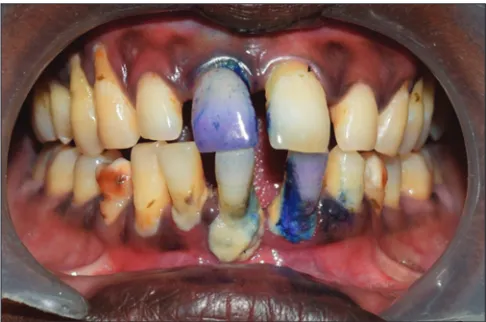
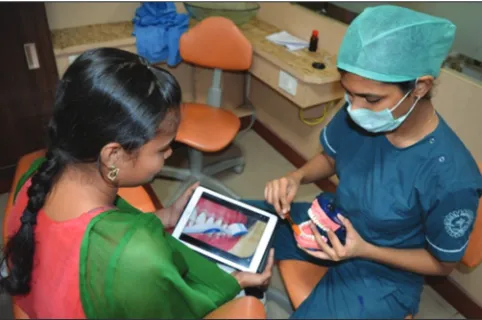
Plaque assessment has been done using PHP index before scaling, and the values were recorded. During the first visit, scaling and root plaining procedure were done. Later, questionnaire was given to the patient and was asked to answer for the first 15 questions which dictate the knowledge of the patient toward oral hygiene. After answering to the questions, patients were given oral hygiene instructions through either of these methods: Orally or demonstrating on model or audiovisual aid or a combination of these modes [Figures 1 and 2]. The choice in selecting the type of instruction to be given was done using random allocation in a computer software and was single blinded.
Follow-up
Patient has been recalled after a month and was checked for the presence of plaque using the same PHP index, and the values were recorded. A comparison of improvement in oral hygiene status is assessed between first and follow-up visit.
Statistical analysis
The information was coded and entered into a Microsoft Excel Spreadsheet. Analysis was done utilizing IBM. SPSS Statistics version 20 windows program software. Descriptive statistics were calculated. Statistical tests that were applied are Chi-square test which was used to compare the values between the groups and frequency analysis. Confidence interval and level of significance were set at 95% and 5%, respectively.
Result
The present study was carried out in 153 patients. Among educational status, 47% of them attained their education below or up to the secondary level and the remaining 53% attained professional education. When PHP score was assessed between the first and follow-up visit, irrespective of education status, both groups showed a significant improvement in the maintenance of oral hygiene. 40.2% and 27.1% of subjects showed excellent prognosis among professional (gingivitis - 32% and periodontitis - 8.2%) and non-professional (gingivitis - 20.3% and periodontitis - 6.8%), respectively. Details about the educational status and the gender are depicted in Table 1. A comparison in the effectiveness of maintaining oral hygiene between the two groups was depicted in Table 2, and it is stated as follows. When compared the group before and after the instructions given, patients whose oral hygiene score falls as poor when measured using PHP before the instructions have improvised to a fair and excellent maintenance. Despite this improvement in oral hygiene, few patients remained in a status of poor maintenance even after the instruction was given. A very less percentage of dentists did not emphasize the importance and benefits of maintaining oral hygiene to their patients that led to a significant negative impact of OHI status on follow-up visits. There is a significant improvement in the oral hygiene after the instructions were given between both the groups, but it does
not reach a statistical significant relevance when compared between the groups. Meanwhile, when different modes of instructions were assessed, patients who received instructions through both audiovisual method and model demonstrations showed a greater improvement in oral hygiene which was assessed through PHP index, and the results attained highly statistical significance (P = 0.001).
When attitude and dental awareness were assessed, it revealed that 86.3% of patients were using manual toothbrush and paste as a primary cleansing aid and 9.2% of patients are still using neem twig to clean their teeth. Considering the frequency of brushing, 41.8% of participants brush twice a day, of which majority of them are professionals.
On probing about additional oral hygiene aids, only 20.3% of subjects use floss, and 39.2% use mouthwash in their daily life. Only 10.5% of participants gargle their mouth twice a day among those using the mouthwash. In view of disease, 73% and 58% of periodontitis and gingivitis group showed improvement in oral hygiene, respectively.
Knowledge, attitude and practices
The results of the study pointed out that education level was one of the factors that governed the KAP of the people. Only 21.6% of participants could able to follow the instructions after being educated by the dentist. In questioning about the recall visits, 51.1% of participants are interested in it. In addition, 16.3% of participants did not understand the way these instructions to be followed, 29.4% of subjects forgot the way to follow, and 33.3% of patients did not follow these instructions as a result of laziness.
Discussion
The present study confirmed that oral hygiene has still remained ignored and the unrealized major social problem. Hence, in this study, attempts were made to evaluate and assess the receptiveness, efficacy, and behavioral motivation of the patients toward following
Figure 2: Demonstration of tooth brushing through model and audiovisual aid
Table 1: Distribution of patients based on their education level
Education Gender N (%)
Up to secondary school level Male 37 (24.1) Female 35 (22.8)
Graduates Male 55 (35.9)
Female 26 (16.9)
Table 2: Variation in result before and after instructions among professional and non‑professional groups
Qualification Oral hygiene status
After P value Poor Fair Excellent
Professional Before
Poor 13 21 15 <0.001
Fair 0 9 14
Total 13 30 29
Non-professional Before
Poor 11 29 8 <0.001
Fair 0 19 14
the oral hygiene instructions and the effect of different modes of these instructions.
There was no gender variation in KAP before and after oral health education. At the end of the study, the participants seem to have gained improved knowledge about the cause and prevention of gingivitis and periodontitis. Their self-reported increase in the utilization of oral hygiene aids and maintenance of oral hygiene as contrasted with the standard reflects their newly gained knowledge of expected behavior which is reported by other studies also.[9-17]
Regardless of advances in awareness, only 86% of patients were using a toothbrush as a basic hygiene aid. These results are similar to the result of a study by Kapoor et al., where 90.6% of the patients among the aggregate utilized toothbrush and toothpaste to clean their teeth.[18] 9.2% of patients were all the while using neem stem to clean their teeth, and their oral hygiene remained poor in the successive visit as they could not transform the habit to toothbrush and is depicted in Figure 3. These outcomes do not correlate with other study, where miswak stick was used as a primary cleansing aid that improved the oral hygiene and periodontal status than a conventional toothbrush.[19,20] Among the subjects using toothbrush and paste, only 41.8% of the subjects brushed their teeth twice daily which is as less when contrasted with the United States where 90% of the studied group was doing the same.[21] Unlike other study, the technique, frequency, and duration of tooth brushing have not been assessed in the current study.[22]
Unlike a study conducted in Saudi Arabia in 2001, where no subject used dental floss for interdental cleaning, 20.3% of subjects used dental floss in this study.[23] Various researchers showed that there was a decline in plaque score when interdental brush was used in conjunction with toothbrush.[24,25] In a survey, it was stated that interdental cleaning was limited in their adequacy by the capacity and motivation of the patient, as opposed to the technique itself.[26]
Only 81% of dental specialist took part in educating the patients in maintaining oral hygiene, and moreover, 54.2% of dental specialist emphasized on recall visits. 51.6% of patients received instructions orally, 11.8% received instructions through audiovisual and by demo on the model, and alternate ways are delineated in Figure 4. The individuals who received instructions through both audiovisual aid and model demonstrated a great improvement in oral hygiene
maintenance. Comparable results with a study showed similar results, where there was a diminishment in plaque scores when a visual method of instruction was given.[27] A study demonstrated that there was no critical distinction in plaque scores when the patients were given an oral hygiene instruction brochure and single individual instruction.[28] There was not much literature of utilizing these different strategies for instructions on adult patients. Preschool children showed that individual instructions were best in enhancing the oral hygiene compared to audiovisual and child as a model which was similar to this study.[29] The results of our study contradict with other where individual cast instruction group showed a greater reduction in plaque score than audiovisual and child as a model.[30] Patients even after all the instructions being given, still 33.3% of patients are feeling lethargic to tail them, and 15% felt that these directions are not all that essential to take after. This study additionally reveals that there is an increase in oral hygiene maintenance in patients who have received instructions with more than one method. Just 58% of gingivitis patients demonstrated an expanded upkeep level when contrasted with 78% of periodontitis patients who demonstrated a more noteworthy increment in keeping up oral hygiene. This could be due to the fact that patients get self-inspired because of the seriousness of the illness they have.
One study states that individuals have distinctive learning styles or attributes for processing information. Based on complexities in learning styles, different instructive techniques can be successful in oral health education programs.[31]
The results from present study also showed that reinforcing the oral hygiene instructions achieved an incredible increment in maintenance of oral health and hence lessening the pervasiveness of gingival or periodontal diseases.
Conclusion
The effectiveness of oral hygiene practices plays a key role in successive periodontal healing or maintenance of oral health in general. The present study shows that there is a lack in oral health awareness among both professional and non-professionals. Moreover, it also shows their negligence toward maintaining oral hygiene and following those instructions. Hence, there is a need to educate and spread
Figure 3: Percentage distribution of patients according to their method of
knowledge of proper dental care by changing the receptiveness, efficacy, and behavior of patients toward following these instructions through dentists. Emphasis to be done in every aspect of oral hygiene maintenance through distinct modes of communication based on their level of understanding.
A suggestion for further research could be to include to assessing the socioeconomic status, occupation, and the variation in the gender among patients following these oral hygiene instructions, thus narrowing the study to a desired aspect.
References
1. Sanadhya YK, Thakkar JP, Divakar DD, Pareek S, Rathore K, Yousuf A, et al. Effectiveness of oral health education on knowledge, attitude, practices and oral hygiene status among 12-15-year-old schoolchildren of fishermen of Kutch district, Gujarat, India. Int Marit Health 2014;65:99-105.
2. World Health Organization. Expert Committee on Dental Health. Periodontal Disease, Report. Geneva: World Health Organization; 1961.
3. Sheiham A, Watt RG. The common risk factor approach: A rational basis for promoting oral health. Community Dent Oral Epidemiol 2000;28:399-406. 4. Friedman LA, Mackler IG, Hoggard GJ, French CI. A comparison of perceived
and actual dental needs of a select group of children in Texas. Community Dent Oral Epidemiol 1976;4:89-93.
5. Wright FA. Children’s perception of vulnerability to illness and dental disease. Community Dent Oral Epidemiol 1982;10:29-32.
6. McCaul KD, Glasgow RE, Gustafson C. Predicting levels of preventive dental behaviors. J Am Dent Assoc 1985;111:601-5.
7. Chen MS. Children’s preventive dental behavior in relation to their mother’s socioeconomic status, health beliefs, and dental behaviors. ASDC J Dent Child 1986;53:105-9.
8. Podshadley AG, Haley JV. A method for evaluating oral hygiene performance. Public Health Rep 1968;83:259-64.
9. Nyandindi U, Palin-Palokas T, Milen A, Robison V, Kombe N. Oral health knowledge, attitudes, skills and behavior of children entering school in urban and rural areas in Tanzania. Public Health 1994;108:35-41.
10. Vanobbergen J, Declerck D, Mwalili S, Martens L. The effectiveness of a 6-year oral health education programme for primary schoolchildren. Community Dent Oral Epidemiol 2004;32:173-82.
11. Saied-Moallemi Z, Virtanen JI, Vehkalahti MM, Tehranchi A, Murtomaa H. School-based intervention to promote preadolescents’ gingival health: A community trial. Community Dent Oral Epidemiol 2009;37:518-26. 12. Nyandindi U, Milen A, Palin-Palokas T, Robison V. Impact of oral health
education on primary school children before and after teachers’ training in Tanzania. Health Promot Int 1996;11:193-201.
13. Worthington HV, Hill KB, Mooney J, Hamilton FA, Blinkhorn AS. A cluster randomized controlled trial of a dental health education program for
10-year-old children. J Public Health Dent 2001;61:22-7.
14. Yazdani R, Vehkalahti MM, Nouri M, Murtomaa H. School-based education to improve oral cleanliness and gingival health in adolescents in Tehran, Iran. Int J Paediatr Dent 2009;19:274-81.
15. Honkala S, Honkala E, Rimpelä A, Vikat A. Oral hygiene instructions and dietary sugar advice received by adolescents in 1989 and 1997. Community Dent Oral Epidemiol 2002;30:124-32.
16. Shenoy RP, Sequeira PS. Effectiveness of a school dental education program in improving oral health knowledge and oral hygiene practices and status of 12- to 13-year-old school children. Indian J Dent Res 2010;21:253-9.
17. Redmond CA, Blinkhorn FA, Kay EJ, Davies RM, Worthington HV, Blinkhorn AS. A cluster randomized controlled trial testing the effectiveness of a school-based dental health education program for adolescents. J Public Health Dent 1999;59:12-7.
18. Kapoor D, Gill S, Singh A, Kaur I, Kapoor P. Oral hygiene awareness and practice amongst patients visiting the Department of Periodontology at a Dental College and Hospital in North India. Indian J Dent 2014;5:64-8. 19. Darout IA, Albandar JM, Skaug N. Periodontal status of adult Sudanese
habitual users of miswak chewing sticks or toothbrushes. Acta Odontol Scand 2000;58:25-30.
20. Wu CD, Darout IA, Skaug N. Chewing sticks: Timeless natural toothbrushes for oral cleansing. J Periodontal Res 2001;36:275-84.
21. Survey of Family Tooth Brushing Practices. Bureau of dental health education. bureau of economic research and statistics. J Am Dent Assoc 1966;72:1489-91. 22. Ganss C, Schlueter N, Preiss S, Klimek J. Tooth brushing habits in uninstructed adults--frequency, technique, duration and force. Clin Oral Investig 2009;13:203-8.
23. Jamjoom H. Preventive oral health knowledge and Practice in Jeddah, Saudi Arabia. J K A U 2001;9(1):17-25.
24. Christou V, Timmerman MF, Van der Velden U, Van der Weijden FA. Comparison of different approaches of interdental oral hygiene: Interdental brushes versus dental floss. J Periodontol 1998;69:759-64.
25. Kiger RD, Nylund K, Feller RP. A comparison of proximal plaque removal using floss and interdental brushes. J Clin Periodontol 1991;18:681-4. 26. Warren PR, Chater BV. An overview of established interdental cleaning
methods. J Clin Dent 1996;7:65-9.
27. Sandeep V, Vinay C, Madhuri V, Rao VV, Uloopi KS, Sekhar RC. Impact of visual instruction on oral hygiene status of children with hearing impairment. J Indian Soc Pedod Prev Dent 2014;32:39-43.
28. Glavind L, Zeuner E, Attström R. Oral hygiene instruction of adults by means of a self-instructional manual. J Clin Periodontol 1981;8:165-76.
29. Leal SC, Bezerra AC, de Toledo OA. Effectiveness of teaching methods for tooth brushing in preschool children. Braz Dent J 2002;13:133-6.
30. Srivastava N. A comparative evaluation of efficacy of different teaching methods of tooth brushing in children contributors. J Oral Hyg Health 2013;1(3):118. 31. Dickinson AO. In: Mason J, editor. Community oral health education. Concept
in Dental Public Health. Philadelphia, PA: Lippincott Williams and Wilkins; 2005. p. 139-57.