http: // www.ijrtsm.com© International Journal of Recent Technology Science & Management 23
ISSN : 2455-9679
[Sachin et al. , 3(4), April 2018] Impact Factor : 2.015
IJRTSM
INTERNATIONAL JOURNAL OF RECENT TECHNOLOGY SCIENCE & MANAGEMENT
“
OPTIMIZATION OF CUTTING PARAMETERS FOR TURNING OPERATION IN CNC LATHE
FOR AISI 1045 MATERIAL USING TAGUCHI METHOD AND ANOVA METHOD BY EXCEL
2007 SOFTWARE
”
Sachin Tripathi
1, Rajeev Dwivedi
2,
Neeraj Nagayach
3 1,PG, Scholar, Dept. of Mechanical Engineering, OIST, Bhopal, MP, India
2Assotciate Professor, Dept. of Mechanical Engineering, OIST, Bhopal, MP India 3Assotciate Professor, Dept. of Mechanical Engineering, OIST, Bhopal, MP India
ABSTRACT
The main purpose of today’s manufacturing industries is to produce low cost, high quality products in short time. They mainly focused on achieving high quality, in term of part accuracy, surface finish, high production rate etc. So, the selection of optimal cutting parameters is a very important issue for every machining process in order to reduce the machining costs and increase the quality of machining products. In this project the cutting of AISI 1045 steel material under wet and dry condition is carried out using CNC lathe machine. Taguchi method is used to formulate the experimental layout. The effect of cutting condition (spindle speed, feed rate and depth of cut) on surface roughness were studied and analysed. The CNC turning machine is used to conduct experiments based on the Taguchi design of experiments (DOE) with orthogonal L9 array and Anova method used by Excel 2007 software. Optimal cutting parameters for each performance measure were obtained employing Taguchi techniques. The orthogonal array, signal to noise ratio and analysis of variance were employed to find minimum surface roughness. Optimum results are finally verified with the help of confirmation experiments.
Keywords: CNC, Surface roughness, Dry, Wet, Taguchi, Anova, Excel 2007
I.
I
NTRODUCTIONManufacturing means transformation of raw materials into finished goods for the satisfaction of human needs. To transform the raw material different manufacturing processes are applied because of which the shape, size and physical properties of given material are altered. Different types of manufacturing process for metals are: -
Metal casting:-Casting is a manufacturing process where a solid is melted and heated to certain temperature, then poured into a cavity or mould, the molten metal solidifies in the mould and the desired shape is formed. Metal forming and shaping:-A simple metallic geometry is transformed into a complex one through plastic deformation. Tools or dies impart pressure on the material to transfer the desired geometry through the tool/material interface. It includes rolling, forging, extrusion, drawing, sheet forming, powder metallurgy, molding etc.
Joining:-Temporary or permanent joining of same or different materials. It includes welding, brazing, soldering, diffusion bonding, adhesive bonding, mechanical joining etc.
Machining:-It is the metal removing process. It includes turning, boring, drilling, milling, planning, shaping, broaching, grinding etc.
http: // www.ijrtsm.com© International Journal of Recent Technology Science & Management 24
ISSN : 2455-9679
[Sachin et al. , 3(4), April 2018] Impact Factor : 2.015
Material property modification process:-This process involves changing the property of materials to achieve desirable characteristics. This includes hardening, quenching, annealing, case carburizing etc.
1.1
CUTTING TOOL MATERIALS AND TOOLS
The Ideal cutting tool material should have all of the following characteristics: Harder than the work it is cutting
High temperature stability
Resists wear and thermal shock
Impact resistant
Chemically inert to the work material and cutting fluid
1.2
TAGUCHI METHOD
Taguchi method is statistical method developed by Genichi Taguchi to improve the performance and quality of the products. According to Taguchi, the most important thing prior to analysis is establishment of the experiment. Only by this approach, it is possible to improve the quality of the process. This
approach could achieve the final output value and minimized the variability around the output value by minimum cost.
1.3
EXCEL SOFTWARE
Excel Data Analysis is a statistics package.. This software is used for Data and File Management- spreadsheet for better data analysis; Analysis of Variance; Regression Analysis; Power and Sample Size; Tables and Graphs; Multivariate Analysis - includes factor analysis; cluster analysis; correspondence analysis; etc., Nonparametric tests including sing test, runs test, friedman test, etc., Time Series and Forecasting tools that help show trends in data as well as predicting future values. In this work, the Excel is used for obtaining ANOVA.
II
.
OBJECTIVEOF PRESENT WORK
The objective of the present work is to investigate the effect of the spindle speed, feed rate and depth of cut on surface roughness in dry and wet conventional turning of AISI 1045 steel using TiN coated cutting tool in dry condition.
III
.
METHODOLOGY AND EXPERIMENTATIONAccordingly the present study has been done through the following plan of experiment.
• Checking and preparing the Lathe ready for performing the machining operation.
• Cutting steel bars by power saw and performing initial turning operation in Lathe to get desired dimension (of diameter 50mm and length 140 mm) of the work pieces.
• Performing straight turning operation under dry and wet conditions on specimens in various combinations of
process control parameters like: spindle speed, feed and depth of cut.
• Length of cut was kept constant at 50 mm for both dry and wet turning.
• Measuring surface roughness and surface profile with the help of a portable stylus-type profilometer,
Talysurf(Taylor Hobson, Surtronic 3+, UK).
Fig 1.1 .1 Turning Processes
http: // www.ijrtsm.com© International Journal of Recent Technology Science & Management 25
ISSN : 2455-9679
[Sachin et al. , 3(4), April 2018] Impact Factor : 2.015
3.1
MATERIAL AISI 1045 AND ITS APPLICATIONS
The material selected was AISI 1045 MS bars (of diameter 50 mm and length 140 mm) on the basis that it was suitable for most engineering and construction applications. AISI 1045 is a low-cost alloy, medium-carbon steel with adequate strength and toughness characteristics, AISI 1045 is valuable for induction- or flame-hardened components. The hardness of bar is 187 HB Automotive type applications. Axle and spline shaft are two examples of automotive components produced using this material where the turning is the prominent machining process used.
3.2
MACHINE USED
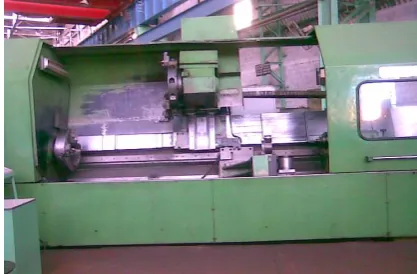
Side Base CNC Lathe machine with coated cemented carbide cutting tool was used in the experiments. Cutting speed, feed rate and depth of cut were selected as the
machining parameters to analyze their effect on surface
roughness
.
Technical Specifications
Travel in X-axis- 1000mm Travel in Z-axis-3000 mm Swing over bed-760 mm Spindle Nose –MT-5 Turret-12 Tools
System-Sinumaric-3T4B Siemens-802D
3.3 COATED CARBIDE TOOL INSERT DESCRIPTION
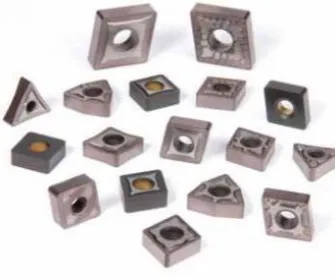
Coated carbide tools have been known to perform better than uncoated carbide tools when turning steel. For this reason, commercially available CVD coated carbide insert was used in this investigation. The cutting inserts used were multi layer coated cemented carbide by (TiN-Al2O3-TiCN) from WIDIA with a standard notation of CNMG 120408 of nose radius 0.8 mm. The selected cutting tool was based on the cutting tool manufacturer‟s manual.
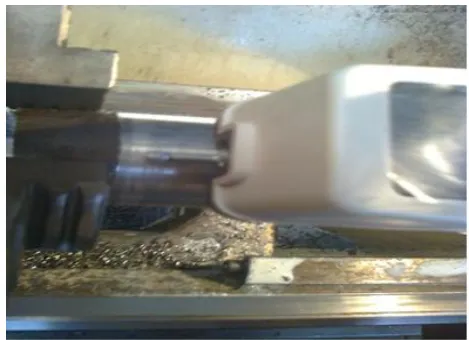
Fig. 3.1 Work piece before machining Fig. 3.2 Work piece after machining
http: // www.ijrtsm.com© International Journal of Recent Technology Science & Management 26
ISSN : 2455-9679
[Sachin et al. , 3(4), April 2018] Impact Factor : 2.015
3.4 SURFACE ROUGHNESS MEASUREMENT
The surface roughness test was done by using Mitutoyo surface roughness tester „Surftest SJ 201‟. The probe was adjusted to measure the Ra value. The
probe was moved a distance of 3mm.
IV.
EXPERIMENTS RESULTS
Fig. 3.4 Surface roughness tester
http: // www.ijrtsm.com© International Journal of Recent Technology Science & Management 27
ISSN : 2455-9679
[Sachin et al. , 3(4), April 2018] Impact Factor : 2.015
4.1 CALCULATIONS OF S/N RATIOS FOR SURFACE ROUGHNESS FOR DRY TURNING AND WET TURNING
Calculation for Dry Turning
• S/N Ratio (Experiment 1) = η1= -10log [(∑ Yi2)/n] =-10 log [1/ (2.24)2] = -7
• 2. S/N Ratio (Experiment 2) = η2= -10 log [1/ (5.67)2] = -15.07
• 3. S/N Ratio (Experiment 3) = η3= -10 log [1/ (5.93)2] = -15.46
• 4. S/N Ratio (Experiment 4) = η4= -10 log [1/ (5.34)2] = -14.55
• 5. S/N Ratio (Experiment 5) =η5 = -10 log [1/ (4.87)2] = -13.75
• 6. S/N Ratio (Experiment 6) =η6= -10 log [1/ (6.07)2] = -15.66
• 7. S/N Ratio (Experiment 7) =η7= -10 log [1/ (2.91)2] = -9.27
• 8. S/N Ratio (Experiment 8) = η8= -10 log [1/ (3.78)2] = -11.54
• 9. S/N Ratio (Experiment 9) =η9= -10 log [1 /(5.05)2] = -14.06
Calculation for Wet Turning
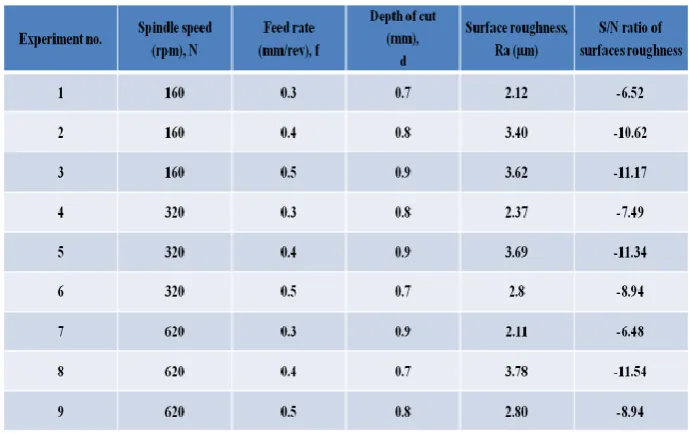
• S/N Ratio (Experiment 1) = η1= -10log [(∑ Yi2)/n] =-10 log [1/ (2.12)2] = -6.52
• 2. S/N Ratio (Experiment 2) = η2= -10 log [1/(3.40)2] = -10.62
• 3. S/N Ratio (Experiment 3) = η3= -10 log [1/(3.62)2] = -11.17
• 4. S/N Ratio (Experiment 4) = η4= -10 log [(1/2.37)2] = -7.49
• 5. S/N Ratio (Experiment 5) = η5 = -10 log [1/(3.69)2] = -11.34
• 6. S/N Ratio (Experiment 6) = η6= -10 log [1/(2.80)2] = -8.94
• 7. S/N Ratio (Experiment 7) = η7 = -10 log [1/(2.11)2] = -6.48
• 8. S/N Ratio (Experiment 8) = η8 = -10 log [1/(3.78)2] = -11.54
• 8. S/N Ratio (Experiment 9) = η9 = -10 log [1/ (2.8)2] = -8.94
4.2 ANOVA METHOD
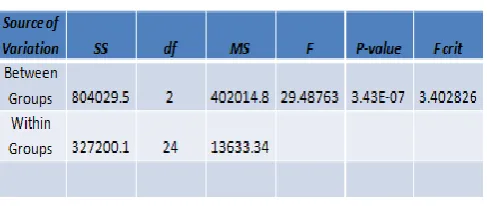
ANOVA is a statistical tool which determines the contribution of individual factors to control the final response. It calculates the parameters like sum of squares (SSS), degree of freedom, variance, f value. p value for each factor.
The ANOVA calculations were done using the help of the MS OFFICE 2007 software Excel. In ANOVA test we found that most important parameter like SS, DOF, Variance, Mean, f value and p value.
http: // www.ijrtsm.com© International Journal of Recent Technology Science & Management 28
ISSN : 2455-9679
[Sachin et al. , 3(4), April 2018] Impact Factor : 2.015
• In below figure we can see that all parameter value have found by ANOVA method. Fishers F 29.48 value and p
value is 3.43x10⁻⁷ is very less from Alpha (0.05). So our result is good.
4.3 DISCUSSION
4.3.1 ANALYSIS OF VARIANCE
The results obtained from the experiment were checked with the help of ANOVA, which predicts the significance of input parameter for any desired response function. It shows the most significant parameter which influences the results.
4.3.2 ANOVA FOR SURFACE ROUGHNESS IN DRY AND WET TURNING
Results obtained for the surface roughness in dry and wet turning experimental results analyzed with ANOVA The F value calculated through Excel 2007 software is shown in the second last column of ANOVA table which suggests the significance of the factors on the desired characteristics.
4.4 CONFIRMATION TEST
The last step of Taguchi parameter design is to verify and predict the improvement of surface roughness (response) using optimum combination of cutting parameters.
4.4.1 CONFIRMATION TEST FOR SURFACE ROUGHNESS IN DRY TURNING
For Spindle speed, factor effects are mA1, mA2 and mA3.
As from Table 3.7, A1 occurs in experiment 1, 2, 3, A2 in 4, 5, 6 and A3 in 7, 8, 9 respectively.
So, mA3= = = -11. 62 dB
Now, Factor effect of B (i.e. Feed Rate), from table 6, B1 occurs in 1, 4, 7 experiment and B2 occurs in 2, 5, 8, B3 in 3, 6 and
9 respectively).
So, mB1 = = = -10.27 dB
Lastly factor effect of C (i.e. Depth of Cut) Again from table 6, C1 occurs in 1, 6, 8 experiments,
http: // www.ijrtsm.com© International Journal of Recent Technology Science & Management 29
ISSN : 2455-9679
[Sachin et al. , 3(4), April 2018] Impact Factor : 2.015
C2 occurs in 2, 4, 9 and C3 in 3, 5 and 7 respectively.
Therefore, mC1 = = = - 11.4 dB
And, m = = -12.928 dB
ηopt =m + ( mA3 – m ) + ( mB3 – m ) + ( mC1 – m)
= -12.928 + (-11.62 + 12.928) + (-10.27 + 12.928) + (-11.4 + 12.928) = -12.928 + 1.308 + 2.658 + 1.528
= -7.434 dB
Now the value of Surface Roughness is, Ra == 2.34 µm
4.4.2 CONFIRMATION TEST FOR SURFACE ROUGHNESS IN WET TURNING
For Spindle speed, factor effects are mA1, mA2 and mA3.
As from Table 3.7, A1 occurs in experiment 1, 2, 3, A2 in 4, 5, 6 and A3 in 7, 8, 9 respectively.
So, mA3= = = -8.99 dB
Now, Factor effect of B (i.e. Feed Rate), from table 6, B1 occurs in 1, 4, 7 experiment and B2 occurs in 2, 5, 8, B3 in 3, 6 and
9 respectively).
So, mB3 = = = -9.68 dB
Lastly factor effect of C (i.e. Depth of Cut) Again from table 6, C1 occurs
in 1, 6, 8 experiments,
C2 occurs in 2, 4, 9 and C3 in 3, 5 and 7 respectively.
Therefore, mC3 = = = - 6.83 dB And, m = = -9.23 dB
ηopt =m + ( mA3 – m ) + ( mB3 – m ) + ( mC1 – m)
= -9.23+ (-8.99+ 9.23) + (-9.68+ 9.23) + (-6.83+ 9.23) = -9.23 + 0.24-0.45 +2.4
= -7.05 dB
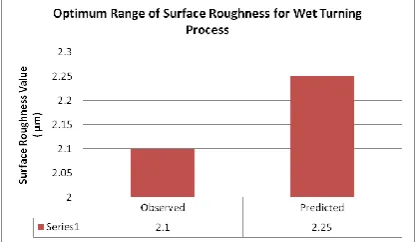
Now the value of Surface Roughness is, Ra = = 2.25 µm
V.
CALCULATIONS
FOR
SURFACE
ROUGHNESS
The following conclusions are done from the study:
It has been found that feed rate is found to be the most significant factor & its contribution to surface roughness is 48.44 %. The best results for surface roughness (lower is better) would be achieved when AISI 1045 work piece is machined at spindle speed of 620 rpm, feed rate of 0.3 mm/rev and depth of cut of 0.7 mm. With 95% confidence interval, the feed rate effects the surface roughness most significantly. The Surface roughness is mainly affected by feed rate, depth of cut and spindle speed. With the increase in feed rate the surface roughness also increases, as the depth of cut increases the surface roughness first increase and decrease and as the spindle speed increase surface roughness decreases.
• From ANOVA analysis, parameters making significant effect on surface roughness are feed rate and depth of cut.
• Optimal machining parameters for minimum surface roughness were determined. The percentage error between experimental and predicted result is 6.83 %.
• The parameters taken in the experiments are optimized to obtain the minimum surface roughness possible. The
optimum setting of cutting parameters for high quality turned parts is as :-
• Spindle speed = 620 rpm
• Feed rate = 0.3 mm/ rev
• Depth of cut = 0.7 mm
Fig. 4.2 Optimum range of surface roughness for Dry turning process
http: // www.ijrtsm.com© International Journal of Recent Technology Science & Management 30
ISSN : 2455-9679
[Sachin et al. , 3(4), April 2018] Impact Factor : 2.015
VI.
FUTURE
SCOPE
In this present study only three parameters have been studied in accordance with their effects. Other factors like Nose radius, Types of Inserts, cutting conditions (dry or wet) etc. can also be studied. Also, the other outputs like power consumption, tool life, cutting forces etc. Can also be added.
.
REFERENCES
[1] Pytlak,B.; (2010) ‟Multicriteria optimization of hard turning operation of the hardened18HGT steel‟,
International Journal Advance Manufacturing Technology, Volume 49: pp. 305-312.
[2] Sieben,B., Wagnerite. and Biermann,D.; (2010) „ “Empirical modeling of hard turning of AISI 6150 steel using
design and analysis of computer experiments”, Production Engineering Research Development, Volume 4: pp. 115
- 125.
[3] Cappellini,C., Attanasio,A., Rotella,G. and Umbrello,D.; (2010) ‟Formation of dark and white layers in hard
turning: influence of tool wear”, International Journal of Material Forming,Volume 3 No.1: pp. 455 - 458.
[4] D. Philip Selvaraj, P. Chandramohan; (2010)“Optimization of surface roughness of AISI 304 Austenitic
stainless steel in dry turning operation using Taguchi design method”, Journal of Engineering Science and
Technology, Volume 5, No. 3: pp 293-301.
[5] R. Ramanujam, R. Raju, N. Muthukrishnan; (2010) “Taguchi-multi machining characteristics optimization in
turning of Al-15% SiCp composites using desirability function analysis”, Journal of Studies on Manufacturing,
Volume 1 Issue2-3: pp 120-125.
[6] J.S.Senthilkumaar, P.Selvarani, RM.Arunachalam; (2010) “Selection of machining parameters based on the
analysis of surface roughness and flank wear in finish turning and facing of Inconel 718 using Taguchi
Technique”, Emirates Journal for Engineering Research, Volume 15, No.2: pp 7-14.
[7] H. Yanda, J.A. Ghani, M.N.A.M. Rodzi, K. Othman and C.H.C. Haron; (2010) “Optimization of material
removal rate, surface roughness and tool life on conventional dry turning of FCD 700”, International Journal
of Mechanical and Materials Engineering, Volume 5 No. 2: pp 182-190.
[8] D. Mittal, M.P. Garg, R. Khanna; (2011) “An investigation of the effect of the process parameters on MRR in
turning of pure Titanium (Grade -2)”, International journal of Engineering Science & Technology, Volume 3
No. 8: pp 6345-6349.
[9] S. Pahda, S. M Sharma, N. Malhotra; (2011) “Analysis of variance and Optimization of surface roughness in
CNC Turning of EN-8 steel by Taguchi method”, International Journal of Advanced Engineering Technology,
Volume 3 Issue 1: pp 264-267.
[10] M. Vellibor, M. milos; (2011) “Optimization of surface roughness in turning alloy steel by using Taguchi
method”, Scientific Research and Essays, Volume 6(16): pp 3474-3484.
[11] S.Khrais, A.M. Hassan, A. Gazawi; (2011) “Investigations into the turning parameters effect on the surface
roughness of flame hardened medium carbon steel with TiN-Al2O3-TiCN coated inserts based on Taguchi
http: // www.ijrtsm.com© International Journal of Recent Technology Science & Management 31
ISSN : 2455-9679
[Sachin et al. , 3(4), April 2018] Impact Factor : 2.015
[12] U. K. Yadav, D. Narang, P.S. Attri; (2012) “Experimental investigation and optimization of machiningparameters for surface roughness in CNC turning by Taguchi method”, International Journal of Engineering Research and Applications, Volume 2 Issue 4: pp 2060-2065.
[13] M. V. Ramana, A. V. Vishnu, G. K.M. Rao, D.H. Rao; (2012) “Experimental investigations, optimization of
process parameters and mathematical modeling in turning of Titanium alloy under different lubricant
conditions”, Journal of Engineering, Volume 2 Issue 1: pp 86-101.
[14] K. Hassan, A. Kumar, M.P. Garg; (2012) “Experimental investigation of Material removal rate in CNC
turning using Taguchi method”, International Journal of Engineering Research and Applications, Volume 2
Issue 2: pp 1581-1590.
[15] R.K. Patel, H.R. Prajapati; (2012) “Parametric Analysis of Surface roughness and Material removal rate of
Harden steel on CNC Turning using ANOVA Analysis: A Review”, International journal of Engineering
Science and Technology, Volume 4 No. 7: pp 3111-3117.
[16] R. Dillibabu, K. Sivasakthive, S. Vinodhkumar (2013), “Optimization of Process Parameters in Dry and Wet
Machining of Ti-6al-4v Eli Using Taguchi Method”, International Journal of Design and Manufacturing
Technology, Volume 4, Issue 3, PP: 15-21.
[17] B Kumaragurubaran, P Gopal (2013), “Optimization of Turning Parameters of En-9 Steel Using Design of
Experiments Concepts”, International Journal of Mechanical Engineering and Robotics Research, Vol. 6, Issue7, PP: 182-190.
[18] Yacovsahijpaul, Gurpreetsingh (2013), “Determining the Influence of Various Cutting Parameters on Surface
Roughness during Wet CNC Turning Of AISI 1040 Medium Carbon Steel”, IOSR Journal of Mechanical and
Civil Engineering, Volume 7, Issue 2, PP 63-72.
[19] Sachin C Borse (2014), “Optimization of Turning Process Parameter in Dry Turning of SAE52100 Steel”,
International Journal of Mechanical Engineering and Technology, Volume 5, Issue 1, PP: 1-8.
[20] Kaushal Pratap Singh, Girish DuttGautam, Rupesh Yadav, LalitBisht, GavendraNorkey (2014), “Selection of
Optimum Machining Parameters for EN36 Alloy Steel in CNC Turning Using Taguchi Method”, International
Journal of Scientific & Engineering Research, Volume 5, Issue 3, PP: 976- 982.
[21] Arularasan. R, Sivasakthivel. K, Dinesh. D (2014), “International Journal of Research in Aeronautical and
Mechanical Engineering Effect of Machining Parameters on Titanium Alloy Wet and Dry Machining”,
Journal of Mechanical and Civil Engineering, Volume 7, Issue 2, PP 63-72.
[22] R. Rajamanickam, K .Thanasekaran, G .Prabu, S.Gopal (2015), “Optimization of Surface Roughness for
Turning Operation in Lathe using Taguchi Method”, International Journal of Innovative Research in Science,
Engineering and Technology, Vol. 4, Issue 6, PP 1668-1674.
[23] Aswathy V G, Rajeev N, Vijayan K (2015), “Effect of machining parameters on surface roughness, material
removal rate and roundness error during the wet turning of Ti-6Al-4V alloy”, International Journal of Applied
Sciences and Engineering Research, Vol. 4, Issue 1, PP: 1-10.
[24] Saurabh Singhvi, M.S.Khidiya, S.Jindal, M.A.Saloda (2016), “Investigation of Material Removal Rate in
Turning Operation”, International Journal of Innovative Research in Science, Engineering and Technology,
http: // www.ijrtsm.com© International Journal of Recent Technology Science & Management 32
ISSN : 2455-9679
[Sachin et al. , 3(4), April 2018] Impact Factor : 2.015
[25] Amritpal Singh, Harjeetsingh (2016), “Review on Effects of Process Parameters in Hard Turning of Steels”,
International Journal for Innovative Research in Science & Technology, Vol. 3, Issue 6, PP: 30-35.
[26] Lavish Sharma, Jai Prakash Sharma, Nitin Sharma (2016), “Optimization of Cutting Parameters for Surface
Roughness in Turning of Alloy Steel EN 47”, International Journal of Advanced Research in Mechanical
Engineering & Technology, Vol. 2, Issue 4, PP: 14-18.
[27] Siva Surya Mulugundam, ShaliniManchikatla, Sridhar Atla (2017), “Optimization of Material Removal Rate
and Surface Roughness in Dry and Wet Machining of En19 Steel Using Taguchi Method”, International
Journal of Research in Mechanical Engineering & Technology, Vol. 7 Issue 1, PP 33-36.
[28] Jitender Sharma, Ajay Kumar Agarwal (2017), “Literature Review on Optimization of Surface Roughness
during Turning Operation”, International Journal of Innovative Research in Science, Engineering and Technology, Vol. 6 Issue 2, PP: 2417-2424.
[29] S. Nandhakumar, R. Shanmuga Prakash (2017), “Parametric Optimization in CNC Turning of Martensitic
Stainless Steel 416 using Taguchi Method”, Journal of Chemical and Pharmaceutical Sciences, Vol. 1, Issue 2,