CONCLUSION
1. In the morphological term, there is no significant importance discrepancy between these strains P.multocida18 andP.multocida144.
2. Confirmation of both virulent and mutant strains using standard and multiplex PCR demonstrated it is P.multocidaand its serotype “B”.
3. The characteristics of these two strains are evolutionary correlated each to other by 93% as compared with randomly selected 10 different strains ofP.multocidaand other Pasteurella spp.
ACKNOWLEDGEMENT
This study was supported by the laboratory of Infectious disease and Immunology, Institute of Veterinary Medicine (IVM) and authors are
specially grateful to administrative staff of the institute.
REFERENCE
1. Lundaa.Ts, Yondondorj.A, Sarantuya.B. “Haemorrhagic septicaemia”. Institute of Veterinary Medicine. Munkhiin useg group.LLC. Ulaanbaatar. 2009
2. Antony P, Nair G, Jayaprakasan, Mini M, Aravindakshan T. “Nucleic acid based differentiation of Pasteurella Multocida Serotypes”. The internet journal of veterinary Medicine. 2006. Volume 2. Number 2.
3. Arumugam N D, Ajam N, Blackall P J, Asiah N M, Ramlan M, Maria J. “Capsular serotyping of Pasteurella multocida from various animal hosts – a comparison of phenotypic and genotypic methods”, Tropical Biomedicine. 2011. 28(1): 55-63.
4. “Haemorrhagic septicaemia”. The World assembly of delegates of the OIE. May 2012. Chap 2.4.12.
5. Kristy M Towsend, John D Boyce, Jing Y Chung, Alan J Frost, and Ben Adler. “Genetic organization of Pasteurella Multocida cap Loci and development of a multiplex capsular PCR typing system”. Journal of Clinical Microbiology, Mar. 2001, p.924-929.
6. Robert L Davies. “Genetic diversity among Pasteurellamultocida strains of avain, bovine, ovine and porcine origin from England and Walses by comparative sequence analysis of the 16s rRNA gene”. Journal of Microbiology. 2004, 150. 4199-4210.
7. Saitou N. and Nei M. (1987). The neighbor-joining method: A new method for reconstructing phylogenetic trees. Molecular Biology and Evolution 4:406-425.
8. Felsenstein J. (1985). Confidence limits on phylogenies: An approach using the bootstrap. Evolution 39:783-791.
9. Tamura K., Nei M., and Kumar S. (2004). Prospects for inferring very large phylogenies by using the neighbor-joining method. Proceedings of the National Academy of Sciences (USA) 101:11030-11035.
10. Tamura K., Stecher G., Peterson D., Filipski A., and Kumar S. (2013). MEGA6: Molecular Evolutionary Genetics Analysis version 6.0. Molecular Biology and Evolution30: 2725-2729. 11. http://www.ncbi.nlm.nih.gov/nuccore
STUDY OF PATHOGENIC BACTERIA DETECTED IN FLY SAMPLES USING UNIVERSAL PRIMER-MULTIPLEX PCR
Alimaa Tsagaan1*, Hirotaka Kanuka2, Kiyoshi Okado2
1-Institute of Veterinary Medicine, MULS, Mongolia, 2-National Research Center for Protozoan Diseases
Obihiro University of Agriculture and Veterinary Medicine, Obihiro, Japan
*-Corresponding author, e-mail: [email protected],
ABSTRACT
Filth flies, especially house fly, Musca domestica L., not only is a nuisance pest, but also acts as an important mechanical vector for pathogenic microorganism agents, including bacteria, protozoa, worms, fungi and viruses amongst humans and animals. More than 100 pathogens are associated with the house fly and bacteria have been isolated from feces, vomits, external surfaces, and internal organs of this species (De Vos V, et al., 1998; Dragon, DC, 1995; West, 1951; Markus, 1980; Kasprzak et al, 1981; Akinboade et al., 1984; Iwasa et al., 1999).
The aim of this study was to detect pathogenic bacteria from house fly by UP-M-PCR. In this study, totally 267 house flies were collected and we tried to find a procedure enabling the detection of three pathogens namely, Escherichia coli, Listeria monocytogenes, Salmonella spp and employed for multiplex PCR analysis in house fly. The most common isolated bacteria were L.monocytogenes (132 cases: 49.4%) and another isolated bacteria belong to E. coli (114 case: 42.6%) and Salmonella spp (98 cases: 36.7%). The results of the current study confirm that flies are much more than a nuisance and that they pose potentially serious health risks. The epidemiologic potential of house flies to disseminate pathogenic bacteria may be greater than initially suspected.
KEY WORDS: Musca domestica, Escherichia coli; Listeriamonocytogenes, Salmonella spp
INTRODUCTION
The house fly, Musca domestica L. (Diptera: Muscidae), is recognized as an important factor in the dissemination of various infectious diseases such as cholera, shigellosis, and salmonellosis. They can also serve as a cross-contamination vector for other food-borne pathogens (Antonio et al., 2003). Food borne pathogens are a growing concern for human
al., 2000; Jay 2004;Gillespie et al., 2005; Olsen et al., 2005).
Multiple PCR has potential to detect out multiple pathogenic contaminants simultaneously (Bhagwat 2003). It has been used to detect and identify 1 organism by amplification of more than 1 gene or multiple organisms by targeting different unique
sequence of each organism simultaneously (Fratamico 2001), which has also been used to detect E. coli, L. monocytogenes, and Salmonella spp. (Kim et al.,2006; Mukhopadhyay et al., 2007). In this study, we used universal primer-multiplex method to detect the 3 pathogens from house fly.
MATERIALS & METHODS Study area and sampling of flies
Flies were Musca domestica according to standard criteria by the use of taxonomic keys. House flies were captured either by using a fly killer, and frozen with -30 degrees.
Fly DNA extraction
Total genomic DNA was extracted from individual house fly using the Genome DNA Extraction kit. The genomic DNA of pathogens, and carrying flies was extracted by homogenizing the cells or organisms with a plastic homogenizer in 200 µl A Buffer A (0.1 M Tris, pH 9.0; 0.1 M EDTA; 1% SDS; and 0.5% DEPC) and incubating the homogenate for 30 min at 70°C. Next, 44.8 μl of 5
M KoAc was added, and the mixture was cooled for 30 min on ice. After centrifugation at 20,000 g for
15 min at 4°C, the DNA-containing 180 μl
supernatant was transferred to a new tube and mixed
with 90 μl isopropanol. The solution was centrifuged at 20,000 g for 20 min at 4°C, and the precipitated DNA was collected, rinsed with 70% ethanol, and dried. Each DNA pellet was diluted in
60 μl TE.
Universal primer-multiplex PCR (UP-M-PCR) Primers
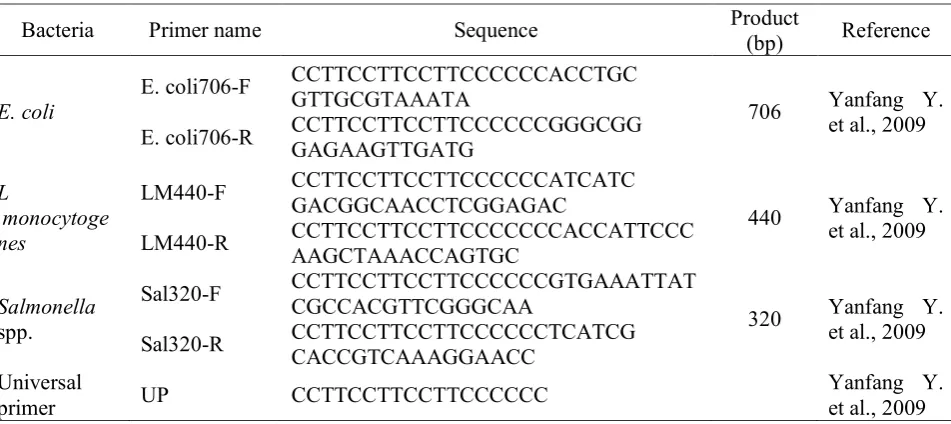
Specific primers for E. coli706-F/R, LM440-F/R, and Sal320-F/R were used to detect the E. coli, L. monocytogenes, and Salmonella spp, respectively (Yanfang Y et al., 2009). Details of primer sequences are shown in Table 1.
Table 1 Primer details
Bacteria Primer name Sequence Product (bp) Reference
E. coli E. coli706-F E. coli706-R
CCTTCCTTCCTTCCCCCCACCTGC GTTGCGTAAATA
CCTTCCTTCCTTCCCCCCGGGCGG GAGAAGTTGATG
706 Yanfang Y. et al., 2009
L
.monocytoge nes
LM440-F
LM440-R
CCTTCCTTCCTTCCCCCCATCATC GACGGCAACCTCGGAGAC
CCTTCCTTCCTTCCCCCCCACCATTCCC AAGCTAAACCAGTGC
440 Yanfang Y. et al., 2009
Salmonella spp.
Sal320-F
Sal320-R
CCTTCCTTCCTTCCCCCCGTGAAATTAT CGCCACGTTCGGGCAA
CCTTCCTTCCTTCCCCCCTCATCG CACCGTCAAAGGAACC
320 Yanfang Y. et al., 2009
Universal
primer UP CCTTCCTTCCTTCCCCCC Yanfang Y. et al., 2009
PCR condition
In this study, the optimized UP-M-PCR system contained 54 mM MgCl2, 200 μmol/l dNTPs and
500 units of Taq DNA polymerase (Biolabs, UK), 300 nmol/l universal primer, 0.5 mM of each compound specific primer. All the PCR reactions were conducted in a 30 μl reaction volume. The final thermal cycling program included an initial 5
RESULTS Fly DNA isolation
We extracted a total of 340 DNA (from 360 house flies) as samples. The extraction of the adequate amount of the pure total DNA is a basic requirement in PCR based detection. The purity of the extracted DNA of flies was also in the acceptable range. The ratios of the absorbance at 260 nm to the absorbance at 280 nm were in the range of 1.6 to 1.8 for all extracted DNA samples.
Optimization of PCR condition and Primers
The multiplex PCR method has been used by many scientists to detect different types of pathogenic microorganisms in food and water (Pham et al. 2007; Petra et al. 2007). The specificity of primers
used to detect target gene is very important in the detection of pathogenic organisms from sample which could contain a mixture of microorganisms, and this is a major concern in establishment of multiplex PCR protocols. The primers used in this study were tested for their specificities. In this study, Taq DNA polymerase (from Biolabs, UK) and master-mix was used with the optimum conditions based on the reported applications of the same primers (Yanfang Y et al., 2009). The used primers (Table 1) were able to amplify successfully the target genes of the extracted DNA from fly samples (Pic.1), so that no non-specific band was observed in gel electrophoresis.
Picture 1. Detection of universal primer triplex PCR. Bands 706, 440, and 320 bp represented the amplification of target gene. M, 1kb DNA marker; (+), amplification of target gene from E. coli, L.
monocytogenes, and Salmonella spp.
Bacterial DNA extraction for positive control
The bacterial DNA extracted from strains, E. coli
(DH5α-GFP), L. monocytogenes (10403c) and S. typhimurium (SL1344) respectively, were reserved in our laboratory. Three bacteria separately were able to produce bands of 706 bp, 440 bp and 320 bp for amplification of target gene from of E. coli, L. monocytogenes, and Salmonella spp respectively, while the bacterial DNA extracted from bacterial strains of all of the three bacteria produced the all above three bands (Figure 1). These results indicated the suitability of the above primers in a UP-M- PCR for the simultaneous detection of three
pathogens, E. coli, L. monocytogenes, and Salmonella spp. Application of the UP-M-PCR assay for detection of E. coli, L. monocytogenes, and Salmonellaspp resulted in successful amplification.
Detection of pathogenic bacteria from house flies by UP-M-PCR
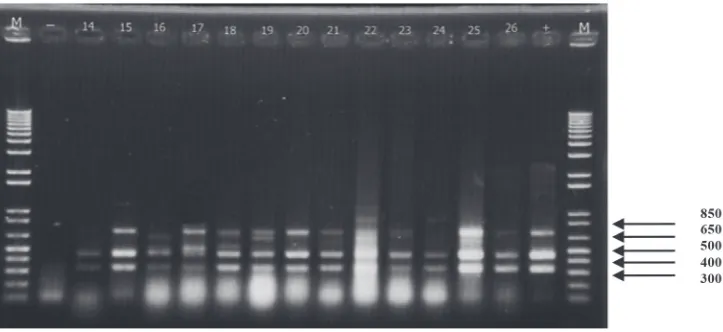
We analyzed a total of 267 fly samples. The most common isolated bacteria were L.monocytogenes (132 cases: 49.4%), and anotherisolated bacteria belong toE. coli(114 cases: 42.7%), and Salmonella spp(98 cases: 36.7%) (Table 4, Pic.2-3).
2000 1650
1000 850
Table 4 Isolated bacteria species
Bacterial species Number of positive
samples Percentage of positive samples
E. coli 114 42.6
L. monocytogenes 132 49.4
Salmonella spp 98 36.7
Picture 2. Detection of universal primer triplex PCR. Bands 706, 440, and 320 bp represents the amplification of target gene from E. coli, L. monocytogenes, and Salmonellaspp., respectively. M, ladders
of DNA Marker (1kb); (-), negative control; 1-13, UP-M-PCR with templates and (+), positive control.
Picture 3. Detection of universal primer triplex PCR. Bands 706, 440, and 320 bp represents the amplification of target gene from E. coli, L. monocytogenes, and Salmonellaspp., respectively. M, ladders
of DNA Marker (1kb); (-), negative control; 14-26, UP-M-PCR with templates and (+), positive control.
DISCUSSION
Previous studies have shown that filth flies can disseminate viable pathogens such as Helicobacter pylori (Grubel et al.,1997), Salmonella(Greenburg 1965), and E. coli O157 (Kobayashi et al.,1999) to other substrates. We identified E. coli on 42.6% (114 cases) of the analyzed fly samples.
Other studies have shown that infection of flies by Salmonellacould be external as well as internal.
Sulaiman et al., (2000) isolated a variety of pathogenic organisms from the gut of flies including M.domestica. The findings of their study indicate that M.domestica can transmit Salmonella and Shigella species showing that dirty environments can easily attract flies which subsequently deposit pathogenic organisms on food and water. The more evident to find the role of house flies on the
850 650 500 400 300
transmission of bacteria is using different insect species and different methods of transmissions. Universal Primer-Multiplex PCR has been used successfully for rapid detection of Escherichia coli, Listeria monocytogenes, and Salmonellaspp. in food samples (Yanfang et al., 2009). This type of PCR testing is intriguing to the food industry because of its reduction in labor and reagent cost as well as a reduction in testing time for multiple bacterial pathogens (Gasanovet al.,2005)
In the present study, we tried to find a procedure enabling the detection of tree pathogens namely, E. coli, L.monocytogenes, Salmonella spp. and employed for Universal Primer-Multiplex PCR
analysis in house fly. It has not yet been investigated in this study whether or not these organisms were carried externally or internally. All detected bacteria from M. domestica in the current study are pathogenic. These findings agree with the previous reports of Alam & Zurek (2004), in which E. coli O157:H7 was detected in both farm and urban environments and Greenburg (1965), Kobayashi et al.,(1999) and Moriya et al.,(1999). In conclusion, we developed an easy and rapid Universal Primer-Multiplex PCR showing high specificity capable of detecting three bacteria. Furthermore, this multiplex PCR can be used to investigate other pathogens in fly.
REFERENCES
1. Akinboade, OA., Hassan, JO., Adejinmi, A. 1984. Public health importance of market meat exposed to refuse flies and airborne microorganisms. International Journal of Zoonoses11:111–114
2. Alam, M. J. & L. Zurek. 2004. Association of Escherichia coli O157:H7 with house flies on a cattle farm. Applied Environmental Microbiology 70: 7578–7580
3. Antonio, J., De Jesu´s, Alan R., Olsen, John R. Bryce, Richard C. 2004. Quantitative contamination and transfer of Escherichia coli from foods by houseflies, Muscadomestica L. (Diptera: Muscidae)., International Journal of Food Microbiology 93:259– 262
4. Bhagwat, AA. 2003. Simultaneous detection of Escherichia coli O157:H7, Listeria monocytogenesandSalmonella strains by real-time PCR. International Journal of Food Microbioliogy84:217–24
5. Chen W, Fu P, Young Y, Chen J, Fan F. 2000. The detection of Listeria monocytogenesin six kinds of foods with PCR. Clinical Journal of Zoonoses16:68–9
6. De Vos V, Bryden, HB. 1998. The role of carnivores in the epidemiology of anthrax in Kruger National Park. In. Proc. Symposium on Lions and Leopards as Game Ranch Animals (J. Van Heerden, ed.) 24-25 October. SAVA Wildlife Group, Onderstepoort, Pretoria. pp 198–203
7. Dragon, DC, Rennie RP. 1995. The ecology of anthrax spores: tough but not invincible. Canadian Veterinary Journal 36: 295–301
8. Fode-Vaughan, K.A., Wimpee, C.F., Remsen, C.C. and Collins, M.L.P. 2001. Detection of bacteria in environmental samples by direct
PCR without DNA extraction. Biotechniques 31: 598–607.
9. Fratamico, PM. 2001. Applications of the polymerase chain reaction for detection, identification, and typing of food borne microorganisms. In: Wilson CL, Droby S, editors. Microbial food contamination. New York: CRC. p 95–9
10. Gasanov, U., Hughes, D., Hansbro, PM. 2005. Methods for the isolation and identification of Listeria spp. and Listeria monocytogenes: a review. FEMS Micro Review. (In Press, Corrected Proof, Available online 21 January 2005. http://www.sciencedirect.com)
11. Gillespie IA, O’Brien SJ, Adak GK, Ward LR, Smith HR. 2005. Foodborne general outbreaks of Salmonella Enteritidis phage type 4 infection, England and Wales, 1992–2002: where are the risks? Epidemiological Microbiology 133:795– 801
12. Greenburg, B. 1965. Flies and disease. Scientific American213: 92–99
13. Grubel, P., J. S. Hoffman, F. K. Chong, N. A. Burstein, C. Mepani& D. R. Cave. 1997. Vector potential of house flies (Muscadomestica) for Helicobacter pylori. Journal of Clinical Microbiology 35:1300–1303
14. Iwasa, M, Makino, SI, Asakura H, Kobori H, Morimoto Y. 1999. Detection of Escherichia coli O157:H7 from Muscadomestica (Diptera: Muscidae) at a cattle farm in Japan. Journal of Medical Entomology 36: 108–112
16. Kasprzak, W., Majewska, A. 1981. Transmission of Giardia cysts. I. Role of flies and cockroaches. Parasitological News27: 555– 563
17. Kim, J., Demeke, T., Clear, RM., Patrick SK. 2006. Simultaneous detection by PCR of Escherichia coli, Listeria monocytogenesandSalmonella typhimuriumin artificiallyinoculated wheat. International Journal of Food Microbiology111:21–
18. Kobayashi, M., T. Sasaki, N. Saito, K. Tamura, K. Suzuki, H. Watanabe & N. Agui. 1999. House flies: not simple mechanical vectors of enterohemorrhagic Escherichia coli O157:H7. American Journal of Tropical Medicine and Hygiene 61:625–629
19. Markus MB. 1980. Flies as natural transport hosts of Sarcocystis and other coccidia. Journal of Parasitology66: 361– 362
20. Moriya, K., T. Fujibayashi, T. Yoshihara, A. Matsuda, N. Sumi, N. Umezaki, H. Kurahashi, N. Agui, A. Wada & H. Watanabe. 1999. Verotoxin-producing Escherichia coli O157:H7 carried by the house fly. Medical Veterinary Entomology13: 214–216
21. Mukhopadhyay, UM.,Mukhopadhyay, A. 2007. Novelmultiplex PCR approaches for the simultaneous detection of human pathogens: Escherichia coli O157:H7 and
Listeriamonocytogenes.Journal of Microbiological Methods68:193–200
22. Olsen, SJ., Patrick, M., Hunter, SB., Reddy, V., Kornstein, L., MacKenzie, WR., Lane, K., Bidol, S., Stoltman, GA., Frye, DM., Lee, I.,
Hurd, S., Jones, TF., LaPorte, TN., Dewitt, W., Graves, L., Wiedmann, M., Schoonmaker Bopp DJ., Huang, AJ., Vincent, C., Bugenhagen, A., Corby, J., Carloni, ER. 2005. Multistate outbreak of Listeria monocytogenesinfection linked to delicatessen turkeymeat. Clinical Infectious Diseases40:962–7
23. Petra, FG.,Wolffs, GK., Norling, B., Mansel and Griffiths, W. 2007. Simultaneous quantifica-tion of pathogenic Campylobacter and Salmonellain chicken rinse fluid by a flotation and real-time multiplex PCR procedure. International Journal of Food Microbiology117:50–54
24. Pham, HN.,Ohkusum, K., Miyasaka, J., Sun, XS and Ezaki, T. 2007. Rapid and specific identification of 5 human pathogenic Vibrio species by multiplex polymerase chain reaction targeted to dnaJ gene. Diagnostic Microbiology and Infectious Disease 59(3):271-275
25. Sulaiman, S., Othman, Z., Aziz, AH. 2000. Isolation of enteric pathogens from Synanthropic flies trapped in downtown Kuala Lumpur. Journal of Vector Ecology25:114–117 26. West LS. 1951. The housefly, its natural history,
medical importance, and control. Comstock Publishing Co.: Ithaca, NY