Michał Sarul
A–F, Beata Kawala
D, Joanna Antoszewska
C–EComparison of Elastic Properties of Nickel-Titanium
Orthodontic Archwires
Porównanie właściwości sprężystych ortodontycznych drutów
niklowo-tytanowych
Department of Orthodontics and Dentofacial Orthopedics, Wroclaw Medical University, Poland
A – research concept and design; B – collection and/or assembly of data; C – data analysis and interpretation;
D – writing the article; E – critical revision of the article; F – final approval of article; G – other
Abstract
Background. Cognizance of the mechanical properties of nickel-titanium archwires is necessary for the manage-ment of orthodontic therapy with fixed appliances. Acting on the periodontium with forces that are too heavy may lead to such complications as: pain, tooth root resorption and destruction of the alveolar bone and may also lead to retardation in tooth movement.
Objectives. The aim of the study was to assess the activation and deactivation forces of nickel-titanium archwires: Titanol Superelastic, Copper NiTi 35oC and NeoSentalloy.
Material and Methods. The examined material was 90 samples of Titanol Superelastic, Copper NiTi 35oC and
NeoSentalloy with diameters of 0.016 and 0.016 × 0.022. All tests were carried out on the Zwick mechanical tests machine at a temperature of 30oC.
Results. In the group of archwires with diameters 0.016, the levels of deactivation forces were, respectively, from highest to lowest: Titanol Supertelastic, NeoSentalloy, Copper NiTi 35oC. In the group of rectangular archwires
0.016 × 0.022, the highest deactivation forces were released in Titanol Superelastic. With the high levels of deflec-tion, 0.016 × 0.022 NeoSentalloy archwires released statistically significantly higher levels of force than 0.016 x 0.022 Copper NiTi 35o C, but this force diminished rapidly with lower deflection and below 3 mm of deflection,
the highest forces were released by Copper NiTi 35oC.
Conclusions. Testing the mechanical properties of the nickel-titanium wires of various diameters, it was found that round section wires release forces which fall within the range of optimal forces (Adv Clin Exp Med 2013, 22, 2, 253–260).
Key words: nickel-titanium alloy, modulus of elasticity, orthodontic wires.
Streszczenie
Wprowadzenie. Znajomość właściwości mechanicznych drutów niklowo-tytanowych jest niezbędna do prowa-dzenia terapii ortodontycznej z użyciem stałych aparatów cienkołukowych. Działanie na ozębną zbyt dużej siły może prowadzić do takich komplikacji, jak: ból, resorpcja korzeni zębów oraz kości wyrostka zębodołowego, oraz spowalniać ruch zębów.
Cel pracy. Ocena wartości sił aktywacji i deaktywacji drutów niklowo-tytanowych: Titanol Superelastic, Copper NiTi 35oC and NeoSentalloy.
Materiał i metody. Materiał badany stanowiło 90 próbek drutów: Titanol Superelastic, Copper NiTi 35oC and
NeoSentalloy o średnicach 0,016 i 0,016 x 0,022. Wszystkie próbki badano na maszynie testującej Zwick w tempe-raturze 30oC.
Wyniki. W grupie drutów o średnicy 0,016 cala wyzwalane siły deaktywacji można uszeregować od najwyższych: Titanol Supertelastic, NeoSentalloy, Copper NiTi 35oC. W grupie drutów o średnicy 0,016 × 0,022 największe siły
deaktywacji były wyzwalane przez druty Titanol Superelastic. Wśród drutów o średnicy 0,016 × 0,022, przy wyż-szych zakresach ugięcia druty NeoSentalloy wyzwalały statystycznie większe wartości sił deaktywacji niż Copper NiTi 35oC, lecz te siły zmniejszały się znacząco dla mniejszych wartości ugięcia i poniżej 3 mm ugięcia siły większe
wyzwalały druty Copper NiTi 35oC.
Adv Clin Exp Med 2013, 22, 2, 253–260 ISSN 1899–5276
OrIgINAl PAPErS
Orthodontic fixed appliances are widely used nowadays in the treatment of tooth irregularities and malocclusions. One of their main advantages is that they provide a wide range of therapeutic possibilities; precise control over the location of teeth in all three dimensions, the possibility of us-ing them with all age groups includus-ing older pa-tients due to using the most physiological forces from the point of view of the reaction of the perio-dontium. A fixed orthodontic appliance consists of orthodontic braces which function as a point where forces working on a patient’s teeth and periodontium are applied, and orthodontic wires which normally constitute the source of those forces. The interaction and the orthodontic arch, the brace, are responsible for the intensity of the forces discussed and at the same time they modify the effectiveness of the therapy and are partially responsible for the good condition of the perio-dontium. Testing individual parts of the appliance is essential for full understanding of the course of treatment and for optimal planning of how the fixed orthodontic appliances should be used [1].
The development of technical sciences that the authors have witnessed in the last twenty-five years has lead to introducing titanium alloy as a biomaterial. The elasticity of nickel-titanium al-loys has made them a very valuable material, used for making intraosseus implants in orthopedic surgery, intravascular stents, endoscopic instru-ments and eleinstru-ments of scaffolds in reconstructive plastic surgery [2, 3]. This quality makes the al-loy the perfect material for producing orthodon-tic wires which are used in the initial stages of the fixed orthodontic appliances treatments. Continu-ous research makes achieving optimal results of treatment possible and at the same time allows for minimizing the undesirable effects of the methods and instruments used in medicine. This is applica-ble to orthodontic therapy and treatment involv-ing nickel-titanium alloy orthodontic wires [1].
The Nitinol alloy was first developed at the be-ginning of 1960s in US Naval laboratories by Bue-hler, and then introduced to orthodontics in the middle of 1970s by Andreasen. Those two events were turning points in using the alloy in contem-porary orthodontic therapy. The forces released when a given diameter wire made of Nitinol was bent were 5 to 6 times smaller than forces released by the same diameter wire made of stainless steel. However, wires made of this alloy lack formability
and have quite a lot of friction in the archwire – the orthodontic bracket system. Another unsolved problem is the linear ratio of the released force to the deformation – in accordance with Hook’s law – in the range of deformations and temperatures clinically encountered. Only the introduction of very elastic nickel-titanium wires in the 1980s al-lowed for obtaining a constant small value force acting in a wide range of activations in the course of treatment. The demand for orthodontic arches providing small and constant forces with a wide range of activations was closely connected with the development of knowledge of reactions between the periodontium and the bones of the alveolar process on the orthodontic forces applied [3–6].
Although there are numerous theories de-scribing the reaction of the periodontium tissues to the orthodontic forces and the ratio of the force applied to the effect achieved by moving a tooth, many authors claim that small and constant forces are most effective [7, 8]. light forces are under-stood as forces which do not exceed the value of blood pressure in the blood vessels of the perio-dontium (20–25 g/cm2)of the surface of the root. Heavier forces may stop blood circulation in the blood vessels of the periodontium causing their hyalinization, necrosis and undermining resorp-tion [9, 10].
A wide variety of bending tests is used in order to examine the basic mechanical properties of the orthodontic archwires.
After titanium alloys were introduced to the orthodontic treatments in the 1970s, the neces-sity of describing and comparing the mechanical qualities of various orthodontic wires came into being. The Olsen test, included in the specification according to the American Dental Association (ADA) as no 32, has been conventionally used since 1977. The American Dental Association specifica-tion for this test includes instrucspecifica-tions how to test properties, how to pack and distribute orthodontic wires [6, 11, 12].
Because of the main flaw of this method, i.e. it is only useful for testing the properties of the material the wire is made of without taking its structural characteristics into account, efforts have been made to create a method which would take into consideration the properties not included in the test. A few types of bending tests are used now. 3-, 4-, and 5-point bending tests are among those mentioned in literature most often.
Wnioski. Badanie właściwości mechanicznych drutów niklowo-tytanowych o różnych przekrojach poprzecznych wykazało, że druty o przekroju okrągłym wyzwalają siły o wartościach z zakresu sił optymalnych (Adv Clin Exp Med 2013, 22, 2, 253–260).
The three-point bending test consists of putting a tester exactly half way between the supports on a section of wire supported at both ends. The test is easy to conduct and interpret. The lack of even distribution of stress inside the tested sample is one of the flaws of the test. Four point bending tests are done, in which a sample supported at both ends is burdened with two testers placed at the same dis-tance from each supporter in order to eliminate that flaw. In the section of the wire between the two testers a homogenous bending moment zone may be observed [6, 13]. Contemporary instruction no. 32 according to the ADA includes the three point bending test in which the distance between the sup-porters is 12 mm, at a temperature of 37.1oC and maximum burden of exactly 300 g [14].
The aim of this test was to compare the level of deactivation forces released by unused nickel-titanium wires of various cross sections, chosen nickel-titanium wires (Titanol Superelastic, Cop-per NiTi 35oC, NeoSentalloy), in a three point bending test and to estimate their clinical useful-ness on the basis of the results obtained.
Material and Methods
The sample consisted of 90 orthodontic wires. Five orthodontic wires of each type taken from two different factory-sealed packages were used. The following makes were tested: NeoSentalloy (Ormco), Copper NiTi 35oC (gAC) and Titanol Superelastic (Forestadent). Each make was repre-sented by 0.016 inch diameter wire (round section) and 0.016 x 0.022 inch diameter wire (rectangular section). A 30 mm segment was cut off each type
of wire and a bending test was done on it. 90 sam-ples from 90 wires, with two types of cross section, from 12 different factory-sealed packages coming from 3 different producers were used in the test.
All samples were tested using the three-point bending test. All tests were carried out on the Zwick mechanical test machine. The tests were done in cooperation with the Department of Food Engineering and Process Management at the War-saw University of life Sciences.
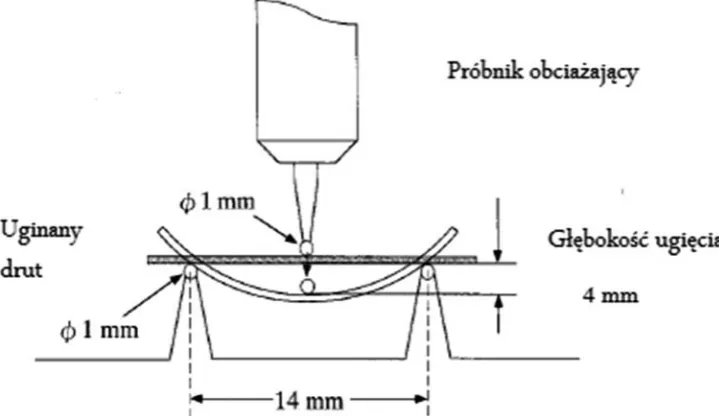
The segment of the wire being tested, the edge of which constituted a 1 mm diameter segment of a sphere, was placed on two supporters made of stainless steel. The distance between the ers was 14 mm. Halfway between the two support-ers, a tester made of stainless steel was placed, the edge of which was a 1 mm diameter segment of a sphere. The tester pushed 4 mm deep with 1 mm per minute speed (scheme on Fig. 1). In the case of rectangular cross wire, the tester was put on its wider edge (0.022 inch width). The test was con-ducted at 30oC. Such conditions were created by a flow of warm air (30oC) insufflated for 30 min-utes into the room where the test was done. The measurements of the temperature were done to an accuracy of 0.5oC. In order to assure the right tem-perature of all tested samples, they were stored at a temperature of 30oC for 30 minutes. The test was conducted eight times for each sample. The values of the bending forces (the bending force – the val-ue needed to obtain a given bending of a wire) and the bending back forces (the bending back forces – the value released by a wire bending back, from a certain bending value) were saved on a hard disk of a PC connected to the testing device. The values of the forces were read every 0.5 mm. Arithmetical
Fig. 1. The diagram according to the assumption of the three point test
means were calculated on the basis of the results obtained for each sample. They were then subject to statistical calculations by 10.0 Statistica (StatSoft Inc., USA). Conformity assessment examining the distribution of values of variables with normal distribution was performed using the Shapiro-Wilk test. Because of the lack of conformity of the majority of the variables tested, distribution with a normal distribution, inter-group comparison used a nonparametric Kruskal-Wallis test with multiple comparisons procedure (post-hoc) Dunn. The assumed level of significance was p = 0.05.
Results
All results obtained are shown in Table 1 and Table 2.
The comparison of forces released by unused 0.016 diameter Titanol Superelastic, NeoSentalloy and Copper NiTi 35oC wires when bent has shown
that the average values obtained in the case of Titanol Superelastic wires were significantly greater than for NeoSentalloy. Copper NiTi 35oC exerted the lowest bending forces. Only at 0.5 mm deflection did Cop-per NiTi 35oC release higher force than NeoSental-loy, but was still lower than Titanol Elastic.
The highest bending force was 122.205 g (SD = 0.64), measured for Titanol Superelastic bent at 2 mm. The lowest was bending-back force, 7.632 g (SD = 4.44), was measured for Copper NiTi 35oC, bending-back 0.5 mm.
The comparison of the forces released by un-used 0.016 x 0.022 diameter Titanol Superelastic, NeoSentalloy and Copper NiTi 35oC wires when bent has shown that average values obtained in the case of Titanol Superelastic wires were significant-ly greater than for other wires. The average values of the forces released by the Titanol Superelastic wires were in the range between 214.303 g (SD = 0.43) (with 0.5 mm bend) and 463.574 g (SD = 2.41) (with 3.5 mm bend). The difference between
Table 1. Comparison of mean values of the force exerted by the unused 0.016 Titanol Superelastic, NeoSentalloy and Copper NiTi 35°C wires
Tabela 1. Porównanie średnich wartości siły wywieranych przez nieużywane druty Titanol Superelastic, NeoSentalloy i Copper NiTi 35oC o przekroju 0,016
Deflection (Odkształcenie) mm
Force –w ires Titanol Superelastic 0.016 (Siła – druty Titanol Superelastic 0,016)
Force – wires NeoSentalloy 0.016 (Siła – druty NeoSentalloy 0,016)
Force – wires Copper NiTi 35o 0.016
(Siła – druty Copper NiTi 35o 0,016)
Statistical significance (Istotność statystyczna) mean (g) (+ SD) mean (g) (+ SD) mean (g) (+ SD) P < 0.05a,b,c,d
0.5 79.174 (0.69) 46.589 (1.22) 69.665 (1.26) a,b,c,d
1 120.043 (1.29) 72.132 (1.08) 70.639 (1.63) a,b,c,d
1.5 121.851 (0.86) 87.484 (1.66) 74.468 (2.46) a,b,c,d
2 122.205 (0.64) 87.196 (2.19) 75.756 (1.17) a,b,c,d
2.5 120.468 (1.23) 85.778 (2.57) 77.373 (1.43) a,b,c,d
3 116.995 (0.46) 83.252 (3.16) 77.462 (1.65) a,b,c,d
3.5 111.819 (1.11) 80.085 (3.81) 77.263 (1.24) a,b,c,d
4 106.680 (0.78) 76.341 (4.21) 75.313 (1.79) a,b,c,d
–3.5 81.478 (0.34) 53.900 (2.99) 49.085 (1.37) a,b,c,d
–3 71.908 (0.87) 46.235 (2.04) 33.048 (2.04) a,b,c,d
–2.5 63.543 (0.94) 38.791 (1.11) 20.754 (2.65) a,b,c,d
–2 60.813 (1.46) 32.322 (0.70) 14.263 (3.24) a,b,c,d
–1.5 60.849 (0.23) 59.275 (1.24) 11.716 (3.83) a,b,c,d
–1 60.317 (0.47) 25.920 (1.31) 10.21 (3.74) a,b,c,d
–0.5 60.955 (1.02) 24.392 (1.36) 7.632 (4.44) a,b,c,d
NeoSentalloy and Copper NiTi 35oC was not sta-tistically significant for bending back, 3.5–2.0 mm. Copper NiTi 35oC exerted higher forces for bending-back, 0.5–1.5 mm, and for this range, the measurement for NeoSentalloy was 0 g. For other measurements, NeoSentalloy bending forces were higher than for Copper NiTi 35oC.
Discussion
In order to forecast the values of forces re-leased while applying a specific type of orthodon-tic wire in specific clinical circumstances, testing its elastic properties in a laboratory is recom-mended. In the case of wires with elastic proper-ties fulfilling Hook’s law, it is possible to theo-retically forecast the values of forces released in specific bends and with specific geometry of the cross section of the wire only by means of extrap-olation of the obtained values of the elasticity co-efficient of the alloy the wire is made of. In 1981, shortly after beta-titanium wires were introduced into fixed appliances therapy, Kusy and green-berg [5] provided formulas which can be used for theoretically calculating the elastic properties of orthodontic wires of various diameters. They also defined the relationship of the bending force of orthodontic wires made of various alloys with growing diameters/crosses: from 0.016 to 0.021 × 0.025 to the bending forces of steel wires with 0.0175 (multistrand), 0.012, 0.014, 0.016, 0.018 and 0.019 × 0.026 diameters.
The above proportions – calculated for steel wires: Tru-Chrome (rocky Mountain), Wildcat (gAC), chrome-cobalt: Elgiloy (rocky Mountain), Nitinol (Unitek) and TMA (American Orthodon-tics) – were again only theoretical because the elasticity coefficients used in the calculations were taken from literature. The tested wires did not ful-fill the conditions of Hook’s law, so calculating the values of the forces was only possible by means of a laboratory test and not theoretical calculations.
reports by Sakima et al. [18], who pointed at the fact that theoretical methods cannot be used to specify the properties of super elastic wires, con-firm the legitimacy of the choice of the laboratory method. According to the authors, the hysteresis curve can depend to a large extent on numerous factors and can even be different for wires provid-ed by the same producer in the same batch. Due to that fact, outlining the curve theoretically may leave too big a margin of error, which confirms the results I obtained in the presented research – used 0.016 x 0.022 diameter Copper NiTi 35oC wires showed large standard deviations for 0.5 mm bend to 2 mm bend back.
Since producers have been offering more and more various types of nickel-titanium wires, the issue of comparing the results of tests has arisen. It is especially important because the unification of methodology is still being questioned. Kusy and Dilley [16] measured the elastic properties of the orthodontic wires using the three point bending test when the tested sample was 0.357, 0.779 or 1.025 long, and the four point bending test when the sample was 1.049 long and the span between the internal testers 0.174, 0.394 or 0.502.
Mullins et al. [19] tested the properties of nickel-titanium wires at a temperature of 5oC and 37oC using – according to their methodology – the three point bending test with 3 mm bend and 14.5 mm length of span. However, taking into consid-eration the fact that they used the model in which the wire was tied to the orthodontic braces on an incisive medial tooth and a canine tooth and sub-sequently it was bent where an incisive side tooth was located, certain controversy arose: as Brantley and Eliades [8] claim, such conditions in reality reflect the five point bending test.
Because of the similarity of the tested mate-rial, parameters recommended by Nakano et al. [20] were used in the test under discussion. The authors used the three-point bending test to test the elastic properties of the orthodontic wires. The distance between supporters was 14 mm, the maximum bend 2 mm and the temperature 37oC. garrec and Jordan [21] used similar parameters; they only changed the depth of bend to 3 mm.
Sakima et al. [18] tested the influence of temperature on the forces released by the orth-odontic wires during deactivation. Among other things, they used Copper Ni-Ti 35oC, Copper Ni-Ti 40oC and NeoSentalloy 200 g wires for their tests. They tested them at 30, 33, 35, 37 and 40oC. The authors claim that the Copper Ni-Ti 40oC and NeoSentalloy 200 g wires at temperatures below 35oC exert an insignificant or sublimi-nal force. They also found that the above wires should not be used with patients with mouth breathing. The results of the above tests are in accordance with findings of the present test: the NeoSentalloy wire was plastically deformed by 2 mm with 5 mm bend; the level of the bend-ing back forces below 0.25 N was recorded in the 3 to 2 mm bend. Sakima et al. [18] did not test circular section Titanol Superelastic, NeoSental-loy and Copper Ni-Ti 35oC wires. Their elastic properties were different from the properties of quadrangle section wires made, according to the producer, of the same alloy.
be fruitless. In light of the research quoted above, it is clearly visible that the elastic properties of the nickel-titanium wires, especially the thermo active ones, depend on the temperature of the environ-ment. The temperature in the oral cavity may in-fluence the way the orthodontic wires react and the course of treatment at the same time. The question about the range of temperature changes in the oral cavity becomes of essential importance.
Ernst et al. [22] showed that the temperature in the oral cavity may fluctuate between 52.8oC and 13.7oC while eating warm (liquid at a tem-perature of 85oC) and cold (water at a temperature of 0oC) foods. McFadden et al. [23], on the other hand, showed that the temperature in the respira-tory tract falls to 20.5oC in the upper respiratory tract when the intensity of breathing decreases while breathing in cold air.
Moore et al. [24] carried out research on the temperature fluctuations inside the oral cavity in
the 24-hour cycle. The researchers made a distinc-tion between the race of the people tested (Asian vs. Caucasian) and the area of dentition (incisive teeth vs. premolar teeth). According to the authors, the daily average temperature for the whole population is 34.9oC and 35.6oC respectively for incisive and premolar areas. The daily fluctuation amplitude can be contained between 5.6oC and 58.5oC for the front area and between 7.9oC and 54oC for the side area of the dental arch. The authors state that for 20% of the day the temperature in the area of the incisive teeth was lower than 33oC. In the case of the Asian race representatives the results of mea-surements were always higher than in the case of the Caucasian race representatives. The research-ers also claim that in the case of patients breathing through their mouth, the tested temperatures can fluctuate significantly and reach significantly lower levels than in patients with a correct respiratory track. Although the authors found that the in vitro Table 2. Comparison of mean values of the force exerted by the unused 0.016 x 0.022 Titanol Superelastic, NeoSentalloy and Copper NiTi 35°C wires
Tabela 2. Porównanie średnich wartości siły wywieranych przez nieużywane druty Titanol Superelastic, NeoSentalloy i Copper NiTi 35oC o przekroju 0,016 x 0,022
Deflection (Odkształcenie) mm
Force – wires Titanol Superelastic 0.016x0.022 (Siła – druty Titanol Superelastic 0,016x0,022)
Force – wires NeoSentalloy 0.016x0.022 (Siła – druty NeoSentalloy 0,016x0,022)
Force – wires Copper NiTi 35o
0.016x0.022 (Siła – druty Copper NiTi 35o
0,016x0,022)
Statistical significance (Istotność statystyczna)
mean (g) (+ SD) mean (g) (+ SD) mean (g) (+ SD) P<0.05a,b,c,d
0.5 272.699 (0.76) 143.704 (2.43) 143.518 (3.44) a,b,c
1 403.434 (0.96) 187.145 (1.82) 155.551 (2.97) a,b,c
1.5 423.314 (1.2) 198.443 (0.94) 149.341 (49.75) a,b,c,d
2 441.302 (1.03) 208.987 (0.75) 175.594 (3.57) a,b,c,d
2.5 454.742 (0.89) 216.475 (0.34) 182.949 (2.75) a,b,c,d
3 461.654 (0.46) 220.795 (3.03) 187.521 (3.16) a,b,c,d
3.5 463.574 (2.41) 221.326 (1.78) 189.789 (3.81) a,b,c,d
4 462.067 (1.92) 220.019 (0.34) 189.931 (4.04) a,b,c,d
–3.5 334.257 (0.76) 131.786 (0.87) 112.843 (2.36) a,b,c
–3 282.358 (0.56) 77.711 (0.94) 67.990 (2.58) a,b,c
–2.5 262.627 (0.44) 27.824 (2.01) 38.590 (3.02) a,b,c
–2 251.078 (0.28) 0.000 (0) 23.367 (2.67) a,b,c,d
–1.5 236.574 (1.11) 0.000 (0) 17.094 (1.98) a,b,c,d
–1 222.219 (1.04) 0.000 (0) 13.825 (1.31) a,b,c,d
–0.5 214.303 (0.43) 0.000 (0) 10.165 (1.36) a,b,c,d
temperature recommended for testing the proper-ties of the nickel-titanium wires should be 35.55oC, this conclusion is contradictory to their observa-tions of much lower in vitro temperatures, espe-cially in patients breathing through their mouth.
On the basis of the results of research done by various authors and presented, it can be stated that round section wires can be more clinically useful for mouth-breathing patients.
The level of susceptibility of the periodontium is one of the essential factors for determining the ef-fective and safe value of the force which should not be exceeded when applied to a single tooth. Forces exceeding its level of susceptibility cause exces-sive stretching of the fibers on the side of the tooth socket opposite to the direction in which the force is working. As a result, the collagen fibers and the blood vessels of the periodontium between them are crumpled in the direction of the force applied. Tanne et al. [25], while doing research on the bio-chemistry of the periodontium of a moving canine tooth, proved that moving a tooth further at the mo-ment of applying a force originates from the elastic properties of the bones of the tooth socket. They estimated the degree of mobility of a tooth before distalization and after it in ten patients with finished growth. They found that forces of 150 g of value caused maximum bend of the periodontium of a ca-nine tooth during distalization as well as after it. The forces of 200 g did not cause any bigger bend of the periodontium, however, they also caused significant increase of the mobility of the tooth after the period of distalization – in comparison to the effect of the force of 150 g. The authors attributed this differ-ence to the changes in elasticity of the ligaments of the periodontium and the bones of the tooth socket connected with their restructuring which took more time after having applied bigger forces.
In the presented research, only 0.016 x 0.022 diameter Titanol Superelastic wires released a force bigger than 150 g when bent. It should be concluded that those wires release too great a force as even in a 0.5 mm bend the force exceeds 200 g. Too great a level of force may cause indirect re-sorption, root resorption and can even lead to damaging of the dental process bone. This was proved by Weiland [26], who did some research on the reaction of the premolar teeth roots on moving by means of nickel-titanium (Sentalloy™ Blue – gAC) and steel (Ormco) arches with a right off-set bend. The author managed to achieve a sta-tistically significant bigger reposition of the teeth
by means of a super elastic wire. However, it was accompanied by a much greater amount of root resorption focuses which rose from the neck of a tooth area to its top. resorptions were also much bigger in size in all three surfaces and the number of their focuses correlated positively with the reach of reposition in a unit of time. The author thought that the forces released by the nickel-titanium wire were too great (0.8–1 N), even thought they were much smaller than the ones released by a steel wire at the beginning of the activation and the time of the influence of a super elastic wire made healing processes which might take place on the surface of a tooth being moved by means of a steel wire impossible. In the test done by the authors, forces greater than 0.8 N (~80 g) were generated by 0.016 x 0.022 diameter Titanol Superelastic in all ranges of bend-back, and Copper NiTi 35oC and NeoSen-talloy wires only with a maximum bend back of 3.5 mm. The results showed that all 0.016 diameter wires, while bending-back, exerted forces less than 80 g. The level of force close to the range of 10–20 g was mentioned by Melsen et al. [27] as the right one for the intrusion of incisive teeth but it was measured by means of a segment technique in the case of movements without any loss of force due to friction. It can then be assumed on the basis of the presented results that 0.016 x 0.022 diameter Neo-Sentalloy wires with bends back below 2 mm re-lease subminimal forces. The effectiveness of 0.016 diameter Copper NiTi 35oC wires is disputable.
The study presented shows that 0.016 x 0.022 diameter Titanol Superelastic wires in the entire range of bending back released forces which could exceed the optimal forces, i.e. are potentially dan-gerous to the periodontium. NeoSentalloy wires of 0.016 x 0.022 diameter do not release any force with bends back smaller than 2 mm. All examined 0.016 wires should be safe in the bending-back range of 0.5–3.5 mm.
References
[1] Proffit WR, Fields Jr HW: Ortodoncja współczesna. Czelej 2000.
[2] Ryhänen J, Kallioinen M, Tuukkanen J, Lehenkari P, Junila J, Niemelä E, Sandvik P, Serlo W: Bone modeling and cell-material interface responses induced by nickel-titanium shape memory alloy after periosteal implantation. Biomaterials 1999, 20, 14, 1309–1317.
[3] Duerig T, Pelton A, Stockel D: An overview of nitinol medical applications. Mater Sci Eng 1999, A273–275, 149–160a.
[4] Chi FL, Wang SJ, Liu HJ: Auricle reconstruction with a nickel-titanium shape memory alloy as the framework. laryngoscope. 2007, 117, 2, 248–252.
[5] Kusy RP, Greenberg AR: Effects of composition and cross section on the elastic properties of orthodontic arch-wires. Angle Orthod 1981, 51, 4, 325–341.
[6] Nikolai RJ: Orthodontic Wire: A Continuing Evolution. Semin Orthod 1997, 3, 157–165; A review of contempo-rary archwires: their properties and characteristics. rP Kusy, Angle Orthod 1997, 67, 3, 197–208.
[7] Kusy RP:A review of contemporary archwires: their properties and characteristics. Angle Orthod 1997, 67, 197–207.
[8] Brantley WA, Eliades T: Materiały ortodontyczne w ujęciu naukowym i klinicznym. Czelej, 2003.
[9] Miura F, Mogi M, Ohura Y, Hamanaka H: The super-elastic property of the Japanese NiTi alloy wire for use in orthodontics. Am J Orthod Dentofac Orthop 1986, 90, 1–10.
[10] Krishnan V, Davidovitch Z: Cellular, molecular, and tissue-level reactions to orthodontic force. Am J Orthod Dentofac Orthop 2006, 129, 469e.1–460e.32.
[11] Schwarz AM: Tissue changes incident to orthodontic tooth movement. Int J Orthod 1932, 18, 331–352.
[12] Oppenheim A: Human tissue response to orthodontic intervention of short and long duration. Am J Orthod Oral Surg 1942, 28, 263–301.
[13] Cattaneo PM, Dalstra M, Melsen B: The finite element method: a tool to study orthodontic tooth movement. J Dent res 2005, 84, 428–433.
[14] Schaus JG, Nikolai RJ: localized, transverse, flexural stiffnesses of continuous arch wires. Am J Orthod 1986, 89, 407–414.
[15] Nikolai RJ, Anderson WT, Messersmith ML: Structural responses of orthodontic wires in flexure from a pro-posed alternative to the existing specification test. Am J Orthod Dentofac Orthop 1988, 93, 496–504.
[16] Kusy RP, Dilley GJ: Elastic Modulus of a Triple-stranded Stainless Steel Arch Wire via Three- and Four-point Bending. J Dent res 1984, 63, 10, 1232–1240.
[17] Johnson S: American Dental Association ASC MD 156; restorative and Orthodontic Materials; Specification #32, 2003.
[18] Sakima MT, Dalstra M, Melsen B: How does temperature influence the properties of rectangular nickel-titanium wires? Eur J Orthod 2006, 28, 282–291.
[19] Mullins WS, Bagby MD, Norman TL: Mechanical behavior of thermo-responsive orthodontic archwires. Dent Mater 1996, 12, 308–314.
[20] Nakano H, Satoh K, Norris R, Jin T, Kamegai T, Ishikawa F, Katsura H: Mechanical properties of several nickel-titanium alloy wires in three-point bending tests. Am J Orthod Dentofac Orthop 1999, 115, 390–395.
[21] Garrec P, Jordan L: Stiffness in Bending of a Superelastic Ni-Ti Orthodontic Wire as a Function of Cross-Sectional dimension. Angle Orthod 2004, 74, 691–696.
[22] Ernst CP, Canbek K, Euler T, Willershausen B:In vivo validation of the historical in vitro thermocycling tem-perature range for dental materials testing. Clin Oral Invest 2004, 8, 130–138.
[23] McFadden Jr ER, Pichurko BM, Bowman HF, Ingenito E, Burns S, Dowling N, Solway JJ: Thermal mapping of the airways in humans. Appl Physiol 1985, 58, 564–570.
[24] Moore RJ, Watts JTF, Hood JAA, Burritt DJ: Intra-oral temperature variation over 24 hours. Eur J Orthod 1999, 21, 3, 249–261.
[25] Tanne K, Inoue Y, Sakuda M: Biomechanical behavior of the periodontium before and after orthodontic tooth movement. Angle Orthod 1995, 65, 2, 123–128.
[26] Weiland F: Constant versus dissipating forces in orthodontics: the effect on initial tooth movement and root resorption. Eur J Orthod 2003, 25, 335–342.
[27] Melsen B: Tissue reaction to orthodontic tooth movement – a new paradigm. Eur J Orthod 2001, 23, 671–681.
Address for correspondence:
Michał Sarul
Department of Dentofacial Orthopedics and Orthodontics Wroclaw Medical University
Krakowska 26 50-425 Wrocław Poland
Tel.: +48 71 7840299
E-mail: [email protected]
Conflict of interest: None declared