Donata Kurpas
1–3, A–F,Joseph Church
4, C–D,Bożena Mroczek
5, B–D,
Anna Hans-Wytrychowska
2, A–B, Aneta Nitsch-Osuch
6, B–C,
Krzysztof Kassolik
3, 7, B–C, Waldemar Andrzejewski
3, 7, B–C,
Andrzej Steciwko
2, 3, F–GThe Quality of Primary Health Care for Chronically
Ill Patients – a Cross-Sectional Study*
Jakość wizyt dla przewlekle chorych pacjentów – badanie przekrojowe
1 Hollins University, Roanoke, Virginia, USA
2 Department of Family Medicine, Wroclaw Medical University, Wroclaw, Poland 3 Public Medical Professional School, Opole, Poland
4 Board of Supervisors, Roanoke County, Virginia, USA
5 Public Health Department, Pomeranian Medical University, Szczecin, Poland 6 Department of Family Medicine, Warsaw Medical University, Warsaw, Poland
7 Department of Physiotherapy, University School of Physical Education, Wroclaw, Poland
A – research concept and design; B – collection and/or assembly of data; C – data analysis and interpretation;
D – writing the article; E – critical revision of the article; F – final approval of article; G – other
Abstract
Background. Patients with at least one chronic disease requiring regular contact with their GP, additional tests and systematic use of medicines constitute one of the challenges for the future of primary medical care.
Objectives. To evaluate correlations between patients’ characteristics and their assessments of the quality of health care and to identify the primary factors influencing the quality of care for chronically ill patients.
Material and Methods. The sample for the current analysis included 232 chronically ill adult patients of primary care clinics in Poland. The patients’ opinions regarding subjective and objective examinations, their participation in clinical decision-making processes, psychosocial factors, contact with the doctor in emergency situations and confidence in the doctor were investigated.
Results. The strongest correlations defining the quality of care for the chronically ill were identified as the occur-rence of hypertension (0.248, p < 0.001), the patient’s gender (0.271, p < 0.001), the patient’s level of education (0.169, p < 0.01) and the patient’s age (0.155, p = 0.018). The results of the ANOVA test were statistically significant (p < 0.05) for the occurrence of myocardial infarction, hypertension, type 2 diabetes, psoriasis, multiple sclerosis, the doctor’s gender, the patient’s gender, age and education.
Conclusions. The areas that the participants gave the highest ratings to are subjective and objective examinations, kindness and willingness to help. The strongest correlations between high assessments of the quality of care pro-vided for chronically ill patients at primary care clinics were observed in the following variables: gender, age, level of education, frequency of visits, therapy conducted by a doctor at a specialist clinic, arterial hypertension, COPD and/or myocardial infarction (Adv Clin Exp Med 2013, 22, 4, 501–511).
Key words: chronic illness, interpersonal communication, health services, holistic care, primary care, quality of care.
Streszczenie
Wprowadzenie. Przyszłość opieki podstawowej to wyzwania stawiane przez pacjentów z co najmniej jedną cho-robą przewlekłą wymagającą regularnych kontaktów z lekarzem rodzinnym, wykonywania badań dodatkowych i systematycznego zażywania leków.
Adv Clin Exp Med 2013, 22, 4, 501–511 ISSN 1899–5276
ORIGINAl PAPERS
© Copyright by Wroclaw Medical University
It is estimated that 133 million people world-wide suffer from chronic diseases, and this number is expected to increase to 177 million by 2030 [1–3]. According to WHO, 75% of the general popula-tion suffer from at least one chronic disease, and nearly half of these suffer from at least two dis-eases that require regular contact with health care providers. The cost of care for the chronically ill now constitutes 78% of all health care expenses in the US [4–6]. With the health care system focused on their proper management, the treatment of chronically ill patients may be the most expensive health problem ever. The current study is based on this premise and the goal is to determine ways to control costs by increasing the quality of care for chronically ill patients.
According to a number of studies, 80% of all primary-care consultations are related to chronic diseases, and 60% of hospitalizations are associated with the treatment of chronic diseases or their com-plications. Studies conducted in Australia, Canada, Germany, Netherlands, New Zealand, the UK and the USA have shown that care for the chronically ill should be based on an information infrastruc-ture focusing on the quality of care [7–9].
To allow health care systems to provide the best care for chronically ill patients, there is a need for studies that gather information along with an anysis of the patients’ current clinical status. It is al-so essential to involve patients in their own disease management, in setting goals and solving emerg-ing problems, as well as usemerg-ing clinical interven-tions to promote changes in the patients’ health-related habits. The goal is to prevent complications and help patients optimize disease control and im-prove their well-being, and to provide evaluation during follow-up exams, which would decrease the costs of care for chronically ill patients. In this model, the quality of health care services is attested
by the bio-psycho-social exponents during chroni-cally ill patients’ consultations with their primary care providers [10–12].
Patients with at least one chronic disease re-quiring regular contact with their GP, addition-al tests and systematic use of medicines constitute one of the challenges for the future of primary med-ical care. To date, no studies have been published describing the most important factors in increas-ing the quality of care for the chronically ill and also taking specific chronic conditions into account.
The present study was aimed at evaluating as-sociations between patients’ characteristics, includ-ing their chronic diseases, with their assessments of the quality of care, and to determine the main factors influencing the quality of care for chroni-cally ill patients. The study focuses on the process of determining the model of care for chronically ill patients in the primary care setting [13].
Material and Methods
The Participants
The sample for the current analysis includ-ed 232 patients of primary care clinics in Poland. To be eligible for this study, patients had to be at least 18 years of age and have at least one chronic disease. The average age was 50.9 years (SD 14.9, median 53). Women were the majority (54.86%, 124); 45.13% (102) were men (p = 0.14). In terms of place of residence: 44.05% (100) patients came from villages; 20.70% (47) came from towns with a population over 100 thousand inhabitants; the same percentage (20.70%, 47) were from towns with a population under 100 thousand inhabit-ants; and 14.54% (33) were from provincial capi-tals (p < 0.001).
Cel pracy. Ocena związku między charakterystyką pacjentów i oceną jakości opieki oraz określenie głównych czyn-ników wpływających na jakość opieki dla pacjentów chorych przewlekle.
Materiał i metody. Grupę badawczą stanowiło 232 dorosłych pacjentów chorych przewlekle z ośrodków opieki podstawowej w Polsce. Określono opinię pacjentów na temat: badania podmiotowego i przedmiotowego, współ-udziału w decyzjach klinicznych, czynników psychologicznych, kontaktu z lekarzem w sytuacjach nagłych, zaufania do lekarza.
Wyniki. Najsilniejszy związek między oceną jakości opieki nad chorymi przewlekle określono dla zmiennych, takich jak: obecność u pacjenta nadciśnienia tętniczego (0,248; p < 0,001), płeć (0,271; p < 0,001), poziom edukacji pacjenta (0,169; p < 0,01), wiek pacjenta (0,155; p = 0,018). Wyniki ANOVA były statystycznie istotne (p < 0,05) dla zmiennych: rozpoznanie zawału mięśnia sercowego, nadciśnienia, cukrzycy typu 2, łuszczycy, stwardnienia rozsianego, płeć lekarza oraz płeć, wiek i edukacja pacjenta.
Wnioski. Najwyżej ocenionymi domenami były: badanie podmiotowe i przedmiotowe, uprzejmość i gotowość do pomocy. Najsilniejsze korelacje między wysoką oceną wizyt dla przewlekle chorych pacjentów obserwowano w przypadku następujących zmiennych: płci, wieku, poziomu edukacji, częstości wizyt, terapii prowadzonej przez lekarza poradni specjalistycznej, obecności nadciśnienia tętniczego, p.o.ch.p. i zawału mięśnia sercowego (Adv Clin Exp Med 2013, 22, 4, 501–511).
Most of the patients (64.7%, 150) had at least secondary education.
The Questionnaire
A validated multi-item self-report question-naire was used to assess patient satisfaction with care provided by the doctor whom they had con-sulted most frequently due to chronic illness in the previous 12 months (Table 1).
The survey tool was based on the same princi-ples as the EUROPEP Questionnaire [14, 15], the Medical Interview Satisfaction Scale developed by S. Williams of the Department of General Prac-tice and Primary Care at london University [16], the Quality Assurance Program Questionnaire of the Columbia Medical Plan [17], the Question-naire for Patients of the American Society of In-ternal Medicine, Family Practice Clinic – Patient Satisfaction Questionnaire of the University of Or-egon, USA [18]. The questionnaire used in the cur-rent study was developed through the work of fo-cus groups and the validation was carried out in a primary care patient population [19, 20].
The patients’ opinions regarding the following areas were determined (Table 2): subjective and objective examination during the visit (11 ques-tions, domain 1 – D1), the patient’s co-participa-tion in the processes of their own diagnosis and therapy (9 questions, domain 2 – D2), psychoso-cial factors (5 questions, domain 3 – D3), contact with the doctor in emergency situations (2 ques-tions, domain 4 – D4), and confidence in the doc-tor and the primary health center medical staff (3 questions, domain 5 – D5). The patients indi-cated their opinions by answering sometimes, no or yes.
The questions were supplemented with in-formation about the patients’ demographic data, chronic diseases occurring in the 12 months pre-ceding the doctor’s appointment and the availabil-ity of diagnostic tests and specialist clinics.
The Procedure
Patients who agreed to participate in the study anonymously signed an informed consent form. They were informed that their replies would re-main anonymous to the doctor. As noted above, the patients’ responses related to the doctor whom they visit most frequently due to chronic disease. The questionnaires specified three types of clinics: public primary care clinics/GP practices (operat-ing under national health insurance; visits do not entail fees to the patient), public specialist clinics (operating under national health insurance; visits do not entail fees to the patient), and private spe-cialist clinics (visits involve fees to the patient, and are not reimbursed by national health insurance).
From June 2010 through November 2011, questionnaires were given to 500 patients to com-plete at home and return in a stamped envelope. There was a 49% response rate. Due to exclusion of questionnaires with missing data, the responses from 232 patients were analyzed.
Ethical Approval
The study was fully approved by the Ethics Committee of Wroclaw Medical University (ap-proval number KB-608).
Statistics
The Shapiro-Wilk test and chi-squared test were used, with a significance level of 0.05. In or-der to assess the strength and direction of the rela-tionship between the variables under investigation, because of their distribution differed from normal distribution, Spearman’s rank correlation coeffi-cient, Pearson’s chi-squared test for independence, Table 1. The frequency of chronic illness(es) during
the previous 12 months
Tabela 1. Występowanie choroby przewlekłej w ciągu ostatnich 12 miesięcy
Chronic illness (Choroba przewlekła) % (N) circulatory system:
hypertension ischemic heart disease myocardial infarction stroke 62.9 (146) 76.7 (112) 34.9 (51) 13.7 (20) 6.2 (9) chronic respiratory diseases
asthma COPD cystic fibrosis 21.6 (50) 72 (36) 28 (14) 6 (3) musculoskeletal disorders arthrosis spinal injury 65.5 (152) 88.2 (134) 17.1 (26) diabetes (type 2) 18.5 (43) chronic gastrointestinal diseases
gastric ulcer/duodenal ulcers irritable bowel syndrome (IBS) inflammatory bowel disease (ulcerative
colitis, lesniowsky-Crohn disease)
22 (51) 60.8 (31) 33.3 (17) 19.6 (10)
chronic skin disorders atopic dermatitis psoriasis vitiligo 9.5 (22) 59.1 (13) 36.4 (8) 22.7 (5) chronic neurological conditions
multiple sclerosis (MS) Parkinson’s disease (PD)
Table 2. Distribution of patients’ evaluations of visits to doctors
Tabela 2. Rozkład ocen wizyt dokonanych przez pacjentów Patients’ opinions regarding the doctor
(Ocena pacjenta na temat lekarza) SOMETIMES NO YES p
% No % No % No
D1: Subjective and objective examinations during the visit
respects patient privacy 9.3 21 1.3 3 89.3 201 < 0.001 is gentle during the examination 11.0 25 1.8 4 87.3 199 < 0.001 provides information about the date of the next visit 9.3 21 8.9 20 81.8 184 < 0.001 gives the name of the disease 12.8 29 8.4 19 78.8 178 < 0.001 listens attentively 18.1 41 3.5 8 78.4 178 < 0.001 carries out the examination carefully 18.4 42 5.7 13 75.9 173 < 0.001 devotes sufficient time during the visit 17.1 39 11.4 26 71.5 163 < 0.001 provides information in a manner understandable to
the patient 24.5 55 7.6 17 67.9 152 < 0.001 explains the cause of the symptoms 16.8 38 15.5 35 67.7 153 < 0.001 remembers the patient’s earlier visit(s) 18.0 41 14.5 33 67.5 154 < 0.001 talks to the patient as long as he/she expects 24.3 55 17.3 39 58.4 132 < 0.001
D2: Patient’s participation in diagnosis and therapy
The doctor explains the results of additional tests 17.3 39 12.8 29 69.9 158 < 0.001 explains the aim of additional tests 17.7 40 14.2 32 68.1 154 < 0.001 explains the method of treatment 18.6 42 13.3 30 68.1 154 < 0.001 provides information about the further course of
dis-ease and treatment 23.6 53 12 27 64.4 145 < 0.001 explains how serious the health problem is 15.6 35 20.5 46 63.8 143 < 0.001 explains how important it is to follow the doctor’s
instructions 18.5 42 20.3 46 61.2 139 < 0.001 allows the patient to decide on the type of treatment
and further proceedings 17.9 40 28.1 63 54 121 < 0.001 The patient’s opinion about the disease is important to
the doctor 26.9 61 22.5 51 50.7 115 < 0.001 The doctor provides information about the side effects
of medicines taken 25.7 58 33.6 76 40.7 92 < 0.001 D3 – Psychosocial factors
The doctor asks the patient about the symptoms of the
disease 16.2 36 33.8 75 50 111 < 0.001 helps the patient to cope with health-related fears and
concerns 23.9 54 33.2 75 42.9 97 < 0.001 is interested in the patient’s material situation
(pro-vides information about cheaper medicines, the pos-sibility of social assistance)
16.3 37 56.4 128 27.3 62 < 0.001
shows interest in the patient’s personal situation
(speci-fies the source of social support) 24.4 55 51.6 116 24 54 < 0.001 is interested in other members of the patient’s family
the Kruskal-Wallis ANOVA and Fisher’s exact test were used. For each pair of variables, the corre-lation coefficient was calculated and the null hy-pothesis was verified in a way that the coefficient is zero (i.e., the variables are independent) at the sig-nificance level of 0.05.
Cronbach’s alpha was used to assess internal consistency [21, 22]. Values above 0.60 are gen-erally considered to indicate satisfactory internal consistency. Those above 0.80 indicate high inter-nal consistency.
All the analyses were carried out using the R language ver. 2.10.1 for Mac OS X Cocoa GUI (The R Foundation for Statistical Computing, Vienna, Austria).
Results
The results indicated that 73.5% of the pa-tients (164) most often turn to their GP for advice about chronic diseases; 44.8% (100) go to a doctor at a public specialist clinic operating under nation-al henation-alth insurance, and 16.1% (36) are treated pri-vately. In the study group, the average number of visits to a doctor in the previous 12 months was 5.77 (SD 5.54, median 4.0, range 0–35.0). Patients wait an average of 9.45 days to see a doctor dealing with their chronic disease; patients treated in spe-cialist clinics wait an average of 14.7 days for a con-sultation (SD 19.1, median 6.0, range 0–91.0), while patients treated in primary care centers wait an av-erage of 7.56 days (SD 14.81, median 1.0, range 0–90.0, p < 0.001). For 29.1% of the patients (64), the waiting time is too long, feeling that it is unac-ceptable to wait longer than an average of 9.74 days. A majority (60.4%) of the respondents stated that the date of the visit suited them, as opposed to
13.7% (31 patients) who stated that the date of the visit did not suit them (p < 0.001). For 77.2% of the patients (176) the doctor’s gender is not important; 14% (32) prefer to be treated by a woman, and 8.8% (20) prefer to be treated by a man (p < 0.001). The majority (83.4%, 191 patients) did not have dif-ficulty getting a referral to a specialist from their GP; only 16.6% (38 patients) had such difficulties (p < 0.001). Similarly, 84.4% (190 patients) did not have any difficulty getting a referral for additional tests (blood tests, X-rays, ultrasound, etc.) related to a chronic disease (as opposed to 15.6%, 35 hav-ing such difficulties, p < 0.001).
The analysis of patient satisfaction with visits to the doctor dealing with their chronic disease is shown in Table 2.
The measures of internal consistency showed a strong total reliability – Cronbach’s alpha was 0.81, and the standardized Cronbach’s alpha was 0.87 (Table 3).
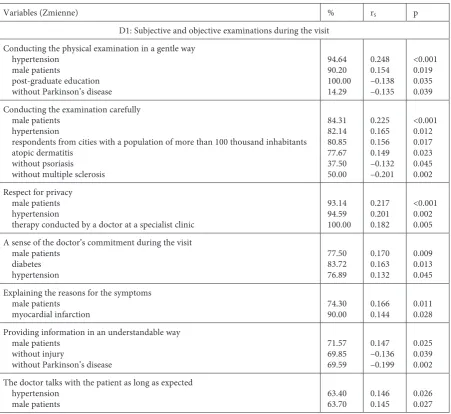
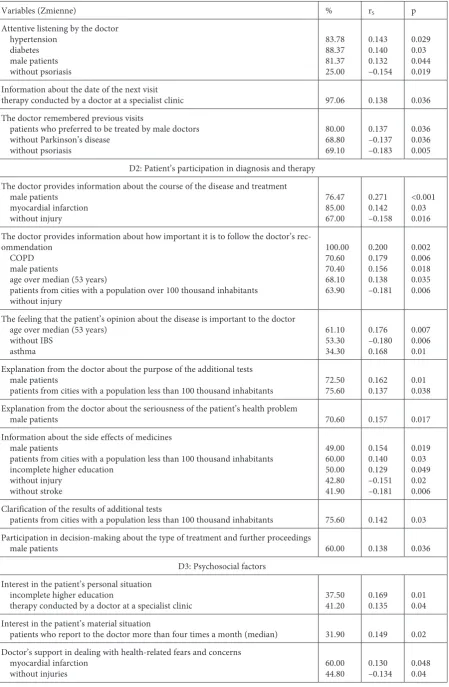
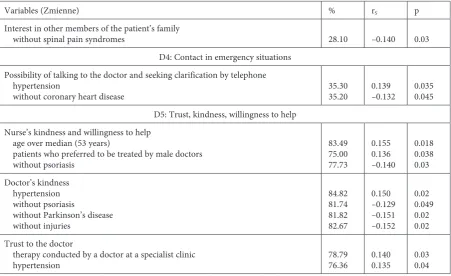
Correlations were identified between the an-swers to questions about the quality of care for the chronically ill (Table 2) and variables such as the presence of a chronic disease, the type of doctor, patient preferences regarding the doctor’s gender, the frequency of visits in the previous 12 months, the patient’s gender, age, education and place of residence (Table 4).
The statistically significant results (p < 0.05) of the Kruskal-Wallis ANOVA for each domain are presented in Table 5.
Discussion
As Vedsted and Heje wrote: „The definition of family medicine emphasizes the patient-centered approach, communication skills, continuity, and
Patients’ opinions regarding the doctor
(Ocena pacjenta na temat lekarza) SOMETIMES NO YES p
% No % No % No
D4: Contact with the doctor in emergency situations When the patient reports difficulties in coping with the
disease, the doctor tries to help 0.0 0 17.3 39 82.7 186 < 0.001 possibilites of talking to the doctor and obtaining
clari-fication by telephone 20.4 46 48.2 109 31.4 71 < 0.001 D5 – Trust, kindness, willingness to help
The doctor related kindly to the patient 18.9 43 0.4 1 80.6 183 < 0.001 The nurses are kind and helpful 21.1 48 2.6 6 76.3 174 < 0.001 confidence in the doctor 23.1 52 6.7 15 70.2 158 < 0.001
Table 2. Distribution of patients’ evaluations of visits to doctors – cont.
Table 3. Descriptive statistics and the internal consistency of latent domains
Tabela 3. Statystyka opisowa i wewnętrzna spójność utajonych domen Domain
(Domena) Mean SD Median Min Max Cronbach’s alpha Standardized Cronbach’s alpha D1: Subjective and objective
examina-tions during the visit 17.88 4.55 19 4 22 0.73 0.82 D2: Patient’s participation in diagnosis
and therapy 12.18 4.88 13 1 18 0.70 0.82 D3: Psychosocial factors 4.06 3.33 4 0 10 0.76 0.86 D4: Contact in emergency situations 2.46 1.31 2 0 4 0.81 0.85 D5: Trust, kindness, willingness to help 5.10 1.17 6 1 6 0.82 0.86 Total 41.64 12.92 44 11 60 0.81 0.87 Points/Answers: 0 – no, 1 – sometimes, 2 – yes.
Punkty/odpowiedzi: 0 – nie, 1 – czasem, 2 – tak.
Table 4. Spearman correlations between the quality of care, the chronic illness and other variables
Tabela 4. Korelacja Spearmana między jakością opieki, chorobą przewlekłą i innymi zmiennymi
Variables (Zmienne) % rS p
D1: Subjective and objective examinations during the visit Conducting the physical examination in a gentle way
hypertension male patients
post-graduate education without Parkinson’s disease
94.64 90.20 100.00 14.29
0.248 0.154 –0.138 –0.135
<0.001 0.019 0.035 0.039 Conducting the examination carefully
male patients hypertension
respondents from cities with a population of more than 100 thousand inhabitants atopic dermatitis
without psoriasis without multiple sclerosis
84.31 82.14 80.85 77.67 37.50 50.00
0.225 0.165 0.156 0.149 –0.132 –0.201
<0.001 0.012 0.017 0.023 0.045 0.002 Respect for privacy
male patients hypertension
therapy conducted by a doctor at a specialist clinic
93.14 94.59 100.00
0.217 0.201 0.182
<0.001 0.002 0.005 A sense of the doctor’s commitment during the visit
male patients diabetes hypertension
77.50 83.72 76.89
0.170 0.163 0.132
0.009 0.013 0.045 Explaining the reasons for the symptoms
male patients
myocardial infarction 74.3090.00 0.1660.144 0.0110.028 Providing information in an understandable way
male patients without injury
without Parkinson’s disease
71.57 69.85 69.59
0.147 –0.136 –0.199
0.025 0.039 0.002 The doctor talks with the patient as long as expected
hypertension
Variables (Zmienne) % rS p
Attentive listening by the doctor hypertension
diabetes male patients without psoriasis
83.78 88.37 81.37 25.00
0.143 0.140 0.132 –0.154
0.029 0.03 0.044 0.019 Information about the date of the next visit
therapy conducted by a doctor at a specialist clinic 97.06 0.138 0.036 The doctor remembered previous visits
patients who preferred to be treated by male doctors without Parkinson’s disease
without psoriasis
80.00 68.80 69.10
0.137 –0.137 –0.183
0.036 0.036 0.005 D2: Patient’s participation in diagnosis and therapy
The doctor provides information about the course of the disease and treatment male patients
myocardial infarction without injury
76.47 85.00 67.00
0.271 0.142 –0.158
<0.001 0.03 0.016 The doctor provides information about how important it is to follow the doctor’s
rec-ommendation COPD male patients
age over median (53 years)
patients from cities with a population over 100 thousand inhabitants without injury
100.00 70.60 70.40 68.10 63.90
0.200 0.179 0.156 0.138 –0.181
0.002 0.006 0.018 0.035 0.006
The feeling that the patient’s opinion about the disease is important to the doctor age over median (53 years)
without IBS asthma
61.10 53.30 34.30
0.176 –0.180 0.168
0.007 0.006 0.01 Explanation from the doctor about the purpose of the additional tests
male patients
patients from cities with a population less than 100 thousand inhabitants 72.5075.60 0.1620.137 0.010.038 Explanation from the doctor about the seriousness of the patient’s health problem
male patients 70.60 0.157 0.017
Information about the side effects of medicines male patients
patients from cities with a population less than 100 thousand inhabitants incomplete higher education
without injury without stroke
49.00 60.00 50.00 42.80 41.90
0.154 0.140 0.129 –0.151 –0.181
0.019 0.03 0.049 0.02 0.006 Clarification of the results of additional tests
patients from cities with a population less than 100 thousand inhabitants 75.60 0.142 0.03 Participation in decision-making about the type of treatment and further proceedings
male patients 60.00 0.138 0.036
D3: Psychosocial factors Interest in the patient’s personal situation
incomplete higher education
therapy conducted by a doctor at a specialist clinic 37.5041.20 0.1690.135 0.010.04 Interest in the patient’s material situation
patients who report to the doctor more than four times a month (median) 31.90 0.149 0.02 Doctor’s support in dealing with health-related fears and concerns
myocardial infarction
without injuries 60.0044.80 0.130–0.134 0.0480.04
Table 4. Spearman correlations between the quality of care, the chronic illness and other variables – cont.
clinical skills. Recommending the GP to others was most strongly associated with the ‘emphatic’, ‘patient-oriented’, ‘informative and coordinating’, and ‘competent/skilled’ GP and to a lesser degree with accessibility to general practice” [23].
The analysis of the results of the current study shows that factors of clinical management that the patients regard as very important include respect for the patient’s privacy, gentleness during phys-ical examinations, information about the date of
Variables (Zmienne) % rS p
Interest in other members of the patient’s family
without spinal pain syndromes 28.10 –0.140 0.03 D4: Contact in emergency situations
Possibility of talking to the doctor and seeking clarification by telephone hypertension
without coronary heart disease 35.3035.20 0.139–0.132 0.0350.045 D5: Trust, kindness, willingness to help
Nurse’s kindness and willingness to help age over median (53 years)
patients who preferred to be treated by male doctors without psoriasis
83.49 75.00 77.73
0.155 0.136 –0.140
0.018 0.038 0.03 Doctor’s kindness
hypertension without psoriasis
without Parkinson’s disease without injuries
84.82 81.74 81.82 82.67
0.150 –0.129 –0.151 –0.152
0.02 0.049 0.02 0.02 Trust to the doctor
therapy conducted by a doctor at a specialist clinic
hypertension 78.7976.36 0.1400.135 0.030.04
Table 4. Spearman correlations between the quality of care, the chronic illness and other variables – cont.
Tabela 4. Korelacja Spearmana między jakością opieki, chorobą przewlekłą i innymi zmiennymi – cd.
Table 5. Statistically significant results (p < 0.05) of the Kruskal-Wallis ANOVA for each domain
Tabela 5. Wyniki istotne statystycznie (p < 0,05) testu ANOVA Kruskala-Wallisa dla każdej domeny Variables
(Zmienne) MI HT D P MS DG PG PA PE
Domain (Domena)
D1 0.04134 0.007974 0.01952 0.04780 0.003039 0.01275 D2 0.01822 0.002691 0.02422 0.006965
D3 0.02366 0.03704 0.005767
D4 0.02770
D5 0.002173
Total 0.007624 0.02438 0.003676 0.04873
D1: Subjective and objective examinations during the visit; D2: Patient’s participation in diagnosis and therapy;
D3: Psychosocial factors; D4: Contact with the doctor in emergency situations; D5:Trust, kindness, willingness to help;
MI: myocardial infarction; HT: hypertension; D: diabetes; P: psoriasis; MS: multiple sclerosis; DG: doctor’s gender;
PG: patient’s gender; PA: patient’s age; PE: patient’s education.
D1: subiektywne i obiektywne badanie podczas wizyty; D2: udział pacjenta w diagnostyce i terapii; D3: czynniki
psychospołeczne; D4: gontakt z lekarzem w sytuacjach nadzwyczajnych; D5: zaufanie, życzliwość, chęć pomocy; MI: zawał serca; HT: nadciśnienie tętnicze; D: cukrzyca, P: łuszczyca; MS: stwardnienie rozsiane; DG: płeć lekarza; PG: płeć pacjenta;
the next visit, the name of the disease, attentive lis-tening and attentiveness during physical exami-nations. Devoting sufficient time during the visit was important to the patients. Areas in need of im-provement are the doctor’s interest in the patient’s symptoms and health-related fears and concerns, information on the side effects of medicines, in-terest in the patient’s material situation, inin-terest in other members of the patient’s family, the patient’s personal situation, and the opportunity to talk to the doctor and to seek clarification by telephone.
As in the current study, the analyses carried out by Petek et al. (2011) also showed high overall levels of patient satisfaction but low levels of satisfaction with the waiting time for an appointment [24].
Correlations were found between a high rat-ing of the quality of care for chronically ill pa-tients within each domain and the following vari-ables (the strongest correlations are marked with an asterisk):
D1: Subjective and objective
examinations during the visit:
• Chronic diseases: the presence of hyperten-sion*, type 2 diabetes and/or myocardial infarction in the medical history; the absence of psoriasis, the absence of atopic dermatitis, the absence of Par-kinson’s disease and the absence of stroke in the medical history;
• The patient’s gender*, therapy conducted by a doctor at a specialist clinic, the patient’s edu-cation, the patient’s place of residence, the patient having a preference regarding the doctor’s gender;
The statistically significant results of the D1 ANOVA (p < 0.05) were the presence of myocar-dial infarction in the medical history, hyperten-sion, psoriasis, multiple sclerosis, the patient’s gen-der and age.
D2: The patient’s participation
in diagnosis and therapy:
• Chronic diseases: COPD*; myocardial in-farction in the medical history; no stroke, injury, irritable bowel syndrome (IBS) or asthma in the medical history;
• The patient’s gender*, age*, place of resi-dence and level of education;
The statistically significant results of the D2 ANOVA (p < 0.05) were hypertension, type 2 dia-betes, patient’s preferences regarding the doctor’s gender and the patient’s gender.
D3: Psychosocial factors:
• Chronic diseases: myocardial infarction*, no injuries, no spinal pain syndromes;
• Education*, the frequency of visits*, therapy conducted by a doctor at a specialist clinic;
The statistically significant results of the D3 ANOVA (p < 0.05) were hypertension, type 2 dia-betes and the patient’s gender
D4: Contact with the doctor
in emergency situations:
• Chronic diseases: hypertension*, without ischemic heart disease
The only statistically significant result of the D4 ANOVA (p < 0.05) was the patient’s education
D5: Trust, kindness, willingness
to help:
• Chronic diseases: hypertension*, no psoria-sis, no Parkinson’s disease, no injury;
• The patient’s age*, therapy conducted by a doctor at a specialist clinic*, preferences regard-ing the doctor’s gender
The only statistically significant result of the D4 ANOVA (p < 0.05) was psoriasis.
The results of the ANOVA show that the oc-currence of hypertension and type 2 diabetes, the patient’s gender and age are statistically signifi-cant in relation to the overall ranking of visits to doctors.
There have been no other studies analyzing all the above variables exclusively in the chronically ill population. However, in investigations of the general population of primary care patients, simi-lar results were obtained by other researchers, who have reported (for example) more positive eval-uations among older patients or those at a cer-tain level of education, among residents of small towns, those reporting to doctors more often, and patients with less pain/discomfort and chronic diseases [25–27].
In the present study there was no correlation between the level of the patient’s education and in-dicators of the quality of care, which differs from results reported by Heje et al. [27]. It is worth not-ing that those authors conducted their study in the general population of primary care patients.
Limitations
Several limitations of the current study should be noted. Due to the nature of the project and the study group, random sampling was not applied. The aim of the study was not randomized observation, but rather investigation of phenomena in the gener-al population of chronicgener-ally ill primary care patients who were willing to cooperate with the researchers, which ensured reliable fulfillment of the research tools. The responses to the (standardized and vali-dated) questionnaires are, however, self-evaluation by nature: The results provide a picture of the phe-nomena only from the standpoint of the patient.
The authors concluded that the top-rated do-mains are subjective and objective examination,
kindness and willingness to help. Average scores were obtained in the domain evaluating the pa-tient’s participation in the processes of diagnosis and therapy, and the lowest scores were in psycho-social factors and the possibilities of obtaining as-sistance in emergencies.
High ratings of visits to the doctors correlat-ed most strongly with the following variables: the patient’s gender, age and education, the frequen-cy of visits, therapy conducted by doctors at spe-cialist clinics, the presence of arterial hypertension, COPD, and myocardial infarction. According to the results of the ANOVA, the following are statis-tically significant for the overall ranking of visits to doctors: the occurrence of hypertension and type 2 diabetes, the patient’s gender and age.
Acknowledgements. The authors would like to thank all the patients who agreed to participate in the research and the managers of the primary health care centers where the recruitment of respondents was conducted.
References
[1] WHO – Chronic diseases: http://www.who.int/topics/test/chronic_diseases/ [5 August 2010].
[2] Schols JMGA, Crebolder HFJM, Van Weel C: Nursing Home and Nursing Home Physician: The Dutch Experience. J Am Med Dir Assoc 2004, 5, 207–212.
[3] Meyer M, Kobb R, Ryan P: Virtually Healthy: Chronic Disease Management in the Home. Dis Manag 2002, 5, 87–94.
[4] Fact Sheet: Actual Causes of Death in the United States. Centers for Disease Control, 2000.
[5] Chronic Care Improvement How Medicare Transformation Can Save lives, Save Money, and Stimulate an Emerging Technology Industry. An ITAA E-Health White paper: A Product of the ITAA E-Health Committee, May 2004.
[6] Education Alliance for long Term Conditions: http://www.educationalliance.co.uk/ [05 August 2010]
[7] Ribbe MW: Care for elderly: the role of the nursing home in Duch health care system. Int Psychogeriatr 1993, 5, 213–222.
[8] Davis K, Doty MM, Shea K, Stremikis K: Health information technology and physician perceptions of quality of care and satisfaction. Health Policy 2009, 90, 239–246.
[9] Denson LA, Winefield HR, Beilby JJ: Discharge-planning for long-term care needs: the values and priorities of older people, their younger relatives and health professionals. Scand J Caring Sci 2012 Apr 13. doi: 10.1111/j.1471-6712.2012.00987.x. [Epub ahead of print]
[10] Powell Davies G, Williams AM, Larsen K, Perkins D, Roland M, Harris MF: Coordinating primary health care: an analysis of the outcomes of a systematic review. Med J Aust 2008, 21 (8 Suppl), S65–68.
[11] Flores LM, Davis R, Culross P: Community health: a critical approach to addressing chronic diseases. Prev Chronic Dis 2007, 4, http://www.cdc.gov/pcd/issues/2007/oct/07_0080.htm [14 January 2009]
[12] Holmberg M, Valmari G, Lundgren SM: Patients’ experiences of homecare nursing: balancing the duality between obtaining care and to maintain dignity and self-determination. Scand J Caring Sci 2012 Mar 16. doi: 10.1111/j.1471-6712.2012.00983.x. [Epub ahead of print]
[13] Szecsenyi J, Campbell S, Broge B, Laux G, Willms S, Wensing M et al.: Effectiveness of a quality-improvement program in improving management of primary care practices. CMAJ 2011, 13, E1326–333.
[14] Wensing M, Baker R, Szecsenyi J, Grol R: Impact of national health care systems on patient evaluations of general practice in Europe. Health Policy 2004, 68, 353–357.
[15] Wensing M: EUROPEP 2006 Revised Europep instrument and user manual: http://www.topaseurope.eu/files/ Europep%202006rapport_0.pdf [20 December 2011]
[16] Hirschhorn N, Lamstein SM, Klein S et al.: Quality by Objectives. A Practical Method for Quality of Care. Assessment and Assurance for Ambulatory Health Centers. G.K.Hall&CO. Medical Publications Division, Boston, Massachusetts, 1978.
[17] Williams S, Weinman J, Dale J, Newman S: Patient expectations: What do primary care patients want from the GP and how far does meeting expectations affect patient satisfaction? Fam Pract 1995, 12, 193–201.
[18] Williams S, Weinman J, Dale J: Doctor-patient communication and patient satisfaction: a review. Fam Pract 1998, 15, 480–492.
[19] Kurpas D, Steciwko A: Patient satisfaction as the main indicator of primary care quality. Przegl lek 2005, 62, 1546–1551.
[21] Cronbach LJ: Coefficient alpha and the internal structure of tests. Psychometrika 1951, 16, 297–334.
[22] Streiner DL, Norman GR: Health measurement scales. 2nd ed. New York: Oxford Press; 1995.
[23] Vedsted P, Heje HN: Association between patients’ recommendation of their GP and their evaluation of the GP. Scand J Prim Health Care 2008, 26, 228–234.
[24] Petek D, Künzi B, Kersnik J, Szecsenyi J, Wensing M: Patients’ evaluations of European general practice-revisited after 11 years. Int J Qual Health Care 2011, 23, 621–628.
[25] Wensing M, van Lieshout J, Jung HP, Hermsen J, Rosemann T: The Patients Assessment Chronic Illness Care (PACIC) questionnaire in The Netherlands: a validation study in rural general practice. BMC Health Serv Res 2008, 8, 182.
[26] Jayasinghe UW, Proudfoot J, Holton C, Davies GP, Amoroso C, Bubner T et al.: Chronically ill Australians’ satisfaction with accessibility and patient-centredness. Int J Qual Health Care 2008, 20, 105–114.
[27] Heje HN, Vedsted P, Sokolowski I, Olesen F: Patient characteristics associated with differences in patients’ evalu-ation of their general practitioner. BMC Health Serv Res 2008, 8, 178.
[28] Genui SJ: Medical practice and community health care in the 21st Century: A time of change. Public Health 2008, 122, 671–680.
[29] Samoutis GA, Soteriades ES, Stoffers HE, Philalithis A, Delicha EM, Lionis C: A pilot quality improvement intervention in patients with diabetes and hypertension in primary care settings of Cyprus. Fam Pract 2010, 27, 263–270.
[30] Lorig KR, Ritter PL, Dost A et al.: The expert patients programme online, a 1-year study of an Internet-based self-management programme for people with long-term conditions. Chronic Illn 2008, 4, 247–256.
[31] Wagner EH: The role of patient care teams in chronic disease management. BMJ 2000, 320, 569–572.
[32] Samoutis GA, Soteriades ES, Stoffers HE, Zachariadou T, Philalithis A, Lionis C: Designing a multifaceted qual-ity improvement intervention in primary care in a country where general practice is seeking recognition: the case of Cyprus. BMC Health Serv Res 2008, 8, 181.
Address for correspondence:
Donata Kurpas 1570 Innsbrooke Drive 24153 Salem, VA USA
Tel.: +48 606 323 449
E-mail: [email protected]
Conflict of interest: None declared