Patient Preference and Adherence
Dove
press
O r i g i n A l r e s e A r c h
open access to scientific and medical research
Open Access Full Text Article
Patient and physician preferences for attributes
of coronary revascularization
carlos Alberto da silva Magliano1
Andrea liborio Monteiro2 Bernardo rangel Tura1 claudia silvia rocha Oliveira1
Amanda rebeca de Oliveira rebelo1
claudia cristina de Aguiar Pereira3
1hTA Department, national institute
of cardiology, rio de Janeiro, Brazil;
2Department of Pharmacy systems,
Outcomes and Policy, college of Pharmacy, University of illinois at chicago, chicago, il, UsA; 3The
national school of Public health sergio Arouca ensP/Fiocruz, rio de Janeiro, Brazil
Background: Patients with a diagnosis of coronary artery disease (CAD) may face important decisions regarding treatment options, with the “right choice” depending on the relative weights of risks and benefits. Studies performed as discrete choice experiments are used to estimate these weights, and attribute selection is an essential step in the design of these studies. Attributes not included in the design cannot be analyzed. In this study, we aimed to elicit, rank, and rate attributes that may be considered important to patients and physicians who must choose between angioplasty and surgery for coronary revascularization.
Methods: The elicitation process involved performing a systematic review to search for attri-butes cited in declared preference studies in addition to face-to-face interviews with cardiolo-gists and experts. The interviews were audio-recorded in digital format, and the collected data were transcribed and searched to identify new attributes. The criterion used to finish the data collection process was sampling saturation.
Results: A systematic review resulted in the selection of the following 14 attributes: atrial fibrillation, heart failure, incision scar, length of stay, long-term survival, myocardial infarction, periprocedural death, postoperative infection, postprocedural angina, pseudoaneurysm, renal failure, repeat coronary artery bypass grafting, repeat percutaneous coronary intervention, and stroke. The interviews added no new attributes. After rating, we identified significant differ-ences in the values that patients and cardiologists placed on renal insufficiency ( p,0.001), periprocedural death ( p,0.001), and long-term survival ( p,0.001).
Conclusion: Decisions regarding the best treatment option for patients with CAD should be made based on differences in risk and the patient’s preference regarding the most relevant endpoints. We elicited, ranked, and rated 14 attributes related to CAD treatment options. This list of attributes may help researchers who seek to perform future preference studies of CAD treatment options.
Keywords: preference, ranking, rating, coronary, angina
Introduction
Coronary artery disease (CAD) is the leading cause of mortality worldwide. For patients with symptomatic CAD refractory to medical therapy, two treatment options are available: percutaneous coronary intervention (PCI) and coronary artery bypass grafting (CABG). Each of these therapies has a different risk and benefit profile. Approximately 12% of affected patients are eligible for either PCI or CABG.1 Knowing
the preferences of the patients who face this scenario may be relevant to decision- making because the available treatment options are different, and the stakeholders may value them unequally.
Determining patient preferences may provide insights that lead to more effective management strategies since which treatment is “right” depends on the relative weight
correspondence: carlos Alberto da silva Magliano
rua das laranjeiras 374, 5 andar, hTA Department, national institue of cardiology, rio de Janeiro, Brazil, ceP 22240-006
Tel +55 21 99680 2076 Fax +55 21 2537 9739 email [email protected]
Journal name: Patient Preference and Adherence Article Designation: Original Research Year: 2018
Volume: 12
Running head verso: Magliano et al
Running head recto: Patient and physician preferences in coronary revascularization DOI: 164550
Patient Preference and Adherence downloaded from https://www.dovepress.com/ by 118.70.13.36 on 26-Aug-2020
For personal use only.
Dovepress
Magliano et al
the patient gives to the risks and benefits of the different treatment strategies. In this study, we aimed to elicit, rank, and rate attributes that may be considered important to patients and physicians who face choosing between PCI and CABG.
This paper describes a qualitative study that was designed to identify which attributes are important to patients and cardiologists. These attributes may help future studies aimed at exploring the preference for coronary revascularization, such as discrete choice experiments (DCEs). DCEs are increasingly used as a method to determine patient prefer-ences, and attribute selection is an important step that is rarely reported in detail.2
Methods
The first step in this study was to elicit attributes. The second step was to rank and rate the attributes selected by patients and physicians. Finally, we analyzed the attributes to identify differences between these stakeholders’ perspectives.
Attribute elicitation
The elicitation process involved performing a systematic review in addition to conducting face-to-face interviews with patients and experts.
systematic review
We performed a systematic review of published studies related to declared preferences for PCI or CABG in patients with a diagnosis of CAD. The MEDLINE, Embase, and LILACS databases were searched for studies published on or before 10 August 2017. Our search terms consisted of key-words for coronary revascularization as well as methods used to assess patient preferences (eg, “patient reported outcome,” “patient satisfaction,” “best–worst scaling,” “Maxdiff,” “discrete choice experiment,” “preference,” “conjoint studies,” “conjoint choice experiment,” “vignette,” “choice,” “willingness-to-pay,” and “conjoint analysis”).
Patient interviews to elicit attributes
Data collection was conducted by trained interviewers, including one cardiologist and two nurses, at the National Institute of Cardiology, Rio de Janeiro, Brazil. These profes-sionals had no previous contact with the patients, and none of them was responsible for the care of the included patients.
In this study, we used a convenience sample of hospital-ized patients with stable CAD, most of whom were waiting for a coronary revascularization procedure. Respondents were selected randomly based on their ward number using a list
of random numbers that were generated in Microsoft Excel. We chose patients with CAD since we assumed that they would be more committed to the interviews than any alterna-tive sample population.
Eligibility to participate in the study was defined as follows: a diagnosis of CAD, willingness to participate in a face-to-face interview during which the patient would answer questions about their preferences regarding pos-sible treatment complications, provided written informed consent, and currently being considered for a revasculariza-tion treatment. Participants were deemed ineligible if they had already undergone surgery or angioplasty or if they viewed themselves as unable to understand the experiment. Ethical approval was obtained from the National Institute of Cardiology Ethical Department (Comitê de ética e pesquisa do Instituto Naional de Cardiologia), and written informed consent was obtained from each study participant (CAAE number 63684017.0.0000.5240).
One-to-one interviews were conducted between August 1 and November 20, 2017. Patients were asked to imagine that they were sharing in the decision-making process regarding which treatment option was better for them between PCI and CABG. They were then asked to answer a semi-structured questionnaire. Open-ended questions were presented in the following sequence: 1) Do you know the reason for your hospitalization? 2) What benefits do you expect to achieve from the treatment? 3) Which risks or complications could occur with the treatment? 4) What most concerns you regard-ing the treatment? 5) Considerregard-ing that there is no difference in mortality between the two, which procedure would you prefer? 6) What are the differences between surgery and angioplasty?
The latter part of the questionnaire included questions regarding demographic information (age, gender, ethnicity, income, and level of education).
cardiologist interviews to elicit attributes
All interviews were completed by the first author (CM), who is a cardiologist. The study population was a convenient sample of cardiologists with expertise in CAD.
Physician eligibility was determined according to the following criteria: specialist in cardiology, willing to partici-pate in a face-to-face interview and answer questions about preferences regarding possible treatment complications, and willing to provide informed consent.
The experts were asked to enumerate the risks and ben-efits they usually consider when exploring the trade-offs between PCI and CABG.
Patient Preference and Adherence downloaded from https://www.dovepress.com/ by 118.70.13.36 on 26-Aug-2020
Dovepress Patient and physician preferences in coronary revascularization
Qualitative analysis of interviews
The interviews were audio-recorded in digital format, and the data collected were qualitatively analyzed. First, the data were transcribed integrally and properly contrasted with the audio versions to detect errors. Then, we reviewed the data to identify any attribute that had not been previously identi-fied in the systematic review. We then sought to identify the terms that were most commonly used by patients to describe clinical outcomes. The criterion used to finish data collection was sampling saturation.3
ranking
The attributes selected in the previous step were randomly and individually presented to patients and physicians. We used cards that were similar in color and size, with each card containing the name of an attribute in layperson’s terms. The amount of explanatory/background information was equivalent for all attributes, and this information was presented according to a pre-established script to avoid overstating the importance of any single attribute.
The following pre-established question was presented to all patients:
Consider you have angina, a chest pain that indicates a heart problem. Your treatment options are medicine, angioplasty (catheterization with stent placement) or bypass surgery. These different treatments are related to different benefits and risks. I have a list of possible complications resulting from these treatments, and I would like to know how con-cerned you are in relation to each one. Please, put in order of relevance from one to fourteen your concerns, ie, one being the most concerned to fourteen the least concerned.
The following similar established question was pre-sented to all physicians:
Imagine that you are responsible for defining the treat-ment of a patient who is complaining about angina. The available treatment options include adjusting medications, angioplasty with stents or coronary bypass surgery. These different treatments are related to different benefits and risks. I have a list of possible complications from these treatments and I would like to know how concerned you are about each one. Please, put in order of relevance from one to fourteen your concerns, ie, one being the most concerned to fourteen the least concerned.
rating
After ranking, each participant received 10 identical black dots. They were instructed to distribute the dots in such a
manner that the most relevant attributes received propor-tionally more points. The participant was asked to define the proportion by considering the relative importance of each attribute. There was no limit to how many points each attribute could receive. It was possible to reorder the attributes during this phase. This method is known as dotmocracy (Figure 1).
statistics
Descriptive statistics were used to summarize the sociodemographic and clinical characteristics of the sample. We summarized the data as means, medians, or percentages, as indicated. An unpaired t-test was used for comparisons between group data. All procedures were performed in accor-dance with the ethical standards of the responsible committee on human experimentation (institutional and national) and with the Helsinki Declaration of 1964, as revised in 2013. Informed consent was obtained from all patients prior to their inclusion in the study.
Results
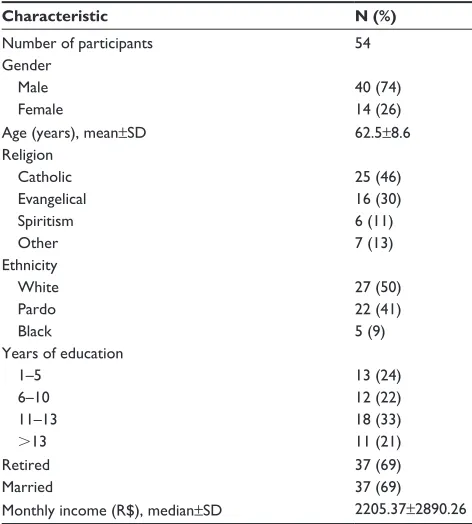
The interviews were ~15 min in duration. We enrolled 76 respondents, comprising 22 cardiologists and 54 patients (32 for elicitation and 22 for ranking and rating). Overall, the majority of respondents were male, Caucasian, retired, married, and religious (Table 1). All physicians were car-diologists and had a mean±SD 15.6±1.2 years of clinical experience.
Attribute selection in the systematic
review
We used a systematic review to search for stated prefer-ence studies that evaluated CAD treatments. Both patient and physician preferences were surveyed. Of a total of 735 citations (436 from MEDLINE and 299 from Embase), 44 articles were eligible for full-text review. Six studies1,4–8
that met our inclusion criteria were included in the final report (Figure 2). The attributes most often cited in these studies coincided with those already used in clinical trials: death,4,6–8 stroke,4,6–8 myocardial infarction,4,7 and repeat
revascularization.1,6–8 Other attributes examined within these
studies included heart attack,6 hospitalization,6 repeat PCI,4
repeat CABG,4 atrial fibrillation,4 mediastinitis,4
postop-erative chronic pain,1,4 postprocedural angina,4,6 length of
stay,1,4 duration of recovery,1,4 depression,4 procedural cost,4
incision scar,1,4,5 pseudoaneurysm,4 pneumonia,4 long-term
use of clopidogrel,4 renal failure,4 acute respiratory distress
syndrome,4 bleeding,4 symptom control, medication side
effects, comfort in taking medication, well-being, the ability to do things, the prolonging of life, and cure.5
Patient Preference and Adherence downloaded from https://www.dovepress.com/ by 118.70.13.36 on 26-Aug-2020
Dovepress
Magliano et al
Figure 1 The dotmocracy rating method.
Patient Preference and Adherence downloaded from https://www.dovepress.com/ by 118.70.13.36 on 26-Aug-2020
Dovepress Patient and physician preferences in coronary revascularization
Procedural and other costs, such as medications, were avoided as possible attributes in this study because the included patients were being treated in the Brazilian public health system and therefore had no copayments. Prolonged use of medications or their side effects were also not included as attributes because our goal was to study preferences between angioplasty and surgery.
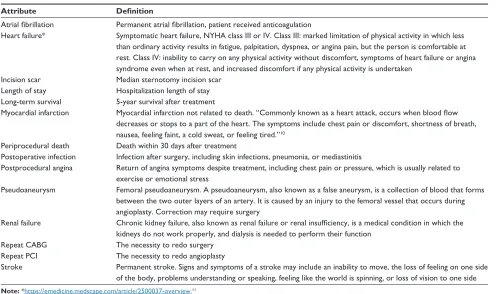
We selected the following 14 attributes based on the attri-butes identified in the systematic review: 1) atrial fibrillation; 2) heart failure; 3) incision scar; 4) length of stay; 5) long-term survival; 6) myocardial infarction; 7) periprocedural death;
8) postoperative infection; 9) postprocedural angina; 10) pseudoaneurysm; 11) renal failure; 12) repeat CABG; 13) repeat PCI; and 14) stroke (Table 2).
Attributes selected from patient and
physician interviews
Interviews with cardiologists and patients did not add new attributes. Notably, the patients exhibited discomfort when encouraged to cite possible complications and claimed that they had not spoken to their physicians about these. The complications most prevalent from a patient perspective were death and stroke, which were cited by 68.75% and 50% of the patients, respectively.
Attribute importance
After ranking and rating the identified attributes, our survey revealed that in some attributes, there was a major discor-dance between patients and cardiologists. Periprocedural death was ranked as the most important outcome by cardiologists, while renal failure was the most important to patients. Incision scars were considered the least important for both groups. There was a significant difference between patients and cardiologists in the value they placed on renal insufficiency ( p,0.001), periprocedural death ( p,0.001), and long-term survival ( p,0.001). The results are shown in Table 3.
Discussion
We would like to highlight some of the important findings of this study. First, neither the patients nor the physicians considered all clinical endpoints equal, and future trials should therefore be careful when considering composite endpoints. Second, patients and physicians do not weigh many relevant cardiovascular outcomes similarly (eg, renal failure, periprocedural death, long-term survival, and atrial fibrillation), and this should be considered during decision- making. Third, repeat revascularization is not highly valued by either doctors or patients and should therefore not sub-stantially impact the decision-making process.
In this study, we identified some important aspects that should be explored in future trials. The attributes that were more frequently cited in the systematic review of prefer-ence studies coincided with the attributes already used in clinical trials. The patient and physician interviews did not add any new attributes. This finding may indicate that these attributes are indeed the most relevant, or it may reflect the impact of previously published trial outcomes on current medical reasoning. One relevant question is that of whether
Table 1 Patients’ sociodemographic characteristics
Characteristic N (%)
number of participants 54
gender
Male 40 (74)
Female 14 (26)
Age (years), mean±sD 62.5±8.6
religion
catholic 25 (46)
evangelical 16 (30)
spiritism 6 (11)
Other 7 (13)
ethnicity
White 27 (50)
Pardo 22 (41)
Black 5 (9)
Years of education
1–5 13 (24)
6–10 12 (22)
11–13 18 (33)
.13 11 (21)
retired 37 (69)
Married 37 (69)
Monthly income (r$), median±sD 2205.37±2890.26 Note: Data are shown as n (%) unless otherwise indicated.
6WXGLHVLQFOXGHGLQ TXDOLWDWLYHV\QWKHVLV
Q )XOOWH[WDUWLFOHVDVVHVVHG
IRUHOLJLELOLW\ Q
)XOOWH[WDUWLFOHVH[FOXGHG 1RW&$'SUHIHUHQFH
VWXG\Q 5HFRUGVH[FOXGHGQ 1RWSUHIHUHQFHVWXG\Q 3UHIHUHQFHEXWQRW&$'Q 5HFRUGVLGHQWLILHGWKURXJK
GDWDEDVHVHDUFKLQJ 0('/,1(Q
(PEDVHQ /,/$&6Q
7RWDO
Figure 2 Flowchart of the systematic review. Abbreviation: cAD, coronary artery disease.
Patient Preference and Adherence downloaded from https://www.dovepress.com/ by 118.70.13.36 on 26-Aug-2020
Dovepress
Magliano et al
Table 2 Definitions of attributes
Attribute Definition
Atrial fibrillation Permanent atrial fibrillation, patient received anticoagulation
heart failure* symptomatic heart failure, nYhA class iii or iV. class iii: marked limitation of physical activity in which less than ordinary activity results in fatigue, palpitation, dyspnea, or angina pain, but the person is comfortable at rest. class iV: inability to carry on any physical activity without discomfort, symptoms of heart failure or angina syndrome even when at rest, and increased discomfort if any physical activity is undertaken
incision scar Median sternotomy incision scar length of stay hospitalization length of stay long-term survival 5-year survival after treatment
Myocardial infarction Myocardial infarction not related to death. “Commonly known as a heart attack, occurs when blood flow
decreases or stops to a part of the heart. The symptoms include chest pain or discomfort, shortness of breath, nausea, feeling faint, a cold sweat, or feeling tired.”10
Periprocedural death Death within 30 days after treatment
Postoperative infection infection after surgery, including skin infections, pneumonia, or mediastinitis
Postprocedural angina return of angina symptoms despite treatment, including chest pain or pressure, which is usually related to exercise or emotional stress
Pseudoaneurysm Femoral pseudoaneurysm. A pseudoaneurysm, also known as a false aneurysm, is a collection of blood that forms between the two outer layers of an artery. it is caused by an injury to the femoral vessel that occurs during angioplasty. correction may require surgery
renal failure Chronic kidney failure, also known as renal failure or renal insufficiency, is a medical condition in which the
kidneys do not work properly, and dialysis is needed to perform their function repeat cABg The necessity to redo surgery
repeat Pci The necessity to redo angioplasty
stroke Permanent stroke. signs and symptoms of a stroke may include an inability to move, the loss of feeling on one side of the body, problems understanding or speaking, feeling like the world is spinning, or loss of vision to one side Note: *https://emedicine.medscape.com/article/2500037-overview.11
Abbreviations: nYhA, new York heart Association; cABg, coronary artery bypass graft; Pci, percutaneous coronary intervention.
Table 3 ranking and rating of attributes according to patients
and cardiologists
Attribute Patients Cardiologists p-value
Ranking Rating Ranking Rating
renal failure 1st 50 6th 10 ,0.001
Periprocedural death 2nd 43 1st 72 ,0.001
stroke 3rd 25 3rd 26 ns
repeat surgery 4th 19 8th 8 ns
Myocardial infarction 5th 16 4th 18 ns
heart failure 6th 15 5th 15 ns
Angina 7th 12 9th 4 ns
Atrial fibrillation 8th 10 12th 1 0.01 Postoperative
infection
9th 9 7th 4 ns
long-term survival 10th 9 2nd 53 ,0.001
length of stay 11th 4 11th 2 ns
Pseudoaneurysm 12th 2 13th 1 ns
repeat angioplasty 13th 2 10th 2 ns
incision scar 14th 0 14th 0 ns
Abbreviation: NS, not significant.
physicians make their decisions based exclusively on the outcomes used in previous trials rather than considering all possible patient-relevant outcomes.
Another important issue related to outcomes is the use of composite endpoints. Death, stroke, myocardial infarction, and repeat revascularization are frequently grouped into a
category called major adverse cardiovascular events (MACE). The use of MACE has been justified as an attempt to capture the overall treatment effect. The main advantage of using composite outcomes is that it reduces the duration, sample size, and costs of clinical trials.1,6 In this study, we found that these
outcomes are weighted differently, and this represents one limi-tation of the use of MACE as a composite endpoint. This finding is in accordance with those presented in the literature.4,6,7
It is important to note that even though the difference was not statistically significant ( p=0.054), the patients rated “repeat surgery” as the fourth most important attribute, and they gave it more than twice the points given by physicians, who considered it the eighth most important. In addition, one endpoint that is very commonly used in composite analysis, “repeat PCI,” was viewed as one of the least important by both patients (13 out of 14) and physicians (10 out of 14). This finding is similar to that of Pandit et al.4 Based on these
findings, future studies should avoid grouping “repeat sur-gery” and “repeat PCI” in addition to avoiding the use of the combined outcomes of death, stroke, myocardial infarction, and “repeat revascularization” because these outcomes are valued differently by patients and physicians.
We considered it essential to clarify the clinical meaning of the endpoints provided during the interviews. For example,
Patient Preference and Adherence downloaded from https://www.dovepress.com/ by 118.70.13.36 on 26-Aug-2020
Dovepress Patient and physician preferences in coronary revascularization
stroke was presented as permanent stroke. This is not likely to be the reality in many clinical trials in which there are several different types of stroke, which can range from a mild transient ischemic event to a large disabling neuro-logical insult. Similarly, myocardial infarction may range from a trivial troponin rise to severe ventricular dysfunction. Future studies should report results stratified by attributes and clinical relevance.
Stroke was identified as an important attribute and was the third most important to both patients and physicians. However, it was not more important than death. This finding is different from that reported in the Pandit and Ahmad studies.4,7 Future
trials should explore cultural aspects that are potentially related to differences in preferences between populations.
Patients and physicians weighted some attributes differ-ently. Patients appear to place considerably less value on “long-term survival.” The Kipp study8 reached a similar
con-clusion, wherein patients chose PCI over CABG across nearly all hypothetical PCI risk scenarios, while physicians were significantly less likely to choose PCI over CABG. During the decision-making process, physicians must recognize that there are possible divergences in the weighted preferences for some relevant attributes, and they should therefore seek the patient’s opinion during this process.
Our study does have several limitations. The number of attributes selected could have resulted in respondent fatigue. Furthermore, the outcome definitions and survey structure were tested in pilot studies but were not validated. Our study was not powered for a subgroups analysis. The patients selected were from a convenience sample from a public health hospital in Brazil, and most of the participants were at the lower end of educational completion, which limits the ability to generalize the study’s conclusions to the overall population. On the other hand, these findings highlight the necessity of elicitation preferences in each scenario before making recommendations.
Another important limitation of our attribute ranking analysis was the absence of attribute levels. This was because we believed that presenting several attributes with different levels would result in excessive cognitive demand. Thus, the attributes were provided with no information regarding risk rates, and we must acknowledge that this could have impacted the results.
As cited by Ciccone et al, building on treatment recom-mendations should take a broad perspective and consider the medical, social, behavioral, and emotional impact on the patient’s quality of life.9 The current guidelines and
recommendations regarding CAD treatment seem to be based on endpoints that do not properly represent patient prefer-ences. Further developing what is known about patients’ preferences, values, and fears may better inform policy and enable physicians to be more accountable to the public.
Conclusion
It is vital that decision makers understand how patients value the aspects associated with a health-care intervention. Incorporating their values may ultimately result in clinical and policy decisions that better reflect patient preferences.
In this study, we elicited, ranked, and rated 14 attributes related to CAD treatment options. Patients and cardiolo-gists valued many of these attributes differently. This list of attributes may help researchers seeking to use discrete choice experiments to develop future preference studies related to CAD treatment options.
Disclosure
The authors report no conflicts of interest in this work.
References
1. Hornberger J, Bloch DA, Hlatky MA, Baumgartner W. Patient preferences in coronary revascularization. Am Heart J. 1999;137(6):1153–1162. 2. Bridges JF, Hauber AB, Marshall D, et al. Conjoint analysis applications
in health – a checklist: a report of the ISPOR Good Research Practices for Conjoint Analysis Task Force. Value Health. 2011;14(4):403–413. 3. Prakke H, Wurster J. [Quality criteria for qualitative research]. Pflege.
1999;12(3):183–186.
4. Pandit J, Gupta V, Boyer N, Yeghiazarians Y, Ports TA, Boyle AJ. Patient and physician perspectives on outcomes weighting in revascu-larization. The POWR study. Int J Cardiol. 2014;177(2):513–514. 5. Bowling A, Culliford L, Smith D, Rowe G, Reeves BC. What do
patients really want? Patients’ preferences for treatment for angina.
Health Expect. 2008;11(2):137–147.
6. Chow RD, Wankhedkar KP, Mete M. Patients’ preferences for selection of endpoints in cardiovascular clinical trials. J Community Hosp Intern
Med Perspect. 2014;4.
7. Ahmad Y, Nijjer S, Cook CM, et al. A new method of applying ran-domised control study data to the individual patient: a novel quantita-tive patient-centred approach to interpreting composite end points.
Int J Cardiol. 2015;195:216–224.
8. Kipp R, Lehman J, Israel J, Edwards N, Becker T, Raval AN. Patient preferences for coronary artery bypass graft surgery or percutaneous intervention in multivessel coronary artery disease. Catheter Cardiovasc
Interv. 2013;82(2):212–218.
9. Ciccone MM, Aquilino A, Cortese F, et al. Feasibility and effectiveness of a disease and care management model in the primary health care system for patients with heart failure and diabetes (Project Leonardo).
Vasc Health Risk Manag. 2010;6:297–305.
10. Ibanez B, James S, Agewall S, et al. ESC Guidelines for the man-agement of acute myocardial infarction in patients presenting with ST-segment elevation. Revista espanola de cardiologia. 2017;70(12): 1082.
11. Ho KK, Pinsky JL, Kannel WB, Levy D. The epidemiology of of heart failure: the Framingham study. J Am Coll Cardiol. 1993;(4 suppl A): 6A–13A.
Patient Preference and Adherence downloaded from https://www.dovepress.com/ by 118.70.13.36 on 26-Aug-2020
Patient Preference and Adherence
Publish your work in this journal
Submit your manuscript here: http://www.dovepress.com/patient-preference-and-adherence-journal
Patient Preference and Adherence is an international, peer-reviewed, open access journal that focuses on the growing importance of patient preference and adherence throughout the therapeutic continuum. Patient satisfaction, acceptability, quality of life, compliance, persistence and their role in developing new therapeutic modalities and compounds to optimize
clinical outcomes for existing disease states are major areas of interest for the journal. This journal has been accepted for indexing on PubMed Central. The manuscript management system is completely online and includes a very quick and fair peer-review system, which is all easy to use. Visit http://www. dovepress.com/testimonials.php to read real quotes from published authors.
Dovepress
Dove
press
Magliano et al
Patient Preference and Adherence downloaded from https://www.dovepress.com/ by 118.70.13.36 on 26-Aug-2020