CODEN [USA]: IAJPBB ISSN: 2349-7750
INDO AMERICAN JOURNAL OF
PHARMACEUTICAL SCIENCES
http://doi.org/10.5281/zenodo.1064832
Available online at:
http://www.iajps.com
Research Article
FORMULATION DEVELOPMENT AND EVALUATION OF
HYDROTROPIC SOLUBILIZATION BASED SUSPENSIONS OF
ITRACONAZOLE
Amareshwar Shabada
1*,
Yellanki Prashanthi
2,CH. Yella Reddy
1, Boya Vivekananda
1,
1
Assistant Professor, Department of Pharmaceutics, St.Mary’s Pharmacy College, Deshmukhi
(Village-508284), Pochampally (Mandal), Yadadri (District), Telangana
2
Assistant Professor,
Department of Pharmaceutical Analysis & Quality Assurance, Nizam Institute of
Pharmacy , Deshmukhi (Village-508284), Pochampally (Mandal), Yadadri (District), Telangana.
1
Assistant Professor,
Department of Pharmaceutics, St.Mary’s Pharmacy College, Deshmukhi
(Village-508284), Pochampally (Mandal), Yadadri (District), Telangana.
1
Assistant Professor,
Department of Pharmaceutical Chemistry, St.Mary’s Pharmacy College, Deshmukhi
(Village-508284), Pochampally (Mandal), Yadadri (District), Telangana.
Abstract:
Hydrotropic solublization is new, simple, economic, safe method, can be used in analysis of drug. The use of various hydrotropes in place of organic solvents for the purpose of solubilization. Hydrotropes increases the solubility of organics in water. Objective of present investigation was to enhance the solubility of Itraconazole using the technique of hydrotropic solubilization technique and convert them into suitable oral liquid dosage form (suspension) useful for enhancement of bioavailability.0.5M, 1M, 2M of the hydrotropes (trisodium citrate, urea, sodium acetate, sodium benzoate and sodium salicylates) were used to study the saturation solubility. Solubility was found to be greater with trisodium citrate. Suspensions were prepared by using trisodium citrate solution, Itraconazole, xanthan gum, acacia, sodium alginate as a aqueous phase, dispersed phase and suspending agents respectively. Prepared suspensions were characterized for appearance of phases, particle size of dispersed Phase, pourability, sedimentation volume and in vitro drug release. All formulations of tri sodium citrate suspension were uniformly distributed, particle size of the dispersed phase was 10μm to 20μm, suspensions were easily pourable from the bottle and sedimentation volume in the rage of 0.5-1. More than 70% drug release was obtained at the end of the 45 minutes. Hydrotropic solubilization technique for preparation of suspensions of poor water soluble drugs will gave stability to the formulation and helps in enhancement of bioavailability of Itraconazole.
Keywords: hydrotropes, solubility, solubilization, Itraconazole, suspensions, bioavailability
Corresponding Author:
Amareshwar Shabada,
Assistant Professor, Department of Pharmaceutics,
St.Mary’s Pharmacy College, Deshmukhi (Village-508284),
Pochampally (Mandal), Yadadri (District), Telangana.
Phone number: - 9573262146
E-mail address: - [email protected]
Please cite this article in press as
Amares
hwar S et al
., Formulation Development and Evaluation ofINTRODUCTION:
Solubility is the major problem for various drugs in pharmaceutical industry. Many drugs show poor aqueous solubility, which result in poor bioavailability of the drug. Solubility enhancement processes are widely used in pharmaceutical industry to improve the dissolution and bioavailability of poorly water soluble drug. The efficacy of drug response is mainly dependent on dissolution and bioavailability. Almost more than 90% drugs are orally administered. Drug absorption, sufficient and reproducible bioavailability, pharmacokinetic profile of orally administered drug substance is highly dependent on solubility of that compound in aqueous medium. It is estimated that 40% of active new chemical entities identified by many pharmaceutical companies are poorly water soluble.
Hydrotropy is a unique solubilization technique in which certain chemical compounds termed as hydrotropes can be used to affect a several fold increase in the aqueous solubility of sparingly soluble solutes under normal conditions. This increase in solubility in water is probably due to the formation of organized assemblies of hydrotrope molecules at critical concentrations. A hydrotrope is a compound that solubilizes hydrophobic compounds in aqueous solutions. Typically, hydrotropes consist of a hydrophilic part and a hydrophobic part (like surfactants) but the hydrophobic part is generally too small to cause spontaneous self-aggregation. Hydrotropes do not have a critical concentration above which self-aggregration 'suddenly' starts to occur. Instead, some hydrotropes aggregate in a step-wise self-aggregation process, gradually increasing aggregation size. However, many hydrotropes do not seem to self-aggregate at all, unless a solubilisate has been added.
Itraconazole is a broad spectrum anti-fungal BCS II compound and it is a potent triazole antifungal agent that is prescribed to patients with fungal infections used for the treatment of mycoses. Inhibits the CYP-450–dependent synthesis of ergosterol, which is a vital component of fungal cell membranes. The drug may be given orally or intravenously. Itraconazole exhibits very poor oral bioavailability owing to its insolubility in intestinal fluids.
Hence objective of present investigation was to enhance the solubility of Itraconazole using the technique of hydrotropic solubilization and formulation, evaluation of hydrotropic solubilization based suspension of Itraconazole which will helpful to provide stability to formulation and enhancement of bioavailability.
MATERIAL AND METHODS: Materials
Itraconazole was obtained as a gift sample from Rachem Pharmaceuticals Ltd, Hyderabad. Trisodium citrate, Sodium benzoate, Sodium salicylate, Urea, Xanthan gum, Acacia, Sodium alginate, Sachcharin sodium, Methyl paraben, Propyl paraben and Menthol were obtained from CDH(P) Ltd, New Delhi and Sreeplast Pvt Ltd.
Experimental
Preparation of hydrotropic solutions
Different molar concentrations 0.5M, 1M, 2M of the hydrotropes (tri sodium citrate, urea, sodium acetate, sodium benzoate and sodium salicylates) were prepared, by dissolving hydrotropes in triple distilled water.
Saturation solubility studies
Saturation solubility studies were performed in triplicate according to the method reported by Higuchi and Connors. Excess of pure drug were added to 20 ml of different molar solutions of hydrotropes in a screwcap tube and shaken in a rotary flask shaker at room temperature for 24 hrs. Once equilibrium had been achieved, appropriate aliquots were withdrawn and filtered through 0.2µ filters. The filtrate was suitably diluted with different molar solutions of hydrotropes and analyzed at 255 nm by UV-visible spectrophotometer.
Preparation of standard stock and calibration curve
10mg of Itraconazole was dissolved in 10ml of methanol until the drug dissolved completely then make up the volume to 100 ml with 0.1N Hcl to give a concentration of 0.1mg/ml (100µgm/ml). From the above standard solution (100µgm/ml) 1ml was taken and diluted to 10ml with 0.1N HCl to give a concentration of 0.01mg/ml(10µgm/ml).
From this stock solution aliquots of 0.2,0.4,0.6,0.8 and 1 ml were pipette out in 10ml volumetric flask and the volume was made up to the mark with 0.1N HCl to produce concentration of 2, 4, 6, 8 and 10 µgm/ml respectively. When this solution was scanned in the UV range i.e. from 200nm to 800nm λmax was
found to be 255 nm for Itraconazole in 0.1N HCl as a blank in UV-Visible Spectrophotometer (UV-3200 Lab India). The absorbance (abs) of each concentration was measured at 255 nm.
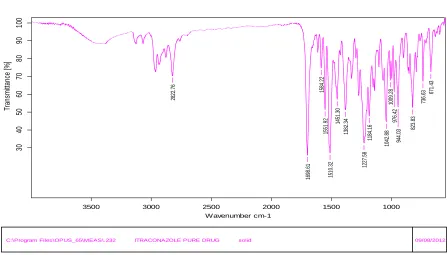
FTIR compatibility studies
grounding the solid powder sample with 100 times the quantity of KBr in a mortar. The finely grounded powder was then introduced into a stainless steel die and was compressed between polished steel anvils at a pressure of about 8t/in2. The spectras were recorded
over the wave number of 8000 to 400cm-1.
Formulation of suspensions
From the results of saturation solubility it was observed that trisodium citrate enhances the solubility to the greater extent than other hydrotropes so that formulations were prepared with tri sodium citrate hydrotope as a structured vehicle in different molar concentrations, xanthan gum, acacia and sodium alginate as a suspending agent, sodium saccharin as a sweetener and menthol as a flavoring
agent and negative coolant, methyl paraben and propyl paraben as preservatives.
In the preparation initially 40 % of the water was taken and then Tri sodium citrate was dissolved in the water.
Then suspending agent and preservatives, sweetner was added and stirred until to dissolve completely and kept for homogenization. To the above solution finally drug was added and homogenized for 15 minutes. Take the remaining water, flavor and coloring agent was dissolved and finally make up the volume with this water and continue homogenization for further 15 minutes.
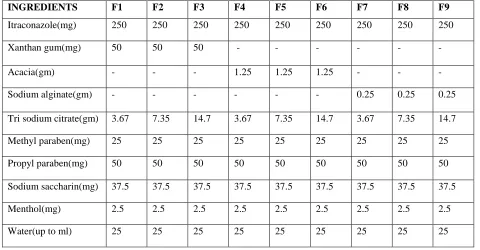
Table 1: Formulation of suspension
Evaluation of suspensions
Appearance of Phases
The visual inspection was done for the appearance dispersed phase and dispersion medium.
Determination of pH
The pH of the prepared suspensions was measured by
using ELICO INDIA pH analyser (Model LI612) by calibrating with standard buffers
Viscosity Measurement
The viscosity of the prepared suspensions was measured by Brookfield viscometer (Model: DV- II+) using spindle S-61 at 100 rpm.
Particle Size measurement
The particle size of particles in the prepared suspensions was measured by optical microscopy using a microscope at 100x (10×10) magnification. The size of 100 particles were measured and the average particle size of was determined.
INGREDIENTS F1 F2 F3 F4 F5 F6 F7 F8 F9
Itraconazole(mg) 250 250 250 250 250 250 250 250 250
Xanthan gum(mg) 50 50 50 - - - -
Acacia(gm) - - - 1.25 1.25 1.25 - - -
Sodium alginate(gm) - - - 0.25 0.25 0.25
Tri sodium citrate(gm) 3.67 7.35 14.7 3.67 7.35 14.7 3.67 7.35 14.7
Methyl paraben(mg) 25 25 25 25 25 25 25 25 25
Propyl paraben(mg) 50 50 50 50 50 50 50 50 50
Sodium saccharin(mg) 37.5 37.5 37.5 37.5 37.5 37.5 37.5 37.5 37.5
Menthol(mg) 2.5 2.5 2.5 2.5 2.5 2.5 2.5 2.5 2.5
Sedimentation volume (F)
Sedimentation volume (F) is nothing but a ratio of the final volume of sediment (Vu) to the original volume of sediment (V0) before settling. 50ml of each suspension were transferred to 50 ml. measuring cylinders and the volume of sediment formed was noted after 1 hr, 2 hr, 6hr, 12hr, 24hr ,month. The sedimentation volume (F) was calculated using the formula-
F = Vu / Vo
Redispersibility
The bottles containing suspension were held up right between the fingers and rotated clockwise upside down through 1800 in a semicircular path and back in
the anti-clock wise direction (one cycle). This process was repeated continuously until the sediment was completely redispersed.
Pourability
This test is carried out on the phases of suspension after mixing to ensure that the final preparation is pourable and will not cause any problem during filling and during handling by patient.
In -vitro dissolution studies
In-vitro release studies were carried out using a modified USP XXIII dissolution test apparatus (Lab India,DS-800). Two objectives in the development of in-vitro dissolution tests was to show that i) Rate of drug release is uniform from batch to batch and is the same as the release rate from those proven to be bioavailable and clinically effective. ii) Release of the drug from the suspension is as close as possible up to 100%. The dissolution fluid was 900ml of 0.1N Hcl buffer at a speed of 50rpm at a temperature of 370c were used in each test. Samples of dissolution
medium(3ml) were withdrawn for 5, 10, 20, 30, 45mins and assayed for Itraconazole by measuring absorbance at 255 nm. For all the tests 3ml of the test medium were collected at specified time intervals and replaced with same volume of 0.1N Hcl buffer used.
Drug Content estimation
The content uniformity test is used to ensure that every tablet contains the amount of drug substance intended with little variation among tablets within a batch.
5 ml of suspension was measured accurately and transferred in to 100 ml volumetric flask. Sufficient quantity of 0.1N Hcl was added to dissolve the drug and the volume was made up with0.1N Hcl. From this solution, 10 ml was taken and transferred in to a 100 ml volumetric flask the volume was made up to the mark with0.1N Hcl. From this 1ml was drawn in to 10ml volumetric flask and the volume was adjusted with. 0.1N Hcl the absorbance of the solution was measured at 255nm on uv-spectrophotometer using 0.1N Hcl as blank.
Accelerated stability studies
Accelerated study of the prepared suspensions was performed at 40OC/75% RH for about 3 months as
per ICH guidelines. The samples were characterized for % drug content, in-vitro dissolution and pH. The results of the accelerated stability showed the good correlation with that of the initial results clearly indicating the good stability of the products.
DSC Studies
The interaction between drug and hydrotrope was characterized by differential scanning calorimetry. DSC patterns of samples were obtained with Shimadzu DSC-50 instrument using vented aluminium pans.
XRD Studies
The interaction between drug and hydrotrope was characterized by X-ray diffraction techniques.
RESULTS AND DISCUSSION:
Standard Calibration curve of Itraconazole
Table 2: Concentration and absorbance obtained for calibration curve of Itraconazole
Concentration (µg/ml)
Absorbance
0 0
2 0.058
4 0.119
6 0.179
8 0.246
Fig. 1: Std graph of Itraconazole
FTIR STUDIES
C:\Program Files\OPUS_65\MEAS\.232 ITRACONAZOLE PURE DRUG solid 09/08/2012
28 22 .7 6 16 98 .6 1 15 84 .2 2 15 51 .9 2 15 10 .3 2 14 51 .3 0 13 82 .3 4 12 27 .5 8 11 84 .1 6 10 42 .8 8 10 09 .2 8 97 6. 42 94 4. 03 82 3. 83 73 6.
63 671.
43 1000 1500 2000 2500 3000 3500 Wavenumber cm-1 30 40 50 60 70 80 90 10 0 Tr an sm itt an ce [% ] Page 1/1
Fig.2: FTIR spectra of Itraconazole pure drug
Fig. 3: FTIR spectra of Itraconazole suspension Table 3: FTIR data interpretation
S.NO
Wave number in formulation (cm-1) Characteristic Wave
number range (cm-1)
Bond nature and bond attributed Pure drug Optimised
formulation
1 3300 3248 3330-3250 N–H stretch 1°, 2° amines, amides
2 2964 2863 3000-2850 C–H stretch alkanes
3 1698 1691 1710-1665 C=O stretch α,β–unsaturated
aldehydes, ketones
4 1584 1582 1650-1580 N–H bend 1° amines
5 1552 1481 1550-1475 N–O asymmetric stretch nitro
compounds
6 1472 1451 1470-1450 C–H bend alkanes
7 1042 736 1000-650 =C–H bend alkenes
8 736 671 900-675 C–H “oop” aromatics
850–550 (m) C–Cl stretch alkyl
halides
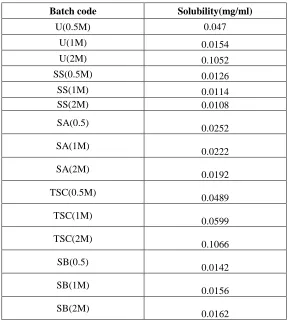
Saturation solubility studies
Table 4: Saturation Solubility studies of Itraconazole
U-Urea, SS-Sodium salicylate, SA-Sodium acetate, TSC-Trisodium citrate, SB-Sodium benzoate.
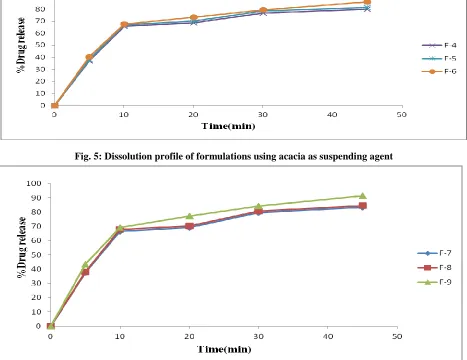
In-vitro drug release studies from the prepared suspensions
The In-vitro dissolution studies were conducted in 900ml of 0.1 N Hcl using USP-II apparatus. Samples were withdrawn at different time intervals such as 5,
10, 20, 30 and 45 min. The samples were analyzed using UV Visible spectrophotometer at 255 nm against reagent blank.
Table 5: In-vitro drug release profiles of the prepared suspensions
Time(min) F-1 F-2 F-3 F-4 F-5 F-6 F-7 F-8 F-9 0 0 0 0 0 0 0 0 0 0
5 36.6 37.5 39.3 37.2 38.1 40.2 37.5 38.1 43.5
10 63.9 65.1 67.2 65.7 66.9 67.5 66.6 67.8 69.3
20 67.5 68.1 72.6 68.7 69.9 73.2 69.3 70.2 77.4
30 75.9 77.4 78.6 76.8 78.3 79.2 79.8 80.7 84.3
45 78.6 80.7 83.4 79.8 81.3 85.8 83.4 84.6 91.4
Dissolution rate is increased in the formulations F-7 to F-9 as the concentration of hydrotrope is increased from 0.5 to 2M respectively. Formulations F-7 shows cumulative drug release is 83.4% at the end of 45min and Formulation F-9 shows more than 90% at the end of 45mins.
Batch code Solubility(mg/ml)
U(0.5M) 0.047
U(1M) 0.0154
U(2M) 0.1052
SS(0.5M) 0.0126
SS(1M) 0.0114
SS(2M) 0.0108
SA(0.5)
0.0252
SA(1M)
0.0222
SA(2M)
0.0192
TSC(0.5M)
0.0489
TSC(1M)
0.0599
TSC(2M)
0.1066
SB(0.5)
0.0142
SB(1M)
0.0156
SB(2M)
Invitro Dissolution Studies of all formulations
Fig. 4: Dissolution profile of formulations using Xanthan gum as suspending agent
Sedimentation volume determination from the prepared suspensions
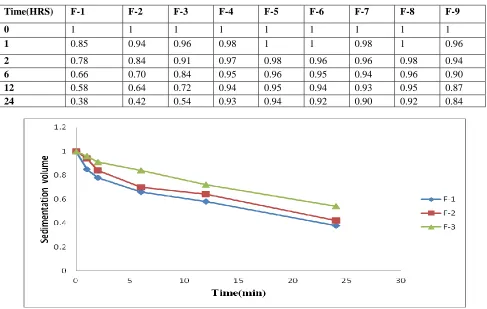
The sedimentation volumes of the prepared suspensions were determined using 50 ml measuring cylinders. The sedimentation volume was checked at 0,1,2,6,12,and 24 hours. Based on sedimentation
volume of suspensions made with sodium alginate as suspending agent are optimised formulations. (F-7, F-8, F-9). Formulations F-1 to F-3 show poor sedimentation volume and formulations F-4 to F-6 shows formation of hard cake.
Table 6: Sedimentation volume of the prepared suspensions
Fig. 7: Sedimentation volume of formulations using Xanthan gum as suspending agent
Fig. 8: Sedimentation volume of formulations using Acacia as suspending agent
Fig. 9: Sedimentation volume of formulations using sodium alginate as suspending agent Time(HRS) F-1 F-2 F-3 F-4 F-5 F-6 F-7 F-8 F-9 0 1 1 1 1 1 1 1 1 1
1 0.85 0.94 0.96 0.98 1 1 0.98 1 0.96
2 0.78 0.84 0.91 0.97 0.98 0.96 0.96 0.98 0.94
6 0.66 0.70 0.84 0.95 0.96 0.95 0.94 0.96 0.90
12 0.58 0.64 0.72 0.94 0.95 0.94 0.93 0.95 0.87
Drug content estimation
Assay of the drug in formulations F-1 to F-3 shown 95.6 to 97%, F-4 to F-6 Shown 95.3 to 98% & F-7 to F-9 shown 96.3 to 99.3% drug content indicates that the drug content remains within the standard limits.
Table 8: drug content uniformity of nine formulations Drug
content(%CDR)
FORMULATIONS
F-1 F-2 F-3 F-4 F-5 F-6 F-7 F-8 F-9
1) 95.6 96.3 97 95.3 97.3 98 96.3 97.6 99.3
Fig.10: Drug content estimation
CONCLUSION:
Hydrotropic solubilisation technique is used for the poorly soluble drug Itraconazole, using various hydrotropic agents, results from studies were found satisfactory. This was found to be excellent technique in the solubility and dissolution enhancement of poor water soluble drugs. A suspension dosage form is often selected if drug is insoluble in aqueous vehicles at the dosage requires and of when the attempts to solublize the drug through the use of cosolvents, surfactants, and other solubilizing agents would compromise the stability or the safety of the product or in case of the oral administration its organoleptic properties. It was concluded that aqueous solubility of Itraconazole greatly enhance by the synergistic effect of different hydrotropic agents . Thus the research work overcome the problem of poorly water soluble drugs and present methodology can be adopted to prepare economical formulation of poorly water soluble drug.
REFERENCES:
1.Akhilesh Kumar Jain, 2007.Solubilization of indomethacin using hydrotropes for aqueous injection. European Journal of Pharmaceutics and Biopharmaceutics, 701-714
2.Bhupendra Kumar Tiwari et al, 2011. Enhancement of solubility of aceclofenac by using different solubilization technique. International Journal of Pharmacy & Life Sciences , ISSN: 0976-7126, 620-624
3.J.K. Badjatya et al, 2011. Enhancement of Solubility of Fenofibrate by Using different Solubilization Techniques. Asian Journal of Pharmacy & Life Science, Vol. 1 (2),144-148
4.Coffman RE Kildsig Hydrotropic solubilization mechanistic studies. Pharm Res 1996; 13(10): 1460 -1463
5.Lee J Lee SC Acharya G Chang C Parke R Hydrotropic solubilization of Paclitaxel. Pharm. Res 2005; 20(7), 1022 – 1030.
6.Agrawal S Pancholi SS Jain NK Agrawal GP Hydrotropic solubilization of nimesulide for parenteral administration Int J Pharm 2004; 274: 149 -155. 7.Blake Martin Loyd E Harris The action of solubility agents on the solubility of xanthine derivatives in water. 8.Kapadiya Nidhi1 et al, 2011. Hydrotropy: a promising tool for solubility enhancement. International Journal of Drug Development & Research, Vol. 3 | Issue 2 | ISSN 0975-9344 |, 26-33
9.A.S.,Shete et al, 2010. Formulation and Evaluation of Hydrotropic Solublization Based Suspensions of Griseofulvin. International Journal of Pharma Sciences and Research (IJPSR), Vol.1(1), 51-57
10.D.Balasubramanian et al, 1989. Aggregation Behavior of Hydrotropic Compounds in Aqueous Solution. J. Phys. Chem., 93, 3865-3872
11.Ecanow, B.; Gold, B.; Ecanow, C. Newer aspects of suspension theory. Am.Perfum. Cosmet. Nov. 1969;84: 27–31.
12.United States Pharmacopeia 24, The Pharmacopeial Convention, Rockville, MD 2000, 4.