Chandrashekhar L Athare
Jain COP, Jain Gurukul, Chandwad, Nasik E-mail: [email protected] Address for correspondence
Access this article online www.japer.in
Effect of novel inhibitor of protein tyrosine phosphatase PTP 1B
(NCE-9) on the amelioration of hyperglycemia in DIO mice
INTRODUCTION
Obesity and diabetes mellitus represent major public health problems. Type 2 diabetes is a polygenic disease affecting over 100 million people worldwide. The risk of developing type 2 diabetes is increased in populations that lead a sedentary lifestyle and consume a typical western diet, in which more than 50% of the calories are derived from fat. [1, 2] A high-fat diet and low energy expenditure predispose to obesity, a condition characterized by increased insulin resistance in insulinresponsive tissues, such as skeletal muscle, liver, and white adipose tissue. [3, 4] Body weight also is subject to polygenic regulation. [5] Many of the key genes that regulate body mass and glucose homeostasis remain to be identified. [6] Impaired insulin and leptin signaling is a key contributor to the pathogenesis of obesity and type 2
diabetes mellitus. Strong evidence indicates a key role for protein-tyrosine phosphatases, most notably PTP1B, in the steady-state regulation of insulin [7] and leptin signaling pathways. [8, 9] PTP1B dephosphorylates the insulin receptor (IR) and IR substrate 1 (IRS1) inactivating the insulin pathway. [7, 10] PTP1B expression and activity are increased in obese and insulin-resistant humans and in rodent models of obesity, [11–13] whereas PTP1B-deficient mice exhibit increased insulin sensitivity in terms of glucose homeostasis and enhanced insulin-induced tyrosyl phosphorylation of IR and IRS1 in skeletal muscle and liver. [14] The absence of PTP1B in all tissues is associated with protection from diet-induced obesity (DIO). [15] Therefore, the focus of this investigation was to characterize the effects of NCE-9 in a murine model of DIO that is representative of the clinically obese human condition and to further define its molecular mechanism of action.
MATERIALS & METHODS
Compounds Research
Research Research
Research ArticleArticleArticleArticle
Metabolic syndrome and type 2 diabetes are complex disorders that are associated with obesity, aging, and genetic predisposition. The increasing prevalence of metabolic abnormalities worldwide presents a serious public health problem, with rates of obesity and diabetes reaching unprecedented levels. A common feature of these disorders is the development of insulin resistance, resulting in decreased insulin-stimulated glucose uptake, failure to suppress hepatic glucose production, and accumulation of hepatic lipid. Recent studies in mice have shown that deficiency of the non-receptor protein tyrosine phosphatase, PTP1B, in liver leads to a host of improvements in metabolic parameters, including improved hepatic insulin sensitivity, reduced liver triglycerides, lower serum and hepatic cholesterol levels, and protection against high-fat diet induced endoplasmic reticulum (ER) stress. Based on these promising studies, PTP1B inhibitors may prove to be a valuable therapeutic tool in the fight against metabolic syndrome and its associated comorbidities. In this study, we investigate effect of NCE-9 in diet induced obese (DIO) mice. NCE-9 significantly improved hyperglycemia and insulin resistance in DIO mice when orally administered at a dose of 30 and 100 mg/kg/day for 28 days. Overall, these studies suggest that NCE-9 improves insulin sensitivity and improves glucose tolerance in animal models through inhibition of PTP1B and that it would be a new therapeutic candidate with potential for the treatment of type 2 diabetic patients.
Keywords: NCE-9, Protein tyrosine phosphatase 1B, Insulin resistant, DIO mice ABSTRACT
ABSTRACT ABSTRACT ABSTRACT Chandrashekhar L Athare*,
Chandrashekhar D Upasani
NCE-9 was synthesized at SNJBs Shriman Sureshdada Jain College of Pharmacy, Nasik, India. The compounds were suspended in 0.25% Tween-80 + 0.5% methyl cellulose solution for in vivo studies.
Animals and treatment
Male C57BL/6J mice were purchased from Laxmi Biofarms Pvt. Ltd. Ale Phata, Pune, India. We fed wild-type male C57BL/6 mice a HFD consisting of 60 kcal% of calories from fat (D12492 Research Diets Inc.) starting at 6 weeks of age for 12 weeks, and we maintained NCD-fed male C57BL/6 controls on normal chow diet consisting of 4.5% fat (5002 Lab Diet). Mice were housed in a specific pathogen-free facility with a 12-hr light-dark cycle and given free access to food and water. All animal use was in compliance Experimental Animal Care issued by the Committee for Purpose of Control and Supervision of Experiments on Animal (CPCSEA).
In vivo efficacy of NCE-9 in DIO mice
Animals were randomized based on pretreatment fed blood glucose levels and body weights. DIO mice were orally gavaged with the NCE-9 (10, 30 and 100 mg/kg, p.o.) and rosiglitazone 10 mg/kg, p.o. for 28 days. Body weight, feed intake and fed blood glucose were taken every week. An oral glucose tolerance test (OGTT) was performed on day 28. In OGTT assay, 6 hr fasted DIO mice were treated with vehicle or compounds (10ml/kg, p.o) after fasting blood glucose (t= −30 min) measurement. The mice were then gavaged with an oral bolus of glucose (2 g/kg). We measured the basal blood glucose level and then at 0, 30, 60 and 120 min for OGTT from tail blood using glucometer (Bayer –Contour TS). On day 28 after OGTT, animals were sacrificed and subcutaneous, epididymal, perirenal fat was collected.
Statistical analysis
Data are presented as mean ± S.E. Statistical analysis of the data for multiple comparisons was performed
P<0.001 was considered statistically most significant using Graph Pad PRISM, Version 5.04
RESULTS AND DISCUSSION
Type 2 diabetes is a metabolic disorder characterised by insulin resistance, hyperglycaemia and dyslipidaemia. PTP1B is a 50 kDa cytosolic tyrosine dephosphorylase consisting of 435 amino acids that is widely expressed in human organs. [16] It is well known that PTP1B dephosphorylates both the phosphorylated IR β-subunit and the phosphorylated IRS to regulate negatively the insulin signal transmission. [17] PTP1B inhibitors can be divided into two types: competitive inhibitors and non-competitive inhibitors. Most of the small-molecule competitive inhibitors mimic the phosphorylated tyrosine IR, while most of the non-competitive inhibitors act via oxidation of the catalytic cysteine Cys215 or by preventing the closure of the WPD loop. [18] Unfortunately, most of the small-molecule inhibitors fail to succeed in vivo. To date, finding a selective smallmolecule phosphatase inhibitor with good cell permeability and oral bioavailability in vivo is difficult mainly due to the highly polar phosphatase active site and the shallowness of the surrounding protein surface, which do not allow for the productive bindings of the typical lipophilic membrane with the permeable small-molecule phosphatase inhibitor. [19, 20] Significantly, NCE-9 different from those small-molecule PTP1B inhibitors, does successfully inhibit the PTP1B activity and decrease the plasma glucose in vivo.
Effect of NCE-9 on metabolic parameter and body
weight in DIO mice
treated DIO mice. Rosiglitazone at 10 mg/kg, p.o. showed increase in body weight (on day 28), while NCE-9 (30, 100 mg/kg) treated mice showed no change in body weight in comparison with the vehicle-treated HFD mice. Rosiglitazone at 10 mg/kg, p.o. showed significant increase in subcutaneous fat while NCE-9 treated mice did not showed significant change in all fat pad in comparison with the vehicle-treated mice which correlates with body weight changes.
Effect of NCE-9 on glucose tolerance test in DIO
Mice
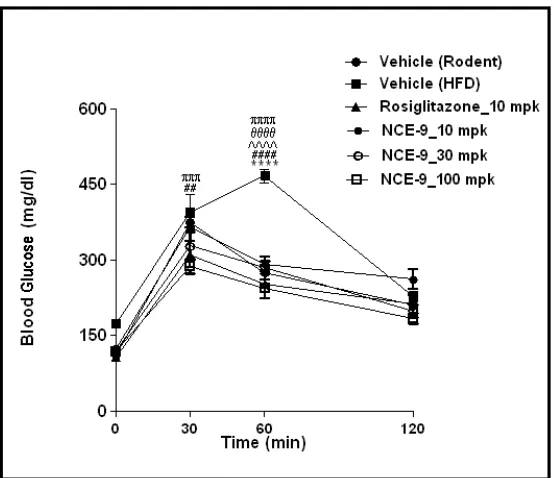
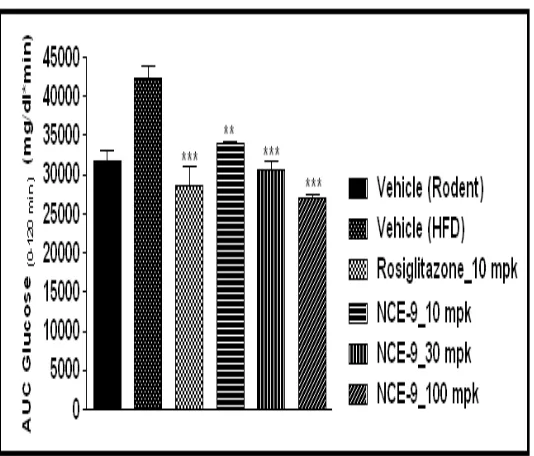
Oral glucose tolerance test was performed on day 28 of treatment period in DIO mice. On day 28 after chronic treatment, when challenged with an oral bolus of glucose, NCE-9 (10, 30 and 100 mg/kg, p.o.) treated animals exhibit a reduced glucose excursion (indicating improved tolerance to glucose) compared with vehicle-treated animals (Fig. 1A, B).
CONCLUSION
These results suggest a protective effect of NCE-9 against the metabolic abnormalities induced by high fat diet. However, further studies should be carried out to explore beneficial use of NCE-9 as PTP1B inhibitors in human subjects suffering from diabetes and obesity.
ACKNOWLEDGEMENT
The authors would like to thank management and staff of the Department of Pharmacology. Faculty of pharmacy, Shri Neminath Jain Bramhacharyashram's Shriman Sureshdada Jain college of pharmacy Jain gurukul, Chandwad, Nasik, 423101 Maharashtra, India for providing facility to carry out research work.
Figure 1A: Effect of NCE-9 on blood glucose in OGTT in DIO mice after four weeks of BID treatment
All values are expressed as Mean ± SEM, n = 6. Vertical lines represent SEM. All data are subjected to Two Way ANOVA followed by Bonferroni’s post test. **** p<0.0001: Vehicle (Rodent diet) vs Vehicle (High Fat diet), ##p<0.01, ####p<0.0001: Rosiglitazone vs Vehicle (High Fat diet), ^^^^p<0.0001: NCE-9 (10 mpk) vs Vehicle (High Fat diet), θθθθ p<0.0001: NCE-9 (30 mpk) vs Vehicle (High Fat diet), πππ p<0.001, ππππ p<0.0001: NCE-9
All values are expressed as AUC Glucose(0-120 min) in mg/dl*min (Mean ± SEM),n = 6. Vertical lines represent SEM. All data are subjected to One Way ANOVA followed by Dunnett’s post test. ** p<0.01, *** p<0.001 vs Vehicle
Table 1: Effect of NCE-9 on Body weight and Blood glucose in DIO mice after four weeks BID treatment
Treatment Group Body weight (g) Blood Glucose (mg/dl)
Initial Final Initial Final
Vehicle Rodent Diet 29.4 (± 0.5) 29.5 (± 0.5) 110 (±4.4) 115 (±6.4)
Vehicle HFD Diet 46.3 (± 0.5) 46.8 (± 0.7) 180 (±6.3) 170 (±5.4)
Rosiglitazone, 10 mpk 46.8 (± 0.4) 49 (± 0.9) 178 (±7) 108 (±4.8)***
NCE-9, 10 mpk 47 (± 0.5) 44.5 (± 0.7) 179 (±6) 145 (±5.3)*
NCE-9, 30 mpk 46 (± 0.6) 41.5 (± 1.4) 181 (±5.8) 132 (±5.4)***
NCE-9, 100 mpk 46 (± 0.6) 42.1 (± 1) 183 (±6.9) 116 (±5.6)***
All values are expressed as Mean ± SEM, n = 6. All data are subjected to One Way ANOVA followed by Dunnett’s post test. . * p<0.05, *** p<0.001 vs Vehicle HFD diet
Table 2: Effect of NCE-9 on plasma insulin, Triglyceride (TG), Total Cholesterol (TC), non-esterified free fatty acid (NEFA), subcutaneous fat, epididymal fat and perirenal fat in DIO mice after four weeks BID treatment
Treatment Group Vehicle HFD Diet Rosiglitazone, 10 mpk NCE-9, 10 mpk NCE-9, 30 mpk NCE-9, 100 mpk
Plasma insulin (ng/ml) 7.08 (±0.2) 6.32 (±0.4)*** 3.98 (±0.4)*** 2.89 (±0.1)*** 3.00 (±0.4)***
TG (mg/dl) 158 (±3.9) 160 (±4.5) 148 (±7.2) 145 (±5.2) 153 (±3.5)
TC (mg/dl) 177 (±4.8) 174 (±5.1) 166 (±5.7) 165 (±4.4) 182 (±5.6)
NEFA (mmol/l) 1.41 (±0.19) 1.39 (±0.14) 1.28 (±0.25) 1.21 (±0.17) 1.19 (±0.12)
Subcutaneous fat (g) 1.96 (±0.19) 2.75 (±0.13)* 1.68 (±0.14) 1.52 (±0.23) 1.86 (±0.25)
Epididymal fat (g) 0.10 (±0.03) 0.09 (±0.08) 0.07 (±0.05) 0.08 (±0.06) 0.10 (±0.07)
Perirenal fat (g) 0.34 (±0.08) 0.31 (±0.04) 0.28 (±0.05) 0.26 (±0.05) 0.30 (±0.05)
2. Grimm J. J. Interaction of physical activity and diet:
implications for insulin-glucose dynamics. Public
Health Nutr. 1999; 2:363–368.
3. Astrup A. Macronutrient balances and obesity: the
role of diet and physical activity. Public Health Nutr.
1999; 2:341–347.
4. Kahn, C. R. Banting Lecture. Insulin action,
diabetogenes, and the cause of type II diabetes.
Diabetes. 1994; 43:1066–1084.
5. Bray M. S. Genomics, genes, and environmental
interaction: the role of exercise. J. Appl. Physiol.
2000; 88:788–792.
6. Echwald S. M. Genetics of human obesity: lessons
from mouse models and candidate genes. J. Intern.
Med. 1999; 245:653–666.
7. Goldstein B. J. Protein-tyrosine phosphatase 1B
(PTP1B): a novel therapeutic target for type 2
diabetes mellitus, obesity and related states of
insulin resistance. Curr Drug Targets Immune
Endocr Metabol Disord. 2001; 1: 265–275.
8. Myers M. P., Andersen J. N., Cheng A. TYK2 and JAK2
are substrates of protein-tyrosine phosphatase 1B. J
Biol Chem. 2001; 276: 47771–47774.
9. Cheng A., Uetani N., Simoncic P. D. Attenuation of
leptin action and regulation of obesity by protein
tyrosine phosphatase 1B. Dev Cell 2002; 2: 497–503.
10. Goldstein B. J., Bittner-Kowalczyk A., White M. F.,
Harbeck M. Tyrosine dephosphorylation and
deactivation of insulin receptor substrate-1 by
protein-tyrosine phosphatase 1B. Possible
facilitation by the formation of a ternary complex
with the Grb2 adaptor protein. J Biol Chem. 2000;
275: 4283–4289.
11. Ahmad F., Azevedo J. L., Cortright R., Dohm G. L.,
Goldstein B. J. Alterations in skeletal muscle
protein-tyrosine phosphatase activity and expression in
insulin-resistant human obesity and diabetes. J Clin
Invest 1997; 100: 449–458.
12. Di Paola R., Frittitta L., Miscio G. A variation in 3’ UTR
of hPTP1B increases specific gene expression and
associates with insulin resistance. Am J Hum Genet
2002; 70: 806–812.
13. Ahmad F., Goldstein B. J. Increased abundance of
specific skeletal muscle protein-tyrosine
phosphatases in a genetic model of insulin-resistant
obesity and diabetes mellitus. Metabolism 1995; 44:
1175–1184.
14. Elchebly M., Payette P., Michaliszyn E. Increased
insulin sensitivity and obesity resistance in mice
lacking the protein tyrosine phosphatase-1B gene.
Science 1999; 283: 1544–1548.
15. Zabolotny J. M., Bence-Hanulec K. K.,
Stricker-Krongrad A. PTP1B regulates leptin signal
transduction in vivo. Dev Cell 2002; 2: 489–495.
16. Chernoff J., Schievella A. R., Jost C. A. Cloning of a
cDNA for a major human
protein-tyrosine-phosphatase. Proc Natl Acad Sci U S A. 1990; 87:
2735–2739.
17. Asante-Appiah E., Kennedy B. P, Protein tyrosine
phosphatases: the quest for negative regulators of
insulin action. Am J Physiol Endocrinol Metab. 2003;
284: E663–E670.
18. Bialy L., Waldmann H. Inhibitors of protein tyrosine
phosphatases: next-generation drugs? Angew Chen
Int Ed Engl. 2005; 44: 3814–3839.
19. Park H., Bhattarai B. R., Ham S. W. Structure-based
virtual screening approach to identify novel classes
of PTP1B inhibitors. Eur J Med Chem. 2009; 44:
3280–3284.
20. Combs A. P. Recent advances in the discovery of
competitive protein tyrosine phosphatase 1B
inhibitors for the treatment of diabetes, obesity, and
cancer. J Med Chem. 2010; 53: 2333–2344.
How to cite this article: Chandrashekhar L Athare*, Chandrashekhar D Upasani; Effect of novel inhibitor of protein tyrosine phosphatase PTP 1B (NCE-9) on the amelioration of hyperglycemia in DIO mice; J. Adv. Pharm. Edu. & Res. 2014: 4(1): 54-58.