Copyright © 2014 IJECCE, All right reserved
Comparative Analysis of Coiflet and Daubechies
Wavelets in Fingerprint Image Compression
Emmanuel, B. S.; Mu’azu, M. B.; Sani, S. M.; Garba, S.
Abstract – The choice of wavelet bases for image signal decomposition and energy de-correlation, as well as, the choice of threshold strategy to achieve sparse representation for image signal are very crucial in the overall performance of a wavelet-based image compression system. In this comparative study, orthogonal Daubechies and Coiflet wavelet bases were applied at different orders and decomposition levels to decompose fingerprint image into approximation and detail components. Level-dependent threshold was applied at three different decomposition levels using Birge-Massart strategy to achieve a sparse representation of the image and the performance of Daubechies and Coiflet wavelets for compression algorithm were evaluated. The performances of the investigated methods were evaluated on the basis of percentage number of zero, NZ (%) and retained energy, RE (%). At decomposition level three, 8-bit source fingerprint image was completely decomposed and the RE (%) values for representation based on Coiflet order 4 ranged from 99.32% to 99.69% as opposed to the values for Daubechies order 4 which ranged from 98.45% to 98.91%. These results revealed that Coiflet wavelet bases performed better than Daubechies wavelet bases in terms of the capability for image energy de-correlation and sparse representation.
Keywords – Wavelet Transform, Image Compression, Quantization, Entropy Coding, Fingerprint.
I.
I
NTRODUCTIONLossy technique is the preferred choice for fingerprint image compression in order to reduce computation, storage and transmission costs. This is because fingerprint images have the property of energy redundancy which can be exploited by removing image pixels that contribute very little to the visual quality of the image. Wavelet coding is based on the idea that the coefficients of a transformed image in which the energy of its pixel values is de-correlated can be coded more efficiently than the original image’s array of pixel values. This is because wavelet transform basis packs most of the important visual information, such as the biometric features of fingerprint image, into a small number of coefficients. The remaining coefficients can be truncated to zero using suitable thresholding method with reduced degradation in image quality [1],[2],[3].
Sparse representation of fingerprint image sequence entails the use of few coefficients to reveal the essential information contained in the image. Such representations can be achieved by decomposing the image signal into elementary waveforms such as a family of wavelets and achieve a reduction in the number of samples by applying a suitable threshold to filter these coefficients in an appropriate orthonormal basis [2],[3]. The term data compression refers to the process of reducing the amount of data required to represent a given quantity of
information. It is important to make a clear distinction between data and information. Data are the means by which information is conveyed [1]. Various amounts of data may be used to represent a specified amount of information depending on the data source. More often than not, a large amount of data only contains a small amount of relevant information [1]. This is a case of data redundancy which is a critical issue in digital image compression.
In digital images, the neighbouring pixels are correlated and, therefore, contain redundant information. The fundamental objectives of any compression process are to reduce redundancy and eliminate irrelevancy. Redundancy means duplication of pixels while irrelevancy means insignificant pixels which are not noticeable by the Human Visual System (HVS) [4]. Image compression addresses the problem of reducing the amount of data required to represent a digital image. The basis for this reduction process is the removal of redundancies in the digital image data [1], [4]. In the compression of a digital grey-scale fingerprint, the source image has a lot of redundancies that need to be removed to achieve compression. These redundancies are not obvious in the spatial domain. Therefore, some kind of transformation such as the preferred wavelet transform is needed to convert the image into another analysis domain that makes the redundancies more obvious. This process will lead to image decomposition and pixel energy de-correlation. The basic idea of wavelet transform is to represent any signal has a set of such wavelets or basis functions. These basis functions are obtained from a single wavelet basis or prototype, by dilations or contraction (scaling) and translation (shifting). Scaling a wavelet simply means stretching (or compressing) it. Shifting a wavelet simply means translating its analysis window.
II.
L
ITERATURER
EVIEWThis section describes the fundamental concepts pertinent to this research work and presents a critical review of similar research works in chronological order.
A. Review of Fundamental Concepts
A wavelet basis defines a sparse representation of piecewise regular signal which may include transients and singularities. In images, large coefficients are located in the neighbourhood of edges and irregular textures [2]. In principle, a wavelet is constructed as a piecewise function of which its dilated versions and translated versions form an orthonormal basis in square integrable real space, L2(ℝ) [2],[6]. This leads to the understanding of the connection between wavelet bases and conjugate mirror filters used in multirate filter banks. These filter banks implement a fast orthogonal wavelet transform that requires a computation of only O (N) operations for signal of size N [2]. Image signal decomposition in a wavelet bases are constructed with a fast algorithm that involves discrete convolution of signal with highpass filter and lowpass filter and then sub-sampled by two. The signal is reconstructed by the reverse process of inverse discrete wavelet transform and then up-sampled by two. A pair of perfect reconstruction filters with a finite impulse response is realized through the conjugate mirror filter system. Discrete filters are said to have a finite impulse response, if the determinants of its array of coefficients can be evaluated [2]. Highpass filter eliminates low frequency components when it is convolved with image signal. Lowpass filter eliminate high frequency components when it is convolved with the image signal.
B. Wavelet Transform in Two Dimensions
For analytic transformation of image signal, a two-dimensional (2-D) discrete wavelet transform is used which can easily be extended from a one-dimensional (1-D) wavelet transform. To achieve this, one 2-D scaling function, φ(x, y), and three 2-D wavelets: 𝛹𝐻(x, y), 𝛹𝑉(x,
y), and𝛹𝐷(x, y) are required. Each is the product of 1-D
scaling function φ and corresponding 1-D wavelets φ as shown [1]:
φ x, y = φ(x)φ(y) 2.1
𝛹𝐻 x, y = 𝛹(x)φ(y) 2.2
𝛹𝑉 x, y = φ(x)𝛹(y) 2.3
𝛹𝐷 x, y = 𝛹(x)𝛹(y) 2.4
Equation 2.1 defines the separable scaling function, φ x, y . Equations 2.2 to 2.4 define the wavelet functions that measure the functional variations of intensity or grayscale for images along different directions: 𝛹𝐻
defines variation along columns (horizontal edges); 𝛹𝑉
defines variation along rows (vertical edges); 𝛹𝐷 defines variation along diagonals.
Given separable 2-D scaling and wavelet functions, 2-D DWT can be defined. First, we define the scaled and translated or shifted basis functions are defined as follows [1]:
φ𝑗 ,𝑚 ,𝑛 𝑥, 𝑦 = 2𝑗2φ 2𝑗𝑥 − 𝑚, 2𝑗𝑦 − 𝑛 2.5
𝛹𝑖
𝑗 ,𝑚 ,𝑛 𝑥, 𝑦 = 2 𝑗
2𝛹𝑖 2𝑗𝑥 − 𝑚, 2𝑗𝑦 − 𝑛 , 𝑖 = 𝐻, 𝑉, 𝐷
2.6 Where, i = directional wavelet index
Therefore, 2-D DWT of function f(x, y) of size MxN is given by [1]:
wφ j0, 𝑚, 𝑛 = 1
𝑀𝑁 𝑓(𝑥, 𝑦) 𝑁−1 𝑦 =0 𝑀−1
𝑥=0 φj0,𝑚 ,𝑛 𝑥, 𝑦 2.7
w𝑖
𝛹 𝑗, 𝑚, 𝑛 =
1
𝑀𝑁 𝑓 𝑥, 𝑦
𝑁−1
𝑦=0 𝑀−1
𝑥=0
𝛹𝑖
𝑗 ,𝑚 ,𝑛 𝑥, 𝑦 ,
𝑖 = {𝐻, 𝑉, 𝐷} 2.8 Where,
j0= Arbitrary starting scale (j0= 0)
wφ j0, 𝑚, 𝑛 = Approximation coefficients for f(x, y) at
scale j0
w𝑖
𝛹 𝑗, 𝑚, 𝑛 = Horizontal, vertical and diagonal details
coefficients at scales j ≥ j0
𝑀 = 𝑁 = 2𝑗, 𝑓𝑜𝑟 𝑗 = 0,1,2, … , 𝑗 − 1
𝑚, 𝑛 = 0,1,2, … ,2𝑗 − 1
Given wφand w𝑖
𝛹, f(x, y) can be obtained from 2-D
Inverse DWT as follows [1]:
𝑓 𝑥, 𝑦 = 1
𝑀𝑁 w𝑚 𝑛 φ j0, 𝑚, 𝑛 φj0,𝑚 ,𝑛 𝑥, 𝑦 +
1
𝑀𝑁 w 𝑖
𝛹 𝑗, 𝑚, 𝑛 𝑛
𝑚
∞
𝑗 =j0
𝑖=𝐻,𝐷,𝑉 𝛹𝑖𝑗 ,𝑚 ,𝑛 𝑥, 𝑦
2.9 It should be noted that since image signal has two dimensional data structure, 2-D DWT is implemented for fingerprint image transformation.
C. Level-dependent Threshold Strategy
In 2-dimensional (2D) image compression, two variants of hard thresholding strategies are commonly used. These include: fixed or global threshold and level-dependent threshold [5],[7]. The global threshold is derived from an equal balance between the percentages of retained energy and number of zeros in a decomposed and energy de-correlated image signal and it is based on the analysis of the level-one detail coefficients. Level-dependent thresholds are more aggressive approach and are derived from Birge-Massart strategy [8]. The Birge-Massart strategy is based on results of adaptive functional estimation in regression or density contexts.
D. Retained Energy and Number of Zeros
The percentage number of zero, NZ (%) and retained energy, RE (%) are measures of the extent of energy de-correlation of image signal and they are given by [9]:
𝑅𝐸(%) = 100 ∗(𝑣𝑛(𝑐𝑐𝑑 ,2))2
(𝑣𝑛 (𝑜𝑟𝑖𝑔𝑖𝑛𝑎𝑙 𝑠𝑖𝑔𝑛𝑎𝑙 ))2 2.10
𝑁𝑍(%) = 100 ∗(𝑍𝐶𝐷 )
𝑛𝑢𝑚𝑏𝑒𝑟 𝑜𝑓 𝑐𝑜𝑒𝑓𝑓𝑖𝑐𝑖𝑒𝑛𝑡𝑠 2.11
Where:
vn = the vector norm,
Copyright © 2014 IJECCE, All right reserved of biometric fingerprint image. The performances of the
wavelet bases in image approximation will be evaluated on the basis of NZ (%) ad RE (%) estimates.
E. Review of Similar Works
This section presents a critical review of some similar research works on image compression in chronological order.
Ashok et al [10] proposed an algorithm for fingerprint image compression based on wave atoms decomposition. This method was used for sparse representation of fingerprint images since they belong to a category of images that oscillate smoothly in varying directions. An appropriate global threshold was used to achieve desired storage and transmission rate after which significance map matrix and significant coefficients were generated. The significant coefficients were quantized using a uniform scalar quantizer. The model was reported to achieve better peak signal to noise ratio (PSNR) than the wavelet scalar quantization (WSQ) standard. However, the global thresholding strategy used for image de-correlation is not optimal. Level-dependent thresholding is more robust and efficient.
Kumar et al [11] proposed a SPIHT based fingerprint compression algorithm. The set partitioning in hierarchical trees (SPIHT) is a modified version of the embedded zerotree wavelet method. It used DWT decomposition of image signal using biorthogonal and orthogonal properties of wavelets. The SPIHT problem is the inability to preserve featured pattern of fingerprint images.
Krishnaiah et al [12] proposed 5/3 discrete wavelet transform (DWT) for fingerprint image compression and reconstruction with the SPIHT algorithm. Experimental results were obtained using 9/7 and 5/3 wavelet transforms for different types of fingerprint images. The experimental results showed that the proposed method, that is, 5/3 wavelet transforms approach consistently outperforms 9/7 wavelet transforms approach on fingerprint images for lossless image compression. This is a lossless compression algorithm and the compression ratio that can be achieved in lossless technique is less than 5:1.
Muhsen et al [13] proposed a methodology for lossy fingerprint compression using wavelet and optimal re-quantization approach. 9/7 wavelet transform was used to decompose the image to form coefficients which were optimally re-quantized using generated codebook. The output stream of coding symbols were entropy coded using run-length encoding scheme. However, in this scheme the generation of codebook required additional computational resources for implementation.
Gangwar [14] presented a fingerprint image compression technique using the Haar wavelet transform for image decomposition. Elimination of redundancies was presented to achieve reduced computation and storage costs. However, this technique fell below international image compression standard as it excluded vital stages of quantization and entropy coding of a typical image encoder.
Shakhakarmi [15] performed an experiment that employed different wavelets to deploy cascaded filter banks to achieve fingerprint image decomposition and
reconstruction. Significantly, the multiscale analysis of 2D fingerprint image at stage-4, produced a better result for wavelet filters in comparison to the result obtained with Fast Fourier Transform (FFT) and Discrete Cosine Transform (DCT) based filters. The inefficiency of FFT and DCT for image compression has been established as they produced blocking artifacts. A comparative study with these techniques is not rigorous enough for accurate judgement.
Libert et al [16] conducted a study to compare the effects of WSQ and JPEG 2000 compression on 500 pixel per inch (ppi) fingerprint imagery at a typical operational compression rate of 0.55 bpp (bits per pixel), corresponding to an effective compression ratio of approximately 15:1. More significantly, the study revealed that while JPEG 2000 exhibited a small advantage over WSQ with respect to PSNR comparison, frequency spectrum comparison shows that WSQ is better tuned to the preservation of fingerprint features than JPEG 2000. However, JPEG 2000 is considerably more stable over multiple compression cycles. WSQ compression ratio is limited to 15:1 while JPEG2000 does not adequately preserve the minutia features of fingerprint at compression ratio higher than 20:1.
Shanavaz and Mythili [17] presented a technique for evolution of wavelet lifting coefficients for fingerprint image compression to enhance computation efficiency. In this work wavelets were evolved with resized and cropped images. Cropped images performed better in wavelet lifting coefficients. It adopted the SPIHT coder which required the use of codebooks and produced blurring effect in fingerprint images at higher compression ratio.
Islam et al [9] investigated Coiflet-type wavelet-based fingerprint image decomposition using wavelet packets. For all Coiflet-type wavelets, different global thresholding values were used at constant decomposition level 3. It was found out that Coiflet5 achieved better compression for the same image using wavelet packets than wavelets. In this study, global threshold strategy was adopted and it is less robust compared to level dependent threshold strategy.
Singla et al [18] conducted a comparative study of wavelet-based compression on medical images. The performances of Haar, Daubechies, Coiflet and Biorthogonal wavelets were compared. The comparison was based on different parameters to measure the image quality and the methods’ compression ratio. The study showed that Coiflets transform produced higher compression rate for ultrasound and mammography images compared to other wavelets using PSNR quality measure. However, the mean squared error was not determined to evaluate the extent of degradation or distortion in the images.
algorithms and hence, the implementation cost. Therefore, this comparative study attempts a performance analysis of Daubechies and Coiflet wavelets in fingerprint image decomposition and approximation to determine their efficiency in compression algorithm
III.
A
IM ANDO
BJECTIVESThe aim of this research works to conduct a performance analysis of orthogonal Daubechies and Coiflet wavelet functions in fingerprint image decomposition and approximation. The objectives are: 1. to achieve a transformation of source fingerprint image into decomposed array of transformed coefficients using Daubechies and Coiflet wavelet bases;
2. to realize an approximation or modification of transformed fingerprint image using suitable threshold strategy to isolate and retain significant coefficients and then discard the insignificant coefficients; and
3. to evaluate the efficiency of Coiflet wavelet in comparison with Daubechies wavelet bases to determine their performance in a compression algorithm.
IV.
M
ETHODOLOGYThe methodologies adopted in this work are as follows: i) Acquisition of source fingerprint image data. Source fingerprint dataset was obtained from the test database of the National Institute of Standards and Technology, USA [19].
ii) Computation of analysis wavelet coefficients up to three-level of decomposition;
iii) Application of level-dependent threshold to achieve sparse representation of source fingerprint image;
iv) Reconstruction of source fingerprint image;
v) Computation of percentage retained energy, RE (%) and number of zero, NZ (%);
vi) Comparative analysis of the results for Daubechies and Coiflet wavelets based fingerprint image approximation.
Based on the analysis flowchart in Figure 4.1, MATLAB script was written to implement the various stages of the wavelet analysis of fingerprint image. First, the input variables were defined for the source fingerprint image (cmp00001.pgm). Wavelet decomposition levels (1, 2 and 3), as well as, wavelet bases with their associated vanishing moments (Daubechies: db2, db3, db4 and Coiflet: coif2, coif3, coif4) were also defined. The justification for the three-level decomposition is that since the input image signal must be a multiple of 2n bits where n is the number of levels. Thus, for 8 bits greyscale fingerprint image, the decomposition level possible is: 8 =2n= 23; n = 3. Therefore, at decomposition level three, the 8-bit fingerprint image is completely decomposed. The source fingerprint image (filename: cmp00001.pgm) was decomposed iteratively, with successive approximations components being decomposed in turn, so that one signal is broken down into many lower-resolution components.
Since the wavelet decomposition process is iterative, suitable number of levels were selected based on the nature of the fingerprint image signal. As a result,
approximation and detail components of the fingerprint image were generated at the three levels. The image decomposition was carried out independently using Daubechies and Coiflet wavelet bases to evaluate the performance of the two bases in biometric fingerprint image approximation for compression algorithm. Using the Mallat decomposition algorithm, coefficients that are spatially related across scale (or frequency) can be sparsely represented and approximated.
Fig.4.1. Flowchart for MATLAB Implementation of 2-D DWT Analysis of Fingerprint Image
Level-dependent threshold strategy was applied to modify the resulting array of coefficients in the transformation to de-correlate the energy distribution of the fingerprint image. Level-dependent thresholding strategy was adopted with the sparsity parameter α value set to 1.5 (this is the standard value for compression application). At this stage, the significant coefficients were retained while the insignificant coefficients were truncated to zero based on the applied thresholds. Hence, the percentage retained energy RE (%) and number of zero NZ (%) were computed.
Copyright © 2014 IJECCE, All right reserved The transformed, thresholded and approximated
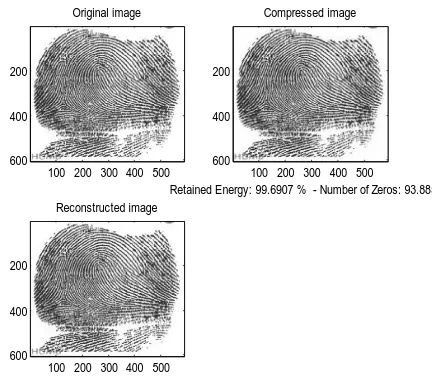
fingerprint image was reconstructed from the resulting array of coefficients using the inverse 2D-discrete wavelet transform (IDWT). The visual output of fingerprint image following the analysis, that is, display of original, reconstructed and compressed images from the MATLAB toolbox are depicted for db4and coif4 wavelet bases in Figure 4.2 to 4.3.
Fig.4.2. Estimation of RE (%) and NZ (%) in Wavelet Approximated Fingerprint Image using Daubechies Order
4 (db4) at Decomposition Level Three
Fig.4.3. Estimation of RE (%) and NZ (%) in Wavelet Approximated Fingerprint Image using Coiflet Order 4
(coif4) at Decomposition Level Three
V.
R
ESULTS ANDD
ISCUSSIONSResults of the performance analysis of biometric fingerprint image approximation and compression using orthogonal Coiflet and Daubechies wavelets bases for image approximation are shown in Tables 5.1 and 5.2 respectively. The analysis involved fingerprint image decomposition, thresholding, compression and reconstruction. The analysis was conducted on the basis of the measures of percentage retained energy, RE (%) and
the percentage number of zero NZ (%) resulting from the analysis process.
Table 5.1: Results of RE (%) and NZ (%) for orthogonal Coiflet wavelets
Decomp. Level
Wavelet Bases
coif2 coif3 coif4
NZ (%)
RE (%)
NZ (%)
RE (%)
NZ (%)
RE (%) 1 51.13 99.99 51.13 99.99 51.13 99.99 2 83.77 99.91 83.25 99.94 82.89 99.95 3 94.77 99.32 94.34 99.57 93.88 99.69
Table 5.2: Results of RE (%) and NZ (%) for orthogonal Daubechies wavelets
Decomp. Level
Wavelet Bases
db2 db3 db4
NZ (%)
RE (%)
NZ (%)
RE (%)
NZ (%)
RE (%) 1 51.13 99.98 51.13 99.99 51.13 99.99 2 84.38 99.74 99.86 84.15 84.07 99.89 3 95.34 98.45 95.21 98.91 95.14 99.15
The results of the comparative performance analysis as depicted in Tables 5.1 and 5.2showed that in terms of the percentage retained energy RE (%), the analysis produced high values for Coiflet wavelet, especially at higher image decomposition levels 2 and 3. At wavelet decomposition level one, the two wavelet bases have the same values for RE (%) and NZ (%) for the three wavelet orders investigated (orders2, 3 and 4). However, decomposition level three is the level of interest as it is the level at which 8 bits source fingerprint image is completely decomposed. At level three, the RE (%) values for Coiflets ranged from 99.32% to 99.69% whereas the RE (%) values for Daubechies ranged from 98.45% to 98.91%. This result is significant in the sense that Coiflet wavelets exhibited higher energy retention capacity than Daubechies wavelet. This is due to the fact that Coiflet wavelet has the property of symmetry and Daubechies wavelet does not. This means that the capacity of Coiflet wavelet for higher image energy retention will enable the realization of compression algorithm with a lower image distortion than Daubechies. Consequently, compressed image with higher perceptual quality is possible with Coiflet wavelet image approximation than that of Daubechies wavelet.
Additionally, it is evident in the results that as the number of vanishing moment or wavelet order of the investigated wavelets and the decomposition level increased the increase in RE (%) values for Coiflet wavelet became more evident than that of Daubechies wavelet. The results also revealed higher values of NZ (%) for Daubechies wavelet than Coiflet wavelet with the value range of 95.14% to 95.34% for Daubechies and 93.88 to 94.77% for Coiflets. These results showed that more insignificant coefficients can be truncated to zero with Daubechies wavelet than Coiflet and this possibility makes the lossy character of the proposed compression algorithm using Daubechies more pronounced. Hence, the distortion rate is higher in Daubechies wavelet. The bar chart plots of the RE (%) and NZ (%) results for
Original image
100 200 300 400 500 200
400
600
Compressed image
Retained Energy: 99.1547 % - Number of Zeros: 95.1412 % 100 200 300 400 500
200
400
600
Reconstructed image
100 200 300 400 500 200
400
600
Original image
100 200 300 400 500 200
400
600
Compressed image
Retained Energy: 99.6907 % - Number of Zeros: 93.885 % 100 200 300 400 500
200
400
600
Reconstructed image
100 200 300 400 500 200
400
decomposition level three for Daubechies and Coiflet wavelet bases are shown in Figures 5.1 to 5.2.
Fig.5.1. Estimation of RE (%) in wavelet approximated fingerprint image using Daubechies and Coiflet wavelet
bases at decomposition level three
Fig.5.2. Estimation of NZ (%) in wavelet approximated fingerprint image using Daubechies and Coiflet wavelet
bases at decomposition level three
VI.
C
ONCLUSIONIn this research work, a comparative performance analysis of orthogonal Daubechies and Coiflet wavelet filter banks for fingerprint image approximation was conducted. Performance of wavelet filters was evaluated on the basis of NZ (%) and RE (%) estimates. Coiflet wavelet was found to exhibit higher energy retention capacity than Daubechies wavelet. This means that the capacity of Coiflet wavelet for higher image energy retention will enable the realization of a compression algorithm with minimal image quality loss than Daubechies. Consequently, compressed image with higher perceptual quality is possible with Coiflet wavelet image approximation than with Daubechies wavelet.
R
EFERENCES[1] Gonzalez, R. C. and Woods, R. E. (2002) Digital Image
Processing, 2rd Edition, Prentice Hall, Upper Saddle River, New
Jersey, pp. 411-486
[2] Mallat, S. (2009) A wavelet tour of signal processing: The sparse
way, 3rd Edition, Elsevier Inc., Burlington MA, USA
[3] Kumar, D. et al (2013) A Comparative Analysis of Different
Wavelets for Enhancing Medical Ultrasound Images;
International Journal of Computer Applications, Vol. 66, No.7,
pp 7-11: Retrieved from http://research.ijcaonline.org/
volume66/number7/ pxc3885768.pdf in March 2014
[4] Iqbal, F. (2004) Wavelet transform based image compression on
FPGA, MSc Thesis, University of Florida, USA: Retrieved from http://diginole.lib.fsu.edu/cgi/viewcontent.cgi?article=2179& context=etd in June 2013
[5] Misiti, M. et al (1996) Wavelet Toolbox for use with MATLAB:
User Guide, The MathWork, USA: Retrieved fromhttp://www.mathworks.com/help/pdf_doc/wavelet/wavelet_ ug.pdf in September 2012
[6] Strang, G. and Nguyen, T. (1996) Wavelets and filter banks,
Wellesley-Cambridge Press, Massachusetts, USA
[7] Luo, G. and Zhang, D. (2012) Wavelet Denoising: Advances in
Wavelet Theory and Their Applications in Engineering, Physics and Technology, Dumitru Baleanu (Ed.), ISBN: 978-953-51-0494-0, In Tech, Retrieved from: http://www.intechopen.com/
books/advances-in-wavelet-theory-and-their-applications-in-engineering-physics-and-technology/wavelet-denoising in
February 2014
[8] Birge, L. and Massart, P. (1997) From model selection to
adaptive estimation; In Festschrift for Lucien Le Cam: Research papers in probability and statistics, 55-88, Springer-Verlag, New York: Retrieved from http://www.stat.yale.edu/~pollard/Books/ LeCamFest/ BirgeMassart.pdf in February 2014
[9] Islam, M. R. et al (2012) Performance analysis of Coiflet-type
wavelets for a fingerprint image compression by using wavelet and wavelet packet transform, International Journal of Computer Science & Engineering Survey(IJCSES), Vol. 3, No. 2, pp.
79-87; Retrieved from http://airccse.org/journal/ijcses/papers/
3212ijcses09.pdf in February 2013
[10] Ashok, J. et al (2010) Wave atoms decomposition based
fingerprint image compression, IJCSNS, Vol. 10, No. 9, pp. 57-61.
[11] Kumar, C. et al (2010) Compression algorithm by using
wavelets, International Journal of Engineering Science and Technology, Vol. 2, No. 10, pp. 4978-4982
[12] Krishnaiah, G. C. et al (2011) Evolved wavelets for improved
fingerprint compression, IJCST, Vol. 2, No. 3, 361-366
[13] Mushen, Z., Dababneh, M., Al Nsour, A. (2011) Wavelet and
optimal re-quantization methodology for lossy fingerprint compression, International Arab Journal of Information Technology, Vol. 8, No. 4, pp. 383-387
[14] Gangwar, D. K. (2012) Compression and development analysis
on an image using Haar wavelet transform, IJATER, Vol. 2 No. 3, pp225-229
[15] Shakhakarmi, N. (2012) Quantitative multiscale analysis using
different wavelets in 1D voice signal and 2D image, IJCSI International Journal of Computer Science, Vol 9, No. 2, Accessed from http://www.IJCSI.org on April 2013
[16] Libert, J. M. et al (2012) Comparison of the WSQ and JPEG
2000Image Compression Algorithms On 500 ppi Fingerprint Imagery, NIST Interagency Report 7781, Retrieved from http://www.nist.gov/customcf/get_pdf.cfm ?pub_id=910658 on April 2013
[17] Shanavaz, K.T. and Mythili, P. (2012) Faster techniques to
evolve wavelet coefficients for better fingerprint image compression, International Journal of Electronics, Vol. 100 No 5,
accessed from http://www.tandfonline.com/doi/pdf/10.1080/
00207217.2012. 720944 on April 2013
[18] Singla, N. and Sharma, S (2013) A Review on Wavelet based
Compression using Medical Images; International Journal of Innovative Research in Computer and Communication Engineering, IJIRCCE; Vol. 1, Issue 8; pp 1649-1653: Retrieved from http://ijircce.com/upload/ 2013/october/7AReview.pdf in March 2014.
[19] NIST (2011) WSQ Fingerprint Image Compression
Copyright © 2014 IJECCE, All right reserved
A
UTHORS’
P
ROFILEB. S. Emmanuel
is a Ph.D. candidate of the Department of Electrical
and Computer Engineering, Ahmadu Bello
University, Zaria, Nigeria. He holds M.Sc. in Microprocessor and Control Engineering from the University of Ibadan and his research interest is in the areas of digital signal processing and digital control systems.
Email: [email protected]
Dr. M. B. Mu’azu
is a Reader and the Head of Department of Electrical
and Computer Engineering, Ahmadu Bello
University, Zaria, Nigeria. He holds PhD in Electrical Engineering and his research interest is in the areas of control engineering and communications. Email: [email protected]
Dr. S. M. Sani
is a Senior Lecturer with the Department of Electrical
and Computer Engineering, Ahmadu Bello
University, Zaria, Nigeria. He holds B.Sc (Hons.) in
Communications Engineering from Plymouth
Polytechnic and M.Sc in Telecommunications from University of Essex, United Kingdom. He also holds Diplôme D’Etude Approfondies (optique, optoelectronique, microondes): ENSERG and Diplôme de Docteur (optique, optoelectronique, microondes): INPG, Grenoble, France. His research interest is in the areas of digital signal and image processing; propagation studies in the
wireless and mobile communication environments, green
communications and spectrum efficiency techniques. Email: [email protected].
Dr. S. Garba
holds a PhD in Electrical Engineering and heis a Senior Lecturer with the Department of Electrical
and Computer Engineering, Ahmadu Bello
University, Zaria, Nigeria. His research interest is in
the areas of wireless communications and