DOI: 10.7324/JAPS.2020.101015 ISSN 2231-3354
Association of the Val66met polymorphism and risk of obesity,
systematic review and meta-analysis
Aqil M. Daher
1*, Halyna Lugova
1, Methil Kannan Kutty
2, Igor Khalin
11Faculty of Medicine and Defence Health, National Defence University of Malaysia, Kuala Lumpur, Malaysia. 2Lincolin University College, Petaling Jaya, Selangor, Malaysia.
ARTICLE INFO
Received on: 20/08/2019 Accepted on: 21/10/2019 Available online: 03/01/2020Key words: Val66Met, obesity, meta-analysis.
ABSTRACT
Single nucleotide polymorphism of brain derived neurotropic factor gene, also known as Val66Met or rs6562, was found to be linked to obesity. However, reports on the link between this gene variant and obesity in Caucasian and Asian populations are inconsistent. A meta-analysis was, therefore, performed to determine the association between Val66Met polymorphism and the risk of obesity.Electronic databases, including Embase, CINAHL, and PubMed, were searched for relevant studies published before November 2018. Random effects model was used to calculate the pooled estimate based on the heterogeneity test results. Data were obtained from 11 studies involving 13,153 individuals with obesity and 18,689 non-obese individuals. The overall estimated odds ratio did not support the proposed association (OR 0.9, 95% CI 0.793–1.136). Stratified analysis, however, showed that Val/Val genotype is associated with increased risk of obesity among adults (OR 1.135, 95% CI 1.001–1.286) but associated with a reduced risk among adolescents (OR 0.61, 95% CI = 0.376, 0.984). The results highlight the role of confounding factors that need to be addressed when making inference.
INTRODUCTION
The prevalence of obesity has reached alarming
proportions with more than
39% of adults aged 18 years and
above being overweight and 13% as obese in 2014 (
WHO, 2014a
).
Childhood obesity likewise also shows an increasing trend.
In
2013, the number of overweight children under the age of 5 years
was estimated to be over 42 million (
WHO, 2014b
). The cost of
treating obesity and associated comorbidities, and prevention
programs has become onerous to all nations in the world (
Wang
et al., 2011
).
The crucial role of gene mutation/polymorphism in
obesity is evident from a plethora of published reports. Genome
wide-linkage studies provided evidence that around 253 trait loci
implicated in obesity-linked phenotypes (
Meyre et al., 2010
).
Accumulating evidence suggests that common genetic
variants or single-nucleotide polymorphisms (SNPs) may be
a contributing factor to the obesity epidemic. Brain derived
neurotropic factor (BDNF) is a type of neurotrophin encoded by the
BDNF gene. This protein supports the growth and differentiation
of neurons in the central nervous system. Although the function of
BDNF is related to long-term memory, neuroplasticity, and growth
of neurons (
Khalin et al., 2015
), a polymorphism of its gene was
found to be related to obesity, where it was thought to suppress
food
intake through hippocampal signaling (
El-Gharbawy et al., 2006
;
Monteleone
et al., 2004
). The rs6265, also known as Val66Met,
is a single nucleotide Polymorphisim (SNP) of BDNF gene found
to be linked to obesity. The more common G allele encodes for
Valine (Val), while the A allele encodes for Methionine (Met).
Accordingly, three genotypes emerge, GG (or Val/Val), AA (or
Met/Met and GA (or Val/Met).
BDNF Val66met polymorphism has been associated with
disorders, such as Schizophrenia (
Eisenberg et al., 2013
;
Gratacòs
et al., 2007
;
Suchanek
et al., 2013
), depression (
Hosang
et al.,
2014
), anxiety (
Chen
et al., 2006
), eating disorders (
Gratacòs
et al., 2007
), and some other disorders like sleeping disorder and
tardive dyskinesia (
Bachmann
et al., 2012
;
Miura
et al., 2014
).
© 2020 Aqil M. Daher et al. This is an open access article distributed under the terms of the Creative Commons Attribution 4.0 International License (https://creativecommons.org/licenses/by/4.0/).
*Corresponding Author
Aqil M. Daher, Faculty of Medicine and Defence Health, National Defence University of Malaysia, Kuala Lumpur, Malaysia.
Daher et al. / Journal of Applied Pharmaceutical Science 10 (1); 2020: 108-115 109
However, considerable attention has been given to its potential
association with obesity among the different populations (
Beckers
et al., 2008
;
Friedel et al., 2005
;
Hotta et al., 2009
;
Ja’afaruSani
et al., 2012
;
León-Mimila et al., 2013
;
Marti et al., 2009
;
Morales-Marín
et al., 2016
;
Perkovic
et al., 2013
;
Skledar et al., 2012
;
Sustar et al., 2016
;
Thorleifsson et al., 2009
;
Timpano et al., 2011
;
Xi et al., 2011
).
Generally, SNPs have modest impact on individual
susceptibility to common forms of obesity, but due to their high
frequency, they may have a large contribution to obesity in a
given population (
Lyon and Hirschhorn, 2005
). The positive link
betweenVal66Met and obesity was not ascertained in all published
reports. Small sample size of the individual studies may have
limited the power and generalizability of the findings. Thus, this
meta-analysis was performed to ascertain the association between
rs6562 and obesity.
MATERIALS AND METHODS
Search strategy
Two independent researchers conducted the search of
the relevant articles in three major databases, Embase, CINHAL,
and PubMed, using a different combination of the following
keywords that paired “Val66Met,” “rs6265,” “G196A,” “BDNF,”
and “SNP” with “obesity,” and separately, with “BMI.” A third
researcher cross-checked and validated the articles selected from
the databases. Any disagreement was discussed and resolved
by the researchers. After the initial screening of the articles for
inclusion criteria, a manual search of the lists of extracted articles
was done to ensure better coverage of the topic. In addition, the
literature search was supplemented by utilizing Google Scholar.
Direct contacts were made with four authors to clarify the results.
The literature search was updated in November 2018.
Study eligibility and selection criteria
We assessed the quality of each study based on the
contents, methodology, and appropriateness for inclusion.
Inclusion criteria were as follows: 1) observational studies; 2)
studies examining the relationship between BDNF Val66Met
polymorphism (including genotype and allele frequencies)
and the risk of obesity; 3) studies reporting the measure of
association as odds ratio (OR); and 4) studies in English. Studies
on eating disorders or animal or experimental studies, reviews,
meta-analysis, editorials, abstract, and unpublished reports were
excluded.
Data extraction
Data including the authors’ name, year of publication,
country (ethnicity), age (mean and SD), number of participants,
genotype, and allele frequency distribution according to the
obesity status, measure of association reported as OR and 95%
confidence interval (CI) were extracted whenever available.
Statistical analyses
The OR with 95% CI from the selected studies was used
to assess the association of obesity and Val66Metpolymorphism.
Data from individual studies were extracted for calculation of OR as
the effect size of interest. The Val/Val genotype was used as the test
group, while Met allele (Met/Met + Val/Met) served as a reference
group. Forest plot was used to depict the individual studies and
pooled effect size. Random effects model was used to calculate
the pooled estimate. Heterogeneity was assessed with Tau-squared,
which reflects variance of true effect sizes, and
I
2statistic, which
reflects the percentage of variation among true effect sizes not due
to sampling error (
Higgins and Thompson, 2002
). A p value of less
than <0.05 was indicative of significant heterogeneity among the
studies. Publication bias was assessed through funnel plot along
with Begg’s and Egger’s regression statistics. Sensitivity analysis
was performed using sequential omission of individual studies
in every comparison. All data were entered and analyzed using
comprehensive meta-analysis software v.2.
RESULTS
The initial search yielded 912 records. Screening by title
resulted in 108 records related to the keywords. After examining
abstracts from each of the records, we excluded 31 articles that
were unrelated to val66met gene and 27 reports on disorders other
than obesity. Another 20 reports were excluded as they were either
reviews, meta-analyses, animal studies, and abstracts or being
written in a language other than English.
The total number of full-text articles, which were eligible
for data extraction, was 30. Out of the 30 studies, 16 studies were
excluded as they did not include reports on the association between
Val66Met polymorphism (including genotype/allele frequency)
and obesity. Further exclusion included studies in which the
measure of association was either ambiguous (
León-Mimila et al.,
2013
) or rejected by the software due to problematic confidence
interval of the odds ratio (
Timpano et al., 2011
;
Wu et al., 2010
) or
where the authors did not reply to our queries, leaving 11 eligible
studies for the meta-analysis (
Fig. 1
).
Characteristics of the participating studies
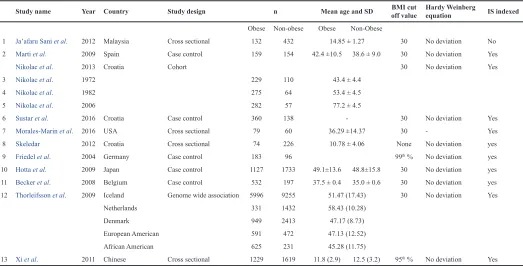
The characteristics of individual studies are shown in
Table 1
. Most of the studies were conducted on adults except for
four studies (
Friedel et al., 2005
;
Ja’afaruSani et al., 2012
;
Skledar
et al., 2012
;
Xi et al., 2011
), which were conducted on adolescents.
Participants in three of the studies were Asians (
Hotta et al., 2009
;
Ja’afaruSani et al., 2012
;
Wang
et al., 2011
) and the rest were
Caucasians and or Americans.
Perkovic et al. (2013)
reported data
from three different time periods and were considered individually,
while
Beckers et al. (2008)
reported data from a sample of female
subjects. All studies had reported in frequency tables that allowed
for computation of OR except (
Thorleifsson et al., 2009
) who only
reported an adjusted OR. In total, 11 studies involving 13,153
individuals with obesity and 18,689 non-obese individuals were
included in this analysis.
Association of val66met and obesity
Figure 1. Flow diagram of study selection.
Table 1. Characteristics of individual studies.
Study name Year Country Study design n Mean age and SD BMI cut off value Hardy Weinberg equation IS indexed
Obese Non-obese Obese Non-Obese
1 Ja’afaru Sani et al. 2012 Malaysia Cross sectional 132 432 14.85 ± 1.27 30 No deviation No
2 Marti et al. 2009 Spain Case control 159 154 42.4 ±10.5 38.6 ± 9.0 30 No deviation Yes
Nikolac et al. 2013 Croatia Cohort 30 No deviation Yes
3 Nikolac et al. 1972 229 110 43.4 ± 4.4
4 Nikolac et al. 1982 275 64 53.4 ± 4.5
5 Nikolac et al. 2006 282 57 77.2 ± 4.5
6 Sustar et al. 2016 Croatia Case control 360 138 - 30 No deviation Yes
7 Morales-Marin et al. 2016 USA Cross sectional 79 60 36.29 ±14.37 30 - Yes
8 Skeledar 2012 Croatia Cross sectional 74 226 10.78 ± 4.06 None No deviation yes
9 Friedel et al. 2004 Germany Case control 183 96 99th % No deviation yes
10 Hotta et al. 2009 Japan Case control 1127 1733 49.1±13.6 48.8±15.8 30 No deviation yes
11 Becker et al. 2008 Belgium Case control 532 197 37.5 ± 0.4 35.0 ± 0.6 30 No deviation yes
12 Thorleifsson et al. 2009 Iceland Genome wide association 5996 9255 51.47 (17.43) 30 No deviation Yes
Netherlands 331 1432 58.43 (10.28)
Denmark 949 2413 47.17 (8.73)
European American 591 472 47.13 (12.52)
African American 625 231 45.28 (11.75)
Daher et al. / Journal of Applied Pharmaceutical Science 10 (1); 2020: 108-115 111
Heterogeneity and sensitivity analysis
Table 2
shows heterogeneity statistics. The variance
(Tau-squared) and the proportion of variation of true effect not
attributed to random error (I
2statistic) were higher for combined
analysis. Nonetheless, the variance and I
2were reduced after
stratification and were the lowest among studies on the adults.
Moreover, omission of the study by
Ja’afaruSani
et al. (2012)
substantially reduced heterogeneity and variance among adolescent
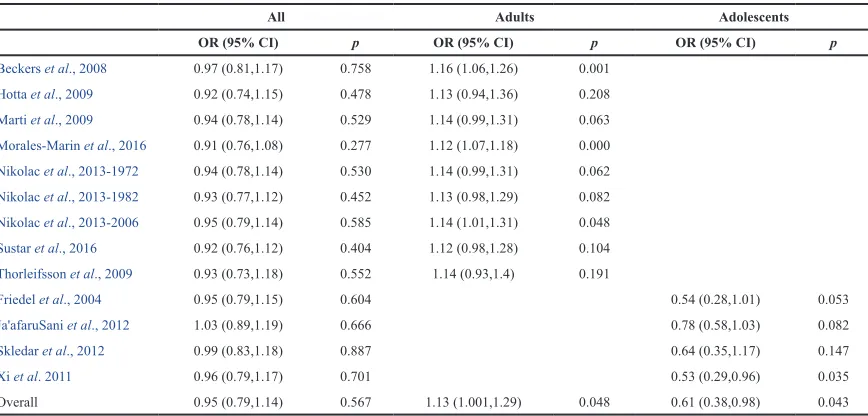
studies. With respect to sensitivity analysis, although the 95% CI
and p value have only minimally changed with the exclusion of
some studies, the magnitude of OR was not appreciably affected
(
Table 3
).
Publication bias
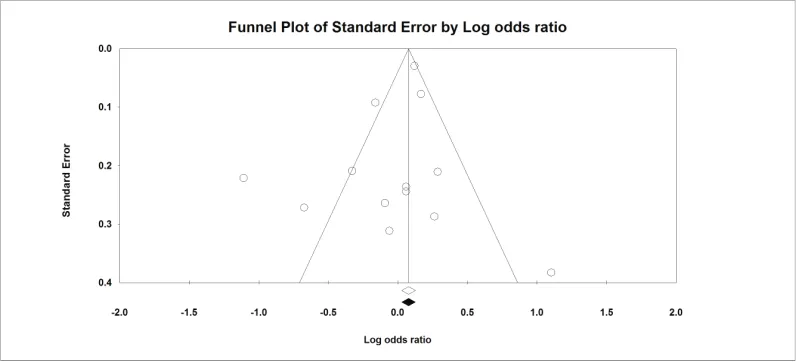
Funnel plot shows some asymmetry (
Figs. 5–7
)
indicating some degree of publication bias. However, Begg’s and
Egger’s p values were greater than 0.05.
DISCUSSION
Successful intervention is undoubtedly based on
evidence-based practice. Meta-analysis is acknowledged as being
amongst the highest levels of evidence (
Burns
et al., 2011
). It
could also provide a tool for clinicians and public health specialists
to design proper interventions that could help curb the escalating
incidence of obesity.
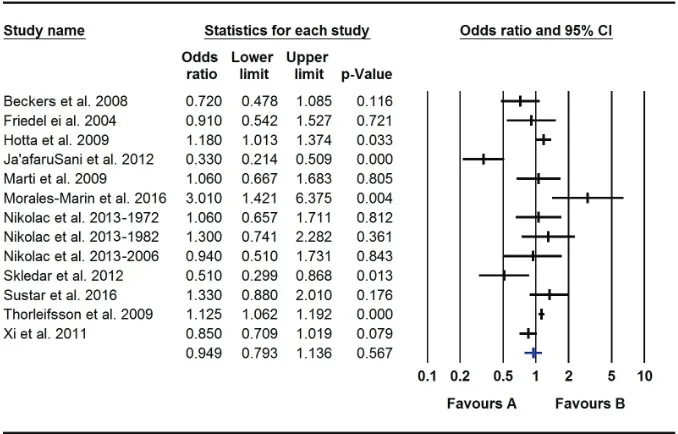
Figure 2. Forest plot-all studies.
In this study, the results of meta-analysis support the
association of obesity with Val66Met polymorphism that is
confounded by age.
The random effects model was used to calculate the
pooled estimate on assumption of variation among the studies
included in this review (
Borenstein
et al., 2007
). The analysis
included different study designs and on mixed populations.
Thus, I
2statistic showed that there was a considerable amount
of variation among studies that is not attributed to random error.
Heterogeneity is inevitable in meta-analysis (
Huedo-Medina
et al., 2006
) and it might indicate the presence of a factor with
differential impact, as was the case in this study. Stratified
analysis by age group reduced the true variance (tua-squared)
and also reduced the I
2whereby apparently identifying a source
of heterogeneity. It identified age as an important factor to be
considered when making an inference. In addition, it also
showed that omission of the study performed by
Ja’afaruSani
et al. (2012)
did not significantly influence the pooled estimate,
but affected the measure of heterogeneity. The claim that a
significant association of Met allele and obesity is only applicable
to female gender was not evident in Ja’afaruSani et al’s study.
This might question the validity of such results. In general, with
Figure 4. Forest plot- adolescents.
Table 2. Heterogeneity indices.
Population Pooled OR 95% CI Tau-squared I2
All 0.949 (0.79,1.14) 0.065 79.73
Adult 1.14 (1.01,1.29) 0.010 37.73
Children 0.61 (0.38,0.98) 0.193 83.85
Children* 0.776 (0.583,1.032) 0.028 40.47
*Ja’afaru Sani et al. removed.
Table 3. Sensitivity analysis.
All Adults Adolescents
OR (95% CI) p OR (95% CI) p OR (95% CI) p
Beckers et al., 2008 0.97 (0.81,1.17) 0.758 1.16 (1.06,1.26) 0.001
Hotta et al., 2009 0.92 (0.74,1.15) 0.478 1.13 (0.94,1.36) 0.208
Marti et al., 2009 0.94 (0.78,1.14) 0.529 1.14 (0.99,1.31) 0.063
Morales-Marin et al., 2016 0.91 (0.76,1.08) 0.277 1.12 (1.07,1.18) 0.000
Nikolac et al., 2013-1972 0.94 (0.78,1.14) 0.530 1.14 (0.99,1.31) 0.062
Nikolac et al., 2013-1982 0.93 (0.77,1.12) 0.452 1.13 (0.98,1.29) 0.082
Nikolac et al., 2013-2006 0.95 (0.79,1.14) 0.585 1.14 (1.01,1.31) 0.048
Sustar et al., 2016 0.92 (0.76,1.12) 0.404 1.12 (0.98,1.28) 0.104
Thorleifsson et al., 2009 0.93 (0.73,1.18) 0.552 1.14 (0.93,1.4) 0.191
Friedel et al., 2004 0.95 (0.79,1.15) 0.604 0.54 (0.28,1.01) 0.053
Ja'afaruSani et al., 2012 1.03 (0.89,1.19) 0.666 0.78 (0.58,1.03) 0.082
Skledar et al., 2012 0.99 (0.83,1.18) 0.887 0.64 (0.35,1.17) 0.147
Xi et al. 2011 0.96 (0.79,1.17) 0.701 0.53 (0.29,0.96) 0.035
Daher et al. / Journal of Applied Pharmaceutical Science 10 (1); 2020: 108-115 113
Figure 5. Funnel plot-all.
Figure 6. Funnel plot-adults.
a limited number of studies, publication bias may be anticipated
(
Copas and Shi, 2000
). However, such bias was not evident in
our study as the studies included in this analysis have shown
contradicting results.
BDNF was found to regulate body weight by suppressing
appetite in mice (
Lapchak and Hefti, 1992
;
Pelleymounter et al.,
1995
). Studies in human and rodents have further confirmed
the dominant role of BDNF and TrKB in the control of energy
balance. In mice, global BDNF down regulation increased feeding
and body weight (
Kernie et al., 2000
;
Rios, 2013
;
Xu et al., 2003
).
Selective deletion of BDNF in the ventromedial and dorsomedial
hypothalamus caused hyperphagia and obesity in adult mice (
An
et al., 2015
;
Kernie et al., 2000
;
Rios et al., 2001
).
Adding to the impact of BDNF gene mutation on body
weight, the polygenic nature of obesity itself makes it difficult to
identify a single most influential gene. Nonetheless, the genetic
differences of obesity have been replicated from different world
populations (
Lyon and Hirschhorn, 2005
). This signifies the
complex interaction of several factors in the causation of obesity
including an individual’s phenotype and disease risk factors other
than BDNF.
It is relevant to acknowledge that the magnitude of
effect size plays an important role in deciding whether the result
is applicable for prognostic or diagnostic purposes (
Chen
et al.,
2010
).
Jakobsdottir et al’s (2009
) logical illustration pointed out
that a good genetic marker should be a good classifier (large
enough) to discriminate between cases and control, which means
high specificity of the applied markers. Nonetheless, the estimated
OR in this study was not sizable and it is in tandem with most
genetic studies.
Although we had taken all necessary precautions to
ensure reliability of the results, few limitations were inevitable.
First, we could not perform gender specific or age specific analysis
due to lack of such information from participating studies.
Several studies have reported sexual dysmorphism with particular
reference to several factors implicated in obesity. Thus, there is a
need to look into this aspect. Second, we only were able to perform
analysis with recessive model due to the nature of extracted data.
Last, most of the data emerged from Caucasian populations. This
might be attributed to a high frequency of gene mutation in the
Caucasians compared to the Asians. In conclusion, our findings
add to evidence of genetic contribution to obesity and highlight
the impact of age as a factor that might influence the interpretation.
ACKNOWLEDGMENT
The authors wish to extend their thanks to the librarians
at National Defence University of Malaysia for their valuable
assistance with the databases search.
FINANCIAL SUPPORT
None.
CONFLICT OF INTEREST
Authors declare that they have no conflicts of interest.
REFERENCES
An JJ, Liao G-Y, Kinney CE, Sahibzada N, Xu B. Discrete BDNF neurons in the paraventricular hypothalamus control feeding and energy expenditure. Cell Metab, 2015; 22(1):175–88.
Bachmann V, Klein C, Bodenmann S, Schäfer N, Berger W, Brugger P, Landolt HP. The BDNF Val66Met polymorphism modulates sleep intensity: EEG frequency-and state-specificity. Sleep, 2012; 35(3):335–44. Beckers S, Peeters A, Zegers D, Mertens I, Van Gaal L, Van Hul W. Association of the BDNF Val66Met variation with obesity in women. Mol Genet Metab, 2008; 95(1–2):110–2.
Borenstein M, Hedges L, Rothstein H. Meta-analysis: Fixed effect vs. random effects, 2007. Available via Meta-analysis. com
Burns PB, Rohrich RJ, Chung KC. The levels of evidence and their role in evidence-based medicine. Plast Reconstr Surg, 2011; 128(1):305.
Chen H, Cohen P, Chen S. How big is a big odds ratio? Interpreting the magnitudes of odds ratios in epidemiological studies. Commun Stat Simul Comput, 2010; 39(4):860–4.
Chen Z, Jing D, Bath K G, Ieraci A, Khan T, Siao C-J, Herrera DG, Toth M, Yang C, McEwen BS, Hempstead BL, Lee FS. Genetic variant BDNF (Val66Met) polymorphism alters anxiety-related behavior. Science,2006; 314(5796):140–3.
Copas J, Shi J Q. Meta-analysis, funnel plots and sensitivity analysis. Biostatistics, 2000; 1(3):247–62.
Eisenberg DP, Ianni AM, Wei S-M, Kohn PD, Kolachana B, Apud J, Weinberger DR, Berman KF. Brain-derived neurotrophic factor (BDNF) Val 66 Met polymorphism differentially predicts hippocampal function in medication-free patients with schizophrenia. Mol Psychiatry, 2013; 18(6):713.
El-Gharbawy AH, Adler-Wailes DC, Mirch MC, Theim KR, Ranzenhofer L, Tanofsky-Kraff M, Yanovski JA. Serum brain-derived neurotrophic factor concentrations in lean and overweight children and adolescents. J Clin Endocrinol Metab, 2006; 91(9):3548–52.
Friedel S, Fontenla Horro F, Wermter A, Geller F, Dempfle A, Reichwald K, Smidt J, Brönner G, Konrad K, Herpertz-Dahlmann B, Warnke A, Hemminger U, Linder M, Kiefl H, Goldschmidt HP, Siegfried W, Remschmidt H, Hinney A, Hebebrand J. Mutation screen of the brain derived neurotrophic factor gene (BDNF): identification of several genetic variants and association studies in patients with obesity, eating disorders, and attention-deficit/hyperactivity disorder. Am J Med Genet B Neuropsychiatr Genet, 2005; 132(1):96–9.
Gratacòs M, González JR, Mercader JM, de Cid R, Urretavizcaya M, Estivill X. Brain-derived neurotrophic factor Val66Met and psychiatric disorders: meta-analysis of case-control studies confirm association to substance-related disorders, eating disorders, and schizophrenia. Biol Psychiatry, 2007; 61(7):911–22.
Higgins J, Thompson S. Quantifying heterogeneity in a meta-analysis. Stat Med, 2002; 21(11):1539–58.
Hosang GM, Shiles C, Tansey KE, McGuffin P, Uher R. Interaction between stress and the BDNF Val66Met polymorphism in depression: a systematic review and meta-analysis. BMC Med, 2014; 12(1):7.
Hotta K, Nakamura M, Nakamura T, Matsuo T, Nakata Y, Kamohara S, Miyatake N, Kotani K, Komatsu R, Itoh N, Mineo I, Wada J, Masuzaki H, Yoneda M, Nakajima A, Funahashi T, Miyazaki S, Tokunaga K, Kawamoto M, Ueno T, Hamaguchi K, Tanaka K, Yamada K, Hanafusa T, Oikawa S, Yoshimatsu H, Nakao K, Sakata T, Matsuzawa Y, Kamatani N, Nakamura Y. Association between obesity and polymorphisms in SEC16B, TMEM18, GNPDA2, BDNF, FAIM2 and MC4R in a Japanese population. J Hum Genet, 2009; 54(12):727.
Huedo-Medina TB, Sánchez-Meca J, Marín-Martínez F, Botella J. Assessing heterogeneity in meta-analysis: Q statistic or I² index? Psychol Methods, 2006; 11(2):193.
Ja’afaruSani M, Hauwa’u YB, Maimuna Z, Renee LLH. Association of Brain-Derived Neurotrophic Factor (BDNF) Variant (rs6265) with Overweight/Obesity or Overfatness, and Effect of Physical Activity Levels in Adolescents Population International Journal of Science and Research. 2012;3 (10):508–14.
Daher et al. / Journal of Applied Pharmaceutical Science 10 (1); 2020: 108-115 115
highly significant odds ratios may be poor classifiers. PLoS Genet, 2009; 5(2):e1000337.
Kernie SG, Liebl DJ, Parada LF. BDNF regulates eating behavior and locomotor activity in mice. EMBO J, 2000; 19(6):1290–300.
Khalin I, Alyautdin R, Kocherga G, Bakar MA. Targeted delivery of brain-derived neurotrophic factor for the treatment of blindness and deafness. Int J Nanomed, 2015; 10:3245.
Lapchak PA, Hefti F. BDNF and NGF treatment in lesioned rats: effects on cholinergic function and weight gain. Neuroreport, 1992; 3(5):405–8.
León-Mimila P, Villamil-Ramírez H, Villalobos-Comparán M, Villarreal-Molina T, Romero-Hidalgo S, López-Contreras B, Gutiérrez-Vidal R, Vega-Badillo J, Jacobo-Albavera L, Posadas-Romeros C, Canizalez-Román A, Río-Navarro BD, Campos-Pérez F, Acuña-Alonzo V, Aguilar-Salinas C, Canizales-Quinteros S. Contribution of common genetic variants to obesity and obesity-related traits in mexican children and adults. PLoS One, 2013; 8(8):e70640.
Lyon HN, Hirschhorn JN. Genetics of common forms of obesity: a brief overview.Am J Clin Nutr, 2005; 82(1):215S–7S.
Marti A, Santos J, Gratacos M, Moreno-Aliaga M, Maiz A, Martinez J, Estivill X. Association between leptin receptor (LEPR) and brain-derived neurotrophic factor (BDNF) gene variants and obesity: a case-control study. Nutr Neurosci, 2009; 12(4):183–8.
Meyre D, Proulx K, Kawagoe-Takaki H, Vatin V, Gutiérrez-Aguilar R, Lyon D, Ma M, Choquet H, Horber F, Van Hul W, Van Gaal L, Balkau B, Visvikis-Siest S, Pattou F, Farooqi IS, Saudek V, O'Rahilly S, Froguel P, Sedgwick B, Yeo GS. Prevalence of loss-of-function FTO mutations in lean and obese individuals. Diabetes,2010; 59(1):311–8.
Miura I, Zhang J-P, Nitta M, Lencz T, Kane JM, Malhotra AK, Yabe H, Correll CU. BDNF Val66Met polymorphism and antipsychotic-induced tardive dyskinesia occurrence and severity: a meta-analysis. Schizophr Res, 2014; 152(2–3):365–72.
Monteleone P, Tortorella A, Martiadis V, Serritella C, Fuschino A, Maj M. Opposite changes in the serum brain-derived neurotrophic factor in anorexia nervosa and obesity. Psychosomatic Med, 2004; 66(5): 744–8.
Morales-Marín ME, Genis-Mendoza AD, Tovilla-Zarate CA, Lanzagorta N, Escamilla M, Nicolini H. Association between obesity and the brain-derived neurotrophic factor gene polymorphism Val66Met in individuals with bipolar disorder in Mexican population. Neuropsychiatr Dis Treat, 2016; 12:1843.
Pelleymounter MA, Cullen MJ, Wellman CL. Characteristics of BDNF-induced weight loss. Exp Neurol, 1995; 131(2):229–38.
Perkovic MN, Mustapic M, Pavlovic M, Uzun S, Kozumplik O, Barisic I, Muck-Seler D, Pivac N. Lack of association between brain-derived neurotrophic factor Val66Met polymorphism and body mass index change over time in healthy adults. Neurosci Lett, 2013; 545:127–31.
Rios M. BDNF and the central control of feeding: accidental bystander or essential player? Trends Neurosci, 2013; 36(2):83–90.
Rios M, Fan G, Fekete C, Kelly J, Bates B, Kuehn R, Lechan RM, Jaenisch R. Conditional deletion of brain-derived neurotrophic factor in the postnatal brain leads to obesity and hyperactivity. Mol Endocrinol, 2001; 15(10):1748–57.
Skledar M, Nikolac M, Dodig-Curkovic K, Curkovic M, Borovecki F, Pivac N. Association between brain-derived neurotrophic factor Val66Met and obesity in children and adolescents. Prog Neuro-Psychopharmacol Biol Psychiatry, 2012; 36(1):136–40.
Suchanek R, Owczarek A, Paul-Samojedny M, Kowalczyk M, Kucia K, Kowalski J. BDNF val66met polymorphism is associated with age at onset and intensity of symptoms of paranoid schizophrenia in a Polish population. J Neuropsychiatry Clin Neurosci, 2013; 25(1):88–94.
Sustar A, Nikolac Perkovic M, Nedic Erjavec G, Svob Strac D, Pivac N. A protective effect of the BDNF Met/Met genotype in obesity in healthy Caucasian subjects but not in patients with coronary heart disease. Eur Rev Med Pharmacol Sci, 2016; 20(16):3417–26.
Thorleifsson G, Walters GB, Gudbjartsson DF, Steinthorsdottir V, Sulem P, Helgadottir A, Styrkarsdottir U, Gretarsdottir S, Thorlacius S, Jonsdottir I, Jonsdottir T, Olafsdottir EJ, Olafsdottir GH, Jonsson T, Jonsson F, Borch-Johnsen K, Hansen T, Andersen G, Jorgensen T, Lauritzen T, Aben KK, Verbeek AL, Roeleveld N, Kampman E, Yanek LR, Becker LC, Tryggvadottir L, Rafnar T, Becker DM, Gulcher J, Kiemeney LA, Pedersen O, Kong A, Thorsteinsdottir U, Stefansson K. Genome-wide association yields new sequence variants at seven loci that associate with measures of obesity. Nat Genet, 2009; 41(1):18.
Timpano KR, Schmidt NB, Wheaton MG, Wendland JR, Murphy DL. Consideration of the BDNF gene in relation to two phenotypes: hoarding and obesity. J Abnormal Psychol, 2011; 120(3):700.
Wang YC, McPherson K, Marsh T, Gortmaker SL, Brown M. Health and economic burden of the projected obesity trends in the USA and the UK. Lancet, 2011; 378(9793):815–25.
WHO. (2014a). Global health observatory. Available via http:// www.who.int/gho/ncd/risk_factors/obesity_text/en/ (Accessed 20 February 2018).
WHO. (2014b). Global strategy on diet, physical activity and health. Available via http://www.who.int/dietphysicalactivity/childhood/en/ (Accessed 20 February 2018).
Wu L, Xi B, Zhang M, Shen Y, Zhao X, Cheng H, Hou D, Sun D, Ott J, Wang X, Mi J. Associations of six single nucleotide polymorphisms in obesity-related genes with BMI and risk of obesity in Chinese children. Diabetes, 2010; 59(12):3085–9.
Xi B, Wang C, Wu L, Zhang M, Shen Y, Zhao X, Wang X, Mi J. Influence of physical inactivity on associations between single nucleotide polymorphisms and genetic predisposition to childhood obesity. Am J Epidemiol, 2011; 173(11):1256–62.
Xu B, Goulding EH, Zang K, Cepoi D, Cone RD, Jones KR, Tecott LH, Reichardt LF. Brain-derived neurotrophic factor regulates energy balance downstream of melanocortin-4 receptor. Nat Neurosci, 2003; 6(7):736.
How to cite this article: