Open Access
Study protocol
Optimising reproductive and child health outcomes by building
evidence-based research and practice in South East Asia
(SEA-ORCHID): study protocol
David J Henderson-Smart
1, Pisake Lumbiganon
2, Mario R Festin
3,
Jacqueline J Ho
4, Hakimi Mohammad
5, Steve J McDonald
6, Sally Green
6,
Caroline A Crowther*
7for the SEA-ORCHID Study Group
Address: 1NSW Centre for Perinatal Health Services Research, Queen Elizabeth ll Research Institute, University of Sydney, NSW 2006, Australia, 2Department of Obstetrics and Gynaecology, Khon Kaen University, Khon Kaen 40002, Thailand, 3Department of Obstetrics and Gynecology, College of Medicine, University of the Philippines Manila, Manila 1000, Philippines, 4Department of Paediatrics, Penang Medical College, Penang 10450, Malaysia, 5Department of Obstetrics and Gynecology, Gadjah Mada University, Yogyakarta 55281, Indonesia, 6Australasian Cochrane Centre, Monash University, Melbourne, VIC 3168, Australia and 7Discipline of Obstetrics and Gynaecology, University of Adelaide, SA 5006, Australia
Email: David J Henderson-Smart - [email protected]; Pisake Lumbiganon - [email protected]; Mario R Festin - [email protected]; Jacqueline J Ho - [email protected]; Hakimi Mohammad - [email protected]; Steve J McDonald - [email protected]; Sally Green - [email protected]; Caroline A Crowther* - [email protected]
* Corresponding author
Abstract
Background: Disorders related to pregnancy and childbirth are a major health issue in South East Asia. They represent one of the biggest health risk differentials between the developed and developing world. Our broad research question is: Can the health of mothers and babies in Thailand, Indonesia, the Philippines and Malaysia be improved by increasing the local capacity for the synthesis of research, implementation of effective interventions, and identification of gaps in knowledge needing further research?
Methods/Design: The project is a before-after study which planned to benefit from and extend existing regional and international networks. Over five years the project was designed to comprise five phases; pre-study, pre-intervention, intervention, outcome assessment and reporting/dissemination. The study was proposed to be conducted across seven project nodes: four in South East Asia and three in Australia. Each South East Asian study node was planned to be established within an existing department of obstetrics and gynaecology or neonatology and was intended to form the project coordinating centre and focus for evidence-based practice activities within that region. Nine hospitals in South East Asia planned to participate, representing a range of clinical settings. The three project nodes in Australia were intended to provide project support.
The intervention was planned to consist of capacity-strengthening activities targeted at three groups: generators of evidence, users of evidence and teachers of evidence. The primary outcome was established as changes in adherence to recommended clinical practices from baseline to completion of the project and impact on health outcomes.
Discussion: The SEA-ORCHID project was intended to improve care during pregnancy and the perinatal period of mothers and their babies in South East Asia. The possible benefits extend beyond this however, as at the end of this project there is hoped to be an existing network of South East Asian researchers and health care providers with the capacity to generalise this model to other health priority areas. It is anticipated that this project facilitate ongoing development of evidence-based practice and policy in South East Asia through attracting long-term funding, expansion into other hospitals and community-based care and the establishment of nodes in other countries.
Published: 24 September 2007
BMC Medical Research Methodology 2007, 7:43 doi:10.1186/1471-2288-7-43
Received: 9 August 2007 Accepted: 24 September 2007
This article is available from: http://www.biomedcentral.com/1471-2288/7/43
© 2007 Henderson-Smart et al; licensee BioMed Central Ltd.
Background
Importance of the health problem
Each year there are over half a million maternal deaths worldwide and 98 percent of these occur in the develop-ing world. This represents a tragic and strikdevelop-ing health risk differential between the developed and developing world. For women in Asia the lifetime risk of maternal death is one in 65 compared with one in 1,800 for women in developed countries [1].
The main causes of mortality directly related to pregnancy and childbirth are unsafe abortions, bleeding, infection, hypertension (including eclampsia) and obstructed labour [2]. The majority of maternal deaths occur after the birth but many are related to conditions that present ear-lier in pregnancy. Serious acute and chronic maternal morbidity has been estimated to occur in one in four women [3].
Perinatal and early infant deaths are also high in develop-ing countries. Each year there are almost eight million stillbirths and early neonatal deaths. These arise because of poor maternal health and pregnancy care. Associated morbidity manifests as low birth weight, asphyxia and infection [4].
The high rate of maternal, infant and child mortality in SE Asian countries has been associated with poverty, reduced education and literacy, lack of remunerative employment, low social status, and limited access to health services and family planning [5]. SE Asia accounts for one quarter of the world's population and more than half of the worlds poor. Solutions to these problems require an inter-secto-ral approach. This has been supported by many interna-tional bodies such as the World Health Organization, World Bank, United Nations Children's Fund and United Nations Population Fund.
Access to scientifically valid and up-to-date information is a prerequisite for allocation of resources according to evi-dence and need. Most health workers and policy-makers in developing countries do not have easy access to the lat-est reliable information on effective care or may not have the skills to evaluate and implement such evidence [6].
A variety of problems arise when clinical practices that are not based on sound scientific evidence are incorporated into established healthcare practice. Valuable resources continue to be used in some developing countries to fund practices of unknown effectiveness, for example electronic fetal monitoring during labour [7]. On the other hand, interventions that have been shown to be both cheap and effective, such as magnesium sulphate to prevent and treat eclampsia, have not been widely implemented [8]. In an empirical example of clinical practice being at odds with
published recommendations, a study conducted in six centres in SE Asia and two in the United States of America, demonstrated a large variation in the use of antibiotic prophylaxis in caesarean section, despite there being strong evidence supporting its use [9]. Only two of the eight participating centres routinely administered appro-priate regimens of antibiotics at the approappro-priate time.
Clearly a mechanism is needed to provide healthcare prac-titioners in the developing world with access to relevant evidence, a means of determining their own evidence requirements and the infrastructure to disseminate and implement clinical practice change based on that evi-dence. The effects of this provision then need to be evalu-ated to inform future initiatives aiming to improve health care.
Previous work instigating this project
The Cochrane Collaboration is an international organisa-tion of healthcare practiorganisa-tioners, researchers and consum-ers that prepares and disseminates systematic reviews of high quality evidence about the effects of healthcare inter-ventions [10]. The growth of the Cochrane Collaboration is well known, with over 3000 reviews published since 1995 and an estimated 11,500 contributors worldwide.
However, this growth has been predominantly in the developed world, and a key objective of the Cochrane Collaboration is to ensure growth of this research activity in the developing world. The Cochrane Developing Coun-tries Network has been established to pursue strategies for encouraging the involvement of contributors from low-and middle-income countries, both in producing reviews and in implementing their findings. In 2004, the level of developing country involvement in the Cochrane Preg-nancy and Childbirth Group was modest, with 59 review authors from 11 developing countries and only eight review authors from SE Asia. In the Cochrane Neonatal Group there were 11 review authors from seven develop-ing countries and only three of these were from SE Asia.
Our project, which began in 2004, planned to build on these previous strategies and go beyond the implementa-tion of evidence alone to assess the effect of a more far-reaching intervention of identifying evidence needs; train-ing and support in evidence generation, synthesis and use; and provision of research infrastructure to facilitate these evidence-based practice activities.
Rationale for this project
It has been stated that providing access to reliable health information for workers in developing countries is poten-tially the single most cost effective and achievable strategy for sustainable improvement in health care [13]. Informa-tion provision alone however is not enough: we need to ensure that clinical practice changes in response to that information. While little is known about the best ways to change the behaviour of healthcare workers and so to implement available evidence, we do know that it is a complex process requiring access to information, skills to interpret that information and a sense of having contrib-uted to the process. The Cochrane Collaboration has had success in the developed world in involving clinicians in the process of generating, synthesising and using evi-dence. The intervention in this project will draw on the experience of the past 10 years in building the Cochrane Collaboration through infrastructure provision, training, support and methodological development and will involve local researchers to ensure the intervention is regionally appropriate and designed to increase capacity within SE Asia.
In order to increase the uptake of effective treatments and stop the use of harmful ones, it is essential that healthcare communities within SE Asia are the drivers of the project. This includes promoting interventions that are locally appropriate, identifying important research questions, conducting relevant research and evidence synthesis, and training local practitioners in the implementation of research findings. It has been demonstrated that a sense of local ownership of projects and processes aiming to improve practice, including evidence generation, contrib-utes to the success of implementing evidence [14].
In 2001, the Thai Cochrane Network, based at Khon Kaen University, became the first registered group of the Cochrane Collaboration in SE Asia and provides the ideal platform from which to launch this current initiative. To maximise the potential of this intervention we plan to build upon existing partnerships and organisations to extend current capacity [15].
Aims and objectives
The project was designed to address the following broad scientific question: Can the health of mothers and babies in Thailand, Indonesia, the Philippines and Malaysia be
improved by increasing capacity for the synthesis of research, implementation of effective interventions, and identification of gaps in knowledge needing further research in those countries? The objectives of the project were intended to answer the following questions as com-ponents of the broad question:
1. What is the current teaching and practice related to pregnancy and childbirth in SE Asia?
2. What are the local barriers to the use of research in SE Asia and how can these barriers be overcome?
3. Will targeted interventions to build capacity for the gen-eration, evaluation, synthesis and implementation of rel-evant evidence lead to improved research output, research implementation and better health outcomes for women and babies in SE Asia?
Methods/Design
The SEA-ORCHID project was designed as a before-after study, using action research to design and implement the intervention. It set out to extend and benefit from existing networks. The project was planned to be conducted across seven nodes, four in SE Asia and three in Australia (Table 1). Each SE Asian study node was planned to be estab-lished within an existing department of obstetrics and gynaecology or neonatology and was intended to form both the project co-ordination centre and the focus for evidence-based practice activities within the region.
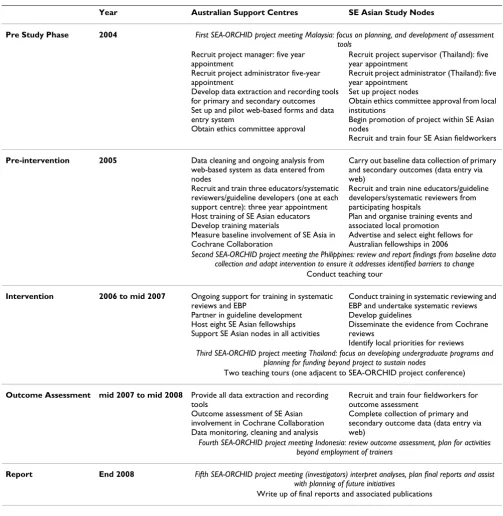
Activities and timelines for each project phase are out-lined in the following sections and summarised in Table 2. A SEA-ORCHID project meeting was planned to be held annually to review progress and strengthen regional col-laborative networks, and was intended to be timed to coincide with a local event (eg. perinatal meeting, hospi-tal seminar) to enhance promotional opportunities and maximise the benefits of having several international speakers present.
Pre study phase (2004)
First SEA-ORCHID project meeting
The investigators planned to meet in Malaysia before the start of the pre-intervention phase to ensure all nodes were functioning smoothly, and to plan the development of the data collection assessment tools, the training of local fieldworkers in web-based data entry and finalise project procedures.
Pre-intervention phase (2005)
The principal activities during this phase were the collec-tion of baseline data and the recruitment and training of staff who were delivering the intervention. Three catego-ries of information were planned to be collected at base-line and post-intervention:
1. Adherence to recommended clinical practices and health outcomes (primary outcomes)
We planned to assess whether current clinical practice during pregnancy and childbirth follows best-practice rec-ommendations, and assess the impact of some these prac-tices on the health of mothers and babies. Adherence to 12 areas of current recommended clinical practice and 13 health outcomes of mothers and babies in the four SE Asian centres were the primary outcome. The various prac-tices and their associated health outcomes were selected on the basis of clear evidence from Cochrane systematic reviews (Table 3).
Data related to the primary outcome were planned to be collected by field-workers over a nine-month period from the consecutive case reports of 1000 women admitted to each of the participating SE Asian hospitals. Specially designed data collection forms were designed to ensure the information was extracted regarding the use of
recom-mended practices, if applicable, together with the subse-quent health outcomes of the mother and baby.
2. Current involvement in evidence-based practice (secondary outcome)
We planned to determine the level of activity and involve-ment in generating, teaching and using evidence at each SE Asian node by:
- identifying current research projects relevant to preg-nancy and childbirth (from government funding bodies, ethics committees and research registers)
- identifying local clinical practice guidelines related to pregnancy, childbirth and infant care (through a survey of health departments and clinical associations)
- assessing the amount of undergraduate medical teaching related to evidence-based practice (through a survey of medical schools)
In addition, we planned to assess the contribution of SE Asians to the Cochrane Collaboration with respect to numbers of reviews and contributors (through a search of
The Cochrane Library).
3. Potential local barriers to practice change (secondary outcome)
The investigators and fieldworkers planned to carry out a series of surveys and interviews within the participating institutions to establish current knowledge, attitudes and extent of evidence-based practice and the factors specific to that node which may form a barrier to practice change, or may be used to enhance practice change. Specific knowledge and beliefs about evidence-based practice,
Table 1: SEA-ORCHID project nodes and participating SE Asian hospitals
Country Node South East Asian Hospitals Investigator
Thailand Department of Obstetrics and Gynaecology, Khon Kaen University, Khon Kaen
Srinagarind Khon Kaen University Hospital Khon Kaen Regional Hospital
Kalasin General Hospital
Pisake Lumbiganon
Philippines Department of Obstetrics and Gynecology, College of Medicine, University of the Philippines Manila, Manila
Philippine General Hospital (University of the Philippines)
Dr. Jose Fabella Memorial Hospital
Mario Festin
Malaysia Department of Paediatrics, Royal College of Medicine, Ipoh
Ipoh Hospital, Perak
Universiti Sains Malaysia, Kota Bharu
Jacqueline Ho
Indonesia Department of Obstetrics and Gynecology, Gadjah Mada University, Yogyakarta
Dr. Sardjito Hospital Sleman District Hospital
Mohammad Hakimi
Australia NSW Centre for Perinatal Health Services Research, Sydney
David Henderson-Smart
Australia Australasian Cochrane Centre, Monash University, Melbourne
Sally Green
Australia Australian Research Centre for the Health of Women and Babies, Discipline of Obstetrics and Gynaecology, University of Adelaide, Adelaide
research results and systematic reviews were assessed, along with perceived difficulties in accessing, appraising and using research-based information. Culturally specific barriers to the use of the selected pregnancy and childbirth healthcare practices were explored, and any relevant issues used to modify the intervention.
Data management and analysis
A customised, secure database was designed to be housed on the project website to allow fieldworkers to enter the
extracted information on data collection forms directly into the database http://www.seaorchid.org. The analysis plan for the baseline data included descriptive statistics to provide a picture of current clinical practices and health outcomes in the management of pregnancy and child-birth at the four SE Asia nodes. Continuous variables were to be presented as means and standard deviations (or medians and ranges if data are not normally distributed) and dichotomous variables presented as numbers and fre-quencies of events.
Table 2: SEA-ORCHID project plan and activities associated with each phase
Year Australian Support Centres SE Asian Study Nodes
Pre Study Phase 2004 First SEA-ORCHID project meeting Malaysia: focus on planning, and development of assessment tools
Recruit project manager: five year appointment
Recruit project administrator five-year appointment
Develop data extraction and recording tools for primary and secondary outcomes Set up and pilot web-based forms and data entry system
Obtain ethics committee approval
Recruit project supervisor (Thailand): five year appointment
Recruit project administrator (Thailand): five year appointment
Set up project nodes
Obtain ethics committee approval from local institutions
Begin promotion of project within SE Asian nodes
Recruit and train four SE Asian fieldworkers
Pre-intervention 2005 Data cleaning and ongoing analysis from web-based system as data entered from nodes
Recruit and train three educators/systematic reviewers/guideline developers (one at each support centre): three year appointment Host training of SE Asian educators Develop training materials
Measure baseline involvement of SE Asia in Cochrane Collaboration
Carry out baseline data collection of primary and secondary outcomes (data entry via web)
Recruit and train nine educators/guideline developers/systematic reviewers from participating hospitals
Plan and organise training events and associated local promotion
Advertise and select eight fellows for Australian fellowships in 2006
Second SEA-ORCHID project meeting the Philippines: review and report findings from baseline data collection and adapt intervention to ensure it addresses identified barriers to change
Conduct teaching tour
Intervention 2006 to mid 2007 Ongoing support for training in systematic reviews and EBP
Partner in guideline development Host eight SE Asian fellowships Support SE Asian nodes in all activities
Conduct training in systematic reviewing and EBP and undertake systematic reviews Develop guidelines
Disseminate the evidence from Cochrane reviews
Identify local priorities for reviews
Third SEA-ORCHID project meeting Thailand: focus on developing undergraduate programs and planning for funding beyond project to sustain nodes
Two teaching tours (one adjacent to SEA-ORCHID project conference)
Outcome Assessment mid 2007 to mid 2008 Provide all data extraction and recording tools
Outcome assessment of SE Asian involvement in Cochrane Collaboration Data monitoring, cleaning and analysis
Recruit and train four fieldworkers for outcome assessment
Complete collection of primary and secondary outcome data (data entry via web)
Fourth SEA-ORCHID project meeting Indonesia: review outcome assessment, plan for activities beyond employment of trainers
Report End 2008 Fifth SEA-ORCHID project meeting (investigators) interpret analyses, plan final reports and assist with planning of future initiatives
Preparing for the intervention
Twelve educational training lecturers (educators), nine from the SE Asian participating hospitals and one at each of the Australian support nodes were recruited and trained, and materials developed for use in the training components of the intervention. A fellowships program was planned to enable health professionals and research-ers from SE Asia to visit Australia to receive advanced training in the skills of evidence-based practice, guideline development, critical appraisal and systematic reviewing. These fellowships were advertised in the four SE Asian countries, and the recipients selected by the SE Asian investigators.
Second SEA-ORCHID project meeting
The investigators and educational training lecturers planned to meet in the Philippines towards the end of the pre-intervention phase to review baseline findings and to finalise the intervention, taking into consideration the barriers to practice change identified by the baseline ques-tionnaires and interviews. Following this meeting, the Australian-based educational trainers planned to carry out the first SE Asia teaching tour, conducting training events with the local training lecturer. This was the beginning of the intervention phase.
Intervention phase (2006 – mid 2007)
The planned intervention can be divided into the follow-ing categories with the timfollow-ing of delivery accordfollow-ing to the project schema in Table 2:
i) Training
The provision of training to support various evidence-based practice initiatives is a major component of the intervention being tested. Local researchers and clinicians planned to conduct training with the support of the
Aus-tralian-based project members through the provision of materials and teaching assistance. Training will comprise of a fellowships program, teaching tours of all four SE Asian nodes by the Australian-based trainers in partner-ship with local trainers, and five project meetings. Activi-ties will focus around three core groups:
1. Generators of evidence and evidence-based materials
The emphasis is on setting up training programs in critical appraisal, systematic reviewing and guideline develop-ment. The Cochrane Collaboration takes great pride in the quality and relevance of its training programs, and the Australian investigators have all been involved in the development and delivery of training in evidence-based practice for many years. We have access to an array of training methods and tools that have been tried and tested cross-culturally and in a variety of formats.
2. Users of the evidence: clinicians and policy makers
We planned to conduct training for clinicians in using The Cochrane Library and WHO Reproductive Health Library; implementing and using guidelines; and accessing and interpreting evidence. Training will be open to all disci-plines involved in the management of the mothers and babies unit (ie. medicine, nursing, community health workers). For policy makers we plan to conduct tailored training workshops around understanding and interpret-ing evidence. These will be adapted from a series of work-shops for policy makers developed by the Australasian Cochrane Centre and will be taught in partnership with SE Asian contributors.
3. Educators about evidence: teachers and trainers
To build capacity and to ensure the outcomes from this project are sustained and extended to other clinical areas, we planned to conduct training events targeting future
Table 3: Health-related outcomes
Recommended practice Outcome intended to reduce
Beneficial forms of care
Antibiotics for preterm prelabour rupture of membranes (pPROM)16 Chorioamnionitis; neonatal sepsis
Corticosteroids prior to preterm birth17 Neonatal death; complications of preterm birth
External cephalic version for breech presentation at term18 Caesarean section rate; birth trauma
Continuous support during labour19 Caesarean section rate
Magnesium sulphate for eclampsia and pre-eclampsia20,21,22 Maternal death; eclampsia
Active management of third stage of labour23 Postpartum haemorrhage; maternal death
Intraoperative antibiotics during caesarean section24 Maternal infection
Vacuum extraction (versus forceps) for operative delivery25 Perineal injury; postpartum haemorrhage
Immunisation for Hepatitis B26 Hepatitis B infection
Forms of care likely to be harmful
Routine episiotomy27 Perineal injury; maternal infection
Routine shaving* 28 Maternal infection
Routine enemas* 29 Maternal infection
clinical trainers and potential opinion leaders in SE Asia. In addition, to facilitate practice change through invest-ment in our future clinicians, we plan to provide material and training on the principles of evidence-based practice to those involved in undergraduate programs for doctors, nurses and allied health workers. We will achieve this through existing networks linking the investigators and medical educators in SE Asia.
ii) Systematic reviewing
We planned to work with those providing care to women and babies in SE Asia to identify important questions for which systematic review evidence is lacking. Interventions appraised in systematic reviews were clinically relevant and culturally acceptable for the management of preg-nancy and childbirth in SE Asia. These reviews were intended to be prepared with support from investigators and educators and published in The Cochrane Library, and the results actively disseminated to clinicians through guidelines, training events and other publications.
iii) Guideline development
Based on experience with developing guidelines for the Australian National Health and Medical Research Coun-cil, we planned to co-ordinate and facilitate locally rele-vant evidence-based guideline development and implementation.
iv) Infrastructure support
Health care based on evidence requires not only trained personnel, but also physical infrastructure, for example, computers and access to information and support. This project was designed to improve research infrastructure and capacity within SE Asia to address locally relevant and culturally specific questions by providing a central focus for research activity and skills.
v) Academic exchange
Over the course of this project there were numerous opportunities for academic exchange. Fellowships in Aus-tralia were offered to researchers and clinicians from SE Asia, and the Australian-based educators will travel to all the nodes to conduct workshops and partner the SE Asian educational trainers in the development of materials.
vi) Promotion
The five project meetings were planned to be held to coin-cide with local clinical meetings and events. This allowed access to the SE Asian and Australian investigators as speakers at these events and assist in the promotion of evi-dence-based practice, the SEA-ORCHID project and the results of the research conducted. In addition, the work resulting from the project was intended to be published in the academic literature and presented at local, national
and international perinatal meetings and Cochrane Col-loquia.
vii) Input into the undergraduate curriculum
We planned to facilitate teaching of evidence-based prac-tice skills in medical, nursing and allied health schools by sharing knowledge, skills and materials from Australia together with content relevant to SE Asia. This was intended to be facilitated based on the audit of evidence-based practice learning gathered as part of the baseline data collection.
Third SEA-ORCHID project meeting
A larger meeting involving the investigators, educational trainers and SEA-ORCHID fellows was planned to be held in Thailand. This meeting intended to review progress with the intervention, identify potential future research projects based on identified research needs, and consider opportunities for funding beyond the project to sustain the SE Asian nodes and evidence-based practice activity. Again, immediately following the meeting, Australian educational trainers planned to undertake a tour to sup-port local educators in training events.
Outcome assessment phase (mid 2007 – mid 2008)
The methodology of outcome assessment was designed to duplicate that of the baseline data collection, with SE Asian fieldworkers recruited and trained to carry out the tasks overseen by the local investigators, and facilitated through a web-based data collection system.
Primary outcome
The primary indication of the value of the intervention was planned as changes in the process of care during preg-nancy and childbirth and any associated impact on health outcomes for mothers and babies. Adherence to recom-mended practice and maternal/neonatal outcomes (Table 3) were recorded from consecutive case records (1000 per participating hospital) over a nine-month period in a sim-ilar fashion to that of the baseline data collection. Descriptive statistics were intended to be used to summa-rise the data and changes from baseline to endpoint calcu-lated for all measures in an effort to demonstrate practice change and improvement in health.
Secondary outcomes
The following activities were planned to be re-assessed in a similar way as at baseline and compared:
a) Involvement in evidence-based practice activity
c) SE Asian contribution to the work of the Cochrane Col-laboration
In addition, sustainability of activities beyond the project through procurement of future research funding was intended to form a measure of the impact of the interven-tion.
Fourth SEA-ORCHID project meeting
The investigators and trainers planned to meet in Indone-sia to review the intervention phase and ensure the project teams are prepared for the post-intervention data collec-tion. There was also planned to be a focus on sustaining the activities initiated during the SEA-ORCHID project once funding ends, and planning for future intra- and inter-regional collaborations and partnerships.
Reporting phase (mid 2008)
Dissemination of results will be an integral feature of the project and we anticipate the following publications:
- management of pregnancy and childbirth in SE Asia prior to the intervention
- perceived barriers to clinical practice change in SE Asia
- several systematic reviews and clinical practice guidelines relevant to the management of pregnancy and childbirth in SE Asia and other resource poor settings
- experiences of training in partnership across cultures
- final report and publications regarding the effect of the intervention
Fifth SEA-ORCHID project meeting
The final conference will be attended by the investigators and will focus on interpretation of the analysed results, planning final reports and associated publications, and planning future work in SE Asia.
Discussion/Conclusion
Basing healthcare practice and policy on evidence ensures the maximal benefit for investment. This is important in all communities but particularly when resources are low and the threats to health are large. This project has the potential to impact significantly on the health of mothers and babies in SE Asia by improving care during pregnancy and birth. Resulting from this project, we anticipate that within SE Asia there will be enhanced capacity to:
• train existing and future clinicians to interpret and implement evidence
• ensure locally relevant evidence is available and accessi-ble
• identify important questions yet to be answered and so take a cost effective and high impact approach to future research funding
• base policy decisions on research findings
• develop and implement local clinical practice guidelines
• contribute more relevant systematic reviews for Cochrane Library
The possible benefits, however, extend beyond maternal and newborn care as at the end of this project there will be an existing network of SE Asian researchers and clinicians with the capacity to generalise this model to other health priority areas. It is anticipated that this project will facili-tate the ongoing development of evidence-based practice and policy in SE Asia through attracting additional long term funding, expansion into community-based care and the establishment of nodes in other countries in the region.
Abbreviations
SE Asia – South East Asia
SEA-ORCHID – South East Asia Optimising Reproductive and Child Health in Developing Countries
UNDP – United Nations Development Programme
UNFPA – United Nations Population Fund
UNICEF – United Nations Children's Fund
WHO – World Health Organization
Competing interests
The author(s) declare that they have no competing inter-ests.
Authors' contributions
DH-S, PL, SG and CC conceived the study and partici-pated in the project design. All authors were involved in the development of the design of the project, drafting of the manuscript and revising it critically for important intellectual content and have given final approval of the version to be published.
Acknowledgements
All authors were funded individually by their respective university/institu-tion for the preparauniversity/institu-tion of the project proposal.
Publish with BioMed Central and every scientist can read your work free of charge "BioMed Central will be the most significant development for disseminating the results of biomedical researc h in our lifetime."
Sir Paul Nurse, Cancer Research UK
Your research papers will be:
available free of charge to the entire biomedical community
peer reviewed and published immediately upon acceptance
cited in PubMed and archived on PubMed Central
yours — you keep the copyright
Submit your manuscript here:
http://www.biomedcentral.com/info/publishing_adv.asp
BioMedcentral This study is jointly funded by an International Collaborative Research
Grant from the National Health and Medical Research Council of Australia (No. 307703) and Wellcome Trust, United Kingdom (071672/Z/03/Z).
References
1. Global Health Council: Making Childbirth Safer Through Pro-moting Evidence-Based Care [Technical Report]. 2002 [http:/ /www.globalhealth.org/sources/view.php3?id=287].
2. World Health Organization: Maternal mortality in 2000: esti-mates developed by WHO, UNICEF and UNFPA. Geneva
2004 [http://childinfo.org/areas/maternalmortality/index.php]. 3. Maternal Mortality Update 1998–1999. United Nations
Popula-tion Fund .
4. Save the children: State of the world's newborns report. 2006 [http://www.savethechildren.org/publications/newborns_report.pdf]. 5. South East Asian Research Office, WHO, Reproductive
Health and Research [http://www.searo.who.int/EN/Section13/ Section36.asp]
6. Godlee F, Pakenham-Walsh N, Ncayiyana D, Cohen B, Packer A: Can we achieve health information for all by 2015? Lancet 2004,
364:295-300.
7. Villar J, Gülmezoglu AM, Khanna J, Carroli G, Hofmeyr GJ, Schulz K, Lumbiganon P: Evidence-Based Reproductive Health In Devel-oping Countries. WHO Reproductive Health Library (No.5), Geneva, WHO/RHR/02.1 .
8. Roberts JM, Villar J, Arulkumaran S: Preventing and treating eclamptic seizures. BMJ 2002, 325:609-610.
9. Huskins WC, Ba-Thike K, Festin M, Limpongsanurak S, Lumbiganon P, Peedicayil A, Purwar M, Shenoy S, Goldmann DA, Tolosa JE: Glo-bal Network for Perinatal and Reproductive Health. An international survey of practice variation in the use of antibi-otic prophylaxis in cesarean section. International Journal of Gyne-cology and Obstetrics 2001, 71:141-145.
10. The Cochrane Collaboration Website [http://
www.cochrane.org]
11. World Health Organization: The WHO Reproductive Health Library. Oxford: Update Software Ltd; 2007.
12. Brown H, Hofmeyr J, Nikodem C, Smith H, Garner P: Promoting childbirth companions in South Africa. BMC Medicine 2007, 5:7 [http://www.biomedcentral.com/content/pdf/1741-7015-5-7.pdf]. 13. Pakenham-Walsh N, Priestley C, Smith R: Meeting the
informa-tion needs of health workers in developing countries: a new program to co-ordinate and advise. BMJ 1997, 314:90-91. 14. Matthews S, Jenkin R, Frommer M, Tjhin M, Rubin G: When reports
and academic journals are clearly not enough. Cooperative Research Centre for Aboriginal and Tropical Health [Occa-sional Paper Series]. 2001 [http://www.crcah.org.au/research/ downloads/researchnotenough.pdf].
15. Chalmers I, Lumbiganon P: The Cochrane Collaboration: pro-viding research syntheses to inform health care and research. Science Asia 2002, 28(Supp 1):9-14.
16. Kenyon S, Boulvain M, Neilson J: Antibiotics for preterm rupture of membranes. Cochrane Database of Systematic Reviews
2003:CD001058. DOI: 10.1002/14651858.CD001058
17. Roberts D, Dalziel S: Antenatal corticosteroids for accelerating fetal lung maturation for women at risk of preterm birth.
Cochrane Database of Systematic Reviews 2006:CD004454. DOI: 10.1002/14651858.CD004454.pub2
18. Hofmeyr GJ, Gyte G: Interventions to help external cephalic version for breech presentation at term. Cochrane Database of Systematic Reviews 2004:CD000184. DOI: 10.1002/ 14651858.CD000184.pub2
19. Hodnett ED, Gates S, Hofmeyr G J, Sakala C: Continuous support for women during childbirth. Cochrane Database of Systematic Reviews 2003:CD003766. DOI: 10.1002/14651858.CD003766 20. Duley L, Gülmezoglu AM, Henderson-Smart DJ: Magnesium
sul-phate and other anticonvulsants for women with pre-eclampsia. Cochrane Database of Systematic Reviews
2003:CD000025. DOI: 10.1002/14651858.CD000025
21. Duley L, Henderson-Smart D: Magnesium sulphate versus diazepam for eclampsia. Cochrane Database of Systematic Reviews
2003:CD000127. DOI: 10.1002/14651858.CD000127
22. Duley L, Henderson-Smart D: Magnesium sulphate versus phenytoin for eclampsia. Cochrane Database of Systematic Reviews
2003:CD000128. DOI: 10.1002/14651858.CD000128
23. Prendiville WJ, Elbourne D, McDonald S: Active versus expectant management in the third stage of labour. Cochrane Database of Systematic Reviews 2000:CD000007. DOI: 10.1002/ 14651858.CD000007
24. Smaill F, Hofmeyr GJ: Antibiotic prophylaxis for cesarean sec-tion. Cochrane Database of Systematic Reviews 2002:CD000933. DOI: 10.1002/14651858.CD000933
25. Johanson RB, Menon V: Vacuum extraction versus forceps for assisted vaginal delivery. Cochrane Database of Systematic Reviews
1999:CD000224. DOI: 10.1002/14651858.CD000224
26. Brocklehurst P: Interventions for reducing the risk of mother-to-child transmission of HIV infection. Cochrane Database of Sys-tematic Reviews 2002:CD000102. DOI: 10.1002/14651858.CD000102 27. Carroli G, Belizan J: Episiotomy for vaginal birth. Cochrane Data-base of Systematic Reviews 1999:CD000081. DOI: 10.1002/ 14651858.CD000081
28. Basevi V, Lavender T: Routine perineal shaving on admission in labour. Cochrane Database of Systematic Reviews 2000:CD001236. DOI: 10.1002/14651858.CD001236
29. Cuervo LG, Rodríguez MN, Delgado MB: Enemas during labour.
Cochrane Database of Systematic Reviews 1999:CD000330. DOI: 10.1002/14651858.CD000330
Pre-publication history
The pre-publication history for this paper can be accessed here: