Open Access
Research
Effect of dietary selenium and omega-3 fatty acids on muscle
composition and quality in broilers
Anna Haug*
1, Susanne Eich-Greatorex
2, Aksel Bernhoft
3, Jens P Wold
4,
Harald Hetland
1, Olav A Christophersen and Trine Sogn
2Address: 1Department of Animal and Aquacultural Sciences, Norwegian University of Life Sciences, 1432 Aas, Norway, 2Department of Plant and
Environmental Sciences, Norwegian University of Life Sciences, 1432 Aas, Norway, 3National Veterinary Institute, Oslo, Norway and 4MATFORSK,
Norwegian Food Research Institute, 1430 Aas, Norway
Email: Anna Haug* - [email protected]; Susanne Eich-Greatorex - [email protected];
Aksel Bernhoft - [email protected]; Jens P Wold - [email protected]; Harald Hetland - [email protected]; Olav A Christophersen - [email protected]; Trine Sogn - [email protected]
* Corresponding author
Abstract
Background: Human health may be improved if dietary intakes of selenium and omega-3 fatty acids are increased. Consumption of broiler meat is increasing, and the meat content of selenium and omega-3 fatty acids are affected by the composition of broiler feed. A two-way analyses of variance was used to study the effect of feed containing omega-3 rich plant oils and selenium enriched yeast on broiler meat composition, antioxidation- and sensory parameters. Four different wheat-based dietary treatments supplemented with 5% rapeseed oil or 4% rapeseed oil plus 1% linseed oil, and either 0.50 mg selenium or 0.84 mg selenium (organic form) per kg diet was fed to newly hatched broilers for 22 days.
Results: The different dietary treatments gave distinct different concentrations of selenium and fatty acids in thigh muscle; one percent linseed oil in the diet increased the concentration of the omega-3 fatty acids 18:3, 20:5 and 22:5, and 0.84 mg selenium per kg diet gave muscle selenium concentration at the same level as is in fish muscle (0.39 mg/kg muscle). The high selenium intake also resulted in increased concentration of the long-chain omega-3 fatty acids EPA (20:5), DPA (22:5) and DHA (22:6), thus it may be speculated if high dietary selenium might have a role in increasing the concentration of EPA, DPA and DHA in tissues after intake of plant oils contning omega-3 fatty acids.
Conclusion: Moderate modifications of broiler feed may give a healthier broiler meat, having increased content of selenium and omega-3 fatty acids. High intakes of selenium (organic form) may increase the concentration of very long-chain omega-3 fatty acids in muscle.
Background
The consumption of broiler meat is high (about 11.5 kg per person per year in Norway [1]). Broiler meat is popu-lar to eat, and the consumption is increasing. Since 1979
the consumption of poultry has increased about five hun-dred percent [1]. The meat is lean and protein rich and rich in nutrients. Meat quality, fatty acid composition and concentration of several nutrients depend largely on the
Published: 29 October 2007
Lipids in Health and Disease 2007, 6:29 doi:10.1186/1476-511X-6-29
Received: 17 September 2007 Accepted: 29 October 2007
This article is available from: http://www.lipidworld.com/content/6/1/29
© 2007 Haug et al; licensee BioMed Central Ltd.
diet fed to the birds. The typical broiler diet today is cereal based (wheat, barley or corn) and the added fat is mostly rendered fat and vegetable oils. The natural diet for poul-try if living in wild environment consists of seeds, plants, insects etc. The concentration of selenium (Se) in wheat grown in Norway is low (wheat grown at Norwegian Uni-versity of Life Sciences, Aas, Norway contains less than 20 microgram Se/kg wheat, own results). The commercial broiler feed concentrate is supplemented with inorganic selenium (sodium selenite). There are dual benefits from the Se supplementation of broilers; improved health and performance of the animal and improved product quality for human consumption. The concentration of omega-3 fatty acids in animal products depends strongly on the fatty acid composition of the diet [2-7]. Green leaves have a surplus of the omega-3 fatty acid alpha-linolenic acid (ALA) compared to the omega-6 fatty acid linoleic acid (LA). In most seeds and grain, LA dominates, and the con-centration of ALA is low. Some seeds have, however, high levels of ALA; e.g. especially linseed but also rapeseed. A hen living in free environments in nature will have a good balance between leaves and seeds in the diet, and thus get-ting both omega-3 and -6 fatty acids. The feed used by modern poultry industry, however, is based on grain with a high ratio of omega-6 fatty acids compared to omega-3 fatty acids. This will result in a high concentration of the omega-6 fatty acid arachidonic acid (20:4 n-6) in the meat or egg product, and less eicosapentaenoic acid (EPA, 20:5 n-3) and docosapentaenioc- and docosahexaenoic acids (DPA 22:5 n-3 and DHA 22:6 n-3).
Selenium has important physiologic effects that include functioning at the catalytic centre of proteins [8], enhancement of immune function [9], and reduction of cancer risk [10,11].
The low Se intake in many European countries is of con-cern [12]. The selenium intake may be increased by sev-eral means; increased consumption of fish and seafood, increased selenium concentration in cereals and plants by adding selenium to commercial fertilizers, increased con-centration in meat and agricultural products by adding selenium to feed, to add selenium supplements directly to the food during processing or to take selenium pills. As selenium is a scarce mineral on our planet and the average concentration in igneous bedrocks is only 0.05 ppm [13], the best and most sustainable way to increase the sele-nium concentration in the human diet also has to be con-sidered.
The essential long chain omega-6 fatty LA and omega-3 fatty ALA competes with each other in binding to enzymes and incorporation into membrane lipids [14]. ALA intake is associated with inhibitory effects on the clotting activity of platelets, on their response to thrombin, and on the
regulation of arachidonic acid metabolism, whereas LA favours oxidative modification of low density lipoprotein cholesterol and increases platelet response to aggregation [15]. The relative proportion between these fatty acids is therefore of importance. The ratio between omega-6 and omega-3 fatty acids is too high in the western diet [16]. Most vegetable oils (except rapeseed oil and linseed oil), most margarines and meat from monogastric animals fed cereal based concentrate feed contribute to this high omega-6 to omega-3 ratio.
The capacity for conversion of ALA to n-3 very long-chain polyunsaturated fatty acids has been investigated [17,18]. It has been shown that this conversion is not high in humans, and it appears that young women of reproduc-tive age have a greater capacity than men to convert the essential fatty acid ALA to DHA [18]. A high Se intake might be speculated to increase the concentration of EPA, DPA and DHA in the tissues either because of increased synthesis from ALA, or reduction in the rate of degrada-tion of EPA, DPA and DHA. Selenide substitutes for sul-phide in proteins and enzymes. It has been shown that mammalian cells contain substantial amounts of selenide [19]. Since FeSe is less soluble than FeS [20,21], reflecting the higher degree of covalency in the iron-selenium than in the iron-sulphur bond, it may be speculated that a higher selenide/sulphide ratio in the sulphide sites of the iron-sulphur clusters will stabilize iron atoms in oxida-tion number +2, making them more difficult to oxidize, thus leading to reduction of the rate of mitochondrial ROS production and reduction of the rate of oxidative attacks. As the rate of peroxidation of polyunsaturated fatty acids depends on the number of double bounds per molecule, the fatty acids EPA, DPA and DHA will be per-oxidized faster than the fatty acids with fewer double bounds.
The consumer knows that to eat fish is healthy, but still the fish consumption is not increasing. It has also been predicted that it may be a shortage on fish and fish oil in the future. If broiler meat is produced to be as healthy as possible, with a favourable fatty acid composition and a selenium concentration in broiler meat at about the same level as in fish (0,365 – 0,481 mg/kg in different fish spe-cies; turbot, tuna, swordfish, wolfish [22]), intake of broiler meat may improve the average human diet.
of Se (organic form) on muscle concentration of EPA, DPA and DHA was also studied.
Materials and methods
Sixty newly hatched male broilers (Ross 308, Sam-virkekylling, Norway) were used in this experiment that was conducted at The Norwegian University of Life Sci-ences. Broilers were weighed and assigned randomly to one of four dietary treatments. The experiment lasted for 22 days. The first 10 days the birds from each group were kept in deep littered pens; 75 cm × 150 cm. At day 10 each individual were weighed and 15 birds in each group were placed in separate wire-floored metabolism cages, and kept there from day 10 to day 22. Chicks were raised in an environmentally controlled room. The room temperature was maintained at 32°C from days 0–3, then gradually reduced by 0,5°C per day until day 22. Chicks were exposed to 23 h light and 1 h dark photoperiod days 0–7. The next two weeks they were exposed to 2 × 4 h dark; the dark periods were between 17–21 h and 00–04 h. The birds had free access to food and water. Water troughs and wire-floors were cleaned daily. At the end of day 19 and 22 feed intake and body weight were determined for each individual. Signs of disease or mortality were recorded daily (but in this experiment none of the birds became ill or died).
Experimental procedures
At day 22 individual blood samples were collected by wing venipuncture into 7 ml tubes containing heparin. One ml of the heparin-blood was frozen immediately for glutathione peroxidase determination. The remaining of the blood samples were centrifuged for 15 minutes at 3,000 × g at 4°C. The plasma was frozen at -20°C in order to determine total antioxidant status. After bleeding, the broilers were sacrificed. The left and right thighs were obtained to determine selenium and fatty acid composi-tion of muscle. Breast muscles were dissected out for sen-sory quality analyses. The liver and heart were weighed. The muscle samples were stored at -20°C before being analyzed.
Diet formulation
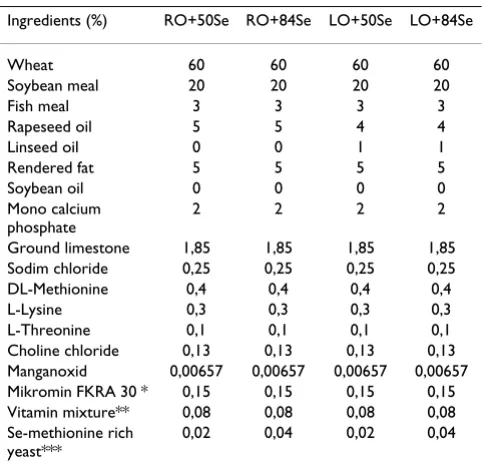
The four diets were wheat-based (60% wheat) containing soybean meal, fish meal, vitamins and minerals. The diets were formulated by combining different levels of rapeseed oil (RO) and linseed oil (LO) with two different concen-trations of selenium enriched yeast; 0.02% or 0.04%. The final Se concentration in the diets with 0.02% Se enriched yeast was 0.50 mg Se/kg diet, and the final concentration in the diets containing 0.04% Se enriched yeast was 0.84 mg Se/kg diet, thus the dietary treatments are named were named: RO+50Se, RO+84Se, LO+50Se and LO+84Se.
The dietary treatment RO+50Se and RO+84Se include rapeseed oil (5%) and rendered fat (5%). Diet LO+50Se and LO+84Se contain 1% linseed oil, 4% rapeseed oil and 5% rendered fat, and 0.02% selenium enriched yeast in LO+50Se, and 0.04% selenium enriched yeast in LO+84Se. Diet compositions are listed in Table 1.
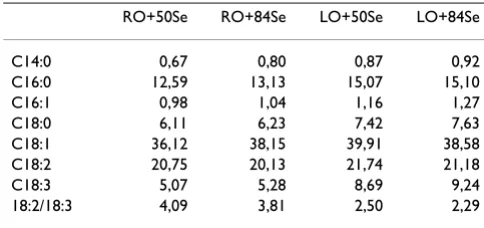
Fatty acid composition of diets (g/100 g fatty acids) is shown in Table 2.
All the diets are rich in oleic acid (18:1), varying from about 36 to 40 g oleic acid per 100 g fat in the RO and LO diets. The diets are also rich in linoleic acid (18:2); accounting to about 20 g per 100 g fat in the diet, and alpha-linolenic acid (18:3) accounting to about 5% of the fat in the RO diets, and about 9% of the fat in the LO diets. Thus the ratio between linoleic acid and alpha linolenic acid is much higher in the RO diet than in the LO diet. The palmitic acid (16:0) content is highest in the LO diets.
Table 1: Diet composition.
Ingredients (%) RO+50Se RO+84Se LO+50Se LO+84Se
Wheat 60 60 60 60
Soybean meal 20 20 20 20
Fish meal 3 3 3 3
Rapeseed oil 5 5 4 4
Linseed oil 0 0 1 1
Rendered fat 5 5 5 5
Soybean oil 0 0 0 0
Mono calcium phosphate
2 2 2 2
Ground limestone 1,85 1,85 1,85 1,85
Sodim chloride 0,25 0,25 0,25 0,25
DL-Methionine 0,4 0,4 0,4 0,4
L-Lysine 0,3 0,3 0,3 0,3
L-Threonine 0,1 0,1 0,1 0,1
Choline chloride 0,13 0,13 0,13 0,13
Manganoxid 0,00657 0,00657 0,00657 0,00657
Mikromin FKRA 30 * 0,15 0,15 0,15 0,15
Vitamin mixture** 0,08 0,08 0,08 0,08
Se-methionine rich yeast***
0,02 0,04 0,02 0,04
*Supplied (mg/kg of diet): Ca 315, Fe 75, Mn 60, Zn 105, Cu 15, I 0,75, **Vitamin mixture provided the following per kg diets: retinyl acetate, 3.1 mg; cholecalciferol, 0.07 mg; DL-alpha-tocopheryl acetate, 38 mg; menadione, 2.25 mg; pyridoxine, 3.4 mg, riboflavin,9 mg; Ca-pantothenate, 12.5 mg; biotin, 0.19 mg, thiamine, 1.9 mg; niacin, 37.5 mg; cobalamin, 0.02 mg; folic acid 1.5 mg.
*** Organic selenium Yeast (BioLogics, Ultra Bio-Logics Inc. New O.S.Y. 2000X)
Rapeseed oil: Askim fruktpresse, Norway; 60% oleic acid, 20% linoleic acid and 10% alphalinolenic acid.
Linseed oil: Fedon Lindberg linseed oil, Norway; 26% oleic acid, 21% linoleic acid and 45% alphalinolenic acid.
Laboratory analyses Fatty acid analyses
Fatty acid composition of thigh muscle, feed and oils were determined by gas chromatography. In muscle, lipid extraction was performed according to Folch [23], on 1 g of thigh muscle tissue. The lipids were resolved in hep-tane, and methylated as described [24], using both sodium methoxide and methanolic HCl 3N (Supelco, PA, USA). Subsequently, the fatty acid methyl esters were ana-lyzed using a Finnigan Focus gas chromatograph with a 100 m capillary column (CP Sil 88 WCOT, 100-m × 0.25 m m, Chrompack, Middelburg, Netherland). Injector and detector temperatures were 250° and 255°C, respectively and oven temperature was 70° initially. After 4 minutes the temperature was increased by 13°C/min to 175°, held there for 27 minutes, programmed at 4°C/min to 215°C, held there for 31 minutes and programmed at 10°C/min to a final temperature of 225°C. The flow rate of the car-rier gas, helium, was 1.62 ml/minute, a 1:34 split mode and a flame-ionization detector. Fatty acid peaks deter-mined by gas chromatograph were then used to calculate the amount of fatty acids (g/100 g fat) by theoretical response factors [25]. Standard fatty acids of known com-position were run to identify the fatty acids in the sam-ples. Muscle control samples was extracted, methylated and analysed by every 10th sample. The coefficient of
var-iation (CV) for the individual fatty acids was found to vary between 4 and 6.5%.
Selenium
Selenium concentration in the diets and leg muscle of each broiler were analyzed by atomic absorption spec-trometry with a hydride generator system [26] using Var-ian SpectrAA-30 with a VGA – 76 vapour generation accessory. Before analysis, each sample was prepared by oxidative digestion in a mixed solution with concentrated nitric and perchloric acids, using an automated system with Tecator 1012 Controller and 1016 Digester heating unit. The method is accredited (NS-EN ISO/IEC 17025). A quality control system using regular analyses of a blood standard (proficiency tested pig blood 1992) with value
0.20 ± 0.02 μg/g was adopted as reference material [27]. The detection limit was 0.01 μg/g.
Whole blood was analyzed for glutathione peroxidase (Gpx) according to [28], where Gpx catalyses oxidation of glutathione and the oxidized glutathione is reduced back to reduced form at the same time as NADPH is oxidized to NADP, giving a decrease in absorbance at 340 nm.
Total antioxidant status (TAS)
was based on the generation of the ABTS (2,2-Azino-di-(3-ethylbenzthiazoline sulphonate) radical cation from the interaction of methemoglobin, ABTS and hydrogen per-oxide. TAS was measured using Randox kit supplied by Randox Laboratories Ltd. UK.
2-Thiobarbituric Acid (TBA) Assay
Lipid oxidation in this experiment was determined by the TBA method described by Sørensen and Jørgensen [29]. Briefly, 10.0-grams of grinded broiler muscle from right thigh were placed in MSE-homogenization tubes, and blended for 30 s with 30 ml 7,5% TCA (Merck) containing 0,1% propylgallat (Merck) and 0,1% EDTA (Merck). The slurry was filtered through a Whatman No. 1 filter. Five ml of the filtrate and 5 ml 0,02 M 2-thiobarbituric acid (Sigma Chemical Co., St. Louis, Mo) were mixed, heated for 35 minutes in boiling water bath, and the colour was measured by a Pharma, Biotech Ultraspec 3000, Cam-bridge, UK, at a wavelength of 532 nm. Thiobarbituric acid reactive substances, expressed as milligrams of malondialdehyde per kilogram of meat, were calculated from the standard curve of TEP (1,1,3,3 -tetra-ethoxypro-pane).
Front-Face Fluorescence Spectroscopy (FFF)
FFF measurements were performed with an optical bench system described by Wold and Mielnik [30] and the spec-tra can be used as an indicator of lipid oxidation [30]. In general, the higher fluorescence intensity around 470 nm, the more oxidised is the sample. Fluorescence emission spectra were measured directly on the illuminated sam-ples of minced broiler thigh plus leg meat. Round, flat, black, plastic cuvettes (diameter 5 cm) were filled with sample, and the top was flattened to a smooth surface. The samples were exposed to 382 nm excitation light and emitted fluorescence light was measured from 410 to 750 nm. The spectra were collected by an imaging spec-trograph (Acton SP-150, Acton Research Corp., Acton, MA) connected to a sensitive charge coupled device (CCD camera) (Roper Scientific NTE/CCD-1340/400-EMB, Roper Scientific, Trenton, NJ). The samples were illumi-nated for 4 s, rotated approximately 90°, and illumiillumi-nated again, giving two readings for each sample. The readings were averaged prior to data handling.
Table 2: Fatty acid composition of diets, g/100 g fatty acids.
RO+50Se RO+84Se LO+50Se LO+84Se
C14:0 0,67 0,80 0,87 0,92
C16:0 12,59 13,13 15,07 15,10
C16:1 0,98 1,04 1,16 1,27
C18:0 6,11 6,23 7,42 7,63
C18:1 36,12 38,15 39,91 38,58
C18:2 20,75 20,13 21,74 21,18
C18:3 5,07 5,28 8,69 9,24
Sensory Analysis
A professional sensory panel with 11 assessors evaluated the breast filet samples in a descriptive test according to an accredited method [31]. The breast filets had been stored individually wrapped in aluminium folio at -20°C for five months.
Prior to the analyses, the panellists were trained on extra sample that had been stored in -20°C for five months, before they started on real samples at the days of analysis. The vocabulary included odour, flavour and colour. The samples were prepared by dividing all the breast filets into two halves, and each peace were vacuum packed in indi-vidual plastic bags, and immersed in water bath at 80°C for 30 minutes. Then the pieces were immediate distrib-uted to the panellists, one to each assessor. The samples were marked with random three digit numbers and pre-sented to the panellists in randomized order. Scores were recorded on a continuous, linear scale from 1 (no inten-sity) to 9 (distinct inteninten-sity) with a Compusense Five soft-ware (v.4.2, Compusense Inc., Guelph, ON, Canada).
Statistical methods
Two-way analyses of variance were performed using the GLM procedure of SAS software (SAS Institute Inc., Cary, NC, USA). Significant differences between treatments
were determined by using the Ryan-Einot-Gabriel-Welch F-test. Square root of MSE (RSD) was used as a measure of random variation. The sensory results were analyzed by ANOVA analysis of variance and Tukeys test. The fluores-cence measurements resulted in spectra covering the range 410–750 nm. Systematic variation from these spectra was extracted by principal component analysis (PCA). The PCA decomposes the spectral variables into a few so-called principal components, which reflect the main spec-tral variation. The second PC was used as an indicator of lipid oxidation.
Selenium concentration in liver, muscle and excreta was determined at the National Veterinary Institute, Norway. Whole blood was analyzed for glutathione peroxidase (Gpx) and total antioxidant status (TAS) was determined in the plasma at The Norwegian University of Life Sci-ences. TBA, FFF and sensory analyses were done at MAT-FORSK, Aas, Norway.
Results
The results of dietary treatment with different fat source; rapeseed oil (RO) or rapeseed oil plus linseed oil (LO), and with different selenium concentration; 0.50 mg/kg or 0.84 mg/kg diet calculated by two-way analysis of vari-ance are shown in Table 3. Final body weight at day 22
Table 3: Final body weight (FBW), liver weight, heart weight, glutathione peroxidase activity (GPX, U/ml), total antioxidant status (TAS, mmol/l), mg selenium/kg leg muscle, thiobarbituric acid reactive substances (TBA) mg/kg leg muscle and front face
fluorescence spectrometry (FFF) and thigh muscle fatty acid composition (g/100 g fatty acid) for broilers fed diets based on wheat with different fat source; rapeseed oil (RO) or rapeseed oil plus linseed oil (LO), and with different selenium concentration: 0.50 mg Se/kg or 0.84 mg Se/kg diet.
Fat source Selenium P (Fat source) P (Selenium) P (Fat source*Selenium) RSD RO LO 50Se 84Se
FBW 783 749 775 756 0,04 NS NS 64,12
Liver g 26,1 24,8 25,8 25 NS NS 0,003 2,63
Heart g 7,24 6,51 7,1 6,7 0,007 NS NS 1,02
Se mg/kg muscle 0,33 0,34 0,28 0,39 <0,0001 <0,0001 <0,0001 0,012
Gpx U/ml 14,4 14,5 12,5 16,3 NS <0,0001 NS 2,29
TAS mmol/l 0,79 0,71 0,77 0,74 NS NS NS 0,186
FFF 76 410 245 224 NS NS NS 1597
TBA ug/g muscle 0,35 0,3 0,31 0,33 0,012 NS NS 0,075
Thigh muscle fatty acids, g/100 g fat:
C14:0 0,38 0,41 0,4 0,39 NS NS 0,018 0,1
C14:1 1,98 2,01 1,91 2,14 NS 0,013 NS 0,35
C16:0 14,44 14,89 14,5 14,83 0,057 NS NS 0,91
C16:1 1,07 1,27 1,21 1,13 0,019 NS 0,043 0,32
C18:0 11,3 11,3 11,1 11,5 NS NS 0,017 1,19
C18:1 23,1 22,6 23,5 22,3 NS NS NS 2,52
C18:2 16,4 15,5 16 16 0,001 NS 0,019 1,03
C18:3 1,71 2,59 2,2 2,1 <.0001 NS NS 0,48
C20:4 5,09 4,22 4,56 4,75 0,0002 NS NS 0,84
C20:5 0,88 1,41 1,07 1,22 <0,0001 0,016 NS 0,23
C22:5 2,24 2,73 2,31 2,66 0,0002 0,006 0,059 0,482
C22:6 3,32 3,27 3,11 3,48 NS 0,035 NS 0,673
18:2/18:3 9,97 6,34 8,1 8,3 <.0001 NS NS 1,94
was a little higher in the broilers in the RO dietary treat-ment, compared to the LO dietary treatment. Feed intake was also a little higher (not significant) in the rapeseed group and feed conversion were not different among the dietary treatments (results not shown).
Heart weight was highest for the RO dietary treatment, whereas it was an interaction between fat source and sele-nium; the product of fat source*selenium significantly affected liver weight.
The Se concentration in broiler thigh muscle was lowest in the treatment group 50Se, and highest in the treatment group, 84Se. The Se concentration in muscle was also slightly affected by the fat source, and muscle Se was high-est in the LO treatment compared to RO dietary treatment (0.34 and 0.33 microgram Se/g muscle, respectively). The product (fat source*selenium) also showed significance, showing interaction between the dietary treatments.
Glutathione peroxidase (Gpx) was lowest in the treatment group 50Se, and highest in the treatment group, 84Se.
Total antioxidant status (TAS) and Front-Face Fluores-cence Spectroscopy (FFF) was not affected by the dietary treatments. Thiobarbituric acid reactive substances (TBA), expressed as milligrams of malondialdehyde per kilogram of meat was affected by fat source, being highest in the RO dietary treatment.
The fatty acid concentrations in thigh muscle were affected by dietary treatments. The LO treatment resulted in higher concentrations of the polyunsaturated fatty acids 18:3, 20:5 and 22:5, and the monounsaturated fatty acid 16:1. The concentrations of 18:2 and 20:4 in muscle were lower in the LO dietary treatment groups. The ratio between 18:2 and 18:3 and the ratio between 20:4 and 20:5 was also lower in the LO dietary treatment group.
The dietary selenium concentration affected the fatty acid concentration. The concentration of the very long chain polyunsaturated fatty acids 20:5, 22:5 and 22:6 were high-est in the high Se (84Se) treatment group. The concentra-tion in muscle of the monounsaturated fatty acid 14:1 was also increased by high dietary Se.
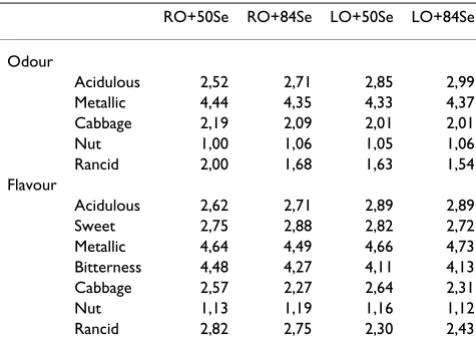
The sensory analysis showed no significant differences among the groups on the sensory quality of cooked breast muscle (Table 4), when tested for acidulous odour, metal-lic odour, cabbage odour, nut odour and rancid odour, and acidulous, sweet, metallic, bitter, cabbage, nut and rancid flavour. In this experiment, the broiler meat was not affected by the dietary treatments regarding the cho-sen cho-sensory traits, and in the descriptive test there were no significant differences between the samples for any of the
12 parameters included in the test. All the samples had clear intensity of metal-smell, metal-taste, and bitter taste. This may be caused by small rests of blood on the sam-ples.
Discussion
Dietary treatments with rapeseed oil (RO), linseed oil (LO) and two levels of selenium enriched yeast (50Se and 84Se) gave major effects on muscle Se concentration and fatty acid concentration in broiler leg muscle, but small effects on final body weight and thiobarbituric acid reac-tive substances, and no effects on total antioxidant status, front-face fluorescence spectroscopy and sensory quality. In the present study, selenium enriched yeast (0.04% in the diet) resulted in increased concentrations of the very long chain fatty acids EPA, DPA and DHA in broiler thigh muscle.
Final body weight and heart weight was affected by fat source, showing higher body and heart weight by the RO treatment than in the LO treatment groups. This might be caused by a firmer pellet quality in the RO feed (observed visually) than in the LO groups, possibly because the more polyunsaturated linseed oil affects the melting point giving a more "floury" feed that is more difficult to eat for the bird. Higher organ weight is expected in birds with higher body weight. As expected, liver weight was higher, but did not reach significance.
Selenium concentration in raw thigh muscle was signifi-cantly increased (33% increase) in the diet with most enriched yeast (84Se) compared to the diet with less Se-enriched yeast (50Se). This increase is in accordance to several studies showing that organic forms of Se in the diet gives increased tissue concentrations of Se [32-34]. The
Table 4: Sensory quality of cooked broiler breast meat.
RO+50Se RO+84Se LO+50Se LO+84Se
Odour
Acidulous 2,52 2,71 2,85 2,99
Metallic 4,44 4,35 4,33 4,37
Cabbage 2,19 2,09 2,01 2,01
Nut 1,00 1,06 1,05 1,06
Rancid 2,00 1,68 1,63 1,54
Flavour
Acidulous 2,62 2,71 2,89 2,89
Sweet 2,75 2,88 2,82 2,72
Metallic 4,64 4,49 4,66 4,73
Bitterness 4,48 4,27 4,11 4,13
Cabbage 2,57 2,27 2,64 2,31
Nut 1,13 1,19 1,16 1,12
Rancid 2,82 2,75 2,30 2,43
yeast mainly contains Se in the form of selenomethionine, which can't be synthesized by poultry and mammals [34]. Selenomethionine is absorbed as an amino acids in the intestine, and in the tissues it is competing with methoi-nine in building in to proteins [33]. Selenomethiomethoi-nine can also be converted to selenocysteine and incorporated into e.g. Gpx [34].
The effect of fat source on Se concentration in muscle and the interaction of fat source and selenium are interesting. The average Se muscle concentration from RO and LO die-tary treatment is not much different in numerical value (0.33 mg/kg and 0.34 mg/kg in RO and LO treatment), but highly significant from each other. It might be specu-lated that the LO diet might have a better absorption or utilization of Se because of the more "floury" pellet qual-ity. Another suggestion may be that long chain polyunsat-urated fatty acids results in an increased concentration of Se-containing proteins in muscle tissue. More oxidizing conditions (e.g. higher rate of ROS production) is known to lead to induction of Se-containing antioxidative enzymes such as Gpx 1, Gpx 4, selenoprotein W or thiore-doxin reductase both in skeletal muscle and other organs [35-37]. It might be speculated that the increased dietary intake of polyunsaturated fatty acids leads to induction of Se-containing antioxidative enzymes in broiler skeletal muscle.
There were no differences among the groups in plasma total antioxidant status, front-face fluorescence spectros-copy and sensory evaluation on meat stored frozen for 5 months. These parameters are indicators of oxidation, and although selenium takes part in antioxidant enzymes, and linseed oil is highly polyunsaturated and prone to oxida-tion, no differences among the groups were shown in this study. The selenium intake was high in both groups, and therefore saturation of Gpx isozymes and selenoprotein P must expected in this study [38,39]. The birds were young and fed a diet rich in essential nutrients, giving healthy birds with a good antioxidant defence, and thus explain-ing the lack of differences in antioxidative parameters among the treatment groups.
The fatty acid composition of the meat was affected by the dietary fat source, and this has been reported by others [32,40-43]. The omega-3 fatty acid ALA is highest in the LO diet, and it is significantly higher in the muscle of LO treated birds. The other omega-3 fatty acids 20:5 (EPA) and 22:5 (DPA) are also increased following linseed oil intake, and this may be a result of elongation and desatu-ration of ALA to EPA and DPA, as has been reported in broilers by others [32]. The decrease in the broiler muscle omega-6 fatty acids LA and arachidonic acid in the LO treatment groups may be explained by a competition between LA and ALA in incorporation into tissue
mem-branes and desaturases and elongases of the 18 carbon fatty acids to 20 carbon fatty acids. The ratio between LA and ALA (18:2 n-6 and 18:3 n-3) and between arachi-donic acid and EPA (20:4 n-6 and 20:5 n-3) is signifi-cantly much lower following the LO treatment, giving a more favourable omega-3 status in the LO-broilers.
In the western diet the intake of omega-3 fatty acids is too low resulting in increased clotting of platelets, inflamma-tion, cardiac diseases and cancer [16]. Meat that is rich in omega-3 fatty acids might therefore have a health advan-tage compared to the regular meat product. But also in the RO treatment groups the omega-3 fatty acid concentra-tions are high and favourable. Therefore the meat from the RO treatment group is a better alternative than the reg-ular broiler that is offered in the supermarkets in Norway, because they have been given a cereal based feed without much omega-3 fatty acids (the fatty acid composition in chicken is reported to be 18:2;12.2%, 18:3; 0,9%, 20:4; 0,5%, 20:5; 0,3%. [44].
The concentration of 16:1 is higher in the LO diets, and this is reflected in the muscle 16:1 in the LO treated groups, and there is an interaction between fat and sele-nium in this parameter.
In the present study, dietary selenium affects fatty acid concentrations; the highest selenium intake increases the muscle concentrations of the very long chain polyunsatu-rated fatty acids EPA, DPA and DHA compared to the 50Se treatment. Also the monounsaturated 14:1 fatty acid is increased by high dietary Se. The very long chain fatty acids are produced by delta-4, delta-5 and delta-6 desatu-rases and elongases. In this study we could not determine where in the fatty acid C-chain the double was located, and thus we do not know it the 14:1 fatty acid is 14:1 n-5 (produced by delta-9 desaturase), or if it is produced by other possible desaturases. The 16:1 fatty acid is com-monly reported to be 16:1 n-7, thus produced by delta-9 desaturase, and in the present study this fatty acid is not increased by high dietary selenium. It may be speculated that the activity of delta-4, 5 or 6 desaturases or elongase may be increased by high Se intakes in broiler or that high Se intakes may lead to reduction of the rate of degradation of these fatty acids by processes of peroxidation.
Another possibility may be that the oxidation of EPA, DPA and DHA in mitochondria may be reduced as a con-sequence of selenide replacing sulphide in mitochondrial iron-sulphur enzymes. This might change the kinetic properties of these enzymes, since a change of the Se--/S
--ratio at the sulphide positions must be expected to affect the standard redox potential for the Fe++/Fe+++
equilib-rium. Fe++ is bound more strongly to selenide than to
sul-phide ions as illustrated by the much lower solubility product of FeSe (10-26) [20] compared with FeS (4 × 10-19)
[21]. A higher selenide/sulphide ratio in the iron- sulphur clusters would therefore be expected to enhance the stabil-ity of ferrous iron, i.e. to enhance the standard redox potential for the Fe++/Fe+++ equilibrium. It might be
spec-ulated that this could lead to enhancement of the rate of mitochondrial NADH oxidation, other factors being equal. This might in turn enhance the rate of electron flow from NADH to cytochrome c oxidase, leading to enhance-ment of the rate of O2 reduction by the latter enzyme. Enhancement of the rate of O2 reduction might in turn
lead to reduction of the intracellular O2 partial pressure in most organs, and to reduction of the rates of reactive oxy-gen species (ROS) production and lipid peroxidation.
The rate of peroxidation of polyunsaturated fatty acid groups depends on the number of double bonds per fatty acid molecule [45]. The number of double bonds is espe-cially high in EPA, DPA and DHA, making these fatty acids particularly vulnerable to peroxidative attack. More oxi-dizing conditions (e.g. higher rate of ROS production) must therefore be expected to affect the rates of EPA, DPA and DHA peroxidation more strongly than it affects the rates of peroxidation of fatty acids with a smaller number of double bonds, such as LA.
Iron is a very important catalyst of lipid peroxidation reac-tions [46,47]. It might be speculated that a higher sele-nide/sulphur ratio in iron sulphur proteins also might affect the concentration of iron that is bound to small molecules and functions as a catalyst of peroxidation reac-tions. This is another putative mechanism, by which a higher selenide/sulphide ratio in mitochondrial enzymes might lead to reduction of the rate of lipid peroxidation reactions, with this effect being especially pronounced for those fatty acids that have the largest number of double bonds.
An increase in the very long chain omega-3 fatty acids EPA, DPA and DHA in muscle by a diet rich in Se is highly interesting. Pending further investigations, it is necessary to keep all possibilities open regarding the possible mech-anisms. In humans the concentration of these fatty acids are also dependent both on the rates of intake plus synthe-sis and degradation. The conversion of ALA to EPA, DPA and DHA is reported to be low in humans [17]. If poor
selenium status should lead to enhancement of the rate of EPA, DPA and DHA degradation or reduced synthesis, this will interact synergistically with low dietary intake of these fatty acids. An increased intake of Se in the diet might thus have practical implications by increasing the level of these valuable fatty acids. A health benefit of high Se intakes on disorders related to lack of long chain omega-3 fatty acid might be suggested.
Conclusion
In conclusion, some moderate modifications of broiler feed by supplementation of rapeseed and linseed oil and adding Se-enriched yeast to the feed, gives broiler muscle enriched in selenium and omega-3 fatty acids. Consump-tion of such a meat product may be beneficial to human health. The increased concentration of long-chain omega-3 fatty acids observed in muscle of broilers that has been fed a diet containing 0.84 mg Se in organic form per kg diet, is interesting, and deserves further investigation.
Authors' contributions
A. Haug; major contributor; in planning, experimental work, analysis and publication of results. S. Eich-Greato-rex; contributed in planning of experiment and in the practical work in the finishing of experiment, with taking blood samples and removing and handling organs for fur-ther analysis. A. Bernhoft; contributed in planning of experiment and in selenium determination. Harald Het-land; contributed in planning of the experiment and in formulation of diets and the upset of the broiler experi-ment. Jens P Wold; contributed in planning and analys-ing. Olav A. Christophersen contributed in planning of the experiment and in discussion of results. Trine Sogn; major contributor in planning of the experiment and in providing funding for the study.
Acknowledgements
This work was supported by the Norwegian Research Council.
The assistance of colleagues at IHA, SHF and FôrTek at The Norwegian University of Life Sciences, Aas, and at the laboratories at MATFORSK, Aas, and at the National Veterinary Institute, Oslo, all Norway, are gratefully acknowledged.
References
1. Utviklingen i norsk kosthold. Sosial og Helsedirektoratet, Oslo, Nor-way 2004.
2. Bou R, Guardiola F, Barroeta AC, Codony R: Effect of dietary fat sources and zinc and selenium supplements on the composi-tion and consumer acceptability of chicken meat. Poult Sci
2005, 84:1129-40.
3. Skjervold H: Lifestyle Diseases and the Human Diet. How Should the New Discoveries Influence Future Food Produc-tion. Ås-Trykk Ås 1992. ISBN 82-992596-0-6
4. Mach N, Devant M, Diaz I, Font-Furnols M, Oliver MA, Garcia JA, et al.: Increasing the amount of n-3 fatty acid in meat from young Holstein bulls through nutrition. J Anim Sci 2006, 84:3039-48.
Lohm-Publish with BioMed Central and every scientist can read your work free of charge "BioMed Central will be the most significant development for disseminating the results of biomedical researc h in our lifetime."
Sir Paul Nurse, Cancer Research UK
Your research papers will be:
available free of charge to the entire biomedical community
peer reviewed and published immediately upon acceptance
cited in PubMed and archived on PubMed Central
yours — you keep the copyright
Submit your manuscript here:
http://www.biomedcentral.com/info/publishing_adv.asp
BioMedcentral
ann Selected Leghorn and ISA Brown hens given diets with different fat sources. Br Poult Sci 2006, 47:294-300.
6. Jiang ZR, Ahn DU, Sim JS: Effects of feeding flax and two types of sunflower seeds on fatty acid compositions of yolk lipid classes. Poult Sci 1991, 70:2467-75.
7. Cherian G, Sims JS: Omega-3 fatty acid and cholesterol content of newly hatched chicks from alpha-linolenic acid enriched eggs. Lipids 1992, 27:706-10.
8. Behne D, Kyriakopoulos A: Mammalian selenium-containing proteins. Annu Rev Nutr 2001, 21:453-73.
9. Beck MA: Antioxidants and viral infections: host immune response and viral pathogenicity. J Am Coll Nutr 2001, 20:384S-388S.
10. Klein EA: Can prostate cancer be prevented? Nat Clin Pract Urol
2005, 2:24-31.
11. Lu J, Jiang C: Selenium and cancer chemoprevention: hypoth-eses integrating the actions of selenoproteins and selenium metabolites in epithelial and non-epithelial target cells. Anti-oxid Redox Signal 2005, 7:1715-27.
12. Rayman MP: The use of high-Se yeast to raise Se status: how does it measure up? Br J Nutr 2004, 92:557-73.
13. Krauskopf KB: Introduction to geochemistry. In Appendix 3 Sec-ond edition. McGraw-Hill. USA; 1982:546.
14. Insel P, Turner RE, Ross D, (Eds): Nutrition. In American Dietetic Association Second edition. Jones and Barlett Publishers. Ma, USA; 2004.
15. Simopoulos AP: Omega-3 fatty acids and antioxidants in edible wild plants. Biol Res 2004, 37:263-77.
16. Simopoulos AP: The importance of the ratio of omega-6/ omega-3 essential fatty acids. Biomed Pharmacother 2002, 56:365-79.
17. Burdge GC, Jones AE, Wootton SA: Eicosapentaenoic and docos-apentaenoic acids are the principal products of alpha-lino-lenic acid metabolism in young men. Br J Nutr 2002, 88:355-63. 18. Bakewell L, Burdge GC, Calder PC: Polyunsaturated fatty acid concentrations in young men and women consuming their habitual diets. Institute of Human Nutrition, Developmental Origins of Health and Disease Division, University of South-ampton, Southampton SO16 7PX, UK. Br J Nutr 2006, 96:93-9. 19. Diplock AT: Vitamin E, selenium, and the membrane-associ-ated drug-metabolizing enzyme system of rat liver. Vitam Horm 1974, 32:445-61.
20. Buketov EA, Ugorets MZ, Tashinkin AS: Solubility products and entropies of sulphides, selenides and tellurides. Russian J Inor-gan Chem 1964, 9:292-4.
21. Sienko MJ, Plane RA: Chemical Principles and Properties. Sec-ond edition. McGraw-Hill Inc. New York; 1974.
22. Folch J, Lees M, Stanley GHS: A simple method for the isolation and purification of total lipids from animal tissues. J Biol Chem
1957, 226:497-509.
23. Kramer JKG, Fellner V, Dugan MER, Sauer FD, Mossoba MM, Yurawecz MP: Evaluating acid and base catalyst in the methyl-ation of milk and rumen fatty acids with special emphasis on conjugated dienes and total trans fatty acids. Lipids 1997, 32:1219-28.
24. Ackman RG, Sipos JC: Flame ionization detector response for the carbonyl carbon atom in the carboxyl group of fatty acids and esters. J Chromatogr 1964, 16:298-305.
25. USDA Nutrient database, USDA Food Composition Data
[http://www.nal.usda.gov/fnic/foodcomp/Data/]. (accessed September 3. 2007)
26. Norheim G, Haugen A: Precise determination of selenium in tissues using automated wet digestion and an automated hydride generator-atomic absorption spectroscopy system.
Acta Pharmacol Toxicol (Copenh) 1986, 59:610-2.
27. Sivertsen T, Vie E, Bernhoft A, Baustad B: Vitamin E and selenium plasma concentrations in weanling pigs under field condi-tions in Norwegian pig herds. Acta Vet Scand 2007, 49:1-9. 28. Paglia DE, Valentine WN: Studies on the quantitative and
qual-itative characterization of erythrocyte glutathione peroxi-dase. J Lab Clin Med 1967, 70:158-69.
29. Sørensen G, Jørgensen SS: A critical examination of some experimental variables in the 2-thiobarbituric acid test for lipid oxidation in meat products. Z. lebesm. Unters Forsch 1996, 202:205-210.
30. Wold JP, Mielnik M: Nondestructive assessment of lipid oxida-tion in minced poultry meat by autofluorescence spectros-copy. J Food Sci 2000, 65:87-95.
31. ISO: Sensory Analysis-Methodology-Flavour Profile Methods 6564; International Organization for Standardization: Geneva, Switzerland. SAS Institute Inc., Cary, NC, USA; 1985. 32. Bou R, Guardiola F, Barroeta AC, Codony RL: Effect of dietary fat
sources and zinc and selenium supplements on the composi-tion and consumer acceptability of chicken meat. Poult Sci
2005, 84:1129-40.
33. Surai PFL: Effect of selenium and vitamin E content of the maternal diet on the antioxidant system of the yolk and the developing chick. Br Poult Sci 2000, 41:235-43.
34. Schrauzer GN: Selenomethionine: a review of its nutritional significance, metabolism and toxicity. J Nutr 2000, 130:1653-6. 35. Franco AA, Odom RS, Rando TA: Regulation of antioxidant enzyme gene expression in response to oxidative stress and during differentiation of mouse skeletal muscle. Free Radic Biol Med 1999, 27:1122-32.
36. Zhou LZ, Johnson AP, Rando TA: NF kappa B and AP-1 mediate transcriptional responses to oxidative stress in skeletal mus-cle cells. Free Radic Biol Med 2001, 31:1405-16.
37. Judge S, Jang YM, Smith A, Hagen T, Leeuwenburgh C: Age-associ-ated increases in oxidative stress and antioxidant enzyme activities in cardiac interfibrillar mitochondria: implications for the mitochondrial theory of aging. FASEB J 2005, 19:419-21. 38. Friis H, Kæstel P, Iversen ANK, Bügel S: Selenium and HIV infec-tion. In Micronutrients & HIV infection Edited by: Friis H. CRC press. Boca Raton; 2002:183-200.
39. Nordic Nutrition Recommendations 2004. Nordic Council, Copenhagen, Denmark 2004.
40. Surai PF, Sparks NH: Tissue-specific fatty acid and alpha-toco-pherol profiles in male chickens depending on dietary tuna oil and vitamin E provision. Poult Sci 2000, 79:1132-42. 41. Pan C, Huang K, Zhao Y, Qin S, Chen F, Hu Q: Effect of selenium
source and level in hen's diet on tissue selenium deposition and egg selenium concentrations. J Agric Food Chem 2007, 55:1027-32.
42. Yoon I, Werner TM, Butler JM: Effect of source and concentra-tion of selenium on growth performance and selenium retention in broiler chickens. Poult Sci 2007, 86:727-30. 43. Gonzalez-Esquerra R, Leeson S: Effects of menhaden oil and
flax-seed in broiler diets on sensory quality and lipid composition of poultry meat. Br Poult Sci 2000, 41:481-8.
44. Fettsyreinnhold i matvarer, Landsforeningen for kosthold og helse. Oslo, Norway 1988.
45. Chow CK, (Ed): Fatty acids in foods and their health implica-tions. Marcel Dekker, Inc. New York; 2000.
46. Pryor WA: The role of free radical reactions in biological sys-tems. In Free Radicals in BiologyVolume I. Edited by: Pryor WA. Aca-demic Press. New York; 1976:1-49.