One
−
Alpha Descriptor
DAMIR VUKIČEVIĆ1 AND ZAHRA YARAHMADI2, 1
Department of Mathematics, University of Split, Nikole Tesle 12, HR-21000 Split, Croatia
2
Department of Mathematics, Faculty of Science, Khorramabad Branch, Islamic Azad University, Khorramabad, I. R. Iran
ARTICLE INFO ABSTRACT
Article History:
Received 5 February 2018 Accepted 11 March 2018 Published online 23 June 2018
Academic Editor: Gholam Hossein Fath-Tabar
Recently, one-two descriptor has been defined and it has been shown that it is a good predictor of the heat capacity at P
constant (CP) and of the total surface area (TSA). In this paper, we analyze its generalizations by replacing the value 2 by arbitrary positive value α. We show that these analyses may be on interest, because even good predictions of CP and TSA can be slightly improved. Furthermore, it can be expected that this more general descriptor can find a wider range of application than the original one. The extremal values of trees have been found for all values of α.
© 2018 University of Kashan Press. All rights reserved Keywords:
One-alpha descriptor Extermal graph Tree
1
I
NTRODUCTIONThe molecular descriptor is the final result of a logical and mathematical procedure which transforms chemical information encoded within a symbolic representation of a molecule into a useful number or the result of some standardized experiment [2]. Molecular descriptors have been shown to be useful in modeling many physico-chemical properties in numerous QSAR and QSPR studies [3-5].
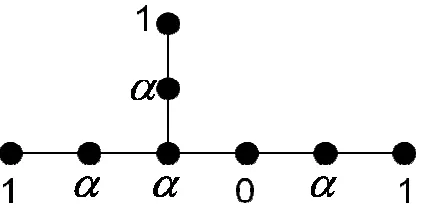
In this paper, we introduce one-alpha descriptor. It is defined as the sum of the vertex contributions is such a way that each pendent vertex contributes 1, each vertex of degree two adjacent to pendent vertex contributes α, and also each vertex of degree higher than two also contributes α and another vertex contributes 0. If we take α=2, we get the previously defined [1] one-two descriptor. As in [1], we illustrate this definition for 3-ethyl-hexane in Figure 1.
Corresponding Author (Email: [email protected])
DOI: 10.22052/ijmc.2018.118091.1342
One-alpha descriptor of graph G will be denoted by OA(G). For instance, if G is 3-ethyl-hexane, then OA(G) = 3 + 4α. We show that one-alpha descriptor as generalization of one-two descriptor may be of interest in chemistry, since it can slightly improve predictions of the heat capacity at P constant (CP) and of the total surface area (TSA) for octane isomers. Further, we analyze mathematical properties of this descriptor. Namely, we find tight upper and lower bounds in the families of the trees with n vertices and the chemical trees with n vertices.
Figure 1. Vertex contributions of 3-ethyl-hexane. Each pendent vertex contributes 1, each vertex of degree two adjacent to pendent vertex contributes α, and also each vertex of degree higher than two also contributes α and another vertex contributes 0.
2.
QSAR
R
ESULTSInternational Academy of Mathematical Chemistry [6] proposed four benchmark sets [7] as sets for testing the molecular descriptors. Also, recently Adriatic descriptors [8−12] have been proposed and in many cases they have provided better results than benchmark descriptors [8,11]. One-two descriptor outperformed both sets of descriptors in the linear modeling of TSA, and it was of comparable quality (slightly better) than benchmark descriptors in the linear modeling of CP, but not as good as the best Adriatic index [8−12].
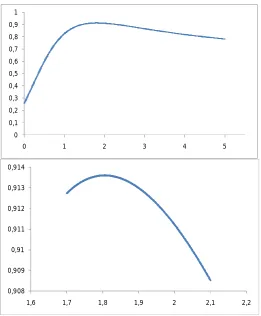
Figure 2. r2 values of the linear models for estimation of the total surface area by one-alpha descriptors. On the left hand-side diagram α ∈ [0,5] and on the right hand-side diagram α ∈ [1.7, 2.1].
Figure 3. r2 values of the linear models for estimation of the heat capacity at P constant by one-alpha descriptors. On the left hand-side diagram α ∈ [0,5] and on the right hand-side diagram α ∈
[1.9, 2.4].
0 0,1 0,2 0,3 0,4 0,5 0,6 0,7 0,8 0,9 1
0 1 2 3 4 5
0,908 0,909 0,91 0,911 0,912 0,913 0,914
1,6 1,7 1,8 1,9 2 2,1 2,2
0 0,1 0,2 0,3 0,4 0,5 0,6 0,7
0 1 2 3 4 5
0,592 0,5925 0,593 0,5935 0,594 0,5945 0,595 0,5955
3.
M
ATHEMATICALP
ROPERTIESBefore proving the main theorems, let us introduce some notations. By ni(G) we denote the
number of vertices of degree i in G and by dG(u) we denote the degree of vertex u in graph
G. Let x be any real number. By [x] we denote the greatest integer not greater than x. In the proofs of the main theorems, we shall use the following well known lemmas:
Lemma 1. Let G be a tree with at least 2 vertices. Then it holds:
31( ) ( 2) ( ) 2 i i G n i G n .
Proof. It is easy to see that:
). ( 2 ) ( ) ( | ) ( | 2 2 ) ( 2 ) ( | ) ( | 2 2 ) ( 2 ) ( 2 ) ( ) 2 ( 1 2 1 2 1 3 3 3 G n G n G n G V G n G n G V G n G in G n i i i i i i i
Lemma 2. Let G be a tree with maximal upper bound for one-alpha descriptor. Then G
does not contain any vertices of contribution 0 to OA index.
Proof. Supposed to the contrary that there exists a vertex u of contribution 0, and adjacent to vertices v1 and v2 such that dG (v1), dG (v2) ≥ 2. Let G
’
= G-uv2+v1v2. It can be easily seen that
contributions of all the vertices except uand v1 to OA index remained the same, the contribution
of v1 did not decrease and the contribution of u increased from 0 to 1. Hence, OA(G ’
) > OA(G), which iscontradiction. Hence, indeed there are no vertices of contribution 0. □
Lemma 3. Let G be a tree with maximal upper bound for one-alpha descriptor and α >1. Then G has at least a vertex of degree 2.
Proof. By Lemma 1,
3 31( ) ( 2) ( ) 2 ( ) 2
i i i
i G n G
n i G
n .
By the above inequality we conclude that, n1(G) − 2 ≥ ∑i≥3ni(G). By contrary we assume
that n2(G) = 0. Since n1(G) + ∑i ≥3 ni(G) = n, n1(G) + n1(G) – 2 ≥ n1(G) + ∑i≥3 ni(G) = n and
so n1(G) ≥ n/2 + 1, where |V(G)| = n.
Also, since n2(G) = 0, OA(G) = n1(G) + α∑i≥3ni(G) = n1(G) + α(n − n1(G)). By
assumption OA(G) is maximal and α > 1, then n1(G) must have minimum value. Now we
construct a graph G' such that |V(G’)| = n and n1(G) < n/2+1 and OA(G’) > OA(G), which
For each case we construct the graph G' as Figure 4, such that OA(G’) = n1(G’) +
α(n−n1(G’)), n1(G’) < n/2+1 and OA(G’) > OA(G), which is contradiction. □
Figure 4. Theconstructed graph related Lemma 3.
Now, we can obtain lower and upper bounds for trees to different values of α.
Theorem 4. Let G be a tree with nvertices. It holds
) 1 (
4 2
2 2 22
0
) (
n n G
OA
3 3 3
n n n
4 3 2 1
n n n n
.
hence OA(G) ≥ 2 + 2α. Now if α = n − 3, then 2 + 2α = (n−1) + α = 2n − 4 and hence for α < n−3, we have 2 + 2α < (n −1) + α. Also for α > n −3, 2 + 2α > (n −1) + α. Examples of the extremal graphs obtaining the lower bounds for α < n − 3are paths Pn, for n ≥ 4 and for α > n − 3are the stars
Sn, for n ≥ 4. Also for α = n − 3, OA(Pn) = OA(Sn) = 2n − 4.
□
Theorem 5. Let G be a tree with n vertices. Then
) 1 3 2 ( 1 3 2 ) 3 2 ( 3 2 ) 1 ( ) ( n n n n n n n G OA 3 2 , 1 3 2 , 1 1 n n .
Proof. First assume that α ≤ 1. By Lemma 2, OA(G) = n1(G) + α(n − n1(G)), then OA(G) is
maximum if and only if n1(G) is maximum. A tree with maximum number of leaves is a
star and OA(Sn) = (n − 1) + α. Therefore, OA(G) ≤ (n − 1) + α.
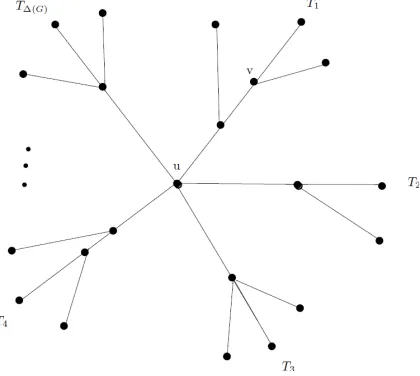
Now we assume that α > 1. Let us prove that for each n, there exists an n-vertices tree G with maximum OA such that Δ(G) ≤ 3. Suppose that G is a tree with n vertices such that OA(G) is maximum. If Δ(G) ≤ 3, then there is nothing to prove. Let Δ(G) > 4, by Lemma 3, there exists a vertex v in V(G) such that degGv = 2. Let u V(G), degGu = Δ(G)
and T1, T2, ..., TΔ(G) be branches from u, see Figure 5. Without loss of generality, we can
assume that v is in T1.
Figure 5. The configuration of graph G in Theorem 5.
Now we instruct a graph G1 as follow: We omit the branches T4, T5, ..., TΔ(G) and
OA(G) and since OA(G) is maximum then OA(G1) will be maximum, then by Lemma 3
there exists a vertex v1 in V(G1), such that dG1(v1)=2. It is clear that Δ(G1) ≤ Δ(G) and
dG1(v) = Δ(G) −1. By continuing the above process we can obtain the graph G2, such that
Δ(G2) ≤ Δ(G1) ≤ Δ(G) and OA(G2) = OA(G1) = OA(G). Finally by continuing this process
we can obtain the graph Gs from Gs-1, such that Δ(Gs) ≤ 3 and OA(Gs) = ... = OA(G1) =
OA(G). Hence from beginning we can assume that G is a tree with maximum OA and Δ(G) ≤ 3. Now by Lemma 1, n1(G) = ∑i≥3(i − 2) ni(G) + 2 = n3(G) + 2. We have n1(G) + n2(G) +
n3(G) = 2, and so
2 n1(G) + n2(G) = n + 2. (1)
By Lemma 2, G does not contain any vertices of contribution 0 to OA index then OA(G) = n1(G) + α(n − n1(G)). Since α > 1, OA(G) is maximum if and only if n1(G) is
minimum. Again, by Lemma 2, we have n2(G) ≤ n1(G). From Equation (1), we conclude
that 3n1(G) ≥ 2n1(G) + n2(G) = n + 2 and then n1(G) ≥ (n + 2)/3. Hence if
(n + 2)/3 = k Z (n 1 mod 3),
then n1(G)=(n+2)/3 is minimum value for n1(G) and if
(n + 2)/3 = k Z (n 0 or 2 mod 3),
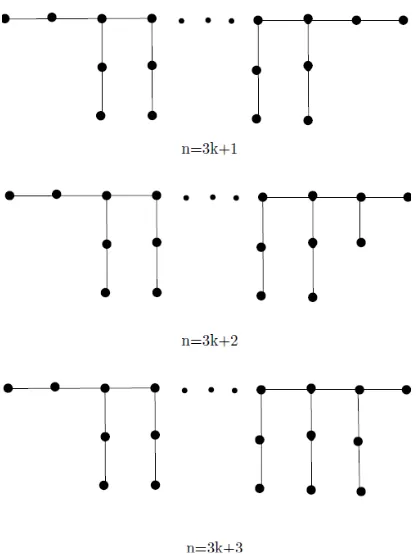
then n1(G)=[(n+2)/3]+1 is minimum value. The examples of the extremal graphs obtaining the
upper bounds are presented in the Figure 6.
Figure 6. Extremal graphs obtaining the upper bounds.
This proves the Theorem. □
ACKNOWLEDGMENT. The partial support of Croatian Ministry of Science, Education and
R
EFERENCES1. D. Vukičević, M. Bralo, A. Klarić, A. Markovina, D. Spahija, A. Tadić and A. Žilić, One-Two descriptor, J. Math. Chem.48 (2010) 395–400.
2. R. Todeschini and V. Consonni, Handbook of Molecular Descriptors, Wiley−VCH, Weinheim, 2000.
3. N. Trinajstić, Chemical Graph Theory, CRC Press, Boca Raton, 1992.
4. J. Devillers and A. T. Balaban (Eds.), Topological indices and related descriptors in QSAR and QSPR, Gordon and Breach, Amsterdam, 1999.
5. M. Karelson, Molecular Descriptors in QSAR/QSPR, Wiley−Interscience, New York, 2000.
6. http://www.iamc-online.org/
7. http://www.moleculardescriptors.eu/dataset/dataset.htm
8. D. Vukičević and M. Gašperov, Bond additive modeling 1. Adriatic indices, Croat. Chem. Acta83 (3) (2010) 243–260.
9. D. Vukičević, Bond additive modeling 2. Mathematical properties of max-min rodeg index, Croat. Chem. Acta 83 (3) (2010) 261–273.
10.D. Vukičević, Bond additive modeling 3. Comparison between the product-connectivity index and sum-connectivity index, Croat. Chem. Acta 83 (3) (2011) 349−351.
11.D. Vukičević, Bond additive modeling 4. QSPR and QSAR studies of variable adriatic indices, Croat. Chem. Acta 84 (1) (2011) 87−91.