220 | P a g e
Does Smart Phone Use Cure or Hurt Academic
Performance? An Empirical Study of Secondary School
Students
Arsheed Ahmad Paray
1, Sajad Ahmad Mir
2 1,2Ph. D. Research Scholar,
School of Education,Central University of Kashmir (India)
ABSTRACT
The study is aimed to examine the impact of smart phone use on academic performance of secondary school students. 160 smart phone user secondary school students belonging to arts, science and commerce academic stream constitute the sample for the present study. The sample has been selected randomly from four higher secondary schools of Kashmir (J & K, India). Data tools included a general information schedule, and previous year academic marks obtained by respondents in their final year examination. Data collected after survey has been analyzed by ANOVA besides mean, standard deviation, and percentage. The findings revealed that academic stream is a significant predictor in determining the academic performance of smart phone user secondary school students. The results of the study are hoped to open the way for novel interventions to improve academic performance of secondary school students.
Keywords: Academic Performance; Secondary School Students; Smart Phone Use
I. INTRODUCTION
The invention of the smart phone has created a new era in the history of mankind. It is proving beneficial to members from all sections of the society in many aspects including the education. The students use it for the communication and information purposes. Smart phone usages help students in communicating with other
students and teachers and also provide them real time information (Haruna, 2016) 1. In modern times the smart phone has become an important part of student’s life (Ling, 2004) 2. Smart phones are used to assist students
in accessing information from the web, transforming it, transferring it, collaborating with students and also
221 | P a g e
cell phone owners is greater than the number who own personal computers. 81% Indian’s are mobile phone
users, out of which 10% uses a smart phone and 9% uses a multimedia phone.
Surveys and studies from a number of countries indicate that the use of mobile phones in young people is increasing rapidly and starting at a younger age. Almost half of the mobile internet users are between 18 and 25 years. The Indian government is committed to setting up a robust digital infrastructure and to promote adoption of mobile Internet and related products and services. In 2014-15, the Government budgeted 500 crore INR for building infrastructure as per the National Rural Internet and Technology Mission with an additional INR 100 crore budgeted for improving e-governance.
Technology addiction is a recently developed term and is considered a challenging problem in educational sector especially at secondary level because secondary school students, who are basically adolescent students, are vulnerable to mobile addiction. Smart phone addiction has been surfaced a new problem among the secondary school students during the recent days. In order to prevent the addiction and to provide new educational methods for the secondary school students, many researchers have proposed various kinds of research works. Every introducing technology is created to make the life of humans easy and enjoyable but most of technologies have benefits and weaknesses. Likewise smart phone use has both advantages and disadvantages which depend on the attitude and mental set up of user.
Smart phone and internet usage enhances the academic performance of students (Mir & Parray, 2018 4;
Pullen, et al., 2015 5; Ismail, et al., 2013 6). However, literature search also reveals a negative influence of smart phone and internet usage on academic performance of students (Nalwa & Anand, 2003 7; Kheirkhah, et al., 2010 8; Abdullah, et al., 2012 9). The appeal factor for learning through smartphones, and particularly through apps, would be the ease and flexibility offered by mobile learning. It minimizes the barriers inherent in traditional methods or activities that used to be carried out in schools and universities (Valk, Rashid, & Elder,
2010 10). The present research is intended to study the impact of smart phone usage on the academic
achievement of the secondary school students in Kashmir.
II. OBJECTIVES
1. To study the Academic Performance of smart phone user secondary school students with respect to their academic stream.
2. To compare the Academic Performance of smart phone user secondary school students with respect to their academic stream.
III. HYPOTHESIS
222 | P a g e
IV.
METHODOLOGY AND PROCEDURE
4.1 Sample
The sample for the present investigation is comprised of 150 secondary school students (50 Science, 50 Arts and 50 commerce) drawn from four secondary schools of Kashmir (J&K, India). Simple random sampling technique was followed to choose the sample.
4.2 Tools Used
1. Information Blank: Self constructed Information Blank was developed by investigator to locate the smart phone user secondary school students. For the present study, Smart Phone User Secondary School Students are those students who are enrolled in 11th and 12th class in a higher secondary school, possess a smart phone, have direct access to the worldwide network, have skill to use the Internet and have at least one year experience of using smart phone.
2. Academic Achievement: For the present investigation, academic achievement is the aggregate
academic marks obtained by higher secondary school students in their previous final examination conducted by JKBOSE.
V. ANALYSIS AND INTERPRETATION
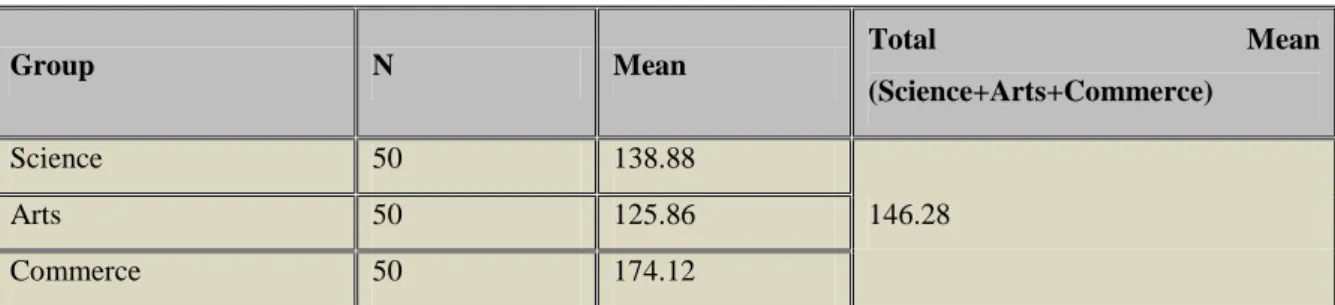
Table 1.00: Showing Academic Performance of Science, Arts and Commerce Smart Phone User
Secondary School Students
Group N Mean Total Mean
(Science+Arts+Commerce)
Science 50 138.88
146.28
Arts 50 125.86
Commerce 50 174.12
223 | P a g e
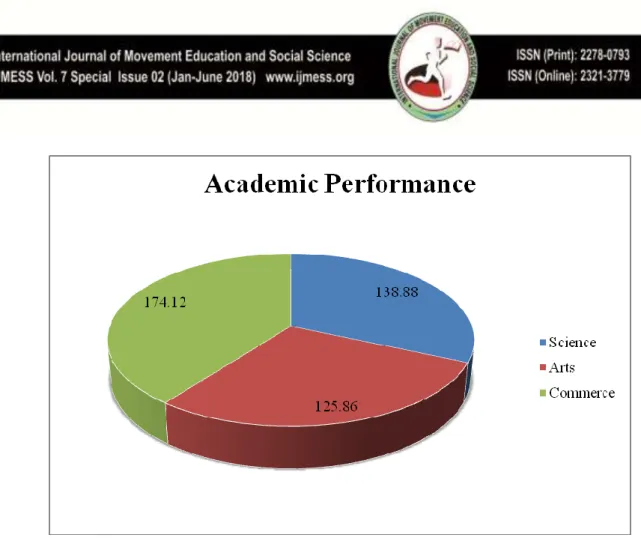
Graph 1.00: Showing Mean Difference of Science, Arts and Commerce Smart Phone User Secondary SchoolStudents on their Academic Performance
Table 2.00: Showing the Significance of Mean Differences among Science, Arts and Commerce
Smart Phone User Secondary School Students on Academic Performance (N=150)
Academic
Performance
Source of Variation SS df MS F – ratio
Between Groups 62340.09 2 31170.04
12.27 Within Groups 345032.58 147 2347.16
Total 407372.67 149
VI. CONCLUSION
224 | P a g e
The table 2.00 depicts that the main effect of stream on academic performance is significant at both levels. It means that there is a significant difference in mean score of academic performance of arts, science and commerce smart phone user secondary school students. Thus, H1 which reads as “there is a significant
difference among science, arts and commerce smart phone user secondary school students on their academic performance” stands accepted.
The reason for the present finding is justified on the fact that arts smart phone user secondary school students are using the smart phone for entertainment and relaxation more than science and commerce smart phone user secondary school students. They spend their time more on social networking web sites such as facebook, twitter, whatsapp, instragam for chatting and talking purposes. Contrary to this, commerce smart phone user secondary school students are using smart phone for communication and educational purposes even more than their science counterparts. Students who make use of e-journals, e-books, and online databases on daily basis have excelled the students’ who don’t make use of it (Cheung & Huang, 2005 11; Zhao, 2006 12; Turner &
Farmer, 2008 13; Shahin, et al., 2010 14).
VII. EDUCATIONAL IMPLICATIONS
7.1 Students should be counseled and guided in using the smart phone and its advantages.
7.2 There should be provision of equipped computer labs, computer trained teachers, mandatory computer class attendance to all secondary schools.
7.3 Blended learning and internet facilities should be promoted for effective and efficient use.
7.4 Workshops should be organized at secondary and higher levels of education for providing training to academic community from the concerned experts.
7.5 Pornography and other visual depiction of sexual subject matters should be banned on the internet.
REFERENCES
1 H Rabiu, Impact of Mobile Phone Usage on Academic Performance among Secondary School Students in
Taraba State, Nigeria. European Scientific Journal, 12(1), 2016.
2 R. S. Ling, mobile connection: the cell phone's impact on society (San Francisco: Morgan Kaufmann, 2004).
3 B. Ferry, Using mobile phones to enhance teacher learning in environmental education. In J. Herrington, A.
Herrington, J. Mantei, I. Olney, & Ferry, B. (Eds.), New technologies, new pedagogies: Mobile learning in higher education, pp. 4555. Wollongong: University of Wollongong: 2009.
4 S. A. Mir & A. A. Parray, Internet usage and academic performance: An empirical study of secondary
225 | P a g e
5 D. Pullen, K. Swabey, M. Abadooz & T. Sing .Malaysian university students’ use of mobile phones for
study. Australian Educational Computing, 30(1), 2015.
6 I, Ismail, S. F. Bokhare, S. N. Azizan, & N. Azman, Teaching via mobile phone: A case study on Malaysian teachers’ technology acceptance and readiness. Journal of Educators Online, 2(1), 2013
7 K. Nalwa, & P. Anand, Internet Addiction in students: A cause of concern. Cyber of Australian students:
Participation habits and prevalence of addiction. Australian Journal of Psychology and Behaviour, 6(6), 2003, 653-656.
8 F. Kheirkhah, A. G. Juibary, & A. Gouran, Internet Addiction, Prevalence and CresEpidemiological
Features in Mazandaran Province, Northern Iran. Iranian RedMedic Journal, 12(2), 2010, 133-137.
9 Y. Abdullah, M. Sedek, J. Mahat, & N. Zainal, Individual characteristic in online gaming and mobile
application use among students in higher education institution: A confirmatory factor analysis. Prosiding Seminar Institusi Pendidikan Tinggi, 1(1), 2012.
10 J. Valk, A. Rashid, & L. Elder, Using mobile phones to improve educational outcomes: An analysis of
evidence from Asia. The International Review of Research in Open and Distributed Learning, 11(1), 2010 117-140.
11 W. Cheung, W. & W. Huang, Proposing a framework to assess Internet usage in university education: An empirical investigation from a students’ perspective. British Journal of Educational Technology, 36(2), 237-253.
12 Y. Zhao, Does home internet use influence the academic performance of low-income children?
Developmental Psychology, 42(3), 2006, 429.
13 S. Turner, & M. E. Farmer, Assessment of student performance in an internet-based multimedia classroom.
Paper presented at International Conference on Frontiers in Education Computer Science and Computer Engineering (FECS08) Las Vegas July 14, - July 17, 2008.
14 Y. G. Shahin, S. Balta, & T. Ercan, The use of Internet resources by university students during their course