Iranian Journal of Fisheries Sciences 17(1) 217-227 2018
DOI: 10.22092/IJFS.2018.115616
Effects of dietary diludine supplementation on growth,
proximate composition, muscle and texture structure of
rainbow trout juveniles
Hisar O.
1; Karaoğlu M.M.
2; Hisar S.A.
3; Yanik T.
4, Gürkan M.
5;
Kaya H.
1*
Received: October 2015 Accepted: July 2016
Abstract
A feeding trial which lasted for eight weeks was conducted to investigate the effects of diludine, a growth promoter, on feed efficiency, muscle structure and proximate
composition of juvenile rainbow trout. Diludine was added at 0.0(D0) 0.2(D1), 0.5(D2) and
1(D3) g kg-1 to a casein-based diet, and every diet was given to the triplicated groups of
juvenile rainbow trout. At the end of experiment, it was determined that a significant improvability existed for both growth and feed utilization in fish fed diets supplemented with diludine (p<0.05). Similarly, different concentrations of diludine affected the densitometric quantification of myofibrillar proteins in fish muscle according to results obtained by Sodium dodecyl sulfate polyacrylamide gel electrophoresis (SDS-PAGE). The mean value of fiber diameters significantly increased in skeletal muscle with increasing concentrations of diludine. The histological results also showed hypertrophic adipocytes in
skeletal muscle of fish fed D2 and D3 diets. The lowest elasticity values were observed in
fish fed the control diet while those fed D3 diet had highest elasticity values. On the other
hand, no differences were found between fish fed experimental diets in terms of survival rate and all fish exhibited similar proximate composition for protein, lipid, moisture and
ash. Consequently, it may be suggested that dietary diludine supplementaion up to 1 g kg-1
concentration in the diets have positive impacts on growth of rainbow trout juvenils and the better growth in the fish fed with diludine supplements could be arise from muscle characteristics, in particular changes in fibres than proximate composition of the muscles.
Keywords: Diludine, Growth, Muscle structure, Texture, Sodium dodecyl sulfate polyacrylamide gel electrophoresis, Trout
1-Faculty of Marine Sciences and Technology, Çanakkale Onsekiz Mart University, Çanakkale-Turkey
2-Faculty of Engineering, Department of Food Engineering, Atatürk University, Erzurum- Turkey
3-Faculty of Engineering, Department of Food Engineering, Çanakkale Onsekiz Mart University, Çanakkale-Turkey
4-Faculty of Fisheries, Atatürk University, Erzurum-Turkey
5-Faculty of Art and Science, Department of Biology, Çanakkale Onsekiz Mart University, Çanakkale-Turkey
*Corresponding author's Email: [email protected]
Introduction
Aquaculture has been among the fastest growing food-producing sectors in the world with the mean annual growth rate of more than 6% within the last 40 years, compared to the rates of only 1.2% for capture fisheries and 2.8% for terrestrial farmed meat production systems during the same period (FAO, 2009; Gültepe et al., 2012). The cost of fish production is likely to be reduced on condition that growth performance and feed efficiency might be increased in commercial aquaculture. Therefore feed efficiency and growth performance in cultured fish species should be paid more attention to minimize the production cost.
Dietary supplementations of different growth promoters have been found to be beneficial for improving feed efficiency and growth performance of fish (Arslan et al., 2008; Ganguly and Prasad, 2012). Diludine is a new kind of growth promoter and it is not an analogue or a derivative of growth hormones the application of which is prohibited in aquaculture (Arslan et al., 2011). The main functions of diludine are to enhance the reproductive performance of livestock, to improve sperm viability, to increase the breeding rate as well as percentage of lean meat percentage. It is commonly used as an antimutagen and skin coloring in fish (Slukvin et al., 2006) and as antioxidant in food and to ensure the stabilization of edible oils (Kourimska et al., 1993; Tirzitis et al., 2001).
Skeletal muscle approximately constitutes 50% of the total fish body weight and represents the edible part (Testi et al., 2006). Muscle composition contributes strongly to flesh quality. Texture and elasticity are used as selection criteria to measure flesh quality and sensory characteristics for consumers. They are influenced by many factors, including the structure of the muscle and properties of its components, in particular, the number and size distribution of muscle fibers (Johnston, 1999; Rasmussen et al., 2011).
Despite the fact that a great deal of work has been conducted on growth promoters, relatively few studies have investigated diludine and its potential effects on fish muscle structure. Therefore, the aim of this work was to assess how dietary diludine supplementation possibly affects the growth and texture structure of fish muscle through physical, electrophoretic (Sodium dodecyl sulfate polyacrylamide gel electrophoresis, SDS-PAGE) and histological methods.
Materials and methods
Experimental fish and rearing facilities
The present study was carried out in the Central Laboratory at the Fish Rearing Facility of the Marine Sciences and Technology Faculty at Çanakkale Onsekiz Mart University. Rainbow trout juveniles obtained from the commercial trout farm were used in this trial. The fish were adapted to ambient conditions in twelve stocking tanks,
Iranian Journal of Fisheries Sciences 17(1) 2018 219
each containing 2400 L rested tap water for four weeks. Fish with an average weight of 11.7±1.2 g were randomly distributed into twelve experimental tanks each including 60 fish, and a triplicate trial design was generated. In order to supply fresh water, recirculated, aerated, and dechlorinated tap water having the flow rate of 4.8±0.1 L/min was used. Other conditions related to the water were determined as follows: the mean value of water temperature was 13±0.5°C; the concentration of the dissolved oxygen was 9.2±0.3 mg/L; the pH was 7.8±0.1, and the total hardness of water was measured as 125±3 mg as CaCO3.
Diet formulations and feeding
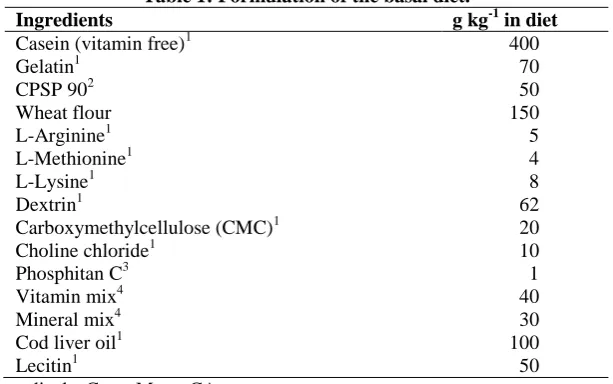
A basal semi-purified (casein based) diet was formulated in a way to comprise approximately 48% protein and 15% lipid (Table 1). The basal diet functioned as the control diet. Other three diets consisted of the basal diet including diludine at 0.2, 0.5 and 1 g kg-1. Before the addition of oil, the dry feed ingredients were thoroughly mixed for 10 min with a mixer and approximately 300 mL of deionized water/kg diet was added to the diet mixture. The moist mixture was extruded through a 2-mm diameter die with a meat grinder. Diets were dried at 5 µm hg pressure at -50oC in a lyophilizator. Following the oil diffusion, pellets were ground into small pieces, then were sieved to get approximate sizes and stored frozen in plastic bags at -20°C up to the time of feeding. Fish stocked in four randomly
assigned tanks were fed 40 g kg-1 biomass day-1 by one of the four experimental diets at 08.00, 11.00, 14.00 and 17.00 h for 8 weeks. The feed ration was daily increased appropriately, which was calculated from the acceptation of food conversion rate (FCR) being equal to one.
Sampling and weighing
Fish were sampled biweekly, to this end, all fish in each tank were captured, anesthetized with tricaine methanesulphonate (MS-222; Pharmaq, Fordingbridge, UK), batch weighed and counted, after one day of fasting. From the results of the final sample, we calculated weight gain (WG) (%) [100(final weight − initial weigh)/initial weight], FCR [feed consumption / weight gain] and survival (%) in accordance with Gültepe et al. (2012). Furthermore, at the end of all tests, all remaining fish were used in proximate analysis, stress relaxation test, histological examination and SDS-PAGE.
Proximate analysis
Fifteen fish per the experimental group were used for proximate analysis. Samples were freeze-dried before the analysis. Gravimetric analysis was preferred to calculate the dry matter following the oven drying conducted at 105oC for 24 h. Gravimetrical method was used to determine gross ash content following the loss of mass after a sample was combusted in a muffle furnace at 600oC for 12 h.
Table 1: Formulation of the basal diet.
Ingredients g kg-1 in diet
Casein (vitamin free)1 400
Gelatin1 70
CPSP 902 50
Wheat flour 150
L-Arginine1 5
L-Methionine1 4
L-Lysine1 8
Dextrin1 62
Carboxymethylcellulose (CMC)1 20
Choline chloride1 10
Phosphitan C3 1
Vitamin mix4 40
Mineral mix4 30
Cod liver oil1 100
Lecitin1 50
1 ICN Biomedicals. Costa Mesa. CA. 2
Soluble fish protein concentrate (CPSP 90). Sopropeche S.A.. Boulogne-Sur-Mer. France 3
Mg-L-ascorbyl-2-phosphate. Showa Denko K.K. Tokyo. Japan
4 Roche Performance Premix composition per g of vitamin mixture: vitamin A. 2646 IU; vitamin D3. 221 IU; vitamin E. 66.1 IU; vitamin B12. 13 μg; riboflavin. 13.2 mg; niacin. 61.7 mg; D-pantothenic acid. 22.1 mg; menadione. 1.32 mg; folic acid. 1.76 mg; pyridoxine. 4.42 mg; thiamin. 7.95 mg; D-biotin. 0.31 mg (Hoffman-La Roche. Nutley. NJ.).
Protein levels were calculated according to the total nitrogen determined by Kjeldhal digestion on the basis of N x 6.25. Crude fat content was determined gravimetrically after the lipids were extracted in accordance with the Soxhlet method. All proximate analysis of fish bodies were performed in accordance with the methods of AOAC (1984).
Stress-relaxation test
Six fish from each of the three replicate experimental groups were used as the initial point of stress-relaxation test. Elasticity was also determined by means of a stress-relaxation test after relaxation for 1 min. Percentage relaxation was calculated as YT=100(F0−F1)/F0, where F0 was the force registered at the onset of relaxation immediately after sample compression and F1 was the force
registered after relaxation for 1 min. Thus, 100−YT was taken as a percentage index of gel elasticity.
Histological examinations
Skeletal muscle samples (nine fish for each group) were taken from the lateral side of every fish in a region located under the first ray of dorsal fin. The size of every muscle sample was around 1.0 cm in width and 1.0 cm in length. Bouin’s solution was used to fix the samples for histological examination. Thereafter, these tissues were treated by means of alcohol, xylene, and paraffin series and then paraffin blocks were prepared. Cross sections having 5 μm thicknesses were obtained from these blocks; they were stained with hematoxylin and eosin (H&E), and were examined histopathologically under a light microscope. Finally, histological imaging of the preparations
Iranian Journal of Fisheries Sciences 17(1) 2018 221
was conducted with a camera mounted on an Olympus BX51 light microscope and DP2-BSW software was used for the analysis. For statistical analyses, 100 fibers were measured from each group according to Ando et al. (1991). The measurements were obtained fibers cross sections and diameters of circles with equivalent areas.
Extraction of muscle proteins and SDS-PAGE
The whole procedure was conducted on ice or below 4oC. Fish muscle (20-30 mg) taken from nine fish for each group were homogenized in a buffer (1 mL) containing 50 mM Trizma base, pH 7.4 and 1 mM EDTA with a Polytron (Kinematica, Littau, Switzerland). The homogenate was heated for 2 min at 85oC and then cooled. Afterwards, the homogenate was centrifuged at 13000 rpm for 4 min. The 90 μL supernatant was withdrawn and resuspended in 0.9 ml homogenization buffer. SDS-PAGE was performed on 10% polyacrylamide gels including 1% SDS (Laemmli, 1970). Twenty-µg samples were used in electrophoresis medium. After that, the gel was stained in a solution containing 10% acetic acid and 50% methanol including 0.1% Coomassie Brillant Blue R-250. Afterwards it was destained with several changes of the same solvents which did not contain Coomassie Brillant Blue R-250. Molecular Analyst TM/PC 1.5 Biorad Software for Windows was used to quantify protein bands densitometrically. Molecular weights
were taken into consideration to determine the molecular weights.
Statistics
Data were firstly tested for normality and homogeneity of variances in order to verify the assumptions of the analysis of variance (ANOVA). Normality of data and homogeneity of variances were checked using Kolmogorov Smirnov and Levene tests, respectively. One-way analysis of variance (ANOVA) was then performed to assess the significance of differences observed between the experimental groups with the Statistical Analysis System (SAS), SAS Institute Inc., Cary, NC. Differences between the mean values were also analyzed with a LSD range test having p < 0.05 significance level (Hisar et al., 2012).
Results
Table 2 indicates the growth performance of fish fed with the four experimental diets. There was no significant effect of diets on survival rate of fish. However, the body weight of each group measured in the second month showed significant differences between control and experimental groups (p<0.05). The WG and FCR were significantly better in the rainbow trout fed the diet with all concentration of diludine than those fed the basal diet (p<0.05).
Analysis of body proximate composition (Table 3) revealed that moisture, crude protein, lipids and ash were unaffected (p> 0.05) in present trial.
Table 2: Growth performance in fish fed experimental diets.
Growthperformance
Diets
Control (diludine at 0.2‰) Diet 1 Diet 2 (diludine at 0.5 ‰)
Diet3 (diludine at 1‰) Initial BW (g) 1.6±0.0 1.5±0.0 1.6±0.0 1.5±0.0 BW at first month (g) 3.0±0.2 a 3.3±0.1 ab 3.2±0.1 ab 3.4±0.1 b Final BW (g) 8.5±0.3a 9.0±0.1b 9.2±0.2b 9.5±0.2b Weight gain (%) 416±19a 470±15b 452±07b 507±17b FCR 1.27±0.02a 1.18±0.01b 1.19±0.01b 1.16±0.01b
Survival (%) 100 100 100 100
*
BW: Body weight. FCR: Food conversion ratio.
**Means with different superscripts in rows are significant different (p<0.05)
Table 3: Body composition in rainbow trout fed the experimental diets for 8 weeks. Five fish from each of the three replicate experimental groups were pooled.
Body composition Control (diludine at 0.2‰) Diet 1 (diludine at 0.5 ‰) Diet 2 (diludine at 1‰) Diet3
Moisture (%) 75.1±0.7 74.6±0.1 74.3±1.9 73.8±0.1 Crude Protein (%) 15.5±0.7 16.6±0.5 17.6±1.0 16.6±0.3
Lipid (%) 5.4±1.4 5.7±0.7 5.5±1.4 6.0±0.0
Ash (%) 1.6±0.0 1.8±0.1 1.6±0.0 1.9±0.2
*Within each row, values are expessed as a mean±SD
The values of elasticity measured by the stress-relaxation test are given in Fig. 1. The four batches of fish muscles displayed significant differences. The control batch had the lowest elasticity values (p<0.05). In addition a noticeable increase in elasticity by stress-relaxation test was found out in muscles of fish which were fed diets with three different diludine concentarions (p<0.05).
SDS-PAGE band profiles of the solubilized myofibrillar proteins in rainbow trout muscle are shown in Fig. 2. These bands were present in all samples, but some of them were faint. The intensity of the α-actin bands at approximately 108kDa was lowest in the muscles of the fish fed diets without diludine (basal diet).
By light microcopy, no histological anomalies were observed in the sections of the skeletal muscle of fish fed control and D1 diets (Figs. 3a, 3b and Fig. 4).
However fish fed D2 and D3 diets had larger adipocytes than those fed basal and D1diets (Figs. 3c and 3d). The mean fiber diameters were also calculated as 435.3, 483.9, 490.2 and 530.7 for the muscle of fish fed D0 (basal), D1, D2 and D3 diets, respectively (Table 4) and the significant differences in respect to the fiber diameter among the groups were found (p<0.05).
Iranian Journal of Fisheries Sciences 17(1) 2018 223
Figure 1: SDS-PAGE analysis of myofibrillar proteins for rainbow trout (n=9). Lane M shows results for standard proteins. Lanes control and D1-D3 show results for myofibrillar proteins from the muscles of rainbow trout juveniles fed diets with different diludine
concentrations at 0, 0.2, 0.5 and 1 g kg-1, respectively.
Fıgure 2: Longitudinal sections of skeletal muscles of rainbow trout juveniles, (a) Control, (b) D1,
(c) D2 and (d) D3 groups (H&E). Fat cells ( ).
Fıgure 3: Skeletal muscle fibers of rainbow trout juveniles in cross section of control group muscle (H&E).
Table 4: Mean fiber diameters (µm) in skeletal muscle of rainbow trout juveniles (n=9). Diets
Control Diet 1 (diludine at 0.2 g kg-1)
Diet 2 (diludine at 0.5 g kg-1)
Diet 3 (diludine at 1 g kg-1) Mean fiber
diameter (µm) ± SD
282.20±18.12a 335.84±14.58ab 346.21±16.45ab 380.49±18.21b
Means with different superscripts in rows are significant different (p<0.05).
Discussion
It is well known that the growth reflects the opposing processes of catabolism and anabolism and it is influenced by a great variety of physiological processes such as food intake, digestion, absorption, assimilation and excretion (Robertson et al., 2003).
Although inclusion of dietary diludine did not have a significant effect on survival rate, fish fed diludine supplemented diets showed a significant growth improvement in the present study. The body weight of each group being measured in the second month indicated a significant difference between control and experimental groups. The WG and FCR were significantly better in the rainbow trout
fed the diet with all diludine concentrations compared to those fed the basal diet. The growth response to the diludine is parallel with the result obtained from previous study (Hisar et al., 2012). Similarly, Slukvin et al. (2006) reported that the feeding of 55-day old carp fry with combined food including diludine for 23 days was found to increase the weight gain to an average of 80% against the control groups.
Fillet texture is one of the most important quality parameters in fish and is influenced by several factors, including fat content, the structure of the muscle and the properties of its components (Dunajski, 1979). In our study while elasticity increased in fish
Iranian Journal of Fisheries Sciences 17(1) 2018 225
muscles in which fed diets with three different diludine concentration, the diets supplemented with diludine at different levels did not affect the lipid and crude protein per cents in whole fish muscle. Similar to the results of the present study, Arslan et al. (2011) reported that lipid accumulation and fatty acid composition of neutral and phospholipids fractions of whole body lipids were not significantly affected by dietary diludine supplementation. However, Abdel-Tawwab et al. (2008) reported that the yeast supplementation used as a growth promotor significantly affected the whole-fish body composition. They also supposed that changes in protein and lipid content in fish body could be linked with changes in their synthesis, deposition rate in muscle and/or different growth rate. In previous studies, it was reported that only one protein, α-actin was clearly associated with the post-mortem disorganisation of muscle structure (Papa et al., 1996; Godiksen et al., 2009). Thus, it was suggested that the intensity of the α-actin band was low in the softer fillets and high in the firmer fish. Therefore, the present study focused on the link between just α-actin protein band intensities in whole myofibrillar proteins and texture of trout fillets. The bands of myofibrillar proteins in SDS-PAGE band profiles were present in all samples, but some of them were faint. Above all the intensity of the α-actin bands in the muscles of fish fed with diludine addition was higher than in those of the control.
Growth is usually measured as variances in body weight, length or condition factor (i.e. weight/length relationship) over time. Skeletal muscle growth in fish can also be determined by the histological method involves the hyperplasia (increase in fiber number) and hypertrophy (increase in fiber size) (Johnston, 1999; Rowlerson and Vegetti, 2001; Kiessling et al., 2006). The number and size of muscle fibers recruited during the growth are subjected to variations contingent upon several factors, such as temperature (Robertson et al., 2003), exercise (Rasmussen et al., 2011) the fish species (Weatherley et al., 1988) However little is known about the effect of diludine on muscle recruitment over fingerling stage of the production life cycle. Therefore, the diet-related changes in muscle structure were also investigated in present study. When making comparisons between control and diludine groups for the mean fiber diameters, it was found that muscles of fish fed diets with the diludine were statistically different from those of the control group. Our data also clearly indicated that the skeletal muscle fiber size increased with the increasing diludine concentrations in diet. In our histological slides, hypertrophic adipocytes were also found in the muscle. Especially those hypertrophic adipocytes were found at the muscles of fish fed D1 and D2 diets.
In general, the data found from the present study suggested that dietary supplementation of diludine up to 1 g kg-1 is effective to enhance growth and
has an impact on flesh quality of rainbow trout juveniles associated with the increases in the mean diameter values of muscle fiber, corresponding to hypertrophy and slightly increases in protein sparing in fish muscles.
Acknowledgments
We thank to Harun YILDIZ for his support in the statistical assessment of our data.
References
Abdel-Tawwab, M., Abdel-Rahman, M.A. and Nahla-Ismael, E.M., 2008. Evaluation of commercial live bakers’ yeast, Saccharomyces cerevisiae as a growth and immunity promoter for Fry Nile tilapia,
Oreochromis niloticus (L.)
challenged in situ with Aeromonas
hydrophila. Aquaculture, 280, 185–
189.
Ando, M., Toyohara, H., Shimizu, Y.
and Sakaguchi, M., 1991.
Post‐mortem tenderisation of rainbow trout (Oncorhyncus mykiss) muscle caused by gradual disintegration of the extracellular matrix structure. Journal of the
Science of Food and Agriculture, 55,
589-597.
AOAC, 1984. Official methods of analysis, 14th edn. Association of official analytical chemists, Washington, DC, 1141P.
Arslan, M., Rinchard, J., Dabrowski, K. and Portella, M.C., 2008.
Effects of different dietary lipid sources on the survival, growth, and fatty acid composition of south
American catfish, Pseudoplatystoma
fasciatum, surubim, juveniles.
Journal of the World Aquaculture
Society, 39, 51-61.
Arslan, M., Yanik, T., Kocaman, E.M., Hisar, O., Slukvin, A. and Goncharova, R., 2011. Effect of dietary diludine supplementation on growth and fatty acid composition of rainbow trout (Oncorhynchus
mykiss) juvenils. World Aquaculure,
Natal-Brazil.
Dunajski, E., 1979. Texture of fish muscle. Journal of Texture Studies, 10, 301-318.
FAO (Food and Agriculture
Organization of the United Nations), 2009. The state of world fisheries and aquaculture - 2008 (SOFIA). FAO Fisheries and Aquaculture Department, Rome, 176P.
Ganguly, S. and Prasad, A., 2012.
Microflora in fish digestive tract plays significant role in digestion and metabolism: A Review. Reviews
in Fish Biology and Fisheries, 22,
11-16.
Godiksen, H., Morzel, M., Hyldig, G. and Jessen, F., 2009. Contribution of cathepsins B, L and D to muscle protein profiles correlated with texture in rainbow trout
(Oncorhynchus mykiss). Food
Chemistry, 113, 889-896.
Gültepe, N., Hisar, O., Salnur, S., Hoşsu, B., Tanrikul T.T. and Aydın, S., 2012. Preliminary assessment of dietary mannaoligosaccharides on growth performance and health status of gilthead seabream Sparus auratus.
Iranian Journal of Fisheries Sciences 17(1) 2018 227
Journal of Aquatic Animal Health,
24, 37-42.
Hisar, O., Yanik, T., Kocaman, E.M., Arslan, M., Slukvin, A. and Goncharova, R., 2012. Effects of diludine supplementation on growth performance, liver antioxidant enzyme activities and muscular trace elements of rainbow trout
(Oncorhynchus mykiss) juveniles at a
low water temperature. Aquaculture
Nutrition, 18, 211-219.
Johnston, I.A., 1999. Muscle development and growth: potential implications for flesh quality in fish.
Aquaculture, 177, 99-115.
Kiessling, A., Ruohonen, K. and Bjørnevik, M., 2006. Muscle fiber growth and quality in fish. Archives
Animal Breeding, 49, 137-146.
Kourimska, L., Pokorny, J. and Tirzitis, G., 1993. The antioxidant activity of 2, 6-dimethyl-3, 5- diethoxycarbonyl-1, 4-dihydropyridine in edible oils. Die
Nahrung, 37, 91–93.
Laemmli, V.K., 1970. Cleavage of structural proteins during the head of bacteriophage T4. Nature, 227, 680-685.
Papa, I., Alvarez, C., Verrez-Bagnis, V., Fleurence, J. and Benyamin, Y., 1996. Post-mortem release of fish white muscle a-actinin as a marker of desorganization. Journal of the Science of Food and
Agriculture, 72, 63-70.
Rasmussen, RS., Heinrich, M.T., Hyldig, G., Jacobsen, C. and Jokumsen, A., 2011. Moderate exercise of rainbow trout induces only minor differences in fatty acid
profile, texture, white muscle fibers and proximate chemical composition of fillets. Aquaculture, 314,159-164.
Robertson, B., Paxton, C.G.M. and Burt, M.L., 2003. Freshwater environment affects growth rate and muscle fiber recruitment in seawater stages of Atlantic salmon (Salmo
solar). The Journal of Experimental
Biology, 206, 1337-1351.
Rowlerson, A. and Vegetti, A., 2001.
Cellular mechanism of post-embryonic muscle growth in aquaculture species. In: Muscle development and growth. (Ed: Ian A. Johnston), Academic Press, London, pp. 103- 140.
Slukvin, A.M., Goncharova, R.I., Anoschenko, B.Y., Smolich, II., Nikitchenko, N.V., Kochetova, N.P., Duburs, G., Uldrikis, J. and Bisenieks, E., 2006. Nonhormonal growth stimulator for juvenile fish. Aqua, Florence, Italy.
Testi, S., Bonaldo, A., Gatta, P.P. and Badiani, A., 2006. Nutritional traits of dorsal and ventral fillets from three farmed fish species. Food
Chemistry, 98,104-111.
Tirzitis, G., Tirzite, D. and Hyvonen, Z., 2001. Antioxidant activity of 2, 6-dimethyl-3, 5 dialkoxycarbonyl-1, 4- dihydropyridines in metal-ion catalyzed lipid peroxidation. Czech
Journal of Food Sciences, 19, 81-84.
Weatherley, A.H., Gill, H.S. and Lobo, A.F., 1988. Recruitment and maximal diameter of axial muscle fibers in teleosts and their relationship to somatic growth and ultimate size. Journal of Fish
Biology, 33, 851-8 59.