Patient Experience Journal
Volume 6 | Issue 1
Article 19
2019
NHS England Always Events® program:
Developing a national model for co-production
Claire Marshall
NHS England, [email protected]
Angela Zambeaux
Institute of Healthcare Improvement, [email protected]
Esther Ainley
Picker Institute Europe, [email protected]
David McNally
NHS England, [email protected]
Jenny King Miss
Picker Institute Europe, [email protected]
See next page for additional authors
Follow this and additional works at:
https://pxjournal.org/journal
Part of the
Health and Medical Administration Commons
,
Health Policy Commons
,
Health
Services Administration Commons
, and the
Health Services Research Commons
This Case Study is brought to you for free and open access by Patient Experience Journal. It has been accepted for inclusion in Patient Experience Journal by an authorized editor of Patient Experience Journal.
Recommended Citation
Marshall, Claire; Zambeaux, Angela; Ainley, Esther; McNally, David; King, Jenny Miss; Wolfenden, Lorraine; and Lee, Helen (2019) "NHS England Always Events® program: Developing a national model for co-production,"Patient Experience Journal: Vol. 6 : Iss. 1 , Article 19.
co-production
Authors
Patient Experience Journal
Volume 6, Issue 1 – 2019, pp. 154-165
Patient Experience Journal, Volume 6, Issue 1 – 2019
© The Author(s), 2019. Published in association with The Beryl Institute and Patient Experience Institute
Downloaded from www.pxjournal.org 154
Case Study
NHS England Always Events® program: Developing a national model for
co-production
Claire Marshall,
NHS England, [email protected]
Angela Zambeaux,
Institute for Healthcare Improvement, [email protected]
Esther Ainley, Picker Institute Europe,
[email protected]
David McNally, NHS England,
[email protected]
Jenny King, Picker Institute Europe,
[email protected]
Lorraine Wolfenden, NHS England,
[email protected]
Helen Lee, NHS England,
[email protected]
Abstract
NHS England, the Institute for Healthcare Improvement, Picker and NHS Improvement started the work described in this article to strengthen how patients, carers and staff working together in co-design and co-production can make a real difference in improving experience of care. Always Events®, which is an improvement methodology for the co-design and consistent implementation of those aspects of patient experience that matter most to patients in a health care setting, was chosen. The approach has been to first test the methodology with three organizations then to spread to a substantial proportion of acute health care providers, with concurrent scale-up within organizations that were early adopters in single settings, and then spread to other providers including care homes, primary care and integrated care systems. For organizations to be successful in embedding and sustaining Always Events, and to have a significant impact on improving experience, we learnt that health organizations should: a) co-produce with patients/service users from the very start and throughout every phase, b) integrate quality improvement, patient experience and person-centered care, c) identify an Executive Leader champion who can support the team to gain momentum from the beginning, d) keep an open mind and not be tempted to pre-determine what changes need to be made; patients/service users & staff know the challenges and have the best, simplest and most affordable ideas for improvement and finally, e) involving point of care staff from the beginning and co-designing the Always Event with them will support engagement and reduce resistance to change.
Keywords
Patient experience, patient engagement, measurement, National Health Service, healthcare, co-production, co-design, quality improvement
Introduction
No one would disagree that genuine partnerships between healthcare professionals and people who use healthcare services to improve experience of care are the right thing to do. It is not at all surprising that the aligned ideas of “What matters to you?”1 and co-production have received
increased attention more recently. There is emerging evidence that these approaches make a positive difference for patients and families. Nonetheless, many healthcare professionals appear to assume that this way of working is “hard to do” and describe not knowing where to start. Some have pointed to “resistant healthcare culture”2 as
one of many challenges to co-producing good healthcare services.
The national Patient Experience Team in NHS England is responsible for supporting improvement in patient
experience in the National Health Service. Recognising that many aspects of good relational care should be experienced reliably, the team wanted to find a way to bring together “What matters to you?” and co-production to improve experiences, whilst also building on Dr. Kate Granger’s very successful #hellomynameis campaign (https://hellomynameis.org.uk). The context in England in 2015 demonstrated a gap in widely applied
improvement methodologies using co-production to improve experiences of care and a gap in national policy that would specifically encourage and support co-production in this area.
of a national program to introduce Always Events®. This is
an improvement methodology for the co-design and consistent implementation of those aspects of patient experience that matter most to patients in a health care setting.The approach has been to first test the
methodology then to spread to a substantial proportion of acute, community, mental health and emergency health care providers, with concurrent scale-up within organizations that were early adopters in single settings, and then spread to other provider contexts including care homes, primary care and integrated care systems. Key challenges include the varying functional separation within many providers between quality improvement, patient experience, and person-centered care efforts, and staff pre-determining where the improvement focus should be and what changes need to be made. To achieve true co-design and co-production, the improvement focus must be determined in partnership with patients, service users, and carers. The strongest examples of Always Events
demonstrate partnership in each phase of work.
Background
Co-production
There are a range of starting points for co-production. These include a community-based “asset” approach, public organization-initiated approaches, and approaches led by people who use services. A core set of principles that characterize what has been described as
“transformative” co-production has been articulated as follows3:
• recognizing that everyone has assets and strengths;
• building mutual and reciprocal relationships in which all parties are recognized as having expertise (not least those with lived experience); and
• forming networks around diverse communities of interest seeking to catalyze change.
It is important to make a clear distinction between co-production and the concepts and practice of engagement and involvement. Engagement and involvement have been described as either an “episodic add-on”, usually in relation to an established agenda, and often a pre-determined set of solutions, or a “representative” or “advisory” model. Co-production is founded on genuine partnerships “from the very first conversation where we establish what question we are exploring together” all the way through the various stages of improvement or transformation work, potentially including “co-delivery of a service”3.
The need to combine this kind of approach with quality improvement in healthcare, including improving experience, was articulated by Ham et al in a 2016 report by The Kings Fund4, which included a section to “ensure
the voice of patients and the public is sought and heard in
the design and implementation of the strategy”. The authors talked about the need for “commitment to listening to and learning from the experiences of patients and carers and assuring their full participation in design, redesign, assessment and governance”, “patients and the public as equal partners” and “developing a cohort of patient leaders able to work in this way”.
There is evidence that co-producing quality improvement makes a difference. The results of a project commissioned by the NHS England Patient Experience Team in 20155,
reported in this journal, found that co-production results in increased attention to the experience of care, alongside clinical effectiveness and safety, and NHS organizations are more likely to act on patient and carer feedback to improve experience of care. A study in five Dutch hospitals6 found similarly that: “The process of
co-production stimulated hospitals’ thinking about how to realize quality improvements…seeing patients and hearing their experiences created a sense of urgency among staff to act on the improvement issues raised. Moreover, the experiences served to legitimatize improvements to higher management bodies”.
Creating national policy that helps
In 2016 NHS England worked with a group of patient leaders and the Coalition for Collaborative Care to develop and publish a Co-production Model for the NHS7. The
model is built on a view of co-production which is entirely consistent with the set of principles described above. It is intended to be simple (avoiding replicating existing guidelines) and to promote and support co-production in the NHS. It has a set of five values and behaviours and seven practical steps which are reproduced below in Figure 1.
The UK Government publishes an annual mandate to NHS England setting out the Government’s objectives for healthcare in England. Since 2017-18 this has included an overall goal to:“Ensure that patients, their families and carers are involved, through co-production, in defining what matters most in the quality of experience of services and assessing and improving the quality of NHS services”
and had, in 2017-18, a deliverable which included “the rollout of Always Events® in 100 providers by April
2018”, which was met.
Methods
The methods described in this section include a design phase, small scale pilot, scale-up to additional healthcare providers, and scale-up within an organization.
NHS England Always Events® Programme: co-production model, Marshall et al.
Patient Experience Journal, Volume 6, Issue 1 – 2019 156
care experience that should always occur when patients, their family members or other care partners, and service users interact with healthcare professionals and the healthcare delivery system. IHI’s Always Events Framework provides a strategy to help healthcare providers, in partnership with patients, care partners, and service users, to identify, develop, and achieve reliability in person- and family-centered care delivery processes.
At the start of the program in 2015, NHS England also imagined that Always Events had the potential to take on the feel of being a social movement, in that once a critical mass of engaged healthcare organizations was reached word would spread well beyond the direct
communications and those not signed up would begin to feel they were missing out on something. The acceleration
in interest and organizations wanting to do Always Events from mid-2017 suggests that the imagined future was not wrong and that the positive nature of the Always Events concept was attractive to many organizations interested in change.
Aims of the Always Events Program
IHI, Picker and NHS England, and subsequently NHS Improvement, have collaborated in a national program with the aim of testing and then scaling up Always Events across the NHS in England. The expertise that this collaboration brought with it, namely quality improvement and co-design from IHI and measurement and evaluation from Picker, has, without doubt, been part of the attraction for NHS healthcare organizations. Within the UK there is also work on Always Events underway in the NHS in both Scotland and Northern Ireland and the
potential for building a consensus on a UK-wide approach is being explored.
The combination of a national model to encourage co-production in quality improvement and a national program to roll out a proven improvement methodology across the NHS has resulted in a significant increase in healthcare providers using co-production with people who use health services to improve the quality of experience of care.
Always Events Criteria and Framework
Picker Institute in the USA developed the original criteria, initial ideas, and themes of Always Events which they outline in the Always Events Blueprint for Action8 and
Always Events Healthcare Solutions Book9. Both were
published in December 2012 before Picker USA transferred Always Events to the IHI. An Always Event must meet four criteria:
1. Important: Patients, their family members or other care partners, and service users have identified the event as fundamental to improving their experience of care, and they predict that the event will have a meaningful impact when successfully implemented.
2. Evidence-based: The event is known to contribute to the optimal care of and respect for patients, care partners, and service users (either through research or quality improvement measurement over time).
3. Measurable: The event is specific enough that it is possible to determine whether or not the process or behaviors occur reliably. This requirement is necessary to ensure that Always Events are not merely
aspirational, but also quantifiable.
4. Affordable and Sustainable:The event should be achievable and sustainable without substantial renovations, capital expenditures, or the purchase of new equipment or technology. This specification encourages organizations to focus on leveraging opportunities to improve the care experience through improvements in relationship-based care and in care processes.
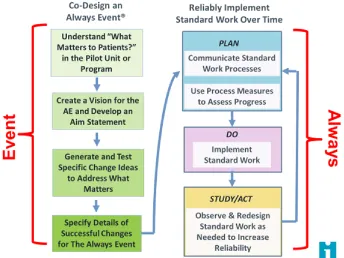
The team at IHI created the Always Events framework to integrate the Model for Improvement into the concept of Always Events and to ensure that patients, families, and service users were involved in the first steps of co-design and to create a system for reliable and sustainable implementation of changes. The framework lays out the high-level steps to co-design, determine a vision and aim, test, and reliably implement the components of the Always Event. (Figure 2)
Initial Testing in Pilot Sites
In early 2014, IHI, NHS England and Picker began to work together to think about how the Always Events concept and framework could be tested by a few select pilot sites in England. By December 2014, there was a list
NHS England Always Events® Programme: co-production model, Marshall et al.
Patient Experience Journal, Volume 6, Issue 1 – 2019 158
of ten interested healthcare providers. An informational call was held on 30 January 2015 with follow-up one-on-one conversations with all providers who expressed interest. Three initial pilot sites were selected based on the following criteria:
• The site had identified a day-to-day leader to drive the work;
• At least one person could attend the face-to-face meeting on 20 February 2015; and
• The provider had previously demonstrated the capability to improve patient experience and was known to one of the three partner organizations for their improvement capability.
The three pilot sites were Blackpool Teaching Hospitals NHS Trust, Kent Community Health NHS Trust, and Lancashire Care NHS Foundation Trust. They were asked to complete a pre-work packet before the meeting on 20 February 2015 to engage the patients, service users, families, staff, and clinicians they would need to partner with to be successful. The purpose of the meeting was to establish a baseline of knowledge about Always Events and using the Model for Improvement to test changes so that each of the pilot teams could begin to launch their Always Events in their organization.
In April 2015, team members from IHI, Picker, and NHS England visited each of the initial pilot sites to facilitate some of the early conversations to co-design an Always Event. By the end of the site visits, each had a plan for their Always Event:
Blackpool Teaching Hospital: On Ward 39, we will always:
• Streamline the discharge process and give patients realistic expectations about the time of discharge;
• Upon discharge, give patients a contact to call when they have worries or concerns; and
• Have nurses add “What matters to you?” to their daily interactions with patients to help patients manage their daily hospital experiences.
Lancashire Care Foundation Trust:
At the Adult Learning Disabilities Service at Bridge House, service users will always:
• Be supported in moving on in care.
Kent Community Health NHS Foundation Trust:
• The initial visit focused on an introduction to Always Events and quality improvement and a discussion about how to use the Hello My Name Is campaign to create an Always Event.
Next the three pilot sites received individual virtual coaching to walk through each step of the framework for the first six months of the program. In November 2015, the pilot teams moved to monthly calls and seven additional healthcare providers were invited to join. The ten providers helped inform the creation and publication of the Always Events Toolkit10 which subsequently has
been critical to the success of the program. The
publication of the toolkit increased interest and visibility of Always Events across the NHS in England. Throughout 2016, the IHI, Picker, and NHS England team continued to work closely with the ten pilot sites to reliably
implement their Always Event within one unit or ward and begin to scale up the Always Events framework beyond the initial pilot site.
Scaling Up the Always Event Program
Based on feedback from the ten healthcare providers, in early 2017, a six-part webinar series was offered to all interested healthcare providers throughout England. The series was designed to provide guidance and examples of success for each step of the Always Events framework including understanding what matters, using measurement for improvement, and partnership with patients, families, and service users to implement an Always Event. During the series, healthcare providers who were preparing to scale up to additional wards or units continued to attend monthly coaching calls with IHI, NHS England, and Picker.
In the summer of 2017, all organizations on the interested list were contacted to understand which stage they were at with Always Events and what support they required. At this point in the program, based on feedback received, it was decided to make the following changes:
- Introduce an informal sign-up agreement between NHS England and an executive sponsor for the organization to ensure Board-level support;
- Actively identify new organizations by targeted recruitment which included the development of an Always Events short film
(https://www.youtube.com/watch?v=ATbrHM0 c6EE) and a letter supporting the program from the Chief Nurses for England; and
In late 2017, the IHI, NHS England, Picker and NHS Improvement launched the scale-up cohort, a small group of six healthcare providers who had successfully
implemented one Always Event and were prepared to scale up to one or more additional wards. The scale-up cohort held twice monthly webinars and individual coaching to each of the day-to-day leaders was provided over six months. At the end of the coaching period, the team leads and executive sponsors gathered for an in-person celebration and learning event. A summary of collective lessons learned and next steps was compiled to inform the continuation of the scale-up cohort and future Always Events work across NHS England.
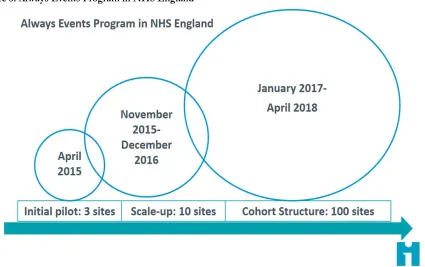
By April 2018, over 100 healthcare providers had signed up to the Always Events program and had taken steps towards creating an Always Event in partnership with patients, service users, and carers. The growth of the program over time is presented in Figure 3 below.
Results
The results presented in this section are drawn from an evaluation of the pilot and initial cohort phases11, the
scale-up coaching calls, evidence submitted by healthcare providers for an “Always Event Recognition Award” and evaluations from both a shared learning event held in November 2017 and a celebration event held in April 2018. This section is structured around the key themes
that emerged; the benefits and challenges to
implementation, engaging staff, importance of links to organizational strategies, measuring reliability and impact, reliable implementation and the impact on patients. Always Events is an attractive framework because it combines widely applied improvement methodologies and person-centered concepts. Like the “Hello my name is…” campaign and the “What matters to you?” concept, Always Events begins with simple changes that make a big impact on patient experience. More than that, the approach is easy to understand, healthcare staff can immediately see that it is not “hard to do” and how it could work in their organization and/or specific setting, thereby helping to overcome resistance.
Key Benefits and Challenges
A key distinction of an Always Event is that it is co-designed with patients, service users and family members from the very beginning. Findings showed that staff recognized the importance and value in partnering with their patients for the successful implementation of their Always Event. The benefits of co-designing improvements include identifying improvements that can make a real difference, empowering patients, and improving quality. Working in partnership with patients is key to
understanding what changes would make the most difference to patient experiences. What matters most to patients may differ to any staff preconceptions:
NHS England Always Events® Programme: co-production model, Marshall et al.
Patient Experience Journal, Volume 6, Issue 1 – 2019 160
“We’ve learnt so much already from just by talking to our patients ...
when we first took it on, we were absolutely convinced that the thing
that they would say would be ‘I always want to see the doctor on time’ … but we learnt so much because that … didn’t get mentioned. So it
was a huge learning curve … it just goes to show that what we think
is important is often very, very different from what they see as
important … it was like a little light bulb went off in my head.” - Deputy Chief Nurse, The Royal Marsden NHS
Foundation Trust
The factors which appear important for achieving a strong and successful partnership with patients include ensuring that:
- The area of focus is identified by people who use the services;
- The activities to be tested are co-designed by patients or service users; and
- Staff have good facilitation skills and support
patients in their involvement and patients see the benefit of being involved.
-
Challenges to co-design include the difficulty of recruiting patients to be involved, having enough time and resource, competing priorities, and getting staff on board.
“It’s taken some time and investment just to make sure that we've
got all the staff on board, because our Always Event is a change from
standard practice … and it's been about changing hearts and minds,
just with a new way of thinking really.” - Deputy Head of Midwifery, University Hospitals of Morecambe Bay
From the evidence collated to date, healthcare providers have been largely successful at gathering information and evidence on what matters most to their patients using a range of approaches, such as interviews (including filmed interviews), focus groups, surveys and social media. There has been more mixed success regarding the test of change ideas being truly shaped and co-designed by patients. There can be a tendency for staff to suggest improvement
“solutions” rather than co-designing the ideas with patients.
Engaging Staff
The importance of ensuring frontline staff are engaged and supported in implementing their Always Event activities is key to success. The benefits of engaging staff through Always Events include improved motivation and
enthusiasm, staff feeling listened to, and increased morale. Difficulties were primarily felt to be due to a lack of time, staff shortages, and the potential impact on workload. For example, one staff member initially felt it would be an unmanageable burden on time but the reality was different:
“I was initially concerned that it was going to be a big pull on my time…. that it was going to be difficult to do, but in practice it wasn’t difficult to do. It was a relatively small investment of time and
resource but seems to have had a very big impact in the difference it
makes to people”
- Team Leader, Lancashire Care NHS Foundation Trust
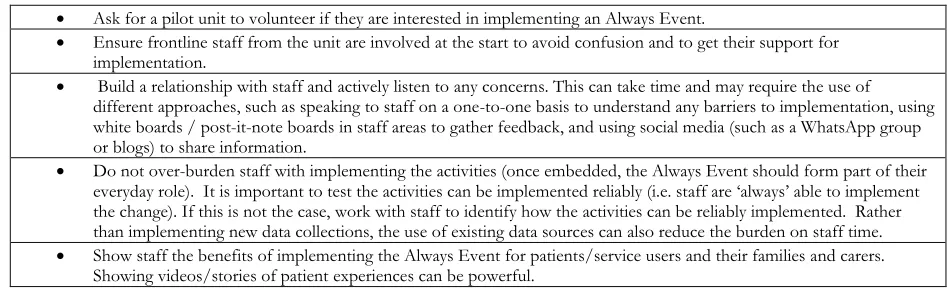
Table 1 lists the factors that have been shown to help with engaging staff in the Always Event.
“We were quite responsive to what the staff were saying to us
,
and I think that helped because they didn't feel that I was
imposing this on them, we were doing it together.”
-
Lead Nurse for Patient Experience and Engagement, Aintree University Hospital NHS Foundation TrustHealthcare providers used a variety of approaches to
promote Always Events, gather feedback from staff,
and to evaluate the impact of the activities on their
role/workload. These include showing filmed patient
interviews, newsletters, surveys, interviews, staff
huddles, white boards in staff areas, and social
networking (e.g., WhatsApp and Facebook). When
rolling out the Always Event to other areas within an
Table 1. Factors to help engage staff in Always Events
• Ask for a pilot unit to volunteer if they are interested in implementing an Always Event.
• Ensure frontline staff from the unit are involved at the start to avoid confusion and to get their support for implementation.
• Build a relationship with staff and actively listen to any concerns. This can take time and may require the use of different approaches, such as speaking to staff on a one-to-one basis to understand any barriers to implementation, using white boards / post-it-note boards in staff areas to gather feedback, and using social media (such as a WhatsApp group or blogs) to share information.
• Do not over-burden staff with implementing the activities (once embedded, the Always Event should form part of their everyday role). It is important to test the activities can be implemented reliably (i.e. staff are ‘always’ able to implement
the change). If this is not the case, work with staff to identify how the activities can be reliably implemented. Rather than implementing new data collections, the use of existing data sources can also reduce the burden on staff time. • Show staff the benefits of implementing the Always Event for patients/service users and their families and carers.
organization, the evaluation of the scale-up cohort
highlighted factors which are helpful for engaging
staff during this process (Table 2). These are the
factors which are valuable for getting the buy-in from
staff in other parts of the organization, rather than
just ensuring the engagement of staff in the pilot area
(Table 1).
Links to Organizational Strategies
When healthcare providers link the Always Events framework with their organizational strategies and quality improvement work, there is increased chance of successful spread and sustainability. This is perhaps best evidenced by Lancashire Care NHS Foundation Trust. They made Always Events part of their corporate quality strategy, providing an organizational commitment to the success and spread of Always Events. Since the initial pilot, Lancashire Care has embarked on six different Always Events which are at various stages in development.
Reliability and Impact
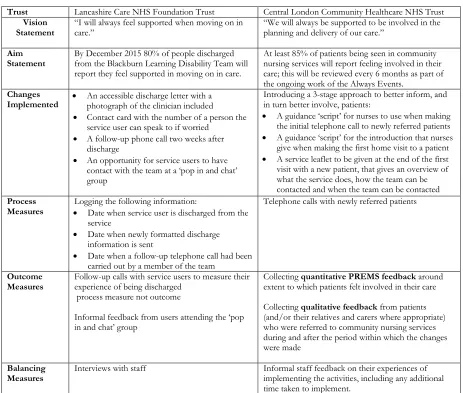
Measuring success is important to identify, in a rigorous and systematic way, whether the changes that are tested as part of an Always Event result in improvement. Table 3 provides a summary of how two case study sites (Lancashire Care NHS Foundation Trust and Central London Community Healthcare NHS Trust [CLCH]) measured the reliability and impact/s of their Always Event.
Reliable Implementation
Implementing reliable care processes is an important aspect of Always Events as it means delivering on the “always” for all patients10. Providers demonstrate reliability
in several ways.
At Lancashire Care NHS Foundation Trust, a database was set up to record process data relevant to their Always Event such as date of discharge, date discharge
information was sent, and confirmation that a follow-up
call had been carried out. To help ensure that the follow-up call was carried out, the team’s administrator added a reminder in the clinician’s calendar and kept track of completed calls. This process measure was easy to
incorporate into the member of staff’s everyday role which enabled it to be sustained.
In order to ensure reliable implementation of the changes being tested at CLCH, pilot teams were asked to provide a list of all newly referred patients to the improvement team. These patients were then telephoned and asked about their experience of the changes that were being tested, such as whether they had received an initial call from a nurse. The recorded responses were used to inform any further actions required.
Impact on Patients
Healthcare providers have used several outcome measures to assess if their Always Events have had the predicted impact on patient/service user experience. Positive impacts have been demonstrated in some organizations. For example, Lancashire Care used follow-up calls with service users two weeks after discharge from the service to determine impact. The call was conducted to understand the service user’s experience of being discharged and to measure the impact of their Always Event activities by asking five questions (developed by the co-design group). Results from this telephone survey showed that more than 80% of people responded positively to the questions about their discharge, thereby achieving the threshold set in their aim statement (Figure 4). Positive impacts on the service users involved in co-producing the changes at Lancashire Care were also evident:
“My idea was chosen… I feel good –like I’m part of my care”
- Service user in the co-design group, Lancashire
Care NHS Foundation Trust.
Table 2. Factors to engage staff during organization scale-up
• Market the Always Event early on and share the learning rather than waiting until the end of the pilot. • Build awareness of the pilot Always Event via social media, intranet, newsletters, etc.
• Ask staff from the pilot area to speak with staff in new areas; this can help to show staff why the Always Event is important and what the benefits are.
• Provide support to staff in the new areas during testing.
• Ensure staff working in the new areas take on the ownership for the work.
• Meet with staff in other areas ahead of the testing such as matrons, ward managers and senior managers to explain the reasons for the Always Event and secure their engagement.
NHS England Always Events® Programme: co-production model, Marshall et al.
Patient Experience Journal, Volume 6, Issue 1 – 2019 162
For their main outcome measure, CLCH used an existing data collection method to examine the percentage of patients that felt involved in decisions about their care. An organization-wide patient reported experience measure is given to all patients receiving community nursing services from the healthcare provider monthly. The results show that since the adoption of the new changes in August 2017, the percentage of patients who reported feeling involved in decisions about their care has improved (Figure 5) and is now above the target set in the aim statement. One of the patient members of the project team described a positive experience of his involvement:
“As a patient representative, I have been fortunate enough to be a part of CLCHs very first ‘Always Event' co design committee. When I was first asked to join, I said that I would but with the proviso that I could see results within six months as I didn't want to waste time with a committee that just talked the good talk. Thankfully, I am proud to be a participating member in creating Always Events within CLCH, an organisation that continues to
show me that it really cares about patients and the dynamic between patients and staff."
- Patient member of the co-design group, Central London Community Healthcare NHS Trust
Measuring the impact of the Always Event on patient experience is key for determining if the change ideas lead to a sustained improvement. The aim of an Always Event piloted at the Mid Yorkshire Hospitals NHS Trust was to improve the response time to patients' call buzzers on an acute respiratory ward. An analysis of electronic call buzzer data, which was their outcome measure, showed that despite an increase in the proportion of buzzers being answered within one minute after the Always Event changes were implemented, the target set in their aim statement was not achieved and the initial improvement had not been sustained. This highlighted the need for the team to explore the barriers to promptly answering call
Table 3. Summary of key Always Event activities and measures at two NHS trusts
Trust Lancashire Care NHS Foundation Trust Central London Community Healthcare NHS Trust Vision
Statement “I will always feel supported when moving on in care.” “We will always be supported to be involved in the planning and delivery of our care.”
Aim
Statement By December 2015from the Blackburn Learning80% of peopleDisability Team willdischarged report they feelsupported in movingon in care.
At least 85% of patients being seen in community nursing services will report feeling involved in their care; this will be reviewed every 6 months as part of the ongoing work of the Always Events.
Changes
Implemented • An accessible discharge letter with a photograph of the clinician included • Contact card with the number of a person the
service user can speak to if worried • A follow-up phone call two weeks after
discharge
• An opportunity for service users to have
contact with the team at a ‘pop in and chat’
group
Introducing a 3-stage approach to better inform, and in turn better involve, patients:
• A guidance ‘script’ for nurses to use when making
the initial telephone call to newly referred patients • A guidance ‘script’ for the introduction that nurses
give when making the first home visit to a patient • A service leaflet to be given at the end of the first
visit with a new patient, that gives an overview of what the service does, how the team can be contacted and when the team can be contacted Process
Measures
Logging the following information:
• Date when service user is discharged from the service
• Date when newly formatted discharge information is sent
• Date when a follow-up telephone call had been carried out by a member of the team
Telephone calls with newly referred patients
Outcome
Measures Follow-up calls with service users to measure their experience of being discharged process measure not outcome
Informal feedback from users attending the ‘pop in and chat’ group
Collecting quantitative PREMS feedback around extent to which patients felt involved in their care
Collecting qualitative feedback from patients (and/or their relatives and carers where appropriate) who were referred to community nursing services during and after the period within which the changes were made
Balancing
Figure 4: Lancashire Care NHS Foundation Trust: Always Event Outcome Measure
NHS England Always Events® Programme: co-production model, Marshall et al.
Patient Experience Journal, Volume 6, Issue 1 – 2019 164
buzzers and to reconsider what changes may have a greater impact on experience of care. Key learnings included ensuring the change ideas are co-designed by patients, rather than just reflecting what staff think are the solutions, and that ideas are focused on changing
approaches and practices rather than one-off transactional changes (such as splitting the ward and purchasing radios which were some of the changes for this pilot). They also recognized the importance of testing the change ideas through a series of Plan-Do-Study-Act cycles before implementation and using process measures to test reliability.
Measurement is important not only for identifying whether changes being tested as part of the Always Event are having a positive impact on the experiences of people using services, but also for checking that there are no negative impacts on the system, such as readmission rates, staff workload, and finances. Examples of balancing measures used by healthcare providers implementing an Always Event include staff surveys and/or interviews, patient and staff Friends and Family Test data, and informal staff feedback via meetings/forums.
The impact of the Always Event on staff experience, in terms of both benefits and any potential detriments, is a key balancing measure. To assess any impact of the Always Event on the system, interviews with staff members were conducted to inform the balancing measure at Lancashire Care NHS Foundation Trust. The interviews showed that since the inception of the Always Event, two positive unintended impacts had arisen. Firstly, the team’s weekly intake meeting changed to include a discussion of those people in the process of being discharged from the service. Secondly, there was an increase in joint working between speech and language therapy and community nursing staff. This included better team work and greater staff awareness of the service users approaching discharge, resulting in the delivery of an improved person-centered service.
Implications for Further Practice
This program developed organically in response to the needs of the organizations who committed to using the methodology whilst remaining true to the overarching vision to embed co-production. There have been many learning opportunities, and this continues as the program progresses both in numbers of organizations but also in length of time for people using the methodology. Most recently, NHS England have focused on ensuring the development of specific and measurable aim statements, alongside placing the emphasis on true co-design of tests of change.
Over the three years of the Always Events Program, the following best practices have emerged:
1. Partner with patients/service users from the very start and throughout every phase.
2. Integrate quality improvement, patient experience, and person-centered care.
3. Identify an executive leader champion who can support you to gain momentum from the beginning. 4. Keep an open mind and don’t be tempted to
pre-determine what changes need to be made.
5. Patients/service users and staff know the challenges and have the best, simplest, and most affordable ideas for improvement.
6. Involve frontline staff from the beginning and co-design with them to support engagement and reduce resistance to change.
Just over 51 percent of all NHS providers in England have committed to using the Always Events methodology. More work needs to be completed to embed this methodology deep within the organizations so the full impact of the scale up and spread can be harnessed to improve experiences of care for patients and staff. In addition, NHS England is beginning to roll-out the methodology in different healthcare sectors including within Primary Care and within the Care Home sector. The ambition is to have several sites in these new sectors to have completed one Always Event by April 2020.
As the NHS in England moves from individual organizations working in silos to Integrated Care Systems (ICSs) that bring together the whole health and social care system for a local population12, there is an
emerging interest in using Always Events as a way of improving experience across pathways of care. Discussions are underway to understand how Always Events can be used to understand what really matters to people in relation to discharge from hospital and other services in one system and in frailty services in another.
References
1. Bisognano M. 2017 Why "What Matters to You?" Matters Around the World. IHI Blog. Available at http://www.ihi.org/communities/blogs/why-what-matters-to-you-matters-around-the-world. Accessed July 25, 2018.
2. Batalden M, Batalden P, Margolis P, Seid M, Armstrong G, et al. Co-production of healthcare service. BMJ Quality and Safety. 2016;25:509-517. 3. Lewis A, King T, Herbert L, Repper J. Co-production
– Sharing Our Experiences Reflecting on Our Learning. ImROC. 2017. Available at
https://imroc.org/resources/13-co-production-sharing-experiences-reflecting-learning/. Accessed July 25, 2018.
5. McNally D, Sharples S, Criag G, Goraya A. Patient leadership: Taking patient experience to the next level? Patient Experience Journal. 2015;2:2:7-15.
http://pxjournal.org/cgi/viewcontent.cgi?article=1091 &context=journal
6. Vennik F, Van de Bovenkamp H, Putters K, Grit K. Co-production in healthcare: rhetoric and practice. International Review of Administrative Sciences 2015; 82(1): 150-168.
7. NHS England, Coalition for Collaborative Care. A co-production model. 2016 Available at
http://coalitionforcollaborativecare.org.uk/a-co-production-model/. Accessed on July 25, 2018. 8. Picker Institute. Always Events® Blueprint for Action.
2012 Maine, USA. Available at
http://www.ihi.org/resources/Pages/Tools/AlwaysEv entsBlueprintandSolutionsBook.aspx. Accessed July 25, 2018.
9. Picker Institute. Healthcare Solutions Book. 2012. Maine, USA. Available at
http://www.ihi.org/resources/Pages/Tools/AlwaysEv entsBlueprintandSolutionsBook.aspx. Accessed July 25, 2018.
10.Prepared by the Institute for Healthcare Improvement for NHS England. Always Events Toolkit. 2016. Available at https://www.england.nhs.uk/always-events/. Accessed July 25, 2018.
11.Picker Institute. An Evaluation of the Always Events® Pilot Programme. 2016. Available at
https://www.england.nhs.uk/always-events/. Accessed July 25, 2018.