Iran University of Medical Sciences
____________________________________________________________________________________________________________________ 1. MD, Associate Professor of Psychiatry, Mental Health Research Centre, Tehran Psychiatric Institute, Faculty of Behavioral Sciences and Mental Health, Iran University of Medical Sciences, Tehran, Iran. [email protected]
2. Associate Professor of Psychiatry, Department of Psychiatry, University of Social Welfare and Rehabilitation Sciences, Tehran, Iran. [email protected]
3. MD, MPH, Professor of Community Medicine, Department of Community Medicine; Mental Health Research Centre, Iran University of Medical Sciences, Tehran, Iran. [email protected]
4. Researcher, Mental Health Research Centre, Tehran Psychiatric Institute; Faculty of Behavioral Sciences and Mental Health, Iran University of Medical Sciences, Tehran, Iran. [email protected]
5. MS, Researcher, Mental Health Research Centre, Tehran Psychiatric Institute, Faculty of Behavioral Sciences and Mental Health, Iran Uni-versity of Medical Sciences; Tehran, Iran. [email protected]
6. MS, Psychologist, Researcher, Mental Health Research Centre, Tehran Psychiatric Institute, Faculty of Behavioral Sciences and Mental Health, Iran University of Medical Sciences, Tehran, Iran. [email protected]
7. (Corresponding author) Assistant Professor of Psychiatry, Family Research Institute, Shahid Beheshti University, Tehran, Iran. [email protected]
Clinical outcomes and cost effectiveness of two aftercare models
provided by general physicians and nurses to patients with severe
mental illness
Seyed Kazem Malakouti1, Arash Mirabzadeh2, Marzieh Nojomi3
Ali Ahmadi Tonkaboni4, Faranak Nadarkhani5, Mosleh Mirzaie6, Narges Chimeh7
Received:16 January 2014 Accepted:7 December 2014 Published:7 April 2015
Abstract
Background: Implementing community-based psychiatric services is one of the priorities of the WHO/EMRO mental health programs. This study presents an aftercare service, as a community based-service, for patients with severe mental illness (SMIs).
Methods: In this randomized controlled clinical trial design, 176 patients, who attended selective hospitals with SMI, were allocated into three groups: clinical case managers provided by general practitioners, nurses and the control group (usual treatment). The clients and their caregivers received monthly home visits (education and treatment supervision). The effectiveness of the intervention was measured by indicators of psychopathology such as scores of YOUNG, caregivers’ knowledge and satisfaction with the services. Health-related quality of life (SF-36) was considered as the primary outcome variable. Data were collected at baseline and at 12 months follow-up. Direct and indirect medical costs were obtained through a periodic completion of questionnaires and interviews by care-givers. Cost effectiveness ratio was estimated as cost per QALY gained in each group. SPSS 16.0 was used in this survey and statistical methods were chi-square, ANOVA, Scheffe as post-Hoc test and paired sample t-test with 95% confidence interval and 0.05 significance level.
Results: The results of our study revealed that the score of YOUNG, caregivers’ knowledge and satisfaction with service were improved in both intervention groups after 12 months. Improvement in health-related quality of life was observed in the general practitioner and nurse group. The incremen-tal cost effectiveness ratio was 5740807 IRR and 5048459 IRR per QALYs gained in the general practitioner and nurse groups, respectively.
Conclusion: The model of aftercare services provided by trained nurses is the most cost- effective and feasible model for Iran’s socio-economic conditions with low resource allocations.
Keywords: Severe Mental Illness, Aftercare, Service, Mental Health, Community.
Cite this article as:Malakouti S.K, Mirabzadeh A, Nojomi M, Ahmadi Tonkaboni A, Nadarkhani F, Mirzaie M, Chimeh N. Clinical outcomes and cost effectiveness of two aftercare models provided by general physicians and nurses to patients with severe mental illness. Med J Islam Repub Iran2015 (7 April). Vol. 29:196.
Introduction
The establishment and expansion of community-based services in WHO/EMRcountries sprung out of a different
ment: shortage of acute psychiatric beds. However, shortage of community-based facilities (such as outreach services) is an important issue which is generally consid-ered in developing countries such as Iran. (1-3). Assertive Community Treatments (ACT) have been introduced and proven effective in maintaining and improving pa-tients’ mental health and quality of life (4-11). However, implementing the ACT sys-tem requires certain substructures in the society and allocation of enough budgets in which the intensive services could be pro-vided.
Although case management services are not promising (12-13), clinical case man-agement services provided by different pro-fessionals such as trained nurses (14) psy-chologist and family members (15) or with minor differences “less intensive home-care service” in our social-economic setting (16) have revealed remarkable results with the main aim of reducing hospitalization rates. We need to evaluate different models of the clinical case managers, particularly their
cost-effectiveness, and eventually introduce the best practices with the least resource demands for outreach services to the policy makers.
The aim of this study was to compare the effectiveness and cost-effectiveness of home-visit clinical case-management ser-vices provided by trained nurses and gen-eral practitioners (GPs). The main focus of the study was set on rates of re-hospitalization and clinical outcomes in patients with severe mental illness.
Methods
Study Design and Sample
This study was registered in Iranian Reg-istry of Clinical Trials under the reference number of IRCT138807251959N3. The study design was a double blind, multi cen-ter, randomized controlled trial. The study participants were selected from patients who attended selective hospitals according to the study criteria and were randomly al-located into three groups by block random-ization method and using random numbers
Fig.1. the selection and allocation of study subjects in three groups
table.
The inclusion criteria we as follows: hav-ing a diagnosis of bipolar or schizophrenia spectrum disorders (as severe mentally ill-nesses), and being hospitalized at least twice in the past two years and not having good compliance according to the caregiver (s). The exclusion criteria included being in the acute phase of the illness, having men-tal retardation, suffering from organic brain problem, addiction to psychoactive sub-stances and receiving the same services contemporarily from other sources. We measured baseline variables at the index point in the beginning of the enrollment in the study and after a 12-month follow-up period. The study participants were ran-domly allocated into three groups: GPs, nurses (trained clinical case managers) and control group (receiving the usual treatment available in the community). In total, 176 individuals were enrolled in the study (Fig. 1).
The study participants were recruited from four psychiatric centers, and the re-sponse rate was 85%. Sixty participants were from Tehran (from different psychiat-ric hospitals) and 92 were from the city of Karaj; of whom, 45% (n= 82) had bipolar mood disorder and 55% (n= 90) had spec-trum diagnosis of schizophrenia. The pa-tients were enrolled between December 2007 to March 2008 from outpatient clinics or immediately after discharge form the hospital.
Selection and Training the Case-Managers
Six registered nurses with a bachelor’s degree were trained for 33 hours.
Five GPs for the other case-mangers group were trained in multiple courses for 24 hours. A training manual was provided to trainees to familiarize them and update their knowledge about schizophrenia and mood disorders (15). After obtaining a written and oral evaluation, 3 trainees were selected from each group to provide clinical case-management (CM) services to the pa-tients. Pre and post tests were performed to
evaluate the training outcomes on trainees. Wilcoxon Signed Ranks Test revealed that the mean of the score before the training was 42.7 (SD= 4.7) which was improved to 77.4 (3.9) (p= 0.06) after training in the nurse group. The scores before and after the training were 60.6 (14.2) and 73.6 (5.3), respectively (p= 0.04) in the GPs group. The selected CMs received supervision ses-sions regularly by the main investigator every two weeks for the first 3 months and then once every month till the end of the survey. The technical and implementing problems were discussed in each session.
Defining Groups and Intervention Home Visit Groups
Each patient in the home visit group had a face-to-face session every month by his/her assigned case manager. The duration of each session was 45 minutes on average. The case manager tasks were as follows: 1) To complete the checklists for symptoms and drug side effects and share the list with the patient’s psychiatrist if necessary; 2) Educating the patients and their family members by providing hand outs and edu-cational material; 3) Being in touch with the patients or their family in case of an emergency situation; 4) Contact the pa-tient’s psychiatrist or study supervisors in case of necessary or emergency conditions; 5) Injection of the depot antipsychotic if prescribed.
Some patients were prescribed psycho-therapeutic medicine by GPs if they needed new medication or needed their prescrip-tion to be refilled. This was unique to GPs group only. The patients were encouraged to visit their psychiatrist to avoid the even-tual replacement of the psychiatrist with CMs services.
Control Group (The Usual Treatment) The control group received “the usual treatment” in which patients receive the services by referring to an outpatient clinic (private or governmental). The interval vis-its was based on the patients and/or their caregiver decision. In this group, the
tients were only looked after by their fami-lies. In case of exacerbation, they were re-ferred to psychiatrist hospitals/wards to be admitted if any empty bed was available.
Evaluators
Each study participant was evaluated us-ing study instruments twice: first immedi-ately after signing the informed consent form, and second at the end of the 12-month follow- up. The study instruments were completed by trained psychiatric resi-dents or clinical psychologists with mas-ter’s degree who were blind to the random-ization of the participants before and after the intervention.
Study Instruments
1. Kohlman Evaluation of Living Skills -KELS (17). In a pilot study, the Kappa co-efficient between the two raters for five subscales were 0.86 to 0.99 (15).
2. Knowledge questionnaire for caregiv-ers. The modified version of the question-naire was developed by Khazaeilie (18) and is comprised of 31 items (true/false) includ-ing symptoms, treatment and family’s awareness and behavior toward the pa-tients. The reliability of this questionnaire via test-retest within a week was acceptable (r= 0.83).
3. Family Experience Interview Schedule (FEIS). In this study, the short-form with 41 items was developed. Test-retest relia-bility within a week was 0.89, and Cronbach’s alpha coefficient was 0.89 for this instrument (15).
4. The Persian version of the General Health Questionnaire-28 (GHQ-28). This questionnaire has 28 items and 4-point lik-ert scale. A higher score indicates a possi-ble case of mental disorder (19).
5. Client Questionnaire Satisfaction (CQS). This is a self-administered ques-tionnaire with 8 items on a 4-point likert scale. For the overall score, the sum of the item responses ranges from 8-32, with a higher score indicating higher satisfaction (20).
6. Positive and Negative Symptoms Scale
(21). In this scale, the positive and negative symptoms of mental disorder, usually psy-chosis, are quantified. In this scale, 7 items evaluate positive symptoms subscale, 7 items evaluate negative symptoms subscale and 16 items evaluate the general symp-toms subscales and three supplementary items. Each item is reported on a scale of 0 to 7 with higher score reflected more severe symptoms. The Farsi translated version of this scale has been used in this study.
7. Young Mania Rating Scale:. This scale is used to evaluate the severity of symp-toms of BMD. Cronbach’s alpha coefficient for the Persian version of this questionnaire was 0.72 (22).
8. In order to examine the utility, the QALY index was measured using the SF-36 questionnaire (23). Information was col-lected through standard interviews with participants and caregivers, and the re-sponse rate was 75%. The outcome is pre-sented as a mean difference (95% CI).
9. Cost questionnaire. This questionnaire consists of the costs of prescriptions, outpa-tient treatment, hospitalization services, telephone calls, case managers’ payments and the cost of training as direct costs. The indirect costs included in this study were patients’ transportation, case managers’ transportation and the loss of income of caregivers due to taking care of their pa-tients. The cost of any services was calcu-lated based on 2008 tariffs.
10. The demographic questionnaire in-cluded age, gender, education, job, marital status, age of disease onset, duration of marriage, duration of illness and frequency of hospitalization (Tables 1 and 2).
Monitoring Program
The following activities were performed to monitor the program progress:
1. Obtaining written confirmation from the patients’ caregivers for every home-visit made by the case managers
2. Providing an Ambulatory Medical Document (AMD) for each patient in inter-vention groups
3. Filling out the symptoms and drug side
effects checklist and updating medical AMD
4. Providing a data sheet to register the collected data for each patient and tracking them
5. Having the AMD reviewed by the su-pervisor in every supervision session
6. Having the patients’ data sheets re-viewed by the main investigator periodical-ly
7. Contacting the participants or their caregivers every 2 to 3 months to trace the activities being performed regularly by each case manager.
Cost Evaluation Method
In this study, the costs consisted of the costs of outpatient visit, hospitalization, transportation, drugs and the cost of time allocated by caregivers to care for the pa-tient, case managers’ transportation and the cost of home visit for one year. The cost of each home visit for the GPs and nurses were 125,000 and 10,5000 Iranian Rials (IRR), respectively.
To evaluate the cost effectiveness of the interventions, the primary health outcome was quality-adjusted life years (QALYs). These were calculated for each group using HRQoL scores from the SF-36 and were converted to utility scores using OLS for-mulae (24).
Ethical Consideration
The study protocol was approved by the Ethical Committee of the Mental Health Research Center of Iran. The participants and their main caregivers were fully in-formed of the study design and were asked to sign a consent form. The study question-naires were numbered and entered in the data sheet identified by codes for each study sample without revealing the name of the participants. There were no known con-flicts of interest.
Statistical Analyses
All analyses were done using SPSS soft-ware package version 16.0 (SPSS, Inc. Chicago, IL). In order to compare
demo-graphic and clinical variables between the three groups, we used chi-square for nomi-nal data and anomi-nalysis of variance (ANOVA) for numeric variables. ANOVA was used to compare the mean score of the question-naires between the groups. We calculated two by two comparisons of groups by Scheffe as a post- Hoc test. Paired sample t-test was used to compare the mean score of the questionnaires before and after inter-ventions among each group. Odds ratio with 95% confidence interval was calculat-ed for independent effect of each interven-tion on rehospitalizainterven-tion rate using logistic regression. Because all demographic varia-bles were the same across groups, we just entered groups as an independent variable and re-hospitalization as a dependent varia-ble in the applied model. The level of sig-nificance was set at 0.05 for all analyses.
Results
Participants
The three groups were similar in all de-mographic features (Tables 1 and 2), but the educational level of the participants in the GP and nurse groups were higher than the control group. More participants in the GP and control groups were employed or had a job compared to the nurse group. The mean (±SD) duration of illness for the par-ticipants was 12.74 (±9.8) years and the mean of hospitalization frequency was 2.7 (±3.3). In other words, the mean frequency of hospitalization was once every four years.
Number of Hospital Admissions
Seven participants in the GP group (15.2%), 9 in the nurse group (17.3%) and 20 in the control group (37%) were hospitalized during the 12 months of the intervention (p= 0.01, χ2= 8.32). The risk of hospitalization was calculated between groups using regression analysis. The results revealed that the risk of re-hospitalization in the control group was OR= 3.3 (CI= 1.23-8.69) and it was OR= 1.16 (CI= 0.39-3.4) in the nurse group.
Outcome Measures
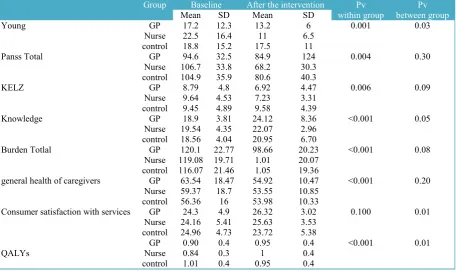
The psychological status was not signifi-cantly different among the three groups be-fore the intervention, validating the ran-domization of the participants. The evalua-tion of the effects of the intervenevalua-tion re-vealed that after 12 months of the follow up, the scores of YOUNG, caregivers’
knowledge and satisfaction with the ser-vices were improved in both intervention groups (Table 3). The social skills (KELZ), caregiver’s burden, the general health of the caregivers, and PANSS of the study participants in the GP and nurse groups were improved after the intervention, but the differences were not significant. The Table 1. Demographic features of the study sample in three groups
Groups N Mean SD 95% Confidence Interval for Mean F Pv Lower Bound Upper Bound
Patients age GP 46 35.3 10.02 32.31 38.30 0.30 0.70
Nurse 52 34.5 9.31 31.88 37.12
control 52 36.2 12.90 32.62 39.84
Disease
duration NurseGP 3738 11.612.4 10.427.74 9.069.01 14.2515.88 0.52 0.59
control 47 13.8 10.80 10.65 17.0
Number
admission NurseGP 3740 2.82.9 3.213.73 1.771.76 4.193.9 0.29 0.75
control 49 2.4 2.86 1.67 3.27
GP: general physician
Table 2. Demographic features of the study sample in three groups
GP group (N=46) Nurse group (N=52) Control group (N=54) 2 df Pv
No. % No. % No. %
Sex Male 29 63.00 29 55.77 30 55.55 0.71 2 0.73
Female 17 37.00 23 44.23 24 44.45
Marital status Single 26 56.52 26 50.00 26 48.15 4.82 4 0.32
Married 17 36.96 17 32.69 24 44.44
Other 3 6.52 9 17.31 4 7.41
Job Unemployed 26 56.52 39 75.00 29 53.70 5.88 2 0.05
Employed 20 43.48 13 25.00 25 46.30
Table 3. the clinical features of the study subjects in three groups Group Baseline After the intervention Pv
within group between groupPv
Mean SD Mean SD
Young GP 17.2 12.3 13.2 6 0.001 0.03
Nurse 22.5 16.4 11 6.5
control 18.8 15.2 17.5 11
Panss Total GP 94.6 32.5 84.9 124 0.004 0.30
Nurse 106.7 33.8 68.2 30.3
control 104.9 35.9 80.6 40.3
KELZ GP 8.79 4.8 6.92 4.47 0.006 0.09
Nurse 9.64 4.53 7.23 3.31
control 9.45 4.89 9.58 4.39
Knowledge GP 18.9 3.81 24.12 8.36 <0.001 0.05
Nurse 19.54 4.35 22.07 2.96
control 18.56 4.04 20.95 6.70
Burden Totlal GP 120.1 22.77 98.66 20.23 <0.001 0.08
Nurse 119.08 19.71 1.01 20.07
control 116.07 21.46 1.05 19.36
general health of caregivers GP 63.54 18.47 54.92 10.47 <0.001 0.20
Nurse 59.37 18.7 53.55 10.85
control 56.36 16 53.98 10.33
Consumer satisfaction with services GP 24.3 4.9 26.32 3.02 0.100 0.01
Nurse 24.16 5.41 25.63 3.53
control 24.96 4.73 23.72 5.38
GP 0.90 0.4 0.95 0.4 <0.001 0.01
QALYs Nurse 0.84 0.3 1 0.4
control 1.01 0.4 0.95 0.4
Cost of services
mean difference of the utility score at base-line and after 12 months was 0.056 (95% CI: -0.13-0.24), 0.15 (95% CI: -0.01-0.32) and -0.068 (95% CI: -0.24-0.10) in the gen-eral practitioner, nurse and control groups, respectively. Improvement in the utility score after intervention was observed in the GP and nurse groups.
Analysis of the cost data showed that the total cost of the nurse group was higher than the GP and control groups and that there was no significant difference between the GP and control groups with respect to cost. The total costs of the study partici-pants in the GP group was 263,719,451 IRR, it was 318,434,542 IRR in the nurse group and 270,961,905 IRR in the control group. The major difference in the costs among the different groups was the cost of hospitalization.
Cost Eeffectiveness Aanalysis
The economic evaluation of the two af-tercare models was made using cost-effectiveness methods. The mean differ-ence of the utility score index was calculat-ed before and after a 12- month period in each group, and the quality adjusted life years (QALYs) for each group were calcu-lated by taking into account the length of each period. We estimated the mean cost in each group, and the following formula was used to obtain the ratios for incremental cost-effectiveness (ICER):
ICER = (Cost Intervention – Cost Con-trol) / (Effect Intervention-Effect ConCon-trol)
The incremental mean cost was 715218.4 IRR and 1105928.1 IRR for the GP and the nurse groups to control group, respectively and the incremental effectiveness was 0.12 QALYs and 0.21 QALYs for the GP and the nurse groups to control group, respec-tively. The incremental cost effectiveness
ratio (ICER) of the GP group, compared to the control group, was 5740708 IRR and 5048459 IRR for the nurse group compared to the control group (Table 4).
Discussion
The Impact of Clinical Case-Management Service on Hospitalization Rate
The program implemented in this study was in accordance with the clinical model of case- management (7). With respect to hospitalization rates, studies conducted in western countries have shown that classic case-management services may increase the hospitalization rate (OR= 1.84) (24-25), but a variety of these services were actually effective in three domains of family bur-den, family satisfaction with services and cost of care and other clinical features ( 26-27).
The result of this study revealed that hos-pitalization rate in patients in the control and nurse groups were 3.3 and 1.2 folds higher compared to those in the GP group. In a previous study in Iran (Ahebba study), trained psychologists were utilized as clini-cal case-managers and non-professional family members, and the results showed that hospitalization rates were 17 and 14 percent, respectively compared to the con-trol group (15). Comparing our results to another study carried out in Roozbeh hospi-tal (16), the re-admission rates were similar in the control group; however, it was rather lower in our study. One reason could be visiting and monitoring patients by psy-chiatrists, but the costs of psychiatrist case managers’ have to be taken into account compared to the other two studies. The main difference is that in our study, case managers acted as a clinical manager and their main task was to look after patients’ drug treatment, help them to continue their Table 4. Cost effectiveness rates in three groups
Nurses GP Control
Mean cost (IRR) 6,123,741 5,733,031 5,017,813
Mean Effect (QALYs gained) 0.15 0.05 -0.06
Cost-Effectiveness ratio 40,571,370 101,541,472 -73,655,971
ICER 5,048,459 5,740,807 NA
current medications and link them to a psy-chiatrist to manage their problems in a more appropriate way. Family education and providing advice for their social skills were mainly in accordance with the above role. In our model of clinical case-manager and home visit services, the case managers were only trained nurses, who could func-tion effectively to reduce hospitalizafunc-tion rate. This is very crucial for Iran’s society where the available acute psychiatric beds are only one thirds of the needed beds in psychiatry.
Clinical Outcomes of Providing Home Visit Services
The study results revealed that among the six clinical features, the caregivers’ knowledge, satisfaction with the services and the severity of BMD psychopathology were improved in the both case managers’ groups compared to the control group.
Against the general belief of conducting home visit with only one person as a case manager, the result of this study showed that it is safe and feasible. the following preparations such as calling the patients’ families in advance to set the home-visit of the case managers and the mandatory pres-ence of the family members of the patients at the time of the visit, could increase the safety of the interventions and reduce the unnecessary expenses even further.
Cost effectiveness
The clinical case manager model defined in this study is a cost-effective model for both GP and nurse case managers. Howev-er, the nurse group was the most cost effec-tive intervention due to the lower incremen-tal cost effectiveness ratio in this group than the GP and the control group. In this study, the difference of the cost for each home visit between the GP and nurse case managers was 25,000 IRR.
Implication for Behavioral Health
According to the aim of this research, the model of aftercare services provided by trained nurses is the most cost effective and
feasible model which could be more appro-priate for Iran’s socio-economic conditions with low resource allocations.
Conflict of interest
This research did not have any sponsors.
Acknowlegments
The authors would like to thank Dr. Abdollah Sani, Dr. Naser Hajian Motlagh, Dr. Niloufar Rastegar and Dr. Ramin Baiat Macu, the psychiatrists who introduced the eligible patients. The authors also thank Dr. Heidari, Dr. Golesorkhi, Dr. Masudi, Ms. Mohebi and Ms. Amrollahi, for providing home-visit services. The authors also ex-tend their gratitude to Mr. Shamsoddin Ka-hani, Naser Soleimani, Ms. Rostami and Ms. Razavion for conducting the interview and completing the research questionnaires and Amin Malakouti to monitor the proce-dures.
This work was partially funded by a grant from the Mental Health Research Center, Family Research Center of Shahid Beheshti University, Mental Health Research Center, Undersecretary of Research of University of Welfare and Rehabilitation Sciences.
References
1. Caqueo-Urízar A, Gutiérrez-Maldonado J. Bur-den of care in families of patients with schizophre-nia. Qual Life Res 2006; 15: 719-24.
2. Okasha A. Focus of psychiatry in Egypt. Br J Psychiatry 2004; 185: 266-72.
3. Yasamy MT, Shahmohammadi D, Bagheri Yazdi SA, Layeghi H, Bolhari J, Razzaghi EM, Bina, M, Mohit A. Mental health in the Islamic Re-public of Iran: achievements and areas of need. East Mediterr Health J 2001; 7: 381-91.
4. Scott JE, Dixon LB. Assertive community treatment and case management for schizophrenia. Schizophr Bull 1995; 21: 657-68.
5. Teague GB, Drake RE, Ackerson TH. Evalua-tion use of continuous treatment teams for persons with mental illness and substance abuse. Psychiatr Serv 1995; 46: 689-95.
6. Burns BJ, Santos AB. Assertive community treatment: an update of randomized trials. Psychiatr Serv 1995; 46: 669-75.
7. Bachrach LL. Case management: toward a shared definition. Hosp Community Psychiatry 1989; 40: 883-884.
8. Marks IM, Connoly J, Muijen M. Home-based versus hospital-based care for people with serious mental illness. Br J Psychiatry 1994; 165: 179-94.
9. Audini M, Marks IM, Lawrence RE. Home-based versus outpatients/ inpatients care for people with serious mental illness. Br J Psychiatry 1994; 165: 202-10.
10. Lehman AF. Public health policy, community services, and outcomes for patients with schizophre-nia. Psychiatr Clin North Am 1998; 21: 221-31.
11. Mueser KT, Bond GR, Drake RE. Models of community care for severe mental illness: a review of research on case management. Schizophr Bull 1998; 24: 37–74.
12. MacDonald AW, Carter CS, Kerns JG, Ursu S, Barch DM, Holmes AJ , et al. Specificity of prefron-tal dysfunction and context processing deficits to schizophrenia in never-medicated patients with first-episode psychosis. Am J Psychiatry 2005; 162(3): 475-84.
13. Marshall M, Gray A, Lockwood A, Green R. Case management for people with severe mental disorders. Cochrane Database Syst Rev 2011; 4: CD000050.
14. Pai S, Channabasavanna SM, Nagarajaiah A, Raghuram R. Home care for chronic mental illness in Bangalore: An experiment in the prevention of repeated hospitalization. Br J Psychiatry 1985; 147: 175-9.
15. Malakouti SK, Nojomi M, Panaghi L, Chimeh N, Mottaghipour Y, Joghatai MT, et al. Case-management for patients with schizophrenia in Iran: a comparative study of the clinical outcomes of Mental Health Workers and Consumers' Family Members as case managers. Int J Ment Health 2009; 45: 447-52.
16. Sharifi V, Tehranidoost M, Yunesian M, Amini H, Mohammadi M, Jalali Roudsari M. Effec-tiveness of a low-intensity Home-Based Aftercare for Patients with Severe Mental Disorders: A 12-month Randomized Controlled Study. Community Ment Health J 2012; 48: 766-70.
17. Ilika YB, Haffman NG. Concurrent validity study on Kohlman Evaluation of Living skills and
Global Assessment Scale. Unpublished Manuscript, 1981.
18. Khazailie M. An evaluation of effect of group education of families of paranoid schizophrenic pa-tients on coping of patient in daily function. Masters thesis. Tehran Psychiatric Institute, Iran University of Medical Sciences, 1993.
19. Noorbala AA, Bagheri Yazdi SA, Yasamy MT, Mohammad K. Validation of GHQ-28 in Iran. Hakim J 1999; 5: 101-10. (Persian).
20. Attkisson CC, Zwick R. The client satisfaction questionnaire: Psychometric properties and correla-tions with service utilization and psychotherapy outcome. Eval Program Plann 1982; 5(3): 233-237.
21. Kay SR, Fiszbein A, Opler LA. The positive and negative syndrome scale (PANSS) for schizo-phrenia. Schizophr Bull 1987; 13: 261–76.
22. Barekatain M, Tavakkoli M, Molavi H, Maroufi M, Salehi M. Standardization, reliability and validity of Young Mania Rating Scale in Isfa-han. Ravanshenasi quarterly J 2007; 11: 150-66. (Persian).
23. Motamed N, Ayatollahi AR, Zare N, Sadeghi-Hassanabadi A. Validity and reliability of the Per-sian translation of the SF-36 version 2 question-naire. East Mediterr Health J. 2005 May;11(3):349-57.
24. Nichol M.B, Sengupta N, Globe D.R. Evaluat-ing Quality-Adjusted Life Years: Estimation of the Health Utility Index (HUI2) from the SF-36. Med Decis Making 2001
25. Holloway F, Carson J. Case management: an update. Int J Soc Psychiatry 2001; 47: 21-31.
26. Marshall M, Lockwood A. Assertive commu-nity treatment for people with severe mental disor-ders. In Schizophrenia Module of Cochrane Data-base Syst Rev (eds C. Adams, C. Anderson & J. De Jesus Mari). London: The Cochrane Library, BMJ Publishing Group, 1998.
27. Laura LD, Gary RB. Relationship between case manager contact and outcome for frequently hospitalized psychiatric clients. Hosp Community Psychiatry 1993; 44: 839-43.