ANNIHILATOR DOMINATION NUMBER OF TENSOR PRODUCT OF PATH GRAPHS
K. SHARMA1, U. SHARMA1,§
Abstract. An annihilator dominating set (ADS) is a representative technique for find-ing the induced subgraph of a graph which can help to isolate the vertices. A dominatfind-ing set of graphGis called ADS if its induced subgraph is containing only isolated vertices. The annihilator domination number ofG, denoted byγa(G) is the minimum cardinality of ADS. The tensor product of graphs G and H signified by G×H is a graph with vertex setV =V(G)×V(H) and edge{(u, v),(u0, v0)} ∈Ewhenever (u, u0)∈E(G) and (v, v0)∈E(H). In this paper, we deduce exact values of annihilator domination number of tensor product of Pm and Pn, m, n ≥2. Further, we investigated some lower and upper bounds for annihilator domination number of tensor product of path graphs.
Keywords: Domination Number, Annihilator Dominating Set, Annihilator Domination Number, Paths, Tensor Product.
AMS Subject Classification: 05C69, 05C50, 05C76
1. Introduction and terminology
All graphs are considered to be only simple, undirected and finite graphs. Let G = (V, G) be a graph. As usual, we denoteV(G) as set of vertices of G and E(G) as set of edges ofG. In 1977, Cockayne and Hedetniemi [2] introduced an outstanding survey of the results about dominating sets in graphs and used the notation γ(G) for the domination number. The beginning of extensive study of dominating sets took place in nearly 1960. De jaenisch discovered and studied in depth the difficulties related to (n×n) chessboard problem that how many number of queens are required to lead. Domination applies in facility location problem like: hospitals, fire stations when a person needs to travel to get to the nearest facility, the number of amenities are permanent and its required to mini-mize the distance in one attempt. It also works on that problem where maximum space to a facility is permanent and needed one attempt to minimize the number of amenities compulsory. In case that everyone is serviced concepts from domination is also occur in problems including discovering sets of representative in the administering communication
1
Department of Mathematics and Statistics, Banasthali University, Banasthali (304022), India. e-mail: [email protected]; ORCID: https://orcid.org/0000-0002-4453-3699.
e-mail: [email protected]; ORCID: https://orcid.org/0000-0002-1804-8278. § Manuscript received: September 16, 2017; accepted: May 15, 2018.
TWMS Journal of Applied and Engineering Mathematics, Vol.9, No.4 cI¸sık University, Department of Mathematics, 2019; all rights reserved.
or electrical network and in land reconnoitering i.e. an evaluator must remain in order to acquire the estimations of height for a whole domain meanwhile the number of places are minimized.
A setS ⊆V(G) is a dominating set of graphGif every vertex of V(G)−S is adjacent to atleast one vertex of setS. Domination number is the cardinality of the smallest dom-inating set ofGwhich is denoted byγ(G). A dominating set of cardinalityγ(G) is called aγ−set.
In 2016, motivated by the study of domination and split domination, Kavaturi and Vangipuram introduced a new parameter on domination which is said to be annihilator dominating set (ADS) and investigated some results of the annihilator domination number for some standard graphs like : Km,n,Pn, Cn,Wn,Sn etc. A dominating set of graph G
is called ADS if its induced subgraph is containing only isolated vertices. The annihilator domination number ofG, denoted byγa(G) is the minimum cardinality of ADS.
Annihi-lator domination concept is widely applicable in real life situations like field of agriculture (control of pests) and the department of defense (armaments, weapons and fundamental commodities)[3].
In graph theory, many operations will be used like as: normal product, Cartesian product, tensor product, Corona product, etc. but here bring to light on the “Tensor Product”.The tensor product of graphs G and H signified by G×H is a graph with vertex set V = V(G) ×V(H) (where × denotes the tensor product of sets) and edge
{(u, v),(u0, v0)} ∈E whenever (u, u0)∈E(G) and (v, v0)∈E(H).
In 1997, Kulli and Janakiram introduced the split domination in graphs [5]. Some im-portant Vizing - like conjecture for direct product graphs were analyzed by Klavˇzar and Zmazek [4]. In 2007, Breˇsar et al. constructed a new approach to obtain dominating set of direct product of graphs [1]. Sampathkumar [7] gave the important results over Kro-necker product of graphs. In 1981, Laskar and Walikar [6] proposed the various interesting results on domination related concept on graph theory and took different approaches to the problem. In this paper, we provide an approach to findingADS of tensor product of path graphs and other graphs. It is based on the cardinality of the smallest annihilator dominating set of G. This paper is organized as follows: In Section 2 contains the main results of the paper and its graphs shown by example. In the Section 3, discussion and conclusion is given.
Theorem 1.1. [3] In a graph G, γ(G)≤γs(G)≤γa(G) where γs(G) be split domination
number and γa(G) be annihilator domination number.
Theorem 1.2. [3] If Pn be a path with n-vertices, then γa(Pn) = bn/2c, where bXc
represents the greatest integer less than or equal to X.
2. Annihilator domination of tensor product of path graphs
In this section, we determine the values ofγa(Pm×Pn) whenm≥2. SinceP1×Pn∼=Pn,
we have:
Theorem 2.1. For n≥2, letPn be a path with n- vertices, then we have
Proof. LetV(P2) ={ui, i= 1,2} ,V(Pn) ={vj, j = 1,2, ..., n},
Si = {(ui, vj) ∈V(P2 ×Pn) | j = 1,2, ...n, i = 1,2} and (ui, vj) → (u0i, v0j) if ui = u0i
orvj =v0j, since γa(Pn) =bn2c.
Assume that the minimum annihilator dominating set of (P2×Pn) be
D={(u1, v2k)∪(u2, v2k)} where 1≤k≤ bn2c.
It is clear that|D|= 2bn
2c.
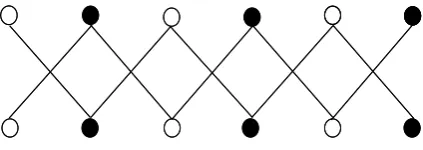
We can check that D is annihilator dominating set for (P2 ×Pn), see Figure 1. If the
Figure 1. An annihilator dominating set for (P2×P6)
vertices of D will be deleted from (P2 ×Pn) then the resulting graph < (V −D) >
contains only isolated vertices. See Figure 2 for (P2×P6).
Figure 2. The induced subgraph<(V −D)>for (P2×P6)
This completes the proof of this theorem.
Theorem 2.2. For n≥2, letPn be a path with n- vertices, then we have
γa(P3×Pn) =n.
Proof. LetV(P3) ={ui, i= 1,2,3},V(Pn) ={vj, j = 1,2, ..., n},
Si={(ui, vj)∈V(P3×Pn) |j= 1,2, ..., n, i= 1,2,3}and (ui, vj)→(u0i, vj0) if ui =u0i
orvj =v0j, since γa(Pn) =bn2c.
Assume that the minimum annihilator dominating set of (P3×Pn) be
D={(u2, vk)} where 1≤k≤n.
It is clear that|D|=n.
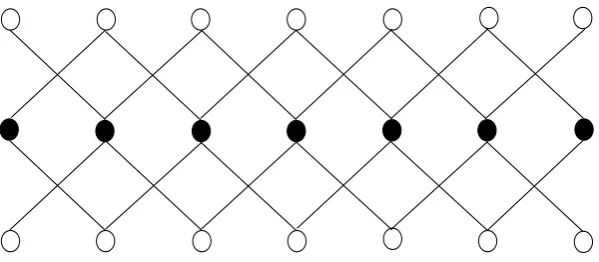
Figure 3. An annihilator dominating set for (P3×P7)
If the vertices ofDwill be deleted from (P3×Pn) then the resulting graph<(V−D)>
contains only isolated vertices. See Figure 4 for (P3×P7).
Figure 4. The induced subgraph<(V −D)>for (P3×P7)
This completes the proof of this theorem.
Theorem 2.3. For n≥2, letPn be a path with n- vertices, then we have
γa(P4×Pn) = 4bn2c.
Proof. LetV(P4) ={ui, i= 1,2,3,4} ,V(Pn) ={vj, j = 1,2, ..., n},
Si = {(ui, vj) ∈ V(P4 ×Pn) | j = 1,2, ..., n, i = 1,2,3,4} and (ui, vj) → (u0i, vj0) if
ui =u0i orvj =vj0, sinceγa(Pn) =bn2c.
Assume that the minimum annihilator dominating set of (P4×Pn) be
D={(u1, v2k)∪(u2, v2k)∪(u3, v2k)∪(u4, v2k)} where 1≤k≤ bn2c.
It is clear that|D|= 4bn
2c.
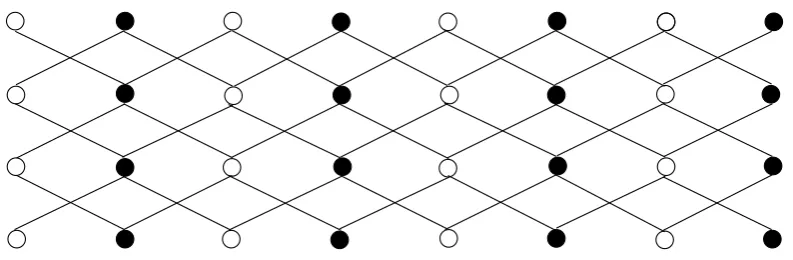
Figure 5. An annihilator dominating set for (P4×P8)
If the vertices ofDwill be deleted from (P4×Pn) then the resulting graph<(V−D)>
contains only isolated vertices. This completes the proof of this theorem.
Theorem 2.4. Let Pn be a path with n - vertices, for every n≥2 and Pm be also a path
withm - vertices, for every m≡0 (mod 2), then we have
γa(Pm×Pn) =
mn
2 if n≡0 (mod2)
m(n−1)
2 if n≡1 (mod2).
Proof. LetV(Pm) ={ui, i= 1,2,3, ..., m} ,V(Pn) ={vj, j = 1,2, ..., n},
Si ={(ui, vj)∈V(Pm×Pn) |j = 1,2, ..., n, i= 1,2,3, ..., m} and (ui, vj)→(u0i, vj0) if
ui =u0i orvj =vj0, sinceγa(Pn) =bn2c.
According to the values ofn, we consider following two cases:
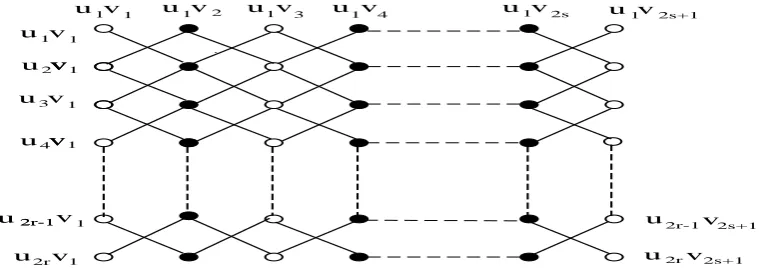
Case I : If m≡0 (mod2) (say 2r) andn≡0 (mod2) (say 2s) wherem, n≥2. Assume that the minimum annihilator dominating set of (Pm×Pn) be
D={(u2k1−1, v2k2−1) ,(u2k1, v2k2−1)} where 1≤k1≤m/2 ; 1≤k2 ≤n/2.
It is clear that|D|= mn2 .
We can check thatD is annihilator dominating set for (Pm×Pn), see Figure 6.
If the vertices ofDwill be deleted from (Pm×Pn) then the resulting graph<(V −D)>
contains only isolated vertices.
Case II : Ifm≡0 (mod2) (say 2r) and n≡1 (mod 2) (say 2s+ 1) wherem, n≥2.
Assume that the minimum annihilator dominating set of (Pm×Pn) be
D={(u2k1−1, v2k2) ,(u2k1, v2k2)}where 1 ≤k1 ≤m/2 ; 1≤k2≤n/2.
It is clear that|D|= m(n2−1).
We can check thatD is annihilator dominating set for (Pm×Pn), see Figure 7.
If the vertices ofDwill be deleted from (Pm×Pn) then the resulting graph<(V −D)>
u1v1
u v1
u v1
u v1
u v1
u v1
u1v u1v u1v u1v u1v
2 3 4 v v 2 3 v 4 u v u v 2s 2r 2s 2r 2s 2s-1 2r-1
u1v1
2r-1
Figure 6. An annihilator dominating set for (Pm×Pn) (Case I)
u1v1
u v1
u v1
u v1
u v1
u v1
u1v u1v u1v u1v u1v
2 3 4 v v 2 3 v 4 u v u 2s+1 2r-1 2r-1 2r-1 2s+1 v2s+1 2s
u1v1
2r 2r
Figure 7. An annihilator dominating set for (Pm×Pn) (Case II)
This completes the proof of this theorem.
Theorem 2.5. Let Pn be a path with n - vertices, for every n≥2 and Pm be also a path
withm - vertices, for every m≡1 (mod 2), then
γa(Pm×Pn) =
(m−1)n
2 if n≡0 (mod 2) mbn2c if n= 3, 5, m6= 3
nbm
2c if n=odd, n≥7.
Proof. LetV(Pm) ={ui, i= 1,2,3, ..., m} ,V(Pn) ={vj, j = 1,2, ..., n},
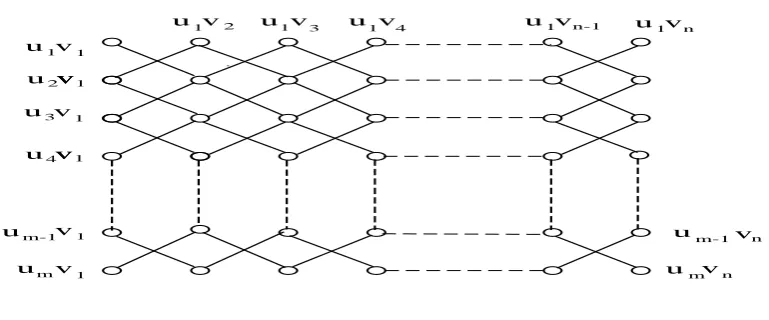
Si ={(ui, vj)∈V(Pm×Pn) |j = 1,2, ..., n, i= 1,2,3, ..., m} and (ui, vj)→(u0i, vj0) if
ui =u0i orvj =vj0, sinceγa(Pn) =bn2c, see Figure 8.
Following three cases may arise according to the values of n.
Case I : If m≡1 (mod2) and n≡0 (mod 2) wherem, n≥2. Assume that the minimum annihilator dominating set of (Pm×Pn) be
u1v1
u v1
u v1
u v1
u v1
u v1
u1v u1v u1v u1v u1v
2
3
4 v v
2 3
v
4
u v
u v
n n-1
m-1
m m n
m-1 n
Figure 8. (Pm×Pn)
It is clear that|D|= (m−21)n.
We can check thatD is annihilator dominating set for (Pm×Pn),
If the vertices ofDwill be deleted from (Pm×Pn) then the resulting graph<(V −D)>
contains only isolated vertices.
Case II: Ifm≡1 (mod 2),m6= 3 and n= 3, 5.
Assume that the minimum annihilator dominating set of (Pm×Pn) be
D={(uk1, v2k2)}where 1≤k1 ≤m ; 1≤k2 ≤ bn/2c.
It is clear that|D|=mbn
2c.
We can check thatD is annihilator dominating set for (Pm×Pn).
If the vertices ofDwill be deleted from (Pm×Pn) then the resulting graph<(V −D)>
contains only isolated vertices.
Case III: Ifm≡1 (mod2) and n=odd, n≥7.
Assume that the minimum annihilator dominating set of (Pm×Pn) be
D={(u2k1, vk2)} where 1≤k1≤ bn/2c ; 1≤k2 ≤n.
It is clear that|D|=nbm2c.
We can check thatD is annihilator dominating set for (Pm×Pn).
If the vertices ofDwill be deleted from (Pm×Pn) then the resulting graph<(V −D)>
contains only isolated vertices. This completes the proof of this theorem.
Corollary 2.1. Let Pn be a path with n - vertices and Pm be a path with m - vertices.
Thenγa(Pm×Pn) =m j
n
2
k
=mγa(Pn), where m is even and n≥2.
Proof. Let the vertices of V(Pm) ={ui, i= 1,2,3, ..., m} , V(Pn) = {vj, j = 1,2, ..., n}.
Since, we have already proved in Theorem 2.4 that γa(Pm×Pn) = mn2 , where m, n are
both even and m(n2−1) where mis even and nis odd. By combining above results, we get
γa(Pm×Pn) =m jn
2
k
=mγa(Pn) (by Theorem 1.2)
Proof. Let the vertices of V(Pm) ={ui, i= 1,2,3, ..., m} , V(Pn) = {vj, j = 1,2, ..., n}. Case I: If mis even
By Corollary 2.1,γa(Pm×Pn) =m j
n
2
k
. We know that
m
3 ≤
jm
2
k
⇒m≤3
jm
2
k
By combining above results, we get
γa(Pm×Pn)≤3 jm
2
kjn
2
k
γa(Pm×Pn)≤3γa(Pm)γa(Pn) Case II: Ifm is odd
By Theorem 2.5,γa(Pm×Pn) = (m −1)n
2 or m
j n
2
k
or njm2k
Subcase I:γa(Pm×Pn) = (m−1)n2. We know that
m−1
3 ≤
jm
2
k
m−1≤3jm 2
k
and n2 =
j n
2
k
(n is even) By combining above results, we get
γa(Pm×Pn)≤3γa(Pm)γa(Pn)
.
Subcase II : γa(Pm×Pn) = m j
n
2
k
. Also m3 ≤ jm2k. Using this inequality, we get
γa(Pm×Pn)≤3γa(Pm)γa(Pn).
Subcase III : γa(Pm ×Pn) = n j
m
2
k
. Also n3 ≤ jn2k. Using this inequality, we get
γa(Pm×Pn)≤3γa(Pm)γa(Pn). Hence the result follows. Theorem 2.7. If m, n≥2,then γa(Pm×Pn)≥2γa(Pm)γa(Pn).
Proof. Let the vertices of V(Pm) ={ui, i= 1,2,3, ..., m} , V(Pn) = {vj, j = 1,2, ..., n}. Case I: If mis even
By Corollary 2.1,γa(Pm×Pn) =m j
n
2
k
. We know that
m
2 =
jm
2
k
⇒m= 2
jm
2
k
(m is even)
By combining above results, we get
γa(Pm×Pn) = 2 jm
2
kjn
2
k
γa(Pm×Pn) = 2γa(Pm)γa(Pn) Case II : Ifm is odd
By Theorem 2.5,γa(Pm×Pn) = (m−21)n or m j
n
2
k
or njm2k
Subcase I:γa(Pm×Pn) = (m−1)n2. We know that
m−1
2 =
jm
2
k
m−1 = 2
jm
2
and n2 =
j n
2
k
(n is even) By combining above results, we get
γa(Pm×Pn) = (m−1)
n
2 = 2
jm
2
kjn
2
k
= 2γa(Pm)γa(Pn)
.
Subcase II : γa(Pm×Pn) = m j
n
2
k
. Also m2 ≥ jm2k. Using this inequality, we get
γa(Pm×Pn)≥2γa(Pm)γa(Pn).
Subcase III : γa(Pm ×Pn) = n j
m
2
k
. Also n2 ≥ jn2k. Using this inequality, we get
γa(Pm×Pn)≥2γa(Pm)γa(Pn). Hence the result follows. Theorem 2.8. If k is even and n≥2, then we get γa(P2k×Pn) = 2γa(Pk×Pn).
Proof. By Corollary 2.1
γa(P2k×Pn) = 2k jn
2
k
= 2γa(Pk×Pn)
Hence the result follows.
3. Conclusions
In this paper, an approach is presented to find the annihilator domination number of tensor product ofPm and Pn,m, n ≥2. Our main emphasis is to obtain the annihilator
domination number which are related to tensor product of path graphs. The main result gives the value ofγa(Pm×Pn) for different cases. Further, we investigated some lower and
upper bounds for annihilator domination number of tensor product of path graphs.
Acknowledgment: The authors would like to express their deepest gratitude to the anonymous referees for the constructive suggestions and comments that improve the qual-ity of this paper.
References
[1] Breˇsar, B., Klavˇzar, S. and Rall, D. F., (2007), Dominating direct products of graphs, Discrete Math-ematics, 307(13), pp. 1636-1642.
[2] Cockayne, E. J. and Hedetniemi, S. T., (1977), Towards a theory of domination in graphs, Networks, 7(3), pp. 247-261.
[3] Kavaturi, V.S.R. and Vangipuram, S., (2016), The annihilator domination in some standard graphs and arithmetic graphs, International Journal of Pure and Applied Mathematics, 106(8), pp. 123-135. [4] Klavˇzar, S. and Zmazek, B., (1996), On a Vizing-like conjecture for direct product graphs, Discrete
Mathematics, 156(1-3), pp. 243-246.
[5] Kulli, V. R. and Janakiram, B., (1997), The split domination number of a graph, Graph theory notes of New York, 32(3), pp. 16-19.
[6] Laskar, R. and Walikar, H. B., (1981), On domination related concepts in graph theory, Combinatorics and Graph Theory. Springer, Berlin, Heidelberg, pp. 308-320.
Khushbu Sharma is pursuing Ph.D in Mathematics from Banasthali Vidyapith, Rajasthan under the supervision of Dr. Usha Sharma. She received her M.Sc degree in Mathematics from St. Wilfred Girls College Jaipur, in 2015. Her research interests are in the areas of Graph Theory, Dominating Set, and Wireless Sensor Networks.