Introduction
Acrylic bone cement is used on a daily basis by orthopedic surgeons as an invaluable aid in securing implants for hip or knee replacements.
However, 10-year prosthesis loosening rates of cemented prostheses have ranged from 5% to 10% [1]. Although loosening is often ascribed to suboptimal performance of the cement, the conditions of cement use during implantation are probably the main problem.
Biomaterial-re-Acrylic antibiotic-loaded bone cement: a basic study
Hossein Farahini, MD.1, Mehdi Ghorbani, MD.2, Ehsan Akbarian, MD.3
Department of Orthopedic Surgery, Rasool Akram Hospital, Iran University of Medical Sciences, Tehran, Iran.
Abstract
Objective: The aim of this study was to evaluate the efficacy of antibiotic-loaded bone cement in controlling local infection and in regard to its physical characteristics, elastic modulus, and tensile strength in-vitro.
Methods: Acrylic bone cement, based on polymethylmethacrylate (PMMA) was mixed with the powder form of three antibiotics, i.e., gentamicin, tobramycin, and ce-furoxime with different doses below 2gr per 40gr of cement powder; thereafter, liquid monomer was added to process the cement. Sensitivity to common clinical isolates was as-sessed by counting the inhibition zone of each ALBC disc in cultured strains. Elution with normal saline was performed to evaluate the effects on ALBC disks and their antimicrobial efficiency. Cement structure, tensile strength, and elastic modulus were assessed by bio-mechanical tests to understand the characteristics of ALBCs after loading antibiotics with different doses and two methods of vacuum and manual mixing.
Results: Gentamicin, tobramycin, and cefuroxime reduced bacterial growth signifi-cantly with doses more than 1gr of antibiotics in 40gr of the cement. Cefuroxime was less efficient than the other two antibiotics in controlling pseudomonas. Elution with normal saline has not affected antibacterial results, significantly. All the 3 antibiotics had the same pattern of physical characteristics while loaded in bone cement. Gross structure of ALBCs with different doses of the three antibiotics was the same as non-ALBC and the elasticity or strength did not decline after loading antibiotics. The elastic modulus of ALBC was in-creased by boosting the doses of antibiotics; however, doses of 1gr to 1.5gr were the opti-mal doses in this regard. The tensile strength of ALBC was increased by doses of 1gr to 1.5gr of antibiotics; however, below and above these doses, the strength was decreased, but it did not exceed the basic strength of non-ALBC. Vacuum mixing method increased strength and elasticity more than manual one, remarkably.
Conclusion: Optimal protective effects of ALBCs against infection could be seen with mixing doses of about 1gr to 1.5gr of antibiotics in 40gr of acrylic bone cements by vacuum method, while optimal elastic modulus and tensile strength could be achieved at the same doses.
Keywords: ALBC, acrylic bone cement, antibiotic, microbiology, biomechanics.
1. Associate Professor of Iran University of Medical Sciences, Orthopedic Surgeon and Fellowship of Knee and Arthroscopy, Rasool Akram General Hospital.
2. Resident of orthopedic surgery, Rasool Akram General Hospital.
lated infections constitute a major threat to the current use of biomaterials. In orthopedics, use of polymethylmethacrylate (PMMA) bone ce-ment loaded with one antibiotic to prevent bio-material-related infections is widespread. Sev-eral studies have shown antibiotic-loaded bone cement to be beneficial in prophylaxis for pri-mary or revision arthroplasty [2,3].
Bacteria adhere to the surface of most materi-als used in joint replacement surgery. Further-more, bone tissue changes related to surgery can promote infection. The bone in contact with the implant can undergo necrosis related to vi-brations from the oscillating saws used to cut the bone, heat release by the cement, or toxicity of the cement monomer. Thus, prophylactic systemic antibiotic therapy is probably not suf-ficient to ensure full protection from infection during and after joint replacement. Local re-lease of an antibiotic from the cement used to secure the implant may be the most effective means of reaching the organisms located at the cement-bone or cement-metal interface. ALBC (Antibiotic-Loaded Bone Cement) is the method that provides the highest antibiotic lev-els in the joint, neighboring bone tissue, and ce-ment-prosthesis interface during the first 2 weeks after surgery [1]. Staphylococcus, strep-tococcus, Escherichia coli, and pseudomonas are the most important bacteria which are re-sponsible for infections of an arthroplasty [4-21].
ALBC was first used by Buchholz and En-gelbrecht [4] who added gentamicin to standard cement for the prophylactic treatment of infec-tion in total hip arthroplasty and they decreased the infection rate after total hip arthroplasty from 6% to 1.6% [5-7]. Subsequently, gentam-icin-loaded bone cement was found helpful in the treatment of documented infection of total hip prostheses. The available data is applicable to all joint prostheses. Although the local con-centrations of gentamicin are very high, diffu-sion of the antibiotic into the bloodstream is minimal in animal models [8] and in humans
[9,10]. Also, a vast literature review found no reports of allergies to gentamicin in bone ce-ment [11]. Adding antibiotics in the amounts used in clinical practice (antibiotic/bone ce-ment: 2gr/40gr) caused no detectable alter-ations in the mechanical properties of the ce-ment [12-16]. In the single prospective ran-domized trial comparing cement with and with-out antibiotics [17], the rate of aseptic loosen-ing was similar in the two groups (29% with standard cement and 24% with antibiotic-loaded cement; n = 1698 total hip prostheses). The aim of this study was to investigate the bac-tericidal effects of antibiotic loaded bone ce-ments using different doses of gentamicin, to-bramycin, and cefuroxime and the mechanical characteristics of these ALBCs.
Methods
Bone Cement Preparation:Acrylic bone ce-ment, based on polymethylmethacrylate (PM-MA), made by Tianjin Institute Synthetic Mate-rial Industry (Tianjin, China) was used in our study. For preparing ALBC, we mixed the pow-der form of gentamicin, tobramycin, and ce-furoxime sodium (Zinacef) antibiotics with the cement. In case of vacuum mixing, vacuum mixing chamber (Stryker Orthopedics, Mah-wah, NJ, USA) was used. Cements were pre-pared by mixing the powdered polymethyl-methacrylate and the antibiotic powder (after manual or vacuum mixing) with the liquid monomer in a bowl with a spatula. Manual mix-ing was done accordmix-ing to the manufacturer’s instructions and resulted in liquid cement. The liquid cement was spread over a cement plate mold (6mm diameter and 3mm thickness). The filled mold was manually pressed between two glass plates, covered with copier overhead film to facilitate removal after hardening, up to the time specified for final hardening. After 24 hours, the cement discs were pulled out of the mold and stored under dark, sterile conditions at room temperature. All procedures were car-ried out under sterile techniques.
Sensitivity of clinical isolates to different bone cements:We studied the cement discs on three kinds of bacterial strains in culture plates: Staphylococcus aureus, Escherichia coli, and Pseudomonas pyocyanea. The bacteria were cultured into agar plates at 37°C in ambient air for 24 hours and suspended in 0.9% saline to a concentration of 105 bacteria/mL. The
thick-ness of the agar was approximately 5mm. Ten minutes after inoculation, the bone cement discs were placed firmly in the center of each plate and the plate was subsequently incubated aerobically at 37 °C. Zones of inhibition around the discs were measured after overnight incuba-tion. Every 24 hours until a week, the discs would be transfered into a fresh culture plate containing of the same strain with the same preparation for evaluating the maintenance of the antibiotic function of the ALBC. The zone of inhibition was considered as the clear area around a disc in which bacteria were not able to grow. The diameter of each zone was measured in two directions and the mean zone of inhibi-tion was calculated. The size of the zone of inhi-bition is used to determine whether the bacteria are sensitive or resistant to the antibiotic(s) in the used bone cement discs. Sensitive strains possess a clear inhibition zone and larger diam-eters indicate a higher sensitivity. Sensitivity was recorded if a zone of inhibition of at least 12 mm was present. The absence of a zone of
in-hibition was taken as an indication of antibiotic resistance. All the processes of culturing strains and testing the efficacy of antibiotics were car-ried out under supervision of a microbiologist.
Elution of Antibiotic In-Vitro:Elution of an-tibiotics from acrylic cements with normal saline has been measured. In this test, we only studied the antibiotic tobramycin with different doses of 0, 0.5, 1.0, 1.5, and 2 grams in 40 grams of the cement. ALBC discs which were pre-pared as the protocol were placed into 10 ml of normal saline, at 37 °C for ten days. Then the discs were transferred into the mentioned cul-ture plates with the same method. Sizes of the zones of inhibition were calculated after 24 hours.
Mechanical Characteristics of ALBCs: Gross structure, elastic modulus, and tensile strength of the bone cement either loaded with different doses of antibiotics (gentamicin, to-bramycin, and cefuroxime) or not loaded were examined. We added fine powder form of an-tibiotics in a variety of doses below 2gr/40gr to the cement by both methods of manual mixing and vacuum mixing. Further, before assess-ment of the tensile strength, the prepared ALBC and the non-loaded antibiotic bone cement were placed into aluminium molds (60×10×2 millimeters) and left for 24 hours to solidify.
Figure 1. Elastic modulus of ALBC regarding doses of
antibiotics. antibiotics.Figure 2. Tensile strength of ALBC regarding doses of
Modulus of elasticity (E) was achieved by this equation: P.Stress L0
b.c. ΔL
Where P = Force (KgF), L0= Original length
before applying the force (cm), and b = width (cm). Therefore, the unit of E would be KgF/cm2. Tensile strength and modulus of
elas-ticity were calculated by mechanical devices using pressing and pulling methods in the bio-mechanical laboratory of Sharif University of Technology in cooperation with a biomechani-cal engineer.
Statistical Analysis: The analysis was ac-complished by performing the independent t-test, Mann-Whitney U-Test, one-way analysis of variance (ANOVA), Chi-Square, and Fisher Exact Test. The data were analyzed with SPSS statistical software (SPSS Version 13, Chicago, IL, USA). The level of significance was set at P value < 0.05.
Results
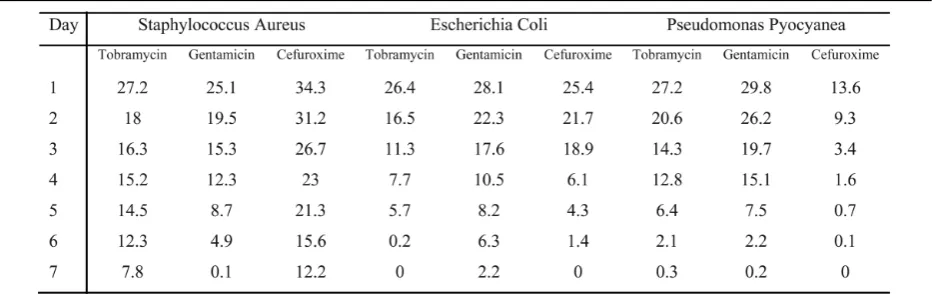
Different tests were carried out to identify the influence, characteristics, and strength of bone cement loaded with various antibiotics. The av-erage of inhibition zones of Staphylococcus a., E. coli, and Pseudomonas p. after adding 1.5gr of different antibiotics to 40gr of acrylic bone cement, from the first until the seventh day of the surveillance, are shown in Table 1. All the three antibiotics significantly inhibited the
growth of all bacteria in our study in the first, second, third, and fourth day of the surveillance (P value < 0.001). There was a noteworthy dif-ference between cefuroxime and the two other antibiotics, tobramycin and gentamicin, in in-hibiting Staphylococcus aureus and Pseudomonas pyocyanea in which cefuroxime was the strongest and the weakest inhibitor, respective-ly (P value = 0.024 and 0.031). Moreover, as Table 2 shows, adding different doses of these antibiotics to 40gr of the bone cement and in-vestigating the mean inhibition zones of Staphylococcus a. after 24 hours of the surveil-lance revealed no remarkable difference in in-hibition zones of various doses of each antibiot-ic; however, there was a slight increase in inhi-bition zones when more doses of an antibiotic had been loaded. In comparison between manu-al and vacuum methods of mixing antibiotics with bone cement, there was no statistical dif-ference; nonetheless, by the manual method, the mean inhibition zone was slightly more than the vacuum one.
Elution test of antibiotic (tobramycin)-loaded cement with normal saline was per-formed and resulted in slightly less inhibition zones than the results of our previous test; how-ever, there was no significant difference in these two groups of results. Mean inhibition zone of Staphylococcus a. after elution was 21.3, 23.2, 25.5, and 26.3 while we added 0.5, 1.0, 1.5, and 2.5 grams of tobramycin to 40
Table 1. Inhibition zones (mm) of various bacteria (1.5gr) with antibiotic-loaded bone cements.
grams of the cement powder, respectively. Gross structure, elastic modulus, and tensile strength of the bone cement were assessed with and without loaded antibiotics. Adding 0, 0.5, 1, 1.5, and 2 grams of the 3 studied antibiotics to the bone cement resulted in no dissimilarity with regard to gross structure and palpable characteristics of the cement. Mean elastic modulus of the cement was increased signifi-cantly after loading more than 1gr of all 3 types of antibiotics into 40gr of acrylic bone cement (P value = 0.034); however, manual mixing procedure reduced the elasticity significantly, rather than vacuum mixing (p value < 0.001). The pattern of increased mean elastic modulus after adding different doses of antibiotics was the same in all 3 studied antibiotics and there was no significant difference among them. Fig-ure 1 depicts the mean elastic modulus of AL-BC regarding doses of antibiotics, while 0gr stands for the control, which means the average of elastic modulus of acrylic cement without adding antibiotics.
Mean tensile strength of the cement was in-creased with adding 1gr of all the three antibi-otics (P = 0.007), while this improved strength is markedly seen in vacuum mixing of to-bramycin to 40gr of acrylic bone cement (P < 0.001). In manual mixing, 0.5gr of antibiotics could also remarkably boost the strength, but in vacuum mixing, no significant change was seen. Adding more than 1gr of antibiotics de-clined the increased pattern of tensile strength; nonetheless, this decreased strength did not ex-ceed the basic control value of the non-antibiot-ic-loaded cement. The pattern of increased mean tensile strength after adding different
doses of antibiotics was similar in all 3 studied antibiotics and there was no significant differ-ence among them. Manual mixing procedure reduced the strength significantly, rather than vacuum mixing (P value < 0.001). Fig. 2 demonstrates the mean tensile strength of AL-BC regarding doses of antibiotics, while 0gr stands for the control, which means the average tensile strength of acrylic cement without adding antibiotics.
Discussion
Local release of an antibiotic by the cement used to secure the implant is probably the most effective means of eradicating organisms locat-ed at the cement-bone and cement-implant in-terface. ALBC is the method of administration that produces the highest concentrations of an-tibiotic in the joint, neighboring bone tissue, and cement-prosthesis interface, with no risk of toxic blood levels. These concentrations are far greater than those obtained with systemic an-tibiotic therapy and usually exceed the minimal inhibitory concentration of relevant bacteria. In our study, it was shown that adding antibiotics to the bone cement could effectively reduce the growth of common strains which are usually seen in joint arthroplasties.
Gentamicin, tobramycin, and cefuroxime were effective in decreasing bacterial growth in-vitro; however, cefuroxime was not as effi-cient as the two other antibiotics in pseudomonas strains. Doses of 1gr of each of the three antibiotics could obtain the best pro-tection against infection, among the diverse doses which were studied in our research. It was seen that protective effects of gentamicin and tobramycin lasted more than cefuroxime in-vit-ro and they could pin-vit-rotect infection better than cefuroxime after several days. Despite many surgeons’ viewpoint about weakening the pro-tective effects of antibiotics which are loaded in cement by elution, it was found out that thera-peutic effects of antibiotics still remain in AL-BCs after elution with normal saline and are
Table 2. Inhibition zones (mm) of Staphylococcus au-reus with different doses of antibiotics.
roughly as efficient as ALBCs without elution process.
Biomechanical assessment of ALBCs loaded with different antibiotics and their diverse dos-es rdos-esulted in no gross structure or palpable characteristic dissimilarities, no elastic modu-lus declining, and no tensile strength reducing. In fact, we learned that elastic modulus of AL-BCs was more than non-antibiotic-loaded bone cements; however, this increased elasticity was at its most when doses of 1 to 1.5 grams of an-tibiotics were applied. Moreover, tensile strength of ALBCs also was more than non-an-tibiotic-loaded bone cements; nevertheless, the increased strength was at its most when doses of 1 gram of antibiotics were applied, just as well as what we have seen in elastic modulus. It is noteworthy to mention that neither elastic modulus nor tensile strength were less than non-antibiotic-loaded bone cement with any doses of loaded antibiotics below 2 grams; however, the method of vacuum mixing result-ed in better elasticity and strength rather than the manual mixing method.
We evaluated the efficacy of antibiotic-loaded bone cement in controlling local infec-tion and in regard to its physical characteristics, elastic modulus, and tensile strength in-vitro. In our study, it was seen that optimal protective ef-fects of ALBCs against bacterial strains could be seen with mixing doses of about 1gr of an-tibiotics in 40gr of acrylic bone cements by vac-uum method, while optimal elastic modulus and tensile strength could be achieved at the same doses. Therefore, it could be recommend-ed that mixing mrecommend-edium doses of antibiotics about 1gr to 1.5gr with 40gr acrylic bone ce-ment by vacuum method may be more benefi-cial in inhibiting infection at the site of surgery and providing the best biomechanical structure of the cement.
References
1. Passuti N, Gouin F. Antibiotic-loaded bone cement in orthopedic surgery. Joint Bone Spine 2003;70 (3):169-74.
2.Espehaug B, Engesaeter LB, Vollset SE, et al. An-tibiotic prophylaxis in total hip arthroplasty. Review of 10,905 primary cemented total hip replacements report-ed to the Norwegian arthroplasty register, 1987 to 1995. J Bone Joint Surg Br 1997; 79: 590–595.
3. Josefsson G, Kolmert L. Prophylaxis with systemat-ic antibiotsystemat-ics versus gentamsystemat-icin bone cement in total hip arthroplasty. Aten-year survey of 1,688 hips. Clin Orthop 1993; 292: 210 –214.
4. Buchholz HW, Engelbrecht H. Über die De-potwirkung einiger Antibiotika bei Vennischung mit dem Kunstharz Palacos. Chirurg 1970; 41:511–5.
5. Buchholz HW, Elson RA, Heinert K. Antibiotic-loaded acrylic cement: current concepts. Clin Orthop 1984;190: 96–108.
6. Buchholz HW. Tiefen Infektionen nach aallohplas-tischern Hüftgelenkersatz. Langenb Arch Chir 1973; 334: 547.
7. Buchholz HW. Results of exchange operations for infection. In: Elson RA, Caldwell ADS, editors. Revision arthroplasty. Proceedings of a Symposium held at Sheffield University. Oxford: Medical Education Ser-vice; 1979. pp. 103–10.
8. Baker AS, Greenham LW. Release of gentamicin from acrylic bone cement. Elution and diffusion studies. J Bone Joint Surg 1998; 70A:1551–7.
9. Wahlig AH, Dingeldein E, Buchholz HW, Buchholz M, Bachmann F. Pharmacokinetic study of gentamicin-loaded cement in total hip replacements. Comparative study of varying dosages. J Bone Joint Surg 1984;66B:175–9.
10. Elson RA, Jephcott AE, Mcgechie DB, Verettas. Antibiotic-loaded acrylic cement. J Bone Joint Surg 1977; 59B: 200–5.
11. Walenkamp GHIM. Gentamicin-PMMA-beads. A clinical, pharmacokinetic and toxicological study. Ams-terdam: Cliteur; 1983. pp. 164.
12. Davies JP. Comparison of the mechanical proper-ties of Simplex P, Zimmer Regular and LVC bone ce-ments. J Biomed Mater Res 1987; 21:719–30.
13. Davies JP, O’Connor DO, Burke DW, Harris WH. Influence of antibiotic impregnation on the fatigue life of Simplex P and Palacos R acrylic bone cements, with and without centrifugation. J Biomed Mater Res 1989; 23: 379–97.
14. Lautenschlager EP,Marshall GW,Marks KE, Schwartz J, Nelson CL. Mechanical strength of acrylic
bone cements impregnated with antibiotics. J Biomed Mater Res 1976; 10:837–45.
15. Lee AJC. The mechanical properties of bone ce-ments. J Med Eng Technol 1977; 1:137–40.
16. Lindberg L. Antibiothérapie prophylactique en chirurgie orthopédique. Cahier d’Enseignement de la SOFCO7, vol. 37. Paris: Expansion Scientifique Française; 1990. pp. 66-75.
17. Joseffson G, Lindberg L, Wiklander B. Systemic antibiotics and gentamicin-containing bone cement in the prophylaxis of postoperative infections in total hip arthroplasty. Clin Orthop 1981; 159: 194-200.
18. Maderazo EG, Judson S, Pasternak H. Late infec-tions of total joint prostheses. Areview and recommenda-tions for prevention. Clin Orthop Relat Res 1988; 229: 131-42.
19. Poss R, Thornhill TS, Ewald FC, Thomas WH, Batte NJ, Sledge CB. Factors influencing the incidence and outcome of infection following total joint arthroplas-ty. Clin Orthop Relat Res 1984; (182):117-26.
20. Fitzgerald RH Jr. Infected total hip arthroplasty: diagnosis and treatment. J Am Acad Orthop Surg 1995; 3:249-262.
21. Garvin KL, Hinrichs SH, Urban JA. Emerging an-tibiotic-resistant bacteria. Their treatment in total joint arthroplasty. Clin Orthop 1999; 369:110-123.