91 Available online at www.ijiere.com
International Journal of Innovative and Emerging
Research in Engineering
e-ISSN: 2394 - 3343 p-ISSN: 2394 - 5494
An Overview on fifth generation (5G) mobile wireless Technology
I.
Miss. Diksha Dileep Neve,
I. Third Year of Engineering, Student, I. Department of Computer Science & Engineering,Hindi Seva Mandal’s, Shri Sant Gadge Baba College of Engineering & Technology, Bhusawal - 425203 Dist. – Jalgaon, Maharashtra, India
ABSTRACT:
5G stands for fifth generation. The Mobile and wireless networks incredible growth in the last fifteen years. There are various wireless technology are invented such as 1G, 2G, 3G and 4G but 5G technology provide fastest connectivity than others. Fast revolution in mobile computing changes our day to day life that is way we work,
interrelate, study etc. 5th generation network provide reasonable broadband wireless connectivity with very high
speed. 5G technology is to make use of mobile phones within very high bandwidth. The 5G technologies include all types of advanced features which make 5G technology most important technology in near future.
Keywords: 1G, 2G, 3G, 4G, 5G, GSM
I. INTRODUCTION
A. Classical 0G:
Wireless telephone ongoing with what you might call 0G if you can learn back that far. The great antecedent is the mobile telephone service that became existing just after World War II. Technologies used in 0G systems incorporated PTT (Push to Talk), MTS (Mobile Telephone System), AMTS (Advanced Mobile Telephone System), OLT (Norwegian for Offending Landmobil Telefoni), IMTS (Improved Mobile Telephone Service)[7].
B. 1G: GSM
0G vision proved wrong when the GSM concretely came to life in 1990-91 in Finland.1G was old analog system and supported the 1st generation of analog cell phones speed up to 2.4kbps[10].in US the Advance mobile phone system (AMPS) was first launched and is a 1G mobile system. It system allows users to make voice calls in one country. 1G technology replaced 0G technology, which featured mobile radio telephones and such technologies as Mobile Telephone System (MTS), Advanced Mobile Telephone System (AMTS), Improved Mobile Telephone Service (IMTS), and Push to Talk (PTT)[7].
C. 2G:
92 D. 2.5 G:
For that last aim (9.6Kbytes/sec doesn’t allow you to surf the Net or up/download an image),Telco operators came up with the GPRS which could allow much faster communications(115Kbytes.sec)[10], but the
Marketplace decided it was still not enough compared to what they had at home[7].
2.75G EDGE:
Which is an attractive recent standard allows for downloading faster. Since mobile devices have become both a TV and a Walkman or music player, people needed to be able to watch streaming video and download mp3 files faster with the use off’s precisely what EDGE allows for and that’s for the good news. The bad news is that if EDGE rock sat downloading, it´s protocol is a balanced hence making EDGE suck at uploading i.e. broadcasting videos of yours for instance. The data packets can effectively reach 180 kbytes/sec EDGE is now widely being used Still an interesting achievement[7].
E. 3G: UMTS
International Mobile Telecommunications-2000, better known as 3G, is a production of values for mobile phones and mobile telecommunications services satisfying condition by the International Telecommunication Union. The use of 3G technology is also able to convey packet switch data proficiently at better and increased bandwidth[10]. Transmission speeds from 125kbps to 2Mbps. In 2005, 3G is ready to exist up to its performance in computer networking and mobile devices area. Voice calls are interpret using circuit switching. right of entry to Global Roaming and simplicity in voice calls. Fast Communication, Internet, Mobile T.V, Video Conferencing, Video Calls, Multi Media Messaging Service (MMS), 3D gaming, Multi-Gaming etc. are also available with 3G phones[7].
F. 3.5G or 3G: HSDPA
It is in theory 6 times faster than UMTS (upto3.6Mbytes/sec).basically talking, the downloading an mp3 file take approximately 30 sec. or an another of rather like 2minutes[7].
G. 4G:
3G Technology has fast data transfer rates. However this feature is not now working properly because, ITU 200 is still making judgment to fix the data rates. Network authentication has won the belief of users, because the user can rely on its network as a reliable source of transferring data. . 4G is a theoretical construction and a conversation point to address future needs of a high speed wireless network. It is estimated to appear around 2010 – 2015[10]. 4G should be able to provided very smooth global roaming far and wide with lower cost. Some of the applications are:
1. Mobile TV – a supplier redirects a TV channel directly to the subscriber's phone where it can be watched. 2. Video on demand – a provider sends a movie to the subscriber’s phone.
3. Video conferencing – user can see as well as talk to each other.
4. Location-based services – a provider sends localized weather or traffic conditions to the phone, or the phone Allows the subscriber to find nearby businesses or friends
5. Mobile ultra-broadband (gigabit speed) access and multi-carrier transmission. 6. Mobile WiMAX (Worldwide Interoperability for Microwave Access)[7]
H. 5G:
5G technology has altered the income to use cell phones within very high bandwidth. User never experience ever before such a high rate technology. The 5G technologies include all type of advanced features which makes 5G technology most powerful and in vast demand in near future[10]. 5G technologies which are on hand held phone offering more power and features than at least 1000 solar modules. A user can also clip their 5G technology cell phone with their Laptop to get broadband internet access. In 5G technologies, it including camera, MP3 recording, video player, large phone memory, dialing speed, audio player and much more you never imagine. For children rocking fun Bluetooth technology and Pico nets has become in market [7].
II. 5G Architecture:
93 providers to flow for a 5G network as early as 4G is commercially set up [4]. To meet the demands of the user and to overcome the challenges that have been put forward in the 5G system, a extreme change in the approach of scheming the 5G wireless cellular architecture is needed. A general inspection of the researchers has shown in [1] that most of the wireless users wait inside for approximately 80 percent of time and outside for roughly 20 percent of the time [6].
In current wireless cellular architecture, for a mobile user to communicate whether inside or outside, an outside base station present in the centre of a cell helps in communication. So for inside users to communicate with the outside base station, the signals will have to pass through the walls of the indoors, and this will result in very high saturation loss, which respectively costs with reduced spectral efficiency, data rate, and energy efficiency of wireless communications. To defeat this challenge, a new idea or designing technique that has come in to existence for scheming the 5G cellular architecture is to dissimilar outside and inside setups [4].With this designing technique, the saturation loss through the walls of the building will be somewhat reduced. This idea will be supported with the help of massive MIMO technology [6], in which geographically diffuse array of antenna's are deployed which have tens or hundreds of antenna units. Since present MIMO systems are using moreover two or four antennas, but the idea of massive MIMO systems has come up with the idea of utilizing the advantages of large array antenna elements in terms of huge capacity gains. To build or construct a large massive MIMO network firstly the outside base stations will be fitted with large antenna arrays and among them some are disperse around the hexagonal cell and linked to the
base station through optical fiber cables, aided with massive MIMO technologies. Fig 1. 5G architecture
94 III. COMPARISON OF ALL GENERATIONS OF MOBILE TECHNOLOGIES
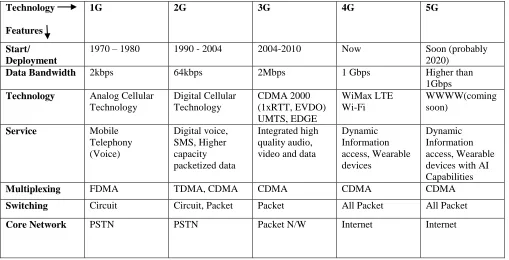
The following table gives the comparison of all generation of mobile technology [5].
Technology
Features
1G 2G 3G 4G 5G
Start/ Deployment
1970 – 1980 1990 - 2004 2004-2010 Now Soon (probably 2020)
Data Bandwidth 2kbps 64kbps 2Mbps 1 Gbps Higher than
1Gbps
Technology Analog Cellular
Technology Digital Cellular Technology CDMA 2000 (1xRTT, EVDO) UMTS, EDGE WiMax LTE Wi-Fi WWWW(coming soon)
Service Mobile
Telephony (Voice) Digital voice, SMS, Higher capacity packetized data Integrated high quality audio, video and data
Dynamic Information access, Wearable devices Dynamic Information access, Wearable devices with AI Capabilities
Multiplexing FDMA TDMA, CDMA CDMA CDMA CDMA
Switching Circuit Circuit, Packet Packet All Packet All Packet
Core Network PSTN PSTN Packet N/W Internet Internet
Table 1: comparison of all generations of mobile technologies
IV. CONCLUSION:
The 5G evolution will be based on 4G. Thus, 5G should make an important difference and add more services and features to the world over 4G. 5G include latest technologies such as cognitive radio, SDR, nanotechnology, cloud computing and based on All IP Platform. 5G should be more intelligent technology that interconnects the entire world without limits. 5G wireless network architecture has been explained in this paper with massive MIMO technology, network function virtualization (NFV) cloud and device to device communication.
ACKNOWLEDGEMENT:
I would like to thank our honorable Principal, Dr. R. P. Singh, our Head of Department, Prof. D. D. Patil, my special thanks to my guide, Prof. L. D. Panjwani & sincere thanks to all the respected teaching faculties of Department of Computer Science & Engineering of Hindi Seva Mandal’s, Shri Sant Gadge Baba College of Engineering & Technology, Bhusawal. My special thanks to all the writers of reference paper that are referred by us.
References
[1] V. Chandrasekhar, J. G. Andrews, and A. Gatherer, ``Femtocell networks: A survey,'' IEEE Commun. Mag., vol. 46, no. 9, pp. 59_67, Sep. 2008.
[2] A. Bleicher, ``Millimeter waves may be the future of 5G phones,'' Samsung's millimeter-wave transceiver technology could enable ultrafast mobile broadband by 2020, Jun. 2013
[3] H. Haas. (Aug. 2011). Wireless Data From Every Light Bulb. [Online]. Available: http://bit.ly/tedvlc
[4] C.-X. Wang, F. Haider, X. Gao, X.-H. You, Y. Yang, D. Yuan, H. M. Aggoune, H. H. S. Fletcher, and E. Hepsaydir, “Cellular architecture and key technologies for 5G wireless communication networks,” IEEE Commun. Mag., vol. 52, pp. 122–130, Feb. 2014.
[5] Qualcomm, “The 1000x Mobile Data Challenge,” White Paper, Nov 2013
95 .
[7] Ms. Neha Dumbre, Ms. Monali Patwa, Ms. Kajal Patwa.,”5G WIRELESS TECHNOLOGIES-Still 4G [8] auction not over, but time to start talking 5G”International Journal of Science, Engineering and
Technology Research (IJSETR)Volume 2, Issue 2, February 2013
[9] J. G. Andrews, S. Buzzi, W. Choi, S. V. Hanly, A. Lozano, A. C. K. Soong, and J. C. Zhang, “What will 5G be?” IEEE J. Sel. Areas Commun., vol. 32, pp. 1065–1082, Jun. 2014.
[10] Y. Kishiyama, “Future Steps of LTE-A: Evolution toward Integration of Local Area and Wide Area Systems,” IEEE Wireless Commun., vol. 20, no. 1, 2013,pp. 12–18.
[11] Ms.Reshma s. sapakal,Ms. Sonali s. kadam,”5G mobile technology”, International Journal of Advanced Research in Computer Engineering & Technology (IJARCET) Volume 2, Issue 2, February 2013