Volume 3, Special Issue 1, ICSTSD 2016
119
An Approach towards Secure Load
Balancing in Cloud Computing
V.T. Lanjewar
1, Prof. R.V. Dharaskar
21
ME Student, PG. Dept. of CSE, SGBAU, Amravati, India.
Email-id: [email protected]
2
Associate Prof., PG. Dept. of CSE, SGBAU, Amravati, India.
2
Email-id: [email protected]
ABSTRACT: Cloud balancing is still new, but the technology to add value is available today. The main objective is to develop an effective load balancing algorithm using task scheduling to maximize or minimize different performance parameters such as throughput, latency for the clouds of different sizes. This work has
also been enhanced with divisible load balance scheduling which has resulted into efficient load balancing with minimum execution time. In order to
authorize the data hosting by genuine user, here in this work a noble public key cryptography scheme has been employed. RSA algorithm has been employed in this work for ensuring authentication of
users to store data on public cloud.
Keywords: Authentication, Hadoop, Load Balancing, MapReduce, Kerberos
I. INTRODUCTION
Cloud computing is a term, which involves
virtualization, distributed computing, networking,
and software and web services. A cloud consists of
several elements such as clients, data center and
distributed servers. It includes fault tolerance, high
availability, scalability, flexibility, reduced
overhead for users, reduced cost of ownership, on
demand services etc. Central to these issues lies the
establishment of an effective load balancing
algorithm. The load can be CPU load, memory
capacity, delay or network load. Load balancing is
the process of distributing the load among various
nodes of a distributed system to improve both
resource utilization and job response time while
also avoiding a situation where some of the nodes
are heavily loaded while other nodes are idle or
doing very little work. Load balancing ensures that
all the processor in the system or every node in the
network does approximately the equal amount of
work at any instant of time. This technique can be
sender initiated, receiver initiated or symmetric
type (combination of sender initiated and receiver
initiated types). Hadoop is one of the platforms for
big data.
Hadoop includes two parts, namely, the Hadoop
Distributed File System (HDFS) and MapReduce.
Data is stored in HDFS as blocks that are of fixed
sized by default. There are two kinds of nodes in
Hadoop, where a namenode serves as the master
node and datanodes as slave nodes. The data blocks
are located on datanodes and Hadoop partitions the
datanodes on different racks. Hadoop installed on a
very large cluster can span many datacenters
including many racks.The MapReduce framework
has proven to be a powerful and cost-efficient
Volume 3, Special Issue 1, ICSTSD 2016
120
Fundamentally, a MapReduce job is executed
through two primary phases. In the map phase, a
function is applied in parallel to data from various
input datasets. This function yields intermediate
results in the form of a list of key-value pairs. Pairs
with the same key are subsequently grouped
together and allocated to a reduce task based on a
partition function. In the reduce phase, the reduce
task runs in parallel over each key group to produce
the final result
Challenges
One problem with Hadoop is balancing the
workload. In Hadoop, the uneven distribution of
data to the datanodes results in load imbalance
between different racks resulting in reduced
performance. There are multiple challenges
involved in the implementation of a fully functional
cloud balancing strategy. Some of these challenges
are a result of the immaturity of current
cloud-based offerings, and, as such, they might be
automatically addressed as cloud environments
continue to mature based on market demand and
experience. Other challenges, however, are likely
to require standards before they will be sufficiently
addressed.
II. BACKGROUND
The evaluation examines the benefits and trade
offs associated with each policy. Less aggressive
policies are able to provide zero overhead
rebalancing at the expense of leaving the
deployment in a non desired state for longer
periods of time[1]. Liu shows the improved
algorithm can really balance the overload racks
much quicker than the Hadoop algorithm and the
improved algorithm can also distribute the data
more evenly to each machine[2]. Wang focuses in
particular on algorithms based on closed queueing
networks for multi-class workloads, which can be
used to describe application with service level
agreements differentiated across users [3].Security
analysis shows that both AnonyControl and
AnonyControl-F are secure under the decisional
bilinear Diffie–Hellman assumption, and the
performance evaluation exhibits the feasibility of
the schemes. In experimental scenario with the
number of task requests increased [4]. There is
need of an algorithm which can offer maximum
resource utilization, maximum throughput,
minimum response time, dynamic resource
scheduling with scalability and reliability. This
work proposes an autonomous agent based load
balancing algorithm (A2LB) to address above
issues.[5] Zhao has verified the load balancing
effect of DLB and LB-BC by comparing their
percentages of the incremental standard deviation
values. These received requests constitute the total
workload to be handled by the cloud data center
and aren't the load of some physical host [6].
This paper introduced The rest of this paper are
organized as follows: Introduction gives an
approach towards achieving secure load balancing
in cloud Section I. Background gives a premise
of the proposed research problem is pointed out,
and then the proposed problem is formalized in
detail in Section II. Previous Work done gives
related work of the current approaches achieving
load balancing of cloud data centers will be
introduced briefly in Section III. Section IV.
Existing methodology discussed in Section V
Analysis and Discussion discuss In Section VI,
Proposed methodology gives the design and
implementation process of the proposed algorithm
in detail and Possible Result in discussed. Finally,
Conclusion of the paper discussed in Section VII.
III. PREVIOUS WORK DONE
Volume 3, Special Issue 1, ICSTSD 2016
121
algorithms through optimizing the candidate target
hosts within an algorithm cycle and then picking
out the optimal target hosts to achieve the
immediate load balancing effect. However, the
immediate effect doesn’t guarantee high execution
efficiency for the next task although it has abilities
in achieving high resource utilization.Duplyakin et
al (2013)[1], presents an environment that manages
multicloud deployment rebalancing by terminating
instances,in lower preferred clouds and launching
replacement instances in higher-preferred clouds
to satisfy user preferences. Liu et al (2013)[2] ,
focused on the overload machines and propose an
improved algorithm for balancing the overload
racks preferentially. The improved method
constructs Prior Balance List list which includes
overload machines, For BalanceList list and
NextForBalanceList list by many factors and
balances among the racks selected from these lists
firstly. Wang et al (2014)[3], experimentally
explores the relation between probabilistic routing
and weighted round robin load balancing policies.
From the experiment a similar behaviour is found
between these two policies, which makes it
possible to assign the weights according to the
routing probability estimated from queueing
theoretic heuristic and optimization algorithms
studied in the literature. Jung et al (2015)[4]
proposes a semi-anonymous attribute-based
privilege control scheme AnonyControl and a
fully-anonymous attribute-based privilege control
scheme AnonyControl-F to address the user privacy
problem in a cloud storage server. Singh et al
(2015)[5] work focuses on load balancing in cloud
computing environment. Load balancing in cloud
computing has been ignored, but rapid growth in
number of cloud users has raised demand for load
balancing mechanisms. This work has proposed an
autonomous agent based load balancing mechanism
which provides dynamic load balancing for cloud
environment. Zhao et al (2016)[5] focused on the
selection problem of physical hosts for deploying
requested tasks and proposed a novel heuristic
approach. The Bayes theorem is combined with the
clustering process to obtain the optimal clustering
set of physical hosts finally.
IV. EXISTING METHODOLOGY
Multicloud architecture: The architecture that designed consists of four main components: (1) a
workload management system (including a job
scheduler and workers), (2) sensors to monitor
demand, (3) policies to scale the number of
deployed instances up or down, and (4) an auto
scaling service to enforce the chosen policy. An
auto-scaling service, Phantom is use to launch
and monitor instances acrossmultiple clouds. [1]
Hadoop Data Load Balancing Algorithm: described the Hadoop load balancing algorithm in
detail. As this algorithm cannot balance the
overload racks preferentially, which could lead to
these racks breakdown, an improved algorithm
propose to balance overload racks as soon as
possible. According to different conditions,
perform different operations:
If of rack j, this rack is deleted from
PriorBalanceList.
If of rack k, this rack is deleted from
ForBalanceList.
If the PriorBalanceList is empty, the
algorithm terminates and jumps to next
step.
If the ForBalanceList is empty, the
algorithm terminates. Otherwise, the
algorithm turns to next step Moving data
between PriorBalanceList list and Next
Volume 3, Special Issue 1, ICSTSD 2016
122
Weighted round robin load balancing: (WRR)
is a common routing policy offered in cloud load
balancers. However, there is a lack of effective
mechanisms to decide the weights assigned to each
server to achieve overall optimal revenue of the
system. The relations between probabilistic routing
(PR) and weighted round robin (WRR) policies
and introduce the result of the algorithms under
different number of users classes. [3]
Autonomous Agent Based Load Balancing Algorithm (A2LB): A2LB which provides dynamic load balancing for cloud environment.
The proposed mechanism has been implemented
and found to provide satisfactory results.
Algorithms of various agents deployed in proposed
framework are given below respectively:
Migration Agent (MA): These agents are initiated
by channel agent. It will move to other data centres
and communicate with load agent of that data
centre to enquire the status of VMs present there,
looking for the desired configuration.
Load Agent (LA):It controls information policy
and maintains all detail of a data centre. The major
work of a load agent is to calculate the load on
every available virtual machine after allocation of
a new job in the data centre.
Channel Agent (CA): It controls the transfer
policy, selection policy and location policy. On
receiving the request from load agent, the channel
agent will initiate some migration agents to other
data centres for searching the virtual machines
having similar configuration. [4]
Anonymous attribute-based privilege control scheme: This paper proposes a semi-anonymous
attribute-based privilege control scheme
AnonyControl and a fully-anonymous
attribute-based privilege control scheme AnonyControl-F
to address the user privacy problem in a cloud
storage server. Using multiple authorities in the
cloud computing system, proposed schemes
achieve not only fine-grained privilege control but
also identity anonymity while conducting
privilege control based on users’ identity
information.[5]
LB-BC (Load Balancing based on Bayes and Clustering): LB-BC first has narrowed down the search scope by comparing performance values.
Then, LB-BC has utilized Bayes theorem to obtain
the posteriori probability values of all candidate
physical hosts. Finally, LB-BC has combined
probability theorem and the clustering idea to pick
out the optimal hosts set, where these physical
hosts have the most remaining computing power
currently, for deploying and executing tasks by
selecting the physical host with the maximum
posteriori probability value as the clustering center
and thus to achieve the load balancing effect from
the long-term perspective. [6]
V. ANALYSIS AND DISCUSSION
Phantom replaces instances if they crash and
terminates them based on rebalancing policies.
Several rebalancing policies also propose that
guide the deployments towards requested
multi-cloud configurations while having minimal impact
on the workload, if possible. [1] LB-BC proposes
for the long-term load balancing effect and it has
employed a heuristic idea based on Bayes theorem
and the clustering process.[6] Anonymous
attribute-based privilege control scheme to address the user
privacy problem in cloud and achieve not only
fine-grained privilege control.[5] Comparison Between
algorithms discussed is given below:
Algorithm/ Method Used
Advantages Disadvantages
Multicloud environment
aggressive policy provides fastest convergence
Volume 3, Special Issue 1, ICSTSD 2016
123
time and the
lowest excess
cost,
reducing it by factor of 3 over opportunistic policy only introducing job termination required for immediate rebalancing.
Hadoop data load
balancing algorithm
Total time used by Hadoop algorithm is shorter . This is due to different data computing and moving strategy. But comparing the experimental results cannot conclude whose total time used for balance is much shorter.
Weighted
round robin
algorithm
1.OPT returns the best revenue 2. Heuristic gives better result than simple weight setting. 3.Optimization program returns the best revenue among all the policies. And the revenue is around 27% higher than others.
1.There is a lack of effective mechanisms to decide the weight assigned to each server to achieve an overall optimal revenue of the system. 2.The heuristic algorithm requires only the demands but the problem is that it only works best for heavy load. Anonymous attribute-based privilege control scheme AnonyControl-F presented which fully prevents the identity leakage and achieve the full anonymity.
The authorities are well protected servers, it is hard to compromise even one authority, and the probability of compromising enough authorities to illegally decrypt some ciphertext is very low.
Autonomous Agent Based Load
Balancing Algorithm
This mechanism is proactive load calculation of VM in a DC and whenever load of a VM reaches near threshold value, load agent
A2LB takes optimum time when virtual machine becomes overloaded. (A2LB ) initiates search for a candidate VM from other DCs.
Heuristic approach for efficient task
placement : LB-BC
1.Reduce the failure number of task deployment events obviously, improved throughput, and optimized the external services performance of cloud data centers. 1.With time increasing, its external service performance is not stable and has a waving mode. 2.Also, the external service performance of DLB is relatively better than that of LB-BC at initial time. Table 1: Advantages and disadvantages
VI. PROPOSED METHODOLOGY
The proposed a load balancing algorithm which
will transfer the load to another server in cloud
when the current server is overloaded. When the
multiple request are arrived to allocate the resource
at server in cloud environment, the server gets
overloaded at some instance. Kerberos
authentication is used to validate the client-side
credentials. This means that the client must request
a Service Ticket valid for the Hadoop environment
and submit this Service Ticket as part of the client
connection. Validation is provided by a trusted
third party in the form of the Kerberos Key
Distribution Center.
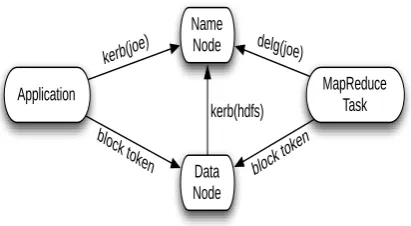
HDFS Authentication:
Authentication process for HDFS is described
Volume 3, Special Issue 1, ICSTSD 2016
124
Name Node
Data Node
kerb(joe)
kerb(hdfs)
block toke n
Application MapReduce
Task
block token
delg(joe)
Fig. Authentication process of HDFS
• Clients authenticate to NameNode via:
– Kerberos
– Delegation tokens
• Client demonstrates authorization to
DataNode via block access token
• DataNode authenticates to NameNode via
Kerberos
MapReduce Authentication:
Authentication process for MapReduce is described
below:
Fig.2 MapReduce Authentication
The process of authentication carried out as shown
in fig. and steps invoved are-
• Client authenticates to JobTracker via
Kerberos
• TaskTracker authenticates to JobTracker
via Kerberos
• Task authenticates to the TaskTrackers
using the job token
• Task authenticates to HDFS using a
delegation token
• NFS is not Kerberized.
Hadoop and Kerberos Authentication Flow:
The process flow for Kerberos
and Hadoopauthentication is given in the below.
1. User obtains Ticket Granting Ticket (TGT)
2.Client application uses TGT to request a Service
Ticket for Hadoop Service (HDFS/HIVE)
3. Client Application connects to Hadoop Service
providing the Service Ticket to authentication
4. User authenticated using the Service Ticket &
Service Key
5. Results from Hadoop Service
The first step, where the end user obtains a
Ticket-Granting Ticket (TGT), does not necessarily
occur immediately before the second step where
the Service Tickets are requested. There are
different mechanisms that can be used to obtain the
TGT. Some users run a kinit command after
accessing the machine running the Hadoop clients.
Others integrate the Kerberos configuration in the
host operating system setup. In this case, the action
of logging on to the machine that runs the Hadoop
clients will generate the TGT.
After the user has a Ticket-Granting Ticket, the
client application access to Hadoop Services
initiates a request for the Service Ticket (ST) that
corresponds to the Hadoop Service the user is
accessing. The ST is then sent as part of the
connection to the Hadoop Service. The
corresponding Hadoop Service must then
authenticate the user by decrypting the ST using the
Service Key exchanged with the Kerberos Key
Distribution Center. If this decryption is successful
the end user is authenticated to the Hadoop Service.
Their main merits are: 1) The proposed
schemes are able to protect user’s privacy against
each single authority. 2) The proposed schemes are
Job Tracker
Task Tracker kerb(joe)
kerb(mapreduce)
Task Other Service
HDFS HDFS HDFS
NFS job token delg(joe)
trust Application
Volume 3, Special Issue 1, ICSTSD 2016
125
tolerant against authority compromise, analysis on
security and performance provided to show
feasibility of the scheme.
VII. EXPECTED RESULTS
In this paper, the developed cloud framework not
only justified its optimum function in terms of
minimization of execution or response time but
also providing a secure data storage facility for
public cloud infrastructure. In order to accomplish
the goal of secure and authenticated data storage on
public cloud, key distribution center technique has
been implemented through enabling authentication
using Kerberos, encryption using SSL/TLS, and
authorization using HDFS.
VIII. CONCLUSION
It is important to evaluate solutions for cloud
balancing implementations with an eye toward
support for the needs of an actual IT department.
Combining high availability with security is just as
important. When the organization is using a
network that’s not its own for mission-critical
application delivery, stability and security become
paramount. Cloud computing has introduced a
cost-effective alternative to building out secondary or
even tertiary data centers as a means to improve
application performance, assure application
availability, and implement a strategic disaster
recovery.
IX. FUTURE SCOPE
This paper has discussed secure load balancing
that can be applied to clouds, but there are still
other approaches that can be applied to balance the
load in clouds. The performance of the given load
balancer in Hadoop can also be increased by. In
future, the plan is to conduct more experiments
with various data sets in the future.
REFERENCES
[1] Dmitry Duplyakin, Paul Marshall Kate ,
Keahey
Henry Tufo,Ali Alzabarah,"Rebalancingin a
Multi Cloud Environment", Science Cloud
’13,Proceedings of the 4th ACM WORKSHOP ON SCIENTIFIC CLOUD
COMPUTING, pp. 21-28, June 17, 2013.
[2] Kun Liu, Gaochao Xu and Jun’e Yuan,
"An Improved Hadoop Data Load
Balancing Algorithm", JOURNAL OF
NETWORKS, VOL.8, NO.12,
pp.2816-2822, December 2013.
[3] Weikun Wang, Giuliano Casale,
"Evaluating Weighted Round Robin Load
Balancing for Cloud Web Services",2014
16th INTERNATIONAL SYMPOSIUM ON
SYMBOLIC AND NUMERIC
ALGORITHMS FOR SCIENTIFIC
COMPUTING published in IEEE, pp. 393
- 400 , 22-25 Sept. 2014 ,
978-1-4799-8448-0/15 $31.00 © 2015 IEEE, doi
:10.1109/SYNASC.2014.59
[4] Taeho Jung, Xiang-Yang Li, , Zhiguo
Wan, and Meng Wan, "Control Cloud
Data Access Privilege and Anonymity
With Fully Anonymous Attribute-Based
Encryption", IEEE TRANSACTIONS ON
INFORMATION FORENSICS AND
SECURITY, pp.190- 199 vol. 10, no. 1,
January 2015
[5] Aarti Singh, Dimple Juneja, Manisha
Malhotra , "Autonomous Agent Based
Load Balancing Algorithm in Cloud
Computing", International Conference On
ADVANCED COMPUTING
TECHNOLOGIES AND APPLICATIONS
Volume 3, Special Issue 1, ICSTSD 2016
126
Published by Elsevier B.V. doi: 10.1016/ j.procs.2015.03.168
[6] Jia Zhao, Kun Yang, Xiaohui Wei, Yan
Ding, Liang Hu, Gaochao Xu, "A
Heuristic Clustering-Based Task
Deployment Approach for Load Balancing
Using Bayes Theorem in Cloud
Environment", IEEE TRANSACTIONS ON
PARALLEL & DISTRIBUTED SYSTEMS,
vol.27, no. 2, pp. 305-316, Feb. 2016,