Uranium Extraction from Solid Waste as Nitrate Complex with
D2EHPA, TOPO and their Synergistic Mixture
A. Ghaemi1∗, A. Rahmati2
1- School of Chemical Engineering, Iran University of Science and Technology, Tehran, Iran 2- Nuclear Fuel Cycle Research School, Nuclear Science and Technology Research Institute,
Amirabad, Tehran, Iran
Abstract
In this work, recovery of uranium from industrial waste was investigated experimentally using solvent extraction technique. Di 2-ethyl hexyl phosphoric acid (D2EHPA), tri-n-octyl phosphine oxide (TOPO) and their synergetic mixture was used as extractant in the experiments. Nitric acid solution was selected the best medium for extraction of uranium from the industrial waste. The extraction process has been investigated as a function of extractant concentration, diluents type, nitride acid pH, contact time, initial uranium concentration and temperature. The experiments were performed in batch mode. Kerosene was selected as the best diluent for the extractants. In the experiments it was found that, high temperature is beneficial for TOPO or D2EHPA extraction but low temperature is profitable for their synergistic effect. The results indicate that the extraction rate for uranium was controlled by diffusion. The best stripping agent for TOPO 0.05M or D2EHPA 0.15M and their mixture were Na2CO3 2M, by 96.2%, 54.3% and 57% uranium recovery respectively. McCabe curve showed that single theoretical stage is sufficient for uranium extraction more than 95 percent.
Keywords: Uranium Recovery, Solvent Extraction, TOPO, D2EHPA, Synergistic
∗ Corresponding author: [email protected]
1. Introduction
Uranium is an important element from industrial applications, nuclear energy programs and environmental views. It is extremely toxic and radioactive. Contamination of soil and groundwater as a consequence of wastes generated during uranium mining and ore processing necessitate its removal and recovery before discharge [1].
During the past decades, the separation and purification of uranium has gained considerable importance due to the increasing demand for this element. Various kinds of separation and preconcentration methods such as liquid-liquid, liquid-solid extraction, etc., have been used for this purpose [2-8].
and purification of solutions containing uranium (VI) that are vital elements for nuclear energy programs. Phosphorus-containing compounds have been synthesized and used as extractants for recovery and separation purposes in nuclear energy industry for several decades. Extractants such as di (2-ethyl hexyl) phosphoric acid (D2EHPA), tri n-butyl phosphate (TBP) and tri-n-octyl phosphine oxide (TOPO) have frequently been used in solvent extraction studies of uranium [9-14].
It was reported that U (VI) was extracted by acidic extractants in a dimeric form of UO2(HA)2A2 where a represents the alkyl
(–OC8H17) and phosphoryl groups (P=O) of
a typical organophosphorus acidic extractant and HA is the organophosphorus acidic extractant itself. Furthermore, whether the metal-extractant complex formed will be a monomer or polymer depends on metal loading level of the extractant. The following reactions were suggested in case of low and high level metal loading conditions [15-17]: For high level metal loading (monomer formation):
n
n
M ++ n HA←⎯⎯⎯⎯→MA + n H+
(1)
For low level metal loading (dimer formation):
( )
2( )(
.)
( )
n
org n org
M + + n HA ←⎯⎯⎯⎯→ M A HA + n H+
(2)
The efficiency of the extraction system was measured in terms of distribution ratios (D), and efficiency (E). The efficiency of extraction depends on the coefficient of
distribution (D) of uranium between the phases. The latter is defined as the ratio of concentration of metallic species in the organic phase to that in the aqueous phase at equilibrium. An extractant which has a high distribution coefficient is, therefore, more efficient for extracting a given metallic species. The distribution coefficient for uranium between the aqueous and organic was calculated as equation 3, where, Ao and
Aw are the activities in the organic and
aquatic solutions; Vo and Vw are the volumes
of the organic and aquatic solutions and the extraction efficiency can be expressed as equation 4. o w w o A V D A V × =
× (3)
,0
,0
.
i A
i
uranium concentration in org phase E
uranium concentration in initial aq phase
C C C = − = (4)
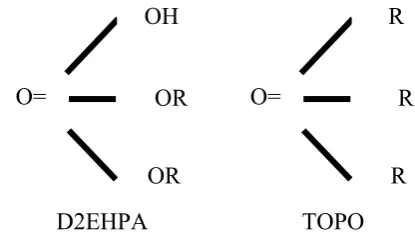
TOPO is a neutral donor and is synthesized by substituting 3 hydroxyls in the chemical structure of orthophosphoric acid by 3 organic radicals (Fig. 1). Uranium is extracted by TOPO through the coordination with the oxygen of the phosphoryl group (P=O) in the structure. The extraction of uranium by TOPO can be represented as equation 6 and HR represents TOPO. K and D are the stoichiometric equilibrium constant and distribution coefficient of uranium [18].
(
)
(
)
2 3 2aq 2 org 2 3 2.2 org
UO NO + HR ←⎯⎯⎯⎯→UO NO HR
(
)
(
)
[ ]
2 3 2
2
2 3 2
.2
org aq
UO NO HR
K
UO NO HR
⎡ ⎤ ⎣ ⎦ ⎡ ⎤ ⎣ ⎦ = (6)
(
)
(
)
2 3 2
2 3 2
.2 org aq
UO NO HR
D UO NO ⎡ ⎤ ⎣ ⎦ ⎡ ⎤ ⎣ ⎦
= (7)
Nitric acid is introduced as the best and most suitable solvent for solid waste characterization presented in this work. After dissolving the solid waste in nitric acid, various extractant for uranium extraction from the waste is used, the D2EHPA and TOPO are two of them. Furthermore, for a better comparison of different extractants, nitric acid was selected for the dissolution of solid waste for all the extractants. Uranium was extracted from the industrial waste using D2EHPA and TOPO. In the batch experiments, the optimum values of extraction parameters were obtained. Also, the best agent for stripping process was determined based on total recovery and distribution ratio.
2. Materials and methods
2-1. Chemical and reagents
TOPO and D2EHPA used in the experiments were obtained from Merck. Kerosene (non-aromatic) was used as diluent without further purification. All other reagents used in the present studies were also obtained from Merck with analytical grade and their respective solutions were prepared with distilled water. The chemical structures of D2EHPA and TOPO are given as follows:
Figure 1. Chemical structure of D2EHPA and TOPO.
2-2. Characteristics of waste
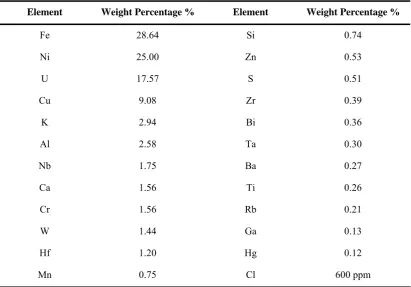
Specific industrial processes and their waste characteristics are known for proper management and control of the wastes produced from these industries. During reaction of the uranium tetrafluoride conversion to the uranium hexafluoride that takes place with fluorine gas in a fluidized bed reactor operating in industrial conditions, some solid waste is produced. Waste characterization study is important and necessary for recovery of it. First, all of the waste was ground and then analyzed with X-ray fluorescence technology (XRF). It was observed that the green solid waste studied here was mostly Fe, Ni and U (71.21% by weight). The waste analysis is given in Table 1.
2-3. Procedure and apparatus
The aqueous solutions of uranium were prepared by dissolving the necessary amount of solid waste (from UCF plant in Iran) with the appropriate amount of concentrated nitric acid. Fig. 2 illustrates the uranium concentration produced by solving ditinct mass of powder in 3M HNO3.
Table 1. Chemical composition of reactor waste.
Weight Percentage % Element
Weight Percentage % Element
0.74 Si
28.64 Fe
0.53 Zn
25.00 Ni
0.51 S
17.57 U
0.39 Zr
9.08 Cu
0.36 Bi
2.94 K
0.30 Ta
2.58 Al
0.27 Ba
1.75 Nb
0.26 Ti
1.56 Ca
0.21 Rb
1.56 Cr
0.13 Ga
1.44 W
0.12 Hg
1.20 Hf
600 ppm Cl
0.75 Mn
Figure 2. The uranium concentration against mass of powder were dissolved in HNO3 3 M.
Shaker was used to study the different parameters affecting the extraction efficiency of uranium by TOPO or D2EHPA or their synergetic in kerosene. Nitrate solutions containing various amounts of uranyl nitrate and nitric acid are mixed well with extractant
diluted with kerosene. The time for mixing and separation is suitable for any test. The phase volume ratio was maintained at 2:1(org to aq). Extractions were performed at room temperature (25 ±2°C).
between the phases. The phases were allowed to settle and the organic phase containing U(IV) was stripped with some agents. After phase disengagement, a portion from the aqueous phase was taken before and after equilibrium for determination of uranium concentrations. The analysis of uranium in the samples was carried out by an inductively coupled plasma emission spectrophotometer (ICP–AES) Perkin-Elmer.7300 DV Model. The concentrations of U(IV) in the organic phase were evaluated from the difference between the concentration in the aqueous phase before and after extraction.
3. Results and discussion
3-1. Effect of various diluents on extraction of uranium
Selection of a suitable diluent for solvent extraction is important in the process technology. Diluent selection depends on physical properties such as flash point, viscosity, density, boiling range, evaporation rate and solubility; on chemical properties such as influence on the distribution ratio, selectivity, reaction with the extractant; hydrodynamic factors such as third phase formation, crud formation, entrainment loss; and safety factors such as the flammability hazard, toxicity rating and effluent control limits; besides the economic factors. The nature of diluent has a significant effect on the kinetics of process, including extraction and phase separation.
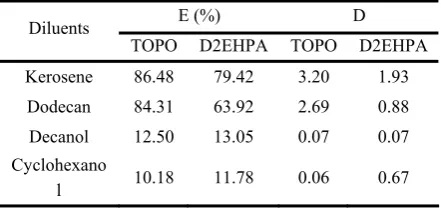
The suitability of several diluents such as Dodecan, Decanol, Cyclohexanol and kerosene was studied for the proposed method. The data obtained are given in Table 2. It was found that the extraction was
quantitative with kerosene and some with Dodecan. In the other diluents the extraction was incomplete [19-20]. Kerosene was used for further extraction studies as it gave better and quick phase separation. Kerosene as obtained from the petroleum distillation contains a mixture of paraffinic aromatic and naphthenic hydrocarbons. Stability of the diluent to chemical attack depends on the presence of double bonds which are the sites for oxidation reaction and irreversible extraction of metals [20].
Table 2. Effect of different diluents on extraction of
uranium (0.47 g/L).
E (%) D
Diluents
TOPO D2EHPA TOPO D2EHPA Kerosene 86.48 79.42 3.20 1.93 Dodecan 84.31 63.92 2.69 0.88 Decanol 12.50 13.05 0.07 0.07 Cyclohexano
l 10.18 11.78 0.06 0.67
3-2. Influence of nitric acid concentration
The extraction of U(VI) from 0.1–10.1 M HNO3 was studied with D2EHPA and
TOPO. In order to examine the variation of distribution ratio of U(VI) as a function of nitric acid concentration, the extractions of U(VI) from 0.1 to 10.1 M nitric acid and about 470 ppm initial Uranium concentration into 0.005 mol/lit TOPO, 0.015 mol/lit D2EHPA in kerosene and a mixture of D2EHPA 0.015 molar and TOPO 0.005 Molar at organic to aqueous phase ratio of 2 (Vorg/Vaq = 2), and at 25°C were studied
then decreased. This indicates that the nitrate concentration plays a significant role in extraction kinetics for the mass transfer from aqueous to organic phase.
(a)
(b)
Figure 3. The effect of HNO3 concentration on the
extraction and distribution ratio for U(VI) by (a) 0.015 mol/l D2EHPA and (b) 0.005 mol/l TOPO.
White and Ross observed that increase in nitric acid concentration to a certain extent increases the extraction of uranium but with further increase in its concentration there is increased competition between uranyl ions and nitric acid for complexation with TOPO [18]. The maximums of D and E occurred when the nitric acid concentration was near 3 mol/lit. The initial increase in D and E for
U(VI) may be caused by the salting-out effect of nitric acid. With further increase of nitric acid concentration, the concentration of the free extractant decreased as a result of the co-extraction of nitric acid. The decrease in D and E at higher acid concentration may also be attributed to the formation of a less extractable complex anion, such as UO2(NO3). This is an indication of the
possibility of two types of extraction mechanisms operating. U(VI) extraction was practically quantitative with 0.10–1M HNO3,
where cationic uranium species can be expected to prevail.
Fig. 3 also shows that the distribution ratio and extraction of U(VI) into D2EHPA from nitric acid solutions decrease with increasing acidity up to 3M HNO3 then become
constant. When D2EHPA is used as
extractant, species such as UO2A2(HA)2 are
shown as (HA= D2EHPA) D2EHPA co-extracts small amounts of HNO3 or NO3−
ions. Hence, further studies were carried out using 3 M HNO3 as the aqueous phase.
Table 3. Effect of HNO3 concentration on distribution
factor and U(IV) extraction by mixture of 0.015 M DEHPA and 0.005 M TOPO.
Acid Conc. (mol/lit)
0.1 1 2.9 5 7.2 10.1
E (%) 93.4 92.7 85.5 83.3 71.3 50.5 D 7.1 6.3 2.9 2.4 1.2 0.5
nitric acid for solvents TOPO and D2EHPA, 3 M nitric acid for synergistic mixture of them can also be used.
3-3. Effect of extractant concentration and synergistic reagent in organic phase
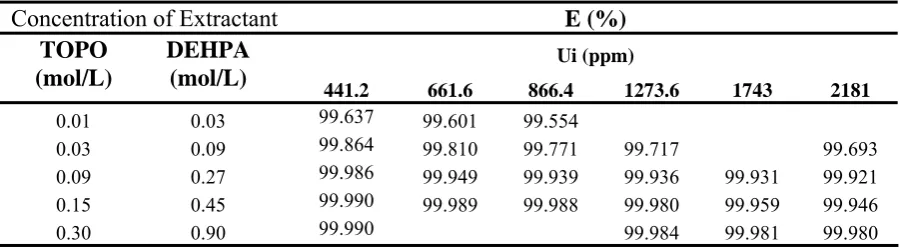
The effect of different concentration of TOPO and D2EHPA and their mixture in kerosene was employed. The parameters D and E values were calculated using Eq 3 and 4. The results are given in Fig 4. At first the extraction of uranium rapidly increases with
increase in concentration of extractant, at higher concentrations of TOPO or D2EHPA, increase in extractant concentration does not influence the mass transfer significantly. At a constant TOPO/D2EHPA molar ratio of 1:3, the extractant concentration in kerosene was varied and the effect on extraction of uranium from 3 M Nitric acid containing about 0.44, 0.66, 0.87, 1.3, 1.7 and 2.2 g/L of U(IV) at 2/1 phase ratio (aqueous/organic) was studied. The results are summarized in Table 4.
(a)
(b)
Figure 4. Effect of TOPO (a) and D2EHPA (b) concentration in organic phase on extraction efficiency (initial
uranium concentration were 441.2, 661.6, 866.4, 1274, 1743 and 2181 ppm, nitric acid concentration was 3 M). TOPO (mol/L)
Table 4. Effect of mixture of TOPO and D2EHPA concentration on extraction efficiency. Concentration of Extractant E (%)
Ui (ppm) TOPO
(mol/L)
DEHPA (mol/L)
441.2 661.6 866.4 1273.6 1743 2181
0.01 0.03 99.637 99.601 99.554
0.03 0.09 99.864 99.810 99.771 99.717 99.693
0.09 0.27 99.986 99.949 99.939 99.936 99.931 99.921
0.15 0.45 99.990 99.989 99.988 99.980 99.959 99.946
0.30 0.90 99.990 99.984 99.981 99.980
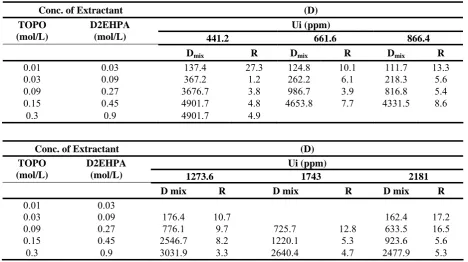
For extraction from 3 M nitric acid containing about 0.44, 0.66, 0.87, 1.3, 1.7 and 2.2 g/L U(IV) using only D2EHPA or TOPO showed that D was increased with increase in concentration of extractant (Fig. 5). The experimental results in Table 5 show that for a synergist, the synergistic extraction increased in that order. At low
uranium concentration, higher concentration of extractant will allow only a small fraction of extractant to be complexes with uranium; hence more extractant is available for making complex with HNO3. Enhancement factor
(R(synergistic)= Dmix/(D1+D2)) was also listed in
Table 5.
(a)
(b)
Figure 5. Effect of extractant concentration in organic phase on distribution coefficient: (a) TOPO;
(b) D2EHPA (3 M nitric acid containing about 0.44, 0.66, 0.87, 1.3, 1.7 and 2.2 g/L U(IV)). DEHPA (mol/L)
1.5 1
Table 5. Effect of TOPO and D2EHPA mixture on distribution coefficient.
Conc. of Extractant (D) Ui (ppm) TOPO
(mol/L)
D2EHPA
(mol/L) 441.2 661.6 866.4
Dmix R Dmix R Dmix R
0.01 0.03 137.4 27.3 124.8 10.1 111.7 13.3
0.03 0.09 367.2 1.2 262.2 6.1 218.3 5.6
0.09 0.27 3676.7 3.8 986.7 3.9 816.8 5.4
0.15 0.45 4901.7 4.8 4653.8 7.7 4331.5 8.6
0.3 0.9 4901.7 4.9
Conc. of Extractant (D) Ui (ppm) TOPO
(mol/L)
D2EHPA
(mol/L) 1273.6 1743 2181
D mix R D mix R D mix R
0.01 0.03
0.03 0.09 176.4 10.7 162.4 17.2
0.09 0.27 776.1 9.7 725.7 12.8 633.5 16.5
0.15 0.45 2546.7 8.2 1220.1 5.3 923.6 5.6
0.3 0.9 3031.9 3.3 2640.4 4.7 2477.9 5.3
3-4. Effect of contact time
Solvent extraction is an equilibrium process and shaking time is one of the important factors influencing the extraction of metals. The time dependence of uranium extraction was investigated between 1-150 min. The data obtained are presented in Fig. 6 and Table 6 as the extraction percent (E%) and distribution factor of U(IV) against the time.
It is clear that the efficiency that is 82.5 and 58.2% for TOPO and D2EHPA respectively for 1 min, reaches 85.8 and 79.1% for 100 min at room temperature. But, 15 min is suitable for extraction (prolonged shaking had no adverse effect on the extraction) hence, a 15 minute period for equilibrium was used in the all experiments.
Table 6. A comparative time effect of the different solvent systems on uranium extraction and distribution factor.
Distribution Factor Extraction (%)
Time
(min) D2EHPA (0.03 M)
TOPO (0.01 M)
D2EHPA (0.03 M) +TOPO (0.01 M)
D2EHPA (0.03 M)
TOPO (0.01 M)
D2EHPA(0.03 M) +TOPO (0.01 M)
1 0.7 2.4 17.0 58 82 96
3 1.0 2.5 18.0 67 83 97
4 1.1 2.7 18.8 69 85 97
8 1.8 2.8 28.9 78 85 98
18 1.8 2.8 32.2 78 85 98
45 1.8 2.9 34.5 78 85 99
60 1.8 2.9 34.8 78 86 99
104 1.9 3.0 36.0 79 86 99
3-5. Influence of initial uranium concentration
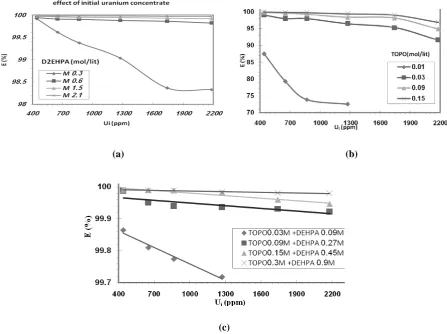
Extraction behavior of uranium was examined by varying initial concentrations from 0.44 g/L to 2.18 g/L. Fig. 6 shows that the extraction of uranium decreases with increasing uranyl concentration and uranium is quantitavely extracted at low con-centration. At high uranium concentration, the percentage of extraction decreases owing to deficiency of extractant. However, it should be noted that the amount of U(VI) permeated increased with the increase in U(IV) concentration in the aqueous phase.
3-6. Temperature effect on uranium extraction
To study the effect of temperature, the extraction of uranium was carried out by D2EHPA 0.03 M and TOPO 0.01 M in kerosene and synergetic mixture of them. Uranium concentration was 0.542 g/L in 3 M HNO3. The extraction was carried out in a
thermostatic bath by changing the temperature from 20 to 80°C and keeping the other variables constant. The mixture was stirred for 15 minutes at phase ratio=2 (org/aq) at different temperatures. The effect of temperature (20–80°C) on the extraction efficiency of uranium is shown in Fig. 7, which shows the plot of ln D vs. 1/T.
(a) (b)
(c)
Figure 6. Influence of initial uranium concentration on uranium extraction in 3M nitric acid solution and by four
According to Arrhenius equation or by means of the Van Hoff equation
lnD = -E RT + c where E is the activation energy of the reaction, R the universal gas constant (8.314 J mol−1 k−1), T the temperature of the reaction in absolute degrees. The activation energy values of the extraction reactions with D2EHPA, TOPO and synergetic mixture of them in kerosene were 1.2±0.1 kJ/mol, 4.7±0.1 kJ/mol and -2.6±0.1 kJ/mol, respectively. TOPO or D2EHPA extraction reactions are endothermic, i.e. high temperature is beneficial for the extraction but reaction of
their synergetic mixture is exothermic, i.e. low temperature is beneficial for the extraction.
Generally, when the activation energy (E) of an extraction reaction is more than 42 kJ/mol, the extraction process is controlled by chemical reaction; when E is lower than 20 kJ/mol, species diffusion is rate-limiting step. The extraction rate is determined by both chemical reaction and diffusion when E is in the range from 20 to 42 kJ/mol. The data obtained in the present systems indicate that the extraction rate for U(IV) may be controlled by diffusion.
(a) (b)
(c)
Figure 7. The plot of ln D vs. 1/T for: (a) 0.03 mol/lit D2EHPA; (b) 0.01 mol/lit TOPO;
3-7. Stripping of U from loaded organic
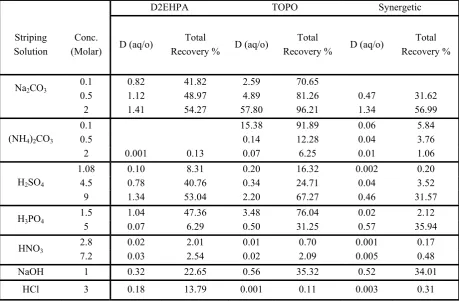
In stripping, it is not only important to have a high transfer of uranium from organic to aqueous phase, but it is essential to have a quick separation of phases with no emulsions. In a trial to recover the uranium from the organic phase, different stripping agents were examined for back-extraction of uranium. In this work, the stripping agents used are solutions of (0.1–2 M) sodium carbonate, (1.1–9 M) sulphuric acid, (2.8 and 7.2 M) nitric acid, (0.1–2 M) ammonium carbonate, (1 M) Sodium hydroxide (caustic soda), (3 M) hydrochloric acid and (1.5–5 M) phosphoric acid. In all cases, the volumetric phase ratio of organic solvent to stripping solution was 1:1 and aqueous and organic phases were mixed by a stirrer for 1 hour and separated after 15 min. Operating
temperature was 25°C. The concentration of uranium in the organic phase before and after mixing was determined by the ICP. Uranium stripping distribution factor was calculated by dividing the concentration of uranium in the aqueous to organic phase. It was observed that quantitative stripping was not possible with nitric acid (2.8 and 7.2 M). The stripping efficiency of uranium from D2EHPA can be significantly increased by the use of higher concentration of sulphuric acid or sodium carbonate in the aqueous strip solution and to ensure that a sufficient fraction of U(VI) will be transferred into the stripping aqueous solution. The best stripping agents for TOPO 0.05M or D2EHPA 0.15M in kerosene and their mixture were Na2CO3
2M, by 96.2%, 54.3% and 57% uranium recovery respectively.
Table 7. Effect of different stripping agents for stripping Uranium from loaded organic
D2EHPA TOPO Synergetic
Striping Solution
Conc.
(Molar) D (aq/o)
Total
Recovery % D (aq/o)
Total
Recovery % D (aq/o)
Total Recovery %
0.1 0.82 41.82 2.59 70.65
0.5 1.12 48.97 4.89 81.26 0.47 31.62 Na2CO3
2 1.41 54.27 57.80 96.21 1.34 56.99
0.1 15.38 91.89 0.06 5.84
0.5 0.14 12.28 0.04 3.76
(NH4)2CO3
2 0.001 0.13 0.07 6.25 0.01 1.06 1.08 0.10 8.31 0.20 16.32 0.002 0.20
4.5 0.78 40.76 0.34 24.71 0.04 3.52 H2SO4
9 1.34 53.04 2.20 67.27 0.46 31.57 1.5 1.04 47.36 3.48 76.04 0.02 2.12 H3PO4
5 0.07 6.29 0.50 31.25 0.57 35.94 2.8 0.02 2.01 0.01 0.70 0.001 0.17
HNO3
7.2 0.03 2.54 0.02 2.09 0.005 0.48 NaOH 1 0.32 22.65 0.56 35.32 0.52 34.01
3-8. Graphical determination of the number of theoretical stages
At sometime in equilibrium, only partial transfer of metallic cations occurs. Thus several stages of contact should be used in order to recover the maximum values of these species. The distribution curve is the graphical plot of metal concentration in the organic phase as a function of the metal concentration in the aqueous phase at equilibrium. Fig. 8 shows the distribution curves for uranium. These curves were constructed at 0.3 M (10% v/v) D2EHPA, and also 0.03 M TOPO in kerosene at temperature of 25oC and volume ratio equal to 2 (organic/aqueous). In this work, the Mc Cabe type construction is used to determine the number of theoretical stages required for achieving more than 95% separation. As indicated in Fig. 9, the number of theoretical stages required is one for U(IV) extraction. 4. Conclusions
Uranium mass transfer from aqueous to organic phase in D2EHPA, TOPO and their
synergistic effect was experimentally investigated. The results of the present work indicate that D2EHPA and TOPO can be used for the recovery of uranium from aqueous solutions. Preliminary test results suggested that a 15 minute agitation time at 300 rpm was adequate for reaching equilibrium and kerosene is the best diluent for this system. The effects of the concentrations of extractant, nitric acid, initial uranium concentration and temperature on the distribution factor and extraction efficiency of U (VI) have been studied. The activation energy values for the extraction reactions with TOPO, D2EHPA and a mixture of TOPO and D2EHPA in toluene were 4.7±0.1 kJ/mol1.2±0.1 kJ/mol and -2.6±0.1 kJ/mol, respectively. McCabe type graphical construction indicated that the number of theoretical stages required for achieving more than 95% extraction is one by using an organic-to-aqueous volume ratio of 2.
(a) (b)
References
[1] Karve, M., and Rajgor, R.V., "Amberlite XAD-2 impregnated organophosphinic acid extractant for separation of uranium (VI) from rare earthelements", Desalination, 232(1–3), 191, (2008).
[2] Abderrahim, O., Didi, M.A. and Villemin, D., "A new sorbent for uranium extraction: Polyethylenimine phenyl phosphon amidic acid", J. Radioanal. Nucl. Chem., 279(1), 237, (2009).
[3] Girgin, S., Acarkan, N. and Sirkeci, A., "The uranium (VI) extraction mechanism of D2EHPA-TOPO from a wet process phosphoric acid", J. Radioanal. Nucl. Chem., 251 (2), 263, (2002).
[4] Jia, Q., Wang, Z.H., Li, D.Q. and Niu, C.J., "Adsorption of heavy rare earth(III) with extraction resin containing bis(2,4,4-trimethylpentyl) monothiophosphinic acid", J. Alloys and compound, 374( 1–2), 434, ( 2004). [5] Mahramanlioglu, M., "Adsorption of
uranium on adsorbents produced from used tires", J. Radioanal. Nucl. Chem., 256(1), 99, (2003).
[6] Radenkovic, M.B., Kandic, A.B., Vukanac, I.S., Joksic, J.D. and Djordjevic, D.S., "Chemical and radiochemical characterization of depleted uranium in contaminated soils", Rus. J. Phys. Chem. A, 81(9), 1448, (2007).
[7] Ferreira, H.S., Bezerra, M.A. and Ferreira, S.L.C., "A pre-concentration procedure using cloud point extraction for the determination of uranium in natural water", Microchim Acta, 154 (1-2), 163, (2006).
[8] Karapinar, E. and Kabay, N., "Synthesis characterization and liquid–
liquid extraction properties of new methoxyaminobiphenylglyoxime deri-vatives and their complexes with some transition metals", Trans. Metal Chem., 32(6), 784, (2007).
[9] Yang, Y.Z., Zeng, S., Bao, L.P., Liu, W.T. and Sun, S.X., "Synergistic extraction of uranium(VI) with mixtures of bis (hexylsulfinyl) ethane (BHxSE) and petroleum sulfoxides (PSO)", J. Radioanal. Nucl. Chem., 258 (2), 403, (2003).
[10] Zhijun, G., Wangsuo, W., Dadong, S. and Minyu, T., "Liquid-liquid extraction of uranium(VI) and thorium(IV) by two open-chain crown ethers with terminal quinolyl groups in chloroform", J. Radioanal. Nucl. Chem., 258 (1), 199, (2003).
[11] Sato, T., "The extraction of uranium (VI) from nitric acid solutions by di-(2-ethylhexyl)-phosphoric acid", J. Radioanal. Nucl. Chem., 25(1), 109, (1963).
[12] Bagawde, S.V., Ramakrishna, V.V. and Patil, S.K., "Complexing of tetravalent plutonium in aqueous solutions", J. Radioanal. Nucl. Chem., 38(7), 1339, (1976).
[13] Bagawde, S.V., Vasudava, P.R., Ramakrishna, V.V. and Patil, S.K., "The effect of temperature on the extraction of uranium(VI) from nitric acid by tri-n-butyl-phosphate", J. Inorg. Nucl. Chem., 40(11), 1913, (1978). [14] Sato, T. and Nishida, T., "The
extraction of uranium(VI) from hydrochloric acid solutions by tri-n-octyl phosphine oxide", J. Inorg. Nucl. Chem., 36(9), 2087, (1974).
[16] Baes, C.F., Ralph, J., Zingaro, A. and Coleman C.F., "The extraction of uranium (VI) from acid perchlorate solutions by Di(2ethylhexyl) -phosphoric acid in n-hexane", The J. Phys. Chem., 62(2), 129, (1958).
[17] Ritcey, G.M. and Ashbrook, A.W., Solvent extraction: Principles and applications to process metallurgy, Part 1, Elsevier, Amsterdam-Oxford-New York-Tokyo, p. 150, (1984).
[18] White, J.C. and Ross, W.J., Separations by solvent extraction with tri-n-octylphosphine oxide, National Academy of Sciences, (1961).
[19] Hudson, M.J., "An introduction to some aspects of solvent extraction chemistry in hydrometallurgy", Hydrometallurgy, 9(2), 149, (1982).
[20] Singh, H. and Gupta, C.K., "Solvent extraction in production and processing of uranium and thorium", Mineral Processing and Extractive Metallurgy Review: An Int. J., 21(1-5), 307, (2000).