[Pulido* 4(6): June, 2017] ISSN 2349-4506
Impact Factor: 2.785
G
lobal
J
ournal of
E
ngineering
S
cience and
R
esearch
M
anagement
INNOCUOUSNESS + KNOWLEDGE MANAGEMENT A CONTRIBUTION TO
PROCESS IMPROVEMENT
García Pulido, Yadrián Arnaldo
*1, Castillo Zúñiga, Victor Javier
2, Medina León, Alberto
3,
Medina Nogueira, Daylín
4, Mayorga Villamar, Carmen Manuela
5*
Quality Management Department, Matanzas University, Cuba
2Business Administration Department, Regional Autonomous University of Andes, Ecuador
3Engineering Department, Matanzas University, Cuba
4Knwoledge Management Cathedra, Matanzas University, Cuba
5Professor, Uniandes University, Ecuador
DOI: 10.5281/zenodo.820253
KEYWORDS
:
knowledge management, innocuousness, HACCP, process improvement, process management.ABSTRACT
The processes improvement is inherent to the business management. In the competitive current market, the businesses adaptation capacity is fundamental. The continuous improvement becomes into the reason of being of the companies, being adapted to the clients, being more efficient and winning in flexibility in the face of an extremely unstable economy. Several tools have been developed with the objective of improving the processes, however the integration of elements of other knowledge areas has been not very employee. The knowledge management offers a solid base to promote the continuous improvement and the HACCP system methodology allow to carry out this objective. The present investigation proposes a way for the processes improvement starting from the elements combination of knowledge and innocuousness management. The proposal leaves of the determination of the process critical activities sustained in the information and the pursuit and control of the corrective measures, what generates new information that stimulates the continuous improvement. At this way the processes are more and more efficient and effective in function of the market and the business characteristics, what assures the business success.
INTRODUCTION
A managerial culture guided to the continuous improvement, the systematizing of the processes, the team work and the creativity, sustain it the advantages of business management with processes focus [1]. The current processes management responds to continuous improvement models [2] that are based generally in the PDCA cycle. The processes subject to the different management systems are immersed in this tendency [3].
There are more than enough reasons to improve the processes, among them [4]:
Every day new methods, programs and teams arise.
The atmosphere of the company changes, the efficient processes become obsolete in a short time.
The consumer's and client's expectations change almost every day; what was excellent yesterday scarcely satisfies today's necessities and it is inadequate tomorrow.
People linked to the process increase their capacities, and it implies an increase of opportunities for the purification of the process.
The careless or not assisted processes demean with the course of time.
Independently of the good thing that it is today the process, there will always be a well road. All that needs to make is to discover it.
At this way the continuous improvement contribute to the processes quality and consequently to the final product and clients satisfaction. The improvement should be impelled by the constant research of satisfying the consumers. In clients are the causes of the improvement and their purpose.
[Pulido* 4(6): June, 2017] ISSN 2349-4506
Impact Factor: 2.785
G
lobal
J
ournal of
E
ngineering
S
cience and
R
esearch
M
anagement
Ex. Costs
Defective units Time
Equipment capacity Ex.
Temperature Standard Asked quality
Transformation
INPUTS S
Requirements: Process indicators
OUTPUTS S
Results:
Results indicators Ex.
Production volume Sales average
Costumer’s satisfaction
According to [5] the knowledge management is the new management paradigm that relates the growth of the company and the services offer it. The knowledge management is the organization know-how valuation. It demands people to understand that it is important to share from a rational point of view, and it is necessary to share with other organization members [6].
Knowledge management is the process that promotes the generation, collaboration and use of the knowledge for the organizational learning and innovation, with which new value is generated and the level of competitiveness rises for the sake of achieving the organizational objectives with efficiency and effectiveness [7].
This point of view bears implicitly the paper of knowledge management for the continuous improvement of the processes, due to generate value that surrenders in product or service to the potential clients.
Also it contributes to the business growth starting from the surveillance of the opportunities that arise in the environment and the constant learning from the management errors in the past.
This surveillance not only settles down toward the environment, but also toward the interior of the organization mediating management indicators. The management indicators, can be considered in two big groups: of process and of results.
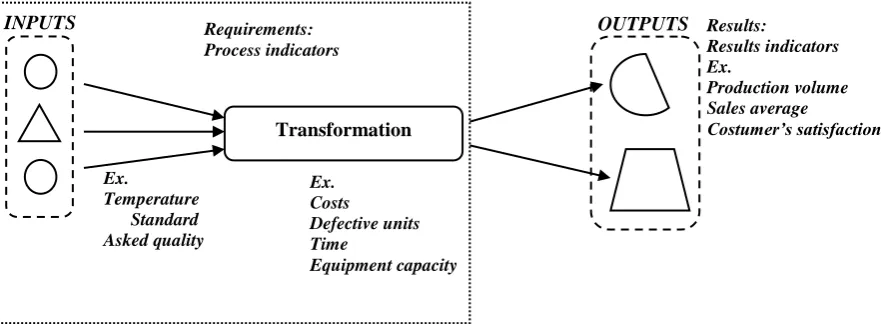
The process indicators are focused on the inputs quality (execution of the requirements) and on the transformation quality, they are essentially operational.
The results indicators, point out to the achievement of process objectives and they are related with the execution of product or service the requirements in correspondence with the clients’ demands (Figure 1).
Figure 1:
Process and Results indicators
Be already indicators of process or results, these are settle down and measure during and at the end of an activities sequence that compose the process [8-13]. Therefore processes improvement, implies it to evaluate each one of the activities and settle down control indicators that guarantee the realization of the following step according to the requirements [14-15].
[Pulido* 4(6): June, 2017] ISSN 2349-4506
Impact Factor: 2.785
G
lobal
J
ournal of
E
ngineering
S
cience and
R
esearch
M
anagement
The HACCP system is based on the identification of critical control points that constitute actions or activities that commit the final product innocuousness [18-19]. With this philosophy, it is possible to settle down in the processes management, those activities whose outputs commit on high level a results indicator behavior or those activities that an incorrect realization implies damages during the transformation.These activities constitute the critical points of the process, therefore their pursuit and control, allow to identify improvement resource and in addition the process improvement.
RELATED WORK
Knowledge management
The knowledge management has changed the form that organizations management their processes, due to the necessity of being able to have reliable, entire and opportune information in all moment that contributes to the execution of their strategic objectives [7]. Authors like Salazar Castillo and Zarandona Azkuenaga distinguish the management by knowledge objectives focused on: the flexibility, the learning, the reduction of costs, the organizational efficiency, the innovation, the continuous improvement, the productivity and the competitiveness; but all they can be summarized in making a good use of the available knowledge to develop new business opportunities [20].
Knowledge is considered one of the most valuable resources in the current society and it has been identified as key element for competitive advantages achievement, even above the tangible ones. It is propose that knowledge is: to create, to innovate and to develop new ideas [21]; the capacity to solve a problem with effectiveness [22]; a mixed flow of experience, values and contextual information to evaluate and to incorporate new experiences and information [23].
The knowledge management model proposed by [7] defines as inputs variables: necessities and demands of the interest groups, not structured information and specialized software supports for their management. It integrates and manage the key factors (people, processes and technology) and the processes for knowledge management (to acquire, to organize, to disclose, to use and to measure), based on the continuous improvement of Deming cycle, to create products/services in those one that adds value to the information and consequently to the processes.
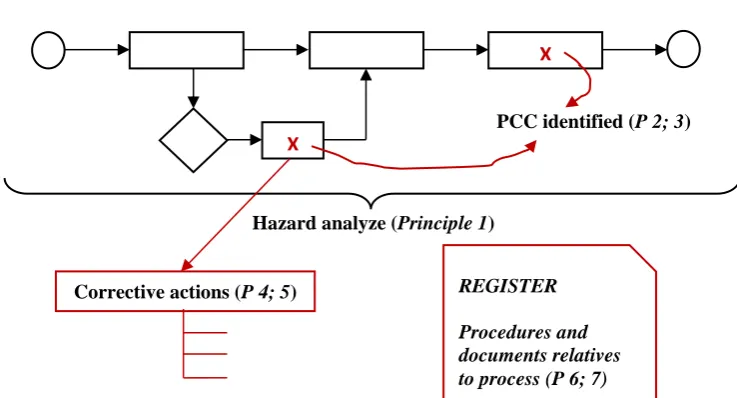
The processes focus guarantees the pattern for processes improvement effectiveness, due to define a series of elements in its conception that are vital for the continuous improvement. Also the output variables return to the pattern like input variables in the future.
On the other hand, their operation is based on the Deming cycle (PDCA), what implies a constant surveillance and a sustained control to the process development (process indicators), to carry out corrective actions or of improvement that impact in a satisfactory way in the clients (indicators of results).
Figure 2:
[Pulido* 4(6): June, 2017] ISSN 2349-4506
Impact Factor: 2.785
G
lobal
J
ournal of
E
ngineering
S
cience and
R
esearch
M
anagement
X
X
PROCESS DIAGRAM
Hazard analyze (Principle 1)
PCC identified (P 2; 3)
Corrective actions (P 4; 5) REGISTER
Procedures and documents relatives to process (P 6; 7) Innocuousness management
The innocuousness management has for objective to guarantee foods with the sanitary required quality [24], what implies a meticulous control of the productive and/or elaboration process. At this way, it is necessary to describe with detail the processes that are carried out and to determine those that add value to the sanitary guarantee of the products.
The main innocuousness management tool used is the HACCP system that according to Sansawat and Muliyil it versatility allows to apply their principles to several conditions that it can go from an industrial process to one handmade [25].
Also this versatility sustains the use of HACCP possibility for processes improvement. In accordance with ISO 22000 this system is based in seven principles:
PRINCIPLE 1: To carry out hazard analysis.
PRINCIPLE 2: To determine critical control points (PCC). PRINCIPLE 3: To establish critical limits.
PRINCIPLE 4: To establish a surveillance system to the control of PCC. PRINCIPLE 5: To establish corrective measured for non-controlled PCC.
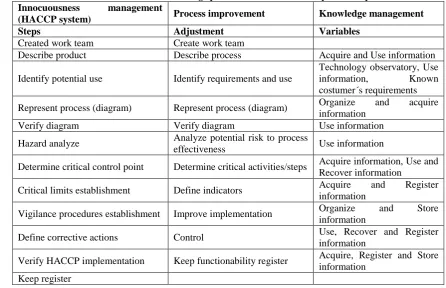
PRINCIPLE 6: To establish verification procedures to confirm HACCP effectiveness. PRINCIPLE 7: To establish relative documentation system to HACCP operation. Based on the focus by processes the implementation of HACCP, it would be (Figure 3):
Figure 3:
Schematic HACCP model implementation
HACCP principles contain the phases: process analysis, design and implementation of the process; pointed out by Amozarraín for processes improvement. This condition support the idea of use HACCP like a processes improvement complement [26].
RESULTS AND DISCUSSION
[Pulido* 4(6): June, 2017] ISSN 2349-4506
Impact Factor: 2.785
G
lobal
J
ournal of
E
ngineering
S
cience and
R
esearch
M
anagement
measures to guarantee the objectives execution.At this way HACCP offers the mark to analysis the process to improve and the knowledge management sustains the continuous improvement and the necessary information availability to realize the monitoring, proceeding, verification, registration and control activities.
Table 1. Innocuousness and knowledge procedures contribution to process improvement
Innocuousness management
(HACCP system) Process improvement Knowledge management
Steps Adjustment Variables
Created work team Create work team
Describe product Describe process Acquire and Use information
Identify potential use Identify requirements and use
Technology observatory, Use information, Known costumer´s requirements
Represent process (diagram) Represent process (diagram) Organize and acquire information
Verify diagram Verify diagram Use information
Hazard analyze Analyze potential risk to process
effectiveness Use information
Determine critical control point Determine critical activities/steps Acquire information, Use and Recover information
Critical limits establishment Define indicators Acquire and Register information
Vigilance procedures establishment Improve implementation Organize and Store information
Define corrective actions Control Use, Recover and Register information
Verify HACCP implementation Keep functionability register Acquire, Register and Store information
Keep register
The tools versatility of innocuousness management and knowledge management, make it possible their use in processes improvement of any nature. The knowledge management is inherent to the application field, and HACCP in spite of being related with foods, its methodology can be adapt it to environments so much productive as services.
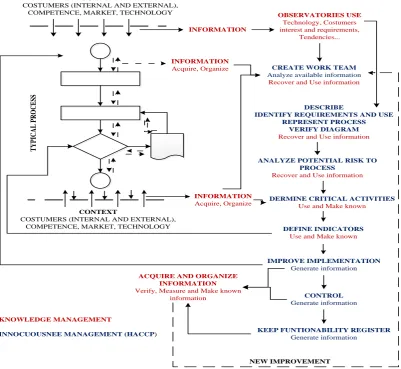
Under the focus by processes, it can be considered the innocuousness like the guarantee that the product/service will fulfill the client's requirements, contributing to its efficiency and effectiveness. Under this same focus, each activity of the process, not only generates inputs to the following step, but also information that properly registered and organized it can be used then for the process improvement.
[Pulido* 4(6): June, 2017] ISSN 2349-4506
Impact Factor: 2.785
G
lobal
J
ournal of
E
ngineering
S
cience and
R
esearch
M
anagement
CONTEXT
COSTUMERS (INTERNAL AND EXTERNAL),
COMPETENCE, MARKET, TECHNOLOGY OBSERVATORIES USE
Technology, Costumers interest and requirements,
Tendencies...
CREATE WORK TEAM
Analyze available information Recover and Use information
INFORMATION T Y P IC A L P R O C E SS CONTEXT
COSTUMERS (INTERNAL AND EXTERNAL), COMPETENCE, MARKET, TECHNOLOGY
INFORMATION
Acquire, Organize
INFORMATION
Acquire, Organize
DESCRIBE
IDENTIFY REQUIREMENTS AND USE REPRESENT PROCESS
VERIFY DIAGRAM
Recover and Use information
ANALYZE POTENTIAL RISK TO PROCESS
Recover and Use information
DERMINE CRITICAL ACTIVITIES
Use and Make known
DEFINE INDICATORS
Use and Make known
IMPROVE IMPLEMENTATION
Generate information
ACQUIRE AND ORGANIZE INFORMATION
Verify, Measure and Make known
information CONTROL
Generate information
KEEP FUNTIONABILITY REGISTER
Generate information
NEW IMPROVEMENT
KNOWLEDGE MANAGEMENT
INNOCUOUSNEE MANAGEMENT (HACCP)
Figure 4:
Process improvement representation
CONCLUSION
The processes improvement is a vital aspect for the current business management development. Therefore it is indispensable the search of more efficient systems that it guarantee the activities effectiveness. In this sense, the organization, information and registrations of the processes, as well as a meticulous analysis of the activities that are carried out, doesn't become in advantage, but in necessity.
The tools proposed by innocuousness management and knowledge management offers a substantial support and of feasible application to the processes improvement. The concept of critical activities that it commits the result of the process constitutes a new vision in processes conception. Also to sustain the activities in the knowledge management add an informative solid structure that is very important for the control and improvement of the processes.
[Pulido* 4(6): June, 2017] ISSN 2349-4506
Impact Factor: 2.785
G
lobal
J
ournal of
E
ngineering
S
cience and
R
esearch
M
anagement
REFERENCES
1. Nariño Hernández, A., Nogueira Rivera, D., and Medina León, A. “La caracterización y clasificación de sistemas, un paso necesario en la gestión y mejora de procesos. Particularidades en organizaciones hospitalarias”. DYNA, VOL. 81, NO. 184, PP 191-198, APRIL 2014, recover from http://dyna.medellin.unal.edu.co/
2. Martínez Llebrez, V. R. “El nuevo proyecto ISO/DIS 9001 Sistemas de Gestión de Calidad. Requisitos. Su aprobación como norma internacional en el 2015”. TECNOGEST event presentation, MARCH, 2015. 3. Ricardo Cabrera, H., Medina León, A., Pérez Hernández, C. M., Núñez Chaviano, Q. and Curbelo Hernández. “Mejora de la disponibilidad en procesos a partir de la confiabilidad”. Anuario Facultad de Ciencias Económicas y Empresariales, 7, 2016, recover from www.ujs.uo.edu.cu/index.php/aeco/issue/view/49
4. Ricardo Cabrera, H. “Modelo y procedimiento para la gestión y mejora de procesos en contribución a la integración de sistemas normalizados en cementeras cubanas”. [PhD] en opción al grado de Doctor en Ciencias Técnicas. Universidad Central “Marta Abreu” de Las Villas, Cuba. 2016.
5. Schalk Quintanar, A. E. “Modelo de enseñanza-aprendizaje para adultos en la era del conocimiento. Diseño y estructura del modelo”. REVISTA DE INVESTIGACIÓN DE LA FACULTAD DE CIENCIAS ADMINISTRATIVAS, UNMSM, VOL, 8 NO 16, pp. 63-87, Lima, 2005.
6. Valencia Rodríguez, M. “Modelo de generación y transferencia de conocimiento para los procesos de dirección y gestión humana en pymes del sector cárnico de la ciudad de Cali”. [PhD] en opción al grado científico de Doctor en Ciencias Técnicas. Universidad de La Habana. La Habana, Cuba, 2010.
7. Medina Nogueira, D. “Instrumento metodológico para gestionar el conocimiento mediante el observatorio”. [PhD] en opción al grado científico de Doctor en Ciencias Técnicas. Universidad de Matanzas, Cuba, 2016.
8. Anthony, R. “El control de gestión”. Bilbao, España. Ediciones DEUSTO S.A. 1990.
9. Blanco Illescas, F. “El control integrado de gestión. Iniciación a la dirección por sistemas”. México. Editorial Limusa S.A. 1993
10. Machado Noa, N. “Procedimiento para el perfeccionamiento del control de gestión. Aplicación a instituciones bancarias con funciones de banca universal”. [PhD] en opción al grado científico de Doctor en Ciencias Económicas, Facultad de Economía. Universidad de La Habana, Cuba, 2003.
11. Pérez Campaña, M. “Contribución al Control de Gestión en elementos de la cadena de suministro. Modelo y procedimientos para organizaciones comercializadoras”. [PhD] en opción al grado científico de Doctor en Ciencias Técnicas, Departamento de Ingeniería Industrial. Universidad Central “Marta Abreu” de Las Villas, 2005.
12. Royero, J. “Modelo de control de gestión para sistemas de investigación universitarios”. REVISTA IBEROAMERICANA DE EDUCACIÓN, ISSN 1681-5653, 2013.
13. Jaquinet Espinosa, R. M. “Contribución al control de gestión en las instituciones de educación superior a través de la comunicación organizacional”. [PhD] en opción al grado científico de Doctor en Ciencias Técnicas, Universidad de Matanzas, Cuba, 2016.
14. Blattmann, U. “Modelo de gestão da informação digital online em bibliotecas acadêmicas na educação à distância: biblioteca virtual”. [PhD], en opción al grado científico de Doctor en Ingeniería de la Producción. Universidad de Santa Catarina, Florianópolis, Brasil, 2001.
15. Nogueira Rivera, D. “Modelo conceptual y herramientas de apoyo para potenciar el control de gestión en las empresas cubanas”. [PhD] en opción al grado científico de Doctor en Ciencias Técnicas. Universidad de Matanzas, Cuba, 2002.
16. García Pulido, Y. A. “Propuesta de un índice para el diagnóstico del cumplimiento de los prerrequisitos higiénico sanitarios, para la gestión de la inocuidad en servicios gastronómicos”. Tesis in option to Master in Tourism Management, Universidad de Matanzas, Cuba, 2014.
17. Pérez García, E. “Aportaciones al sistema de autocontrol en microestablecimientos alimentarios de restauración colectiva”. [PhD], en opción al grado científico de Doctor en Ciencias. Facultad de Veterinaria. Departamento de Patología Animal, Producción Animal, Bromatología y Tecnología de los Alimentos. Universidad de Las Palmas de Gran Canaria. Las Palmas de Gran Canaria, España, 2012. 18. ISO 22000:2005. “Food safety management systems. Requirements for any organization in the food
[Pulido* 4(6): June, 2017] ISSN 2349-4506
Impact Factor: 2.785
G
lobal
J
ournal of
E
ngineering
S
cience and
R
esearch
M
anagement
19. Varinia Paredes, V. “Inocuidad de los alimentos”. Universidad Nacional Agraria, Nicaragua. 170 p.ISBN 978-99924-1-008-0. 2016.
20. Salazar Castillo, J. M. and Zarandona Azkuenaga, X. “Valoración crítica de los modelos de gestión del conocimiento”. Paper presented at the global enterprise and local markets. XXI Congreso Anual AEDEM, Universidad Rey Juan Carlos, Madrid, 6- 8, junio, 2007.
21. Machlup, F. “Knowledge industries and knowledge occupations”. ECONOMICS OF EDUCATION: RESEARCH AND STUDIES, VOL, 14, pp. 65-92, 2014.
22. Muñoz Seca, B. and Riverola, J. “Problem Driven Management: Achieving Improvement in Operations Through Knowledge Management”. Editorial Springer. 2016.
23. Davenport, T. H., Barth, P. and Bean, R. “How ‘big data’ is different”. MIT SLOAN MANAGEMENT REVIEW, VOL. 54, NO. 1, pp. 128-136, 2013.
24. Kay Folk, M. “Identifying production facility characteristics in small and very small meat processing plants with reference to FSIS salmonella test results”. [PhD], in option to scientific grade of Philosophy Doctor. Ohio State University. Ohio, United State, 2008.
25. Sansawat, S. and Muliyil, V. “Introducción al estándar de certificación en inocuidad de alimentos FSSC 22000”, FSSC, VOL. 15, OCTOBER, 2009.