Research Paper:
Effectiveness of Cognitive Behavioral
Therapy Training in Reducing Depression in Visually
Impaired Male Students
Erfan Soleimani Sefat1, Seyyed Jalal Younesi1*, Asghar Dadkhah1, Mohammad Rostami1
1. Department of Counseling, University of Social Welfare and Rehabilitation Sciences, Tehran, Iran.
* Corresponding Author:
Seyyed Jalal Younesi, PhD
Address: Department of Counseling, University of Social Welfare and Rehabilitation Sciences, Tehran, Iran. Tel: +98 (21) 22180061
E-mail: [email protected]
Objectives: According to the prevalence of psychological problems, especially depression in people with visual impairment, this study aimed at investigating the effectiveness of group training of cognitive behavioral therapy in reducing depression in visually impaired male students.
Methods: This study employed a quasi-experimental design, with pre-test and post-test and control group. The study population included 30 students with visual impairment from high school and pre-university levels. The subjects studied at the Martyr Mohebi School in Tehran which is for visually impaired students. The subjects were selected by convenience sampling method and were assigned randomly to experimental and control groups (15 subjects in each group). The second version of the Beck Depression Inventory (BDI)-II was used as pre-test and post-test for both groups. The experimental group received 10 sessions (twice a week) of cognitive behavioral therapy while the control group followed their daily routine.
Results: Data analysis was done using statistical software SPSS (version 21). ANCOVA test was performed to examine differences between the two groups. The findings of this study indicate that cognitive-behavioral therapy training was significantly effective in reducing depressive symptoms of male students with visual impairment in the experimental group (P<0.01).
Discussion: The findings demonstrated that cognitive behavioral therapy was significantly effective in improving depression of male students with visual impairment in experimental group. The group training needs to be adopted by medical practitioners on a cohort for validating its effectiveness on a larger scale.
A B S T R A C T
Article info:Received: 12 Jan. 2017 Accepted: 27 Apr. 2017
Keywords:
Cognitive behavioral therapy, Depression, Male students, Visual impairment
Citation: Soleimani Sefat E, Younesi SJ, Dadkhah A, Rostami M. Effectiveness of Cognitive Behavioral Therapy Training in Reducing Depression in Visually Impaired Male Students. Iranian Rehabilitation Journal. 2017; 15(2):165-172. https://doi. org/10.18869/NRIP.IRJ.15.2.165
:
: https://doi.org/10.18869/NRIP.IRJ.15.2.165 Use your device to scan
1. Introduction
isual impairment, including blindness
and low vision, is one of the most com-mon disabilities. It has different definitions
from the educational, medical, and legal point of views [1]. The WHO reported that about 285 million people worldwide have incur-able visual impairment. Among them, about 39 million people are blind and 246 million have low vision. As per WHO’s estimate, a person goes blind every 5 seconds globally. In Iran, there are about 124,165 blind people and 463,431 people with low vision [2].
The prevalence of visual impairment in Iran is
moder-ate in comparison with other countries [3]. Based on the current trends and the lack of effective interventions, it
is predicted that the number of visually impaired in the
worldwide will increase to double by 2020 [4].Causes of
blindness vary from country to country and even within a country [5]. The condition of blindness is also one of the most common sensory disabilities. Without any vi-sion, the individual’s perceptions of the world around him/her will be different, which can lead to emotional and social problems such as lack of compatibility, inac-tivity, lack of interest in others people, depression, and low self-concept [6].
Loss of vision is treated as a common symptom of
old age; however, this complication is also prevalent in
younger people [7]. In 2006, estimations showed that ap-proximately 14 million visually-impaired Americans (12 years and older) experienced mental and physical
chal-lenges associated with loss of vision [8]. Many studies showed that during the developmental stage of children
and adolescents with visual impairment, they continue
becoming more vulnerable to life circumstances [9]. Low vision is associated with negative consequences such as limitations in day-to-day activities [10,11], poor physical function [10], depressive symptoms [12-16],
and low quality of life [17]. There is an internal
rela-tionship between sensory impairment, mental and social functioning, and communication [18].
It is well-documented that people with sensory impair-ment suffer from communication problems and reduced
psychosocial functioning [18]. The results of Koenes and Karshmer’s research showed that the incidence of
depression among young visually impaired individuals is greater than that in normal sighted adolescents [19]. The results from a number of population-based and hos-pital-based studies in Asia, Europe, and North America indicated that people with visual impairment exhibited
the highest rate of depression [20]. High rate of depres-sion has also been marked in people with visual impair-ment in institutional environimpair-ments [14]. Cyber Ravens believed that students with visual impairment caused due
to sensory deprivation interacted less with their environ -ment as compared to sighted people. Due to their low social skills and expressiveness, they gradually become introvert, depressed, and anxious [21]. In their study, Owsley and colleagues concluded that people with
vi-sual impairment are mainly presented with depression, social isolation, and other emotional problems such as
frustration, fear, sadness, and inadequacy [22].
Childhood and adolescence depression is not a transient
phenomenon that improves during the developmental
stage. Factors contributing to recurrent depressive
epi-sodes, if neglected without any intervention, can subse -quently lead to further inevitable complications [23]. One of the most effective treatments in this field is Cognitive-Behavioral Therapy (CBT) [24]. CBT relies on the role
of cognitive and behavioral processes in the formation of mental disorders and the use of empirical measures of cognitive and behavioral responses to change dysfunc
-tional patterns [24]. Given the high prevalence of
depres-sion, psychotherapy cannot respond to these problems
[25]. Therefore, we can use group therapy, instead of
individual psychotherapy, as it is more advantageous in
terms of cost, effectiveness, and duration of treatment. CBT is useful for people with visual impairment for rea-sons such as empirical evidence, its modified CBT
meth-od was made available for visually impaired individuals
[26] and confirmation of its effectiveness for people with
disabilities and chronic pain [27].
Successful use of CBT in studies involving adults with mild mental disabilities has been reported; these studies are mainly in the field of harassing behavior problems [28] and long-term psychotic symptoms [20]. Nadia and
colleagues [25,26] carried out cognitive-behavioral self-help programs to improve depressed mood and anxiety
in people with hearing impairments and severe physical
disorders that yielded positive results. Also, the results of Bison and colleagues’ study [29] showed that cognitive-behavioral interventions reduced short-term symptoms of post-traumatic psychological distress in people with physical injuries.
Several studies [11-16] have stated high rates of de-pression in people with impaired vision. But only a few
researches conducted on visually impaired people have accredited the role of psychological interventions in re -ducing depression in this group. Most of these studies
nation of the impact of psychological interventions in improving the mental health of visually impaired indi -viduals has been less attended. Indi-viduals with visual impairment, as a member of the society, should take advantage and benefit from their ability to prevent and deal with a variety of mental disorders. Therefore, in this study, the effectiveness of cognitive behavioral group therapy in depression reduction is studied on male
stu-dents with visual impairment.
2. Methods
This study employed a quasi-experimental design with pre-test and post-test and control group in which the
ef-fectiveness of an independent variable on a dependent
variable was studied. Purposive sampling was used to select the sample. The study population included all high school and pre-university students with visual im-pairment in Tehran. The sample consisted of 30 students with visual impairment who were studying in The Mar-tyr Mohebi School for the visually impaired in Tehran. According to scientific literature, a group having 6 to 14 or 8 to 15 members was ideal for carrying out group
therapy sessions [30].
The sample was selected by purposive sampling
method and was assigned randomly to experimental and control groups (15 subjects in each group). The second version of the Beck Depression Inventory (BDI)-II as pre-test and post-test was used for both groups. The ex-perimental group received 10 sessions (twice a week) of CBT while the control group followed their daily rou-tine. This self-report questionnaire was used as a tool for assessing depression-related cognition. The question-naire obtained 21 items by observing signs of depressed patients. Each of these phrases is graded from 0 to 3
ac-cording to the severity of the patient's reported condi -tion. A grade of 0 to 13 indicated minimal depression or
being an ordinary individual [31].
Score 14 to 19 indicates mild depression, 20 to 28 indi-cates moderate depression, and scores of 29 to 63 show severe depression. The revised version of BDI com-pared to the first version has been found to be more con-sistent with DSM-IV and covers all elements of
depres-sion based on cognitive theory [32]. Reviews of Beck, Steer and the Caribbean stated that the second edition
highlighted the presence and severity of depression in
patients and normal population. They reported the reli-ability and internal consistency by Cronbach’s alpha for patients to be 0.86 and 0.81, respectively. In domestic studies conducted on the validity of this questionnaire,
the values for parameters mentioned above were 0.70 to 0.90, respectively [33].
The study was approved by the Ethics Committee of the University of Social Welfare and Rehabilitation Sciences and Exceptional Education in Tehran. Written consents from the parents were also obtained.
The study inclusion criteria were as follows: 1. Students with no history of psychiatric hospitalization (based on the advice of cases); 2. No history of drug abuse (based on the counseling files); 3. Depression score between 14 and 28 (mild to moderate depression) (based on the Beck Depression Inventory); 4. Therapy or other methods are not effective; 5. Have willingness to participate in the study (via an interview in which they will be marked); and 6. IQ is in the range of 90-110 (the files of coun-seling in school). After selecting the experimental and control groups, the students in the experimental group were subjected to 10 CBT sessions of 90 minutes each for over a period of 45 days (twice a week). According
to research ethics, after psychological intervention and
the implementation of the post-test, researcher held three sessions of CBT for the control group.
Framework and content of intervention used in this study was the Directory of specialists, “Overcoming the
depression” [34] and a combination of group CBT
ses-sions that has been designed to prevent recurrences of
depression. The following training plan was followed. First session: Make an initial therapeutic alliance and an overview of the problem of depression. Second session: Recognition of depression and linking activities with depression. Third session: Overcoming behavioral syn-drome. Fourth session: Meeting with avoidance. Fifth Session: Overcoming the emotion syndrome (linking of thinking and depression). Sixth session: Fighting nega-tive thoughts (CBT - 3 questions). Seventh session: Dis-carding negative thoughts. Eighth session: Reforming the conflicting beliefs (meaning life). Ninth session: Pre-paring for the end of treatment. Tenth session: Review of
group health plan, assessment of progress, reducing the
possibility of recurrence, and saying goodbye.
After the intervention and the implementation of the
post-test, data was analyzed via SPSS (version 21).
Af-ter reviewing the assumptions of analysis of covariance
as-signed to experimental and control groups. The assump-tions of statistical method is homogeneity of variances using the Lyon test and Kolmogorov-Smirnov to review normality and total defaults as (Sig=0.386, F=0.849) and (Sig=0.869, Z=0.569), respectively.
3. Results
Incomplete data from three students who completed the pretest but did not complete group therapy and five students who eventually completed group therapy but did not complete the posttest (four from control group
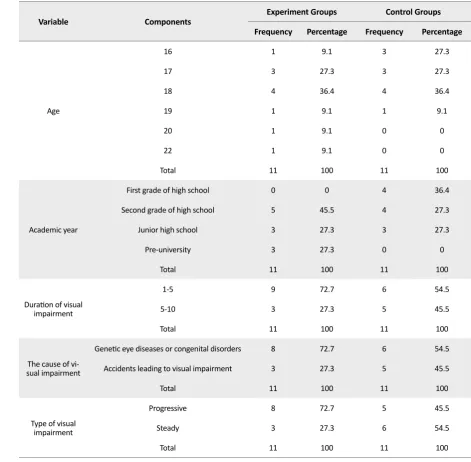
and one from experimental group) were excluded due to lack of essential information. The final sample size reached to 22 subjects (11 in each group). The control and experimental findings of the demographic groups
are presented in Table 1.
According to the data presented in Table 1, most of the students in both the experimental and control groups were aged 18 years and were mostly in the second grade of high school. Also, genetic diseases or congenital dis-orders in the early birth (up to 5 years) have been seen as
the leading cause for visual impairment in many of the
Table 1. Demographic variables of male students with visual impairment
Variable Components Experiment Groups Control Groups
Frequency Percentage Frequency Percentage
Age
16 1 9.1 3 27.3
17 3 27.3 3 27.3
18 4 36.4 4 36.4
19 1 9.1 1 9.1
20 1 9.1 0 0
22 1 9.1 0 0
Total 11 100 11 100
Academic year
First grade of high school 0 0 4 36.4
Second grade of high school 5 45.5 4 27.3
Junior high school 3 27.3 3 27.3
Pre-university 3 27.3 0 0
Total 11 100 11 100
Duration of visual
impairment
1-5 9 72.7 6 54.5
5-10 3 27.3 5 45.5
Total 11 100 11 100
The cause of vi-sual impairment
Genetic eye diseases or congenital disorders 8 72.7 6 54.5
Accidents leading to visual impairment 3 27.3 5 45.5
Total 11 100 11 100
Type of visual impairment
Progressive 8 72.7 5 45.5
Steady 3 27.3 6 54.5
subjects. The resulting descriptive test results of the
ex-perimental and control groups are presented in Table 2.
The table shows a decrease in the mean of depression
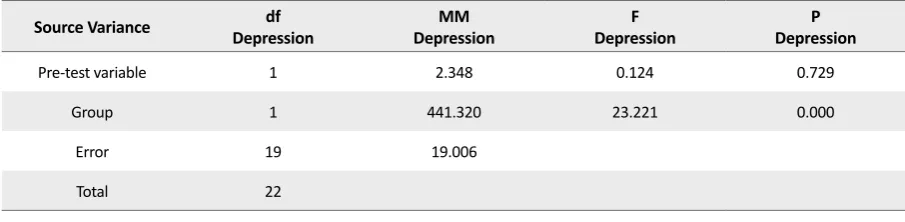
score in the pretest of experimental group compared to posttest of experimental group. The analytical results of the experiment and control groups are presented in Table
3. As seen in Table 3, the effect of group or intervention is statistically significant by removing and neutralizing the pre-test variable (P<0.01). Therefore, it can be
con-cluded that the education component of cognitive behav -ioral therapy has been causing differences in the groups.
4. Discussion
This study aimed at investigating the effectiveness of
the components of the cognitive behavioral group train
-ing therapy in reduc-ing depression symptoms in visually
impaired male students who were exposed to the inde-pendent variable (CBT) over a two-month period for ten 90-minute sessions. The findings of this study showed that CBT training played a crucial role in improving de-pression symptoms in male students with visual impair-ment in the experiimpair-mental group. To neutralize the effect of depression in the pre-test score, it can be said that this difference is caused by the implementation of the independent variable in the experimental group. In other words, as CBT was conducted only in the experimental
group and the control group did not receive any training,
this program reduced depression scores of male students with visual impairment in the experimental group.
These findings are consistent with the results of other studies [20,28,35,36]. It can be noted that childhood
depression is not a transient phenomenon that can be im -proved during the developmental stage. In the etiology of depression, cognitive-behavioral patterns have their own place; depression is assumed in these patterns as a result
of negative schema, learned helplessness, negative attri -bution style, lack of positive reinforcement, and lack of efficacy [37]. People with visual impairment face many challenges in their day-to-day life and are often deprived of basic abilities and skills, thus, becoming more vul-nerable. Blindness is a serious condition that can affect mental balance and the entire organization of a visually impaired person. However, the negative attitude of visu-ally impaired persons affects their personality in the orga-nization more than their condition, and this also leads to
depression and other psychological problems [38].
According to the model of Beck’s cognitive therapy, the therapy is most effective when the therapist deals
with the underlying assumptions in patients and replac -es extreme thoughts (with intellectual distortions) with positive and logical thinking. In the present study, the therapist tried to get through proprietary techniques of Table 2. The mean and standard deviation scores of experimental and control groups in the variable of depression
Variable N Groups Mean Standard Deviation
Pre-test 11 Experimental 41.81 3.37
11 Control 39.45 2.38
Post-test 11 Experimental 32.90 3.36
11 Control 42.36 5
Table 3. Covariance test was used to compare post-test score depression for subjects in the experimental and control groups
Source Variance Depressiondf DepressionMM DepressionF DepressionP
Pre-test variable 1 2.348 0.124 0.729
Group 1 441.320 23.221 0.000
Error 19 19.006
cognitive therapy to correct the underlying assumption
of some students with visual impairment that were dys-functional. But in other cases, though people with visual impairment may not grow up with irrational thinking,
but their health conditions and presumptions relating to
their work performance can lead to negative thoughts and incompatible cognitions. Although their cognition is real, reasonable, and justified in terms of evidence, the
truth is that some people with visual impairment have
preoccupations. These preoccupations are harmful to people and increase stress and prevent positive response
and intervention to do things that are useful for the indi -vidual. These preoccupations are often associated with difficult emotions, behaviors or physiological responses,
and annoying problems [27].
Based on the study results, it can be concluded that CBT training reduces depression of male students with visual impairment. Also, based on the association of depression
with other aspects of mental health, there is a need to pay
attention to students with visual impairment in their pres-ent mpres-ental health conditions. Fundampres-ental importance must be given to the use of psychological interventions, particularly the employed methods, by experts and psy-chologists to work with students with visual impairment. It seems that congenital visual impairment and acquired visual impairment have different effects on the psycho-logical state of person. Therefore, it is recommended that these resolutions be considered in future research.
In this study, due to the small number of high school and pre-high school students at the Martyr Mohebi Schools, the researcher did not distinguish between students with congenital visual impairment and students who became visual impaired in later stage of their life. Another point is
that because of cultural issues, the researcher was not able
to do research on female students with visual impairment, these study was conducted only on male students with
visual impairment Therefore is recommended on female
students with visual impairment may also be performed.
5. Conclusion
In the present study, some people with visual
impair-ment that yet was not compatible with their visual im -pairment and did not accept it (particularly those with visual impairment were 1 to 4 years) They believed that visual impairment is the worst thing that causes great
dis-comfort, sadness, pleasure does not refer to many things,
lack of activity, restrictions, and many other problems.
This logically incompatible cognition, are real and the
techniques used to deal with these cognitions differs from other techniques used to challenge irrational thoughts.
Therefore in Psychological trainings of These students, techniques such as self-advocacy training, problem solv-ing, distraction and meditation, visualization, positive mental, planning for the future, stop thinking, and to
in-volve family members in treatment should be used [27].
Acknowledgments
The authors would like to express their appreciation to the students who participated in this study. This research was extracted from the master's thesis of Mr. Erfan So-leimani Sefat in the Department of Counseling, Univer-sity of Social Welfare and Rehabilitation Sciences.
Conflict of Interest
The author declared no conflicts of interest.
References
[1] Congdon NG, Friedman DS, Lietman T. Important caus-es of visual impairment in the world today. JAMA. 2003; 290(15):2057-60. doi: 10.1001/jama.290.15.2057
[2] Siamian H, Hassanzadeh M, Nooshinfard F, Hariri N. [Health information needs of blind people in Iran (Persian)]. Journal of Mazandaran University of Medical Sciences. 2012; 22(93):73-81.
[3] Soori H, Ali JM, Nasrin R. Prevalence and causes of low vision and blindness in Tehran Province, Iran. Journal of the Pakistan Medical Association. 2011; 61(6):544-9. PMID: 22204207
[4] Siamian H, Hassanzadeh M, Nooshinfard F, Hariri N. [Health information needs of blind people in Iran (Persian)]. Journal of Mazandaran University of Medical Sciences. 2012; 22(93):73-81.
[5] Shrifian E, Estebsari F, Haghjou L, Nedjat S, Majdzadeh S. [Determining behavioral preventive factors of blindness based on BASNEF model in the Chaharborj Village, city of Esfarayen (Persian)]. Iranian Journal of Health Education and Health Promotion. 2014; 2(3):186-98.
[6] Maleki Tabar A, khodabakhshi koolaee a, Khoshkonesh A. [Comparing the self-concept and social adjustment among blind and healthy male students (Persian)]. Zahedan Jour-nal of Research in Medical Sciences. 2012; 13(10):33. [7] Loprinzi PD, Codey K. Influence of visual acuity on
anxi-ety, panic and depression disorders among young and mid-dle age adults in the United States. Journal of Affective Dis-orders. 2014; 167:8-11. doi: 10.1016/j.jad.2014.05.052 [8] Vitale S, Cotch MF, Sperduto RD. Prevalence of visual
[9] Van Hasselt VB, Kazdin AE, Hersen M. Assessment of problem behavior in visually handicapped adolescents. Journal of Clinical Child Psychology. 1986; 15(2):134-41. doi: 10.1207/s15374424jccp1502_5
[10] Alma MA, Van der Mei SF, Melis-Dankers BJ, Van Til-burg TG, Groothoff JW, Suurmeijer TP. Participation of the elderly after vision loss. Disability and Rehabilitation. 2011; 33(1):63-72. doi: 10.3109/09638288.2010.488711
[11] Wallhagen MI, Strawbridge WJ, Shema SJ, Kurata J, Ka-plan GA. Comparative impact of hearing and vision impair-ment on subsequent functioning. Journal of the American Geriatrics Society. 2001; 49(8):1086-92. doi: 10.1046/j.1532-5415.2001.49213.x
[12] Augustin A, Sahel J, Bandello F, Dardennes R, Maurel F, Negrini C, et al. Anxiety and depression prevalence rates in age-related macular degeneration. Investigative Ophthal-mology and Visual Science. 2007; 48(4):1498. doi: 10.1167/ iovs.06-0761
[13] Burmedi D, Becker S, Heyl V, Wahl HW, Himmelsbach I. Emotional and social consequences of age-related low vision. Visual Impairment Research. 2002; 4(1):47-71. doi: 10.1076/vimr.4.1.47.15634
[14] Evans JR, Fletcher AE, Wormald RP. Depression and anxiety in visually impaired older people. Ophthalmology. 2007; 114(2):283-8. doi: 10.1016/j.ophtha.2006.10.006 [15] Hayman KJ, Kerse NM, La Grow SJ, Wouldes T,
Rob-ertson MC, Campbell AJ. Depression in older people: Vis-ual impairment and subjective ratings of health. Optom-etry & Vision Science. 2007; 84(11):1024-30. doi: 10.1097/ opx.0b013e318157a6b1
[16] Horowitz A, Reinhardt JP, Kennedy GJ. Major and sub-threshold depression among older adults seeking vision rehabilitation services. American Journal of Geriatric Psy-chiatry. 2005; 13(3):180-7. doi: 10.1097/00019442-200503000-00002
[17] La Grow S, Alpass F, Stephens C, Towers A. Factors af-fecting perceived quality of life of older persons with self-reported visual disability. Quality of Life Research. 2010; 20(3):407-13. doi: 10.1007/s11136-010-9758-6
[18] Soleimani-Sefat E, Rostami M, Amani S, Movallali G. The needs and problems of students with visual impairment. Journal of Social Sciences and Humanity Studies. 2016; 2(2): 8-16.
[19] Koenes SG, Karshmer JF. Depression: A compari-son study between blind and sighted adolescents. Is-sues in Mental Health Nursing. 2000; 21(3):269-79. doi: 10.1080/016128400248086
[20] Evans JR1, Fletcher AE, Wormald RP. Depression and anxiety in visually impaired older people. Ophthalmology. 2007; 114(2):283-8. doi: 10.1016/j.ophtha.2006.10.006 [21] Ravens-Sieberer U, Morfeld M, Stein R, Jessop DJ,
Bull-inger M, Thyen U. [The testing and validation of the Ger-man version of the impact on family scale in families with children with disabilities (German)]. Psychotherapie, Psy-chosomatik, Medizinische Psychologie. 2000; 51(9-10):384-93. doi: 10.1055/s-2001-16899
[22] Owsley C, McGwin Jr G, Scilley K, Dreer LE, Bray CR, Ma-son III JO. Focus groups with perMa-sons who have age-related
macular degeneration: Emotional issues. Rehabilitation Psy-chology. 2006; 51(1):23-9. doi: 10.1037/0090-5550.51.1.23 [23] Power M. CBT for depression: The Wiley-Blackwell
hand-book of mood disorders. Hoboken: Wiley-Blackwell; 2013. [24] Zarb J. Cognitive behavioural assessment and therapy
with adolescents. Abingdon: Routledge; 2014.
[25] Talaei A, Kimiaei SA, Borhani Moghani M, Moharreri F, Talaei A, Khanghaei R. [Effectiveness of group cognitive behavioral therapy on depression in infertile women (Per-sian)]. The Iranian Journal of Obstetrics, Gynecology and Infertility. 2014; 17(94):1-9.
[26] Utoyo DB. Modifying cognitive-behavioral therapy for a depressed older adult with partial sight: A case re-port. Gerontology and geriatric medicine. 2015; 1:1-3. doi: 10.1177/2333721415585432
[27] Taylor RR, Renee R. Cognitive behavioral therapy for chronic illness and disability. Berlin: Springer; 2006. [28] Shahni R, Shairi MR, Asghari Moghaddam MA.
Appoint-ment the effectiveness of cognitive-behavioral treatAppoint-ment of pain on increasing of self-efficacy in patients with chronic pain. Procedia-Social and Behavioral Sciences. 2013; 84:225-9. doi: 10.1016/j.sbspro.2013.06.539
[29] Bisson JI, Shepherd JP, Joy D, Probert R, Newcombe RG. Early cognitive–behavioural therapy for post-traumatic stress symptoms after physical injury: Randomised. Brit-ish Journal of Psychiatry. 2004; 184(1):63-9. doi: 10.1192/ bjp.184.1.63
[30] Corey MS, Corey G, Corey C. Groups: Process and prac-tice. Boston: Cengage Learning; 2013.
[31] Stefan-Dabson K, Mohammadkhani P, Massah-Choulabi O. [Psychometrics characteristic of Beck Depression Inven-tory-II in patients with magor depressive disorder (Per-sian)]. Archives of Rehabilitation. 2007; 8:80-86.
[32] Aben I, Verhey F, Lousberg R, Lodder J, Honig A. Valid-ity of the beck depression inventory, hospital anxiety and depression scale, SCL-90, and Hamilton depression rating scale as screening instruments for depression in stroke pa-tients. Psychosomatics. 2002; 43(5):386-93. doi: 10.1176/ appi.psy.43.5.386
[33] Azkhosh M. Application of psychological tests and clini-cal diagnosis. Tehran: Ravan Publication; 2009.
[34] Emery G. Overcoming depression: Therapist Protocol. Oakland: New Harbinger Publications; 2000.
[35] Hyun MS, Chung HIC, Lee YJ. The effect of cognitive–be-havioral group therapy on the self-esteem, depression, and self-efficacy of runaway adolescents in a shelter in South Korea. Applied Nursing Research. 2005; 18(3):160-6. doi: 10.1016/j.apnr.2004.07.006
[36] Nash VR, Ponto J, Townsend C, Nelson P, Bretz MN. Cognitive behavioral therapy, self-efficacy, and depression in persons with chronic pain. Pain Management Nursing. 2013; 14(4):236-43. doi: 10.1016/j.pmn.2012.02.006