International Journal of Epidemiologic Re
search
© 2018 The Author(s); Published by Shahrekord University of Medical Sciences. This is an open-access article distributed under the terms 2018 Spring;5(2):50-54
doi:10.15171/ijer.2018.11
A Comparison of Test Anxiety Between Normal Students
and Students With Learning Disorders in Lordegan County
During Academic Year 2015-2016
Reza Heidari-Soureshjani1*, Farnaz Kargaran Dehkordi1, Tayeb Mohammadi2
1Student Research Committee, Shahrekord University of Medical Sciences, Shahrekord, Iran
2Department of Biostatistics, School of Public Health, Hamadan University of Medical Sciences, Hamadan, Iran
http://ijer.skums.ac.ir
Original Article
Abstract
Background and aims: Anxiety can be defined as a state of fear and worry. Test anxiety is one of the students’ constant fears that produces destructive and negative effects on students’ educational performance and mental condition. There is not an exception among students with learning disorders and they all experience such type of anxiety. Therefore, in this research the test anxiety was compared in these two mentioned types of students.
Methods: The present analytical-descriptive study was conducted on a sample of 129 students composed of 86 normal and 43 cases with learning disorders in Lordegan county. The cases were selected by simple random sampling and Sarason Anxiety Questionnaire was used for gathering data and finally the collected data was analyzed via analysis of covariance (ANCOVA) and SPSS 16.0.
Results: The mean of anxiety level among students with learning disorders was 24.21 (±4.33) and 20.65 (±6.81) before and after the test respectively, and the measured mean for normal students was 18.52 (±5.56) before the test and 16.7 (±5.47) after the test. This result showed a significant difference between these two types of students (P < 0.001), but there were no significant differences between control and test groups’ sex and anxiety level (P > 0.05).
Conclusion: In these 2 studied groups, the test anxiety was decreased sharply after the test in comparison with that before it. As well, it was concluded that the normal students’ anxiety was less than the anxiety of students with learning disorders in both phases.
Keywords: Test anxiety, Learning disorders, Students
Received: 3 November 2017 Accepted: 12 February 2018 ePublished: 24 April 2018 *Corresponding Author:
Reza Heidari-Soureshjani, BSc student of nursing, Students Research Committee, Shahrekord University of Medical Sciences, Shahrekord, Iran, Email: heidari.reza1995@ gmail.com
Introduction
Anxiety is a generalized, unpleasant and vague state along with autonomic nervous system’s provocation that leads to headache, sweating, and fast heart rate in addition to chest muscle spasms, gastrointestinal upsets, restlessness and tension. In fact, it can be defined as a feeling of worry, danger and threat that alerts a person against the imminent, vague and even unknown risks.
Since low level of anxiety makes people prepare themselves against potential threats, it can be regarded as an appropriate reaction of a person’s adaptation. On the other hand, however high level of anxiety may result in cognitive and mental disorders such as attention, concentration and memory disruptions and defects.1
According to another definition, anxiety is an inner thrill accompanied by an unknown and deep pain that disrupts a person’s balance and is related to factors such as age, sex, vocation as well as mental and physical diseases.2
Test anxiety is a special case of generalized anxiety
disorder and a serious educational problem that annually involves millions of students around the world. This unpleasant emotional reaction refers to a set of cognitive, behavioral and physiological responses that is accompanied by exams’ failure concerns or other similar situations as well as its negative consequences.
Test anxiety occurs during students’ evaluation and gives them the feeling of uncertainty about their abilities. In addition to this it has a negative effect on their effectiveness, talent flourishing, personality development and social identity.
In fact, test anxiety disrupts concentration, memory and learned material remembering and prevents students from presenting their real intellectual and training abilities, thus it can be considered as the most important weakening factor for students’ performance at all grades. Students with such disorder are sensitive, with unrealistic expectations and also have low levels of confidence.1,3,4
frequency and the performance expectations of students is subsequently increased; therefore the phobia of parents’ blaming, other people’s mocking, getting bad scores and worry about further education accompanies them permanently during education levels. It should be taken into consideration that this type of phobia or fear is not a passing one and may remain until adulthood if be neglected.3
Annually some students are faced with learning disorders. With a global prevalence of 1%-3% on average, these disorders are common childhood ones that have caused frequent clinical visits of parents, and some consequences of them are educational failure and low self-esteem. In some cases, we can also point to the discouragement, chronic frustration and poor relationship with peers as some other results.5-9
Children with learning disorders have impairments in one or more of their basic psychological processes associated with understanding or usage of spoken or written language. These may be appeared in the form of hearing, speech, spelling and mathematic learning impairments and defects, and even they disrupt attention that by itself plays a fundamental role.
This type of children is recognized when their progress is much lower than the expected level due to their age, talent and intelligence level. Their disorders are normally caused by nervous system lesions and are manifested in different forms depending on the location of the lesion.6,8-10
According to what was mentioned and the importance of anxiety and its occurrence in both normal and learning disabled students and also the direct impact of it on their daily lives, the objective of this research was to determine and compare the anxiety between normal students and those with learning disorders.
Methods
The current analytical-descriptive study was conducted in a number of elementary schools in Chaharmahal and Bakhtiari province, Lordegan County, Khanmirza district. One hundred twenty-nine participants were selected from both normal students as the control group and students with learning disorders as the test group. In the 86 member students of normal group, 26 cases belonged to the third grade, 33 cases belonged to the fourth grade, and other 27 cases were from the fifth grade who were imported from normal schools of Khanmirza district. The other group including the students with learning disorders was composed of 11 cases in the second grade, 10 cases in the third grade, 8 elementary fourth grade cases, and 14 elementary fifth grade students, who were imported from the Lordegan Learning Disorders Center. The mean age of subjects in the test and control groups
was 9.58 (±1.2) and 10.01 (±0.79), respectively.
Since the total number of students with learning disorder was 43 according to the Lordegan Learning Disorders Center’s statistics, the sampling of these students was done by census. On the other hand, the control group students were selected via simple random sampling in such a way that for each student with learning disorders, we had two normal students and one would be replaced if any of them left the study.
In the first stage of the study, a questionnaire was given to normal students and those with learning disorder when they did not have any tests. The questionnaire that was used for gathering data in this study was Sarason Anxiety Inventory which included 37 two-choice items. Each respondent had to fill the questionnaire during 10 to 15 minutes in a form of yes or no for each item. This questionnaire with the Cronbach alpha coefficient equal to 0.88, the internal consistency equal to 0.95 and the criterion validity equal to 0.72 is one of the most prestigious test inventories and its validity and reliability has been admitted frequently in different studies.4,11
Afterwards, in the second stage of this study, after one week when the students of both groups had an exam, they were given a Sarason questionnaire just before the exam, and they were collected after completion.
All cases in the control and test groups got the Sarason inventory before and after the test and descriptive statistics and covariance analysis were used for studying the data collected from them. Allof the calculation was performed using SPSS 16.0 and significance level was considered as P ≤ 0.05.
Results
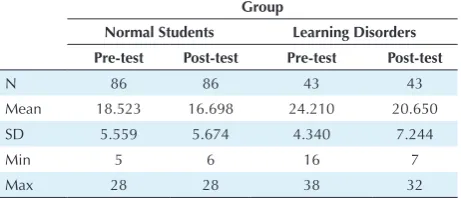
Data analysis showed that the test anxiety decreased after the test in both groups and its level either before or after the test was higher for the students with learning disorders in comparison to normal ones (Tables 1 and 2; Figure 1).
Independent t test results had a significant difference according to age between the 2 control and test groups (P < 0.05) (Table 3).
same before and after the test (Table 4).
In addition, this data was studied according to the gender in both groups and the independent t-test showed that there was not a significant difference in the anxiety level before the test between male and female students of both control and test groups (Tables 5, 6 and 7).
Table 1. Descriptive Statistics of the Anxiety Level Between Normal Students and Students With Learning Disorders Before the Test
Group Anxiety Level Number Percent
Test (students with learning disorders)
Mild 0 0
Moderate 5 11.6
Intensive 38 88.4
Total 43 100
Control (normal students)
Mild 14 16.3
Moderate 36 41.9
Intensive 36 41.9
Total 86 100
Table 2. Frequency Distribution of the Anxiety Level Between Normal Students and Students With Learning Disorders After the Test
Group (After the Test) Anxiety Level Number Percent
Test (students with learning disorders)
Mild 20.9 9
Moderate 25.6 11
Intensive 53.5 23
Total 100 43
Control (normal students)
Mild 24.4 21
Moderate 51.2 44
Intensive 24.4 21
Total 100 86
Figure 1. Comparison of the Average Test Anxiety Marks Between the 2 Groups -Before and After the Test.
Table 3. Descriptive Statistics of the Average Age Distribution of the Research Subjects in the Test and Control Groups
Variable
Groups
Results of the Independent t test Test (Students With Learning Disorders) Control (Normal Students)
Average SD Number Average SD Number t P Value
Age 9.58 1.2 43 10.01 0.79 86 -2.132 0.037
Discussion
Anxiety is an indispensable part of the childhood and a sign of natural growth which is common in early years of life. In fact it is a constituent of children’s character fixed in these ages and continues until adulthood. Test anxiety is a kind of performance stress that learners experience and it is not significant until success in exams is considered important. Anxiety in education brings about motivation in students for scientific success and improvement and increases their performance level, otherwise intensive stress has opposite effects; reduces self-confidence, lowers marks and causes unsuitable behavior in classes and negative tendency to subjects which all mean that it acts as a source of failure and incompatibility and embraces a vast area of cognitive and physical disturbances to unjustified fears and horrors of life.12,13
In the present study, 83.7% of normal students and 100% of students with learning disorders felt a moderate or high level of stress before the test but after the test these statistics reduced to 75.6% and 79.1%, respectively. These findings confirm stress as a pervasive phenomenon in all students. In Mohammadi and Parandin’s study conducted in Kermanshah University of Medical Sciences in 2014, 61.2% of students felt averagely or intensively stressed which is compatible with our findings obtained.13 Based
on the study of Darabi et al in 2012 in Ilam, 66% of students were evaluated with average or intensive levels of stress, which also supports our findings.14 On the
other hand, Moadeli and Ghazanfari Hesamabadi in their studies acknowledged weak level of stress for students which is in contrast with the present study.15 To justify
this difference, we can point to the impressionability of this kind of stress from different factors and also different individual interpretations. Difficulty of exam questions and fear of getting insufficient marks or strict professors and universities are some more factors.14
Table 4. Results of the Analysis of Covariance, by Adjusting and Eliminating the Effect of Stress Scores Before Test and Controlling the Effects of Children’s Age and Gender
Variable Parameter Estimation Standard Error t Value P Value
Intercept 27.935 7.348 3.802 <0.001
Pre-test anxiety score -0.074 0.109 -0.677 0.500
Group -4.300 1.342 -3.204 0.002
Age -0.079 0.600 -0.132 0.896
Gender -0.269 1.128 -0.262 0.794
Dependent variable: post-test anxiety score.
Table 5. Descriptive Statistics of the Anxiety Level Between the Test and Control Groups According to the Gender Before the Test
Group (Before the Test) Gender Anxiety Level Percent
Test (students with learning disorders)
Female
Mild 0
Moderate 0
Intensive 100
Total 100
Male
Mild 0
Moderate 25
Intensive 75
Total 100
Control (normal students)
Female
Mild 17.6
Moderate 41.2
Intensive 41.2
Total 100
Male
Mild 15.4
Moderate 42.3
Intensive 42.3
Total 100
Table 5. Frequency Distribution of the Anxiety Level Between the Test and Control Groups According to the Gender After the Test
Group (Before the Test) Gender Anxiety Level Percent
Test (students with learning disorders)
Female
Mild 13
Moderate 26.1
Intensive 60.9
Total 100
Male
Mild 30
Moderate 25
Intensive 45
Total 100
Control (normal students)
Female
Mild 20.6
Moderate 52.9
Intensive 26.5
Total 100
Male
Mild 26.9
Moderate 50
Intensive 23.1
Total 100
caused academic performance drops.16 Moreover, studies
on children with various disorders showed a higher level of anxiety for them in comparison to their normal peers.17
In studying the samples according to the gender, no significant difference was reported between girls and boys, showing that anxiety does not depend on gender in the case of education and learning. This result despite being consistent with some studies,3,14 is in contrast with
most researches.6,13,15,18-21 In the study of Mohammadi and
Parandin about stress among students of Kermanshah University of Medical Sciences in 2014, this difference was significant as the anxiety level was higher in girls than that in boys.13 Studies of Yousefi et al during
2012-2013 at Kordestan University of Medical Sciences had a similar result, as well.18 Further in a study of the
relationship between test anxiety and ethnicity, gender and age, girl students needed more help to overcome their anxiety.19 Jenaabadi et al also reported a higher level
of stress for girls.20 This difference may be because of
cultural and social differences of societies but the higher level of anxiety in girls is explained by the gender role-play; whereas girls accept anxiety as a feminine feature and give up when they face stress, for boys, anxiety is a threat against their male character and they find a way to overcome stress.21 In addition, girls are more emotionally
affected by exam results and this brings about high levels of anxiety for them. Girls’ more responsibility and worry about school homework are also effective.18
Different studies point to various strategies to reduce stress, from which the most influential ones are time management and problem solving trainings.20,22,23
Acquaintance with these methods can help authorities to increase the mental health level in students.
Conclusion
The present study showed that the level of anxiety is high in both groups and students with learning disorders have higher levels of anxiety in comparison to normal students. Attending the children with learning disorders is of great importance because using these exercises with empowering methods, can facilitate their treatment and learning processes; therefore, it is suggested that
Table 7. Mean and Standard Deviation of the Test Anxiety Marks in the 2 Groups According to the Gender
Group
Normal Students Learning Disorders Pre-test Post-test Pre-test Post-test
N 86 86 43 43
Mean 18.523 16.698 24.210 20.650
SD 5.559 5.674 4.340 7.244
Min 5 6 16 7
How to cite the article: Heidari-Soureshjani R, Kargaran Dehkordi F, Mohammadi T. A comparison of test anxiety between normal students and students with learning disorders in Lordegan county during academic year 2015-2016. Int J Epidemiol Res. 2018;5(2):50-54. doi: 10.15171/ijer.2018.11.
educational authorities compile educational programs to employ methods like time management and problem solving trainings to improve the mental health and educational status of students.
Ignoring the mental status of students while answering the questions and not studying the subgroups related to learning disorders, were some limitations of this research; so it is suggested that in future studies, the level of test anxiety in different kinds of learning disorders be evaluated and compared.
Ethical Approval
This research was approved by the Ethics Committee of Shahrekord University of Medical Sciences (No. IR.SKUMS.REC.1394.131) and all collected data were kept confidential.
Conflict of Interest Disclosures
None.
Acknowledgement
The present study was deduced from the approved research project in the Student Research Committee of Shahrekord University of Medical Sciences (No. 1557), therefore we appreciate the Research Deputy of Shahrekord University of Medical Sciences for supporting this research. We also thank the Education Department of Lordegan for their help to conduct this study.
References
1. Hagh-Shenas H, Bahredar MJ, Rahman-Setayesh Z. A Clinical Trial for Reduction of Test Anxiety in a Group of Adolescents. Iranian Journal of Psychiatry and Clinical Psychology. 2009;15(1):63-9. 2. Seylani K, Karlsson S, Hallberg I, Mohammadi E, Negarandeh R.
Spirituality among iranian nursing students during undergraduate study. Nurs Midwifery Stud. 2016;5(3):e33044. doi: 10.17795/ nmsjournal33044.
3. Khosravi M, Bigdely I. The relationship between personality factors and test anxiety among university students. Int J Behav Scis. 2008;2(1):13-24.
4. Yazdani F. Test anxiety and academic performance in female nursing students. Quarterly Journal of Nursing Management. 2012;1(1):47-58. [Persian].
5. Wible B, Nicol T, Kraus N. Atypical brainstem representation of onset and formant structure of speech sounds in children with language-based learning problems. Biol Psychol. 2004;67(3):299-317. doi: 10.1016/j.biopsycho.2004.02.002.
6. Rahimian Boogar E, Sadeghi A. Prevalence of Reading Disorder in Primary School Students. Iranian Journal of Psychiatry and Clinical Psychology. 2007;12(4):396-402.
7. Faramarzi S, Taghipour Javan A, Dehghani M, Moradi MR.
Comparison of attachment styles and child rearing in parenting mothers of normal students and students with learning disabilities. Jentashapir J Health Res. 2013;4(3):245-54.
8. Amiriani F, Tahaei AK, Kamali M. Comparative evaluation of auditory attention in 7 to 9 year old learning disabled students. . Audiol. 2011;20(1):54-63.
9. Atadokht A, Norozi H, Ghaffari O. The effect of social problem-solving training on psychological well-being and resiliency of students with learning difficulties. J Learn Disabil. 2014;3(2):92-108.
10. Eghlidi J, Koobasi F, Nejati V, Tabatabaee SM. A comparative study of sustain attention to auditory and visual stimulus in children with mix learning disorder and normal peers. Journal of Research in Rehabilitation Sciences. 2013;9(3):435-444. [Persian].
11. Sarason IG. The Test Anxiety Scale: Concept and Research. Seattle: Washington Univ, Dept of Psychology; 1977.
12. Ghorbani F, Ghorbani Z, Avazeh A. The Effect of Listening to the Holy Quran on the Level of Pre-Exam Anxiety of Secondary School Students in Zanjan City, in 2011. J Zanjan Univ Med Sci. 2014;22(90):89-96.
13. Mohammadi M, Parandin S. Evaluation of Exam Anxiety Level among Kermanshah University of Medical Sciences Students and its Association with Demographic Characteristics in 2014. The Journal of Medical Education and Development. 2015;10(3):227-36.
14. Darabi M, Aivazi AA, Gholami-Parizad E, Ghazanfari Z. Test anxiety among ilam ums’students, 2012. Advances in Nursing Midwifery. 2014;23(82):1-7.
15. Moadeli Z, Ghazanfari Hesamabadi M. A Survey On The Students’ Exam Anxiety In The Fatemeh (P.B.U.H.) College Of Nursing And Midwifery, Spring 2004. Strides in Development of Medical Education. 2005;1(2):65-72. [Persian].
16. Mirzakhani N, Kangarani Farahani M, Rezaee M, Akbarzadeh Baghban A, Sadeghi S. Comparison of assertiveness skills and anxiety between students with learning disability and typical peers in elementary schools of tehran. J Rehabil Med. 2016;5(2):209-17. 17. Ooi YP, Lam CM, Sung M, Tan WT, Goh TJ, Fung DS, et al. Effects
of cognitive-behavioural therapy on anxiety for children with high-functioning autistic spectrum disorders. Singapore Med J. 2008;49(3):215-20.
18. Yousefi F, Habibi S, Mohammadkhani M. Test anxiety level in medical students and its relationship with sexuality. Education Strategies in Medical Sciences. 2013;6(3):141-5.
19. Barahmeh M. Measuring speaking anxiety among speech communication course students at the arab american university of jenin (aauj). European Social Sciences Research Journal. 2013;1(3):229-48.
20. Jenaabadi H, Nastiezaie N, Jalalzaei S. The Effect of Time Management Training on Student’s Test Anxiety. J Nurs Educ. 2016;5(1):12-22.
21. Akbaryboorang M, Aminyazdi S. Test-Anxiety and Self-Efficacy: A Study on the Students of Islamic Azad University, Branch of Southern Khorasan. Quarterly of Horizon of Medical Sciences. 2009;15(3):70-6.
22. Kamarzarin H, Hosseini M. Investigation of relationship between metacognitive strategies and self-concept with social compatibility of high school student in the city of Karaj. European Journal of Psychology and Educational Studies. 2015;2(3):66-70.