Iranian Rehabilitation Journal, Vol. 11, Special issue, 2013
Original Article
Effectiveness of Audiovisual Stimulation on Executive function in
Children with High-functioning Autism
Majid Naeeimi; Seyed Ali Hosseini; Akbar Biglarian; Nasrin Amiri; Ebrahim Pishyareh*
Pediatric Neurorehabilitation Research center
University of Social Welfare and Rehabilitation Sciences, Tehran, Iran
Objectives: Autism is one subsets of pervasive developmental disorders that are characterized by abnormal behaviors and verbal communication. In recent years, the reason for this communication disorder has been developed for determining executive function. The current study investigated the feasibility of audiovisual stimulation intervention focused on enhancing executive function in children with high-functioning autism.
Method: 41 children diagnosed with high functioning autism randomly selected and assigned in to experimental (20) and control (21) group. Initially both of groups were administered by the "Behavior Rating Inventory of Executive Functioning Test".then intervention group received 18 sessions of audiovisual stimulation across 6weeks and two groups were administered by test again.
Results: Multivariate analysis was used to compare significant advances in variables progress. Considering significance level, outcome indicates that audio visual stimulation used in the present study increased executive function (inhibition, shifting and planning ability) based on Behavior Rating Inventory of Executive Functioning measures (F= 5/55, P<0/05, F= 24/587, P< 0/05, F= 15/28, p<0/05).
Discussion: These findings suggest that the audiovisual stimulation platform is a promising tool for improving executive function subsets. Similarly, the use of such technology that is user friendly appears to prevent onset of early behavioral problems and executive dysfunction in children with autism.
Key words: Audiovisual stimulation, High-function autism, Executive function, inhibition, shifting.
Submitted: 11 Oct. 2013 Accepted: 18 Dec 2013
Introduction
Autism is one subsets of pervasive developmental disorders that are characterized by abnormal behaviors and verbal communication (1). High-functioning autism is a group of children with autism that have sustained impairment in nonverbal behaviors, using repetitive patterns in favorite things and interpersonal relationship dysfunction (2). Statistics obtained from research centers in US implies an increase of 10% to 17% annual risk of this disorder (3).
However the core impairment in autism is communication disorder. In recent years, the reason for this communication disorder has been developed for determining executive function in autism (4, 5). Executive functions is an umbrella term for cognitive processes that regulate, control, and manage other cognitive processes such as planning, working memory, attention, problem solving, verbal reasoning, inhibition,
high-functioning autism such as Applied Behavior Analysis and developmental interventions such as sensory integration therapy have positive effects on children's cognitive skills, such as working memory, planning and decision-making (12). Alternatively, a new form of treatment for children with high-functioning autism is neurofeedback that aims to influence or change irregular activities of brain waves. Neurofeedback is designed to train individuals to enhance poorly regulated brainwave patterns by using sophisticated computer technology (13). The beneficial effects of neurofeedback on shifting, working memory, attention control and reduction of negative behaviors in children with high-functioning autism have been reported (14). While interventions based on education through rehabilitation approaches can be effective in improving impaired executive functioning in autistic children, Pharmacotherapy and psychosocial interventions such as family therapy and behavior therapy for improving social deficits and reduce impulsive behavior would be useful in this group of children (14, 15). But audiovisual stimulation has been selected as intervention in this study, using entrainment would Try to change the brain's response to external changes and would do this by changing the link between different areas of the cortex (16). AVE consists of constant, repetitive stimuli of the proper frequency and sufficient strength to "excite" the thalamus and neocortex. These stimuli do not transfer energy directly into the cortex. The direct transmission of energy from AVE only goes so far as to excite retinal cells in the eyes and pressure sensitive cilia within the cochlea in the ears. The nerve pathways from the eyes and ears carry the elicited electrical potentials into the thalamus. From there, the entrained electrical activity within the thalamus is "amplified" and distributed throughout other limbic areas and the cerebral cortexes via the cortical thalamic loop. AVS involves the continuous electrical response of the brain in relation to the stimulus frequency plus the mathematical representation (harmonics) of the stimulus wave shape (17). AVS is believed to achieve its effects through several mechanisms simultaneously. These include: altered EEG activity, dissociation / hypnotic induction, limbic stabilization, improved neurotransmitter production and altered cerebral blood flow (17).
Previous studies with Audiovisual stimulation, has been conducted mostly in children with ADHD (18). The results in these researches indicated a significant improvement in the children's working memory, sustain attention and planning (16). In another study of audiovisual stimulation effects on school-age
children with autism, the results cleared significant increase in attention, shifting and decrease repetitive movements (16). The present study investigated the effects of audiovisual stimulation on executive functioning in high function autistic children. It appears that due to the growing and unpredictability prevalence of autistic disorder, damaging effects on quality of life (especially the activities of daily living), the lack of a specific treatment plan and executive difficulties of previous methods, Using a low-cost approach, specific, measurable, and fewer complications such as audiovisual stimulation, could affect the areas of executive function in autistic disorder improving underlying impairments in social skills, communication skills and reducing repetitive behaviors in these children (16, 18).
Methods
This study is a clinical trial. The participants in this study consist of 41 high-functioning autism spectrum disorders in children 5 to 8 years old who were referred to Tehran's Autism Charity. After selection of the patients referred to Tehran's Autism Charity, the participants were randomly assigned to specific category. The independent variable in this study was audiovisual stimulation; on the other hand, the dependent variables were increasing three main subgroups of executive function (inhibition, shifting and planning). All children who participated in the study needed to 5 to 8 years old diagnosed as high-functioning autism by a verified child psychiatrist. On the other hand, after clear description of the research objectives, parents were asked to complete a consent survey form to have their children participate in the research.
Executive Function (BRIEF) developed by Gerard Gioia, Ph.D., Peter Isquith, Ph.D., Steven Guy, Ph.D., and Lauren Kenworthy, Ph.D., is an assessment of executive function behaviors at home and at school for children and adolescents aging 5 to 18. The 86-item questionnaire has separate forms for parents and teachers, and typically takes 10–15 minutes to administer and 15–20 minutes to score. The BRIEF is useful for evaluating children with a variety of disorders and disabilities. Specifically, it is often used for assessing executive functioning in children with developmental and/or acquired neurological conditions including: learning disabilities, Tourette syndrome, traumatic brain injury, pervasive developmental disorders, high functioning autism, low birth weight . The BRIEF is most often used to assess Attention Deficit/Hyperactivity Disorder (19). Each form of the BRIEF parent- and teacher- rating form contains 86 items in eight non-overlapping clinical scales and two validity scales. These are theoretically and statistically derived scales form two indexes: a) Behavioral Regulation (Inhibit, Shifting and Emotional Control), and b) Meta cognition (Initiate, Working memory Plan/organize, Organization of materials, Monitor). Experimental instrument in this study was David Pal’s unit that is manufactured by Mind Alive Inc. This device consists of a main controller, a headset, a forward glasses a wire and power supply interface. There are buttons on the unit to adjust the power button, select button (to select the type of incentive program), light intensity and volume buttons, as well as a part input adapter to connect with. It has 18 default programs of audiovisual stimulation that have been used in children with ADHD or LD. The audiovisual stimulation plan in this study was A 5
program with volume 2 and light intensity 3. It includes 35 minutes of decreasing Stimulation 19 to 10 Hz frequencies which have been extremely effective in increasing ability to control attention and planning in children with attention deficit disorder, according to recent research (17). Following that, the children are referred to the Autism Charity Foundation in which they would be prepared with a soft toy phone and glasses during two sessions to be conducted for constant 35 minutes use of audiovisual unit in each session. The intervention procedure consisted of 18 sessions of 35-minute long over 6 weeks by 3 sessions per week. Both intervention and control groups continued their usual rehabilitation programs such as occupational therapy, speech therapy, education and play therapy during conduction of audiovisual stimulation sessions. Data were analyzed using the SPSS.20 software. After testing Kolmograph-Smirnov and ensure normal distribution of the data, parametric tests were used. Descriptive statistics (mean and SD) in each group were reported. In the following section, multivariate analysis was used to compare significant advances in executive function progress.
Results
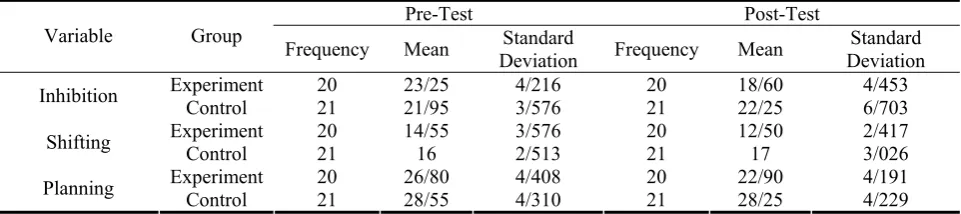
In this research, for the quantitative data collected and testing the hypothesis, descriptive and inferential statistical methods were used. To demonstrate variable frequency table were also used showing the frequency, mean, standard deviation and descriptive diagrams. The mean and standard deviation of the test subjects in both groups, before and after the intervention are shown in Table (1).
Table 1. Parameters of the study variables in experimental and control groups before and after intervention Post-Test
Pre-Test
Standard Deviation Mean
Frequency Standard
Deviation Mean
Frequency Group
Variable
4/453 18/60
20 4/216
23/25 20
Experiment
6/703 22/25
21 3/576
21/95 21
Control Inhibition
2/417 12/50
20 3/576
14/55 20
Experiment
3/026 17
21 2/513
16 21
Control Shifting
4/191 22/90
20 4/408
26/80 20
Experiment
4/229 28/25
21 4/310
28/55 21
Control Planning
As it can be seen from the mean of each variable, inhibition, shifting and planning, have been significantly reduced in the experimental group. Table (2) presents the results of covariance analysis in order to prove the research hypothesis. The
followings are the results of covariance analysis to test each of the research hypotheses:
2. Audiovisual stimulation used in this study, increase shifting ability in high-functioning autism children based on Behavior Rating Inventory of Executive Functioning measures.
3. Audiovisual stimulation used in this study, increase planning ability in high-functioning autism children based on Behavior Rating Inventory of Executive Functioning measures.
Table 2. MANCOVA results for the comparison between control and experimental groups
Sig. F
Mean square df
Square
0/082 3/193
97/749 1
97/749 Pre-Test
0/024 5/554
170/056 1
170/056 Group
30/616 37
1132/801 Error
40 18051/000
Total
Inh
ib
ition
0/001 13/326
75/446 1
75/446 Pre-Test
0/000 24/587
139/296 1
139/296 Group
5/663 37
209/534 Error
40 9190/000
Total
Sh
ifting
0/000 19/518
232/607 1
232/607 Pre-Test
0/000 15/280
182/095 1
182/095 Group
11/917 37
440/943 Error
40 27123/000
Total
Pl
anni
ng
Based on the results shown in Table (2), the F between group variable for inhibition, shifting and planning are respectively 5/55 ،24/587, 15/28. Considering significance level, outcome indicates that audio visual stimulation used in the present study increased inhibition, shifting and planning ability based on Behavior Rating Inventory of Executive Functioning measures (F= 5/55, P<0/05, F= 24/587, P< 0/05, F= 15/28, p<0/05).
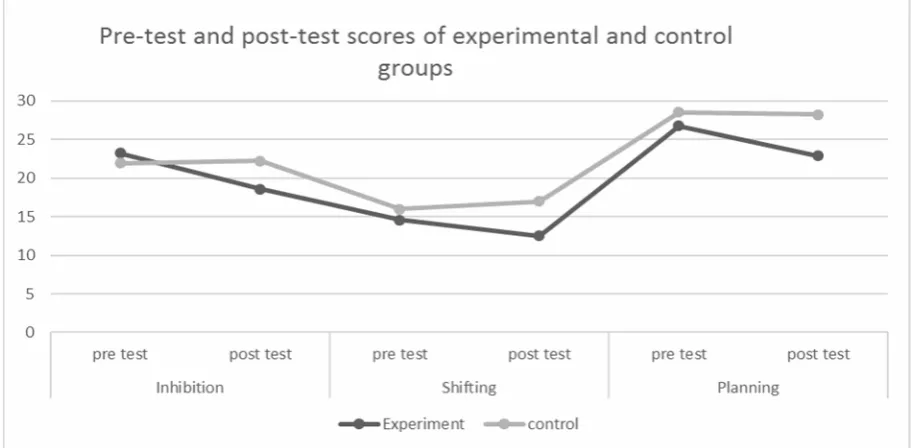
As can be seen in Figure (1) inhibition, shifting and planning ability scores in the experimental group had declined and this means that audiovisual stimulation used in this study, increase inhibition, shifting and planning ability in high-functioning autism children based on Behavior Rating Inventory of Executive Functioning measures while the control group had not.
Figure 1. Pre-test and post-test scores of experimental and control groups
Discussion
This study is among the first studies in the field of audiovisual stimulation to enhance the capabilities
and safe stimulation for effectiveness in inhibition, shifting and planning abilities. After 18 sessions of intervention by the audiovisual stimulation, according to the significant differences in pre-test and post-test scores of the variables, considerable progress on all three variables (the ability to inhibit the ability to shift and ability to plan) has been made. These findings indicate the potential utility of this stimulus to test the possibility of using other subsets of executive function such as working memory, organization of material, and emotional control in children with high functioning autism. Similar to previous research, the results of this study suggest audiovisual stimulation is effective in enhancing inhibition ability in children with high-functioning autism. As Woodbury in 1996 stated this stimulation increases ability to inhibit and control impulsivity in children with high functioning autism, the findings of this study also showed the same results (16). Similarly, Damasio in his studies cited that one of the reasons for, impaired inhibition ability in autism disorder would be poor performance of prefrontal region of the brain that audiovisual stimulation also impacts on this area (20).
In addition, the findings in this study show the ability of shifting in children participating in the study increased as a result of audiovisual stimulation and this is consistent with results in Olmstead study 2005, in children with attention deficit hyperactivity disorder and learning disability (16). Of course Interventions including 12 sessions, two times a week, were conducted by Olmstead in comparison with intervention in this study was longer and expensive to the researcher. On the other hand, it was found reducing the length of time in intervention sessions would not be barrier for effectiveness of audiovisual stimulation.
Another important subset of executive function was examined in the present study, planning ability; there was a significant improvement in results. Carter and Russell In 1994, a study was done on children with learning disorders, have also achieved such results (21). In addition to the results in the shifting ability in children with attention deficit hyperactivity disorder and learning disorder had
taken by Olmstead, in 2005, satisfying results on planning ability also reported in her study (16).
Conclusion
Overall, the interventions were used in this study as a method of rehabilitation programs and software to improve executive function of autistic children. Limitations of the study included differences in symptoms, age and cultural conditions of each of the participants that complicated generalizability of results to other autistic children. Because children with autism have sensory problems, wearing sunglasses and head phones in a certain period of time in initial sessions seemed to be difficult. Moreover, the original study with more control is needed to validate the findings. In future research, it is better to use the larger sample sizes for the intervention of the new methods that can be varied according to patient age and diagnosis.
Also, conducting a follow-up study on the effects of such interventions could help to register sustainability of results. However, regarding the mechanism of audiovisual stimulation conducting this research in other disorders such as cerebral palsy, neurological, brain damage and mental retardation considered to be useful. Furthermore, the use of more precise assessment measures such as QEEG during audiovisual stimulation intervention can prove essential in providing additional useful information on the mechanism of action of these stimuli to the researcher. Overall the current investigation provides preliminary evidence for the feasibility and use of audiovisual stimulation intervention in children with high functioning autism. Similarly, the use of such technology that is user friendly appears to prevent onset of early behavioral problems, cognitive and executive dysfunction in children with autism.
Acknowledgments
The authors would like to appreciate the efforts of the Autism Charity Foundation President and all families and colleagues who have helped in this research. In addition, special thanks go to Dr. Harold Russell and Dr. Patricia Woodbury for sharing valuable information.
References
1. Grzadzinski R, Huerta M, Lord C. DSM-5 and autism
spectrum disorders (ASDs): an opportunity for identifying ASD subtypes. Molecular autism. 2013;4(1):1-6.
2. Bauminger-Zviely N. Social and academic abilities in
children with high-functioning autism spectrum disorders:
Guilford Press; 2013.
3. Harpaz R, Ortega-Sanchez I, Seward J. The United States
4. Hill EL. Executive dysfunction in autism. Trends in Cognitive Sciences. 2004;8(1):26-32.
5. Ozonoff S. Components of executive function in autism and
other disorders. 1997.
6. Elliott R. Executive functions and their disorders Imaging
in clinical neuroscience. British Medical Bulletin. 2003; 65(1):49-59.
7. Monsell S. Task switching. Trends in Cognitive Sciences.
2003;7(3):134-40.
8. Chan RC, Shum D, Toulopoulou T, Chen EY. Assessment
of executive functions: Review of instruments and identification of critical issues. Archives of Clinical Neuropsychology. 2008;23(2):201-16.
9. Pennington BF, Ozonoff S. Executive functions and
developmental psychopathology. Journal of Child Psychology and Psychiatry. 1996;37(1):51-87.
10. Kenworthy L, Black DO, Harrison B, della Rosa A,
Wallace GL. Are executive control functions related to autism symptoms in high-functioning children? Child Neuropsychology. 2009;15(5):425-40.
11. Colón-Torres M. Executive Functions of Preschool
Children with Autism Spectrum Disorders: Indiana University of Pennsylvania; 2011.
12. Hourmanesh N. Early comprehensive interventions for
children with autism| A meta-analysis: the university of UTAH; 2006.
13. Coben R, Linden M, Myers TE. Neurofeedback for autistic
spectrum disorder: a review of the literature. Applied Psychophysiology and Biofeedback. 2010;35(1):83-105.
14. Kouijzer ME, van Schie HT, de Moor JM, Gerrits BJ,
Buitelaar JK. Neurofeedback treatment in autism. Preliminary findings in behavioral, cognitive, and neurophysiological functioning. Research in Autism Spectrum Disorders. 2010;4(3):386-99.
15. Barkley RA, Grodzinsky G, DuPaul GJ. Frontal lobe
functions in attention deficit disorder with and without hyperactivity: A review and research report. Journal of abnormal child psychology. 1992;20(2):163-88.
16. Olmstead R. Use of auditory and visual stimulation to
improve cognitive abilities in learning-disabled children. Journal of Neurotherapy. 2005;9(2):49-61.
17. Siever D, Evans J. Audio-visual entrainment: History,
physiology, and clinical studies. Handbook of neurofeedback: Dynamics and clinical applications. 2007:155-83.
18. Siever D. Applying audio-visual entrainment technology
for attention and learning (Part 3). Biofeedback Magazine. 2008;31(4).
19. Gioia GA, Isquith PK, Retzlaff PD, Espy KA.
Confirmatory factor analysis of the Behavior Rating Inventory of Executive Function (BRIEF) in a clinical sample. Child Neuropsychology. 2002;8(4):249-57.
20. Damasio AR, Maurer RG. A neurological model for
childhood autism. Archives of neurology. 1978;35(12):777.
21. Carter J, Russell H. An audio-visual stimulation unit with