Microencapsulation methods
A-Physical methods :
1- Pan Coating :
- The pan coating process, widely used in
the pharmaceutical industry, is among the oldest industrial procedures for forming small, coated particles or tablets.
- The particles are tumbled in a pan or other device while the coating material is applied slowly.
2- Air suspension method :
- In the air suspension coating , the fine solid core materials are suspended by a vertical current of air and sprayed with the wall material solution .
- After the evaporation of the solvent, a layer of the encapsulating material is deposited onto the core material.
- The process can be repeated to achieve the desired film thickness.
- The size of the core particle for this technique is usually large
- Micro-encapsulation by air suspension is a technique that gives improved control and flexibility compared to pan coating
3- Spray Drying :
- In spray drying the liquid feed is atomized to droplets and contacted with a hot gas which causes the solvent of the droplets to
evaporate, leaving dried particles.
- The particles are subsequently separated from the drying gas in a cyclone or a bag filter.
- Spray drying is the most widely used
industrial process for particle formation and drying. It is extremely well suited to the continuous production of dry solids as either powder, granulates or
agglomerates from liquid feeds. Feeds include solutions, emulsions and pumpable suspensions.
- Spray drying is a versatile process and therefore it provides good control over the final powder properties such as flowability, particle size, redissolution rate, bulk density and mechanical strength.
4-
Centrifugal Extrusion
:
- The centrifugal extrusion process is a liquid co-extrusion process utilising nozzles
consisting of concentric orifices located on the outer circumference of a rotating cylinder.
- A liquid core material is pumped through the
inner orifice and a liquid wall material through the outer orifice forming a co-extruded rod of core material surrounded by the wall material.
5- Vibrational nozzle :
- Core-Shell encapsulation or Microgranulation (matrix-encapsulation) can be done using a laminar flow through a nozzle and an additional vibration of the nozzle or the liquid.
- The vibration has to be done in resonance of the Rayleigh instability and leads to very uniform droplets.
- The liquid can consists of any liquids with limited viscosities (0-10,000 mPa·s have been shown to work), e.g. solutions, emulsions, suspensions, melts etc.
- The soldification can be done according to the used gelation system with an internal gelation
(e.g. sol-gel processing, melt) or an external (additional binder system, e.g. in a slurry).
- The process works very well for generating droplets between 100–5,000 µm (3.9– 200 mils), applications for smaller and larger droplets are known.
- The units are deployed in industries and research mostly with capacities of 1– 10,000 kg per hour (2–22,000 lb/h) at working temperatures of 20–1500 °C (68– 2732 °F) (room temperature up to molten silicon).
B- Physico-chemical methods :
1- Coacervation :
there are two methods for coacervation are available, namely simple and complex processes. The mechanism of microcapsule formation for both processes is identical, except for the way in which the phase separation is carried out.
-In simple coacervation : a desolvation agent is added for phase separation.
whereas complex coacervation involves complexation between two oppositely charged polymers.
The three basic steps in complex coacervation are: (i) formation of three immiscible phases. (ii) deposition of the coating.
(iii) rigidization of the coating.
First step : include formation of three immiscible phases; liquid manufacturing vehicle, core material, coating material.
The core material is dispersed in a solution of the coating polymer.
The coating material phase, an immiscible polymer in liquid state is formed by (i) changing temperature of polymer solution.
(ii) addition of salt.
(iii) addition of nonsolvent.
(iv) addition of incompatible polymer to the polymer solution. (v) inducing polymer – polymer interaction.
Second step: includes deposition of liquid polymer upon the core material.
supercritical carbon dioxide assisted microencapsulation :
- Compressed carbon dioxide in the liquid or supercritical state is
attractive as a solvent in microencapsulation processes. .
- Carbon dioxide is toxic,
non-flammable, and inexpensive.
- The high volatility of carbon dioxide
allows it to be easily separated from polymeric materials by lowering pressure.
- The supercritical fluid state is reached
when the temperature and pressure of a substance are above its critical
temperature and pressure. For carbon dioxide, the critical temperature is 31 °C
and the critical pressure is 74 bar. Phase
diagram of CO2.
- Generally there are three steps in the impregnation :
First, the polymer materials are exposed to supercritical CO2 for a
while;
then the solution of additives in CO2 is introduced and the solute is
transferred from CO2 to polymer
- Last, CO2 is released and the solute is trapped in the polymer material.
- When suspensions of polymer particles in water are exposed to
supercritical CO2 with the presence of additives in water, the transport
of the additive into polymer particles can also be enhanced. After
Figure : Scheme showing the encapsulation of additives into polymer colloids with
the help of compressed CO2.
3-Sol-Gel Encapsulation :
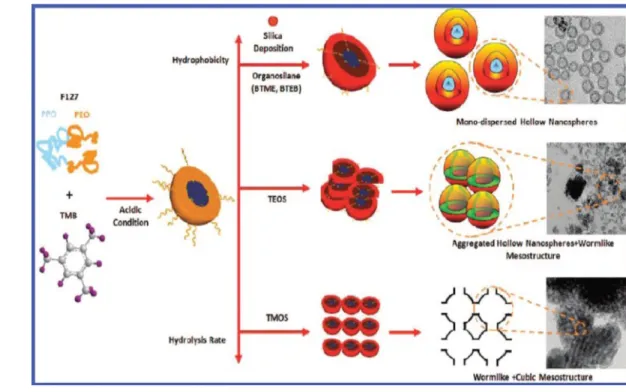
- Sol-gel encapsulation allows trapping lipophylic components inside the spherical shell of amorphous silicon dioxide .
- The process can be run, for example, in the oil-in-water (O/W) emulsion with an active material solubilized in the silicon phases such as tetraethoxysilane (TEOS) or tetramethoxysilane (TMOS).
- Hydrolysis of the silicon droplets and condensation of the hydrolyzed species to silica occurs at the oil-water interface and leads to formation of the hard silica shell.
References :
http://en.wikipedia.org/wiki/Micro-encapsulation
http://www.scribd.com/doc/28977603/Methods-of-Micro-Encapsulation