doi: 10.5681/jcs.2013.001 http:// journals.tbzmed.ac.ir/ JCS
* Corresponding Author: Somayeh Ghavipanjeh (MSc), E-mail: [email protected]
The Effect of Training Problem-Solving Skills on Coping Skills of
Depressed Nursing and Midwifery Students
Hossein Ebrahimi1, Shirin Barzanjeh Atri2, Somayeh Ghavipanjeh1*, Alireza Farnam3, Leyla Gholizadeh4
1 Department of Psychiatric Nursing, Faculty of Nursing and Midwifery, Tabriz University of Medical Sciences, Tabriz, Iran 2
Department of Community Health Nursing, Faculty of Nursing and Midwifery, Tabriz University of Medical Sciences, Tabriz, Iran
3
Department of Psychiatry, Faculty of Medicine, Tabriz University of Medical Sciences, Tabriz, Iran 4
Department of Medical-Surgical Nursing, Faculty of Nursing and Midwifery, Tabriz University of Medical Sciences, Tabriz, Iran
ARTICLE INFO ABSTRACT
Article type: Original Article
Introduction: Nurses have a considerable role in caring and health promotion. Depressed nurses are deficient in their coping skills that are important in mental health. This study evaluated the effectiveness of training problem-solving skills on coping skills of depressed nursing and midwifery students. Methods: The Beck Depression Scale and coping skills questionnaire were administered in Tabriz and Urmia nursing and midwifery schools. 92 students, who had achieved a score above 10 on the Beck Depression Scale, were selected. 46 students as study group and 46 students as control group were selected randomly. The intervention group received six sessions of problem-solving training within three weeks. Finally, after the end of sessions, coping skills and depression scales were administered and analyzed for both groups. Results: Comparing the mean coping skills showed that before the intervention there were no significant differences between the control and study groups. However, after the intervention, a significant difference was observed between the control group and the study group. By comparing the mean coping skills before and after the intervention, a significant difference was observed in the study group. Conclusion: Training problem-solving skills increased the coping skills of depressed students. According to the role of coping skills in people's mental health, increasing coping skills can promote mental health, provide the basis for caring skills, and improve the quality of nurses’ caring skills.
Article History: Received: 10 July.2012 Accepted: 28 July. 2012 ePublished: 26 Feb.2013
Keywords: Problem-solving Nurses Midwifery Coping skills Quality of health care
Introduction
Stress is an integral part of human life which people frequently encounter.1 Stress as a
psychological phenomenon is an important factor in the occurrence and persistence of mental disorders.2 Nursing is a profession
that involves stress. Students form a large population of a country, but the nursing students have very different position than the other students. They struggle with many different situations such as working with different medical staff, having happy and sad
moments, experiencing patient’s life and death, and they have to adapt themselves with these situations.3 Nurses and nursing
students have a high level of stress during their daily life and profession.4,5 Patients
expect that these students make the best decisions in dealing with their problems.6
However, this stress causes interference with their decision making, decreases the quality of nursing care, and increases health problems for the nurses and students.
among all the provided care services in the
hospitals nursing care is the most important.7
Among health staff, midwives not only have an important task in health counseling and education for women, but also for all the family and society. They are responsible for maintaining and improving mother and child health, and providing high quality care and
information for the patient.8 Providing
quality care and services is always a priority in the health care system specially in nursing and midwifery services.9 Therefore, the rating
and validation of hospitals are dependent on the quality of nursing care.10 It is estimated
that more than half of the health care services are representative of care and the rest representative of treatment. For this reason
there should be more emphasis on care.11
One of the factors that can influence nursing care and its quality is the cognitive and emotional preparation of the caregiver. Stress and depression can lead to inability in finding solutions to problems, reducing coping strategies in dealing with emergency stressors, and lack of flexibility in performance.11 Therefore, to reduce stress and
make adjustments, using coping strategies is important.12
The concept of coping as cognitive and behavioral efforts is defined as taking over
threatening situations.13,14 Based on
psychological theories, coping styles have an important role in reducing stress and improving general health.15 Smith et al.16
define the concept of coping as a process by which an individual tries to control and manage psychological stress. According to Brannon et al. coping behaviors include the problem oriented process, in which the person is faced with the reason for his/her disturbance, and the emotional oriented process, based on which the person tries to adjust his/her emotional responses.17
One way of improving coping skills is training of problem-solving skills.18
Problem-solving is a cognitive behavioral process that provides potential effective responses for a difficult situation, and increases the
possibility of selecting the best answer. The training of problem-solving can be defined as a process that helps a person to develop problem-solving skills and as a result increases the possibility of effective coping.19
Some researchers believe that training and
implementing problem-solving skills
provides a purposeful guideline, through which people define the problem, provide different solutions, decide to choose the best solution and therefore demonstrate their problem-solving strategy.20 From a scientific
view point, problem-solving training solves people’s difficulties in problem-solving.21
Despite the importance of empowering nursing students in problem-solving skills, these skills have not been included and organized in the nursing and midwifery
educational program.22 Although, the nursing
process is an instructional strategy that is used specially in clinical trainings, the results show that this skill is very low in nursing students and nurses.23,24 The stages of nursing
process can be compared to the problem-solving stages.25
The results of the study by Goff indicated that high stress interferes in the nurses’ care, thinking and problem-solving ability.26 One
way to cope with stress is learning to deal with problems, resolve conflicts and the ability to make decisions. Phillips also reported in his study that a coping mechanism for dealing with stress is essential for nursing students.27 A coping mechanism
is used in those who have higher problem-solving skills and are aware of their emotions. Lim et al. argued that if the nurse’s stress reduces, they will apply their problem-solving skills in coping with their problematic environment.28 Applying of the
problem-solving trainings will facilitate the
adapting with different situations.28
able to ensure the patient’s safety and provide them with optimal care, and the nurses play an important role in improving the quality of care. Therefore, this study aimed to determine the effects of training of problem-solving skills on depressed nursing and midwifery students.
Materials and methods
The present study is a clinical trial, which aimed to determine the effectiveness of training problem-solving skills on coping skills of depressed nursing and midwifery students. Pretest, posttest and control group was designed. Two subject groups were used and were measured twice. This study was conducted on the nursing and midwifery students of Tabriz and Urmia University of Medical Sciences, Iran. The names of all the students were gathered. Coping skills questionnaire and Beck Depression Scale were performed. 92 students, who received a
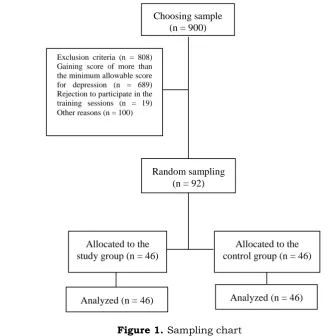
score of 10 and more on the Beck Depression Scale, were selected as study samples. They were randomly divided into control group and study group. The two groups were matched according to age, sex, marital status and family history of psychiatric disorders. An invitation was sent to the study group for attending the training classes for solving problem skills. From the 65 sent invitations, 50 people gave positive responses. Finally 46 students within the age range of 18 to 37, studying for a bachelor or master’s degree in nursing and midwifery were chosen as the study sample. Figure 1 shows the sampling chart. For the study group six sessions of training in problem-solving in small groups were performed during three weeks as the following:
First session: introduction, program explanation, introduction of problem-solving, and providing time for the students to express their opinions.
Figure 1. Sampling chart
Analyzed (n = 46) Allocated to the control group (n = 46) Allocated to the
study group (n = 46)
Random sampling (n = 92) Exclusion criteria (n = 808)
Gaining score of more than the minimum allowable score for depression (n = 689) Rejection to participate in the training sessions (n = 19) Other reasons (n = 100)
Choosing sample (n = 900)
Second session: describing the first stage of problem-solving (identifying the general situation, defining the problem and clarifying it).
Third session: remembering different potential solutions for the problems by using brain storming.
Forth session: choosing the best solution from the ones given and decision making.
Fifth session: implementing the selected solution and reviewing the results of each proposed solution.
Sixth session: reviewing the previous sessions and performing posttest.30
No training sessions were performed for the control group. After training, a posttest was conducted on the two groups and the results of the coping skills questionnaire were compared. After finishing the study, a six session training course was held for the control group for ethical consideration. Collected data were analyzed by SPSS software version 13, frequency, mean, standard deviation and 95% confidence interval.
To collect data a three part questionnaire was used. The first part of the questionnaire
included personal information such as age,
sex, marital status, economical status, residency, parent’s job, and interest in the studying field. The second part included 21
multi-optioned questions related to
depression. Each question had four parts and each part had a score range of 0 to 3. The lowest rate of depression was zero and the highest was 63. The Beck Depression Scale is a self-report scale, which measures the different levels of depression. The reliability of the questionnaire was reported from 0.73 to 0.93, with the mean of 0.86, and correlation of 0.73.31 The coefficient alpha to assess the
internal consistency of this scale in Iran is reported 78%.32
The third part of the questionnaire included Ways of Coping Questionnaire that were designed by Lazarus and Fulkman. This questionnaire has 66 parts that measures two main methods of problem-focused coping
(seeking social support, accepting
responsibility, planful problem solving and positive reappraisal) and emotion-focused coping (confrontive coping, distancing, escape-avoidance and self-controlling) in 8 scales. This questionnaire has been used in many studies and in many groups to determine coping methods and is a standard
and reliable tool.33 The coefficient of
concordance for the clarity of the questions is 0.76 in Iran.34 The reliability coefficient is 0.93
in Iran’s samples.33 Lazarus has reported the
internal consistency for each of the coping methods to be 0.79 to 0.66.35
To gather data permission was obtained from the research deputy of Tabriz and Urmia University of Medical Sciences. An ethical principle for performing this study was followed. Before starting the study, the design and study tools were approved by the local Research Ethic Committee of Tabriz University of Medical Sciences, and ethical number: 911. All the information on the study, aims, the participants’ rights to withdraw from the study, and the confidentiality of the information was explained to the participants. An informed consent was obtained from each participant.
Results
The sample size was 24 midwifery students and 22 nursing students. Mean age was 21 years old, with the age range of 18 to 37.
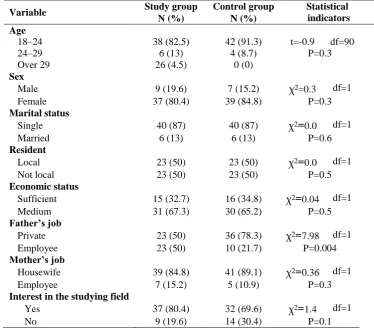
Table 1 shows the demographical
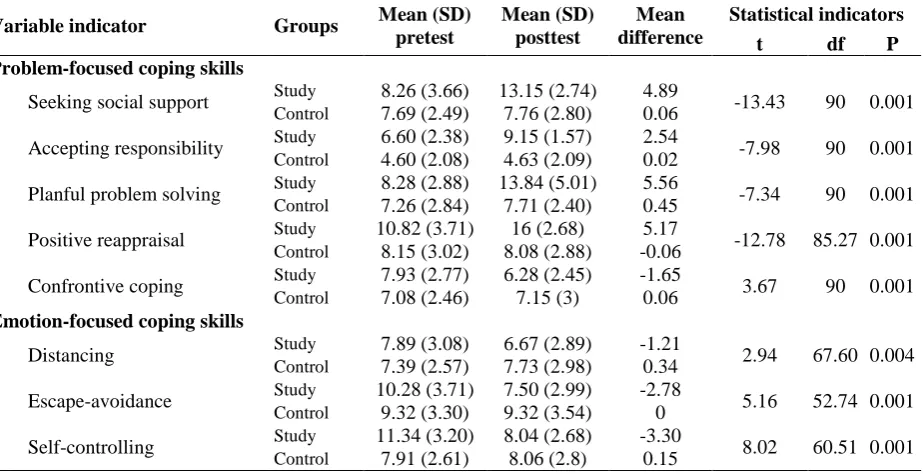
significant increase in problem-focused coping skills. This table also shows that emotion-focused coping skills in the study group had a significant decrease compared to the control group. According to table 3, the mean difference of the four subscales of problem focused coping in posttest has increased in the study group. Mean
difference of emotion-focused coping has decreased in the study group.
Discussion
Today, problem solving skills are at the highest level of human cognition and are the
most valuable aim of education. The method
of training problem-solving skills reflects the
Table 1. Demographical information of the study and control groups
Variable Study group Control group Statistical
indicators
N (%) N (%)
Age
18–24 38 (82.5) 42 (91.3) t=-0.9 df=90
24–29 6 (13) 4 (8.7) P=0.3
Over 29 26 (4.5) 0 (0)
Sex
Male 9 (19.6) 7 (15.2) χ2=0.3 df=1
Female 37 (80.4) 39 (84.8) P=0.3
Marital status
Single 40 (87) 40 (87) χ2=0.0 df=1
Married 6 (13) 6 (13) P=0.6
Resident
Local 23 (50) 23 (50) χ2=0.0 df=1
Not local 23 (50) 23 (50) P=0.5
Economic status
Sufficient 15 (32.7) 16 (34.8) χ2=0.04 df=1
Medium 31 (67.3) 30 (65.2) P=0.5
Father’s job
Private 23 (50) 36 (78.3) χ2=7.98 df=1
Employee 23 (50) 10 (21.7) P=0.004
Mother’s job
Housewife 39 (84.8) 41 (89.1) χ2=0.36 df=1
Employee 7 (15.2) 5 (10.9) P=0.3
Interest in the studying field
Yes 37 (80.4) 32 (69.6) χ2=1.4 df=1
No 9 (19.6) 14 (30.4) P=0.1
Table 2. Comparison of score differences between the two groups coping skills
Variable indicators Groups Mean (SD)
pretest
Mean (SD) posttest
Mean difference
Statistical indicators
t df p
Problem-focused coping skills
Study 34.04 (9.32) 43.76 (7.02) 9.71
-8.46 90 0.001
Control 32.78 (10.25) 24.32 (6.11) - 8.45
Emotion-focused coping skills
Study 37.43 (9.09) 29.82 (7.84) - 7.60
8.34 90 0.001
Table 3. The difference between the mean scores of the pretest and posttest of the two groups’ problem focused and emotion focused subscores
Variable indicator Groups Mean (SD)
pretest
Mean (SD) posttest
Mean difference
Statistical indicators
t df P
Problem-focused coping skills
Seeking social support Study 8.26 (3.66) 13.15 (2.74) 4.89 -13.43 90 0.001
Control 7.69 (2.49) 7.76 (2.80) 0.06
Accepting responsibility Study 6.60 (2.38) 9.15 (1.57) 2.54 -7.98 90 0.001
Control 4.60 (2.08) 4.63 (2.09) 0.02
Planful problem solving Study 8.28 (2.88) 13.84 (5.01) 5.56 -7.34 90 0.001
Control 7.26 (2.84) 7.71 (2.40) 0.45
Positive reappraisal Study 10.82 (3.71) 16 (2.68) 5.17 -12.78 85.27 0.001
Control 8.15 (3.02) 8.08 (2.88) -0.06
Confrontive coping Study 7.93 (2.77) 6.28 (2.45) -1.65 3.67 90 0.001
Control 7.08 (2.46) 7.15 (3) 0.06
Emotion-focused coping skills
Distancing Study 7.89 (3.08) 6.67 (2.89) -1.21 2.94 67.60 0.004
Control 7.39 (2.57) 7.73 (2.98) 0.34
Escape-avoidance Study 10.28 (3.71) 7.50 (2.99) -2.78 5.16 52.74 0.001
Control 9.32 (3.30) 9.32 (3.54) 0
Self-controlling Study 11.34 (3.20) 8.04 (2.68) -3.30 8.02 60.51 0.001
Control 7.91 (2.61) 8.06 (2.8) 0.15
approaches in preventing mental and
emotional disability.3 Training
problem-solving skills is a logical and organized approach to help a person in dealing with stressful situations.36 Therefore, the aim of
this study was to increase the coping skills of depressed nursing and midwifery students, since they are the future caregivers, and to increase their care giving ability and promote the quality of their performance.
The results of the study showed that problem-solving skills can increase the coping skills of students. This result is in consistence with other researches in this area. The study by Moattari et al. showed that training of problem-solving skills to students resulted in a decrease in stress and increase in self-confidence.3 It is believed that successfully
solving problems causes positive self-confidance.3 Problem-solving skills act as a
shield in protecting the individual in negative incidents.25 Since stress decreases the quality
of nurse care,37 the existing relationship
among coping skills, problem-solving, and nurse care, it is hoped that by increasing coping skills and reducing stress, the quality of the nurses’ performance will increase.
The study by Graves et al. showed that training these methods and skills resulted in helping families in weight loss of children.38
The results of the study by Carvalho and Hopko on depressed women with breast cancer also showed that 8 sessions of training problem-solving skills resulted in a decrease
in stress and increase in self-care.39
Khoushkam et al. performed a study on the
social skills of students with visual impairment, and showed that training problem-solving did not help in decreasing their behavioral problems.40 This result might
be due to the low sample size (n = 10).
Results of the statistical analysis showed that the impact of training problem-solving skills in reducing emotional skills of students was statistically significant in the study group compared to the control group. This result was in consistence with the studies of Dreer et al41 and Telch and Telch.42
According to the findings, training the problem solving skills increases social support focused coping and this is in consistence with the study of McDonell et al.43 Based on the study of Shewchuk et al.
reactions to problems, have better problem-solving skills and less stress. This is due to their better understanding of the problem.44
Based on the multiple roles of nurses, especially problem-solving and communic- ating with different health teams, critical thinking is essential for the nursing profe- ssion.45 The best method to foster critical
thinking is using the problem-solving approach, which can lead to better and more appropriate clinical decisions and reduce the
amount of stress.46 The main difference with
previous studies is that the two sets of problem-solving skills and coping strategies have been put together in order to empower the nursing and midwifery students in providing better care. The findings of this study can be the basis of improving the quality of nursing care of depressed students until more serious and more effective actions are taken for their mental health. Authorities and nurse managers should pay more attention to the factors that impair the quality of care and public health, and promote nursing care by appropriate communication with nurses and by supporting them.
The overall results of the study indicated that due to the sensitivity of the nurse’s profession and the importance of their decision making and ability to take care of patients, it can be hoped that by developing this skill in students, an effective and decisive step is taken towards improving the quality of nursing care and promoting nursing students as future health care providers.
This study had some limitations. Generalization of the results of this study is limited, since it was conducted only on nursing and midwifery students of Tabriz and Urmia University of Medical Sciences. It is recommended to perform this study on different universities, with more training sessions and longer follow up periods.
Ethical issues
None to be declared.
Conflict of interest
The authors declare no conflict of interest in this study.
Acknowledgments
This research was supported financially by the research deputy of Tabriz University of Medical Sciences. We appreciate the help of the Tabriz and Urmia Nursing and Midwifery Departments and all the students who participated in the study.
References
1. Taylor C. Fundamental of Nursing: the art and sciences of nursing care. Philadelphia: Lippincott Williams & Wikins; 2005.
2. Mazure CM. Does Stress Cause Psychiatric Illness? Washington, DC: American Psychiatric Pub; 1995. 3. Moattari M, Soltani A, Moosavinasab M, Ayatollahi AR. The effect of a short term course of problem solving on self-concept of nursing students at Shiraz faculty of nursing and midwifery. Iranian Journal of Medical Education 2005; 5(2):147-55. (Persian)
4. Craven RF, Hirnle CJ. Fundamentals of nursing: human health and function. Philadelphia: Lippincott Williams & Wilkins; 2007.
5. Morton PG, Fontaine DK, Hudak CM, Gallo BM. Critical care nursing: A holistic approach. Philadelphia: Lippincott Williams & Wilkins; 2009. 6. Altun I. The perceived problem solving ability and
values of student nurses and midwives. Nurse Educ Today 2003; 23(8):575-84.
7. Pazargadi M, Tafreshi MZ, Abedsaeedi Z, Majd HA, Lankshear AJ. Proposing indicators for the development of nursing care quality in Iran. Int Nurs Rev 2008; 55(4):399-406.
8. Jones SR. Ethics in midwifery. Philadelphia: Elsevier Health Sciences; 2000.
9. Haghighi Khoshkho N. The quality of nursing care from nurses and patients viewpoints in the teaching hospitals of Tabriz University of Medical Sciences [Master Thesis]. Tabriz: Faculty of Nursing and Midwifery, Tabriz University of Medical Science; 2004. (Persian)
10.Mosavi SA, Mosavi F, Foroghi S, Zakavati R, Mahdian Nasab SA, Hosein Abasi N. Fundamental of management in nursing. Tehran: Ashora Publication; 2007. (Persian)
12.Thompson EA, Eggert LL, Randell BP, Pike KC. Evaluation of indicated suicide risk prevention approaches for potential high school dropouts. Am J Public Health 2001; 91(5): 742-52.
13.Sarafino EP, Smith TW. Health Psychology: Bio psychosocial Interactions. New Jersey: John Wiley & Sons; 2002.
14.Tuncay T, Musabak I, Gok DE, Kutlu M. The relationship between anxiety, coping strategies and characteristics of patients with diabetes. Health Qual Life Outcomes 2008; 6: 79.
15.Barbara SR, Irwin SG. Abnormal psychology. Najarian B, Asghari MA, Dehghani M, translator. Tehran: Roshd Publication; 2008. (Persian)
16.Smith E, Nolan Hoxema S, Farid Rikson B, Lofton J. The field of Hilgard and Etkinson psychology. Saatchi M, Moradi AR, Behzad M, Dezhkam M, translator. Tehran: Gap Publication; 2007.(Persian) 17.Brannon L, Feist J. Health Psychology: An
Introduction to Behavior and Health. Boston: Cengage Learning; 2009.
18.Koshan M, Vagei S. Psychiatric nursing. Tehran: Rafi Publication; 2009. (Persian)
19.Malouff JM, Thorsteinsson EB, Schutte NS. The efficacy of problem solving therapy in reducing mental and physical health problems: a meta-analysis. Clin Psychol Rev 2007; 27(1): 46-57. 20.Elliott TR, Sherwin E, Harkins SW, Marmarosh C.
Self-appraised problem- solving ability, affective states, and psychological distress. Journal of Counseling Psychology 1995; 42(1): 105-15. 21.Hoyt P. Problem Solving for Better Health Nursing:
a working approach to the development and dissemination of applied research in developing countries. Appl Nurs Res 2006; 19(2): 110-2. 22.Meamarian R. Application of nursing's
fundamentals and hypothesis. Tehran: Tarbiat Modares University Publication; 2000. (Persian) 23.Moattari M, Abedi HA, Amini A, Fathi Azar E.
The effect of reflection on critical thinking skills of nursing students in Tabriz medical university. Iranian Journal of Medical Education 2001; 1(4): 55-64. (Persian)
24.Salehi SH, Bahrami M, Hosseini SA, Akhondzadeh K. Critical thinking and clinical decision making in nurse. Iranian Journal of Nursing and Midwifery Research 2007; 12(1): 13-6. (Persian)
25.Klaassens E. Strategies to enhance problem solving. Nurse Educ 1992; 17(3): 28-31.
26.Goff AM. Stressors, academic performance, and learned resourcefulness in baccalaureate nursing students. Int J Nurs Educ Scholarsh 2011; 8: Article 1.
27.Phillips JK. Exploring student nurse anesthetist stressors and coping using grounded theory methodology. AANA J 2010; 78(6): 474-82.
28.Lim J, Bogossian F, Ahern K. Stress and coping in Singaporean nurses: A literature review. Nurs Health Sci 2010; 12(2): 251-8.
29.Zeigami R. The effect of coping strategies and stressful factors of nursing students of the Shiraz faculty of nursing & Midwifery [Master Thesis]. Shiraz: Faculty of Nursing and Midwifery, Shiraz University of Medical Sciences; 2001. (Persian) 30.Dzurilla TF, Nezu AM. Problem- solving therapies.
In: Dobson KS, Editor. Handbook of cognitive-behavioral therapies. 2nd ed. New York: Taylor & Francis Group; 2002.
31.Beck AT, Steer RA, Brown GK. BDI-II, Beck depression inventory: manual. San Antonio: Psychological Corporation; 1996.
32.Sardoiy G. Introduction of norm finding of Becks revision depression questionnaire [Master thesis]. Tehran: Allame Tabatabaiy University; 2000. (Persian)
33.Haibati KH. The relationship between coping strategies with stress and methods of child training of high school students of the Zargan [Master thesis]. Shiraz: Shiraz University of Medical Sciences. 2004. (Persian)
34.LoBiondo-Wood G, Haber J. Nursing research: methods, critical appraisal, and utilization. Philadelphia: Mosby; 2002.
35.Lazarus RS, Folkman S. Stress, appraisal, and coping. New York: Springer Publishing Company; 1984.
36.MacGovern Billings D, Halstead JA. Teaching in nursing: a guide for faculty. Philadelphia: Elsevier Science Health Science Division; 2005.
37.Rahmani F, Behshid M, Zamanzadeh V, Rahmani F. Relationship between general health, occupational stress and burnout in critical care nurses of Tabriz teaching hospitals. Iran Journal of Nursing (IJN) 2010; 23(66): 54-63. (Persian) 38.Graves T, Meyers AW, Clark L. An evaluation of
parental problem-solving training in the behavioral treatment of childhood obesity. J Consult Clin Psychol 1988; 56(2): 246-50.
39.Carvalho JP, Hopko DR. Treatment of a depressed breast cancer patient with problem-solving therapy. Clinical Case Studies 2009; 8(4): 263-76.
40.Khoushkam Z, Malekpour M, Moulavi H. The impact of group problem-solving training on social skills for students with visual impairment. Research on Exceptional Children 2008; 8(2): 141-56. 41.Dreer LE, Elliott R, Donald C, Fletcher DC,
Swanson M. Social problem- solving abilities and psychological adjustment of persons in low vision rehabilitations. Rehabilitation Psychology 2005; 50(3): 232-8.
patients: a comparison of strategies. J Consult Clin Psychol 1986; 54(6): 802-8.
43.McDonell JR, Limber SP, Connor-Godbey J. Pathways teen mother support project: longitudinal findings. Children and Youth Services Review 2007; 29(7): 840-55.
44.Shewchuk RM, Johnson MO, Elliott TR. Self-appraised social problem solving abilities,
emotional reactions and actual problem solving performance. Behav Res Ther 2000; 38(7): 727-40. 45.O'Connell Smeltzer SC, Bare BG, Hinkle JL,
Cheever KH. Brunner and Suddarth's textbook of medical-surgical nursing: in one volume. Philadelphia: Lippincott Williams & Wilkins; 2009. 46.Shaabani H, Mehrmohammadi M. Training of