University of New Orleans University of New Orleans
ScholarWorks@UNO
ScholarWorks@UNO
University of New Orleans Theses and
Dissertations Dissertations and Theses
8-8-2007
Gendered Representations of Jazz Vocal Artists: A Critical
Gendered Representations of Jazz Vocal Artists: A Critical
Discourse Analysis of CD and Performance Reviews, and
Discourse Analysis of CD and Performance Reviews, and
Interviews
Interviews
Miroslava Jichova University of New Orleans
Follow this and additional works at: https://scholarworks.uno.edu/td
Recommended Citation Recommended Citation
Jichova, Miroslava, "Gendered Representations of Jazz Vocal Artists: A Critical Discourse Analysis of CD and Performance Reviews, and Interviews" (2007). University of New Orleans Theses and Dissertations. 569.
https://scholarworks.uno.edu/td/569
This Thesis is protected by copyright and/or related rights. It has been brought to you by ScholarWorks@UNO with permission from the rights-holder(s). You are free to use this Thesis in any way that is permitted by the copyright and related rights legislation that applies to your use. For other uses you need to obtain permission from the rights-holder(s) directly, unless additional rights are indicated by a Creative Commons license in the record and/or on the work itself.
Gendered Representations of Jazz Vocal Artists:
A Critical Discourse Analysis of CD and Performance Reviews,
and Interviews
A Thesis
Submitted to the Graduate Faculty of the University of New Orleans in partial fulfillment of the requirements for the degree of
Master of Arts in English
by Mirka Jichova
Acknowledgements
I would like to thank the co-chair of my thesis committee, Dr. Abigail Konopasky, for the invaluable encouragement, guidance and support in the drafting stages of my thesis and throughout my time at UNO as well as for the countless hours spent on the phone and the Internet to discuss my projects and provide feedback in the aftermath of Hurricane Katrina. I am grateful to her for introducing critical discourse analysis (CDA) to me and for sharing her experience and knowledge of the field so readily and
Table of Contents
CHAPTER ONE: Introduction ... 1
CHAPTER TWO: Literature Review ... 7
1. Critical Approach to Discourse Analysis ... 7
2. Texts, Discourses and the Social Construction of Meaning ... 9
3. Social Institutions ... 11
4. Institutional Power: Action at a Distance ... 12
5. Postmodernist Representation: Reality or a Simulacrum? ... 16
6. The Language of Experts: Promotional Genres, Conversationalization of Genres, and Technologization of Discourse ... 18
7. Feminist Theory: Social Construction of Gendered Identities ... 20
8. A Paradigmatic Woman, A Paradigmatic Man: Men’s Fantasy ... 21
9. Interdiscursivity and Intertextuality: Discourse as a Social Practice ... 23
CHAPTER THREE: Research Questions and Analytical Techniques ... 25
1. Systemic Functional Linguistics ... 26
1.1 Material Clauses ... 29
1.2 Verbal Clauses ... 31
1.3 Mental Clauses ... 31
1.4 Relational Clauses ... 32
2. Parataxis, Hypotaxis: Expansion ... 34
3. Presuppositions ... 35
4. Interdiscursivity ... 37
5. Naming Analysis ... 38
CHAPTER FOUR: An Analysis of CD Reviews in Jazz Times ... 40
1. The institution of Jazz Times: My Sample of CD reviews ... 40
2. The Discursive “Disappearing” of the (Female) Artist ... 42
3. Some Numbers ... 43
4. The Mental Clause ... 45
5. Analysis of Process Types: The Power of the Participant ... 46
6. Relational Clauses: Female Vocalists’ Roles and Identities ... 48
7. Discourse of Achievement and Male Vocalists’ Roles ... 50
8. The Grammar of the Material Clause: The Female Singer and Her Achievement ... 52
9. Discourse of the ‘Spiritual and Intangible’ (The ‘Essence’ of a Goal) ... 54
10. A Paradigmatic Woman? ... 56
11. Presupposed Identities ... 57
12. Conclusion ... 60
CHAPTER FIVE: Analysis of Performance Reviews In Live New Orleans ... 63
1. Live New Orleans ...63
2. The Focus of My Analysis ... 65
3. Relational Clauses with Singers, Their Voices or Presupposed Qualities as Participants ... 67
4. Embedded Presuppositions: Relational Processes Represented as a Noun Phrase ... 73
5. Evaluation via Material Process Types ... 75
6. Verbal Processes and Dialogue ... 82
7. The Jhelisa and Manuel Reviews ... 87
8. Conclusion ... 89
1. Naming Analysis ... 93
2. Relation/Possession Embedded in a Noun Phrase ... 101
3. Identification and Classification Realized as Relation: Metaphors ... 107
4. Conclusion ... 109
CHAPTER SEVEN: Thesis Conclusion ... 111
References ... 116
Appendix ... 118
Abstract
This study of contemporary jazz discourse and gender applies the techniques of critical discourse analysis, inspired by M.A.K. Halliday’s systemic functional linguistics and Norman Fairclough’s qualitative critical discourse analysis, to explicate the unequal distribution of power in society as
represented by the institutions of jazz and mass media, in discourse about jazz vocal artists. Specifically, the study focuses on the way the genres of jazz CD review, jazz performance review, and interviews with jazz artists – disseminated via the institutions JazzTimes and Live New Orleans – represent the artists’ identities, roles, achievements and skills. Following Norman Fairclough and the feminist scholar Mary Talbot, the study assumes that institutions of mass media not only discursively construct the gender of jazz vocal artists, but also represent the performers’ achievement and skills from a hegemonic standpoint, reflecting the commonsense assumptions about women and men and their roles in patriarchal society.
CHAPTER ONE
Introduction
As someone who has studied jazz singing and performed jazz and various other types of music for the
past five years, I cannot help but notice that professional, or even semi-professional, female jazz
musicians are very often not given the respect that their male counterparts receive. Women are often
talked about and talked to as if their skills and professionalism do not match those of men, and if their
accomplishments are praised, then it is very often in relation to the way they look, the clothes they
wear (on stage and in promotional pictures), or to the way they interact with audience. This is
especially true of female jazz vocalists, whose singing is often downplayed by the more “serious”
male players.
There has been a widespread belief among musicians and perhaps society at large that
whereas the study of an instrument may be a worthy endeavor, the study of vocal techniques, almost
as a passing fancy, does not require much effort or talent. While jazz players, predominantly men, are
often praised for their technique and skill, female jazz vocalists are sometimes looked at as fancy
additions to the institution of jazz, endured and tolerated more for the air of novelty and feminine
appeal that they bring to the historically male arena than for their genuine skills and accomplishments
as musicians. While it is true that the institution of jazz is and has been historically a male domain, the
first popular jazz singers were women. Billie Holiday, Ella Fitzgerald, Sarah Vaughan, and Carmen
McRae – the first a prostitute, the third nicknamed Sassy – have helped to create a picture of vocal
jazz as a predominantly female space within the patriarchal institution of jazz, and a prototype of a
jazz singer who is a woman. And though music critics have praised the four vocalists above for their
vocal techniques and significance in helping to define the jazz idiom, there has been a curious division
between vocal jazz and instrumental artists in terms of the level of ‘inherent’ musical or intellectual
merit that their performance can bring to the development of jazz performance and its status as an
academic discipline. This division may simply be due to the belief that while theoretically anyone can
guitar to make harmonious sounds; playing looks much harder than singing. However, since jazz
players are predominantly male and jazz singers are predominantly female (or at least the ‘romantic’
vision of a jazz singer is), the belief that ‘singing’ is inferior to ‘playing’ may have less to do with
inherent characteristics of musical instruments and vocal chords, and rather be directly tied to the
unequal distribution of power between women and men in contemporary American society.
My thesis is primarily concerned with explicating the unequal distribution of power between
women and men, perpetuated within social institutions and naturalized in discourses (see discussion in
chapter two), of which the unequal distribution of power between female and male jazz vocal artists is
but one demonstration. However, it is important to note that apart from gender, ethnicity and class
also play into the empowerment or disempowerment of a specific person or a group of people in
contemporary Western society. Due to space constrains, I will not address in detail the intersections
of gender and ethnicity (or gender and class), but a reader may refer to Representation, edited by
Stuart Hall, for more information about mass media representations of ethnicity. My choice of topic
was guided by the knowledge that while ethnicity and its representation in mass media and Western
society in general have been studied in quite a detail (see Hall or Gates), the representation of unequal
distribution of power between women and men in mass media institutions has not been given much
notice up till now. Specifically, the arena of jazz performance as one of the sources and
demonstrations of unequal distribution of power between women and men had not been studied in
depth before, so I am entering an unchartered territory with this project.
Though it may seem obvious to many people, it is important to note that representations of
unequal distribution of power serve to maintain the status quo and validate the position of the
dominant, those who already hold power. Studies of representations are concerned with both texts
and images of social actors and events with the aim of explicating how texts and images perpetuate
unequal distribution of power. My study will focus in great detail on textual and discursive
representations of jazz vocal artists and the way their competence/incompetence as jazz performers is
constructed via texts (any meaningful cultural forms) and discourses (social practices and ways of
Written texts about jazz performers disseminated by institutions of mass media – especially
those specializing in depictions of jazz performance, CD reviews, interviews with and feature articles
about jazz performers, and jazz in general – and general ‘talk’ about jazz artists among jazz musicians
or music fans play a great part in the representation and construction of gender and maintenance of the
discourse of competence/incompetence. As scholars of language have noted, language is a powerful
tool in helping to construct the picture of ‘reality’ as we know it (see discussion in chapter two). The
words we use to refer to and describe social phenomena not only reflect the way we perceive these
phenomena, but also significantly influence and to a certain extent construct the social conditions and
relations in our society. In other words, our understanding and perception of the social world is
inextricably linked to the language that we and others use to describe and represent this social world.
If social conditions are to a certain extent constructed by discourse, then our subject positions, effects
of these conditions, are also socially and discursively constructed. And if our subject positions are
determined in part by our gender, then the language of our society also constructs our gendered roles
and identities.
Feminist scholars have noted this particular character of discourse when speaking about the
social construction of gender. While most people would probably readily equate the notion of gender
with the notion of sex, the important difference between the two is that while sex of a person is (to a
certain extent) acquired at birth and biologically founded, the gender of a person is determined by
pressures that a society places on women and men to ‘display’ their sex-affiliation by enacting a
socially-determined set of practices and their willingness to comply with society’s norms and
‘perform’ their gender. The critic Talbot points out that “unlike sex, gender is not binary. We can talk
about one man being more masculine (or feminine) than another” – but not about one man being
*maler or *malest (7). The society at large determines a person’s gender by prescribing
gender-specific attire, behavior and interaction, and the impact of this prescription on the lives and behavior
of women and men lies largely in the way the social notion of gender is disseminated and preserved
via discursive representations of gender.
While regular, everyday conversation may influence the way we perceive our (gendered)
social conditions and interactions in institutions of mass media have an even greater impact on our
understanding of our identities and roles. Various scholars have pointed out that the impact of
institutions of mass media lies in their access to technical and economic capital, which in turn enables
them to disseminate textual representations of ‘reality’ to a large number of people and potential
consumers (see discussion in chapter two). Because of their ability to create multiple copies of textual
representations, institutions of mass media, such as radio, television, newspapers, magazines, or the
Internet, have the power to affect the opinions of a large number of people, influencing their
understanding of themselves, their relation to the social world and events in it.
More specifically, institutions of mass media specializing in jazz and writing for an audience
of jazz critics and fans have the means needed to circulate discursive representations of jazz musicians
that may determine how readers will experience and understand a particular performer’s identity or
role, and his or her recording or performance. The subject position of an individual performer is
obviously determined not only by her gender, but also by her other roles and identities, as a player, a
singer, a professional performer, and by the roles she is expected to perform as a member of the
institution of the family – jazz performers may also be mothers, fathers, daughters or sons (the list of
the roles that each of us is expected to perform in contemporary society is endless). However, it is
significant that the gendered identities of a jazz musician are perhaps more on display on stage than
any other of her identities (and as noticeable as her racial or ethnic identity). And just as we are
expected to perform our gender in everyday lives, jazz performers are pressured to perform, even
exaggerate their gender performance on stage, as part of the musical performance, and as a way of
selling the performance to the public and mass media.
While there is no research on discursive representations of jazz performers (to the best of my
knowledge), feminist research offers evidence that contemporary mass media representations of
women and men tend to maximize gender difference, using exaggerated gender markers that
commodify the sex of the person depicted, offering it to readers for their consumption (Talbot
171-174, 193-199). The sex of a person is “used to sell another commodity: the magazine itself” (Talbot
174). If maximization of gender difference sells, as Talbot and others have shown, then the arena of
of their market value, precisely because the gender of jazz performers is on display, readily accessible
and easily exploited. Mass media images and accounts of jazz artists thus may exaggerate the gender
of a particular performer as a way of selling the performer and the media institution as a valuable
commodity. This can be done through images and pictures of the performer, which emphasize one
specific aspect or dimension of the performer, but also discursively, through a set of discursive
practices. As readers, we need to be aware that mass media representations of gender may affect the
way we perceive the women and men depicted. Without critical understanding of the way language
functions as the lens through which we view real people, the real performers, we may not be aware of
the narrative character of discursive accounts of jazz performers, their recordings and their skills, and
may form a gender-specific understanding of their roles and identities as performers, as well as
similar gender-specific expectations of what these performers can or cannot do – their status in other
institutional arenas as well as their skills as musicians.
In the subsequent chapters, I want to answer the following questions: How are jazz performers
discursively depicted as performing mainstream gender roles on stage? How do texts written about
jazz performers and performances – music reviews and interviews – highlight and emphasize gender
difference in an effort to make the best of the commodity that jazz has become at the beginning of the
twenty first century? What specific set of discursive practices do institutions of mass media use to
represent jazz musicians?1 Are these practices stable and determined by the performers’ gender?
How do these practices construct the performers’ gender and why are they different for female and
male vocal artists? My goal is to find out how social institutions of mass media disseminate gendered
depictions of jazz musicians and construct the discourse of competence/incompetence in a gendered
way. In order to do this, I will focus specifically on representations of jazz vocal artists, to counter the
possibility that the discourse of competence/incompetence is tied exclusively to the instrument
(including voice) of a particular performer. I will analyze the language that media use in interviews
with female and male jazz vocalists and reviews of their performance and work, and explicate how the
set of practices that media use to report on a specific performer’s achievement and skill and to
1
represent her or him textually to the public is informed by the performer’s gender. I will argue that
through language, media create not only the gender of specific jazz performers but also generalized
gendered representation of vocal jazz. Using a combination of linguistic analysis and rhetorical
strategies, I will show that the gender of jazz vocalists is socially constructed through discursive
representations of their identities, roles, skills, and achievement. I will look at three different mass
media genres—CD reviews, performance reviews and interviews – and show in what ways the
language of these genres contributes to the construction of womanhood as decorative, sexual,
objectified, and sometimes passive and incompetent. For comparison, I will analyze reviews of and
interviews with both female and male performers, showing in what ways representations of female
CHAPTER TWO
Literature Review
The theories and research that inspired my study of contemporary jazz discourse and gender and the
analytical techniques that I will use are grounded mainly in the following four disciplines: critical
discourse analysis, cultural studies, post-modern theory, and feminist theory.
1. Critical Approach to Discourse Analysis
Critical discourse analysis is different from earlier general linguistics analyses in that it does not aim
to analyze discourse with the goal of showing inherent properties of language systems or the
differences and similarities between languages. Rather, as a relatively new field of linguistic analysis,
Critical Discourse Analysis (CDA) aims to analyze and de-naturalize discourses to point out
inadequacies in the distribution of social power as represented through language. Its main goal is to
uncover the ideologies which are encoded in language, and which make the unequal distribution of
social power seem natural and given, and make them unnatural – or ‘denaturalize’ them, so that
people can see and – if they want to – reject them.2
Norman Fairclough, a prominent CDA scholar, defines language as a “form of social
practice” (Language 22) and the relationship between language structures and social structures as
inherently dialectical:
2
Fairclough uses the following two definitions of power offered by Giddens in
New Rules ofSociological Method: (1) “power in its most general sense of the ‘transformative capacity of human action’, the
capacity to ‘intervene in a series of events so as to alter their course’”; (2) and “power in the ‘relational’ sense of
the capability to secure outcomes where the realization of these outcomes depends upon the agency of others.”
Both depend on “’resources or facilities’ which are differentially available to social actors” (Analysing 41). In
addition, Thompson defines power as “the ability to act in pursuit of one’s aims and interests, the ability to
intervene in the course of events and to affect their outcome” (13). When I talk about power in my study, I use
There is not an external relationship ‘between’ language and society, but an internal and
dialectical relationship. Language is a part of society; linguistic phenomena are social
phenomena of a special sort, and social phenomena are (in part) linguistic phenomena.
(Fairclough , Language 23)
Because of this complex relationship between language and social structures, the analysis of discourse
can reveal not only how sociolinguistic conventions distribute power unequally but also how they
reproduce “relations of power and struggles for power” [emphasis mine] (1). The dialectical relation
between language and social structures also enables language to become one of the primary means of
social control and the instrument for the exercise of power by consent.3 The social and political aim of
CDA is thus to show the “significance of language in the production, maintenance, and change of
social relations of power” and to “help increase consciousness of how language contributes to the
domination of some people by others” (Fairclough, Language 1).
As a field, CDA draws on a variety of approaches to discourse analysis, but the main point of
reference is Systemic Functional Linguistics (SFL), the linguistic theory and analytical methods
generated by M.A.K. Halliday (Fairclough, Analyzing 5). Unlike general linguistics in the tradition of
3
In contrast to ‘coercive power,’ which involves the exercise of physical force, ‘power by consent’ is an ability
to compel someone to do something without the application of physical force. Mumby and Clair point out that
“the most effective use of power” occurs when power is exercised “subtly and routinely,” not through coercion,
but through consent (184). The most effective way of exercising power is “when those with power are able to
get those who have less power to interpret the world from the former’s point of view” (184). One of the first
critics who pointed out that language is a powerful means of social control and an important source of power
was the French philosopher and social theorist Michel Foucault, who noticed that ‘power’ in social sciences has
to do with “who does the speaking, the positions and viewpoints from which they speak, the institutions which
prompt people to speak... and which store and distribute the things that are said” (11). Those who have the
means to exercise power by consent are usually those who have also access to dominant institutional discourses
and the power to “impose and enforce constraints on [other people’s] access” to these discourses (Fairclough,
Ferdinand DeSaussure or Noam Chomsky (Bloor 241), Halliday was concerned with the analysis of
real texts as “artefacts” of social interaction (Halliday 4). Because of the social character of Halliday’s
approach to linguistic analysis, his SFL offers a set of methods and analytical techniques that can be
used by CDA practitioners to show the relationship between language and power structures in
contemporary western societies. As a tool for social research, CDA draws on a range of
methodologies and findings from various other disciplines, including general linguistics,
socio-linguistic, pragmatics, social criticism, philosophy, political science, sociology, and psychology. (I
will not trace all of these disciplinary relations here; but the reader may refer to Norman Fairclough’s
Language and Power and his introduction to Analysing Discourse for a more complete history of the
field.)
CDA is grounded in post-modernism, in that its assumptions are postmodernist assumptions.
Like postmodernism, CDA seeks to critique the grand meta-narratives of the past, which have been
founded on Enlightenment reason and rationality. Like postmodernism, CDA realizes the plurality of
“truths,” realities and subject positions and seeks to empower the historically marginalized “other.”
Like Postmodernism, CDA realizes that there is no place outside culture or language from which to
view or understand culture and texts, but it offers linguistic and rhetorical tools and methodology that
can help to expose the limitations of social and political institutions and structures in contemporary
Western societies. (Pat Waugh gives a nice overview of the goals and concerns of postmodernism in
an introduction to Postmodernism: A Reader).
2. Texts, Discourses and the Social Construction of Meaning
Norman Fairclough states that CDA ‘oscillates’ between a focus on specific texts and a focus on
specific discourses (Analysing 3). The definition of a ‘text’ in post-modernism is very broad,
encompassing Halliday’s definition of a text as “any instance of language, in any medium, that makes
sense to someone who knows the language” (3), as well as the postmodernist definition of a text as
any “meaningful cultural form, from films and TV programmes to billboard ads and subway graffiti”
(Thompson 37). Fairclough sees all texts as parts of social events and distinguishes between texts that
and texts in which most of the action is non-linguistic—such as the genre of jazz performance, for
example (Analysing 21).4 While texts are viewed as particular “product[s] of the process of text
production” (Fairclough, Language 24), produced in a specific location and at a specific time,
discourses reflect whole “process[es] of social interaction” (24). Discourses are “ways of
representing aspects of the world” (Fairclough, Analysing 215) and forms of “social practice” that
contribute to the social construction of knowledge (Talbot 156-160). Discourses reflect and help to
sustain stable socio-linguistic practices associated with a particular sphere of social life and are
“determined by social structures,” “sets of conventions associated with social institutions” and
“ideologically shaped by power relations in social institutions and in society as a whole” (Fairclough,
Language 17; Fairlough, Analysing 3).5 While texts, as social acts, can contribute to social change
(Fairclough, Analysing 8), discourses contribute to the perpetuation of common-sense assumptions.
The meaning of texts and discourses is socially constructed and determined by a background
set of “‘common-sense’ assumptions” (Fairclough, Language 2) that each of us brings to bear on our
interpretation of a piece of text or a message that we seek to understand. According to the critic
Thompson, these assumptions and expectations “constitute a kind of explicit background knowledge
... which provides [individuals] with a framework for the interpretation and assimilation of what is
new” (41). For example, one common assumption, which has its origin in patriarchal institutions of
Western society, is that a woman’s proper place is in her family and home, taking care of her husband
and children, and her proper attitude is obedience to her husband. Fairclough points out that this
common-sense knowledge includes people’s “knowledge of language, representations of the natural
and social worlds [that they] inhabit, values, [and] beliefs” (Language 24), and that people use these
resources not only to interpret the meanings of texts but also to produce new texts. These
assumptions, as representations of that which people already know, thus help to perpetuate the
existing social relations and differences of power through their frequent reoccurrence in social life,
4
Fairclough defines a genre as a “way of (inter) acting discoursally” [Analysing 26]. His definition is inspired by genre studies, which define genres as “dynamic discursive formations in which ideology is naturalized and realized in specific social actions, relations, and subjectivities” (Bawarshi 7-8).
5
and undermine the possibility of social change (Fairclough, Language 2). These assumptions are the
implicit property of discourses, as the socio-linguistic “conventions according to which people
interact linguistically” inside institutions (Language 2)
3. Social Institutions
While our common-sense knowledge, which determines our interpretation and understanding of texts,
is realized in texts and perpetuated in discourses, discourses are validated and perpetuated as
socio-linguistic practices inside social institutions. Institutions, according to Timothy Cook, are “social
patterns of behavior identifiable across the organizations that are generally seen within a society to
preside over a particular social sphere” (70). In addition, these social patterns of behavior are “taken
for granted,” are “valued in and of themselves,“ and “extend over space and endure over time” (84).
For instance, mass media institutions such as JazzTimes and Live New Orleans participate in the
production and dissemination of texts about jazz performers, performances, and other discursive
artifacts related to the production, consumption and performance of jazz. These social practices and
patterns of behavior enable them to “preside over” the particular sphere of social life that is concerned
with the discursive representation of jazz, apart from other mass media institutions that also specialize
in discursive representations of jazz. The patterns of production and dissemination are “taken for
granted” in that consumers normally do not question the authority of mass media institutions to
participate in the production and dissemination of discursive representations, and they are “valued in
and of themselves” in that consumers value discourse production and dissemination that enables them
to receive valuable information about musicians or vocal artists (e.g. apart from valuing a jazz
performance experienced in real time); but the patterns also “extend over space” because anyone with
adequate technological, financial or symbolic means can theoretically access the product (whether as
a print copy or online), and they “endure over time” since the texts and reproductions are fixed and
can theoretically be accessed centuries from now. Because discourse is inextricably tied to these
patterns of social behavior, the socio-linguistic practices of the institutions of JazzTimes and Live New
endure over time.” The discourse of institutions such as JazzTimes and Live New Orleans is also
identifiable across other similar institutions that preside over the same sector of social life.
Though unique institutions, JazzTimes, Live New Orleans, and other mass media institutions
specializing in discursive representations of jazz share and jointly create the discursive patterns and
practices associated with the representations of jazz in contemporary society. The fact that institutions
which preside over the same sector of the social sphere share the same discursive practices becomes
extremely important for critical discourse analysis. Since CDA is mainly concerned with qualitative
analysis (for the results which careful qualitative analysis can yield usually cannot be obtained by any
other means), it is important to note that while one is analyzing the discursive practices of one
institution, the results of the analysis can be assumed to represent the discursive practices of other
institutions which preside over the same sector.
4. Institutional Power: Action at a Distance
The power of institutions of mass media stems from their ability to disseminate their discursive
practices to a large number of people and to make these practices seem natural and universal. The
critic Thompson defines power as “the ability to act in pursuit of one’s aims and interests, the ability
to intervene in the course of events and to affect their outcome” (13). Institutions such as JazzTimes (a
print publication that is also accessible online) and Live New Orleans (a local New Orleans online
publication and database of performers) manage to acquire this kind of power in two ways: (1) They
have access to symbolic and economic capital or resources, which enable them to fix in time,
reproduce and disseminate their discursive practices to a large number of people, (2) and they have
the ability to create discursive representations of reality that are “mediated” and representative of
reality only so far as they only represent reality.
Institutions of mass media gain their symbolic and economic power by engaging in
“large-scale production and generalized diffusion of symbolic forms in space and time” (Thompson 17).
Cultural or symbolic power stems from one’s ability to produce, fix, and transmit symbolic content
(such as information or any type of intellectual, cultural or artistic activity) and disseminate it to
competence and forms of knowledge” and “accumulated prestige, recognition and respect” to the
command of “technical means of fixation and transmission” (16) and of “material and financial
resources” (17). For example, JazzTimes has the ability to produce, fix in time and space, and
disseminate a written and printed CD review or an interview with an artist to a large amount of
readers worldwide, encourage those readers to feel a certain way about the CD, performance or
performer and potentially persuade them to buy the CD. In a print or online medium, the source of
the symbolic power and the means of action are mostly printed words and sometimes images.
Economic power, on the other hand, rests on one’s ability to create material and financial resources, in
most cases with the aim of augmenting one’s economic power. An institution augments its economic
resources by reproducing symbolic forms in multiple copies for consumption by an indefinite number
of readers. (Thompson’s definition of institutions of mass communication presupposes that their
“products are available in principle [though not necessarily in actuality] to a plurality of recipients”
[24].) An institution’s economic power is determined by the economic or market value of its
products. Through reproduction, symbolic forms are commodified, or turned into objects that can be
sold and bought in a market. The greater the number of multiple copies of an issue that a print
medium can produce and sell, the greater is its economic and symbolic power. The greater the
economic valorization of a symbolic form that an institution disseminates, the greater is the
institution’s prestige.
The power of institutions to intervene in the course of events stems also from their ability to
reconstruct reality discursively, disseminating the representations to a great number of people and
presenting them as real. Thomson points out that institutions of mass media create, through social
patterns of behavior, a new kind of social interaction – mediated quasi- interaction (82 – 84). While
face-to-face interaction (such as actual face-to-face conversation between two or more people) takes
place in the “context of co-presence” (Thompson, 83) and a “mediated interaction” involves
participants who are spacially and/or temporally removed (such as communication over the phone or
via mail), both of these types of interaction are dialogical in nature and involve a “two way flow of
information and communication” (Thompson 82-83). However, technologies and institutions of mass
on action and interaction at a distance that is monological in that the flow of information is primarily
one-sided – Thompson calls this “mediated quasi-interaction” (84 [see also Fairclough, Language 49
and Analysing, 30-31 and 219]). Mediated quasi-interaction creates essentially unequal power
relations between the parties involved – producers on the one hand and receivers/consumers on the
other (Fairclough, Language 49).6 Fairclough points out that:
Producers exercise power over consumers in that they have the sole producing rights and can
therefore determine what is included and excluded, how events are represented, and ... even
the subject positions of their audience”
(Language 50).
A good illustration of the impact of the institutions of mass media on our society is the genre
of news report. The genre of news report is an “interpretive and constructive process,” even a “form
of social regulation.” It is inherently selective in that it includes some voices and texts, excludes
others, and “reduces complex series of events whose relationship may not be terribly clear to stories,
imposing narrative order upon them” (Fairclough, Analysing 84-85). The power that mass media like
news reports have over consumers is realized in the portrayal of social events and texts that are
primarily non-linguistic, such as jazz performance (and a multitude of other social events). A jazz
performance can produce a wide variety of texts, even though the discursive activity during one
particular performance may have an ancillary role. Texts that create a jazz performance can include
any type of verbal or non-verbal communication that is part of the performance, as well as the music
itself and visual images. The genre of review of such a performance structures the texts that were
6
Though the flow of information is primarily one-way (from producers to the audience), the audience or readers are not simply passive recipients of mediated discourses. On the contrary, readers actively and consciously participate in the reception of mediated messages by interpreting the messages and making conscious choices with regard to the consumption of mediated discourse. For example, they can refuse to buy a particular magazine or refuse to watch a specific TV program. Thompson notes that reception must be seen as an “activity,” a kind of “practice in which individuals take hold of and work over the symbolic materials they receive” (39). In addition, individuals can also actively influence the processes of production of symbolic materials, for example, by writing letters to the editor or phoning specific TV or radio shows (Thompson 25). However, though not entirely one-way, the communication between mass media producers and mass media recipients is still largely asymmetrical, in that mass media producers have access to and the ability to
produced during the course of one particular performance, interprets them, evaluates them, and
re-structures them so as to produce a new kind of text and genre, the review, whose text is primarily
linguistic. The impact of a review of a jazz performance stems from its power to represent in a
digested and linear form a complex social event.
When Fairclough talks about this phenomenon, he uses the term “genre chains” and points out
that the primary text (in this case, the performance per se) is being “filtered” as it moves along the
different genres that also claim to realize it discursively (34). One particular social event (e.g. jazz
performance) can be discursively realized in a variety of different ways through a variety of different
genres: It can not only become a music review published in a magazine (news report), but also a
linguistic text in the mouths of music goers (chat). Whereas the primary social event (the music
performance) can include a variety of voices that structured the real jazz performance, the reported
text (chat, talk or a review) can suppress some of these voices. The voices and discourses that do not
“make” it through and are not represented in the reported text are said to be filtered.
Our understanding of social events derives in large part from media representations. In the age
of mass media and globalization, most people in the Western hemisphere have access to events from
remote locations, which means that they can learn about a specific performer, politician, or a brand
new car model by reading the news and watching the television. We do not have to be physically
present, as in face to face conversations, in the same space-time as a product or event advertised to
decide whether we would like to spend our money on it and see it in real time. For music critics and
music fans, media provide an important source of information as to the whereabouts of a particular
performer, her recordings and performances. For jazz performers (or any public figures, really),
television and radio airtime, and magazine and newspaper coverage provide important means of
survival. Through media coverage, jazz performers can build their careers, fan base and revenue,
reaching out to people they would not have been able to reach only a century ago. However, it is also
important to note that in many cases, we as fans have to rely on mediated representation of events and
people to form our understanding of them. For instance, when we read a review of a jazz
the immediate, physical experience of the event to help us determine whether the event unfolded
exactly as described in the review.
Critical discourse analysis, which assumes that socio-linguistic conventions both reflect and
help to perpetuate unequal distribution of power, finds media discourse especially well suited for
analysis because of the way media genres not only reflect but also restructure social events. Mass
media discourses, like other discourses, contribute to the maintenance of socio-linguistic conventions,
but because of their wide accessibility, they are more powerful in retaining the current conventions.
Because of their wide appeal and seemingly “objective” representations of reality – which stem from
the status that institutions of mass media hold in our society, their prestige and symbolic power –
mass media discourses function as perpetuators of unequal relations of power, which may seem
natural when represented in mass media with regularity.
5. Postmodernist Representation: Reality or a Simulacrum?
Since one of the goals of mass media institutions is to “mediate” reality to the public by representing
vignettes of social events, it may be helpful to attempt to define reality. Barry Brummett gives us a
reader-friendly definition of reality, differentiating it from representation and simulation:
Reality is what happens when I stub my toe on a stone; it is immediate, material experience.
Representation is my telling you about my stubbing my toe; the telling of it is not the same as
stubbing my toe; it is the re-presenting of it to you in signs and symbols. Simulation is my
stubbing a toe on a stone in the seventh dungeon level of the latest Academics of Doom video
game; it is a self-contained fantasy..., not real or a representation of the real but an experience
within a world apart from the world.
(1)
In this sense, media genres are only able to disseminate representations of the real. As Thompson
points out, mediated quasi-interaction helps to construct a new kind of reality – mediated reality, or
lies beyond the sphere of our personal experience” (34). Our understanding of events, people, and
things that lie beyond the world of our immediate experience is always solely mediated, and therefore
only a representation of the real. But since we have access to and therefore an understanding of some
events only through mediated representations, then those representations become reality for us: we
experience them as though they were reality. This mediated reality – images and discursive
representations of events, people, and objects – can be reproduced infinitely through technical
reproduction, and finally eclipse the real. Jean Baudrillard notes: “At the limit of this process of
reproductibility, the real is not only what can be reproduced, but that which is always already
reproduced. The hyperreal” (186). Baudrillard uses the term “simulacrum” to refer to the mediated
and reproduced event recognized as real (186). In the arena of jazz performance, the simulacrum can
be either a televised performance which is accessed as real by those who have access to the
reproduction, or a textually reconstructed representation of the performance (a review or a news
report).
Moreover, our lived experience, according to Thompson, is “preceded by a set of
preconceptions derived, at least to some extent, from the words and images conveyed by the media”
(35) – and so our understanding of our place within this world is, to a certain extent, formed by
simulacra. For instance, if our own community is represented through a medium of mass
communication, we will derive at least a portion of our understanding of this community from media
representations of this community. If we happen to be a member of the community of jazz singers,
then our understanding of ourselves as singers will stem in part from media representations of other
jazz singers. The reproduced image of the community of jazz singers becomes the real community so
that we have a “mediated” understanding of ourselves.7
7
Baudrillard might argue that our understanding and experience of the world is also a “simulation” (in
Brummett’s sense of the word) since we have no way of checking whether the mediated representations of
events, people, and objects objectively exist in this world or whether they are only simulations. E.g., the main
plot of the 1997 film Wag the Dog directed by Barry Levinson was largely based on the premise and possibility
6. The Language of Experts: Promotional Genres, Conversationalization of Genres, and Technologization of Discourse
The selective reconstruction of texts and events for large audiences in news media is guided by a
certain set of principles and linguistic choices, designed to enhance the economic desirability and
value of commodities, whether that commodity is an audio recording, a music event, a jazz performer,
a politician, a restaurant service, or a pair of jeans. In “Global Capitalism and Critical Awareness of
Language,” Norman Fairclough uses the term “technologisation of discourse” (par 18) to refer to this
careful structuring of discourse with the aim to increase (or sometimes decrease) the value of a
commodity. He points out that discourse in the postmodern era has been commodified in that
language is increasingly becoming the one aspect of goods or services that ‘sells.’ As an example, he
talks about a restaurant service, a commodity that no longer consists only of the kind of food or drink
served, but includes also the “appearance, behavior and talk of the staff” (par 17). The look of the
place where the food is being served, the appearance of the staff, as well as the language that the staff
use to interact with customers are all part of the commodity and help to determine its economic value.
In a similar way, jazz performance as a commodity does not consist only of the actual music
delivered, but includes the appearance of the performer and her interaction with her audience on stage,
as well as all visual and textual representations of jazz performance on websites, television, radio, or
on CD and magazine covers.
Mass media genres such as the jazz performance review or interview rely even more heavily
on language to promote performers, music recordings, or music venues where jazz is normally being
heard with the aim of making them more desirable. The interview and review genres are promotional
and “purpose-driven” genres in that their purpose is to sell “commodities, brands, organizations, or
individuals” (Fairclough, Analysing 71 and 33), and in the postmodern age, the language that they use
largely determines whether or not they succeed in achieving this goal. Because language is so vitally
important, it “comes to be designed for success on markets” (Fairclough, “Global” par 17) and
Fairclough’s notions about discourse, its technologization and commodification, were
importantly influenced by Jurgen Habermas’s idea that discourse, which primarily serves the purpose
of communication, has been subject to practices of instrumental rationality, practices whose main aim
is arriving at a goal, as opposed to establishing bonds through communication. Habermas claims that
“spheres of communicative action, centered on the reproduction and transmission of values and
norms, [have been] penetrated by a form of modernization guided by standards of economic and
administrative rationality” (164). As a result, the “life-world,” the aspect of human interaction
realized as ordinary everyday communicative practices, has become the domain of “specialists,” who
parcel out the life-world into segments, each subject to the dictates of specialized knowledge and
expertise. Consequently, there has been a growing alienation between the culture of the larger public
and that of “experts” (165). This distance of the specialists from the larger public and their expertise
in their field has also led to the unquestioned acceptance among the public of their status as authorities
in the field of their expertise. Thus, for example, news reporters’ representations of events may be
accepted as facts by the larger public simply because reporters are assumed to be experts in their field
(their authority stems from their status as reporters). These reporters will use what Fairclough calls
“commodified” or “technologised” discourse as a way of solidifying their status as “experts,” but also
to enhance their value as commodities and the value of their products (reports, reviews, etc.)
However, promotional and purpose-driven genres also frequently employ another discursive
strategy as a way of enhancing their market value, which runs counter to the tendency of
technologization. Genres such as radio talks, broadcast news, or commercials often “take on certain
features of the conversational language within the (anticipated) contexts in which they are listened to
or watched (typically at home)” (Fairclough, Analysing 35). Fairclough speaks of “synthetic
personalization” (Language 62) and “conversationalization of genres” (Analysing 35) to express the
idea that certain genres that are purpose driven (and expressive of the instrumental rationality that
characterizes the world of “experts” – to use Habermas’s term) achieve their goals by purposefully
utilizing the “personal” language and discourses that characterize the “life-world.” Other scholars
have noted that “synthetic personalization” helps producers build rapport and intimacy with
of two-way interaction, an informal style that is closely linked to positive politeness and the
establishment of common ground” (185). The discursive pattern is characterized by frequent use of
the terms of address “you” or “we,” which gives the impression that the writers (producers, reporters)
and readers (audience) form one group of people with shared values, norms, and shared
common-sense notions (185-186). Direct address to “you” also helps to build the illusion of two-way
interaction, which characterizes face-to-face conversations. Conversationalized genres sometimes
invoke positive politeness strategies, such as compliments, as a way of making consumers feel
“interesting” and “valued” (92).
7. Feminist Theory: Social Construction of Gendered Identities
Various postmodernist scholars point out that the alienation between the larger public and the
detached world of “experts” (Habermas) has brought about a split between the subject and the object
of knowledge, which generate a corresponding “series of dualisms”: body/mind, matter/spirit,
emotion/reason, femininity/masculinity (Waugh 2). While the feminine came to be equated with the
body, the matter, the emotion, and that which can be observed and manipulated for its own end, the
masculine came to represent the mind, the spirit, the reason and that which does the observing and
manipulating, the voice of the rational. In addition, to counter their fear of all that threatens
masculinity, the modern and postmodern eras and discourses have identified women with all that
cannot be rationally controlled or subdued: mortality, desire, emotionality, nature (Waugh 203). These
representations are largely discursive in character and naturalized through repetition within various
discourses.
Mary Talbot points out that our “masculine and feminine identities” are socially constructed as
“effects of discursive practices” (Talbot 191). From the time we are born, various institutional and
societal practices create discursive spaces for us within which we are obliged to perform our gendered
roles and identities (Talbot 156). Images and concepts of masculinity and femininity are ingrained in
our institutions and discourses, determine who we are, what we think of ourselves, and perpetuate
assumptions regarding the proper performance of gender. Because discursive institutional practices
and roles seems inevitable and natural as well. Discursive practices that construct our gender also
perpetuate social and power relations between genders and validate gender difference.
However, we – the ordinary women and men who occupy Habermas’s “life-word” – also actively
participate in the performance of our gendered identities and enact our gender by the way we speak,
dress, or interact, among other things. By agreeing to perform our masculine and feminine roles and
identities, as represented through discourse and institutionalized, we actively participate in the social
construction of our gender, or—as Talbot says—we “perform” our gendered identities (157).
8. A Paradigmatic Woman, A Paradigmatic Man: Men’s Fantasy
Writing in 1977, Julia Stanley explores the way women’s sexuality is represented and reconstructed
metaphorically through language in a male-dominated world and claims that the terms which men
have created to refer to women show the patriarchal assumption and fantasy that a “woman’s only
means of identification lies in her relationship to a man (or men)” (305). One of Stanley’s main
arguments is that women are able to capitalize on the “culturally favored stereotypes of women, like
passivity, instability, shrewishness, and pliancy” by fulfilling “the male expectations embodied in
these stereotypes” and exploiting men’s “fantasies of women projected by these expectations” (306).
Women who are willing or able to do this can achieve financial success. Stanley focuses on the
prostitute as a representative of women who willingly lend their bodies in service to men in return for
financial rewards while capitalizing on men’s fantasies: “The prostitute personifies for the male the
dual aspects of the female that he seems to cherish: he can look down on the prostitute as being
inferior to him in social status; at the same time she creates for him a fantasy world in which woman
harkens to his every beck and call” (307). This dual aspect of the prostitute is what makes her
desirable in the eyes of men and a valuable commodity. By the same token, it can be argued that any
contemporary woman who is able or willing to fulfill this male fantasy and become passive and
inferior (or at least pose as such) is cherished by men and looked upon as a valuable commodity. In
the arena of jazz, where success depends on the approval of an audience, women are frequently forced
or choose to perform their gendered roles as a way of increasing their desirability and appeal. The
therefore also a more highly-valued commodity than one who does not succumb to the dictates of the
patriarchal rationality.
The critic MacKinnon points out that the patriarchal discourse creates a prototype of a
spectator, a “theorized” or ideal male, in order to counter its fear of the “feminization” of the male
(127). This theorized male is characterized by a set of attributes that are denied to women, which
construct him as overtly masculine. Though the prototypical spectator was first noted in narrative
cinema, which objectified the female as an object of “erotic gazing” (128), this notion can be applied
to all social contexts which allow for the creation of the subject positions of a “spectator” (audience)
that interprets and evaluates and a “spectacle” (music performer or actor) that can be evaluated. The
male spectator constructs the female spectacle not only as an object to be looked at, in a possessive
and evaluative way, but also as an “object of [erotic] gaze” and sexual desire. The objectification of
the female is made possible through her sexualization. The critic emphasizes the fact that even though
the ideal male is a pure theoretical construct, the social assumption constructed by the dominant
patriarchal discourse is that he exists.
A female jazz musician on stage functions within this discourse of “idealized manhood”
which constructs her femininity as an antipode to “idealized” masculine characteristics, within a
patriarchal discourse that defines her as an object of male gaze, desire and control. Her femininity is
socially constructed and “idealized” (read: idealized in the “theoretical” male’s eyes, objectified and
sexualized) to the same extend that the man’s maleness is idealized.
Moreover, institutions of mass media contribute to the dissemination of these representations
of idealized masculinity and femininity. Mass media articles and TV shows assume that to be
desirable, or even simply to be a legitimate member of the female sex, a woman has to become an
object, commodified and beautified for the pleasure of men (Talbot 170-171). The representations of
womanhood in mass media show women’s bodies “fragmented and itemized” for the pursuit of
beauty. (186). The assumption is that representations which highlight a woman’s gender and sexuality
will be considered more valuable and desirable than those that do not. Since in the absence of
face-to-face interactions media institutions must produce discourse with some interpreters in mind, they have
prototype of a spectator has been constructed by the patriarchal discourse as an idealized male, it is
plausible that institutions of mass media produce language and images with this socially constructed
ideal male spectator in mind. This specific practice in turn serves to commodify women, their bodies,
and gender, as that which is offered to men for consumption. By circulating the notions of femininity
inherent in patriarchal discourse, institutions of mass media help to sustain the inadequacies in the
distribution of social power.
9. Interdiscursivity and Intertextuality: Discourse as a Social Practice
Norman Fairclough defines interdiscursivity as the mixing of genres. Much like discourse, genres are
“important in sustaining the institutional structure of contemporary society” (Analysing 32). The
mixing of genres occurs when a genre that is normally associated with a specific institution draws on
discourses that are associated with other institutions (34 – 35). In the post-modern era, this happens
quite often, as genres often incorporate technologized discourses and mass media genres in particular
are regularly conversationalized (see the discussion above). For example, the genres of the jazz
performance review and the jazz interview frequently use not only specialized vocabulary associated
with jazz, such as “horns” for brass instruments, but also make use of the term of address “you.” In
addition, they can also incorporate discourse types that seemingly have nothing to do with jazz at all.
Reviews of female performers, for instance, frequently incorporate references to the discourses of
motherhood or sexuality, as I will show in my analysis, and reviews of both female and male
performers incorporate the discourse of patriarchy.
Intertextuality, on the other hand, is the inclusion or exclusion of particular voices and points
of view in a specific text or a genre (Fairclough, Analysing 41). All texts and genres are characterized
by varying degrees of intertextuality or dialogization (42), depending on the number and kinds of
voices that they include or exclude. Their level of intertertextuality also determines their orientation to
difference and hegemony. Whereas “undialogized language is authoritative and absolute,” (42)
language that leaves room for dialogue will include a wide variety of voices or texts that created the
primary social event, i.e. a jazz performance. While the primary social event may be characterized by
primary text drastically. But even media genres vary in their orientation to dialogue. E.g., a review
may incorporate a variety of voices that structured the primary social event and be open to difference
and public dialogue, or it may suppress some of the voices that structured the social event and
represent it discursively in a hegemonic way, as the creation of one person (the music reviewer). A
text or a genre can advocate one particular representation or interpretation of an event or a person by
minimizing dialogue and representing only the voices and texts that favor the particular interpretation
that the text aims to purport.
A very useful CDA tool is thus to analyze the orientation to dialogue as well as
interdiscursivity of a particular text or a genre. The analysis of “significant absences” developed by
Fairclough (Analysing 47) is based on the assumption that in any given genre or text, there are voices
and discourses that can be both included and excluded.
The concepts and theories that I have covered in this chapter are important for understanding
the assumptions and goals of CDA. The tools that CDA uses, mostly aimed at detailed qualitative
analysis of texts and discourses, help to expose the underlying ideologies and assumptions of our
society, implicated in language and contributing to unequal distribution of power. In the next chapter,
I will explain in detail those CDA tools that I will use in my analysis of discursive representations of
CHAPTER THREE
Research Questions and Analytical Techniques
My goal in this study is to use the tools of CDA to explicate an area of unequal distribution of power
in society as represented by the institutions of jazz and mass media, in discourse about jazz vocal
artists. Specifically, I will focus on the way the genres of jazz CD review, jazz performance review,
and interviews with jazz artists represent the artists’ identities, roles, achievements and skills as
musicians. I will analyze these three genres as represented by the institutions of JazzTimes and Live
New Orleans, the first a widely-known print media publication, also accessible online (in full as a
subscription), the second a local New Orleans publication and database of musicians. My assumption,
following Norman Fairclough and other CDA scholars, is that the achievement and skills of jazz vocal
artists will be represented from a hegemonic standpoint, reflecting the commonsense assumptions
about men and women and their roles in patriarchal society. Because of these covert assumptions and
the belief that the maximization of gender difference sells (Talbot 1998:199), the discursive
representations of female and male performers will emphasize their gendered roles and identities.
While the analytical approaches that CDA draws on are varied, the analytical techniques that
inform my analysis are inspired mainly by M.A.K. Halliday’s functional analysis of discourse
(otherwise known as Systemic Functional Linguistics or SFL), especially his analysis of the clause as
representation; Norman Fairclough’s postmodern approach to discourse analysis, namely his analysis
of presuppositions, significant absences, interdiscursivity and intertextuality; and also by naming
analysis, which has been used by various feminist scholars, but is also related to M.A. K. Halliday’s
analysis of lexical connotation (Halliday 2004:40).8 I have chosen these tools because they illuminate
particularly well speakers’ and writers’ assumptions, which are implicit in texts and discourses, and
make them explicit. These tools are also well suited for an analysis whose goal is to show how
unequal distribution of power is encoded in language.
8
1. Systemic Functional Linguistics
The functional approach to the analysis of discourse, developed by M.A. K. Halliday, provides a
concrete and extensive set of methods and tools that can be used to show how mass media genres
reconstruct complex social events and texts in a narrative way and how institutional power and
societal assumptions are encoded in, represented and expressed through discourse.
In his chapter, “Clause as Representation,” Halliday shows how the “grammar of the clause”
(170) structures our experience: “The clause is ... a mode of reflection, of imposing order on the
endless variation and flow of events.” Halliday explains that the transitivity system of the English
clause “construes the world of [our] experience into a manageable set of PROCESS TYPES, each
process type provid[ing] its own model or schema for construing a particular domain of experience”
(170). As each process type is capable of construing one particular experience in a unique way,
writers can and do make choices (often unconsciously) with regard to process types when referring to
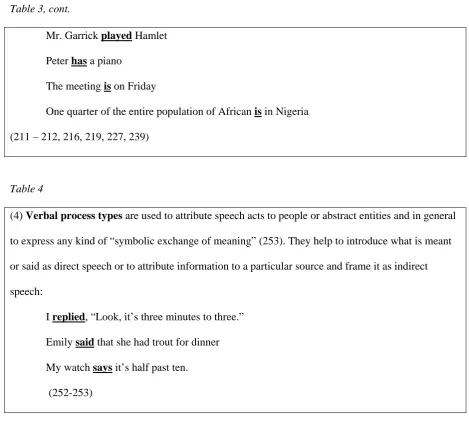
a particular social event or action. Though Halliday differentiates between six process types,
depending on the type of action or activity which the verb represents, I will refer to only four process
types in my analysis. The following charts include short descriptions and examples of different
process types, with the verbs representing the process highlighted and underlined:
Table 1
(1) Material process types refer to the physical processes of the “external world,” and are used to depict actions and events (“doings” and “happenings” [180]), including abstract or metaphorical
processes:
The lion sprang
Emily caught a trout I hit Peter
The company has succeeded
Table 2
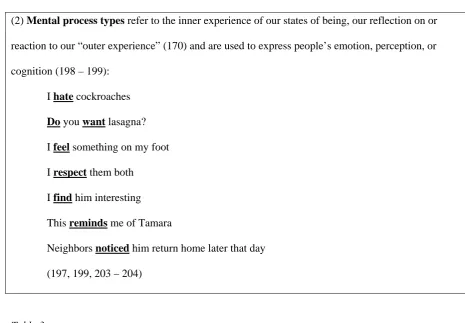
(2) Mental process types refer to the inner experience of our states of being, our reflection on or reaction to our “outer experience” (170) and are used to express people’s emotion, perception, or
cognition (198 – 199):
I hate cockroaches
Do you want lasagna? I feel something on my foot I respect them both
I find him interesting This reminds me of Tamara
Neighbors noticed him return home later that day (197, 199, 203 – 204)
Table 3
(3) Relational process types are used to classify, characterize, or identify people, objects or concepts (210), usually with the help of the verbs “to be” or “to have” (or an equivalent) (214), to express
possession, and to ascribe the circumstance of time, place, manner, cause, accompaniment, role,
matter or angle (240). Relational clauses set up a “relationship of being” between two entities:
“something is said to ‘be’ something else;” (213) or something ‘possesses’ something else.
There are important differences among the first three types: while material clauses construct
experience solely as having an impetus in the external world, mental clauses construct experience
solely as unfolding from within; relational clauses can construe both inner and outer experience:
The bottle is empty Sarah is wise Peter is a genius

![Table 13 Participant [You] (implied -- imperative)](https://thumb-us.123doks.com/thumbv2/123dok_us/8933591.1847249/50.595.67.529.91.256/table-participant-you-implied-imperative.webp)