Tanaffos (2002) 1(4), 51-59
2002 NRITLD, National Research Institute of Tuberculosis and Lung Disease, Iran
Development of a New Method for Sampling and Analysis
of Biomarker of Lipid Peroxidation in Exhaled Breath
Mansur Azari1, Shane Que Hee2
1Faculty of Public Health, Shaheed Beheshti University of Medical Sciences and Health Services, TEHRAN-IRAN, 2Department of Environmental Health Sciences, School of Public Health, University of California Los Angeles, Los Angeles-California, USA
ABCTRACT
Background: The measurement of breath ethane and pentane has offered noninvasive method for evaluating of lipid peroxidation in occupations exposed to free radicals and whole body radiation. However, the methods introduced up to this date have particular complexities, that makes such measurements not easily accessible for routine monitoring of high risk occupational groups.
Materials and Methods: The new sampler consists of a 5-centimeter stainless steel syringe packed with Carboxen - 1000. Sampler, after heat conditioning (200 0C for 2 hours) was utilized for adsorption of breath alkanes and isoprene, it was subsequently injected in the injection port of gas chromatography (GC) for analysis.
Results: Breath pentane and isoprene were analyzed just with gas chromatograph without auxiliary cryfocusing equipment or a thermal desorber with sensitivity of ≥15 ρmol/l. Humidity of breath volume up to 320ml did not cause problems in sampling and analysis of breath alkanes.
Conclusion: This study introduces a reliable and practical method for to measure breath pentane and isoprene. (Tanaffos 2002; 1(4): 51-59)
Key words: Lipid Peroxidation, Free Radicals, Breath Pentane.
INTRODUCTION
Biomonitoring of exposure to environmental hazardous chemicals, physical and biological agents is gaining more momentum in toxicology in recent decades. Biomarkers have been developed and validated in exposed populations that quantify individual exposure, susceptibility, and early markers of health effects and can be used to study relationship between exposure and environmentally induced disease and possibly to screen vulnerable individuals (1).
Correspondence to: Azari, M.
Tel.:+98-21-8907294; fax:+98-21-8907893
E-mail address: [email protected]
(9). However, the other successful methods have utilized elaborate cold trap and thermal desorption (10). In recent years, a very novel method of sampling of environmental hydrocarbons has been introduced by solid phase, micro-extraction technique(11-13). In these methods a new sampler does not need a separate thermal desorption or elaborate cold trap. Solid phase micro-extraction sampler has not been used breath ethane and pentane up to this date. Grote (14) has used the modified version of solid phase micro-extraction (SPME) successfully for sampling and analysis of ethanol, acetone, and isoprene in exhaled breath. The most notable discovery in this paper is simplicity of sampling and analysis. However, problems of peak widening were reported in chromatograms, which was dealt with cryofocusing of released analytes by programmable injection port of GC. However, detection limit of the SPME used for sampling breath isoprene (fairly similar compound to pentane) was far above the concentration breath pentane at 3.8-302.5 ρmol/l (15). Generally, analytical methods involved with breath ethane and pentane requires cumbersome concentrating procedure of breath analytes in order to increase the sensitivity of such analysis (14,15). Considering simplicity of SPME sampling., the objective of this study was to develop a new sampler called Micro Packed Injector (MPI). The sampler, simply consist of a hypodermic needle packed with adsorbing materials, which acts as a sampler without the need for separate desorption and is injected directly into a injection port and released analytes are injected abruptly with 1ml of carrier gas into the column for gas chromatography for analysis.
MATERIALS AND METHODS
Chemicals and Materials: Chemicals such as
n-pentane, isoprene and hexane (99%+ HPLC grade) were purchased from Sigma-Alderich (Milwaukee, WI). Standard gases such as methane, ethane,
propane, and butane (99% grade) were purchased from Nor Lab (Boise, Idaho). Ultra pure air (hydrocarbon free air) was obtained from “Air Products Co”. (Long Beach Calif).
Materials: Air sampling Tedlar bags (1L, 3L, 5L and
8L) were used for standard preparation (SKC Co.). Three and 2 inch steel needles (gauges 18 and 20) and luer-lock syringes (5, 10 and 50 ml) were obtained from Hamilton Co. (Los Vegas, Nevada), Carboxen-1000 mesh size 60-80 was purchased from Supelco Co. (Milwaukee, Ohio). The SPME fibers and holders were also obtained from Supelco Company.
Selection of adsorbing materials for Micro Packed Injector:
Few types of adsorbing materials such as Carbosieve SIII, Carboxene-1000, and Anasorb®CMS are capable of adsorbing breath alkanes C2-C6. Hydrophobic Carboxen-1000 with highest retention volume for breath alkanes was selected as the best adsorbent material for breath alkanes and isoprene (16).
2-inch-needle gauge 18 and 3-inch-needle gauge 20 were filled with Carboxen-1000 under strong suction vacuum. Both ends of needle were closed with a piece of 1.5 mm of a needle with finer gauge (Figure-1).
Figure 1. Micro Packed Injector designed for extracting breath alkanes and isoprene
The amount of Carboxen-1000 packed in 2-inch-needle gauge 18 was about 12 mg. Micro Packed Injector (MPI) was conditioned at 200 0C in the oven
Preparation standard atmosphere: Stock standards of ethane, butane, Pentane, and isoprene were prepared by injecting of known volume of pure liquid (pentane and isoprene) and 99.9% gas (ethane, butane) into a fixed volume of the hydrocarbon free air (HCFA) in cleaned Tedlar bags (washed five times with HCFA). The volume of HCFA in the bags was measured according to the flow of air by a clean flow meter and time of flow. After heating and ruffling stock bags containing ethane, butane, pentane, and isoprene, they were used for preparation of standard atmospheres. Standards were prepared by diluting stock standard gases with HCFA. Concentration range of mixed standards of ethane, pentane and isoprene were respectively 273-2448 ρml/l, 5.34-534
ρmol/l and 5.48-584 ρml/l. To all standard atmospheres in Tedlar bags (containing 5L of HCFA), 160 ρmole of butane were added as an internal standard.
Two sets of standard atmospheres (dry and humidified 100%) were prepared. Standards were kept at room temperature of 22.5 0C but were heated
and raffled half an hour prior to extraction by MPI.
Collecting exhaled breath samples: Breathing apparatus of a 3M hood (3M Co.) connected to HCFA cylinder by teflon tubing. Volunteered subjects breathed pure air wearing 3M hood for 4 minutes for lung wash out. After 4 minutes of washing period, exhaled breath was sampled, while subjects breathed HCFA under normal breathing condition. Exhaled breath was collected by a sterile mouth piece connected to a Tedlar bag by teflon tubing.
Extraction of ethane, butane, pentane, and isoprene from standards and breath samples by MPI. Standards and breath samples were extracted by heat conditioned MPI (200 0C for at least 2 hours) at fixed room
temperature (22.5 0C) and cryogenic condition
at – 42 0C. Cryogenic apparatus consisted of a 100
ml plastic bottle connected to the central vacuum with flow of 60 ml/min and had two ports for passing
through 2 or 3 inches MPI. Sharp side of MPI was then inserted to septum of Tedler bag and the other side of it, was connected to a central vacuum system with flow of 20-25 ml/min.
Cooling agent was liquefied 1,1,1,2 Tetraflouroethane (Fisher Co.) which was sprayed over MPI by a tube inserted in plastic bottle, and temperature was measured by a electronic thermocouple device. Extraction at room temperature was similar to previous condition except cryogenic condition.
Analytical instrument parameters: Perkin Elmer 2000 Gas Chromatograph equipped with flame ionization detector was employed for experimental analysis in this study. A packed stainless steel column a 1.5m ×
3.18 mm OD packed with 80-100 mesh poracil C from Alltech company was utilized for proper separation of breath alkanes from isoprene. The flow of carrier gas N2 (Air Products) was set at 9.8 ml/min. Oven temperature was initially programmed at 22.5 0C for 4.5 minute and
temperature was increased at the rate of 30 0C/min to
90 0C and hold constant for 2 minutes in order to
clean the column from residual humidity.
Injection port of the GC was modified for insertion of needle gauges 20 and 18. Injection port was equipped with a pierced septum obtained from Supelco and temperature was set at 275 0C.
Optimization of gas chromatograph for analysis of breath analytes. Flow of hydrogen Gas, air, carrier gas, and FID temperature were optimized for analysis of breath analytes. Since fairly smooth base line of chromatograph (Figure 2) was obtained in this study, Hewlett Packard recorder was set for fairly high sensitivity (Threshold -5 and Attenuation -3). Loaded MPI was inserted fully at the injection port of GC (275 0C), and highest level of detection was obtained
Co. Nevada), b) abrupt injection of desorbed analytes from MPI with 1ml of carrier gas N2 into the column.
Determination of hydrocarbon elution times: Separate standard atmospheres of methane, ethane, butane, pentane and isoprene and mixed standards were prepared as described earlier; furthermore, 1ml of each standard was injected directly into the gas chromatograph, and retention time of each analyte, independently and with respect to internal standard (butane) was obtained. Moreover, peaks of mixed standards and breath samples were identified according to their retention times.
RESULTS
Representative chromatogram of HCFA and mixed standard (methane, ethane, propane, butane, pentane and isoprene) and a breath sample is shown in the figure 2.
Ratio of peak area for each analytes to peak area of internal standards was considered for drawing calibration curves and quantification of breath alkanes and isoprene. Pentane and methane were
detected in HCFA; furthermore, area ratio of methane/butane and pentane/butane were detected from all standards and breath samples prior to quantification. Data regarding linear range, precision, and limits of detections are presented in Table 1. Linear range of standard ethane in range of 273-2448
ρmol/l extracted through MPI (total volume of 320 ml) at -42 0C temperature produced linear calibration
curve, Y=0.7009X, r2=0.988 and p<0.001. Linear
range of pentane standards in concentration range of 15-1184 ρmol/l and extraction of 320 ml through MPI at room temperature (22.5 0C) produced linear
calibration Y= 1.4064X, r2=0.999 and p<0.001.
Linear range of isoprene standards in the range of 30-1504 ρmol/l and extraction of 320 ml by MPI at room temperature (22.50C) produced linear
calibration curve Y=1.4082X-0.0054, r2= 0.999,
p<0.001.
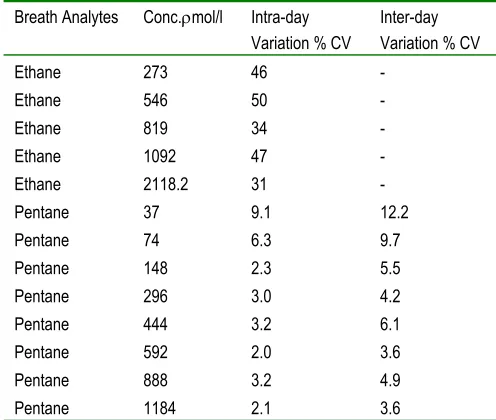
Analytical precision and limit of detection: Coefficient of variation of intra-day and inter-day measurements of ethane, pentane, and isoprene standards (humidified) through extraction by MPI are shown in Table 1.
Fig2. An example of breath chromatogram
Methane Butane
Pentane
Isoprene
Table 1. Linear range, Precision and limits of detection
a-Specifications of linear range of humidified standard atmospheres
Breath Analytes Linear concentration Range
(ρmol/l) r
2 p-Value
Ethane * 273-2448 0.988 <0.001
Pentane** 15-1184 0.999 <0.001
Isoprene** 30-1504 0.999 <0.001
b-Precision of breath analytes measurements Breath Analytes Conc.ρmol/l Intra-day
Variation % CV
Inter-day Variation % CV
Ethane 273 46
-Ethane 546 50
-Ethane 819 34
-Ethane 1092 47
-Ethane 2118.2 31
-Pentane 37 9.1 12.2
Pentane 74 6.3 9.7
Pentane 148 2.3 5.5
Pentane 296 3.0 4.2
Pentane 444 3.2 6.1
Pentane 592 2.0 3.6
Pentane 888 3.2 4.9
Pentane 1184 2.1 3.6
c-Limits of Detentions (ρmol/l)
Ethane Pentane Isoprene
200 10 15
* Extracted at-42 0C
** Extracted at room temperature (22.5 0C)
Maximum CV for the measurement of pentane and isoprene at room temperature (22.5 0C) is less than
10%. However, the results for ethane are not as good as pentane and isoprene. The detection limit of ethane standard using MPI utilizing cold trap (-42 0C), pentane and isoprene were respectively 200 ρmol/l, 10 ρmol/l and 15 ρmol/l. Limits of detection were calculated from lowest concentrations of standards that produced peaks area three times more than background peaks.
Recovery of triplicate of known standards of ethane, pentane and isoprene were investigated
against the respective calibration curve. Recovery of ethane standards (544 ρmol/l) extraction at -42 0C at
flow 20-25 ml/l with total volume of 320 ml was in the range of 100 ± 40% the actual concentration. Recovery of mixed standards of pentane (16,32 and 96ρmol/l) and isoprene (146, 438, 876 ρmol/l) and extraction at room temperature (22.5 0C) at flow
20-25 ml/l with total volume of 320ml were in range of 100±10%. Recoveries of dry standards were also performed by increasing volume of extraction of each standard. Mixed standards of pentane and isoprene also produced 100±10% recoveries for 250% of volume of extraction in this study.
Stability of standards. Stability of target compounds for analysis in breath (ethane, butane, pentane, and isoprene) was tested. Ethane standards were not stable more than 24 hours, but pentane, isoprene, and internal standard (butane) were stable at least five days. All mixed standards and samples were not kept more than 24 hours.
Breath analysis: Breath samples were extracted and analyzed with the same a procedure as in standards. In this study, breath samples of 10 volunteers were collected and tested for breath alkanes and isoprene; results are presented in table 2. Breath ethane could not successfully be measured in this study utilizing cold trap at minus 42 0C. Reproducibility of breath
analysis is also represented in table 2.
Table 2. Results of breath pentane and isoprene analysis (ρmol/l)
Subject Code No. Pentane Isoprene
S-3 52 667
M-3 72 620
A-3 15 148
T-2 17 558
W-1 40 863
C-1 24 400
Z-3 50 551
B-2 52 780
DISCUSSION
All studies in regard to measurement of breath alkane have used some kinds of trapping media plus cryogenic condition and subsequent desorption by single or double thermal desorber (8). The new technique presented in this study offers a simpler method of measurement, since it does not require a separate costly thermal desorber, and extraction with MPI does not release trapped compounds in slow pace; as a result, it does not need cryofocusing at injection port as indicated in the earlier study (14). Reliability of the introduced method in term of precision, recovery, sensitivity, and lowest quantifiable breath pentane (10 ρmol/l) is comparable to the most recent study introduced by Knutson (15). Previous studies have reported variable concentration of breath pentane ranging from 5ρmol/l to 5nmol/l, which was attributed to inadequate separation of isoprene from pentane (9) and also improper washing of lungs from ambient air contaminated with ethane and pentane (8). The quality of chromatography of pentane from isoprene, in this study, was satisfactory (Figure 2). Washing period of subject’s lung for 4 minutes, which reported by many investigators as a sufficient (15) lung wash out period, was observed in this study. Breath pentane measured in this study ranged from 15-72 ρmol/l, which was also comparable to the most recent breath-alkane study (15). 1.5m Poracil C column was used rather than 15m column for efficient chromatography of breath alkanes from isoprene which is abundant in breath as metabolite of cholesterol (14). However, in contrast to previous chromatography of breath, the conditions were modified for better separation such as lowering both the temperature of oven to 22.5 0C rather than 40 0C
and carrier gas flow to 9.8ml/min, as a result total run time of 90 minutes was reduced to 14 minutes, which could be considered as a more practical
chromatography. Identification of peaks was accomplished just by retention times; therefore, additional verification by mass spectrometry could be helpful in the future studies. Thus, chromatographic condition of this study with carrier flow of 9.8ml/min would be much better for mass detector.
Various studies reported interference of humidity in trap and purge technique as well as causing problems in functioning of chromatographic separation (14,15,17). However, the newly developed MPI’s adsorbing capacity is not damaged by extraction of 320 ml of breath and or damaged the column. As it was demonstrated earlier the retention volume of MPI for dry standards can be increased 250% without any break through in adsorption of pentane and isoprene; therefore, this method could be even more sensitive for sampling of alkanes in a relatively dry environmental air. Generally, the new method introduced in this study does not require dehumidification process for extraction of 320 ml of breath as reported in other studies analyzing breath pentane and isoprene (14,16). Nevertheless, the new technique for trapping breath alkane did not produce good results for ethane comparing to pentane (Table 1). The poor result for analysis breath ethane is possibly due to insufficient cold trap for trapping ethane with boiling point of -88 0C. It is suggested
that lower temperature of cold trap by applying liquid nitrogen must be considered in future studies.
lipids in human bodies (19). In addition, since there is no consensus for preference for breath ethane as a better marker of lipid peroxidation (8), the measurement of breath pentane using MPI is suggested for examining level of oxidative stress among different occupational groups, general population exposed to free radicals and ionizing radiation, and screening susceptible population groups(20).
The technique used in this study is also quite efficient for monitoring of possible toxicity of isoprene in breath of patients during hemodialysis (21) and environments of certain workplace producing of polyisoprene elastomers (22).
The new method described in this paper is a novel and practical way of concentrating low level breath pentane without the need of a separate desorption equipment or complex gas chromatography, and it is hoped that the present method could be further applied for variety of hydrocarbons in ambient air in ppb and sub-ppb range.
REFERENCES
1. Suk WA, Collman G, Damstra T. Human biomonitoring:
research goals and needs. Environ Health Perspect 1996;
104(Supple 3): 479-83.
2. Hassoun EA, Wang H, Abushaban A, Stohs SJ. Induction of
oxidative stress in the tissues of rats after chronic exposure
to TCDD, 2,3,4,7,8-pentachlorodibenzofuran, and
3,3’,4,4’,5-pentachlorobiphenyl. J Toxicol Environ Health
A 2002; 65(12): 825-42.
3. Chen F, Vallyathan V, Castranova V, Shi X. Cell apoptosis
induced by carcinogenic metals. Mol Cell Biochem 2001;
222(1-2): 183-8.
4. Arterbery VE, Pryor WA, Jiang L, Sehnert SS, Foster WM,
Abrams RA, et al. Breath ethane generation during clinical
total body irradiation as a marker of
oxygen-free-radical-mediated lipid peroxidation. Free Radic Biol Med 1994;
17(6): 569-76.
5. Kretzschmar M, Muller D. Aging, training and exercise. A
review of effects on plasma glutathione and lipid
peroxidase. Sports Med 1993; 15(3): 196-209.
6. Arora A, Willhite CA, Liebler DC. Interactions of
beta-carotene and cigarette smoke in human bronchial epithelial
cells. Carcinogenesis 2001; 22(8): 1173-8.
7. Perez DD, Strobel P, Foncea R, Diez MS, Vasquez L,
Urquiaga I, et al. Wine, diet, antioxidant defenses, and
oxidative damage. Ann NY Acad Sci 2002; 957: 136-45.
8. Kneepkens CM, Lepage G, Roy CC. The potential of the
hydrocarbon breath test as a measure of lipid peroxidation.
Free Radic Biol Med 1994; 17(2): 127-60.
9. Springfield JR, Levitt MD. Pitfalls in the use of breath
pentane measurements to assess lipid peroxidation. J Lipid
Res 1994; 35(8): 1497-504.
10. Knutson MD, Viteri FE. Concentrating breath samples
using liquid nitrogen: a reliable method for the simultaneous
determination of ethane and pentane. Anal Biochem 1996;
242(1): 129-35.
11. Koziel J, Jia M, Pawliszyn J. Air sampling with porpous solid-phase microextraction fibers. Anal Chem 2000; 72(21): 5178-86.
12. Martos PA, Pawliszyn J. Sampling and determination of formaldehyde using solid-phase microextraction with on-fiber derivatization. Anal Chem 1998; 70: 2311-20. 13. Martos PA, Pawliszyn J. Time-weighted average sampling
with solid-phase microextraction device: implications for enhanced personal exposure monitoring to airborne pollutants. Anal Chem 1999; 71(8): 1513-20.
14. Grote C, Pawliszyn J. Solid-phase microextraction for the analysis of human breath. Anal Chem 1997; 69(4): 587-96. 15. Knutson MD, Lim AK, Viteri FE. A practical and reliable
method for measuring ethane and pentane in expired air from humans. Free Radic Biol Med 1999; 27(5-6): 560-71. 16. Wang J-L, Chen Lin Y-H, Tsai C-H. Retention volumes of
adsorbing materials. Journal of Chromatog A 2000; 896: 31-9.
volatile organic compound from the atmospheric air.
Analyst 2000; 125: 2112-17.
18. Supelco chromatography products catalog. Supelco application note 2001; 187: supelco Inc, USA.
19. Dillard CJ, Dumelin EE, Tappel AL. Effect of dietary vitamin E on expiration of pentane and ethane by the rat.
Lipids 1977; 12(1): 109-14.
20. Block G, Dietrich M, Norkus EP, Morrow JD, Hudes M, Caan B, et al. Factors associated with oxidative stress in human populations. Am J Epidemiol 2002; 156(3): 274-85.
21. Capodicasa E, Trovarelli G, De Medio GE, Pelli MA, Lippi G, et al. Volatile alkanes and increased concentrations of isoprene in exhaled air during hemodialysis. Nephron 1999; 82(4): 331-7.