The Effects of Processing Instruction, Consciousness-Raising Tasks, and Textual Input Enhancement on Intake and Acquisition of the English
Causative Structures
Manoochehr Jafarigohar
Assistant Professor of TEFL, Department of Foreign Languages and Literature, Payame Noor University
Mehri Jalali a
PhD Candidate of TEFL, Department of Foreign Languages and literature, Payame Noor University
Received 2 July 2013; revised 16 February 2014; accepted 23 February 2014
Abstract
The importance of input has been a broadly documented concept in the field of second or foreign language acquisition. However, kinds of input and ways of its presentation are among the controversial issues in L2 classroom research. Therefore, this study was designed to compare the effects of three kinds of input-based instruction on intake and acquisition of the English causative structures by Iranian EFL learners. A total of 105 university students in four intact classes were randomly assigned to four different conditions: processing instruction (PI), textual input enhancement (TE), consciousness-raising (C-R), and control (CO). A pretest/posttest (immediate and delayed) design was used, where participants’ ability to interpret and produce the target structure was assessed through administering a multiple choice interpretation test and a sentence-level production test. Moreover, a grammaticality judgment test was run to assess the amount of
a
Email address: [email protected]
Corresponding address: Department of Foreign Languages and Literature, Payame Noor University, POB: 19395-4697 Tehran, I. R. Iran
intake. Results revealed that learners in the PI group significantly outperformed learners in the other groups on both immediate/delayed production posttests. The findings also indicated that, C-R group could not retain the significant effect of instruction on delayed production posttest and TE tasks were not effective in improving the learners’ production of the target structure. Moreover, the PI group outperformed the other groups on grammaticality judgment test too. Based on these findings, we can conclude that PI which encompasses the most outstanding features of both focus on form and meaning instruction might be a more effective approach in helping EFL learners to acquire the target grammatical forms.
Key words: Consciousness-raising; Focus on Form; Input processing; Intake;
Processing instruction; Textual input enhancement
Introduction
According to Gass (1997), second language (L2) learning cannot happen without some sort of input and many researchers (e.g., Benati, 2001, VanPatten, 1996) have
supported this idea regardless of the theoretical approach they follow. Building
upon this understanding, some studies have focused on instructional approaches that might improve input in order to promote acquisition (e.g. various kinds of explicit or implicit form-focused instruction). For example, findings of Hernandez’s (2011) study showed that accompanying input with explicit form-focused instruction might result in noticing and subsequent intake of the target forms. In direct contrast to these conclusions; however, findings of a number of empirical studies (Morgan-Short, Sanz, Steinhauer, & Ullman, 2010) have revealed that explicit instruction is not a significant contributor to SLA and input alone is sufficient for developing learners’ interlanguage. Given that the effectiveness of explicit or implicit instruction still remains in question, this study investigated the comparative effectiveness of three instructional treatments, namely processing instruction (PI), consciousness-raising tasks (C-R), and textual input enhancement (TE) in acquisition of the English causative structures. Even though this research was conducted in a foreign language setting, the terms acquisition and learning are used interchangeably since according to Ellis (2008), second language acquisition refers to the acquisition of any language after the acquisition of the mother tongue regardless of the role that language plays in the community.
Literature Review
As VanPatten (1996) states, input, intake, developing system, and output are basic processes of language acquisition. He believes that rather than providing learners with chances to produce the target features, instruction should focus on changing how learners process input since this kind of instruction is more likely to be changed into intake and has significant effects on developing language system. Reinder (2005) defines intake as “a subset of the detected input (comprehended or not), held in short-term memory, from which connections with long-term memory are potentially created or strengthened” (p. 73). In this regard, input-based motivated approaches like VanPatten’s (1996) Processing Instruction (PI) might be more effective than the instruction which requires learners to produce language as it supplies a direct route for converting input into intake. According to VanPatten (2004), L2 learners use some default input processing strategies which prevent them from making form-meaning connections efficiently or attending to target linguistic forms. He has organized these strategies under some principles in the input processing model which serves as the basis of PI
WanPatten (2004) points out that the purpose of PI as an explicit Form-Focused Instruction (FFI) is to alter the faulty processing strategies learners use in task comprehension and to engage them in activities which have been manipulated in order to make language forms more salient. In this way, learners move towards more systematic processing techniques to acquire those forms effectively. According to Benati (2001), while output practices like traditional instruction (TI) might help learners to develop fluency and accuracy in production, they are not so useful in getting the grammar into the learner’s head.
PI is made of three components: explicit grammatical explanation, information on processing strategies that may negatively affect learners’ attention to the form or structure during comprehension, and structured input (SI) activities. Structured input activities are referential and affective meaning-focused tasks that direct learners away from production. In these activities, input is manipulated in specific ways to make learners rely on form to get the meaning (VanPatten, 2007).
VanPatten and Cadierno (1993) were the first investigators who compared the effects of PI and TI on the development of Spanish preverbal direct object pronouns by second-year Spanish students. Researchers used a pre-test/post-test design to measure probable outcomes of a two day treatment. Findings revealed
that for the interpretation test, the PI group performed significantly better than the traditional group and the control group. In contrast, for the production test, there was no significant difference between the test scores of the experimental groups, but both of them performed significantly better than the participants in the control group.
On the other hand, Farley (2001) addressed the issue of meaningfulness and compared the effects of PI and meaningful output-based instruction on the acquisition of subjunctive forms in Spanish. Participants were randomly assigned to PI and meaningful output-based instruction groups and both groups received explicit information on processing strategies. Results revealed that learners in the PI group scored higher than those in the meaningful output-based instruction group on interpretation test. Surprisingly, similar to the results of the studies in PI strand that had used TI as a grammar instruction approach (Benati, 2001), findings of this research did not show any significance difference between the mean scores of both groups on immediate / delayed production posttests.
Moreover, components of PI have been the focus of attention by some other researchers. The first research in this field was conducted by VanPatten and Oikenon (1996) who selected the Spanish direct object pronouns and syntax as their target structures and divided their participants into three treatment groups: (a) full PI group, (b) explicit grammar explanation only group, and (c) referential structured input activities only group. Results indicated that the performance of the full PI group and the structured input only group on interpretation tasks improved similarly from pretests to posttests, while the explicit grammar explanation only group did not make any gains. Likewise, the structured input only group and the full PI group scored higher than the only explicit information group on the production tasks. As a result, VanPatten and Oikenon (1996) concluded that structured input activities were responsible for learning the target forms by learners through making form-meaning connections. They also stated that explicit explanation is not a necessary component of PI.
On the other hand, Takimoto (2007) attempted to compare the effects of PI components with another type of input-based instruction namely consciousness-raising task. For this purpose, she assigned sixty Japanese learners of English to three groups: (a) structured input tasks with explicit information, (b) consciousness-raising tasks, and (c) structured input tasks without explicit
information. Results revealed that the three treatment groups were equally successful in using the English polite request forms. Therefore, this study also failed to find any significant effect for the explicit information in PI.
According to Eckerth (2008), consciousness-raising (C-R) is a grammar instruction approach which persuades learners to concentrate on language forms believing that an awareness of forms is indirectly related to language acquisition. Fotos (1994) asserted that C-R tasks do not engage learners in repeated production as their purpose is not enabling them to perform structures correctly, but they help them to achieve explicit knowledge about these linguistic features through problem solving activities. Moreover, Yip (1994) stated that these tasks hold a middle-ground position on the continuum of grammar instruction approaches which starts with Zero approaches (no need for instruction) and ends with traditional grammar-based approaches (explicit instruction). According to Ellis (1997), isolating specific linguistic features for focused attention, providing the data which illustrate the target features, and using intellectual effort by learners to understand and articulate rules describing these features are specific characteristics of C-R tasks.
So far, many studies (e.g., Fotos & Ellis, 1991; Mohamed, 2001; Shak & Gardner, 2008) have attempted to examine the effects of C-R tasks on the development of grammatical knowledge. For example, Fotos and Ellis (1991) examined the effects of traditional instruction and C-R tasks on learning dative
alternation by Japanese learners of English. Results revealed that both treatments
had significant effect on improving the learners’ scores on the immediate comprehension posttest. However, learners in the traditional instruction group were more successful in maintaining the significant effect of their instruction on delayed posttest. In contrast, findings of Mohamed’s (2001) study were not in favour of traditional instruction. He found that consciousness-raising tasks were more effective than traditional instruction when applied to high intermediate ESL learners from mixed L1 background in comparison to low intermediate learners, suggesting that learner’s proficiency level can affect the effectiveness of C-R tasks.
Shak and Gardner (2008) studied young learners’ attitudes towards different form-focused activities including C-R tasks. They investigated C-R, dictogloss, grammar interpretation and grammaring tasks with 78 children from three intact classes in Brunei who were learning English as a foreign language. Results of an attitude questionnaire showed that while there was a general trend of positive
attitudes among children towards C-R tasks, variations in task preference existed mainly with respect to three main sources of influence: cognitive demands, production demands, and pair/group opportunities. As a result, they suggested that to improve children L2 proficiency, C-R tasks should be supplemented with sufficient contextual support to guarantee a sense of accomplishment in learners.
On the other hand, Takimoto (2012) compared the effects of C-R tasks with a more implicit approach namely input enhancement (IE) on the development of speech act of apology by Japanese university students. The results of the multiple-choice discourse completion task indicated that learners in the C-R group outperformed those in the IE group and the control group on both immediate and
delayed posttests.
Input enhancement is a theory-based language approach proposed by Sharwood Smith (1991). He defines it as "any pedagogical intervention that is used to make specific features of L2 input more salient as an effort to draw learners’ attention to these features” (p. 119). Theoretically, this approach is grounded in models of SLA that consider noticing L2 input as a requirement for its further processing (Gass, 1997). Different types of input enhancement vary in their degree of explicitness. Alsadhan (2011) argued that explicitness refers to the degree of complexity applied in attention-drawing. He believed that meta-linguistic description of the target linguistic features needs the maximum amount of explicitness, whereas textual enhancement requires the minimum amount of explicitness. Textual enhancement (TE) is an implicit input enhancement technique used to expand the saliency of the new target forms (Sharwood Smith, 1991). According to Simard (2009), TE attempts to draw learners’ attention to linguistic features through typographical cues like underlining, boldfacing, italicizing, capitalizing, highlighting, and changing the size or the font of the letters.
Results of studies on textual input enhancement are controversial. Some investigations have shown a positive effect for it (e.g., Doughty, 1991; Wong 2002). In a lab study, Doughty (1991) examined the impacts of two types of comprehension-based instruction on acquisition of the English relative clauses. Participants were randomly divided into three groups: a meaning oriented group, a rule oriented group, and a control group. Results revealed that TE and its combination with explicit instruction also could lead to improving the intake of the target structure. Doughty claimed that since both experimental groups improved
from the pretest to the posttest, it can be inferred that input enhancement might have been the cause.
In direct contrast to these conclusions, other researchers have offered evidence against the significant role of TE in second language learning. For example, Overstreet’s study (1998) showed using this technique might actually hinder L2 learners’ comprehension of the target language input. He examined the effects of TE and content familiarity on comprehension and acquisition of the Spanish preterit and imperfect. The measurement instruments were grammaticality judgment test, comprehension quiz, and production task. No significant effect was found in favour of input enhancement. Moreover, text familiarity did not appear to facilitate the acquisition of the target forms.
However, some studies have shown only a minimal effect for TE. For example, Izumi (2002) examined the effects of four output and visual input enhancement techniques on the acquisition of English relativization. Results indicated that visual enhancement tasks were effective in noticing but not learning of the target form.
As discussed above, PI, C-R, and TE are well-researched focus-on-form approaches which try to direct L2 learners’ attention to linguistic features in meaningful contexts. As a result, it would be theoretically appealing to compare their pedagogical effects in classroom settings. A review of the literature of PI studies reveals that most of the studies in this field (e.g., Han & Liu, 2013; VanPatten & Uludag, 2011) have been criticized in different ways such as using measurement tasks which assess learners’ comprehension of the input passage instead of measuring input processing of the target linguistic features. In addition, they have not preserved loyalty to the standard steps introduced by VanPatten (1996) in their design and few studies have compared PI with other kinds of input-based instruction (Lee & Benati, 2007).
On the other hand, the existing body of research in C-R paradigm confirms that most of these studies have focused on certain target structures and this makes generalizability of their findings difficult. The main reason is that a C-R task which has been proved effective in facilitating the acquisition of one linguistic feature might not necessarily be effective when applied to other linguistic features due to their different linguistic complexity and frequency of occurrence. Therefore, the need for doing more research on different linguistic features is sensed. Moreover,
the controversial results of the studies conducted on TE make further research necessary. Thus, the present study can contribute to the input-based instruction database by examining the effects of PI, C-R tasks, and TE on helping EFL learners improve their intake and acquisition of the English causatives. This target structure was selected based on the faulty strategy mentioned in VanPatten’s (1996) First Noun Principles in which learners usually consider the first noun or pronoun that appears in the sentence as the real agent.
Research Questions The study attempted to answer the following questions:
1. Is there any significant difference among the study groups (PI, C-R, TE,
CO) in terms of their performances on the interpretation of the English causative structures over time?
2. Is there any significant difference among the study groups (PI, C-R, TE,
CO) in terms of their performances on the production of the English causative structures over time?
3. Is there any significant difference among the study groups (PI, C-R, TE,
CO) in terms of their performances on the intake of the English causative structures?
Methodology
Participants
Four intact classes consisting of 119 male and female students (M age = 24.5 years, age range: 19–35 years) who had enrolled in the General English Course in one of the universities of Iran participated in this study. All of them had studied English for 6 to 7 years in junior and senior high school and their first language was Persian. Based on the scores on an English language proficiency test (Cambridge: PET), the participants were assessed as being at the pre-intermediate level. It is notable that the data from 14 learners were removed from the original pool mainly due to some reasons like knowledge of the target structure and level of language proficiency.
Target structure
As mentioned before, the target structure (English causatives) in this study was selected based on VanPatten’s (1996) “First Noun Principle”. According to this principle, the order in which learners encounter sentence elements is a powerful factor in assigning grammatical relations among sentence elements. In this regard,
VanPatten pointed out that, “the human mind may be predisposed to placing agents and subjects in a first noun position” (2004, p.15). Thus, English causatives are good examples for investigating this principle. In these structures, the first noun is not the real agent of the sentence and this makes their comprehension and production difficult. It is important to mention that the meaning difference between
the causative verbs have and get was not considered as a factor in this study and
they were grouped together with the same meaning against the verbs let, help, and make. All of the verbs were also considered in active voice.
Teaching materials
Separate instructional packages were developed for each treatment group. The packages were reviewed by two highly proficient Iranian EFL learners, five pre-intermediate level students who were representative of the actual participants in the study, and three English language teachers. The teachers’ and students’ views resulted in changing or omitting some of the sentences and creating a bilingual vocabulary list mainly consisting of the problematic vocabulary items. The description of each instructional package is provided below.
Processing instruction. This type of instruction was operationalized
according to the guidelines presented by Lee and VanPatten (2003) which include: (a) an explicit explanation of grammar in non-paradigmatic form, (b) information on the false strategies learners usually use, and (c) structured input activities including both referential and affective tasks. This study used four structured input tasks including four referential activities, one affective activity, and one reading comprehension. To design these tasks, four short stories suitable for participants’ language proficiency level were selected. Since moving from sentences to connected discourse is one of the purposes of PI, the stories were divided into separate sentences which were presented in different structured input activities (see Appendix A).
Consciousness-raising tasks. These tasks were designed based on
Mohamed’s (2004) model of indirect C-R tasks due to some reasons such as reflecting Ellis’s (1997) guidelines in their design and their frequency of use in different studies (Takimoto, 2012). An attempt was made to isolate specific linguistic features for focused attention. Then, the data illustrating the target form was presented to the learners and they were asked to articulate the rule describing the causative structures. The same stories presented to the PI group were used
again as language data in this group. In each instructional session, students in the C-R group received a reading passage followed by a table with three columns. The table consisted of correct and incorrect samples of the target structure. Students were supposed to compare the correct and incorrect samples and explain why some of them were incorrect. Then, they were asked to construct an explicit rule for the target structure (see Appendix B).
Textual input enhancement tasks. Boldfacing and underlining techniques
were used for enhancing the target form and the treatment package contained the same stories used in the other treatment groups. After being exposed to the enhanced passages, learners received multiple-choice interpretation tests (see Appendix C).
Instruments In order to measure the effects of instruction on acquisition of the target structure, a
knowledge test including an interpretation and a production subtest was developed in three parallel forms (A, B, C) which were administered as pretest, immediate posttest, and delayed posttest. The interpretation test consisted of 25 mini dialogs (including five distractors). Moreover, a written completion task was developed to measure the participants’ ability to produce causative structures. It consisted of 13 mini dialogs (3 items were dedicated to distractors) in which students were supposed to complete their summaries by using the words (four words) provided in the brackets (see Appendix D & E).
Additionally, a timed grammaticality judgment test was developed in two parallel forms which were run as pre and posttest to measure intake of the
causative structures. They consistedof 20 sentences, half in grammatical and half
in ungrammatical forms with 5 distractor items (see Appendix F). The tests were timed because according to Reinders and Ellis (2009), in grammaticality judgment tests, giving too little time will obviously impair understanding, whereas giving too much time risks allowing participants to reflect on the sentences. For determining the time limitation, they were trialed with 10 advanced EFL learners. They answered the items quickly, but no time limitation was enforced. The average response time for each individual sentence was calculated. Subsequently, the same tests were run in a group including 20 learners of pre-intermediate proficiency level. The participants’ average time on each individual sentence was calculated once more and compared with the advanced learners’ average. The time difference
was calculated and added to the average gained for the pre-intermediate level learners. Therefore, the actual participants were given 52 seconds for every item (total time: 17 minutes). Moreover, participants were not supposed to correct the incorrect items since as Rosa and O’Neill (1999) state, production measures are not appropriate for assessing intake because intake is detected input held in working memory for immediate recognition and comprehension.
In order to ensure the reliability of the tests, they were piloted with 20 pre- intermediate level learners with characteristics similar to those of the actual participants. The Cronbach's alpha indexes were .84, .79, and .81 for different forms of the interpretation subtest (forms A, B, and C respectively) and .88, .85, and .76 for forms A, B, and C of the production subtest. KR 20 analysis was performed to calculate participants’ response consistency across the two versions of the grammaticality judgment tests. The estimated values were 0.91and, 0.88
respectively. To ensure the content validity of all of thetests, they were examined
by three ELT teachers and a number of the sentences were replaced on the basis of their difficulty level.
Scoring
In the interpretation test, the raw scores were calculated as follows: incorrect response = 0 point, correct response = 1 point (with maximum score of 20). The raw scores for the grammaticality judgment test were calculated in the same way. In the production test, the raw scores were calculated by giving 1 point to a fully correct answer, 0.25 point for using each element correctly, and zero point if all of the elements were used incorrectly (the maximum score was 10). In fact, this tolerant scoring procedure was used, as in previous investigations, to reveal any partial effects of instruction.
Procedure
The study lasted for 6 weeks including the time required for administering the
assessment measures as well as the training sessions. The language proficiency test and the pretests were administered one week before the experiment. The experiment was carried out in four sessions spanning over 4 weeks. During the treatment sessions, participants were divided into small groups of three or four to complete the tasks. Instructional groups received implicit feedback and correct answers were not provided if participants answered incorrectly in order to avoid providing them with incidental input. However, the control group was exposed to
the instruction targeting the development of reading comprehension skills with no reference to the causative structures. The timed grammaticality judgment posttest
was administered immediately after the first session of the treatment because as
Rosa and O’Neill (1999) pointed out, if process-oriented measures are used for measuring intake, they should be administrated immediately after exposure to the target feature. The first posttest immediately followed the last treatment session and the delayed posttest was administered one month later.
Results and Discussion
With regard to the first research question, results of a one-way ANOVA showed that there was no significant group difference in participants’ ability to interpret causative structures before starting the treatment, F (3, 101) = 2.22 , p > .05. Then participants’ pre, post, and delayed posttest scores were analyzed using repeated measures ANOVA with one between-subject factor (type of instruction) and one within-subject factor (time). Findings revealed a significant instruction × time
interaction effect, F (6, 101) = 52.98, p <.05, a significant main effect for time, F
(2, 101) = 183.48, p < .05 and a significant main effect for type of instruction, F (3, 101) = 56.57, p < .05. The effect size for the main effect of instruction × time interaction (ŋ² = .62), time (ŋ² = .64), and type of instruction (ŋ² = .61) were computed which were large enough to be meaningful.
Table 1
Analysis of Variance for Interpretation Subtest Scores
Source SS df MS F Sig
Between Subjects
(Instruction) 396.25 3 132.08 52.98 .000 Within Subjects (Time) 631.45 2 315.72 183.84 .000 Instruction × Time 582.78 6 97.13 56.57 .000
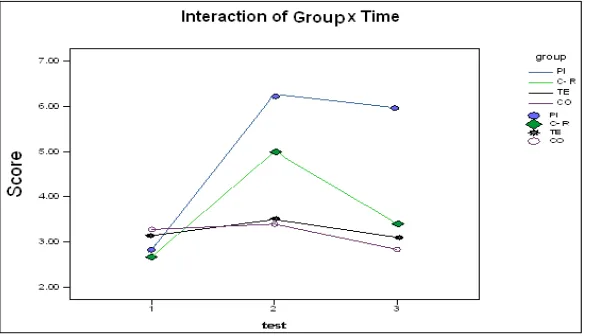
A series of post-hoc Scheffe tests were conducted on the scores of the immediate and delayed posttests to explain the contrast among the groups (Figure 1 illustrates the results). Results indicated that the three treatment groups performed significantly better than the control group on the immediate posttest and there was a significant difference between them. The PI group performed better than the other instructional groups and maintained its superiority on the delayed posttest too. However, the TE group could not retain the significant effect of instruction on the delayed post-test.
Figure 1: Interaction Plot for the Interpretation Test
In order to answer the second research question, scores from the production pretest were submitted to a one-way ANOVA and results revealed no significant differences among the means of the four groups for the production of English causatives before starting the instruction, F (3, 101) = 1.22 , p > .05. Results of
repeated measures ANOVA on the posttests scores showed a significant main
effect for time, F (2, 101) = 75.87, p < .05, a significant main effect for type of
instruction, F (3,101) = 23.38, p < .05, and a significant instruction × time
interaction effect, F (6, 202) = 30.47, p <.05. The effect size for these items were
also computed which were ŋ² = .82, ŋ² = .66, and ŋ² = .79, respectively.
Table 2
Analysis of Variance for Production Subtest Scores
Source SS df MS F Sig
Between Subjects (Instruction)
63.23 3 21.07 23.38 .000
Within Subjects (Time) 125.86 2 72.90 75.87 .000 Instruction × Time 151.65 6 29.28 30.47 .000
Results of Post-hoc Scheffe tests revealed that: (1) there were significant differences among the treatment groups on the immediate posttest. The PI group performed better than the other groups and the TE group did not have any improvement from the pretest to the immediate posttest; (2) there were significant differences among the instructional groups on the delayed posttest. The PI group maintained its improvement, while C-R group was not successful in that and control group did not make any gains. These results are illustrated in Figure 2.
Figure 2: Interaction Plot for the Production Test
To answer the third research question, the pretest scores from the grammaticality judgment test were compared through using a one-way ANOVA
and the results showed that all groups were almost equal, F (3, 101) = 4.15, p >
.05 regarding their knowledge of the target structure. Then, posttest scores were submitted to another one-way ANOVA and the findings revealed a significant
difference in how the groups judged the sentences as correct or incorrect, F (3,
101) = 62.71, p< 0.05. The results of the post-hoc Scheffe test indicated that all instructional treatments had positive effects on improving the intake of the English causative structures but these effects were not equal (PI> C-R> TE).
Table 3
Results of One-way ANOVA for Timed Grammaticality Judgment Posttest Scores Sum of
squares
df Mean square F Sig
Between Groups Within Groups Total
466.48 250.42 716.91
3 101 104
155.49 2.47
62.71 .000
Regarding the first research question, analysis of the interpretation data indicated that all of the instructional groups experienced knowledge gain on the immediate posttest; however, the amount of this knowledge was not equal (PI> C-R> TE). In contrast, the TE group could not retain the positive effects of instruction on acquisition of the English causatives. Again, the PI group maintained its superiority over the other groups on the delayed post-test and the control group did not improve on both posttests. This shows that pure implicit instruction is not enough for storing the information in long-term memory.
Analysis of the production data on immediate posttest revealed that only TE instruction did not have any significant effects on production of the target structure. As for the durability of the results, examination of the means for each group indicated that the initial production gains made by PI were sustained from the immediate posttest to the delayed posttest, whereas the C-R group was not able to retain the knowledge gained through the treatment sessions. Moreover, the positive effects of instructional packages on the interpretation and production of the causatives reduced slightly from the first to the second posttest.
Additionally, the answer to the third research question is also yes and all of the treatments had positive effect on intake of the causatives; however, PI was superior to other instructional treatments in improving the intake of the target structure. What is important about the results of the production test is that PI and C-R groups did not practice production of the causatives during the treatment at all. Hence, contrary to Swain’s (1985) claim regarding the role of output in syntactic analyses of language, PI and C-R are effective enough to result in considerable change in learners’ knowledge and it can be concluded that the effects of these kinds of instruction can be transferred to non-input tasks.
The results of the present study confirm the findings of those studies which compared PI with other grammar instruction approaches and attested to the superiority of PI for interpretation tasks (Qin, 2008; VanPatten & Cadierno, 1993). However, these findings do not confirm those presented in Marsden’s (2006) study in which PI was compared with enriched input. His findings showed that PI group made significant gain from the pretests to the posttests for both interpretation and production tasks and the gains were maintained on the delayed posttests, but input enhancement group made no gain even in interpretation tasks.
The effects of PI on intake of the causatives is in line with Lee and Benat’s (2007) argument that PI helps learners alter their processing strategies, thereby delivering better intake to their developing systems. Hence, the better intake gives way to improved performance on both interpretation and production tasks. In fact,
the main purpose of PI is to change L2 learners’ faulty processing strategy and
prepare them for comprehending the target form accurately (Qin, 2008).
Failure of the C-R group in retaining the positive effects of its instruction on the delayed production posttest and the failure of TE instruction in improving production of the target structure and retaining its positive effect on interpretation tasks give support to advocates of using explicit instruction as the most effective approach of drawing learners’ attention to the rules regulating a complex linguistic structure such as causative structures. In IE and C-R tasks, learners themselves should discover the rules, while according to Anderson (1983), most of the second language grammar is initially learnt through conscious study and application of the explicit rules.
There are some non-exclusive reasons for the results of this study. One is the fact that the less implicit forms of instruction such as TE are not sufficient for trigging the necessary cognitive processes required for language performance to happen (Qin, 2008). Leow (1997) suggested that certain methodological considerations may clarify why implicit instruction does not result in the desired goals including the level of attention learners pay to the enhanced features, and the amount of exposure to the enhancement. Ellis (1997) also presented the same argument by stating that in comparison to explicit instruction, implicit instruction is often slow and difficult and needs longer time for being effective. Therefore, the explicit information provided in PI is effective in inducing changes in learners’ L2 ability.
As for the relationship between the level of awareness and language learning, some scholars (Farley, 2001) believed that awareness at the level of noticing is not enough for language performance to occur. For progress in performance, awareness at the level of understanding is required and implicit instruction provides awareness at the level of noticing.
The effectiveness of the C-E tasks in improving intake and interpretation of causative structures is legitimized on the grounds that this form of middle-ground Form-Focused instruction provides learners with numerous opportunities for collaborative work in small groups in order to discover the grammatical rules. According to (Rutherford, 1988), discovery learning in group implies interaction among learners which ultimately results in additional noticing and restructuring of the target form. In fact, the processes of noticing, structuring and restructuring involved in C-R tasks are consistent with an organic process-oriented view of the interlanguage development which helps language learners develop an awareness of specific linguistic features at the level of understanding (Luchini, 2007). However, it seems that for long term production of grammatical structures a more explicit approach is required.
The pitfalls of TE in developing acquisition of the target structure supports the significant effect of explicit metalinguistic explanations on system learning (internalization of a group of abstract and inter-related linguistic rules, which are steadily organized into a system, Cruttenden, 1981). The findings of this study fully concur with those of preceding studies (Leow, 1997; Radwan, 2009) considering inadequate outcomes of TE in inducing changes in L2 learners’ performance.
Conclusion
The results of the present study provided further evidence for using PI for instruction of those grammatical structures that follow VanPatten’s “First Noun Principle”. Findings imply that explicit instructional approaches like PI are more effective than inductive ones for learning complex target structures. The superior effects of explicit instruction were also proved in second language acquisition investigations centring on structural features (Doughty & Williams, 1998). The possible recommendation that can be made based on the results of this research is that dedicating some parts of the classroom time to explicit grammar instruction
followed by meaningful input-based activities might help language instructors to successfully teach grammatical rules. The results of this study can be useful for English teachers and curriculum developers especially in a foreign language context where exposure to English is limited. In this regard, teachers may need to examine different tasks they use in their lessons to see whether they provide learners with the chance of processing both forms and meanings of the target forms.
Limitations of the current study suggest several areas for future research. Due to the participants’ low language proficiency level, the production test was restricted to sentence completion. Further research with advanced EFL learners is required to use free production tasks. In addition, it would be more insightful to examine the effects of these tasks with or without feedback (e.g. explicit or implicit). Moreover, this research might be improved in future replications by investigating whether the instructional treatments could be delivered effectively online as well as in classrooms. In short, such studies would provide helpful guidelines for selecting methodological options regarding grammar instruction in EFL contexts.
Notes on Contributors:
Manoochehr Jafarigohar is an assistant professor of TEFL at Payame Noor University of Tehran. He has published many articles and books in different domains of English language education with 20 years of teaching and research in distance education.
Mehri Jalali is a PhD candidate of TEFL at Payame Noor University of Tehran. Her research interests include psycholinguistics and task-based language instruction. She is currently teaching English courses at Farhangian University and Payam-e-Noor University of Saveh.
References
Alsadhan, R. O. (2011). Effects of textual enhancement and explicit rule
presentation on the noticing and acquisition of L2 grammatical structures: A meta- analysis (Unpublished doctoral dissertation). Colorado State University, Colorado.
Anderson, J. (1983). The architecture of cognition. Cambridge, MA: Harvard University Press.
Benati, A. (2001). A comparative study of the effects of processing instruction and output-based instruction on the acquisition of the Italian future tense. Language Teaching Research, 5(2), 95-127.
Cruttenden, A. (1981). Item-learning and system learning. Journal of
Psycholinguistic Research, 10(1), 79-88.
Doughty, C. (1991). Second language instruction does make a difference:
Evidence from an empirical study of SL relativization. Studies in
Second Language Acquisition, 13, 431-469.
Doughty, C., Williams, J., (1998). Issues and terminology. In Doughty, C.
Williams, J. (Eds.), Focus on form in classroom second language
acquisition (pp. 1-11). Cambridge: Cambridge University Press.
Eckerth, J. (2008). Investigating consciousness-raising tasks: Pedagogically
targeted and non-targeted learning gains. International Journal of
Applied Linguistics, 18(2), 119-44.
Ellis, R. (1997). SLA research and language teaching. Oxford: Oxford
University Press.
Ellis, R. (2008). The study of second language acquisition. Oxford: Oxford
University Press.
Farley, A. (2001). Authentic processing instruction and the Spanish subjunctive. Hispania, 84, 289-299.
Fotos, S. (1994). Integrating grammar instruction and communicative
language use through grammar consciousness-raising tasks. TESOL
Quarterly, 28(2), 323-351.
Fotos, S., & Ellis, R. (1991). Communicating about grammar: A task-based approach. TESOL Quarterly, 25, 605–628.
Gass, S. M. (1997). Input, interaction, and the second language learner.
Mahwah, NJ: Lawrence Elrbaum.
Han, Z., & Liu, Z. (2013). Input processing of Chinese by ab initio learners. Second Language Research, 29(2), 145-164.
Hernandez, T. A. (2011). Re-examining the role of explicit instruction and
input flood on the acquisition of Spanish discourse markers.
Language Teaching Research, 15(2), 159-182.
Izumi, S. (2002). Output, input enhancement, and the noticing hypothesis:
An experimental study on ESL relativization. Studies in Second
Language Acquisition, 24, 541-577.
Lee, J., & Benati, A. (2007). Second language processing: An analysis of theory, problems, and solutions. London: Continuum.
Lee, J., & VanPatten, B. (2003). Making communicative language teaching
happen. New York: McGraw-Hill.
Leow, R. P. (1997). The effects of input enhancement and text length on adult L2 readers comprehension and intake in second language acquisition. Applied Language Learning, 8(2), 151-182.
Luchini, P. (2007). Raising learners’ speech awareness through self- assessment and collaborative assessment in the pronunciation class. IATEFL Speak Out, 37, 17-23.
Marsden, E. (2006). Exploring input processing in the classroom: An
experimental comparison of processing instruction and enriched
input. Language Learning, 56, 507-566.
Mohamed, N. (2001). Teaching grammar through consciousness-raising
tasks (Unpublished master’s thesis). University of Auckland, Auckland.
Mohamed, N. (2004). Consciousness-raising tasks: A learner perspective. ELT Journal, 58(3), 228-237.
Morgan-Short, K., Sanz, C., Steinhauer, K., & Ullman, M. (2010). Second language acquisition of gender agreement in explicit and implicit
training conditions: An event-related potential study. Language
Learning, 60(1), 154-193.
Overstreet, M. (1998). Text enhancement and content familiarity: The focus of learner’ on attention. Spanish Applied Linguistics, 2, 229-258.
Qin, J. (2008). The effect of processing instruction and dictogloss tasks on
acquisition of the English passive voice. Language Teaching
Research, 12(1), 61-82.
Radwan, A. (2009). Input processing instruction and traditional output practice instruction: effects on the acquisition of Arabic morphology. Asian EFL Journal, 11(3), 29-45.
Reinders, H. (2005). The effects of different task types on second language
learners’ intake and acquisition of two grammatical structures
(Unpublished doctoral dissertation). University of Auckland,
Auckland.
Reinders, H., & R. Ellis. (2009). The effects of two types of positive enhanced input on intake and L2 acquisition. In R. Ellis, S. Loewen,
R. Erlam, J. Philp, C. Elder, & H. Reinders (Eds.), Intake in second
language acquisition (pp.27-41). Clevedon: Multilingual Matters.
Rosa, E., & O’Neill, M. D. (1999). Explicitness, intake, and the issue of
awareness: Another piece to the puzzle. Studies in second language
acquisition, 21(4), 511-556.
Rutherford, W. (1988). Second language grammar: Learning and teaching.
London: Longman.
Shak, N., & Gardner, R. (2008). Grammar consciousness raising tasks. Language Learning, 18, 57-81.
Sharwood Smith, M. (1991). Speaking to many minds: On the relevance of
different types of language information for the L2 learner. Second
Language Research, 7, 118-132.
Simard, D. (2009). Differential effects of textual enhancement formats on intake. System, 37, 124-135.
Swain, M. (1985). Communicative competence: Some rules of
comprehensible input and comprehensible output in its development.
In S. Gass & C. Madden (Eds.), Input in second language
acquisition (pp. 235-253). Rowley, Mass: Newbury House.
Takimoto, M. (2007). The effects of input-based tasks on the development of learners pragmatic proficiency. Applied Linguistics, 30 (1), 1–25.
Takimoto, M. (2012). The effects of explicit feedback and form-meaning
processing on the development of pragmatic proficiency in
consciousness-raising tasks. System, 34, 601-614.
VanPatten, B. (1996). Input processing and grammar instruction: Theory
and research. Norwood, NJ: Ablex.
VanPatten, B. (2004). Processing instruction. Mahwah, NJ: Lawrence
Erlbaum Associates.
VanPatten, B. (2007). Input processing in adult second language
acquisition. In B. VanPatten, J. Williams (Eds.), Theories in second
language acquisition (pp. 173-196). Mahwah, NJ: Erlbaum.
VanPatten, B., & Cadierno, T. (1993). Explicit instruction and input processing. Studies in Second Language Acquisition, 15, 225-243.
VanPatten, B., & Oikkenon, S. (1996). Explanation vs. structured input in
processing instruction. Studies in Second Language Acquisition, 18,
495-510.
VanPatten, B., & Uludag, O. (2011). Transfer of training and processing instruction: From input to output. System, 39, 44-53.
Wong, W. (2002). Decreasing attentional demands in input processing: A
textual enhancement study. Paper presented at the annual meeting of the Second Language Research Forum (SLRF), Toronto, Canada.
Yip, V. (1994). Grammar consciousness-raising and learnability. In T. Odlin
(Ed.), Perspective on pedagogical grammar (pp. 132-147).
Cambridge: Cambridge University Press.
Appendices
Appendix A
Samples of Processing Instruction Tasks
Task 1
Bernardo is a successful businessman. Although he has a routine schedule, he was very busy and got confused yesterday. Below are some statements about his bad day.
Activity1
Read these statements and do as following:
a) Underline the work done and circle the doer of the action.
b) Pay attention to the form of the verbs used after the doer of the actions. c) Choose the sentence that best describes the situation.
1. Bernardo had to get a mechanic replaced his car tires.
a) Bernardo replaced his car tires. b) A mechanic replaced his car tires.
2. Bernardo made the kids get up so early.
a) Bernardo forced the kids to get up. b) Bernardo let the kids get up.
Activity2
Read these situations and complete the sentences by circling the correct underline verbs.
1. My wife started complaining when she saw the cooker didn’t work and this
got/made me feel crazy.
2. She helped/had me to make the breakfast, but it didn’t improve anything.
Activity 3
Read these incomplete short conversations and choose the correct options to complete them.
1. Bernardo’s friend: Could you find Toney’s pullover yourself?
Bernardo: No, finally I had to ……… the whole wardrobe.
a) get Tony to turn on b) help Tony turn on
2. Bernardo’s friend: Why did you drive so fast?
Bernardo: Jenny tried to ……….. because she enjoys speed.
a) let me drive faster b) made me drive faster
Activity 4
Listen to each sentence and select a sentence that match what you hear.
1. □ Bernardo got up so early. □ The children got up so early.
2. □ The hairdresser dyed Angela’s hair red. □ Angela dyed her hair red
herself.
Activity 5
Each sentence below indicates the possibility of happening in your daily life. Have you had same experience? Read each sentence and tick "I have had a same experience" or "I have never had a same experience".
Same Different 1. I always have my mom make the breakfast. □ □
2. I repaired my watch myself. □ □
Appendix B
Samples of Consciousness-raising task
Directions: Read the following passage carefully and work with your partners to answer the questions and complete the table.
A Bad Day
Yesterday, I had a really bad day. I made the children get up at half past five, because I had to take my car to the garage to have a mechanic replace its wires. I couldn’t get my wife to take the children to school, because she had already arranged to have a hairdresser dye her hair. Then, children made me fry them eggs for breakfast. Then, I split some hot oil on my hand, which had me run round the kitchen cursing and banging on everything. I helped the kids to put on their pullovers. Jenny couldn’t find her favourite blue pullovers, so I let her turn the whole wardrobe upside down to find it. In the car, Jenny tired to get me to drive faster. Suddenly a police car forced me to stop. When I arrived at the office, I found that my assistant hadn’t been able to help the typist to type the letters. I simply let my secretary cancel all of the meetings and bring me a cup of coffee.
1. Which of the following best describes Bernardo’s mood at the beginning of this passage?
a) surprised and curious c) confused and tired
b) suspicious and cautious d) depressed and nervous
2. What other title would best fit this passage?
a) "Bad Luck" c) "Granting Kids’ Wish" b) "Lazy Kids" d) "The Disappointing Work"
Correct Incorrect
Explanation of the sentences in
L1
1 I helped the kids to put on their pullovers
2 Suddenly a police car made
me to stop.
3
I had to take my car to the garage to have a mechanic replacing it wires.
4 They made me fry them eggs for the breakfast
Appendix C
Samples of Textual input enhancement Tasks
Directions: Read the following passage carefully and pay attention to the bolds
and underlined parts and work with your partners to answer the questions related to them.
A Bad Day
Yesterday, I had a really bad day. I made the children get up at half past five, because I had to take my car to the garage to have a mechanic replace its wires. I couldn’t get my wife to take the children to school, because she had already arranged to have a hairdresser dye her hair. Then, children made me fry them eggs for breakfast, which took quite long because I split some hot oil on my hand,
which had me run round the kitchen cursing and banging on everything. I
helped the kids to put on their pullovers. Jenny couldn’t find her favourite blue pullovers, so I let her turn the whole wardrobe upside down to find it. In the car, Jenny tired to get me to drive faster. Suddenly a police car forced me to stop.
When I arrived at the office, I found that my assistant hadn’t been able to help
the typist to type the letters. I simply let my secretary cancel all of the
meetings and bring me a cup of coffee.
Questions:
1. Bernardo had to get a mechanic replaced his car tires.
a) Bernardo replaced his car tires. b) A mechanic replaced his car tires.
2. Bernardo made the kids get up so early.
a) Bernardo forced the kids to get up. b) Bernardo let the kids get up
Appendix D
Sample of Interpretation Tests
Direction: Choose the option that best describes the situations in the following dialogs. Then, check mark on your answer sheet.
1. Mary: This short story is in Spanish. I can’t understand it. Alice: I’ll make Jane translate it. Her Spanish is very good.
Mary: It would be nice of you. a. Mary will translate the story. b. Jane will translate the story. c. Alice will translate the story.
Appendix E
Sample of Interpretation Tests
Direction: Use the given cue words and write a short summary for the following short dialogs on your answer sheets. (Please pay attention to the meaning differences).
1. David: I have to finish this report before 10 pm., since the newspaper wants to put it in the "Accident" column.
Leonardo: Don’t worry. I will type it for you. We will finish it on time. David: Thank you very much.
Summary: Leonardo ... the report. (help / type)
Appendix F
Sample of Timed Grammaticality Judgment Tests
Direction: Write “C” for each sentence that is grammatically correct (sounds right) and “I” for each sentence that is grammatically incorrect (sounds wrong). If you don’t know and cannot make an educated guess, write “I don’t know.”
…….. 1. Sally has problem with her children. I think she is going to have her lawyer change her will.