DEMOGRAPHIC RESEARCH
VOLUME 31, ARTICLE 15, PAGES 421
−
458
PUBLISHED 7 AUGUST 2014
http://www.demographic-research.org/Volumes/Vol31/15/ DOI: 10.4054/DemRes.2014.31.15
Research Article
Fertility and the fast-track:
Continued childbearing among professionals in
Sweden, 1991–2009
Maria Stanfors
©2014 Maria Stanfors.
This open-access work is published under the terms of the Creative Commons Attribution NonCommercial License 2.0 Germany, which permits use, reproduction & distribution in any medium for non-commercial purposes, provided the original author(s) and source are given credit.
1 Introduction 422
2 Theoretical considerations and previous research 423
2.1 Education and fertility 423
2.2 Occupation and fertility 424
2.3 Career and family compatibility 425
2.4 Differences between professions 427
2.5 Hypotheses regarding profession and continued childbearing 428
3 Data and methods 429
3.1 Data 429
3.2 Variables 430
3.3 Sample 431
3.4 Methods 434
4 Results 435
4.1 Descriptive analysis 435
4.2 Multivariate analysis 437
4.3. Sensitivity analysis 445
4.4 Limitations 446
5 Discussion 446
6 Acknowledgements 450
References 451
Fertility and the fast-track:
Continued childbearing among professionals in Sweden, 1991–2009
Maria Stanfors1
Abstract
BACKGROUND
During recent decades women have made considerable advances in education and the labor market, even in fast-track professions such as law, medicine, and academia. While women have entered high-status professions, the career paths of some jobs have changed little and are still inflexible, which implies that professional gains may be offset by familial losses.
OBJECTIVE
We investigate continued childbearing, focusing on the relationship between occupation and second and third births, among highly educated men and women in three high-status professions.
METHODS
We analyze the determinants of having a second or a third birth using longitudinal data from population registers in Sweden, 1991–2009. We use descriptive statistics and logistic models.
RESULTS
Net of demographic and socioeconomic controls, medical doctors are more likely to continue childbearing than lawyers and academics, irrespective of parity and gender. The patterns that emerge are independent of income. Public sector work is conducive to continued childbearing, especially for women.
CONCLUSION
Although there are more opportunities to combine career and family in Sweden than in many other countries, this does not hold equally for all. The results indicate that working conditions and career structures contribute to making it easier for some groups than others to combine a professional career and children. Patterns that emerge reflect that women and men are not equally sensitive to career structures that imply a tradeoff
1 Centre for Economic Demography and Department of Economic History, Lund University, Sweden.
between career and children at an early stage of the career. This puts policies promoting work and family for all into perspective.
1. Introduction
During recent decades women’s progress in education and the labor market has been comprehensive throughout most industrialized nations. Not least does this apply to their inroads into the professions. Today, both women and men are attaining high-status degrees and entering fast-track professions such as law, medicine, and academia. In Sweden women earned 17% of all PhDs in 1977, but 47% in 2007. Similarly 24% of all law school graduates and 35% of those graduating from medical school were women in 1977, but the corresponding figures were 63% and 60% in 2007. Generally, high levels of education and career orientation among women are related to delayed and reduced involvement in family life, indicating that professional gains may be offset by familial losses. One reason is that human capital investment, especially that of higher education and starting a career, takes time. Also, childbearing and career breaks are associated with high opportunity costs for the highly educated. But, perhaps more importantly, while women have made substantial advances into the fast-track professions, the career paths of some jobs have changed little and remain inflexible. They are therefore incompatible with having a family, especially for women, who typically take on more care-giving responsibilities than men.
various aspects of gender equality, partly through a longstanding strong orientation towards work-family policies targeting men as well as women. If a certain pattern is emerging in the combination of career and family among highly educated professionals Sweden is one of the places where this should be noticed first, indicating what might be coming elsewhere.
2. Theoretical considerations and previous research
2.1 Education and fertility
Much interest has been devoted to the association between education and fertility, especially educational attainment and fertility. Typically, studies have focused on women and assumed a negative relationship between education and fertility. Based on standard human capital theory (Becker 1991), better-educated women will have their first births later in life and ultimately fewer children compared to less educated women. Women with higher education postpone family formation because enrolment in education and earning a degree is demanding and not compatible with childbearing. After finishing their degrees, women with higher education face higher opportunity costs of childbearing than women with lower education because they usually have better jobs, career prospects, and wages (Mincer 1963; Willis 1973; Becker 1991: chapter 5). They are also more often in occupations with steeper earnings profiles and potentially faster depreciation rates than women with less education (Polachek 1981). High opportunity costs in both real economic and career terms depress fertility among highly educated women, especially those in fast-track professions. Whereas the opportunity cost of childbearing is supposed to outweigh the income effect of earnings potential among women, this is not the case among men (Becker 1991: 38, 135 ff). As long as fathers are not expected to give up the same amount of their working time for childcare as mothers, men’s education and careers will not conflict with childbearing to the same extent as women’s; instead they are expected to be positively rather than negatively related to fertility.
The emergent positive association between education and fertility may be explained by a strengthening of the income effect in more gender-equal contexts where childbearing and employment are more compatible and women are not primarily caregivers but workers who contribute substantially to household income. The income effect may be reinforced by assortative mating based on education (i.e., a partner effect, see Kreyenfeld 2002). A positive association between education and higher-order births may also be a result of highly educated women spacing their births (especially the second one) closely together in order to compensate for their older age at first birth (i.e., a time squeeze effect, see Kreyenfeld 2002) or to minimize earnings forgone and human capital depreciation (Nì Bhrolcháin 1986). Kravdal (2001, 2007) has proposed that a positive association between education and higher-order births may be a result of self-selection when modeling birth intervals - something we will return to below.
2.2 Occupation and fertility
It has recently been shown that educational orientation may be a more important determinant of fertility than level of education (Stanfors 2003; Lappegård and Rønsen 2005; Hoem et al. 2006a, 2006b; Miranti et al. 2009; Van Bavel 2010). To a high degree educational orientation matters through occupational choice since the two are closely related. This is especially true for the professions. Should there be systematic differences when it comes to career tracks, work demands, and perceived work-family life balance between occupations, the investment in different kinds of higher education may be decisive for the individual’s range of choices with respect to personal as well as professional life.
Bram 1985; Budig and England 2001; Hewlett 2002; Avellar and Smock 2003; Budig 2003; Noonan and Corcoran 2004; Goldin and Katz 2008).
2.3 Career and family compatibility
Having a career and a family is seen as incompatible, at least for women, as both demand commitment, time, and energy, which implies a tradeoff. There exists considerable variation across countries when it comes to policies and institutions that affect the combination of work and family. In many countries policies only deal with the reconciliation of women’s double roles. In some countries, like Sweden, institutional arrangements address gender equality issues alongside the work-family balance for all parents (McDonald 2000). Swedish institutions seem to be more supportive of childbearing than conservative and liberal models with a more traditional approach to family and gender roles (Billari and Kohler 2004). Due to the universalistic and general design of the Swedish welfare state, all parents potentially benefit from the opportunities to combine work and family. Parental leave, child benefits, and subsidised quality childcare reduce the negative price effect of parents’, especially mothers’, wages on fertility, making it independent of education, and instead boost the income effect. Once parenthood and employment are no longer alternatives at odds with each other but are instead possible to combine, the negative effects of women’s education, labor force participation and wages are expected to be greatly reduced, and even reversed into a positive income effect. Thus it may be that women’s, as well as men’s, education and earnings may impact positively on continued childbearing and family size, but perhaps not equally across professions.
accommodate family responsibilities and reduce earnings punishment (cf. Polachek 1981).
Career structure rigidity and work inflexibility likely affect men and women in the professions differently. They are legacies of organizational norms that developed in times when men, married to full-time homemakers, were the only ones to be fast-track professionals. The norms that guide when in life specific career achievements should be made rest upon expectations about work-related productivity applying to a worker without the responsibility to care for home and family. If different social norms and practices apply for men and women with respect to parenting, putting more pressure on women to be primary caregivers and take more responsibility for housework than men, women will face more difficulties combining a career and family.
The degree of career-family compatibility may also depend on the relation between partners. In traditional neoclassical economic models spouses specialize according to comparative advantages. Despite equal productivity in the marketplace, small biological gender differences may be sufficient for specialization (Becker 1985, 1991: chapter 2). Bargaining models were developed in opposition to this view. The bargaining power of each spouse is assumed to be determined mainly by their relative resources and their respective threat points (Lundberg and Pollak 1996; Manser and Brown 1980; McElroy and Horney 1981). Resources of importance are education, income, occupational prestige, etc., which are used to negotiate a favorable outcome.2 It may, however, be that educational homogamy and more level bargaining positions provide the basis for equality in partnerships.
In many industrialized nations there is an increasing tendency for partners to resemble each other in educational attainment (Blossfeld and Timm 2003). Educational sorting can be taken as an indicator of homogeneity in partners’ preferences and values.3 Couples in which both partners have the same level of education can be expected to agree more on how to allocate resources and time from a gender equality point of view. When it comes to the organization of family life they may also attain efficient solutions in a more frictionless manner compared to other couples. The positive aspects of educational similarity may be further enhanced by occupational homogamy and affect both family life and careers of the partners. For example, Sweet and Moen (2004) find that academics who work at the same university report less stress and more satisfaction when it comes to both work and family life than do other dual-professional couples.
2 The standard approach to assess equality has been to measure each partner’s contribution to the family’s
finances.
3 Edgell (1980) and Singy (1996) indicate that educational homogamy leads to less role segregation in
2.4 Differences between professions
This study contrasts the patterns of continued childbearing among lawyers with that of medical doctors and PhDs in academia (i.e., working as post-secondary teachers and researchers). They are all high-status professions that demand higher education, specific degrees, and long training. Traditionally the professions have been male-dominated but are becoming increasingly feminized. They are, to varying degrees, examples of a career model that is not conducive to childbearing if that implies assuming more involved parenting and childrearing responsibilities.
Law school is a four-year program and medical school comprises five years. Entry into these programs is highly restricted. After graduation a more or less compulsory two-year training period as a clerk or an intern follows. When and where this internship takes place is often seen as a defining moment in terms of career opportunities. The majority of law and medical school graduates are in the 25–29 year age range, which means that they are around 30 when they finish as clerks or interns. A law graduate has several career options: one is to join a law firm and spend five to ten years before becoming a partner, which is challenging. It implies a less secure position in the company hierarchy. Failure to become a partner implies slower career development and perhaps a change of law firms. Not all law graduates aspire to such a career and choose alternatives routes. One alternative is the career track in the national courts administration. This is competitive, as are all professional careers, but is different in character because of the public sector’s long-standing bureaucratic and standardized promotions schedule. There is no up-or-out decision. It is possible to slow down or stop the career for a period of time when, for instance, care-giving demands are pressing. This means that mothers and fathers may become district attorneys and judges at a later point in life than colleagues that do not have similar family responsibilities, but they are not excluded from the competition. There are, however, wage differences that follow the career choices: law practitioners in the private sector earn considerably more than those who work in the public sector.
Medical school graduates who finish their internships may follow additional specialist training or work as internists. All doctors – even interns – are regularly employed during their residencies, the overwhelming majority in publicly run hospitals or health care centers.4 Wages improve with each step up the hierarchical ladder. Due to
4 Health care in Sweden is primarily publicly run. Doctors employed in the private sector are to a large extent
the limited supply of doctors and the high demand for their skills, medical graduates can expect to rank among the top earning professional groups, not only of those employed in the public sector but in society as a whole. There is a gender wage gap among medical doctors, to some extent determined by internal segregation related to men’s and women’s different fields of specialization. The female-to-male wage gap for doctors of about 10%, irrespective of age, is less than that for privately employed lawyers, but larger than that for lawyers in the public sector. Job stability is good, although the terms of contracts may vary. In sum, around age 30 many medical school graduates reach a secure position, both income-wise and career-wise, that is conducive to childbearing. Irregular hours and night calls may be demanding, especially for parents with young children, but this is solved partly through the provision of the childcare that is available for parents that work at odd hours of the day.5
Becoming an academic is different from the other professional tracks. Graduate school follows a Bachelors’ or Masters’ degree and is usually a four-year program (but may be extended due to teaching, etc.). Men and women who start a PhD program are generally 25–29 years old.6 In 2007 41% of all male PhD recipients and 37% of all female PhD recipients were in the age span 30–34. PhD students are employed on fixed-term contracts. After graduate school they may either stay in academia or seek work elsewhere. In academia PhDs may continue as post-docs or assistant professors, to a large extent on fixed-term contracts. Since the Swedish academic system has no tenure track, there is variability among academic careers and the challenge to publish or perish within a six-year period does not apply to all (cf. Wolfinger et al. 2010). Early career research activities are often funded through ‘soft money’, associated with casual contracts and a pressure to publish. On the other hand, many full-time teachers get open-ended contracts early on but have few opportunities for career advancement. Promotion from assistant to associate professor is associated with individual research accomplishment but not with tenure. Wages improve with each step up the academic hierarchy and are mainly related to research proficiency.
2.5 Hypotheses regarding profession and continued childbearing
Based on the differences in working conditions, career structures, and professional demands between the professions, doctors are expected to be most likely to have a
_____________________________________
in the private sector is very small during the period studied and the distinction between public and private sector is not really useful for the purpose of our study.
5 Workers that qualify for this kind of childcare are typically shift workers in industrial or health care
employment.
6 Only about 10% of all PhDs are awarded to people under 30. The statistics in this section come from the
second or a third birth once they have started childbearing, irrespective of gender. They are expected to be followed by academics and law practitioners in the national courts system who are public sector employees. Lawyers working in the private sector are expected to be least likely to have either a second or a third birth once they have started childbearing, especially if they are women. More differences with respect to type of profession are expected among women than among men.
The fact that women and men are not equally involved in childbearing may result in different timing patterns by profession and gender. Women professionals may postpone childbearing more and thereafter space their births more closely together in order to compensate for this. This tendency would be expected more among professions that involve long training, early career responsibilities, and insecure contracts. PhDs in academia and lawyers working in the private sector are expected to postpone births more than lawyers in the national courts system and medical doctors. Similarly, academics and private sector lawyers are expected to have shorter birth intervals than lawyers employed in the public sector and doctors, particularly in the case of second births.
As regards the partners’ education, the hypothesis is that similarity is positively related to continued childbearing. Individuals in couples where both partners belong to the professional categories studied are expected to have higher risks of second and third births, since networks, shared interests, mutual understanding, and support are important for fast-trackers.
3. Data and methods
3.1 Data
The data analyzed come from the Swedish population registers maintained by Statistics Sweden. From a dataset consisting of all individuals in the birth cohorts 1942–1989 who resided in Sweden at any time from 1961 onwards, individuals in heterosexual couples (married or cohabiting without being formally married) who are in their first partnership are selected. The couples are followed from the birth of the first child (the registers only have information on non-marital cohabitation when the cohabitants have common children), beginning in 1989, to woman’s age 45, the dissolution of the partnership, emigration, or the end of the study period in 2009.
adoption dates, only biological children are included in the analysis. The number of children previously born is the same for men and women in the couples, because only first partnerships with children are studied.
There is no information on non-marital cohabitation when there are no common children, but from 1990 onwards the Swedish population registers record non-marital cohabitation when there are common children (RTB-families). To make sure that the entire history of the couple is considered from the birth of the first child onwards, only couples experiencing their first births after 1989 are included in the sample. For the individuals in these couples there is linked register-based information on place of residence, income, education (level and field), and branch of employment, as well as demographic events (deaths, external migration, and changes in civil status). In the models estimated all variables refer to the situation on January 1.
3.2 Variables
In order to study differences between couples in which either the man or the woman is a law professional, a medical doctor, or an academic, a variable is constructed using a combination of educational and occupational codes (highest educational level obtained, field of that education, and branch of employment). “Own profession” is divided into lawyer working in a private law firm, law practitioner employed in the national courts and taxation system, medical doctor, and PhD in academia (e.g., post-secondary teacher and/or researcher belonging to any academic field). All have professional degrees and were working in line with their education at the time of their first birth. Those who have shifted professional orientation, often by changing branches of employment since their first birth, are left in the category “job changer”.
In order to control for spousal status a variable is constructed according to the highest educational level obtained and professional orientation. The partner’s educational status and professional orientation are divided into three categories: (1) secondary education or less, which includes basic education and high school; (2) higher education (universities, community colleges, nursing schools, etc.) comprising all fields except for the professional degrees that are the focus of our investigation; and (3) professional degree (PhD, law, or medical degree) and employment in the relevant branch.
called base amount) of the year. The base amount is set for each year on the basis of changes in the Consumer Price Index (CPI). Its main purpose is to adjust different kinds of public benefits (pensions, student aid, sickness insurance, etc.) to account for inflation. A variable measuring the income share earned by the woman proxies her relative position in the partnership.
A number of covariates with possible impacts on continued childbearing are also controlled for. A set of standard demographic characteristics are included: man’s age; woman’s age; their squared terms, included to account for curvilinearity in relation to the likelihood of a birth; duration since last birth; age of woman at first birth; cohort; and civil status. In addition, the place of residence is controlled for to capture differences in fertility levels between geographical areas. The categorization of municipalities from the Swedish Association of Local Authorities and Regions is used, which is common in regional analyses. It captures both population density and the character of the municipality. A variable measuring the country of birth for each partner is also included, distinguishing between Swedish and foreign-born.
3.3 Sample
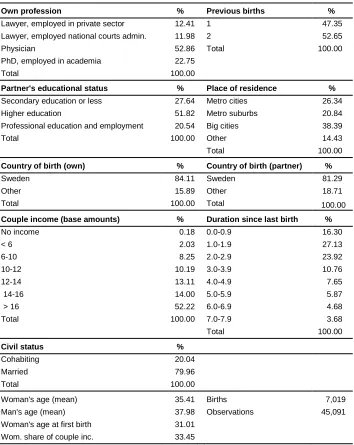
Table 1a: Descriptive statistics of the sample (men)
Own profession % Previous births %
Lawyer, employed in private sector 12.41 1 47.35
Lawyer, employed national courts admin. 11.98 2 52.65
Physician 52.86 Total 100.00
PhD, employed in academia 22.75
Total 100.00
Partner's educational status % Place of residence %
Secondary education or less 27.64 Metro cities 26.34
Higher education 51.82 Metro suburbs 20.84
Professional education and employment 20.54 Big cities 38.39
Total 100.00 Other 14.43
Total 100.00
Country of birth (own) % Country of birth (partner) %
Sweden 84.11 Sweden 81.29
Other 15.89 Other 18.71
Total 100.00 Total 100.00
Couple income (base amounts) % Duration since last birth %
No income 0.18 0.0-0.9 16.30
< 6 2.03 1.0-1.9 27.13
6-10 8.25 2.0-2.9 23.92
10-12 10.19 3.0-3.9 10.76
12-14 13.11 4.0-4.9 7.65
14-16 14.00 5.0-5.9 5.87
> 16 52.22 6.0-6.9 4.68
Total 100.00 7.0-7.9 3.68
Total 100.00
Civil status %
Cohabiting 20.04
Married 79.96
Total 100.00
Woman's age (mean) 35.41 Births 7,019
Man's age (mean) 37.98 Observations 45,091
Woman's age at first birth 31.01
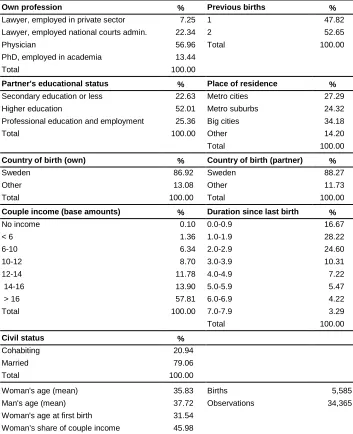
Table 1b: Descriptive statistics of the sample (women)
Own profession % Previous births %
Lawyer, employed in private sector 7.25 1 47.82
Lawyer, employed national courts admin. 22.34 2 52.65
Physician 56.96 Total 100.00
PhD, employed in academia 13.44
Total 100.00
Partner's educational status % Place of residence %
Secondary education or less 22.63 Metro cities 27.29
Higher education 52.01 Metro suburbs 24.32
Professional education and employment 25.36 Big cities 34.18
Total 100.00 Other 14.20
Total 100.00
Country of birth (own) % Country of birth (partner) %
Sweden 86.92 Sweden 88.27
Other 13.08 Other 11.73
Total 100.00 Total 100.00
Couple income (base amounts) % Duration since last birth %
No income 0.10 0.0-0.9 16.67
< 6 1.36 1.0-1.9 28.22
6-10 6.34 2.0-2.9 24.60
10-12 8.70 3.0-3.9 10.31
12-14 11.78 4.0-4.9 7.22
14-16 13.90 5.0-5.9 5.47
> 16 57.81 6.0-6.9 4.22
Total 100.00 7.0-7.9 3.29
Total 100.00
Civil status %
Cohabiting 20.94
Married 79.06
Total 100.00
Woman's age (mean) 35.83 Births 5,585
Man's age (mean) 37.72 Observations 34,365
Woman's age at first birth 31.54
Woman’s share of couple income 45.98
More than half of the sample of men and women are medical doctors. Being a medical doctor is the most common profession for both men and women, with only a small difference between genders. Being a law professional is the second most common for both men and women. But while men are equally distributed between private law and the national courts and taxation system, women are employed in the courts administration to a larger extent than in private law firms. It is more common for men to be PhDs employed in academia.
There are some gender differences when it comes to demographic characteristics. Whereas the overwhelming majority of the men and women belonging to the professional groups studied have a partner with higher education, a larger share of the men has a partner with only secondary education or less.
A larger share of the women is in couples with high total income. There is also a difference regarding the woman’s share of couple income: in the sample of male professionals the woman’s share of couple income is a mean 33%, whereas in the sample of female professionals the equivalent share is 46%, which shows that women professionals are in a stronger relative position in their couple contexts than are women in unions with men belonging to the professional groups studied.
3.4 Methods
Most of the register-based information, such as income, is available once a year, while demographic information, such as births, is available on a monthly basis. For this reason a discrete approach is chosen in the multivariate analysis, studying the probability of having a birth during the year conditioned on the values of the covariates at the beginning of the year. Multiple births during a year (i.e., twins or two separate births within the same year) are counted as one delivery, but the number of previous births takes multiple births into account.
Given the discrete approach, logit models of the transformed probability of having a birth during the year are estimated.7 Models are estimated separately for each birth interval (i.e., first to second births and second to third births).
4. Results
4.1 Descriptive analysis
Tables 2 and 3 provide descriptive measures relating to the births of men and women with different professional orientations included as focal persons in the analysis. A large majority of the births studied are second births, which is not surprising since the two-child norm is strong in Sweden.
Among men the mean age at childbirth of the woman in the couple (i.e., their partner) is 33.3 for second births and 35.3 for third births. In the sample of women professionals the mean age at childbirth is slightly higher: 33.8 for second births and 36.0 for third births. Academics stand out as having children at older ages compared to the other professional groups, irrespective of gender and parity. However, lawyers in private law firms (irrespective of gender) overtake PhDs in being, on average, the oldest in the case of third births. The general impression is that medical doctors and law professionals employed in the national courts system have children at slightly younger ages. Women who are lawyers, doctors, or academics are older at higher-order childbearing than women partnered with men who belong to these professional groups. This reflects the late motherhood of the well educated. It also indicates postponement of higher-order childbearing due to career reasons and working conditions on the part of the woman.
Women who are professionals themselves postpone their second and third births to higher ages than women partnered with men who belong to the professional categories studied, but the question is whether they compensate for higher age through shorter birth intervals? When it comes to spacing, the mean birth intervals are between 2.7 and 3.4 years for both men and women. Couples in which both partners are highly educated do not have shorter birth intervals than other couples, and do not seem to reduce their birth intervals by much, despite being older when reaching each parity (Dribe and Stanfors 2010). There are, however, some differences in birth intervals with respect to professional orientation. Physicians tend to have shorter birth intervals, and certainly have the shortest interval between the first and the second birth, but PhDs have the shortest birth interval between the second and the third birth.8 Contrary to theoretical expectations, law professionals have the longest birth intervals: among men, lawyers employed in the national courts administration have the longest birth intervals at both parities, whereas women who are employed in private law firms space their births more than others.
8 This makes sense, given that the woman’s age at second childbirth is highest among couples in which one
Table 2: Age of woman in couple at birth by parity and profession of focal person
Second births Third births
Men Mean St.dev. Mean St.dev.
Lawyer, employed in private sector 33.74 3.35 35.75 2.99
Lawyer, employed in courts admin. 32.99 3.38 35.14 3.03
Physician 32.91 3.24 35.22 2.97
PhD, employed in academia 34.07 3.33 35.73 2.81
Total 33.26 3.32 35.34 2.96
Births 5,387 1,632
Women Mean St.dev. Mean St.dev.
Lawyer, employed in private sector 34.67 2.89 37.44 2.43
Lawyer, employed in courts admin. 33.54 2.99 36.14 2.73
Physician 33.56 3.07 35.78 2.72
PhD, employed in academia 35.05 2.93 36.91 2.31
Total 33.81 3.07 36.00 2.71
Births 4,265 1,320
Note: Birth histories have been truncated at eight years since last birth. Source: See Table 1.
Table 3: Birth intervals (years) by parity and profession of focal person
Second births Third births
Men Mean St.dev. Mean St.dev.
Lawyer, employed in private sector 2.81 1.23 3.58 1.61
Lawyer, employed in courts admin. 2.93 1.35 3.73 1.78
Physician 2.55 1.12 3.41 1.52
PhD, employed in academia 2.80 1.17 3.38 1.50
Total 2.67 1.18 3.46 1.56
Births 5,387 1,632
Women Mean St.dev. Mean St.dev.
Lawyer, employed in private sector 2.94 1.18 4.11 1.61
Lawyer, employed in courts admin. 2.89 1.28 3.66 1.60
Physician 2.53 1.03 3.30 1.41
PhD, employed in academia 2.82 1.07 3.24 1.28
Total 2.66 1.10 3.39 1.45
Births 4,265 1,320
Note: Birth histories have been truncated at eight years since last birth. Source: See Table 1.
4.2 Multivariate analysis
Table 4 shows the logit estimates for second and third births separately by gender. In addition to own profession, partner’s educational status, country of birth (own as well as partner’s), and civil status, the regressions also include controls for man’s age, woman’s age, their squared terms, age of woman at first birth, couple income and its squared term, woman’s share of couple’s income, duration since last birth, cohort, and place of residence. Demographic as well as income controls render results in line with expectations.
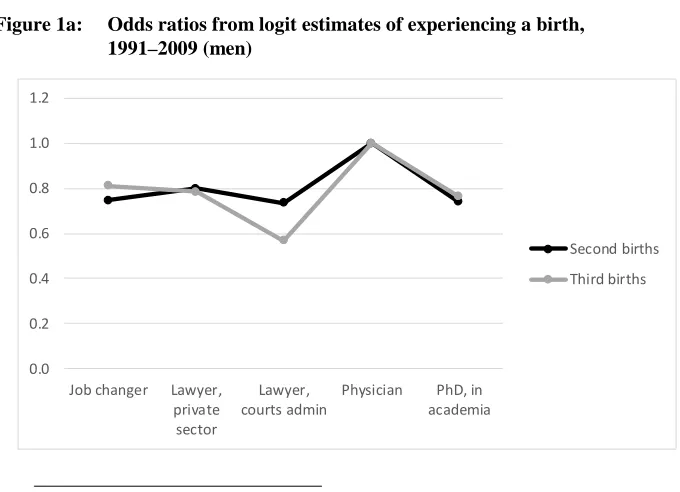
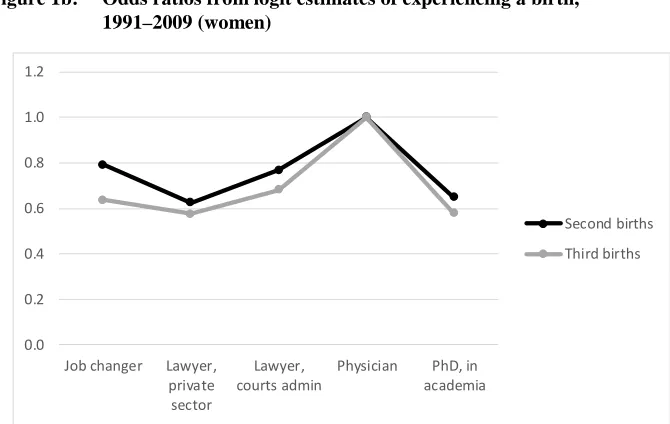
From Table 4 it is established that physicians have the highest chances of having a higher-order birth in relation to the other professional groups.9 This is true for both birth intervals, and for women as well as for men. The patterning of odds ratios of having a second or a third birth by profession is stable for both men and women, yet there is a difference in pattern by profession and gender, as seen in Table 4 and Figure 1a-b.
Table 4: Odds ratios from logit estimates of experiencing a birth, 1991–2009
Second births
Men Women
Own profession Odds ratios P>|z| Odds ratios P>|z|
Job changer 0.747 0.000 0.792 0.000
Lawyer, private sector 0.800 0.001 0.625 0.000
Lawyer, courts admin 0.734 0.000 0.767 0.000
Physician 1 ref.cat. 1 ref.cat.
PhD, in academia 0.739 0.000 0.648 0.000
Partner's educational status
Secondary education or less 1 ref.cat. 1 ref.cat.
Higher education 0.994 0.894 1.219 0.000
Professional 0.969 0.581 1.342 0.000
Number of obs 21,349 16,434
Wald chi2(76) 2989.97 2587.13
Prob > chi2 0 0
Pseudo R2 0.181 0.204
Log pseudolikelihood -9877.903 -7487.720
Third births
Men Women
Own profession Odds ratios P>|z| Odds ratios P>|z|
Job changer 0.812 0.003 0.636 0.000
Lawyer, private sector 0.786 0.027 0.575 0.009
Lawyer, courts admin 0.568 0.000 0.682 0.002
Physician 1 ref.cat. 1 ref.cat.
PhD, in academia 0.763 0.003 0.577 0.001
Partner's educational status
Secondary education or less 1 ref.cat. 1 ref.cat.
Higher education 1.179 0.018 1.190 0.040
Professional 1.590 0.000 1.392 0.001
Number of obs 23,742 17,920
Wald chi2(76) 893.45 841.30
Prob > chi2 0 0
Pseudo R2 0.104 0.127
Log pseudolikelihood -5323.571 -4115.170
Note: Regressions also control for man's age, woman's age, their square terms, age of woman at first birth, couple income and its square term, woman’s share of couple’s income, time since last birth, cohort, country of birth for both partners, civil status, and place of residence.
Among women, lawyers in private law firms are the least likely to experience a second and third birth once they have started childbearing. For women in law, employment in the public sector seems to be more conducive to continued childbearing, all else being equal. This is not the case for men who are working as law professionals, for whom the opposite applies. Women in academia also have less chance of continued childbearing – having almost equally low odds ratios as women working in private law firms. Men working in academia have lower odds ratios of experiencing a second or a third birth than doctors and also compared to lawyers in the private sector. The group “job changer”, which consists of professionals who belonged to one of the four professional categories at the time of their first birth but have since changed professional status, quite consistently has medium-to-low odds of experiencing a birth at both intervals, among men as well as women. There is generally more variation according to profession among women than among men, but the main result is that doctors stand out in relation to the other professional groups.10 The pattern by profession observed for second births is attenuated, particularly among women, for third births.
Figure 1a: Odds ratios from logit estimates of experiencing a birth, 1991–2009 (men)
10 This is corroborated by sensitivity tests where the model is estimated with different professions as the
reference category.
0.0 0.2 0.4 0.6 0.8 1.0 1.2
Job changer Lawyer, private sector
Lawyer,
courts admin Physician academiaPhD, in
Figure 1b: Odds ratios from logit estimates of experiencing a birth, 1991–2009 (women)
Note: Based on model estimates controlling for all other variables, cf. Table 4. Source: See Table 1.
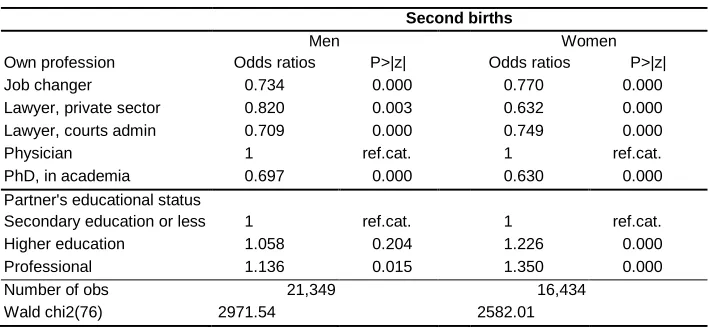
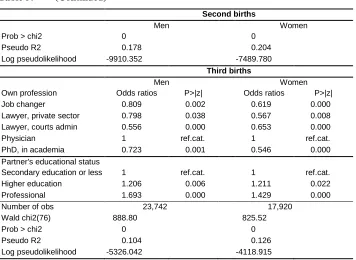
It should be noted that the relationship between professional orientation and continued childbearing is not driven by couple income. This is illustrated in Table 5 and made further visible in Figure 2a-d. Couple income has a positive impact, subject to decreasing returns (see Table A1). Results from regressions without controls for income (Table 5), however, indicate the same patterns and relationships as shown in Table 4. The odds ratios of own profession are similar when it comes to both magnitude and statistical significance. Should the impact of own professional status at the time of first birth be working through income, i.e., physicians as a group being more likely to have a second and a third birth because they earn more money and thus can afford more children, then the exclusion of the income controls would increase the impact of “own profession”. The results in Table 5 indicate that virtually no differences in continued childbearing among fast-track professionals relate to income. When odds ratios for second and third births of two separate models (one including income controls and one without such controls) are compared, there is only a marginal change in odds ratios for academics and lawyers working in the national courts administration. This is understandable, since academics and lawyers in the public sector earn less on average than medical doctors. Accordingly, they have somewhat lower chances of experiencing a second and a third birth than physicians. Regression results without income controls
0.0 0.2 0.4 0.6 0.8 1.0 1.2
Job changer Lawyer, private sector
Lawyer,
courts admin Physician academiaPhD, in
produce somewhat lower odds ratios than regression results with such controls. It should, however, be stressed that the patterns are highly robust as to whether income is controlled for or not, so the main explanation of the observed patterns according to profession and profession and gender seems to come from underlying differences between the professions, for example regarding career structures.
When considering the educational and professional status of the partner, it becomes obvious that couples where both partners have high educational status generally have higher chances of having a higher-order birth. The only exception is men and second births where the partner’s education is insignificant and other factors matter more. The fact that couples where both partners have higher education also have higher chances of continued childbearing reflects that pursuing a higher education and a career is widely perceived as compatible with family in Sweden. This can also be seen in Table 4, where the odds ratios of experiencing a birth increase with the partner’s educational and professional status. Having a partner who belongs to one of the professional categories studied further increases the risks of having a second as well as a third birth for women and third births for men. Given the high degree of homogamy among fast-track professionals it may very well be that the low fertility of female law professionals and academics in comparison to doctors accounts for the low odds ratios of experiencing a birth among male lawyers and enforces the impact of the individual’s own professional status. To a certain extent this works through couple income, as indicated by Table 5.
Table 5: Odds ratios from logit estimates of experiencing a birth, 1991–2009. Second and third births. No control for income
Second births
Men Women
Own profession Odds ratios P>|z| Odds ratios P>|z|
Job changer 0.734 0.000 0.770 0.000
Lawyer, private sector 0.820 0.003 0.632 0.000
Lawyer, courts admin 0.709 0.000 0.749 0.000
Physician 1 ref.cat. 1 ref.cat.
PhD, in academia 0.697 0.000 0.630 0.000
Partner's educational status
Secondary education or less 1 ref.cat. 1 ref.cat.
Higher education 1.058 0.204 1.226 0.000
Professional 1.136 0.015 1.350 0.000
Number of obs 21,349 16,434
Table 5: (Continued)
Second births
Men Women
Prob > chi2 0 0
Pseudo R2 0.178 0.204
Log pseudolikelihood -9910.352 -7489.780
Third births
Men Women
Own profession Odds ratios P>|z| Odds ratios P>|z|
Job changer 0.809 0.002 0.619 0.000
Lawyer, private sector 0.798 0.038 0.567 0.008
Lawyer, courts admin 0.556 0.000 0.653 0.000
Physician 1 ref.cat. 1 ref.cat.
PhD, in academia 0.723 0.001 0.546 0.000
Partner's educational status
Secondary education or less 1 ref.cat. 1 ref.cat.
Higher education 1.206 0.006 1.211 0.022
Professional 1.693 0.000 1.429 0.000
Number of obs 23,742 17,920
Wald chi2(76) 888.80 825.52
Prob > chi2 0 0
Pseudo R2 0.104 0.126
Log pseudolikelihood -5326.042 -4118.915
Note: Regressions also control for man's age, woman's age, their square terms, age of woman at first birth, time since last birth, cohort, country of birth for both partners, civil status, and place of residence.
Figure 2a-d: Model comparisons of odds ratios from logit estimates of
experiencing a birth, 1991–2009, with and without controlling for couple income and woman’s share of couple income
2a – Men, second births
0 0.2 0.4 0.6 0.8 1 1.2
Job changer Lawyer, private
sector
Lawyer, courts admin
Physician PhD, in academia
Control No control
2b – Men, thirds births
0 0.2 0.4 0.6 0.8 1 1.2
Job changer Lawyer, private
sector
Lawyer, courts admin
Physician PhD, in academia
Figure 2: (Continued)
2c – Women, second births
0 0.2 0.4 0.6 0.8 1 1.2
Job changer Lawyer, private sector
Lawyer, courts admin
Physician PhD, in academia
Control No control
2d – Women, third births
0 0.2 0.4 0.6 0.8 1 1.2
Job changer Lawyer, private
sector
Lawyer, courts admin
Physician PhD, in academia
Control No control
When it comes to control variables, country of birth matters in the sense that native-born Swedes are more likely to experience a second birth than are foreign-born women and men, and this holds for own as well as partner’s origin (see Table A1). For third births, the results are not statistically significant.
In line with findings of many previous studies, formally married couples are more likely to continue childbearing, once they have started, than are cohabiting couples, and this is valid for both samples including men and women professionals. Married couples are generally considered more child-oriented than those in informal unions (Bernhardt 2002).
4.3 Sensitivity analysis
It should be noted that the results presented are highly robust. The general pattern of physicians versus the other professional groups is stable for both men and women, irrespective of what profession is used as the reference category of the variable “Own profession”. The results also hold up for a number of sensitivity tests, including stepwise modeling with a gradual inclusion of independent variables. In addition, sensitivity tests include the estimation of logit models of the probability of having a second or a third birth within five years, to see if the results are driven by a subgroup with a specific temporal fertility behavior. Since the original analysis is based on a select group consisting of men and women who have attained their professional status and started their careers at the time of their first birth, logit models are estimated for individuals who ever attain the professional status in question. It should be noted that this inclusive definition of professionals at risk of having a second and a third birth does not change the general pattern. The relative position of academics improves, but physicians are still the most likely to experience higher-order births once they have started childbearing.
4.4 Limitations
We come by the results acknowledging a number of limitations. Some pertain to data. Although register data cover the entire population and are very reliable, they mostly include crude measures of demographic and economic indicators and few social and job-related indicators, and they do not include any attitudinal variables.
The most notable limitation to this study is that it does not deal with selection. The decision whether to become a professional is not made randomly; there will be a selection of able, career-oriented individuals into the professions who are not as family-oriented as other individuals. Thus the employment in a certain type of profession may be underlying the childbearing decisions of this group. Of more relevance for the present study, there is also selection associated with selection into larger families. The decision to be a mother or a father is not a decision made randomly, neither does the decision to move on to higher parities imply that family-building occurs among the more family-oriented, and this may differ between subgroups (e.g., by profession).
Kravdal (2001, 2007) attempts to deal with unobserved heterogeneity relating to selection into larger family sizes according to educational attainment by estimating models for first, second, and third births simultaneously with a common unobserved factor. By using this random effects technique, a positive education effect found in models estimating higher-order births separately may disappear (cf. Kreyenfeld 2002). This approach has merits when analyzing the education-fertility relationship, the most important of which is being able to get a cleaner estimate of how education affects parity transitions without the confounding effects stemming from educational differentials in the timing and quantum of previous transitions. It does not, however, handle selection into profession and its potential associations with career-family orientation.11
5. Discussion
This study investigates differences within the professions with respect to continued childbearing, rather than analyzing underlying differences in fertility more generally. The focus is on what happens after the birth of the first child among highly educated individuals who, already at the time of their first birth, have a degree and have started a career in medicine, law, or academia. All have made considerable human capital and career investments, yet follow professional routes that are not equally compatible with family life. The primary aim of the study is to establish whether there are differences by
11 The main reason why we do not estimate all birth transitions jointly with a common factor for unobserved
profession in continued childbearing, and determine which professions facilitate higher-order childbearing.12
There are obvious differences with respect to continued childbearing within the group of highly educated professionals in Sweden. There are not only differences in higher-order childbearing by profession but also by profession and gender. Doctors emerge as more likely to go on to have a second and a third child once they have started a family, compared to law professionals and academics. Doctors are clearly different compared to the rest: this holds for both men and women. There are, however, differences in the variation across professions by gender, indicating that public sector employment is conducive to women’s continued childbearing. Moreover, the tendency among the other professional groups to be less likely to go on to a second birth compared to doctors is attenuated when it comes to third births, especially among women.
There is general support for the hypothesis that differences in working conditions, career structures, and the professional development that follow occupational choice generate differences in continued childbearing within the professions studied. First, the patterns that emerge are independent of income. In line with expectations, those who are in a rigid fast-track hierarchy, with constant pressure to produce measurable results and output, obviously face more difficulties combining work and more than one child than those who work in organizations with more job protection and less career penalties, where it is possible to temporarily step out of the rat race. In line with this reasoning, it is found that, among women, lawyers working in the private sector are the least likely to have either a second or a third birth once they have started childbearing, compared to doctors. Women in academia are, however, not very different to lawyers working in the private sector when it comes to their chances of continued childbearing, whereas women working in court administration have somewhat higher odds ratios than the two aforementioned groups, but still lower odds ratios of continued childbearing in relation to physicians, all else being equal.
It is perhaps not surprising that the results indicate a sharper tradeoff between career and continued childbearing for women working in private law firms than for women working as doctors and in the national court system, but it is more challenging to understand why academics have similarly lower chances of experiencing a second and third birth in relation to physicians. In the light of the career structure rigidity and work demands that are important in all fast-track professions, the lower odds ratios of continued childbearing among academics could be explained by the fact that even though there is no formal tenure track in Swedish academia, PhDs have invested extensively in their careers with a lengthy training period and face a competitive environment after graduating. This is especially the case if they are research-oriented
and aim for an academic career and not just a teaching position. There is a de facto tenure track for the career-oriented that puts pressure on Swedish academics in a way similar to the US system (cf. Mason and Goulden 2002; Wolfinger et al. 2010). There is also a longstanding shortage of academic positions, in contrast to the undersupply of physicians, which adds to the competitive pressure. This puts academics in a relatively disadvantaged situation compared to other professionals such as doctors.
Our results should be seen in light of the fact that working conditions, career structures, and professional demands are not the same for all professionals, and that the men and women at risk of having a second or a third birth may be a select group because they have already revealed a preference for children, which may make them more prone to have an additional child. Individuals in professions such as private law, where it is more difficult to combine parenthood, care-giving responsibilities, and a career, but who nevertheless did become parents, might be more select than those working as medical doctors. This selection bias, however, leads to an overestimation of the risk of higher-order childbearing for lawyers, making our results lower-bound estimates rather than anything else.
relatively stronger position of the woman in the partnership when it comes to childbearing decisions.13
Overall, the opportunities to combine work and family are good in Sweden compared to elsewhere. Parents have statutory rights to parental leave and are generously compensated even in the upper tail of the earnings distribution. Low-cost quality day care is available to all through government subsidies, which facilitates the combination of work and family for all parents. Despite its many pros, the Swedish model has some limitations, especially for fast-track professionals who may need more flexible solutions in order to accommodate work demands. In the Swedish context the lack of alternatives may be more of a compatibility issue, especially for fast-track professionals, and so it may be the lack of home-care services that make people devote more time and energy to housework and maintenance on a do-it-yourself basis, thereby spending less time and effort on market work and careers. Lately there has been a tendency among private companies to accommodate workers who are parents with family-friendly policies and flexible solutions. This does not, however, eliminate the fact that fast-track jobs in rigid hierarchies are inflexible: the volume of work produced is still vital for promotion, and the common response to this is longer work hours. There are norms concerning when certain career achievements should be met, and these are not designed around the primary caregiver but around the full-time breadwinner who has support from home. All else being equal, workers who spend more hours working and devote more effort to their careers will produce more, leaving mothers (and fathers) who have family responsibilities, and perhaps a partner with a demanding profession, disadvantaged and put under pressure.
Compatibility issues are found in the workplace and the career structures of the professions investigated in this study, but in many senses the degree of career-family compatibility also depends on the relationship between partners. Regarding partner characteristics, the results support the hypothesis that homogamy is positively related to continued childbearing with respect to educational level as well as to professional status. Couples in which both partners have higher education are generally more likely to experience a second or a third birth once they have started childbearing, compared to couples where one partner has lower education. While this kind of homogamy, indicating similarity with respect to level of education, being conducive to continued childbearing may come as no surprise, it actually is the case that couples in which both partners belong to one of the professional groups studied are more likely to experience a second or a third birth compared to others, net of all other factors. This is evident among women but is also the case for men and third births. It thus seems as if the
13 Similarly, among couples in which the spouses have different educational levels, the mean age of the
assumed disadvantages of and pressures from pursuing a professional career are mediated by shared interests and networks, and a mutual understanding of each other’s situation. The higher continued childbearing among homogamous professional couples can probably also be explained by more egalitarian attitudes and practices towards household division of labor in these couples. In dual-career households in which both spouses have a high level of career involvement, both partners have access to economic resources that serve as a basis for negotiations, and thus perhaps goals can be achieved in a frictionless manner. Moreover, competing preferences and stress can be mediated through a higher degree of understanding for each other’s workload and this may facilitate work-family issues, especially for women. When it comes to childrearing, couples with higher educational status and skills share more of the total parental leave benefits than those with lower educational status and skills and they make more use of public childcare.
To conclude, this study offers new insights into the relationship between type of profession and continued childbearing. It shows that continued childbearing varies by profession and also by profession and gender. These differences cannot be explained by income and the fact that professionals such as doctors earn more than professionals such as academics. Rather the results indicate that working conditions and career structures make it easier to combine a professional career and children for some groups than for others. The patterns that emerge for men and women reflect the fact that women and men are not equally involved in childbearing and not equally sensitive to career structures, especially hierarchies with up-or-out decisions, resulting in a tradeoff between career and children at an early stage of the career. This puts policies promoting work-family compatibility for all in perspective.
6. Acknowledgements
References
Avellar S. and Smock, P.J. (2003). Has the price of motherhood declined over time? A cross-cohort comparison of the motherhood wage penalty. Journal of Marriage and Family 65(3): 597–607. doi:10.1111/j.1741-3737.2003.00597.x.
Becker, G.S. (1985). Human capital, effort, and the sexual division of labor. Journal of Labor Economics 3: 33–58. doi:10.1086/298075.
Becker, G.S. (1991). A treatise on the family. Cambridge: Harvard University Press. Bernhardt, E.M. (2002). Cohabitation and marriage among young adults in Sweden:
Attitudes, expectations and plans. In: Carling, J. (ed.). Nordic demography: Trends and differentials. Oslo: Unipub/Nordic Demographic Society: 157–170. Billari, F.C. and Kohler, H.-P. (2004). Patterns of low and lowest-low fertility in
Europe. Population Studies 58(1): 161–176. doi:10.1080/0032472042000213 695.
Blackburn, M.L., Bloom, D.E. and Neumark, D. (1993). Fertility timing, wages, and human capital. Journal of Population Economics 6(1): 3–30. doi:10.1007/ BF00164336.
Bloom, D.E. and Trussell, J. (1984). What are the determinants of delayed childbearing and permanent childlessness in the United States? Demography 21(4): 591–611.
doi:10.2307/2060917.
Blossfeld, H.-P. and Huinink, J. (1991). Human capital investments or norms of role transition? How women’s schooling and career affect the process of family formation. American Journal of Sociology 97(1): 143–168. doi:10.1086/229743. Blossfeld, H.-P. and Timm, A. (eds.) (2003). Who Marries Whom? Educational
Systems as Marriage Markets in Modern Societies. Dordrecht: European Association for Population Studies & Kluwer Academic Publishers.
doi:10.1007/978-94-007-1065-8.
Boulis, A. (2004). The evolution of gender and motherhood in contemporary medicine. Annals of the American Academy of Political and Social Science 596: 172–206.
doi:10.1177/0002716204268923.
Budig, M. (2003). Are women’s employment and fertility histories interdependent? An examination of causal order using event history analysis. Social Science Research 32(3): 376–401. doi:10.1016/S0049-089X(03)00012-7.
Budig, M. and England, P. (2001). The wage penalty for motherhood. American Sociological Review 66(2): 204–225. doi:10.2307/2657415.
Cooney, T. and Uhlenberg, P. (1989). Family-building patterns of women professionals: A comparison of lawyers, physicians, and post secondary teachers. Journal of Marriage and the Family 51(3): 749–758. doi:10.2307/ 352173.
Dribe, M. and Stanfors, M. (2010). Family life in power couples: Continued childbearing and union stability among the educational elite in Sweden, 1991– 2005. Demographic Research 23(30): 847–878. doi:10.4054/DemRes.2010. 23.30.
Edgell, S. (1980). Middle class couples: A study of segregation, domination and inequality in marriage. London: Allen & Unwin.
Gerster, M., Keiding, N., Knudsen, L.B., and Strandberg-Larsen, K. (2007). Education and second birth rates in Denmark 1981–1994. Demographic Research 17(8): 181–210. doi:10.4054/DemRes.2007.17.8.
Goldin, C. and Katz, L. (2008). Transitions: career and family life cycles of the educational elite. American Economic Review: Papers and Proceedings 98(2): 363–369. doi:10.1257/aer.98.2.363.
Gustafsson, S. and Wetzels, C. (2000). Optimal age at giving birth: Germany, Great Britain, the Netherlands and Sweden. In: Gustafsson, S.S. and Meulders, D.E. (eds.). Gender and the Labor Market. Econometric Evidence on Obstacles in Achieving Gender Equality. Basingstoke: MacMillan: 188–209.
Happel, S.K., Hill, J.K., and Low, S.A. (1984). An economic analysis of the timing of childbirth. Population Studies 38(2): 299–311. doi:10.2307/2174078.
Hewlett, S.A. (2002). Executive women and the myth of having it all. Harvard Business Review 80(1): 66–73.
Hoem, J.M., Neyer, G., and Andersson, G. (2006b). Educational attainment and ultimate fertility among Swedish women born in 1955–59. Demographic Research 14(16): 381–403. doi:10.4054/DemRes.2006.14.16.
Joshi, H. (2002). Production, reproduction and education: women, children and work in a British perspective. Population and Development Review 28(3): 445–474.
doi:10.1111/j.1728-4457.2002.00445.x.
Kravdal, Ø. (2001). The high fertility of college educated women in Norway: An artefact of the separate modelling of each parity transition. Demographic Research 5(6): 187–216. doi:10.4054/DemRes.2001.5.6.
Kravdal, Ø. (2007). Effects of current education on second- and third-birth rates among Norwegian women and men born in 1964: Substantive interpretations and methodological issues. Demographic Research 17(9): 211–246. doi:10.4054/ DemRes.2007.17.9.
Kreyenfeld, M. (2002). Time-squeeze, partner effect or self-selection? An investigation into the positive effects of women’s education on second birth risks in West Germany. Demographic Research 7(2): 15–48. doi:10.4054/DemRes.2002.7.2. Köppen, K. (2006). Second births in western Germany and France. Demographic
Research 14(14): 295–330. doi:10.4054/DemRes.2006.14.14.
Lappegård, T. and Rønsen, M. (2005). The multifaceted impact of education on entry into motherhood. European Journal of Population 21(1): 31–49. doi:10.1007/ s10680-004-6756-9.
Lundberg, S. and Pollak, R. (1996). Bargaining and distribution in marriage. Journal of Economic Perspectives 10: 139–158. doi:10.1257/jep.10.4.139.
Manser, M. and Brown, M. (1980). Marriage and household decision-making: A bargaining analysis. International Economic Review 21: 31–44. doi:10.2307/252 6238.
Marini, M.M. (1984). Women’s educational attainment and the timing of entry into parenthood. American Sociological Review 49(4): 491–511. doi:10.2307/209 5464.
Mason, M.A. and Goulden, M. (2004). Marriage and Baby Blues: redefining gender equity in the Academy. Annals of the American Academy of Political and Social Science 596: 86–103. doi:10.1177/0002716204268744.
McElroy, M.B. and Horney, M.J. (1981). Nash-bargained household decisions: Toward a generalization of the theory of demand. International Economic Review 22: 333–349. doi:10.2307/2526280.
McDonald, P. (2000). Gender equity in theories of fertility transition. Population and Development Review 26: 427–439. doi:10.1111/j.1728-4457.2000.00427.x. Mincer, J. (1963). Market prices, opportunity costs, and income effects. In: Christ, C.F.
et al. (eds.). Measurement in Economics. Stanford: Stanford University Press: 67–82.
Miranti, R., McNamara, J., Tanton, R., and Yap, M. (2009). A narrowing gap? Trends in the childlessness of professional women in Australia 1986‒2006. Journal of Population Research 26: 359–379. doi:10.1007/s12546-009-9022-5.
Nì Bhrolcháin, M. (1986). Women’s paid work and the timing of births. European Journal of Population 2: 45–70. doi:10.1007/BF01796880.
Noonan, M.C. and Corcoran, M.E. (2004). The Mommy track and partnership: temporary delay or dead end? Annals of the American Academy of Political and Social Science 596: 130–150. doi:10.1177/0002716204268773.
Perna, L. (2001). Sex and race differences in faculty tenure and promotion. Research in Higher Education 42(5): 541–567. doi:10.1023/A:1011050226672.
Polachek, S.W. (1981). Occupational self-selection: a human capital approach to sex differences in occupational structure. Review of Economics and Statistics 63(1): 60–69. doi:10.2307/1924218.
Rindfuss, R.R., Morgan, S.P., and Offutt, K. (1996). Education and the changing age pattern of American fertility: 1963–1989. Demography 33(3): 277–290.
doi:10.2307/2061761.
Singy, F. (1996). Modern marriage and its costs to women: A sociological look at marriage in France. Newark: University of Delaware Press.
Sweet, S. and Moen, P. (2004). Coworking as a career strategy: Implications for the work and family lives of university employees. Innovative Higher Education 28: 255–272. doi:10.1023/B:IHIE.0000018909.62967.b5.
Swedish National Board of Health and Welfare, (Socialstyrelsen) (2013). Nationella planeringsstödet 2013. Stockholm: Swedish National Board of Health and Welfare.
Van Bavel, J. (2010). Choice of study discipline and the postponement of motherhood in Europe: the impact of expected earnings, gender composition and family attitudes. Demography 47(2): 439–458. doi:10.1353/dem.0.0108.
Willis, R.J. (1973). A new approach to the economic theory of fertility behavior. Journal of Political Economy 81: S14–S64. doi:10.1086/260152.
Wolfinger, N.H., Mason, M.A., and Goulden, M. (2010). Alone in the ivory tower. Journal of Family Issues 31: 1652–1670. doi:10.1177/0192513X10374939. Yang, Y. and Morgan, S.P. (2004). How big are educational and racial fertility
Appendix
Table A1: Coefficients from logit estimates of experiencing a birth, 1991–2009
Second births Third births
Men Women Men Women
Own profession Coeff P>|z| Coeff P>|z| Coeff P>|z| Coeff P>|z|
Job changer -0.292 0.000 -0.233 0.000 -0.208 0.003 -0.452 0.000
Lawyer, private sector -0.223 0.001 -0.470 0.000 -0.241 0.027 -0.553 0.009
Lawyer, courts admin -0.309 0.000 -0.265 0.000 -0.565 0.000 -0.383 0.002
Physician 0 0 0 0 0 0 0 0
PhD, in academia -0.302 0.000 -0.433 0.000 -0.297 0.003 -0.549 0.001
Partner's educational status
Secondary education or less 0 0 0 0 0 0 0 0
Higher education -0.006 0.894 0.198 0.000 0.165 0.018 0.174 0.040
Professional -0.031 0.581 0.294 0.000 0.464 0.000 0.331 0.001
Couple income 0.040 0.000 0.019 0.155 0.016 0.055 0.018 0.009
Couple income square -0.0004 0.003 -0.00006 0.482 -0.0001 0.188 -0.0001 0.068
Woman’s share of couple income 0.006 0.000 0.002 0.169 0.002 0.368 0.003 0.184
Man's age 0.040 0.403 -0.021 0.715 0.291 0.013 -0.096 0.386
Man's age square -0.001 0.166 -0.00003 0.971 -0.004 0.007 0.001 0.567
Woman's age 1.975 0.000 2.801 0.000 0.954 0.000 1.330 0.000
Woman's age square -0.024 0.000 -0.036 0.000 -0.018 0.000 -0.023 0.000
Woman’s age at first birth -1.396 0.000 -1.954 0.000 -0.471 0.008 -0.354 0.136
Woman’s age at first birth square 0.015 0.000 0.023 0.000 0.011 0.000 0.010 0.012
Duration since last birth (years)
0.0–0.9 -0.103 0.101 0.135 0.054 0.589 0.000 0.823 0.000
1.0–1.9 -1.707 0.000 -1.877 0.000 -2.011 0.000 -2.198 0.000
2.0–2.9 0 0 0 0 0 0 0 0
3.0–3.9 -0.789 0.000 -0.588 0.000 0.773 0.000 0.965 0.000
4.0–4.9 -1.609 0.000 -1.384 0.000 0.794 0.000 1.091 0.000
5.0–5.9 -2.247 0.000 -2.047 0.000 0.785 0.000 0.672 0.001
6.0–6.9 -3.350 0.000 -3.023 0.000 0.775 0.000 0.830 0.000