Max Planck Institute for Demographic Research Konrad-Zuse Str. 1, D-18057 Rostock · GERMANY www.demographic-research.org
DEMOGRAPHIC RESEARCH
VOLUME 19, ARTICLE 9, PAGES 225-248
PUBLISHED 01 JULY 2008
http://www.demographic-research.org/Volumes/Vol19/9/ DOI: 10.4054/DemRes.2008.19.9
Research Article
Overview Chapter 7:
The rising importance of migrants
for childbearing in Europe
Tomáš Sobotka
This publication is part of Special Collection 7: Childbearing Trends and Policies in Europe (http://www.demographic-research.org/special/7/)
© 2008 Sobotka.
1 Introduction 226
2 Concepts and data limitations 227
3 Contribution of immigrants to the total number of births 229 4 Differential fertility rates: immigrants vs. native women 231
5 The heterogeneity in immigrants’ fertility 233
6 How rapid is the assimilation to local fertility patterns? 236 7 The impact of migrants’ fertility on total fertility rates 238 8 The multifaceted impact of migration on childbearing and
population trends
240
9 Acknowledgements 242
Overview Chapter 7:
The rising importance of migrants for childbearing in Europe
Tomáš Sobotka1
Abstract
This contribution looks at the influence of immigration on childbearing trends in the countries of Western, Northern and Southern Europe, which have received relatively large numbers of immigrants during the last decades. It analyses the contribution of migrants to the total number of births and compares fertility rates of migrant women with the fertility rates of native women, pointing out huge diversity between migrant groups. It also discusses the evidence regarding the progressive ‘assimilation’ in migrants’ fertility to the local fertility patterns and analyses the net impact of migrants on period fertility rates. This review reveals that migrant women typically retain substantially higher levels of period fertility than the ‘native’ populations, but this difference typically diminishes over time and with the duration of their stay in a country. Immigrants contribute substantially to the total number of births and their share of total births has increased in the last decade, exceeding in some countries one fifth of the recorded live births. However, the ‘net effect’ of the higher fertility of migrants on the period total fertility of particular countries remains relatively small, typically between 0.05 and 0.10 in absolute terms.
1. Introduction
Immigration to Europe, especially to the European Union (EU), has surged in the last two decades due to a combination of multiple factors, including the general increase of mobility and easier international travel, the economic malaise in many post-communist countries after the collapse of state socialism, violent conflicts and instability in the Balkans and other areas. Also successful enlargement of the EU, which has progressed hand in hand with economic integration, has played a significant role. Migration and its various effects on the economy (including the overall economic performance, gross domestic product (GDP) growth, wages, employment and the labour market) and society are vigorously debated in the media on a daily basis. Overall, the economic and social effects of migration are difficult to assess and disagreement frequently exists among experts and researchers2. Migration involves various conflicts of interest which may contribute to an ambiguous assessment regarding the overall impact of immigration. For instance, the positive impact of immigration on the economic growth of a country may be counterbalanced by its negative impact on wages and employment prospects of some segments of the ‘native’ population, especially low-skilled workers (Boeri and Brücker 2005).
Migration constitutes a powerful component of demographic change, albeit one that is difficult to trace. After 1990 migration has become the main engine of population growth in many countries of Europe. It is gradually transforming European population in a manner unforeseen by various population projections (Coleman 2006). In 2004 the European Union (EU-25) recorded the highest population increase since 1972—0.54 percent—of which 0.38 percent was attributable to a positive migration balance (Eurostat 2006a, 2006b). Consequently, the EU has received larger migration streams since the early 2000s than the United States, which often serves as a model country of immigration. However, migration is also the most unstable and the least predictable component of population change (Alho et al. 2006). Despite the wealth of migration theories, projections of migration “continue to rely on ad-hoc assumptions based on little theory and virtually no definable methodology” (Howe and Jackson 2005: 1). Spain, which was until 1990 a country with negative migration balance, provides a telling example of the unexpected effects of migration on population change. Between 1999 and 2006 the total population of Spain rose by 4.0 million persons, i.e., by 10.2 percent, of which 9.3 percent was due to migration (Eurostat 2006a, Council of Europe 2006, Roig Vila and Castro Martín 2007; see also Spain chapter∗).
2 See Coleman and Rowthorn (2004) for an example of a debate on the economic costs and benefits of
immigration to the United Kingdom.
Besides contributing directly to population size and composition, migration has a broader demographic impact on each society, especially when immigrant populations have different levels and patterns of fertility, union formation and mortality. Most expert analyses and projections of population trends focus exclusively on the direct influence of migration on population size and composition and ignore the potentially important contribution of immigrants on birth rates and childbearing trends (country studies in Haug, Compton and Courbage 2002 are among important exceptions). At the same time, the wider public in many developed countries often believes that immigrants have high birth rates that may place the provision of welfare support to families under strain and may even eventually lead to an outnumbering of the native majority by a population of foreign origin. Immigrants might also be perceived as the main factor behind the recent rise in period fertility in a number of European countries (e.g., Héran and Pison 2007 for the case of France; see also below).
This contribution scrutinises contemporary evidence regarding the effects of immigration on childbearing trends in European countries. These effects have a growing relevance for the societies of Western, Northern, Southern, and recently also Central Europe. Focusing on these regions, I consider the contribution of migrants to the total number of births, compare fertility rates of migrant women with fertility of the native women and point out the heterogeneity between different migrant populations. Subsequently, I discuss the pace of ‘assimilation’ in migrants’ fertility to local fertility patterns and the net impact of migrants on period fertility rates. In conclusion, this article lays emphasis on the multifaceted impact of migration on childbearing trends and population change. Given space limitations, lack of data and lack of comparative studies, this contribution focuses almost exclusively on women and does not discuss the effects of internal migration, short-term migration and illegal migration. It pays very little attention to the impact of emigration on fertility and also neglects immigrants’ fertility in the post-communist countries of Central and Eastern Europe, where data availability is limited and larger-scale immigration either constitutes a very recent phenomenon or was an outcome of these countries being parts of larger state units (Czechoslovakia, Soviet Union and Yugoslavia).
2. Concepts and data limitations
(1) Different definitions of what a migrant is are used by various statistical agencies. With respect to immigrants, the most common categorizations are those of foreign-born persons and persons with foreign citizenship. The latter category is problematic in statistics on migrants, as its size frequently depends more on national legislation on citizenship of a country of residence than on the size of immigration streams. There are vast differences between countries in the rate of naturalisation and the average period elapsing between immigration and naturalisation. Due to incomplete or missing records, there are also very few data on births to immigrant men, which means that statistics on the proportion of births with at least one immigrant parent is also usually unavailable. A study of the effects of immigration on fertility can be limited to the first generation of migrants, or it can also include the second and the third generation (see the Netherlands chapter).
(2) When assessing the effects of migration on fertility and population change, different estimates and assumptions should be made about the fertility and mortality of emigrants and immigrants. In practice, lack of data limits such empirical studies. Any analysis of the effects of migration on childbearing trends commonly takes differential fertility of immigrants into account, but usually ignores the potential fertility differentials due to emigration. This is because of the absence of information on childbearing patterns of emigrants and the impossibility of assessing how emigrants would have behaved if they had stayed in their country of origin (see Albania chapter).
Practically all available studies focusing on European countries analyse the impact of legal migration and disregard the impact of illegal migration.
3. Contribution of immigrants to the total number of births
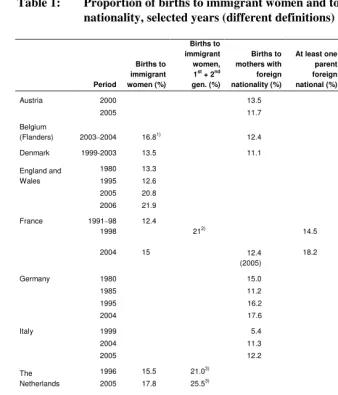
The proportion of births to immigrant women provides a basic indication of the importance of immigrants for childbearing. This measure is a function of past immigration levels, the age composition of immigrants, and their fertility rates. In practice, most countries collect data on the proportion of births to women with foreign nationality (see also above). Since many women eventually obtain the nationality of their new host country, these statistics constitute a downward-biased approximation of immigrants’ contribution to the total number of births in a country.
Table 1 summarises the percentage of births to immigrant or foreign-nationality women in eleven European countries with a recent history of sizeable migration streams. Births to immigrant women contribute considerably to the recorded total number of births in the analysed regions: well above one tenth of all births are attributable to immigrant women, even when the partial data on foreign nationals are considered. This share is typically higher than the proportion of immigrants, since migrant women tend to be younger and more fertile than the native population (see also below). Births to immigrant women currently account for around one fifth of all births in England and Wales, the Netherlands, Sweden and Germany (German data are for foreign nationals only), whereas in Switzerland women with foreign nationality contribute more than one quarter of the total number of births. When the second generation of immigrants is also considered, immigrant women account for more than one fifth of births in France (data pertain to 1998 and exclude French nationals born abroad) and more than a quarter of births in the Netherlands.
Table 1: Proportion of births to immigrant women and to parents of foreign nationality, selected years (different definitions)
Period Births to immigrant women (%) Births to immigrant women, 1st + 2nd gen. (%)
Births to mothers with foreign nationality (%)
At least one parent foreign
national (%) Source
Austria 2000 13.5 Kytir 2006
2005 11.7 Kytir 2006
Belgium
(Flanders) 2003–2004 16.81) 12.4 VAZG 2007
Denmark 1999-2003 13.5 11.1 Statistics Denmark 2004
1980 13.3 Schoorl 1995
England and
Wales 1995 12.6 ONS 2006
2005 20.8 ONS 2006,
2006 21.9 ONS 2007
France 1991–98 12.4 Toulemon 2004
1998 212) 14.5
Prioux 2005, Tribalat 2005
2004 15 12.4
(2005)
18.2 Prioux 2005, Héran and Pison 2007
Germany 1980 15.0 Schoorl 1995
1985 11.2 Schoorl 1995
1995 16.2
2004 17.6
Statistisches Bundesamt 2006
Italy 1999 5.4 ISTAT 2007
2004 11.3 ISTAT 2007
2005 12.2 ISTAT 2007
1996 15.5 21.03) CBS Statline 2006
The
Netherlands 2005 17.8 25.53) CBS Statline 2006
Spain 1996 3.3 4.5
2000 6.2 7.9
2004 13.7 16.9
2006 16.5
INE 2006 and 2007, Roig Vila and Castro Martín 2007
Sweden 2005 19.5 11.8 Statistics Sweden 2006
Switzerland 1980 15.3 Coleman 2003
2000 22.3 Coleman 2003
2005 26.3 SFSO 2006
Note:Figures shown without decimal points are not available with higher precision. 1)
Births to women with other than Belgian nationality at the time of their birth. This share excludes immigrants born with Belgian nationality and births to women with unknown nationality at their birth (6.2 percent).
2)
When ‘repatriate’ women (i.e., French nationals born abroad) are included, births to immigrant women of the first and second generation made up 26.5 percent of all births in 1998 (Tribalat 2006, Figure 12).
3) Births to the second generation of immigrants are defined as births to women born in the Netherlands, where one or both parents
4. Differential fertility rates: immigrants vs. native women
Several contributions have argued that the commonly used period total fertility rate (TFR) cannot serve as a reliable indicator of the level of immigrants’ fertility (Andersson 2004, Toulemon 2004). Schoorl (1995: 103) proposes that migrants’ TFR reflects “various aspects of the migration process: selective migration and migration policies, disruption of the process of family formation due to migration, the degree to which migration is marriage migration, and—in time—adaptation or assimilation”. This potential distortion in the TFR is particularly large for women with foreign nationality, who, depending on the process of naturalisation, constitute a select group of women with a relatively short duration of stay in the country. Thus, the closer immigration is linked to childbearing and the faster the process of naturalization, the more biased is the period TFR for foreign women. However, with the exception of alternative estimates of the TFR for France adjusted for age at entry and duration of stay (Toulemon and Mazuy 2003, Toulemon 2004, see also France chapter), there are no other readily available alternative indicators of immigrants’ fertility rates. Despite its drawbacks, the period TFR gives a basic picture of the major trends in fertility of immigrants, differences between immigrants from various regions, and the overall impact of immigration on the observed TFR of national populations.
Table 2a: Total fertility rate of native and immigrant women
TFR
Country Period
Native women
Immigrant
women Difference Source
Denmark 1999–2003 1.69 2.431)
0.74 Statistics Denmark 2004 England and
Wales 2001 1.62) 2.2 0.6 ONS 2006
France 1991–98 1.65 2.50 0.85 Toulemon 2004 1991–98 1.703)
2.163)
0.463)
Toulemon 2004 The Netherlands 2005 1.65 1.97 0.31 CBS 2006 Norway 1997–98 1.76 2.42 0.66 Østby 2002 Sweden 2005 1.72 2.01 0.29 Statistics Sweden 2006
Table 2b: Total fertility rate of women with local and foreign nationality
TFR
Country Period
‘Native Nationals’
Foreign
Nationals Difference Source
Austria 2001–5 1.29 2.03 0.74 Kytir 2006 Belgium 1995 1.49 2.13 0.64 Poulain and Perrin 2002 Flanders
(Belgium) 2001–5 1.50 3.00 1.50
van Bavel and Bastiaenssen 2006 France 1999 1.72 2.80 1.08 Héran and Pison 2007 2004 1.80 3.29 1.49 Héran and Pison 2007
Italy 2004 1.26 2.61 1.35 ISTAT 2006
Spain 2002 1.19 2.12 0.93 Roig Vila and Castro Martín 2007 Switzerland 1997 1.34 1.86 0.52 Wanner 2002
1) Excluding immigrant women born with Danish nationality.
2)
Figures not available with a higher precision.
5. The heterogeneity in immigrants’ fertility
The overall differences in the TFR reported above hide a large heterogeneity between different groups of migrants. Migrants from certain countries and regions, such as Bangladesh, Morocco, Pakistan and parts of sub-Saharan Africa usually have a TFR far exceeding that of native populations in Europe. This pattern appears to be consistent for the first generation of migrants across different countries. In contrast, migrants from other regions of Europe and the Caribbean display a TFR similar to the natives (e.g., Coleman 1994).
Table 3 provides an illustration of some of these contrasts for a few European countries with statistics on the TFR of immigrants by country of origin. It shows the TFR of two high-fertility groups of migrants (Somalians and Pakistanis) compared with the TFR of women born in Turkey, Iran and Western Europe. The first two groups have a TFR that exceeds the TFR of the host country by a factor of two or more, ranging from 3.6 (Pakistani women in Denmark and Norway) up to 5.2 (Somali women in Denmark and Norway). Turkish women also have an elevated TFR level, which exceeds the TFR in their host country and frequently even the TFR of Turkey3, but is well below the TFR of Somali, Pakistani, as well as Bangladeshi, Iraqi and Moroccan women (not shown here). European immigrants usually have a TFR close or somewhat below that of the host country. This also applies to women from Iran, who in the Netherlands and Sweden reached very low TFR levels, below 1.5.
Table 3: TFR of immigrant women from Somalia, Pakistan, Turkey, Iran and
Western Europe
Country (region) of origin
Country of residence Period Somalia Pakistan Turkey Iran (Western) Europe3) Source
Austria 2000–051) 2.96 Kytir 2006
Denmark 1999–2003 5.21 3.58 1.84 1.57 Statistics Denmark 2004
England and Wales 2001 4.7 ONS 2006
France2) 1991–98 3.21 1.66 Toulemon 2004
The Netherlands 2005 4.4
(1999)
2.22 1.1
(1999)
1.45 CBS 2006; the Netherlands chapter
Norway 1997-8 5.2 3.59 3.09 1.92 2.02 Østby 2002
Sweden 2005 3.82 2.62 1.31 1.57 Statistics Sweden 2006
1) Women without Austrian nationality.
2)
Data adjusted for age at immigration and duration of stay in France.
3) Denmark: EU-15 countries; France: EU-15 countries except Italy, Portugal and Spain; The Netherlands: ‘western immigrants’
(Europe, North America, Oceania, Indonesia and Japan); Norway: Western Europe; Sweden: EU-25 excluding Nordic countries.
These examples were selected to illustrate the heterogeneity in migrants’ fertility that lies hidden in summary data for all immigrants in a country. They also show that the differences in fertility rates between ethnic or national groups cannot be explained by a single factor, such as religion. This is most clearly evident in the case of women coming from predominantly Muslim societies who, according to commonly held opinion, have fertility far above that of native women in European countries. Although some Muslim populations in Europe display the highest fertility and the slowest pace of fertility decline (e.g., Coleman 1994: 124; Østby 2002), the contrasting examples of very-high fertility of women from Somalia and Pakistan and low fertility of women from Iran and Indonesia (for the latter group in the Netherlands see Heering et al. 2002) point out that the pronatalist influence of religion, if any, is strongly modified by other factors, including woman’s socio-economic position4.
Four interrelated factors are frequently identified in order to explain higher fertility rates of some migrant groups.5 First, the selection hypothesis emphasizes distinct social characteristics of immigrants (such as their educational level, income, level of integration, and rates of intermarriage) that may be conducive to higher fertility. Kahn (1994) reported that the higher fertility of immigrants in the United States was explained by their socioeconomic and demographic characteristics. Second, the
socialisation hypothesis (or ‘culture’ hypothesis) emphasizes the effects of pronatalist culture, norms and values in the region of origin, which is mirrored in the reproductive behaviour of immigrants after their arrival to a new, low-fertility setting. Also relatively low fertility rates, typical of migrant groups coming from low-fertility countries, including migrants from European countries, from the Caribbean and many parts of South America, generally support the socialization hypothesis. Third, the family formation hypothesis accentuates the interrelatedness of migration and family formation among many groups of migrants. The frequent finding of elevated fertility of migrants during the first years after their arrival (Alders 2000, Østby 2002, Toulemon and Mazuy 2003, Andersson 2004, Andersson and Scott 2005) may be seen as an outcome of a common ‘package’ of migration, marriage, and childbearing (Milewski 2007; see also France chapter). It also suggests another selection effect: first-generation migrant women may form a distinct group immigrating mostly for the reasons of family formation and reunion (see Milewski 2007 for the case of West Germany).6 The family
4 Esposito (1998) stresses the importance of local context and cultural traditions in explaining the diversity in
attitudes to and the actual prevalence of family planning across Muslim societies: “Islam has legitimated and reinforced traditional pronatalist believes and practices in areas where social conditions made large families desirable” (Esposito 1998: 513).
5 See Forste and Tienda 1996, Abbasi-Shavazi and McDonald 2002, Kulu 2005, and Genereux 2007 for
similar sets of explanations of ethnic and migrant differences in fertility.
6 Alders (2000: 14) found that in the Netherlands the correlation between immigration and childbearing was
20-formation hypothesis contrasts with the disruption hypothesis that envisions lower fertility among recent migrants, linked to the disruption effect migration may have on partnership formation and childbearing.7 Although such a disrupting effect of migration has not been found in the existing studies on immigrants’ fertility in Europe, some supporting evidence for this hypothesis was found, for instance, among European migrants to Australia (Abbasi-Shavazi and McDonald 2002). Fourth, the ‘minority status’ explanation can be proposed to explain both rapid fertility limitation among some groups of migrants as a way of achieving higher social mobility (Forste and Tienda 1996) and the persistence of higher fertility as a defensive response among the more disadvantaged communities with strong ethnic or religious consciousness and slow adaptation to local fertility ideals (Coleman 1994, Fargues 2000, McQuillan 2004).
Immigrants often differ from the native population in many fertility characteristics other than fertility rates. Several contributions in Haug, Compton and Courbage (2002) document an early start of childbearing among many groups of migrant women, especially those from Turkey (see also Italy chapter).8 Foreign-born women also frequently display markedly lower levels of childlessness (see Garssen and Nicolaas 2006 and the Netherlands chapter) and high progression rates to third and higher-order births (see Austria chapter). This is also in part mirrored in their ideal family size, which remains high among migrants from Pakistan and northern Africa (Penn and Lambert 2002). A striking influence of the culture of the country of origin is demonstrated by vast differences in living arrangements, marriage patterns and non-marital fertility across migrant groups (see Sweden chapter for the case of Turkish young adults in Sweden). Even in societies where non-marital childbearing has become common, immigrants from the more culturally conservative societies realise childbearing exclusively within marriage (various chapters in Haug, Compton and Courbage 2002). In 2005, only two percent of children born in England and Wales to women originating from Bangladesh, India and Pakistan were non-marital, in contrast to 49 percent of children born to native-born mothers (ONS 2006). On the other hand, non-marital births are frequent among women from Latin America and from the Caribbean, in line with patterns in their countries of origin, suggesting again the
30 had a child in the calendar year after the year of their arrival. This pattern was not found for women from Suriname and the Netherlands Antilles.
7 However, Milewski (2007: 861-862) points out that the ‘disruption effect’ may also explain elevated birth
rates after migration, which may constitute a ‘catching up’ of childbearing that was postponed or interrupted in the period shortly before and during migration.
8 De Valk and Liefbroer (2007, Table 2) show that both first and second-generation migrants from the main
usefulness of the socialization hypothesis for explaining immigrants’ childbearing behaviour. In Spain, a high proportion of non-marital births among the growing population of migrants from Latin America has largely contributed to the recent rapid rise in non-marital fertility in the whole country (see Spain chapter). Finally, immigrant women also display different patterns of contraceptive use and abortion. Immigrants from less developed societies frequently rely on ineffective means of contraception and on abortion. In the Netherlands, 60 percent of women undergoing abortion have an ethnic minority background (see the Netherlands chapter, Fokkema et al. 2008:770).
6. How rapid is the assimilation to local fertility patterns?
Because of the progressive assimilation of each subsequent generation of descendents of immigrants in their union formation and childbearing behaviour and, in a broader sense, their language and ethnic identity, any analysis of long-term effects of migration is very sensitive to assumptions on migrants’ assimilation and on the emergence of mixed-origin populations (see Coleman 2006: 413-417).
Most studies find that, within a decade after their arrival, migrants’ fertility rates decline to the level close to fertility rates among native women (Schoorl 1995; Toulemon and Mazuy 2004). Furthermore, over time immigrants’ expectations about their future childbearing have been found to converge with the birth expectations of native women (Kahn 1994). However, some populations show a slower pace of convergence.9 Women immigrating at a young age, sometimes called the ‘1.5 generation,’ frequently display similar fertility rates to autochtonous women (Andersson 2004; Toulemon and Mazuy 2004). This ‘assimilation’ to local fertility patterns has also been reported in the incidence of early childbearing. Østby (2002: 43) found that women who arrived in Norway before age seven became mothers before age 22 much less frequently than women who arrived at a later age. The Sweden chapter highlights two non-demographic factors—educational attainment and exposure to Swedish society (as measured by neighbourhood composition)—which were important for an adaptation of family attitudes and behaviour of young adults from Poland and Turkey to the Swedish patterns. National welfare policies, employment patterns and other institutional factors constitute important mechanisms that facilitate an adjustment of migrants’ fertility to ‘local’ fertility patterns. Andersson and Scott (2005) found a similar effect of labour market position on first birth intensity among different groups
9 Østby (2002: 42) found that women immigrating to Norway from ‘Muslim non-western countries’
of immigrants in Sweden: for immigrant and Swedish women alike, labour-market activity was positively linked with their propensity to have a first child.10
A cohort analysis gives another view on fertility assimilation across cohorts and generations of migrants. As the Netherlands chapter shows, younger cohorts of women from initially high-fertility groups usually display a marked decline in fertility when compared to their older counterparts (see also Alders 2000). This is in part a result of changes in reproductive norms and behaviour in their country of origin, but it is also a sign of an adaptation of their fertility to the conditions of the host country. Frequently, fertility of immigrants from high-fertility societies declines well below the fertility of women in their country of origin (see France chapter and Schoorl 1995). Due to a lack of data fertility patterns of the second and third generation of immigrants are relatively little researched. Dutch data suggest that the fertility level of the second generation of migrants is closer to that of the native women than to the first generation of migrants with the same ethnic origin. For instance, Turkish and Moroccan women from the second generation have much lower levels of cumulated fertility and substantially higher levels of childlessness at ages 25-35 than their first-generation migrant counterparts (Alders 2000, Garssen and Nicolaas 2006)11.
10 However, migrant women vastly differ in their labour market status: among childless women in Sweden
aged 21-45, the percentage in the labour force having a job as the main source of income was 74 percent for Swedish-born women and 63 percent for migrant women, with a wide range from 10 percent (childless Somali women) to 75 percent (childless women from Finland; see Andersson and Scott 2005, Table 3 and Table A1). Also cross-country differences in the employment rate of migrant women aged 15-64 remain large, ranging from 40 percent in Belgium up to 64 percent in Greece in 2004 (Dumont and Liebig 2004: Figure 4). Despite a common trend of increasing employment rates of migrant women, reflecting in part their rising educational level and also an increase in the importance of work-related migration, migrant women in most countries still have lower employment rates than the ‘native’ women, especially when they come from non-OECD countries (Dumont and Liebig 2005, OECD 2007).
11 Research on fertility trends among Mexicans in the United States of America (US) shows, however, that
7. The impact of migrants’ fertility on total fertility rates
The aggregate net impact of migrants on observed trends and levels in period fertility appears to be relatively small, despite their fertility rates far exceeding those of the native population (see chapters on Austria, England and Wales, France, the Netherlands and Spain). In all eleven countries analysed in Table 4, fertility of immigrant (or foreign-national) women had a slight upward effect on the period TFR. This effect was of comparable size across countries and did not differ greatly when all immigrant women or only foreign-nationality women were analysed12: the period TFR shifted upwards by 0.05-0.10 (i.e., by 3-7 percent). In Switzerland, the net positive impact of foreign nationals on the TFR was greater and reached 0.14 in 1997, shifting the TFR upwards by 10 percent. The data for the Netherlands indicate that the inclusion of the second generation of immigrants (also used in the Netherlands chapter) considerably lowers the estimated impact of immigration on the TFR because their fertility rates frequently decline to or even below fertility rates of native women (see above).
This analysis indicates that immigration was not the main factor responsible for the recent upswing in the period TFR in some countries of Europe and that this upswing was mainly due to the rise in the TFR of the native population, probably associated with a slowing down of fertility postponement. The data for the Netherlands support this argument: Between 1996 and 2002, when the period TFR for all women increased from 1.53 to 1.73, the TFR among women born in the Netherlands rose even faster (from 1.47 to 1.69, data from CBS Statline 2006). In France, women with foreign nationality partly contributed to the rise of the period TFR between 1999 and 2004, but a larger part of this increase of 0.11 is attributable to the rise in the TFR among native French women by 0.08 (Héran and Pison 2007, Figure 1; see also Table 2b above).13
12 The similarity of the two estimates of the net effect of immigrants’ fertility is apparent in the case of
France, where the data for all immigrant women in 1991-98 give the same net effect (+0.07) as the data for foreign-nationality women in 1990 and 1999 (Tables 4a and 4b). A possible explanation is that the selection effect, implying an elevated fertility of foreign-nationality women (as compared to all migrant women), is counterbalanced by their smaller population size, which is important for computing the overall effect on the TFR in a country.
13 A decomposition of change in the period TFR in Italy and Spain between 1996 and 2004-2005 by Gabrielli,
Paterno and Strozza (2007) distinguished between the effects of (1) an increased share of foreigners
Table 4a: ‘Net effect’ of immigrant women on the observed period TFR
TFR
Country Period
All women
Native women
Net
effect Source
Denmark 1999–2003 1.760 1.685 0.075 Statistics Denmark 2004 England and
Wales 1996 1.74 1.67 0.07 Coleman et al. 2002 France 1991–98 1.72 1.65 0.07 Toulemon 2004 The Netherlands 2000–2005 1.724 1.646 0.078 CBS Statline 2006 The Netherlands 1) 2000–2005 1.724 1.680 0.044 CBS Statline 2006 Norway 1997–98 1.81 1.76 0.05 Østby 2002 (Lappegård 2000) Sweden 2005 1.769 1.716 0.053 Statistics Sweden 2006
Table 4b: ‘Net effect’ of women with foreign nationality on the observed TFR
TFR
Country Period
All
women Nationals
Net
effect Source
Austria 2000–2005 1.39 1.29 0.10 Kytir 2006 Belgium 1995 1.56 1.49 0.07 Poulain and Perrin 2002 Flanders
(Belgium)
2001–2005 1.59 1.50 0.09 van Bavel and Bastiaenssen 2006 France 1990 1.78 1.71 0.07 Héran and Pison 2007 1999 1.79 1.72 0.07 Héran and Pison 2007 2004 1.90 1.80 0.10 Héran and Pison 2007
Italy 2004 1.33 1.26 0.07 ISTAT 2006
Spain 2002 1.27 1.19 0.08 Roig Vila and Castro Martín 2007
Switzerland 1997 1.48 1.34 0.14 Wanner 2002
1) Including the second generation of immigrant women (mother born in the Netherlands, at least one of her parents born outside the
8. The multifaceted impact of migration on childbearing and
population trends
Different studies often provide contrasting assessments about the actual and potential contribution of migration to fertility rates, total numbers of births, and also population growth and ageing. Although this partly reflects differences between countries, it is also a reflection of the fact that the evaluation of the importance of migration hinges critically on the specific questions asked. With some simplification, this review pertaining to Western, Northern and Southern Europe has shown that:
• Despite their relatively rapid demographic assimilation, immigrants usually have markedly higher levels of period fertility than the ‘native’ populations;
• This differential varies widely by country of origin;
• Immigrants contribute substantially to the total number of births;
• The ‘net effect’ of the higher fertility of immigrants on the total fertility of
particular countries is relatively small.
Immigration levels have been consistently under-projected in historical forecasts in many European countries (Alders, Keilman, and Cruijsen 2007, Shaw 2007). The inclusion of recently recorded higher migration rates into population projections postpones the likely start of future population decline in the EU-15 countries, Norway, Iceland and Switzerland after the year 2050 (Alho et al. 2006). Recent research by Dalla Zuanna (2006), focusing on the industrial triangle of north-west Italy and including the effects of internal (south to north) migration, has shown that significant and continuous immigration may slow population ageing and prevent population decline, even in a region experiencing half a century of very low fertility. In addition, the higher fertility of migrants, typically not envisioned in projection scenarios, may further strengthen the importance of immigration for population trends. In the case of Mexicans in the United States, Jonsson and Rendall’s (2004) estimates and projections show that the long-term contribution of immigrants to childbearing is frequently underestimated when conventional methods of analysis are used. They also suggest that “differences in the fertility of immigrants and the native born are likely to be the primary cause of any rejuvenation of the population induced by migration” (Jonsson and Rendall: 146) and that Mexican migration flows after 1981 may generate one additional working-age person for every four Americans in the retirement age by 2040. The open question remains whether European regions with long experience of low fertility can attract and accommodate migration streams necessary to achieve the relative stability in the size of their populations and labour force.
The importance of immigration for childbearing trends and population change in many European countries underlines the need to rethink the traditional concept of replacement-level fertility (Smallwood and Chamberlain 2005). Calot and Sardon (2001) suggest that the ‘net replacement rates’ which reflect both mortality and migration are preferable to the widely used ‘net reproduction rates’ and that the application of these measures may change the evaluation of future population prospects (see also Preston and Wang 2007 and Sobotka 2008). In addition, much research needs to be done on various effects of immigration that have an indirect influence on fertility. The Spain chapter outlines one such channel: it suggests that migration may reduce imbalances in the marriage market, and, through increased marriage rates and partnership formation, it may also have an additional positive effect on fertility. Another contribution on Spain (Roig Vila and Castro Martín 2007) proposes that immigrants in Spain also positively contribute to fertility by filling the domestic ‘caring gap.’ Their frequent employment in the care of children and the elderly partly substitutes inadequate childcare and social services and thus enables more Spanish women to have a child.
(Albania, Lithuania and Slovakia chapters) suggest that temporary labour emigration, typical of these societies, has above all a disrupting effect on family formation, which contributes to the ongoing postponement of childbearing. Such disruption may be most pronounced when emigration streams are sex-specific, as was the case of Albania in the early 1990s: male-dominated emigration reduced women’s exposure to pregnancy due to the lack of male partners staying in the country (see Albania chapter). The Lithuania chapter also points at other factors related to emigration: the destabilization of already created families, the weakening of ties between family members and adaptation to new trans-national lifestyles. The returning emigrants can be seen as conveyors of new ideas and behaviour related to family and fertility, which they adopted during their stay abroad (Fargues 2006). Such a reciprocal effect between circular migration and fertility in the country of origin constitutes an important area for further research.
9. Acknowledgements
References
Abbasi-Shavazi, M. J., and P. McDonald. 2002. A comparison of fertility patterns of European
immigrants in Australia with those in the countries of origin, Genus 58(1): 53–76.
Alders, M. 2000. Cohort fertility of migrant women in the Netherlands. Paper presented at the
BSPS-NVD-URU Conference in Utrecht (the Netherlands), 31 August–1 September 2000.
Alders, M., N. Keilman, and H. Cruijsen. 2007. Assumptions for long-term stochastic population
forecasts in 18 European countries, European Journal of Population 23(1): 33–69.
Alho, J., M. Alders, H. Cruijsen, N. Keilman, T. Nikander, and D. Q. Pham. 2006. New forecast:
Population decline postponed in Europe, Statistical Journal of the United Nations ECE
23: 1–10.
Andersson, G. 2004. Childbearing after migration: fertility patterns of foreign-born women in
Sweden, International Migration Review 38(2):747–775.
Andersson, G., and K. Scott. 2005. Labour-market status and first-time parenthood: the
experience of immigrant women in Sweden, 1981–97, Population Studies 59(1):21–38.
Beaujot, R. 2003. Effect of immigration on Canadian population: Replacement migration?
Discussion paper No. 03–03, London, Canada: University of Western Ontario. Population Studies Centre. http://sociology.uwo.ca/popstudies/dp/dp03-03.pdf.
Bijak, J., D. Kupiszewska, M. Kupiszewski, K. Saczuk, and A. Kicinger. 2007. Population and labour force projections for 27 countries, 2002–2052: impact of international migration
on population ageing, European Journal of Population 23(1): 1–31.
Boeri, T., and H. Brücker. 2005. Why are Europeans so tough on migrants?, Economic Policy
October 2005: 629–703.
Calot, G., and J.-P. Sardon. 2001. Fécondité, reproduction et replacement, Population 56(3): 337–
396.
CBS. 2006. CBS Statline. Internet database of the Centraal Bureau voor de Statistiek (Statistics
Netherlands). Voorburg. http://statline.cbs.nl.
Coale, A. C. 1988. Demographic effects of below-replacement fertility and their social
implications, in K. Davis, M. S. Bernstam, and R. Ricardo-Campbell (Eds.)
Below-Replacement Fertility in Industrial Societies: Causes, Consequences, Policies.
Supplement to Population and Development Review 12,: 203–216.
Coleman, D. 2006. Immigration and ethnic change in low-fertility countries: a third demographic
transition?, Population and Development Review 32(3): 401–446.
Coleman, D. 2003. Mass migration and population change, Zeitschrift für
Bevölkerungswissenschaft 28 (2–4): 183–215.
Coleman, D. 1994. Trends in fertility and intermarriage among immigrant populations in Western
Europe as measures of integration, Journal of Biosocial Science 26: 107–136.
Coleman, D., and R. Rowthorn. 2004. The economic effects of immigration into the United
Kingdom, Population and Development Review 30(4): 579–624.
Coleman, D., P. Compton, and J. Salt. 2002. Demography of migrant populations: the case of the
United Kingdom, inW. P.Haug, P. Compton and Y. Courbage (Eds.), The Demographic
Compton, P., and Y. Courbage. 2002. Synthesis report, in W. P. Haug, P. Compton, and Y.
Courbage (Eds.), The Demographic Characteristics of Immigrant Populations.
Population Studies, No. 38, Strasbourg: Council of Europe Publishing, pp: 553–592.
Council of Europe. 2006. Recent Demographic Developments in Europe 2005. Strasbourg:
Council of Europe Publishing.
Dalla Zuanna, G. 2006. Population replacement, social mobility and development in Italy in the
twentieth century, Journal of Modern Italian Studies 11(2): 188–208.
de Valk, H., and A. C. Liefbroer. 2007. Timing preferences for women’s family-life transitions.
Intergenerational transmission among migrants and the Dutch, Journal of Marriage and
Family 69(1): 190–206.
Dumont, J.-C., and T. Liebig. 2005. Labour market integration of immigrant women: overview
and recent trends. ROOM Document No. 3 prepared for the OECD and European
Commission Seminar, Brussels, 26–27 September 2005. http://ec.europa.eu/
employment_social/employment_analysis/imm/imm_migrwom05_dum_lieb_en.pdf.
Esposito, J. L. 1998. Population ethics: Islamic perspectives, in W. T. Reich (Ed.), The Ethics of
Sex and Genetics. USA, New York: Macmillan Reference, pp: 510–515.
Eurostat. 2006a. Population in Europe 2005: First results. Statistics in Focus. Population and
Social Conditions 16/2006. Luxembourg: European Communities. http://epp.
eurostat.cec.eu.int/cache/ITY_OFFPUB/KS-NK-06-016/EN/KS-NK-06-016-EN.PDF.
Eurostat. 2006b. Population statistics. 2006 edition. Luxembourg: Office for Official
Publications of European Communities.
Fargues, P. 2000. Protracted national conflict and fertility change among Palestinians and Israelis
in the twentieth century, Population and Development Review 26(3): 441–482.
Fargues, P. 2006. The demographic benefit of international migration: Hypothesis and
application to Middle Eastern and North African contexts. World Bank Policy Research Working Paper 4050, November 2006.
Feld, S. 2000. Active population growth and immigration hypotheses in Western Europe,
European Journal of Population 16(1): 3–40.
Feld, S. 2005. Labor force trends and immigration in Europe, International Migration Review
39(3): 637–662.
Fokkema, T., de Valk, H., de Beer, J., van Duin, C. 2008. The Netherlands: Childbearing within
the context of a “Poldermodel” society, Demographic Research 19(21).
http://www.demographic-research.org/Volumes/Vol19/21/
Forste, R., and M. Tienda. What’s behind racial and ethnic fertility differentials?, in J. B.
Casterline, R. D. Lee and K. A. Foote (Eds.), Fertility in the United States. New patterns,
new theories. Supplement to Population and Development Review 22, New York, Population Council, pp: 109–133.
Frank, R., and P. Heuveline. 2005. A crossover in Mexican and Mexican-American fertility rates:
evidence and explanations for an emerging paradox, Demographic Research 12(4): 77–
104. http://www.demographic-research.org/volumes/vol12/4/
Garssen, J., and H. Nicolaas. 2006. Recente trends in de vruchtbaarheid van niet-Westers
allochtone vrouwen, Bevolkingstrends 01–2006: 15–31.
Gabrielli, G., A. Paterno, and S. Strozza. 2007. Dynamics, characteristics, and demographic
Genereux, A. 2007. A review of migration and fertility theory through the lens of African immigrant fertility in France. MPIDR Working Paper WP 2007-008, Rostock: Max Planck Institute for Demographic Research.
Haug, W., P. Compton, and Y. Courbage (Eds.). 2002. The Demographic Characteristics of
Immigrant Populations. Population Studies, No. 38, Strasbourg: Council of Europe Publishing.
Heering, L., H. de Valk, E. Spaan, C. Huisman, and R. van der Erf. 2002. The demographic
characteristics of immigrant populations in the Netherlands,inW. P.Haug, P. Compton,
and Y. Courbage (Eds.), The demographic Characteristics of Immigrant Populations.
Population Studies, No. 38, Strasbourg: Council of Europe Publishing, pp: 245–298. Héran, F., and G. Pison. 2007. Two children per woman in France in 2006: are immigrants to
blame?, Population and Societies 432 (March 2007). http://www.ined.fr/fichier/t_
telechargement/7659/telechargement_fichier_en_publi_pdf2_pop.and.soc.english.432.pdf
Holzmann, R. 2005. Demographic alternatives for aging industrial countries: Increased total
fertility rate, labor force participation, or immigration. IZA Discussion Paper No. 1885. Bonn: Institute for the Study of Labor.
Howe, N., and R. Jackson. 2005. Projecting immigration. A survey of the current state of practice
and theory. A report of the CSIS Global Aging Initiative. Washington: CSIS. http://www.csis.org/media/csis/pubs/0504_howe_jacksonprojimmigration.pdf.
INE. 2006. Vital Statistics 2005. Definitive data. Madrid: Instituto National de Estadística.
http://www.ine.es/inebase/cgi/um?M=%2Ft20%2Fe301&O=inebase&N=&L=1.
INE. 2007. Movimiento natural de la población. Resultados provisionales 2006. Madrid: Instituto
National de Estadística. http://www.ine.es/inebase/cgi/um?M=%2Ft20%2Fe301%2Fprovi 06&O=pcaxis&N=&L=1.
ISTAT. 2006, 2007. Natalità e fecondità della popolazione residente: caratteristiche e tendenze
recenti. Anno 2004 [2005]. Roma: Instituto nazionale di statistica. http://www.istat.it. Jonsson, S. H., and M. S. Rendall. 2004. Fertility contribution of Mexican immigration to the
United States, Demography 41(1): 129–150.
Kahn, J. R. 1994. Immigrant and native fertility during the 1980s: adaptation and expectations for
the future, International Migration Review 38(3): 501–519.
Kulu, H. 2005. Migration and fertility: Competing hypotheses re-examined, European Journal of
Population 21(1): 51–87.
Kytir, J. 2006. Demographische Strukturen und Trends 2005, Statistische Nachrichten 2006(9):
777–790.
Lappegård, T. 2000. Mellom to kulturer Fruktbarhetsmønstre blant innvandrerkvinner i Norge.
Reports 2000/25, Oslo: Statistics Norway. http://www.ssb.no/emner/02/02/10/rapp_ 200025/.
Lutz, W., and S. Scherbov. 2003. Can immigration compensate for Europe's low fertility? European Demographic Research Papers 1 (2003), Vienna: Vienna Institute of Demography.
McQuillan, K. 2004. When does religion influence fertility?, Population and Development
Review 30(1): 25–56.
Milewski, N. 2007. First child of immigrant workers and their descendants in West Germany:
interrelation of events, disruption, or adaptation?Demographic Research 17(29): 859-896. http://www.demographic-research.org.
ONS. 2006. Birth statistics. Review of the Registrar General on births and patterns of family building England and Wales, 2005. Series FM1, No. 34. London Office of National Statistics. http://www.statistics.gov.uk/downloads/theme_population/FM1_34/FM1_no34 _2005.pdf
ONS. 2007. Fertility rate is highest for 26 years. News release, 7 June 2007. London: Office of
National Statistics http://www.statistics.gov.uk/pdfdir/frc0607.pdf.
Østby, L. 2002. The demographic characteristics of immigrant populations in Norway. Reports
2002/22, Oslo: Statistics Norway.
Penn, R., and P. Lambert. 2002. Attitudes towards ideal family size of different ethnic/nationality
groups in Great Britain, France and Germany, Population Trends 108: 49–58.
Poulain, M., and N. Perrin. 2002. The demographic characteristics of immigrant populations in
the Belgium, in W. Haug, P. Compton, and Y. Courbage (Eds.), The Demographic
Characteristics of Immigrant Populations. Population Studies, No. 38, Strasbourg: Council of Europe Publishing, pp: 57–130.
Preston, S., and H. Wang. 2007. Intrinsic growth rates and net reproduction rates in the presence
of migration. Population and Development Review 33(4): 657-666.
Prioux, F. 2005. Recent demographic developments in France, Population-E 60(4): 371–414.
Roig Vila, M., and T. Castro Martín. 2007.Childbearing patterns of foreign women in a new
immigration country: The case of Spain. Population-E 62(3): 351-380..
Schoorl, J. 1995. Fertility trends of immigrant populations, in S. Voets, J. Schoorl and B. de
Bruijn (Eds.), The Demographic Consequences of International Migration. Proceedings
of the symposium, NIAS, Wasenaar, 27–29 September 1990. Report No. 44, The Hague: NIDI, pp: 97–121.
SFSO. 2006. Statistique du mouvement naturel de la population. Résultats définitifs 2005.
Neuchâtel: Swiss Federal Statistical Office. http://www.bfs.admin.ch/.
Shaw, C. 2007. Fifty years of United Kingdom national population projections: how accurate
have they been?, Population Trends 128: 8–23.
Smallwood, S., and J. Chamberlain. 2005. Replacement fertility, what has it been and what does
it mean?, Population Trends 119): 16–27.
Sobotka, T. 2008. Does persistent low fertility threaten the future of European populations?,
Forthcoming in J. Surkyn, J. van Bavel and P. Deboosere (Eds.), Demographic
Challenges for the 21st Century. A State of Art in Demography. Brussels; VUBPRESS,
pp. 27-89.
Statistics Denmark. 2004. Befolkningens bevægelser 2003. Vital statistics 2003. Copenhagen:
Danmarks Statistik.
Statistics Sweden. 2006. Tabeller över Sveriges befolkning. Statistiska centralbyrån Stockholm:
Statistics Sweden.
Statistisches Bundesamt. 2006. Statistisches Jahrbuch 2006. Wiesbaden: Statistisches
Bundesamt.http://www.destatis.de/jahrbuch/jahrbuch2006_downloads.htm.
Toulemon, L. 2004. Fertility among immigrant women: new data, new approach, Population &
Societies 400 (April 2004): 1-4.
Toulemon, L., and M. Mazuy. 2004. Comment prendre en compte l’âge à l’arrivée et la durée de
Tribalat, M. 2005. Fécondité des immigrées et apport démographique de l’immigration étrangère,
in C. Bargouignan et al. (Eds.), La population de la France. Évolutions démographiques
depuis 1946. Vol. II. CUDEP / IEDUB, Bordeaux, pp: 727–767.
UN. 2000. Replacement migration. Is it a solution to declining and ageing populations? New
York: United Nations. http://www.un.org/esa/population/publications/migration/
migration.htm.
Van Bavel, J., and V. Bastiaenssen. 2006. De evolutie van de vruchtbaarheid in het Vlaamse
Gewest tussen 2001 en 2005. Interface Demography Working Paper 2006-1 Brussels: Vrije Universiteit Brussel.
VAZG. 2007. Tables on births in Flanders provided by the Flemish Healthcare Agency. (Vlaams
Agentschap Zorg en Gezondheit); http://www.zorg-en-gezondheid.be/topPage.
aspx?id=684.
Wanner, P. 2002. The demographic characteristics of immigrant populations in Switzerland,in
W. Haug, P. Compton, and Y. Courbage (Eds.) The Demographic Characteristics of