in the population sciences published by the Max Planck Institute for Demographic Research Doberaner Strasse 114 · D-18057 Rostock · GERMANY www.demographic-research.org
DEMOGRAPHIC RESEARCH
VOLUME 7, ARTICLE 15, PAGES 523-536
PUBLISHED 17 OCTOBER 2002
www.demographic-research.org/Volumes/Vol7/15/
DOI: 10.4054/DemRes.2002.7.15
Research Article
The Geographic Context of Male
Nuptiality in Western Germany During
the 1980s and 1990s
Karsten Hank
1 Introduction 524
2 A contextual view on marital behavior 525
3 Data and method 526
3.1 Data source and variables 526
3.2 The discrete-time multilevel logit model 528
4 Regression results 529
5 Discussion 530
6 Acknowledgements 531
References 532
Appendix 535
Research Article
The Geographic Context of Male Nuptiality in Western Germany
During the 1980s and 1990s
Karsten Hank 1
Abstract
This paper studies the relationship between characteristics of men’s place of residence and the probability of entering marriage in western Germany during the 1980s and 1990s. We link micro-information from the German Socio-Economic Panel Study (GSOEP) with district-level data to estimate discrete-time multilevel logit models. Our results support the widely accepted idea about the importance of men’s individual economic status in marital decisions. They furthermore indicate a negative relationship between women’s aggregate labor force participation and male transition rates to marriage, which could be interpreted as evidence for the popular ‘economic independence hypothesis’ of marital behavior. Complementary, we put forward an interpretation of female employment rates as indicators of a region’s degree of secularization, for example. Consistent with a previous study on female nuptiality in Germany, our findings (which also include a significant latent contextual effect) suggest that a man’s propensity to marry is influenced by the regional socio-cultural milieu he lives in.
1. Introduction
Marked spatial patterns of differences in family formation behavior have continued to exist not only between, but also within industrialized countries. The increasing attention that the interrelation between individuals and their regional social context has lately received in family demography (e.g., Hoem 2000; Kravdal 2002; Teachman and Crowder 2002) is an important step towards a better understanding particularly of the latter phenomenon.
For the contemporary western German setting, Hank (2002a; 2002b) has recently investigated the role of contextual influences in women’s family formation behavior (Note 1). Applying multilevel discrete-time logit models to data from the German Socio-Economic Panel Study (GSOEP), the author shows that (i) basically all regional heterogeneity in women’s entry into parenthood is due to differences in the respondents’ marital status, while there (ii) remains a significant regional variation in women’s transition to first marriage, which can neither be explained by population composition, nor by structural contextual effects related to the degree of urbanization or local labor market characteristics, for example. Hank (2002b) concludes that regional influences on fertility behavior do not have an autonomous quality, but are merely mediated through a latent contextual effect on women’s marriage probabilities, which he attributes to differences in regional socio-cultural milieus, e.g. regarding collective expectations concerning the timing and sequencing of events in the transition to adulthood.
Following-up on this research, the present paper investigates the relationship between properties of the geographic context, which we define at the district (i.e. Kreis) level, and men’s risk of entering marriage in the 1980s and 1990s (Note 2). The intention is to check whether the findings of Hank’s previous study on female nuptiality hold when the attention is turned to men, or whether there are gender specific contextual determinants of marital behavior (cf. Lloyd and South 1996). Thus, our paper also contributes to the so far sparse literature on the family formation of men (e.g., Goldscheider and Kaufman 1996; Greene and Biddlecom 2001) (Note 3).
2. A contextual view on marital behavior
In a social situation where entering marriage and parenthood are still closely related events, but unmarried cohabitation has become a normality that offers many of the benefits of marriage, it is crucial to understand, under which circumstances individuals decide to marry (e.g., Waite et al. 2000).
At the micro-level of decision-making, it has often been argued that marriage risks should depend on the individual’s position in the life-course, the educational attainment, the economic status, the family background, and value orientations (e.g., Clarkberg et al. 1995; Cooney and Hogan 1991; Oppenheimer 2000). With regard to determinants at the contextual level, previous research has primarily focussed on
marriage market characteristics (e.g., Lichter et al. 1991), where the selection of
potential mates is likely to grow out of spatially circumscribed social networks (South and Crowder 2000: 1069; Lengerer 2001). When analyzing local marriage markets, it is useful to distinguish between the ‘quantity’ and the ‘quality’ of the pool of eligible partners. Results of a study by Lloyd and South (1996: 1114) show that a “surplus in the quantity of females facilitates men’s marital transitions by enhancing their assortative mating process”, which is consistent with theories of marital search behavior (e.g., Oppenheimer 1988). These models also point to the role of quality considerations in marriage decisions, where an individual’s propensity to marry should increase with the local supply of economically attractive partners, with whom resources can be pooled (e.g., Lichter et al. 1991). However, female labor force participation and higher levels of female educational attainment result in greater economic independence of women, which is frequently suggested to “serve as a deterrent to men’s marriage formation” (Lloyd and South 1996: 1114) (Note 4).
Marriage markets are part of broader regional opportunity structures (e.g., Hank 2002a: Section 2.2). Since a man’s potential income is a function of individual employment and educational characteristics plus macro-level economic factors, the individual’s perception of the economy should affect his propensity to form a family. If labor market prospects are poor, for example, men might be reluctant to contract a marriage, because it is uncertain whether they will be able to fulfill their traditional role as the family’s primary breadwinner in the future (independent of their current individual employment status).
which the neighborhood is embedded increases” (South and Crowder 2000: 1073), because there is less cohesion and involvement in urban than in rural communities.
Since the prime issue of interest here is not partnership formation in general, i.e. finding a suitable mate, but entry into marriage, i.e. the choice of a specific type of union, collective behavioral expectations in the actor’s social environment might be even more relevant for his decision-making than structural marriage market conditions. Variations in the degree of modernization and individualization, for example, have been proposed to be a major determinant of spatial patterns in the prevalence of different modes of union formation and living arrangements among young couples (e.g., Klein 2000: 61f.; Lichter et al. 1991: 847). Age- and sequencing-norms attached to family transitions are likely to vary across contexts, but are difficult to measure empirically (e.g., Marini 1984). For this reason in particular, it is crucial to account for unobserved regional heterogeneity in our models.
3. Data and method
3.1 Data source and variables
The individual-level data used in this paper were made available by the German Socio-Economic Panel Study (GSOEP) at the German Institute for Socio-Economic Research (DIW Berlin) (see SOEP Group [2001] for a description of the data set). This longitudinal survey was started in western Germany in 1984, and is conducted annually since then. The full marital history of all respondents who participate in the survey is provided with the data. In this paper, only men’s transition to first marriage until 1999 is considered.
The GSOEP can be linked to Kreise, i.e. district-level data. Unfortunately, information on the regional variables is mostly available for two points in time only. The German Youth Institute (DJI) provides regional indicators at the Kreis-level for the second half of the 1980s, while contextual information for the mid-1990s is drawn from the regional database of the German statistical offices (‘Statistik regional’). Therefore, time-varying aggregate variables cannot change their value annually, but only between two equally long periods lasting from 1984 to 1991, and from 1992 to 1999, respectively.
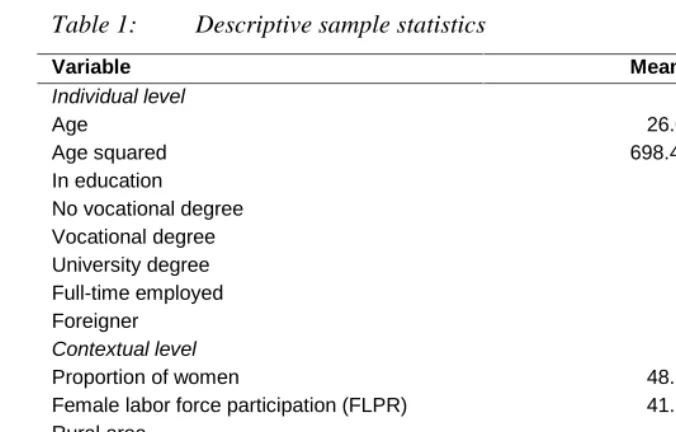
age limit is 40 years. Since each respondent is allowed to contribute multiple observations, this leads to 15,223 individual records, nested within 300 Kreise (out of 328 Kreise in the population). The number of observed first marriages in the period 1984 to 1999 is 850. See Table 1 for further descriptive sample statistics.
We use the following individual-level control variables in the analysis:
 the respondent’s age and age squared,
 a set of time-varying binary variables, indicating the highest educational degree at the time of each interview: in education, no degree, vocational degree (reference category), university degree,
 a time-varying binary variable that equals 1 if the respondent is full-time employed,
 and a time-constant binary variable that equals 1 if the person belongs to the oversample of foreigners the GSOEP.
The main variables of interest are characteristics of the man’s residential district:
 the average proportion of women in the local population aged 20 to 40 in 1995-1997 (in per cent) (time-constant),
 the local female labor force participation rate (in per cent) (time-varying, 1987/1995),
 a time-constant binary variable, indicating whether the district is defined as rural area (i.e., population density is less than 150 inhabitants per km2), and
Table 1: Descriptive sample statistics
Variable Mean (Stdv.)
Individual level
Age 26.0 (4.8)
Age squared 698.4 (268.3)
In education .20
No vocational degree .18
Vocational degree .52
University degree .09
Full-time employed .59
Foreigner .23
Contextual level
Proportion of women 48.6 (0.8)
Female labor force participation (FLPR) 41.2 (3.4)
Rural area .17
Unemployment rate 8.6 (3.1)
N (events) N (districts) N (men) N (records) 850 300 2,880 15,223 Note:
Mean values refer to person-years of observation. Standard deviations are not displayed for binary variables.
Source: GSOEP 1984-1999, DJI Regionaldatenbank, Statistik regional 1999, author’s calculations.
3.2 The discrete-time multilevel logit model
In the analysis performed here, all regression coefficients other than the intercept are constrained to be fixed across the regional units, i.e. we assume that the effect of the explanatory variables on the log odds that a man contracts his first marriage within a one-year interval t does not differ between contexts. This ‘random intercept model’ (Snijders and Bosker 1999: Chapter 4) takes the following form:
log[pijt/(1-pijt)] = b0 + b1xij + b2zijt + b3vj + b4wjt + u0j
where pijt is the probability of individual i in region j to marry in year t. xij and vj are
vectors of individual- and macro-level time-constant explanatory variables, while zijt
and wjt are vectors of time-varying explanatory variables at time t. The parameter b0 –
which is constrained to be equal across all years – represents the random intercept’s fixed part, while the normally distributed macro-level error term u0j depicts its random
component.
The regional random coefficient u0j indicates that the intercept may vary over
contexts, i.e. it measures the deviation of each context from b0 (‘between-context
variance’). This accounts not only for the correlation between individuals nested within the same context, but also captures otherwise unobserved regional effects.
4. Regression results
Two different models are estimated to analyze men’s transition to first marriage. In
Model 1, we use only individual-level explanatory variables, while Model 2 also
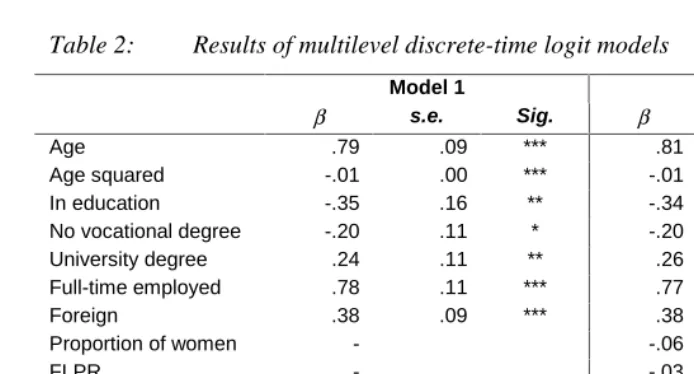
includes contextual variables. In both models, we control for unobserved heterogeneity at the regional level. The regression results are displayed in Table 2.
The individual-level variables come out as expected. We find a non-monotonic effect of age, i.e. a man’s propensity to enter marriage first increases with age, but decreases at later stages in his life course. The education and employment variables show that enrollment in education and having no vocational degree reduces the marriage risk, while men with a university degree and those who are full-time employed have a higher probability of contracting a marriage than their counterparts in the reference categories. Finally, foreigners are more likely to marry than western Germans. Neither the coefficients of the individual variables, nor the initial size of the highly significant regional random effect are altered by the inclusion of contextual indicators in Model 2. Our regional-level variables do not contribute to an explanation of the between-context variance indicated by σu, and they do not improve the overall model fit
of entering marriage. This result is consistent with previous findings for the US (see Lloyd and South 1996).
Table 2: Results of multilevel discrete-time logit models
Model 1 Model 2
β s.e. Sig. β s.e. Sig.
Age .79 .09 *** .81 .09 ***
Age squared -.01 .00 *** -.01 .00 ***
In education -.35 .16 ** -.34 .16 **
No vocational degree -.20 .11 * -.20 .11 *
University degree .24 .11 ** .26 .11 **
Full-time employed .78 .11 *** .77 .11 ***
Foreign .38 .09 *** .38 .09 ***
Proportion of women - -.06 .05
FLPR - -.03 .01 **
Rural area - .03 .11
Unemployment rate - -.02 .01
Constant -14.93 1.27 *** -13.91 1.33 ***
σu .22 .07 ** .22 .07 **
-2 Log likelihood 6,206 6,196
Note:
Reference category for educational variables is ‘vocational degree’. Significance: *<.10; **<.05; ***<.01 .
Source: GSOEP 1984-1999, DJI Regionaldatenbank, Statistik regional 1999, author’s calculations.
5. Discussion
In recent years, a growing body of empirical research has investigated the influence of contextual effects on individual behavior. At the same time, scholarly interest in the demography of men has grown. Taking a multilevel perspective on male nuptiality in western Germany, this paper jointly considers these two topics.
Our multivariate analysis underlines the well-known finding that men’s economic status plays a major role for their marital behavior. Highly-educated and full-time employed individuals clearly have the highest probability of getting married. At the
regional level, we find a negative relationship between the female labor force
‘independence hypothesis’ only in aggregate-level studies, while micro-level event-history analyses “generally show that women’s educational attainment, employment, and earnings either have little or no effect on marriage formation or, where they do have an effect, find it to be positive”. This matches with results presented in Hank (2002b), where no effect of the female labor force participation rate is detected, but terminating education without degree is found to reduce a woman’s marriage risk (compared to women with a vocational degree).
Thus, one should also consider a complementary interpretation of the role of women’s aggregate employment in men’s marriage behavior. High female labor force participation rates may not only point to contexts in which women depend less on a husband’s economic support, but might also mark social environments that place greater emphasis on individual autonomy and gender equity (cf. Lesthaeghe and Neels 2001; Sackmann and Häussermann 1994). Both are important dimensions of the societal background for the ‘second demographic transition’. Following this approach, differentials in the ideational domain – for example regarding the degree of secularization – can be considered to be an underlying cause of the regional heterogeneity in the propensity to contract a marriage, which we detect in our models. The persistent and statistically significant latent contextual effect on men’s risk of entering marriage moreover corroborates the results reported in Hank’s (2002b) study of female nuptiality. These findings suggest that collective behavioral expectations and value orientations related to family formation may be manifested in geographically bound socio-cultural milieus. However, this explanation is far from being exclusive, and there are likely to be unobserved economic factors that might have an impact on marriage as well. Thus, further research is needed to identify more specifically, what the behaviorally relevant contextual characteristics are, which eventually result in regional differences in both men’s and women’s marital behavior.
6. Acknowledgements
References
Barber, J.S. / S.A. Murphy / W.G. Axinn / J. Marples. 2000. Discrete-time multilevel hazard analysis. In: M.E. Sobel & M.P. Becker (eds.), Sociological
Methodology, Vol.30. Washington: Blackwell Publishers, 201-235.
Clarkberg, M. / R.M. Stolzenberg / L.J. Waite. 1995. Attitudes, Values, and Entrance into Cohabitational versus Marital Unions. Social Forces, 74 (2), 609-634.
Coleman, D.A. 2000. Male Fertility Trends in Industrial Countries: Theories in Search for Some Evidence. In: C. Bledsoe et al. (eds.), Fertility and the Male Life-Cycle
in the Era of Fertility Decline. Oxford: Oxford University Press, 29-60.
Cooney, T.M. / D.P. Hogan. 1991. Marriage in an Institutionalized Life Course: First Marriage among American Men in the Twentieth Century. Journal of Marriage
and the Family, 53 (1), 178-190.
Courgeau, D. 1989. Family Formation and Urbanization. Population: An English
Selection, 44 (1), 123-146.
Goldscheider, F.K. / G. Kaufman. 1996. Fertility and Commitment: Bringing Men Back In. Population and Development Review, 22 (Suppl.), 87-99.
Greene, M.E. / Biddlecom, A.E. 2001. Absent and Problematic Men: Demographic Accounts of Male Reproductive Roles. Population and Development Review, 26 (1), 81-115.
Guo, G. / H. Zhao. 2000. Multilevel Modeling for Binary Data. Annual Review of
Sociology, 26, 441-462.
Hank, K. 2002a. Regional Social Contexts and Individual Fertility Decisions: A Multilevel Analysis of First and Second Births in Western Germany. European
Journal of Population, 18 (3), 281-299.
Hank, K. 2002b. The Differential Influence of Women’s Residential District on the Risk of Entering First Marriage and Motherhood in Western Germany. MPIDR
Working Paper WP 2002-027, available at http://www.demogr.mpg.de.
Klein, T. 2000. Partnerwahl und Partnerschaftsformen im regionalen Kontext. In: H. Bertram et al. (eds.), Solidarität, Lebensformen und regionale Entwicklung. Opladen: Leske + Budrich, 59-82.
Kravdal, Ø. 2002. The impact of individual and aggregate unemployment on fertility in Norway. Demographic Research, 6 (10), available at http://www.demographic-research.org/Volumes/Vol6/10.
Lengerer, A. 2001. Wo die Liebe hinfällt – ein Beitrag zur ‘Geographie’ der Partnerwahl. In: T. Klein (ed.), Partnerwahl und Heiratsmuster.
Sozialstrukturelle Voraussetzungen der Liebe. Opladen: Leske + Budrich,
133-162.
Lesthaeghe, R. / K. Neels. 2001. From the First to the Second Demographic Transition: An Interpretation of the Spatial Continuity of Demographic Innovation in France, Belgium and Switzerland. Paper presented at the Euresco Conference
on ‘The Second Demographic Transition in Europe’. Bad Herrenalb, June 23-28.
Lichter, D.T. / F.B. LeClere / D.K. McLaughlin. 1991. Local Marriage Markets and the Marital Behavior of Black and White Women. American Journal of Sociology, 96 (4), 843-867.
Lloyd, K.M. / S.J. South. 1996. Contextual Influences on Young Men’s Transition to First Marriage. Social Forces, 74 (3), 1097-1119.
Marini, M.M. 1984. Age and Sequencing Norms in the Transition to Adulthood. Social
Forces, 63 (1), 229-244.
Oppenheimer, V.K. 1988. A Theory of Marriage Timing. American Journal of
Sociology, 94 (3), 563-591.
Oppenheimer, V.K. 1997. Women’s Employment and the Gain to Marriage: The Specialization and Trading Model. Annual Review of Sociology, 23, 431-453.
Oppenheimer, V.K. 2000. The Continuing Importance of Men’s Economic Position in Marriage Formation. In: L.J. Waite et al. (eds.), The Ties That Bind. Perspectives
on Marriage and Cohabitation. New York: Aldine de Gruyter, 283-301.
Sackmann, R. / H. Häussermann. 1994. Do regions matter? Regional differences in female labour-market participation. Environment and Planning A, 26 (6), 1377-1396.
Snijders, T.A.B. / R.J. Bosker. 1999. Multilevel analysis: An introduction to basic and
SOEP-Group. 2001. The German Socio-Economic Panel (GSOEP) after more than 15 years – Overview. In: E. Holst et al. (eds.), Proceedings of the 2000 Fourth
International Conference of German Socio-Economic Panel Study Users (GSOEP2000), Vierteljahrshefte zur Wirtschaftsforschung, 70 (1), 7-14.
South, S.J. / K.D. Crowder. 2000. The Declining Significance of Neighborhoods? Marital Transitions in Community Context. Social Forces, 78 (3), 1067-1099.
Teachman, J. / K. Crowder. 2002. Multilevel Models in Family Research: Some Conceptual and Methodological Issues. Journal of Marriage and Family, 64 (2), 280-294.
Waite, L.J. (ed.; co-edited by C. Bachrach / M. Hindin / E. Thomson / A. Thornton) 2000. The Ties That Bind. Perspectives on Marriage and Cohabitation. New York: Aldine de Gruyter.
Appendix
Figure 1: Spatial distribution of average crude marriage rates by Kreis in western Germany, 1986/93
CMR lower than 7.35 (79)
CMR 7.35 to 8.05 (175)
CMR higher than 8.05 (74)
Note:
Notes
1. Hank uses the following contextual-level predictors in his models: rural-urban indicators, the child care provision rate, the share of employees in the service sector, the unemployment rate, the female labor force participation rate, the crude birth rate (crude marriage rate, respectively), and a measure of the district’s ideational homogeneity in terms of denominational affiliation and party preference. Individual-level control variables are: the respondent’s age and age squared, her highest educational degree at the time of the survey in each year, ethnicity, marital status (in the fertility analysis), and whether she has a pre-marital child (in the marriage analysis).
2. Figure 1 in the Appendix illustrates the spatial distribution of average regional
crude marriage rates in western Germany for the years 1986 and 1993. Unfortunately, our data do not allow to calculate sex- or age-specific marriage rates.
3. In an overview of male fertility trends in industrialized countries, Coleman (2000: 32) notes that “[t]he dominant linkage of men’s economic position in the marriage and fertility system of historical Western Europe with late and avoidable marriage led to the apparent paradox that while almost all analysis of the pattern and trend of fertility was conducted with respect to the employment and wage earning of men, the indices of fertility and reproduction universally employed related to women only and were based on women’s rates. […] Since the Second World War, and the overturning of this Malthusian apple-cart based on single (male) earner households, the balance of interest has moved further against men.”
4. See Oppenheimer (1997) for a critical discussion of the so called ‘independence hypothesis’.
5. Since a person’s entry into first marriage is a non-repeatable event, no individual-level unobserved heterogeneity factor can be identified.