٭Corresponding Author, Email: [email protected]
A Variable Structure Observer Based Control Design for
a Class of Large Scale MIMO Nonlinear Systems
R. Ghasemi1* and M. B. Menhaj2
1- Associate Professor, Department of Electrical Engineering, University of Qom, Qom, Iran 2- Professor, Department of Electrical Engineering, Amirkabir University of Technology, Tehran, Iran
Received 12 October 2015, Accepted 16 January, 2016
ABSTRACT
This paper fully discusses how to design an observer based decentralized fuzzy adaptive controller for a class of large scale multivariable non-canonical nonlinear systems with unknown functions of subsystems’ states. On-line tuning mechanisms, which adjust both the parameters of the direct adaptive controller and the observer that guarantee the ultimately boundedness of the tracking error as well as that of the observer error, are derived through Lyapunov stability analysis. The most important merits of both the proposed controller and the observer are their robustness against external disturbances. The observer proposed in the paper is designed based on a reconfiguration of the system in which the dynamics of the model reference is taken into account. It should be emphasized that compared to the other methods recently cited in the literature, this paper designs proper controllers for a class of nonlinear large scale MIMO systems in which merely the structure of the systems is known. The simulation results easily approve the remarkable capability of the proposed method.
KEYWORDS
1. INTRODUCTION
As a result of both tunable structure of the FAC and using the experts’ knowledge in controller design procedure, fuzzy adaptive controller (FAC) attracted many researchers to develop appropriate controllers for nonlinear systems especially for large scale systems (LSS).
Nowadays, FAC has been fully studied. Initially, the Takagi-Sugeno (TS) fuzzy systems have been used to model nonlinear systems and then TS based controllers have been designed with guaranteed stability [1]. Modeling affine nonlinear systems and designing stable TS fuzzy based controllers have been employed in [2]. Designing of the sliding mode fuzzy adaptive controller for a class of multivariable TS fuzzy systems were presented in [3].
The linguistic fuzzy systems have also been used to design controllers for nonlinear systems. [4] has considered linguistic fuzzy systems to design stable adaptive controller for affine systems based on feedback linearization. Stable FAC based on sliding mode was designed for affine systems in [5]. Designing FAC for affine chaotic systems was presented in [6]. Designing stable FAC and linear observers for class of affine nonlinear systems were discussed in [7]. The output feedback FAC for class of affine nonlinear MIMO systems was suggested in [8]. A robust adaptive fuzzy controller, based on a linear state observer, for a class of affine nonlinear systems has been presented in [9]. Considering linear observer for nonlinear system and designing controller for SISO affine nonlinear system are the main disadvantages of [9]. In [10], direct and indirect adaptive output-feedback fuzzy decentralized controllers for a class of large-scale affine nonlinear systems have been developed based on linear observer. [11] presented fuzzy adaptive controller for a class of affine nonlinear systems. This method guarantied ultimately boundedness of tracking error. A direct adaptive fuzzy controller for a non-minimum phase two-axis inverted pendulum servomechanism has been presented based on real-time stabilization in [12]. The main drawbacks of these papers are those restricted conditions imposed on the system dynamics. For example, it is assumed the control gain is bounded to some known functions or constant values.
[13] developed stable FAC for class of non-affine nonlinear systems. The main limitation of these methods is that convergence of tracking errors to zero was not guaranteed. [14, 15] proposed a decentralized fuzzy model reference state tracking controller for a class of canonical nonlinear large scale system. The main limitations of these
references are both considering the interaction as a bounded disturbance and availability of all states.
Designing adaptive fuzzy controller for a class of stochastic affine nonlinear controller is proposed in [16]. Combination of fuzzy adaptive controller and back-stepping controller is discussed for a class of affine pure feedback switching system in [17, 20]. In [18], a class of fuzzy adaptive controller is designed for affine nonlinear stochastic system with input saturation based on observer. Designing decentralized output fuzzy adaptive controller is derived for a class of affine canonical stochastic nonlinear system in [19, 21, 22]. Designing adaptive fuzzy sliding mode decentralized controller for a class of large scale affine nonlinear systems is proposed in [23].
Availability of the states of the subsystems and considering SISO affine nonlinear systems for each subsystem are the main disadvantages of the proposed controller proposed in [23]. [24] discussed about designing observer based indirect fuzzy adaptive controller for a class of affine SISO nonlinear system in which the gain sign is unknown. Fuzzy adaptive controller design based on observer is derived for a class of affine nonlinear system with dead-zone input in [25]. In [26], observer based fuzzy adaptive controller design is proposed for affine MIMO nonlinear systems with unknown control direction. [27, 28] argues about observer based fuzzy adaptive controller for affine MIMO nonlinear systems with time delay.
Compared with the previous studies which mainly concentrated on observer-based affine SISO systems or affine large scale systems without observer design, the proposed method is focused on the designing of the observer based large scale non-canonical nonlinear systems.
The remainder of the paper is organized as follows. Section 2 gives problem statement. Designing fuzzy adaptive controllers and nonlinear observers are proposed in Section 3. Section 4 presents simulation results of the proposed controller and finally Section 5 concludes the paper.
2. PRELIMINARIES
Consider the following large scale nonlinear system.
, ,
, 1 2
( ) 1, 2,..., 1 , 1, 2,..., ( ) ( ) ( , ,..., ) ( )
i
i l i l i i
i n i i i i i i N i T
i i i
x f x l n i N
x f x g x u m x x x d t
y C x
= = - =
ì
ï = + + +
í ï = î
&
& (1)
where
x
i l, declaresth
l
state of thei
thsubsystem,n
iissubsystems, i i,ni
n T i
= [x , . . . , x ]
i,1x
Î
R
is the statevector of the system which is assumed not available for measurement,
u
iÎ
R
is the control input,y
iÎ
R
is the system output,f
i,l ii(x )
’s andg
i ii(x )
are unknown smooth nonlinear function,m x x
i( ,
1 2,...,
x
N)
is an unknown nonlinear interconnection term, andd t
i( )
is bounded disturbance.The above equation can be revised as
0 0
( )
1 2
(
( ))
( ( )
( )
( ,
,...,
)
( ))
i ii i i i i i i i i i f x
i i i i N i
T i i i
x
A x
A x
f x
b f x
g x u
m x x
x
d t
y
c x
¢
=
+ -
+
+
ì
ï
ï
+
+
+
í
ï =
ï
î
&
1442443
(2)
where
f x
i( )
i ,A
i0 andb
i are defined below.[
]
i0
i
,1 , 1
0
1
0
0
0
0
1
0
A =
0
0
0
1
0
0
0
0
b
0
0 1
( )
( )
( )
0
i n n
T n
T
i i i i i n i
R
R
f x
f
x
f
x
´
-é
ù
ê
ú
ê
ú
ê
ú Î
ê
ú
ê
ú
ê
ú
ë
û
=
Î
é
ù
= ë
û
L
L
M M M O M
L
L
L
L
(3)
The control objective is to design an observer based adaptive fuzzy controller for system (1) such that the tracking error and observer error are ultimately bounded while all signals in the closed-loop system remain bounded.
In this paper, we will make the following assumptions concerning the system (1) and the desired trajectory
(t)
im
x
.Assumption 1: without loss of generality, it is assumed that the nonzero function
g x
i( )
i satisfies the followingcondition:
i n
min i i
( )
> 0 (x , u )
×
i i
g x
³
g
"
Î
R
R
(4)Comment: For the case in which
g
min< 0
, we may easily use the following controller and observer design given below.Assumption 2: The desired trajectory
x
im(t)
is generated by the following desired system.0
( )
im i im i i
T
im i im
x
A x
b r t
y
C x
=
+
ì
í
=
î
&
(5) where
r t
i( )
is external desired value.Assumption 3: the interconnection term satisfies the following:
( )
1 2 0 1
ˆ
( ,
,...,
)
N Ti N i j ij i i j
m x x
x
£
x
+
å
=x
c e
%
x
(6)( )
0 1
ˆ
N T
i j ij
c e
i ix
jx
+
å
=x
%
is unknown upper bound of interaction terms. To use this upper bound in controller design procedure, it uses thez
ˆ
ij’s as estimation ofz
ij’s that adjusted adaptively.Assumption 4: the external disturbance satisfies the following property.
max
( )
i
d t
¥£
d
(7)Consider
x t
ˆ ( )
i as an estimation ofx t
i( )
and thefollowing definitions.
(n-1) T
im i i i
(n-1) T
im i i i
e =x -x = [e e ...e
]
ˆ
ˆ
ˆ ˆ
ˆ
e =x -x = [e e ...e
]
ˆ
i i
i i
i i i
e
= -
e
e
&
&
%
(8)
where
e
istands for the tracking error,e
ˆ
i presents theobserver error and
e
%
iis for the observation error. Consider the following tracking error vector.i i
n T i i,1 i,2 i,n
e = [e , e , . . . , e ]
Î
R
(9) Taking the derivative of both sides of the equation (8) we have:(
i im i 0 0
1 2
iy i
e = x -x
( )
( )
( )
( )
( ,
,...,
)
( )
e
e
i im i i i i i
i i i i i i i N i
T i
A x
b r t
A x
f x
b
f x
g x u
m x x
x
d t
c
ì
=
+
-
-
¢
ï
-
+
+
+
í
ï =
î
& & &
(10)
Use equation (2) to rewrite the above equation as:
i i0 i i
1 2
iy i
e = A e
( )+b { ( )- ( )
( )
( ,
,...,
)
( )}
e
e
i i i i
i i i i N i
T i
f x
r t f x
g x u
m x x
x
d t
c
ì
-
¢
ï
+
-
-í
ï =
î
&
where
A
i0 is defined in equation (3).To construct the controller, let
v
i be defined as Ti ic
ˆ
iv = ( )+k e
r t
i+
v¢
i (12)Consider the vector
i T
ic i,1 i,2 i,n
k = [k , k , . . . , k
]
be coefficients of ii
n -1
i,n i,1
( )
s
s
ni+k s
+...+k
y
=
and chosenso that the roots of this polynomial are located in the open left-half plane and the
v¢
i is the adaptive term that be introduced later. This makes the matrixA =A - b k
ioc i0 i Ticbe Hurwitz.
By adding and subtracting the term
(
k e
Ticˆ
i+
v
i¢
)
from the right-hand side of equation (14), we obtainT i0
1 2
T
iy i
ˆ
e = A e -b k e
( ) b { ( )
( )
( ,
,...,
)
( )+ }
e =C e
i i i ic ii i i i i
i i i i i N i i
i
f x
f x
g x u
v
m x x
x
d t
v
ì
-
¢
-ï
¢
+
- +
+
í
ï
î
&
(13)
Invoking the implicit function theorem, it is obvious that the nonlinear algebraic equation
( )
( )
0
i i i i i i
f x
+
g x u
- =
v
is locally soluble for the inputu
ifor an arbitrary(x , v )
i i . Thus, there exists some ideal controlleru (x , v )
*i i i satisfying the following equality for a given nii i
(x , v )
Î
R × R
: *( )
( )
0
i i i i i i
f x
+
g x u
- =
v
(14)As a result of the mean value theorem,
( )
( )
i i i i i
f x
+
g x u
can be expressed aroundu
*i as:i * i
* *
i i i u
( )
( ) = ( )
( )u
+ (u -u ) ( )
( )
( )u + e
( )
i i i i i i i i i
i i i i i i i i
f x
g x u
f x
g x
g x
f x
g x
g x
+
+
=
+
(15)Substituting equation (15) into the error equation (13), we get
T i0
1 2 T
iy i i
ˆ
e = A e -b k e
( ) b {
( )
( ,
,...,
)
( )+ }
e =c e
i i i ic i i i iu i i
i N i i
f x
e g x
m x x
x
d t
v
ì
-
¢
-ï
¢
+
+
í
ï
î
&
(16)
3. OBSERVER BASED FUZZY ADAPTIVE CONTROLLER
DESIGN
If the function is continuous on compact set, it can be written in compact form as:
( )
( )
Ty x
=
w x
q
(17)where
q = é
ë
y y
1 2...
y
Mù
û
is a vector of consequent parameters, and( )
[
1( )
2( ) ...
( )]
TM
w x
=
w x w x
w
x
is aset of fuzzy basis functions.
This section deals with the observer and controller design procedure. To design observer for the mentioned system in equation (16), this paper proposes the following observer error.
ioc
T
i0 ic i0
A
T iy
ˆ
ˆ
ˆ
e = (A -b k ) e +k
( , )
ˆ
ˆ
e =c e
T T
i i i i i ino i i i i i i
c e
b k
e e c e
ì
+
ï
í
ï
î
&
%
%
%
14243
(18)where
k k
io,
inoare the linear observer gain and the nonlinear observer gain respectively.k
io is selected to make sure that the characteristic polynomial ofioo io i0
(A =A -k
T)
i
c
is Hurwitz. Defining the observation errore
%
i= -
e
ie
ˆ
i. Subtracting (16) from (19) yieldsi0 i0
1 2
T iy
e = (A -k ) ( ) b { ( )
ˆ
( )+ ( , ,..., ) ( , ) }
e =c e
oo
T
i i i i i iu i i
A
T
i i i N ino i i i i
i i
c e f x e g x
d t v m x x x k e e c e
ì - ¢
-ï
ïï+ ¢+ +
í ï ï ïî
&% 14243 %
% %
% %
(19)
The output error dynamics of the above equation can be given as:
iy 1 2
e = ( ){ ( ) b { ( ) ( , ,..., )
ˆ
( )+ ( , ) }}
i i i iu i i i N
T
i i ino i i i i
H s f x e g x m x x x d t v k e e c e
¢ + +
¢
+ +
%
% % (20)
where
(
)
-1T
i0 i0
H (s)= - c
sI-(A -k
T)
i i
c
iB
i (21)i
B
is the identity matrix, andH (s)
i is a known stable transfer function. In order to use the SPR-Lyapunov design approach, equation (20) is rewritten asiy
1 2
e =
( ) ( ){ ( )
b {
( )
( )+
ˆ
( ,
,...,
)
( , )
}}
i i if i iu i i if if T
i N inof i i i i
H s L s f
x
e g x
d t
v
m x x
x
k
e e c e
¢
+
+
¢
+
+
%
%
%
(22)where
f
if¢
( )
x
i=
f x
i¢
( )
i ,1
( )
iu f i iu
f
l=
L s
-f
l, 1( )
if i i
v
¢
=
L s
-v
¢
,d t
if( )
L s
i( )
1d t
i( )
-=
.L (s)
i ischosen so that 1
( )
i
transfer function. Let
L (s)=s + b s + + b
i m i1 m-1L
imwhere
(m = n - 1)
.The state-space realization of (22) can be written as
is is
T
1 2 i
T iy is is
e = ( ) b {
( )
( )
ˆ
( ,
,...,
)+
( , )
}
e =c e
ioo is is if iu i i if if N if ino i i is
A e
B f
x
e g x
d t
m x x
x
v
k
e e c e
ì
-
¢
-
+
ïï
+
¢
+
í
ï
ïî
&%
%
%
%
%
%
(23)The ideal controller can be represented as: *
( )
i i i iu
u
=
f z
+
e
(24)where
[ , ]
Ti i i
z
=
x v
andf z
i( )
i=
q
i*1w z
i1( )
i , andq
i*1 andw
i1( )
z
i are consequent parameters and a set of fuzzybasis functions, respectively.
e
iu is an approximation error that satisfiese
iu£
e
max ande
max>
0
. Denote the estimate ofq
i*1 asq
i1andu
irob as a robust controller to compensate approximation error, uncertainties, disturbance and interconnection term. To rewrite the controller given in (24) as:1 1
( )
ˆ
2 i0T T
i i i i irob i i
u
=
q
w z
+
u
+
e P k
(25)Consider
x
ij(
c e
iT%
i)
=
h
jic e
iT%
i and thenu
irobbe defined below. 0 min min 2 1 min min 1 min minˆ
(
)(
2
1
ˆ
ˆ
2
ˆ
ˆ
ˆ
ˆ
( , )(
))
T T i
irob is is is is
N T
ir
ij i is is icom
j
T
is is T
i
ino i i i i i
N
u
sign c e
c e
g
g
u
x
c e
u
g
g
c e
v
k
e e
e P b
g
g
x
h
==
+
+
+
+
¢
+
+
+
å
%
%
%
%
%
(26)In the above, T1 1
( )
i
w z
iq
approximates the ideal controller, 2 0 11
ˆ
ˆ
ˆ
2
N Ti j ij
x
jc e
is isx
+
å
=h
%
tries to estimate the interconnection term,u
icomcompensates forapproximation errors and uncertainties,
u
ir is designed to compensate for bounded external disturbances,min 1
ˆ
( , )(
ˆ
Tˆ
T))
inof i i is is i i i
k
e e
%
c e
%
g
+
e P b
tries to estimate the nonlinear gain of the observer, andv¢
ˆ
i is estimation ofi
v¢
. Define error vectorq
%
i1=
q
i1-
q
i*1 and use (26) and(27) to rewrite the error equation (17) as:
T
i i0 i i ic i i 1 1 i
1 2 i
T
iy i i
ˆ
e = A e -b k e ( )-b {( ( )
) ( ) ( , ,..., ) ( )+ }
e =C e
T
i i i irob
iu i i i N i
f x w z u g x m x x x d t v
q
e
ì - ¢ + ï - + + ¢ í ï î % & (27)Based on equations (25) and (26), the state-space realization of the equation (23) can be written as
is is 1 1
T iy is is
e = ( )-b {(
( )
ˆ
) ( )
( )+
( , )
}
e =c e
T
ioo is is if i i i irob T iu i i if if inof i i i i
A e
B f
x
w z
u
g x
d t
v
k
e e c e
q
e
ì
-
¢
+
ïï
-
+
¢
+
í
ï
ïî
&
%
%
%
%
%
%
%
(28)Consider the following update laws.
0 2
i 2 i
min
1 1 1
0 min
ˆ
(
ˆ
)
( )
ˆ
i Tis is T T
ino iko is is i
T
i is is i i
T
i is is
c e
k
c e b P e
g
c e w z
c e
g
xg
q
g
x
=
+
= G
=
%
&
%
&
%
&
%
2 min ˆˆ
ˆ
2
ˆ
ji ir icom i T ji is is iT ir u is is
T icom u is is
T i v is is
c e
x
g
u
c e
u
c e
v
c e
h
g
h
g
g
g
¢=
=
=
¢ =
&
%
&
%
&
%
&
%
(29)where 1 1
0,
ir,
ji,
icom,
ˆi,
0
Tu h u v iko
g g g
g g
¢G = G >
>
areconstant parameters.
Theorem 1: consider the error dynamical system given in (18) and (28) for the large scale system (1) satisfying assumption (1), interconnection term satisfying assumption (3), the external disturbances satisfying assumption (4), and a desired trajectory satisfying assumption (2), then the controller structure given in (25), (26) with adaptation laws (29) makes the tracking error and the observer error converge asymptotically to the origin and all signals in the closed loop system bounded.
Proof: consider the following Lyapunov function.
0
1
1 2 1 1 1
1
2
2 2 2 2 2
1 0 ˆ
1
1
ˆ
ˆ
(
2
)
fi ji ir icom i
N
T T T
is i is i i i i i
i iu
N ji j
i ir icom ino i
u u iko v
V
e P e
e P e
g
u
u
k
v
l
x h
q
q
h
x
g
g
g
g
g
g
-=
=
¢
=
+
+ G
¢
+
+
+
+
+
+
å
å
%
%
%
%
%
%
where
q
%
i1=
q
i1-
q
i*1,u
%
ir=
u
ir-
d
max, maxicom icom
u
%
=
u
-
e
,k
%
ino=
k
ˆ
ino-
k
ino,h
%
ji=
h
ˆ
ji-
h
ji,0 0 0
ˆ
i i i
x
%
=
x
-
x
andv
%
i¢
= -
v
ˆ
i¢
v
i¢
.The time derivative of the Lyapunov function becomes.
(
)
0
1 1 2 1
1
1 0 0
2 2 1 1 1
ˆ
1
1
1
2
ˆ
1
ˆ
ˆ
ˆ
ˆ
2
ˆ
ˆ
i jiir icom i
N
T T i T
is i is is i is is i is
i i i i
T T T i i
i i i i i i i i ir ir icom icom i i ino ino
u u v
g
V
e P e
e P e
e P e
g
g
g
e P e
e P e
u u
u
u
v v
k k
x h
x x
q
q
g
g
g
g
g
= -¢
æ
ö
=
ç
+
+
÷
è
ø
+
+
+ G
+
+
¢ ¢
+
+
+
+
å
å
&
&
&
&
%
%
%
%
%
%
&
%
&
&
%
&
&
&
%
% &
% &
%
ko
g
(31)
Use (18) and (28) and to rewrite above equation as:
1
is 1 1
1 1
is 1 1
1 1
(
( )
2
-b {(
( )
) ( )
ˆ
( )+
( , )
})
1
(
( )
2
-b {(
( )
) ( )
( )+
(
N
ioo is is if
i i
T
i i i irob iu i i
T T
if if inof i i i i i is
T
is i ioo is is if
i
T
i i i irob iu i i
if if inof
V
A e
B f
x
g
w z
u
g x
d t
v
k
e e c e
P e
e P A e
B f
x
g
w z
u
g x
d t
v
k
e
q
e
q
e
=¢
=
-+
-¢
+
+
¢
+
-+
-¢
+
+
å
&
%
%
%
%
%
%
%
%
%
(
)
(
)
1 2ioc i0 2
2 ioc i0
ˆ
, )
})
2
1
ˆ
ˆ
ˆ
A e +K
( , )
2
1
ˆ
ˆ
A e +K
( , )
ˆ
2
T i T
i i i i is i is
i
T
T T
i i i ino i i i i i i
T T T
i i i i i ino i i i i
g
e c e
e P e
g
C e
b k
e e c e
P e
e P
c e
b k
e e c e
+
+
+
+
+
&
%
%
%
%
%
%
%
%
%
0 11 0 0
1 1 1
ˆ
ˆ
ˆ
ˆ
ˆ
i ji ir
icom i
N
ji ji
j
T i i ir ir
i i
u
icom icom i i ino ino
u v ko
u u
u
u
v v
k k
x h
h h
x x
q
q
g
g
g
g
g
g
=
-¢
+ G
+
+
+
¢ ¢
+
+
+
å
&
&
%
%
% &
%
&
&
&
%
% &
%
(32)
A assumption (1) yields
1
g
i£
1
g
min and use assumptions (3) and (4) to rewrite (32) as:(
)
(
)
1 2 1 1 1 1 1 2 min Tioc 2 2 ioc
1 1
1
2
1
( )
2
1
ˆ
A
A
ˆ
2
-(
( )
)
i i N T Tis ioo i i ioo is i i
Q
T T T
i
is i is i is i is i
T
i i i i
Q
T T
i i i irob iu is is
V
e
A P
P A
e
g
g
e P e
f
x
B P e
g
g
e
P
P
e
w
z
u
c e
q
e
=-£
+
¢
-
+
+
+
+
-å
&
%
%
1442443
& % %
%
1442443
%
%
(
)
max 0 1 min min 2 min min2 i0 2
ˆ
ˆ
( , )
ˆ
( , )
ˆ ˆ
T N is is Tis is i j ij j
T is is i T
is is ino i i
T T T T
i i is is ino i i i i i is is
c e
d
c e
x
g
g
c e
v
c e
k
e e
g
g
e P k c e
k
e e e P b c e
x
=x
+
+
+
¢
+
+
+
+
å
%
%
%
%
%
%
%
%
0 11 0 0
1 1 1
ˆ
ˆ
ˆ
ˆ
ˆ
i ji ir
icom i
N ji ji j
T i i ir ir
i i
u
icom icom i i ino ino u v ko
u u
u
u
v v
k k
x h
h h
x x
q
q
g
g
g
g
g
g
=
-¢
+ G
+
+
+
¢ ¢
+
+
+
å
&
&
%
%
% &
%
&
&
&
%
% &
%
(33)
Using sigmoid properties, (25)-(26) and well-known equality
a
2+
b
2³
2
ab
, we can easily obtain (34), this can be rewritten as given below.(
)
(
)
(
)
0
1 2 1
1 2 1 min 1 1 min 2 2 1 min 0 0 min
1
2
2
1
1
ˆ
ˆ
( )
2
ˆ
-
( )
ˆ
ˆ
2
ˆ
i ji i NT i T
is i is is i is
i i i
T T T
i i i i is i is T
is is T T i i i i i is is
v T
N is is i
ji ji j T is is i i
g
V
e Q e
e P e
g
g
e Q e
f
x
B P e
g
c e
v
v
w z c e
g
c e
x
g
c e
g
h xq
h
h
x
x
= ¢ =-£
-¢
+
+
¢
¢
-
--
--
-å
å
% % %&
&
%
%
%
%
%
%
%
%
1424
3
%
14243
%
1
ˆ
2K
i0T T i i is is
e P
c e
+
%
4243
(
)
(
)
0 2 2 min max max min 11 0 0
1 1 1
ˆ
ˆ
(
)
ˆ
ˆ
ino icom iri ji ir
ico
T
is is T T ino ino i i i is is
k
T is is T
is is icom ir
u u
N ji ji j
T i i ir ir
i i
u
icom icom u
c e
k
k
e P b c e
g
c e
c e
u
u
d
g
u u
u
u
x he
h h
x x
q
q
g
g
g
g
=-æ
ö
ç
÷
-
-
+
ç
÷
è
ø
-
-
-
-+ G
+
+
+
+
å
% % %%
%
14243
%
% 14243
14243
&
&
%
%
% &
%
&
% &
ˆˆ
ˆ
m ii i ino ino v ko
v v
k k
g
¢g
¢ ¢
+
%
&
+
%
&
Finally, The above equation can also be rewritten as:
(
1 2 1
1
2 1
min
1
1 1 1 1
ˆ min 2 2 1 min 0
1
2
1
1
ˆ
ˆ
( )
2
ˆ
-
( )
ˆ
ˆ
2
i ji N T iis i i is
i i i
T T T
i i i i is i is T
is is i T T
i i i i is is i v
T
N is is i ji ji j T is i
g
V
e
Q
P
e
g
g
e Q e
f
x
B P e
g
c e
v
v
w z c e
g
c e
x
g
c
hq
q
g
h
h
g
x
= -¢ =æ
ö
-£
ç
+
÷
è
ø
¢
+
+
æ
¢
ö
¢ç
÷
-
-
- G
ç
÷
è
ø
æ
ö
ç
÷
-
-ç
÷
è
ø
-å
å
&
&
%
%
%
&
%
%
&
%
%
&
%
%
%
%
0 0 min 2 2 min minˆ
ˆ
ˆ
i ir icomis i T ir
icom is is u T
is is T T ino ino i i i is is
ko T
is is icom ir
u
e
u
u
c e
g
c e
k
k
e P b c e
g
c e
u
u
g
xx
g
g
g
g
æ
ö
æ
ö
ç
-
÷
-
ç
ç
-
÷
÷
ç
÷
è
ø
è
ø
æ
ö
ç
÷
-
+
-ç
÷
è
ø
æ
ö
ç
÷
-
-ç
÷
è
ø
&
&
%
%
&
%
%
%
%
&
%
(35)After some algebraic manipulations on the time derivative of the Lyapunov function and using equation (29), we will have:
1 2 1
1 2 1 min
1
2
1
1
ˆ
ˆ
( )
2
i N T iis i i is
i i i
M
T T T
i i i i is i is
g
V
e
Q
P
e
g
g
e Q e
f
x
B P
e
g
=æ
ö
£
-
ç
+
÷
è
ø
¢
-
+
å
&
&
%
%
144244
3
%
(36)
Furthermore knowing the fact that the reference signals (i.e.
x
im) are bounded and using the fact1 2
( )
T
i i
f
¢
x
£
c x
+
c
, we can proceed as follows.{
2
1 2
1 2
ˆ
1 1 1 2
( )
ˆ
ˆ
ˆ
is i T i ii i i im im
e e
is i im
c
f
x
c x
c
c x
x
x
x
x
c
c e
c e
c x
c
¢ £
¢
£
+
£
- + -
+
+
£
+
+
+
%123
%
14243
(37)Using (37), the equation (36) can be written as:
2 2
min min 2
min
2
1 1 1 1
min min 2 1 min
1
1
ˆ
(
)
(
)
2
1
1
ˆ
1
i is i i
T T
is is i i is is i T
is is i
V
M
e
Q
e
g
c e
B P
c e
e
B P
g
g
c e
B P
g
l
l
£ -
-+
+
¢
+
&
%
%
%
%
(38)The above inequality becomes:
min 1 1
min
2 1 min 2
1 1 min
(
(
)
1
ˆ
) (
(
)
2
1
ˆ
)
is Ti is is is i T
is i i i
T is is i i
e
V
M
e
c e
B P
g
c B P
Q
e
c e
B P
e
g
l
l
£ -
-¢
-
-%
&
%
%
%
(39)
Choosing appropriately the matrices
M
i andQ
i2, we can guarantee thatV
&
is negative as long as the observation and observer errorse e
%
is,
ˆ
i remain outside of the compact setW
edefined as(
2 1
min 1 1
1 1 2 1
min 2 min min 1 1
( )
ˆ ,
2 ˆ
( ) g ( )
T is i
is T
i is i
e is i T T
is i is i
i T
i i is i
c B P e
M c B P
e e
c B P c B P e
Q M c B P
l l l ì ¢ ü ï £ ï -ï ï ï ï
W = í ¢ ý
ï £ ï ï - ï ï ï î þ % % (40)
According to the standard Lyapunov theorem, we conclude that observation error, accordingly the observer error and the tracking error are ultimately bounded and
ˆ
,
is i
4. SIMULATIONRESULTS
In this section, we apply the proposed observer based decentralized fuzzy model reference adaptive controller to the following large scale system.
11 11 12 11
12 11 12 1 21 1
1 11
sin(
)
sin(
) 1
200
4 sin(
)
( )
x
x
x
x
x
x
x
u
x
d t
y
x
=
+
-ì
ï
=
+ -
+
+
+
í
ï =
î
&
&
21 21 22 21
22 21 22 2 11 2
2 21
sin(
)
sin(
) 1
200
4 sin(
)
( )
x
x
x
x
x
x
x
u
x
d t
y
x
=
+
-ì
ï
=
+ -
+
+
+
í
ï =
î
&
&
(41)
It has been considered that the desired value of the outputs are
r
1=
2sin(
p
t
)
+
2 sin(3
p
t
)
and2
2 sin(1.8
)
2 sin(3.6
)
r
=
p
t
+
p
t
. Furthermore, it is assumed thatd t
1( )
=
sin(200
p
t
)
and2
( )
sin(120
)
d t
=
p
t
.Now we apply the proposed controller defined in (25), (26) to the system given in (1). Based on the experts’
knowledge, Let us define
1 2 1 2
[
,
] ,
T[
,
, ]
Ti i i i i i i
x
=
x x
z
=
x x
v
and the states of the subsystems are in the range of[5, 5]
-
, furthermore, vi are defined over[ 45, 45]
-
. For each fuzzy system input, we define 6 membership functions over the defined sets. Consider that all of the membership functions are defined by the Gaussian function2 2
( )
( ) exp( )
2 j
c
c m c
d
-= , where
c
is center of the membership function andd
is its variance. We assume that the initial value of controller parameters be zero. Furthermore, it has been assumed thatmin
1
f
=
,G =
110
,g
xi0=
2,
g
xij=
2
,g
uicom=
2
,5
ir
u
g
=
,g
vˆi¢=
2
andg
iko=
10
. In addition, we assumethat
s
=
0.01
,e
=
0.01
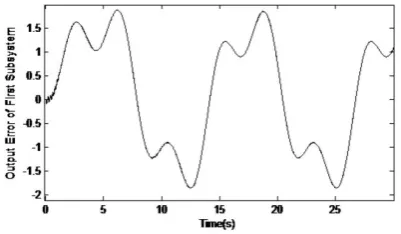
.As shown in Fig. 1 and 2, it is obvious that the performance of the proposed controller is promising. Fig. 3 and 4 show the estimation of the first and second states of the first subsystem with their desired value.
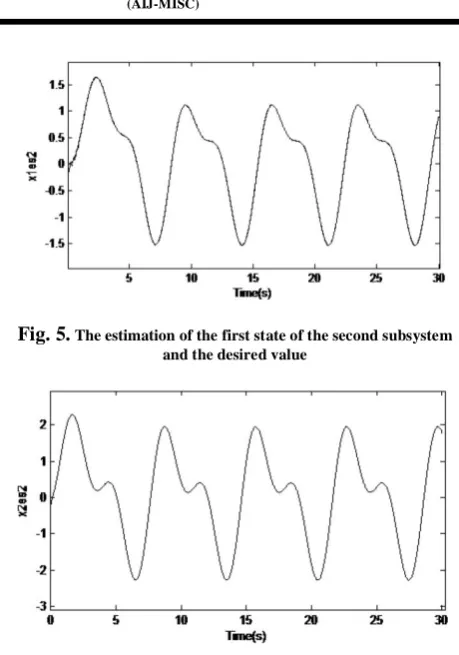
The performance of the proposed observer on the second subsystem and their desired trajectories are shown in Fig. 5 and 6.
As shown in Figs. 3-6, it is obvious that the nonlinear state observer can generate the estimated states and perform exactly. Moreover, it is also clear that the output of the system converge to the desired value. The stability
of the closed loop, the boundedness of the tracking error, as well as the observer error, robustness against both external disturbance and approximation error are the merits of the proposed controller and observer.
Fig. 1. Performance of the proposed controller in first subsystem
Fig. 2. Performance of the proposed controller in second subsystem
Fig. 3. The estimation of the first state of the first subsystem and the desired value
Fig. 5. The estimation of the first state of the second subsystem and the desired value
Fig. 6. The estimation of the second state of the second subsystem
5. CONCLUSION
This paper proposed new fuzzy adaptive observer based controller for a class of nonlinear large scale systems. It was assumed only the structure of the large scale system is known and the functions of the subsystems are unknown. The advantages of the proposed method are 1) it guarantees the boundedness of both tracking and observer errors, 2) it makes the overall closed loop control systems robust against external disturbances and approximation errors as well and 3) the stability of the closed loop system (plant, observer and controller) is guaranteed. The simulation results easily approve the promising performance of the proposed controller the observer as well.
REFERENCES
[1] G. Feng, “An Approach to Adaptive Control of Fuzzy Dynamic Systems,” IEEE Transactions on Fuzzy Systems, Vol. 10, No. 2, pp. 268-275, 2002. [2] Y. C. Hsu, G. Chen, S. Tong and H. X. Li,
“Integrated fuzzy modeling and adaptive control for nonlinear systems,” Elsevier Science, Information Sciences 153, pp. 217-236, 2003. [3] C. C. Cheng and S. H. Chien, “Adaptive sliding
mode controller design based on t–s fuzzy system models,” Elsevier Science, Automatica 42, pp. 1005-1010, 2006.
[4] Tong, S., Tang, J. and Wang, T., “Fuzzy adaptive control of multivariable nonlinear systems,” Elsevier Science, Fuzzy Sets and Systems 111, pp. 153-167, 2000.
[5] S. Labiod, M. S. Boucherit and T. M. Guerra, “Adaptive fuzzy control of a class of mimo nonlinear systems,” Elsevier Science, Fuzzy Sets and Systems 151, pp. 59–77, 2005.
[6] Y. Tang, N. Zhang and Y. Li, “Stable fuzzy adaptive control for a class of nonlinear systems,” Elsevier Science, Fuzzy Sets and Systems 104, pp. 279-288, 1999.
[7] L. Zhang, “Stable fuzzy adaptive control based on optimal fuzzy reasoning,” IEEE, Proceedings of the 6th International Conference on Intelligent Systems Design and Applications (ISDA'06), 2006.
[8] T. Yiqian, W. Jianhui, G. Shusheng and Q. Fengying, “Fuzzy adaptive output feedback control for nonlinear mimo systems based on observer,” Proceedings of the 5th World Congress on Intelligent Control and Automation Hangzhou, P. R. China, pp. 506-510, 2004.
[9] A. Hamzaoui, N. Essounbouli, K. Benmahammed and J. Zaytoon, “State observer based robust adaptive fuzzy controller for nonlinear uncertain and perturbed systems,” IEEE Transactions on Systems, Man and Cybernetics-Part B, Vol. 34, No. 2, 2004.
[10] S. Tong, H. X. Li and G. Chen, “Adaptive fuzzy decentralized control for a class of large-scale nonlinear systems,” IEEE Transactions on Systems, Man and Cybernetics-Part B, Vol. 34, No. 1, 2004.
[11] D. Vélez-Díaz and Y. Tang, “Adaptive robust fuzzy control of nonlinear systems,” IEEE Transactions on Systems, Man and Cybernetics-Part B: Cybernetics, Vol. 34, No. 3, 2004.
[12] R. J. Wai, M. Kuo and J. D. Lee, “Cascade direct adaptive fuzzy control design for a nonlinear two-axis inverted-pendulum servomechanism,” IEEE Transactions on Systems, Man and Cybernetics-Part B: Cybernetics, Vol. 38, No. 2, 2008.
[13] Y. J. Liu and W. Wang, “Adaptive fuzzy control for a class of uncertain non-affine nonlinear systems,” Elsevier Science, Information Sciences pp. 1-17, 2007.
[14] R. Ghasemi, M. B. Menhaj and A. Afshar, “A decentralized stable fuzzy adaptive controller for large scale nonlinear systems,” Journal of Applied Science, Vol. 9, Issue 5, pp. 892-900, 2009. [15] R. Ghasemi, M. B. Menhaj and A. Afshar, “A new
nonlinear systems,” European Journal of Control, Vol. 5, pp: 1–11, 2009.
[16] Sui S., Li Y. and Tong S., “Adaptive fuzzy control design and applications of uncertain stochastic nonlinear systems with input saturation,” Neurocomputing, Vol. 156, pp: 42-51, 2015. [17] Li Y., Tong S. and Li T., “Adaptive fuzzy
backstepping control design for a class of pure-feedback switched nonlinear systems,” Nonlinear Analysis: Hybrid Systems, Vol. 16, pp. 72-80, 2015.
[18] Sui S., Tong S. and Li Y., “Observer-based fuzzy adaptive prescribed performance tracking control for nonlinear stochastic systems with input saturation,” Neurocomputing, Vol. 158, pp. 100-108, 2015.
[19] Zhang T. and Xia X., “Decentralized adaptive fuzzy output feedback control of stochastic nonlinear large-scale systems with dynamic uncertainties,” Information Sciences, Vol. 315, pp. 17-38, 2015.
[20] Wang T., Zhang Y., Qiu J. and Gao H., “Adaptive fuzzy backstepping control for a class of nonlinear systems with sampled and delayed measurements,” IEEE Transactions on Fuzzy Systems, Vol. 23, Issue 2, pp. 302-312, 2015.
[21] Li Y., Tong S. and Li T., “Adaptive fuzzy output feedback dynamic surface control of interconnected nonlinear pure-feedback systems,” IEEE Transactions on Cybernetics, Vol. 45, Issue 1, pp 138-149, 2015.
[22] Li Y. and Tong S., “Adaptive fuzzy output-feedback control of pure-output-feedback uncertain nonlinear systems with unknown dead zone,” IEEE
Transactions on Fuzzy Systems, Vol. 22, Issue 5, pp. 1341-1347, 2014.
[23] Tong S., China J., Li H. and Chen G., “Adaptive fuzzy decentralized control for a class of large scale nonlinear systems,” Systems, Man and Cybernatics, Part B: Cybernatics, IEEE Transactions on, Vol. 34, Issue 1, pp. 770-775, 2004.
[24] W. Shi, “Observer-based indirect adaptive fuzzy control for SISO nonlinear systems with unknown gain sign,” Neurocomputing, Vol. 171, pp. 1598-1605, 2016.
[25] J. Hua, Y. Li and K. Zhang, “Observer-based adaptive fuzzy control of a class of nonlinear systems with unknown symmetric nonlinear dead-zone input,” Applied Mathematical Modelling, Accepted Manuscript, Available online 1 Dec. 2015.
[26] W. Shi, “Observer-based fuzzy adaptive control for multi-input multi-output nonlinear systems with a nonsymmetric control gain matrix and unknown control direction,” Fuzzy Sets and Systems, Vol. 263, pp. 1-26, 2015.
[27] C. Kuo, T. Lin and C. Chen “Direct adaptive fuzzy tracking control with observer and supervisory controller for nonlinear MIMO time delay systems,” International Conference on Fuzzy Systems (FUZZ-IEEE), Beijing, China, pp. 1891-1897, 2014.