Galley
Pro
of
Vol. 9, No. 2, (2019), pp 31–47 DOI:10.22067/ijnao.v9i2.73724
————————————————————————————————————
Research Article
Approximate solution of a system of
singular integral equations of the first
kind by using Chebyshev polynomials
S. Ahdiaghdam∗ and S. Shahmorad
Abstract
The aim of the present work is to introduce a method based on the Cheby-shev polynomials for numerical solution of a system of Cauchy type singular integral equations of the first kind on a finite segment. Moreover, an esti-mation error is computed for the approximate solution. Numerical results demonstrate the effectiveness of the proposed method.
AMS(2010): 45F15; 33C45; 42C10; 41A50.
Keywords: System of singular linear integral equations; Orthogonal poly-nomials; Fourier series; Best approximation.
1 Introduction
Let us consider a system of singular integral equations of the form
A(t)Φ(t) +B(t) ∫ 1
−1
Φ(τ)
τ−tdτ+
∫ 1
−1
K(t, τ)Φ(τ)dτ =F(t), −1< t <1,(1)
where
∗Corresponding author
Received 25 June 2018; revised 7 December 2018; accepted 23 January 2019 Samad Ahdiaghdam
Department of Mathematics, Marand Branch, Islamic Azad University, Marand, Iran. e-mail: [email protected]
Sedaghat Shahmorad
Department of Applied Mathematics, University of Tabriz, Tabriz, Iran. e-mail: [email protected]
Galley
Pro
of
K(t, τ) = [Kij(t, τ)], i, j= 1,2, . . . , N,
F(t) = [f1(t), f2(t), . . . , fN(t)]T,
Φ(t) = [ϕ1(t), ϕ2(t), . . . , ϕN(t)]T,
A(t) = [aij(t)], i, j= 1,2, . . . , N,
B(t) = [bij(t)], i, j= 1,2, . . . , N.
Here, {Kij}Ni,j=1 and {fi}Ni=1 are given real-valued H¨older functions and
{ϕj}Nj=1 are the unknown functions. The matricesAandB are known such
that S=A+B andD =A−B are nonsingular for allt∈[−1,1]. In some familiar physical problems, the entries of the matricesAandBare constants. The singular integral equations play important roles in physics and the-oretical mechanics, particularly in the areas of elasticity, aerodynamics, and unsteady aerofoil theory. They are highly effective in solving boundary value problems occurring in the theory of functions of a complex variable, potential theory, the theory of elasticity, and the theory of fluid mechanics. A general theory of the system of equations (1) has given in [12].
We study the system (1) in the case thatA(t) = 0 andB(t) is a constant matrix. Therefore, theith equation of system (1) takes the form
N
∑
j=1
bij
∫ 1
−1
ϕj(τ)
τ−t dτ+
N
∑
j=1
∫ 1
−1
Kij(t, τ)ϕj(τ)dτ =fi(t), −1< t <1. (2)
Studies on this singular integral equation can be found in some literatures (see [1,3,6,7]). Chakrabarti and Berghe [3] proposed a method for solving (2), using polynomial approximation and collocation points have chosen to be the zeros of the Chebyshev polynomials of the first kind for all cases. Kashfi and Shahmorad [7] constructed another approximate solution of this equation by using the Chebyshev polynomials of the first and second kinds. Some other methods for solving this equation can be found in [1,6]. A convergence analysis of Galerkin and collocation methods for (2) has been given by Miel [11].
A special type of (2) is the famous Cauchy singular integral equation ∫ 1
−1
ϕ(τ)
τ−tdτ =f(t), −1< t <1, (3)
which has the following analytical solutions in four special cases based on boundedness of the unknown function ϕ at the endpoints of the interval [−1, 1]; see [3,9,13].
Case 1. If the function ϕis unbounded at the endpoints τ=±1, then
ϕ(τ) =√ a0 1−τ2 −
1
π2√1−τ2
∫ 1
−1
√
1−t2f(t)
Galley
Pro
of
wherea0 is an arbitrary constant.Case 2. If the function ϕis bounded at the endpoints τ=±1, then
ϕ(τ) =− √
1−τ2
π2
∫ 1
−1
f(t) √
1−t2(t−τ)dt , −1< τ <1,
and a necessary and sufficient condition of existing this solution is ∫ 1
−1
f(t) √
1−t2dt= 0.
Case 3. If the functionϕis bounded at the endpointτ =−1 and unbounded at the endpointτ = 1, then
ϕ(τ) =− 1
π2
√ 1 +τ
1−τ
∫ 1
−1
√ 1−t
1 +t f(t)
t−τdt , −1< τ <1.
Case 4. If the functionϕis bounded at the endpointτ= 1 and unbounded at the endpointτ =−1, then
ϕ(τ) =− 1
π2
√ 1−τ
1 +τ
∫ 1
−1
√ 1 +t
1−t f(t)
t−τdt , −1< τ <1.
An application of (3) were given in [2] by reducing a system of dual integral equations to Cauchy type singular integral equations, and more methods for solving this equation have given in [5,8,13,15].
In the next section, we investigate approximate solutions for system (1) in the above four cases.
2 Approximate solution
To find approximate solutions for system (1) in the cases 1,2,3,4, for ν ∈
{1,2,3,4}, we set
ϕj(τ)≃φν,j(τ) :=
λν(τ)
√ 1−τ2
M
∑
l=0
βjlPν,l(τ), j= 1,2, . . . , N, (4)
Galley
Pro
of
Kij(t, τ) := M
∑
k=0
γijk(t)Pν,k(τ), i, j= 1,2, . . . , N , (5)
where
Pν,j(x) =
Tj(x) = cos(jθ), ν = 1,
Uj(x) =
sin((j+1)θ)
sin(θ) , ν = 2,
Vj(x) =
cos((j+1 2)θ)
cos(θ
2)
, ν = 3,
Wj(x) =
sin((j+1 2)θ)
sin(θ
2)
, ν = 4,
are the Chebyshev polynomials of the first to fourth kinds and
λν(t) =
1, ν = 1,
1−t2, ν = 2,
1 +t, ν = 3,
1−t, ν = 4,
in which x = cos(θ). The roots of Chebyshev polynomials Pν,M+1(x) are
given by
xν,n=
cos (
(2n−1)π
2(M+1)
)
, ν= 1,
cos (
nπ M+2
)
, ν= 2,
cos (
(2n−1)π
2M+3
)
, ν= 3,
cos (
2nπ
2M+3
)
, ν= 4,
(6)
where n = 1,2, . . . , M + 1. These roots are used as the nodes of Gauss– Chebyshev quadrature rules.
Galley
Pro
of
∫ 1−1
λν(t)
√
1−t2Pν,i(t)Pν,j(t)dt =
0, i̸=j,
π, i=j= 0, ν = 1,
π
2, i=j̸= 0, ν= 1,
π
2, i=j, ν = 2,
π, i=j, ν = 3,4.
(7)
Theorem 1. [10] As the Cauchy principle value of a singular integral, we have
∫ 1
−1
λν(τ)
√ 1−τ2
Pν,j(τ)
τ−t dτ =π
Uj−1(t), ν= 1,
−Tj+1(t), ν= 2,
Wj(t), ν= 3,
−Vj(t), ν= 4.
(8)
Now we describe details of finding approximate solution in cases1-4.
Case 1. Forν = 1, the relations (4)–(5) take the forms
ϕj(τ)≃φ1,j(τ) :=
1 √
1−τ2
M
∑
l=0
′
βjlTl(τ), j = 1,2, . . . , N, (9)
and
Kij(t, τ) := M
∑
k=0
′
γijk(t)Tk(τ), i, j= 1,2, . . . , N, (10)
where βjl (j = 1,2, . . . , N, l = 0,1, . . . , M) are unknown coefficients and
the symbol (∑′) denotes that the first term in the summation is halved. The functions
γijk(t) =
2
π
∫ 1
−1
Kij√(t, τ)Tk(τ)
1−τ2 dτ , i, j= 1,2, . . . , N, k= 0,1, . . . , M,
can be determined exactly or may be approximated by using the Gauss– Chebyshev quadrature rule, that is,
γijk(t)≃
2
M+ 1
M∑+1
s=1
Kij(t, x1,s)Tk(x1,s),
Galley
Pro
of
Substituting from (9)–(10) into (2) and using (7)–(8) forν= 1, gives the system N ∑ j=1 M ∑ l=1bijβjlUl−1(t) +
1 2 N ∑ j=1 M ∑ k=0 ′
γijk(t)βjk=
1
πfi(t), i= 1,2, . . . , N.(11)
If the given functionsfi and γijk are square integrable on [−1, 1] with
respect to the weight function √λ1(t)
1−t2, then they can be expanded as
γijk(t)≃
∑M−1
l=0 GijklUl(t), i, j= 1,2, . . . , N, k= 0,1, . . . , M,
1
πfi(t)≃
∑M−1
l=0 cilUl(t), i= 1,2, . . . , N,
(12)
where the coefficients
Gijkl =π2
∫1
−1
√ 1−t2γ
ijk(t)Ul(t)dt
=π42
∫1
−1
∫1
−1
√
1−t2
1−τ2Kij(t, τ)Ul(t)Tk(τ)dτ dt
i, j= 1,2, . . . , N, k= 0,1, . . . , M, l= 0,1, . . . , M−1,
cil =π12
∫1
−1
√ 1−t2f
i(t)Ul(t)dt, i= 1,2, . . . , N, l= 0,1, . . . , M−1,
can be approximately determined from
Gijkl≃ (M+1)4 2
∑M r=1
∑M+1
s=1 (1−x 2
2,r)Kij(x2,r, x1,s)Ul(x2,r)Tk(x1,s),
cil≃π(M2+1)
∑M
r=1(1−x 2
2,r)fi(x2,r)Ul(x2,r).
(13)
Using (12) in (11), we have
M∑−1
l=0
N
∑
j=1
bijβj{l+1}Ul(t) +
1 2
M∑−1
l=0 N ∑ j=1 M ∑ k=0 ′
GijklβjkUl(t) = M∑−1
l=0
cilUl(t),
which leads to the linear system
N
∑
j=1
[
bijβj{l+1}+
1 2 M ∑ k=0 ′
Gijklβjk
]
=cil, i= 1,2, . . . , N, l= 0,1, . . . , M−1,
(14)
for the unknown values βjk (j = 1,2, . . . , N, k = 0,1, . . . , M).
Tak-ingβ11, . . . , βN1arbitrary, the remaining coefficientsβjk are uniquely found
Galley
Pro
of
Case 2. We setν = 2 in (4)–(5) and substitute them in (2) to get− N ∑ j=1 M ∑ l=0
bijβjlTl+1(t) +
1 2 N ∑ j=1 M ∑ k=0
γijk(t)βjk=
1
πfi(t), i= 1,2, . . . , N,(15)
where we used the formulas (7)–(8). Then, we expand the functions fi and
γijk as
γijk(t)≃
∑M l=0
′
GijklTl(t), i, j= 1,2, . . . , N, k= 0,1, . . . , M
1
πfi(t)≃
∑M l=0
′
cilTl(t), i= 1,2, . . . , N,
where the coefficients are determined by
Gijkl =π2
∫1
−1 1
√
1−t2γijk(t)Tl(t)dt, i, j= 1,2, . . . , N, k, l= 0,1, . . . , M,
=π42
∫1
−1
∫1
−1
√
1−τ2
1−t2Kij(t, τ)Tl(t)Uk(τ)dτ dt
cil= π22
∫1
−1 1
√
1−t2fi(t)Tl(t)dt, i= 1,2, . . . , N, l= 0,1, . . . , M,
or approximated by
Gijkl ≃(M+1)(4M+2)
∑M+1
r=1
∑M+1
s=1 (1−x 2
2,s)Kij(x1,r, x2,s)Tl(x1,r)Uk(x2,s),
cil≃ π(M2+1)
∑M+1
r=1 fi(x1,r)Tl(x1,r).
Using the last expansions in (15), returns the following linear system of equa-tions 1 2 ∑N j=1 ∑M
k=0Gijklβjk=cil, i= 1, . . . , N, l= 0,
∑N j=1
{
−bijβj{l−1}+12
∑M
k=0Gijklβjk
}
=cil, i= 1, . . . , N, l= 1, . . . , M,
for the unknown values βjl (j = 1,2, . . . , N, l = 0,1, . . . , M). Then
ele-ments of the vector function Φ(t) obtain from (4).
Cases 3,4. Similar to cases 1 and 2, we get the linear systems
N
∑
j=1
{
bijβjl+ M
∑
k=0
Gijklβjk
}
=cil, i= 1,2, . . . , N, l= 0,1, . . . , M, (16)
Galley
Pro
of
N
∑
j=1
{
−bijβjl+ M
∑
k=0
Gijklβjk
}
=cil, i= 1,2, . . . , N, l= 0,1, . . . , M,(17)
respectively for ν = 3 and ν = 4, and then we determine the elements of corresponding vector Φ via (4).
3 An estimation error and numerical results
In this section, we describe an estimation error for the approximate solution. Let
Φ(t) = [φ1(t), φ2(t), . . . , φN(t)]T
be the vector of approximate solution of the system (1) and letE(t) = Φ(t)− Φ(t) be the associated vector valued error function. Due to the approximation Φ(t), forA(t) = 0, system (1) may be written as
B(t) ∫ 1
−1
Φ(τ)
τ−tdτ +
∫ 1
−1
K(t, τ)Φ(τ)dτ =F(t) +H(t), −1< t <1, (18)
where the perturbation term H(t) obtains from
H(t) =B(t) ∫ 1
−1
Φ(τ)
τ−tdτ+
∫ 1
−1
K(t, τ)Φ(τ)dτ −F(t), −1< t <1.
Subtracting (18) from (1) yields a system of error equations as
B(t) ∫ 1
−1
E(τ)
τ−tdτ+
∫ 1
−1
K(t, τ)E(τ)dτ =H(t), −1< t <1,
which is solvable approximately like system (1).
The following examples illustrate application of the method.
Example 1. Let
A(t) = 0, B(t) = [
1 0 0 1 ]
, K(t, τ) = [
τ−t t τ τ+t
]
, F(t) = [
π
2πt
]
,
and find the solution of system (1) in case1.
By the above information, the system (1) is reduced to
∫1
−1
ϕ1(τ)
τ−t dτ +
∫1
−1(τ−t)ϕ1(τ)dτ+
∫1
−1tϕ2(τ)dτ =π, −1< t <1,
∫1
−1
ϕ2(τ)
τ−t dτ +
∫1
−1τ ϕ1(τ)dτ+
∫1
−1(τ+t)ϕ2(τ)dτ = 2πt,−1< t <1,
Galley
Pro
of
and since the matricesS=A+B=I2andD=A−B=−I2are nonsingular,then system (19) has a unique solution. The kernels K1j(t, τ), K2j(t, τ)
(j= 1,2), and the functionsf1 andf2 are polynomials of degree at most 1,
so we set
ϕj(τ) :=
1 √
1−τ2{βj0T0(τ) +βj1T1(τ) +βj2T2(τ)}, j= 1,2, (20)
and
Kij(t, τ) =γij0(t)T0(τ) +γij1(t)T1(τ), i, j= 1,2,
fi(t) =ci0U0(t) +ci1U1(t), i= 1,2,
where
γ110(t) =−12U1(t), γ111(t) =U0(t), γ120(t) = 12U1(t), γ121(t) = 0,
γ210(t) = 0, γ211(t) =U0(t), γ220(t) = 12U1(t), γ221(t) =U0(t),
c10(t) = 1, c11(t) = 0, c20(t) = 0, c21(t) = 1.
Substituting these expansions into (19) and using (7)–(8), for ν = 1, we obtain
β11U0(t) +β12U1(t)−12β10U1(t) +12β11U0(t) +12β20U1(t) =U0(t),
β21U0(t) +β22U1(t) +12β11U0(t) +12β20U1(t) +12β21U0(t) =U1(t).
Then the linear independency of{U0(t), U1(t)} implies
3
2β11= 1,
−1
2β10+β12+ 1
2β20= 0, 1
2β11+ 3
2β21= 0, 1
2β20+β22= 1.
A nonunique solution of this system for the arbitrary values ofβ10 and β20
is given by
β10, β11=
2
3, β12= 1
2(β10−β20), β20, β21=− 2
9, β22= 1− 1 2β20. For example, ifβ10=β20 = 2, thenβ12 =β22= 0 and so we find from (20)
that
ϕ1(τ) = 2 3τ+ 2
√
1−τ2, ϕ2(τ) =
−2 9τ+ 2
√ 1−τ2 ,
(see Figure1 for the behavior of these solutions).
Galley
Pro
of
Figure 1: The plots of approximate solutions of Example 1 for M=2.ϕj(τ) :=
√ 1 +τ
1−τ {βj0V0(τ) +βj1V1(τ)} , j = 1,2, (21)
and
Kij(t, τ) =γij0(t)V0(τ) +γij1(t)V1(τ), i, j= 1,2,
fi(t) =ci0W0(t) +ci1W1(t), i= 1,2,
where
γ110(t) =W0(t)−12W1(t), γ111(t) =γ210(t) =γ211(t) =γ221(t) = 12W0(t),
γ120(t) =−12W0(t) +12W1(t), γ121(t) = 0, γ220(t) =12W1(t),
c10(t) = 1, c11(t) = 0, c20(t) =−1, c21(t) = 1.
Substituting these expansions into (19) and using (7)–(8) forν= 3, result
β10W0(t) +β11W1(t) +β10W0(t)−12β10W1(t)
+12β11W0(t)−12β20W0(t) +12β20W1(t) =W0(t),
β20W0(t) +β21W1(t) +12β10W0(t) +12β11W0(t)
+1
2β20W1(t) + 1
2β21W0(t) =−W0(t) +W1(t),
and from the linear independency of{W0(t) andW1(t)}, we get the algebraic
system
2β10+12β11−12β20= 1,
−1
2β10+β11+ 1
2β20= 0, 1
2β10+ 1
2β11+β20+ 1
2β21=−1, 1
2β20+β21= 1,
Galley
Pro
of
Figure 2: The plots of approximate solutions of Example 2 for M=2.β10=−
10
27, β11= 28
27, β20=− 22
9 , β21= 20
9 ,
and the solutions of (19) can be found via (21). The graphs of these solutions plotted in Figure2.
Example 3. Solve the following system in the case3[16]:
3∫−11ϕ1(τ)
τ−t dτ +
∫1
−1
ϕ2(τ)
τ−t dτ = (t
2+ 1) sin 2t,−1< t <1,
2∫−11ϕ1(τ)
τ−t dτ +
∫1
−1
ϕ2(τ)
τ−t dτ =tcos 2t, −1< t <1.
In this case, we will approximate the unknown functions as
ϕi(τ)≃φi(τ) :=
√ 1−τ2
M
∑
j=0
βijUj(τ), i= 1,2,
where the exact solutions are
ϕ1(τ) =−
√
1−τ2
π2
∫1
−1
(t2+1) sin 2t−tcos 2t √
1−t2(t−τ) dt, ϕ2(τ) =−
√
1−τ2
π2
∫1
−1
3tcos 2t−2(t2+1) sin 2t √
1−t2(t−τ) dt.
We define the error functions as
Ei(τ) =|ϕi(τ)−φi(τ)|, i= 1,2,
where the exact solutionsϕ1 andϕ2are calculated by using the Maple code
Galley
Pro
of
Table 1: Comparison of our results (Ei) with the results of [16] (εi) for M=8.τ ϕ1(τ) ϕ2(τ) E1(τ) E2(τ) ε1(τ) ε2(τ) −0.96 −0.2164694659571311 0.5107921932649533 1e−8 2e−8 8e−5 2e−4
−0.70 −0.5394637532569845 1.185306580331174 3e−7 6e−7 4e−5 1e−4
−0.25 −0.5831756914063946 1.129312022840245 4e−7 9e−7 9e−6 2e−5 0.25 −0.5831756914063946 1.129312022840245 4e−7 9e−7 9e−6 2e−5 0.75 −0.5394637532569845 1.185306580331174 3e−7 6e−7 4e−5 1e−4 0.96 −0.2164694659571311 0.5107921932649533 1e−8 2e−8 8e−5 2e−4
Table 2: The approximated valuesφi(τ) forM= 15 by using 16-digits arithmetic.
τ φ1(τ) φ2(τ) E1(τ) E2(τ) ε1(τ) ε2(τ) −0.96 −0.2164694659571311 0.5107921932649527 0 6e−16 -
-−0.70 −0.5394637532569844 1.185306580331173 1e−16 1e−15 -
-−0.25 −0.5831756914063935 1.129312022840244 1e−15 1e−15 - -0.25 −0.5831756914063935 1.129312022840244 1e−15 1e−15 - -0.75 −0.5394637532569844 1.185306580331173 1e−16 1e−15 - -0.96 −0.2164694659571311 0.5107921932649527 0 6e−16 -
-In Table1, we compared our numerical results (absolute errors E1 and
E2) with those reported in [16] (absolute errors ε1 and ε2). Table 2 shows
our results forM = 15, which were not reported in [16].
Example 4. Consider the singular integral equation ∫ 1
−1
ϕ(τ)
τ−tdτ +
∫ 1
−1
eitϕ(τ)dτ = 1−2t2+it+1 2e
−it, −1< t <1, (22)
with the exact solution ϕ(τ) = √1π−τ2(2τ−i) in the complex plane, where i=√−1.
By takingϕ1:=Re{ϕ}andϕ2:=Im{ϕ}, equation (22) is reduced to the
system of singular integral equations
∫1
−1 ϕ1(τ)
τ−t dτ+
∫1
−1cos(t)ϕ1(τ)dτ−
∫1
−1sin(t)ϕ2(τ)dτ = 1−2t 2+1
2sint,−1< t <1,
∫1
−1 ϕ2(τ)
τ−t dτ+
∫1
−1sin(t)ϕ1(τ)dτ+
∫1
−1cos(t)ϕ2(τ)dτ =t− 1
2cost, −1< t <1.
Similar to Examples 1 and 2, by setting
ϕi(τ)≃φi(τ) :=
√ 1−τ2
M
∑
j=0
βijUj(τ), i= 1,2,
we get the exact solutions for M = 1.
Galley
Pro
of
1000 π ∫1 −1ϕ1(τ)
τ−t dτ+
10
π
∫1
−1
ϕ2(τ)
τ−t dτ =f1(t) +ig1(t),−1< t <1,
500
π
∫1
−1
ϕ1(τ)
τ−t dτ+
200
π
∫1
−1
ϕ2(τ)
τ−t dτ =f2(t) +ig2(t),−1< t <1,
(23) where
f1(t) =−990t8+ 1089t7+ 937t6−2670425 t
5−349161 1000 t
4+792327 2000 t
3+1761 250t
2−53511 4000t−
53929 2000,
g1(t) = 990t8−1189t7−897110 t
6+119047 100 t
5+163961 500 t
4−279198 625 t
3−30873 10000t
2+69533
4000t+113050140000 ,
f2(t) =−300t8+ 330t7+ 215t6−244710 t 5−8607
100t 4+735
8 t 3−17253
2000t 2+29541
4000t−147011000,
g2(t) = 300t8−380t7−197t6+14625 t 5+9419
100t 4−27549
250 t 3−183
400t 2−7957
2000t+575834000.
It is easy to see that system (23) is equivalent to the following disjointed singular integral equations,
1 π ∫1 −1
Re{ϕ1(τ)}
τ−t dτ =
20f1(t)−f2(t)
19500 , −1< t <1, 1
π
∫1
−1
Im{ϕ1(τ)}
τ−t dτ =
20g1(t)−g2(t)
19500 ,−1< t <1, 1
π
∫1
−1
Re{ϕ2(τ)}
τ−t dτ =
2f2(t)−f1(t)
390 , −1< t <1, 1
π
∫1
−1
Im{ϕ2(τ)}
τ−t dτ =
2g2(t)−g1(t)
390 , −1< t <1.
(24)
The exact solution of system (23) was reported in [14] for the case r = 4. By applying our method for the equation in (24), we get the real parts of unknown functions exactly but, for the imaginary parts, we obtain the error functions
Ei(τ) =|Im{ϕi(τ)} −Im{φi(τ)}|=
√ 1−τ
1 +τhi(τ), i= 1,2,
where {
h1(τ) = 5.128205128205128×10⁻⁸(1 +τ), −1< τ <1,
h2(τ) = 5.128205128205128×10⁻⁶(1 +τ), −1< τ <1.
The plots of h1 and h2 and the regular parts of the error functions, are
shown in Figure 3. As shown in these plots, the absolute errors increase when τ approaches to 1, because in case 4, the singularity for the integral part happens atτ = 1.
Galley
Pro
of
Figure 3: The plots of the regular parts of the error functions in Example 5.
∫1
−1
ϕ1(τ)
τ−t dτ+
∫1
−1[K11(t, τ)ϕ1(τ) +K12(t, τ)ϕ2(τ)dτ] = 0,
∫1
−1
ϕ2(τ)
τ−t dτ+
∫1
−1
[
K21(t, τ)ϕ1(τ) +K22(t, τ)ϕ2(τ)dτ
] =π,
(25)
with
K11(t, τ) =−(τ−tτ)−2+4t h2 +
8h2(τ−t) [(τ−t)2+4h2]2 −
4h2(τ−t)[12h2−(τ−t)2]
[(τ−t)2+4h2]3 , K12(t, τ) =K21(t, τ) =−
8h3[4h2−3(τ−t)2]
[(τ−t)2+4h2]3 , K22(t, τ) =−(τ−tτ)−2+4t h2 −
8h2(τ−t)
[(τ−t)2+4h2]2 −
4h2(τ−t)[12h2−(τ−t)2]
[(τ−t)2+4h2]3 ,
wherehis the distance of crack from the boundary. The physical conditions of the problem impose that the relations
∫ 1
−1
ϕ1(τ)dτ = 0,
∫ 1
−1
ϕ2(τ)dτ = 0, (26)
and
ϕ1(t) =ϕ1(−t), ϕ2(t) =−ϕ2(−t)
are satisfied. Therefore the unknown functions may be expressed as
ϕ1(τ)≃
1 √
1−τ2
M
∑
j=0
β1jT2j(τ), ϕ2(τ)≃
1 √
1−τ2
M
∑
j=1
Galley
Pro
of
Figure 4: Crack parallel to a free boundary in Example 6.Forν= 1, it follows from the orthogonality condition (7) that the second condition in (26) satisfies and the first one givesβ10= 0.
Takingβ11 =β21 = 0, the remaining coefficientsβij are uniquely
deter-mined from the linear algebraic system (14) for each values ofhandM.This leads to find the functionsϕ1and ϕ2 from (27).
The stress intensity factors
k1= lim
τ→1−
√
1−τ2ϕ 2(τ)
k2= lim
τ→1−
√
1−τ2ϕ 1(τ)
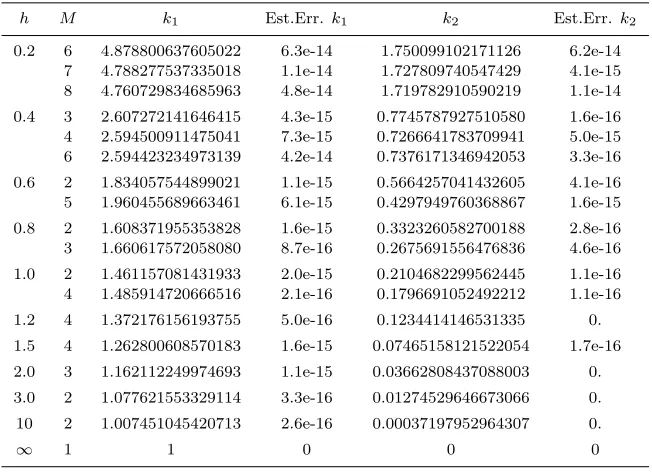
and their absolute estimation errors(Est.Err.) are reported in Table 3. For
h=∞andKij(t, τ) = 0,from (27) and (13)–(14), the exact solutions of (25)
are obtained as
ϕ1(τ) = 0, ϕ2(τ) =
τ
√ 1−τ2,
which give k1 = 1 and k2 = 0. This is shown in the last row of Table 3.
The table shows the rapid convergence of the results even for relatively small values ofM.
4 Conclusions
Galley
Pro
of
Table 3: Stress intensity factors for the crack parallel to the boundaryh M k1 Est.Err. k1 k2 Est.Err. k2
0.2 6 4.878800637605022 6.3e-14 1.750099102171126 6.2e-14 7 4.788277537335018 1.1e-14 1.727809740547429 4.1e-15 8 4.760729834685963 4.8e-14 1.719782910590219 1.1e-14 0.4 3 2.607272141646415 4.3e-15 0.7745787927510580 1.6e-16 4 2.594500911475041 7.3e-15 0.7266641783709941 5.0e-15 6 2.594423234973139 4.2e-14 0.7376171346942053 3.3e-16 0.6 2 1.834057544899021 1.1e-15 0.5664257041432605 4.1e-16 5 1.960455689663461 6.1e-15 0.4297949760368867 1.6e-15 0.8 2 1.608371955353828 1.6e-15 0.3323260582700188 2.8e-16 3 1.660617572058080 8.7e-16 0.2675691556476836 4.6e-16 1.0 2 1.461157081431933 2.0e-15 0.2104682299562445 1.1e-16 4 1.485914720666516 2.1e-16 0.1796691052492212 1.1e-16 1.2 4 1.372176156193755 5.0e-16 0.1234414146531335 0. 1.5 4 1.262800608570183 1.6e-15 0.07465158121522054 1.7e-16 2.0 3 1.162112249974693 1.1e-15 0.03662808437088003 0. 3.0 2 1.077621553329114 3.3e-16 0.01274529646673066 0. 10 2 1.007451045420713 2.6e-16 0.00037197952964307 0.
∞ 1 1 0 0 0
References
1. Abdolkawi, M. Solution of Cauchy type singular integral equations of the first kind by using differential transform method, Appl. Math, Model. 39 (2015), 2107–2118.
2. Ahdiaghdam, S., Shahmorad S. and Ivaz, K.Approximate solution of dual integral equations using Chebyshev polynomials, Int. J. Comput. Math. 94(3) (2017), 493–502.
3. Chakrabarti, A. and Berghe, G.V.Approximate solution of singular inte-gral equations, Appl. Math. Lett., 17 (2004), 533–559.
4. Erdogan, F., Gupta, G.D. and Cook, T.S.Mechanics of fracture, Noord-hoff International Publishing, Leyden, Netherlands, 1973.
5. Eshkuvatov, Z.K., Nik Long, N.M.A. and Abdulkawi, M. Approximate solution of singular integral equations of the first kind with Cauchy kernel, Appl. Math. Lett., 22 (2009), 651–657.
Galley
Pro
of
7. Kashfi, M. and Shahmorad, S.Approximate solution of a singular integral Cauchy-kernel equation of the first kind, Comput. Methods Appl. Math. 10(4) (2010), 345–353.8. Liu, D., Zhang, X. and Wu, J.A collocation scheme for a certain Cauchy singular integral equation based on the superconvergence analysis, Appl. Math. Comput. 219 (2013), 5198–5209.
9. Mandal, B.N. and Chakrabarti, A. Applied singular integral equations, Taylor and Francis Group, CRC Press, 2011.
10. Mason, J.C. and Handscomb, D.C. Chebyshev polynomials, Chapman and Hall, CRC Press, 2003.
11. Miel, G.On the Galerkin and collocation methods for a Cauchy singular integral equation, SIAM J. Numer. Anal. 23(1) (1986), 135–143.
12. Muskhelishvili, N.I. and RADOK, J.R.M. Singular integral equations, Wolters-Noordhoff Publishing Groningen, Netherlands, 1958.
13. Setia, A. Numerical solution of various cases of Cauchy type singular integral equation, Appl. Math. Comput. 230 (2014), 200–207.
14. Sharma, V., Setia, A. and Agarwal, R.Numerical solution for system of Cauchy type singular integral equations with its error analysis in complex plane, Appl. Math. Comput., 328 (2018), 338–352.
15. Tsalamengas, J.L.A direct method to quadrature rules for a certain class of singular integrals with logarithmic, Cauchy, or Hadamard-type singu-larities, Int. J. Numer. Model. 25 (2012), 512–524.
![Table 1: Comparison of our results (Ei) with the results of [16] (εi) for M=8.](https://thumb-us.123doks.com/thumbv2/123dok_us/8944111.1853479/12.612.135.467.230.299/table-comparison-results-ei-results-ei-m.webp)