Munich Personal RePEc Archive
Should the Neoclassical growth model
include the saving flow in the Utility
function?
Khelifi, Atef
ECONETRIX Consulting
15 November 2014
Online at
https://mpra.ub.uni-muenchen.de/59751/
Should the Neoclassical growth model include the saving
flow in the Utility function?
Atef Khelifi*
Abstract
Despite ‘joy of giving models’ have been extensively examined in the literature, the Ramsey growth model has never been explored under the assumption of a direct
preference for bequeathing savings that are reinvested. This assumption implies a
Utility function depending on both consumption and savings, which may also be
motivated as one that captures a direct preference for thriftiness or wealth
accumulation arguably involved. The resulting growth model generalizes those
accounting for the capitalist spirit as Zou (1994), and shows that the restrictive
standard one is perhaps not the actual optimized version of the Solow model.
JEL O41, E21, D91
Keywords: Bequest; Status; Anticipatory feelings; Ramsey growth model
* ECONETRIX Consulting, Paris, France, [email protected], Tel: +33 (0)1.85.06.77.98
“The difficulty lies not in the new ideas, but in escaping the old ones, which ramify, for those brought up as most of us have been, into every corner of our minds.”
J.M.Keynes, New York 1987.
1.Introduction
It goes to our mind almost systematically, that the flow of saving should never be included in
the Utility function along with consumption, to solve the inter-temporal maximization problem of
the consumer. Two reasons can be stated precisely and may sound a bit obvious only at first
glance. The first one which is to consider savings as having no intrinsic value for the individual,
can arguably be contested in some cases. The second, a technical redundancy deduced from
standard conceptions, can be shown to be misleading, especially in models of accumulation. The
goal of this paper is to criticize the systematic neutrality of a Utility effect of savings in the
literature, and to report the relevant implications in the Ramsey growth model where specifically,
such neutrality is perhaps inappropriate.
To contest the first reason for excluding savings from Utility in the Ramsey context, it might
not be necessary to recall the capitalist spirit literature motivating that individuals derive direct
Utility from wealth accumulation for the status; see for example Weber (1930), Zou (1994),
Bakshi and Chen (1996), or Carroll (2000). Indeed, by introducing the saving flow in the Utility
function, not only is the continual seek for a higher capital and status captured, but also a direct
preference for thriftiness which could be involved if the individual worries about the necessity to
renovate the depreciated capital, or to accumulate sufficient wealth for the growing household.1
In life-cycle (LC) or overlapping generations (OLG) models, the neutrality of this direct
preference for thriftiness or wealth accumulation is systematically constrained every period, such
that the individual saves only to defer own consumption in the future when ‘profitable’. Because
of this particularity, alternative models accounting for the bequest motive have been proposed in
the literature. One type includes for example Barro (1974) or Laitner (1992), where successive
generations working for only one period value the level of Utility of their children. Another
consists in “joy of giving models” like for example Andreoni (1990), or more recently Dynan,
Skinner and Zeldes (2002), where individuals gain satisfaction from bequeathing a part their
1 This idea can be related to the modern literature of anticipatory feelings, like for example Kuznitz, Kandel and Fos (2008). The individual is supposed conscious and can be affected in the present by future situations, even under a deterministic context. In our case, the thrifty individual
lifetime income to the children. Although the second type has been extensively examined in the
literature, the altruistic Ramsey model has never been explored under the assumption of a direct
preference for bequeathing savings that are reinvested. It could be supposed for example, that
each generation working at period t cares about saving for renovating or increasing the capital left
to the children at t+1, before retiring or eventually dying. From this conceptual viewpoint, a
direct preference for saving finds a very strong motivation in that framework, aside from a
plausible preference for thriftiness or wealth accumulation.
Technically, it may have seemed redundant at first glance to introduce explicitly this preference
in the model, because the time preference rate already measures the relative preference for
current consumption, and the dynamics is already such that savings and accumulation occur when
the interest rate exceeds this time preference rate. However, the time discounter is precisely
defined by Samuelson (1937) as a degree of impatience that reflects the relative preference for
current well-being2, and the standard dynamics is specific to the lifetime utility function which corresponds by construction to one of a LC model in an infinite-horizon case. Assuming a direct
preference for saving or accumulating generates a more general dynamics, which also extends
those of models accounting for the capitalist spirit as Zou (1994). Furthermore, it allows to
recover logically the basic static properties of the exogenous Solow version.
Similarly to growth models involving absolute wealth in Utility as Zou (1994), or relative
wealth as Corneo and Jeanne (2001), the presented model allows to invest more than in the
standard version by modulating the preference for wealth accumulation. This property is known
as a plausible way to contrast with the contested lower boundary condition and convergence
theorem of the traditional theory. It implies for instance that necessary and sufficient conditions
required to meet the golden rule of accumulation can be specified. Another similarity that might
also be important to report, is that the effect of the natural growth rate of workers on the
steady-state level of capital per capita appears confirmed. Those common results could eventually be
interpreted as two steps already made towards a reconciliation with Solow’s static properties of
the steady-state.
In contrast with this previous literature however, the proposed preference function generates a
slower transition, and offers the possibility to reach also lower steady-state levels of capital per
2
capita than in the standard model by investing less. Aside from allowing to recover a total
coherence with the basic exogenous version, this second property might complement
explanations of cross-country differences, and for instance, reconcile more empirical growth facts
of developing countries with optimal growth theory.
The proposed Ramsey model is not presented as an augmented version of the standard one
only, or as a generalization of capitalist spirit growth models, but as being perhaps an appropriate
formulation that could have been missed because of an eventual misunderstanding of the
preference for saving. Given such properties of the results indeed, nothing really precludes the
possibility that the standard model assumes an unsuitable Utility function to optimize the Solow
version. Precisely, it could for example be necessary to clarify first the goal of the individual in
the exogenous model, before deciding which preferences would be more appropriate. Does this
individual want to consume or to accumulate wealth, when choosing a constant saving rate 𝑠 ∈
(0,1)? If the answer is ‘both’, which of those two alternatives is most preferred by this ‘saver’?
The remainder is organized as follows. Section 2 presents conditions under which it might be
relevant to introduce savings in Utility. Section 3 shows that applying this type of preferences in
the Ramsey model appears to generate more consistent results than in the standard case. Section 4
concentrates on a discussion of the transition through a comparative analysis, and Section 5
concludes.
2. A Further Formulation of Preferences
It is highly important to justify in details why individuals could derive direct Utility from
saving. The first section presents what is meant by a direct preference for thriftiness and wealth
accumulation. The second concerns ‘joy of bequeathing’.
A. Preference for Thriftiness and Wealth
According to its generic definition, the concept of Utility which measures satisfaction or
welfare is of course not limited to consumption and leisure; examples in the literature are indeed
gifts, cash-holding or wealth. As soon as a particular individual endowed of personal preferences
gains satisfaction from actions decided among a set of alternatives, then such actions could
eventually be arguments of a Utility function of this individual. For example, an individual could
individual appreciates to be thrifty, is out of the microeconomic field and relies completely on
personal reasons it takes as given. Perhaps, it is not necessarily a Utility function including a
saving effect that needs to be justified, but eventually the assumption that all individuals can
never feel (instantaneously) better by saving instead of consuming; one evidence that indeed
contradicts this assumption is at least miserliness (under an extreme case.)
More particularly, some reasons could be exposed to defend the relevance of controlling a
saving (or investment) utility effect in neoclassical growth models.
The conceptual logic of the Solow model is to involve a thrifty agent who saves each time a
part of income to accumulate or renovate capital in the long run. It could be plausible to consider
that saving (or investing) causes this individual to feel immediately better because, (i) it removes
bad anticipatory feelings like anxiety or sadness if future wealth appears insufficient for some
reasons (welfare of children, renovation of capital, job loss, illness, retirement, bequests, etc.); (ii)
enhancing wealth is a way to achieve a higher social status, as argued for example by Weber
(1930) who defines this desire as the spirit of capitalism.
In real life indeed, reasons why individuals decide to save or invest are not necessarily
economic. Admittedly, some of the reasons are either psychological or sociological. It may not be
surprising therefore if the traditional theory involving an agent who derives Utility from the act of
consuming only, appears limited when applied to real data. For instance, Kenneth Arrow also
said in 1988:
“The dominant paradigm was that people essentially saved to spend in their lifetime.
But today the evidence seems to be accumulating that this hypothesis is not true, and
everybody seems to agree that you cannot explain savings solely on a life cycle basis
[…] So to conclude, I think that the key thing when it comes to the relationship between
economics and sociology is the willingness to look at new kinds of data, like in savings. I
think that once you do that, you are automatically going to be forced to consider social
elements. Just ask different questions, and I think you are going to be forced into
considering and drawing upon sociology.”
(Stanford University, April 1988).
Many research works in various fields of the literature have incorporated factors affecting
bequests, gifts, and more recently, social status and anticipatory feelings. Notable works follow
respectively Yaari (1965), Barro (1974), Andreoni (1990), Zou (1994), and Kuznitz, Kandel and
Fos (2008).
In the neoclassical growth framework, a direct preference for the stock of capital has been
introduced by Zou (1994) to formalize the spirit of capitalism of Max Weber3, and proved to be
relevant for the explanation of several empirical growth facts. In contrast, Corneo and Jeanne
(2001) have proposed to account for the relative amount of wealth instead, by suggesting that
individuals care about their relative position in a society. In the presented paper, an alternative
way to formalize the continual seek for a higher status is proposed through a saving (or
investment) effect in the flow of Utility, meaning that individuals value the growing of wealth (or
capital) each time, rather than the absolute or relative stock itself.
Aside from the status motive or anticipatory feelings, earlier literatures have already considered
the possibility for individuals to derive Utility from gifts or bequests. It might be worth
discussing implications of ways to characterize the intergenerational altruism in the Ramsey
growth model.
B. Joy of Bequeathing
Traditional inter-temporal maximization problems of the consumer might be separated into two
major categories. The first one includes LC or OLG models as developed by Modigliani and
Brumberg (1954), Modigliani (1986), Diamond (1965), etc. The second is constituted of altruistic
or inter-dependent generations’ models as in Barro (1974), Laitner (1992), Yaari (1965), etc.
In the first case, each generation derives utility only from own lifetime consumption and
dissaves, or ‘plans’ to dissave, entirely during retirement. The second case mainly includes
models where life-cycle utility can also, either be affected by the welfare of children, or by the
act of giving or bequeathing (which gave the name of ‘joy-of-giving’ or ‘warm glow’ to this
literature).
Recall now the conceptual approach of the altruistic Utility proposed by Barro (1974) that
serves as a basis to the standard Ramsey model. Assuming each generation lives for only two
periods, utility of individuals born at time t is expressed as:
3
(1) 𝑉𝑡= 𝑈𝑡+ 𝛾𝑉𝑡+1,
where 𝑉𝑡 denotes total Utility of parents, 𝑈𝑡 is the Utility from life-cycle consumption (of both
periods), 𝑉𝑡+1 is the total Utility of children, and 𝛾 is the discounting factor that measures the
degree of altruism. Substituting recursively all Utilities up to generation T, gives the following
dynastic function:
(2) 𝑉𝑡 = ∑𝑇−1𝑗=𝑡 𝛾𝑗−𝑡𝑈𝑡+ 𝛾𝑇−𝑡𝑉𝑇,
where the term 𝛾𝑇−𝑡𝑉𝑇 vanishes as T tends to infinity. In other words, the resulting specification
simplifies by construction to one of a LC model in the infinite horizon case. Under this
assumption, the optimal rule which governs saving decisions is such that individuals save to defer
consumption only when profitable; ie. only when interest opportunities are more valuable than
current consumption. In the standard Ramsey model particularly, properties of the production
technology are such that the agent finds optimal to save and to accumulate up to an equilibrium
level when starting from below, and to disaccumulate when departing from above. Recalling that
the time discounting factor is technically bounded downward by the natural growth rate in that
framework, the inevitable consequence is that the household is ‘condemned to poverty’ if
marginal productivity of capital, as the unique driving force of the accumulation process, happens
unfortunately to be low. Many research works in endogenous growth theory have tried to escape
this constraining rule or ‘lower boundary condition’ by assuming different production
technologies, but as suggested by Zou (1994), it seems reasonable to revise preferences as well,
and to admit that individuals could still decide to invest more and grow under such unfavorable
conditions.
An alternative conceptual approach to the lifetime Utility of an altruistic household, is one
which separates Utility from giving, and Utility from the well-being of children which depends
on their own total income at time t+1. For instance, the previous Utility of a generation born at
time t could be expressed as:
where 𝑐𝑡 is consumption and 𝑠𝑡 is the bequest. This intergenerational ‘transfer’ of income might
be a convenient way to measure the degree of altruism in the Ramsey framework, alternatively to
the time discounting factor only. In that case, the bequest reflects the desire to renovate or to
increase the capital stock left to the children at time t+1, before retiring or eventually dying.
Interestingly, this idea may apply to various examples in real life. Aside from business or private
concerns indeed, the natural environment could also be assimilated as a productive capital for
which (insufficient) investments and efforts are made today, in order to preserve it for the
children and future generations.
3. A Further Formulation of the Ramsey Growth Model
The first section presents the model which involves an interesting application of the
Pontryagin’s Maximum Principle. The second discusses the steady-state and Golden Rule.
A. The Optimal Control Program
At time t, a representative generation composed of L workers cares about consuming and
reinvesting a part of income produced. The instantaneous preference function is defined by
𝑈𝑡(𝑐𝑡, 𝑠𝑡), where 𝑐𝑡 denotes per capita consumption at t, 𝑠𝑡 denotes per capita savings (or
bequests), and 𝜃 ∈ (0,1) is a proportion which measures the degree of preference for
consumption over savings. The budget constraint of this representative agent is given by 𝑐𝑡+
𝑠𝑡 = 𝑦𝑡, where 𝑦𝑡 denotes income per worker. The production function is supposed of the
Cobb-Douglas form with constant returns to scale, such that 𝑦𝑡 = 𝑓(𝑘𝑡) = 𝑘𝑡𝛼, where 𝑘𝑡 denotes capital
per worker, and 𝛼 ∈ (0,1). The dynastic Utility function (after substitution of 𝑠𝑡) is denoted by
𝑉{𝑐𝑡, 𝑘𝑡}. It is maximized over an infinite horizon subject to a dynamic constraint of capital
accumulation (by the social planner):
(4) Max
𝑐𝑡 𝑉{𝑐𝑡, 𝑘𝑡} = ∫ 𝑈𝑡(𝑐𝑡, 𝑘𝑡) 𝑒
(𝑛−𝛽)𝑡𝑑𝑡 ∞
𝑡0 ,
where 𝑛 is the natural growth rate of workers, 𝛽 is the usual degree of impatience and 𝛿 is the
rate of depreciation of capital. We impose the usual restriction 𝛽 > 𝑛 to ensure a feasible interior
solution to the problem.
Some interesting steps of the resolution are worth presenting. For the sake of concreteness, we
assume a Cobb-Douglas Utility function 𝑈𝑡(𝑐𝑡, 𝑠𝑡) = 𝑐𝑡𝜃𝑠𝑡1−𝜃 and its log-transformation
𝑈𝑡(𝑐𝑡, 𝑠𝑡) = 𝜃ln(𝑐𝑡) + (1 − 𝜃)ln(𝑠𝑡).
Considering the first specification for example, the Hamiltonian is given by:
(6) 𝐻𝑡(𝑐𝑡, 𝑠𝑡) = 𝑐𝑡𝜃[𝑓(𝑘𝑡) − 𝑐𝑡]1−𝜃𝑒(𝑛−𝛽)𝑡+ 𝜆𝑡𝑒(𝑛−𝛽)𝑡[𝑓(𝑘𝑡) − 𝑐𝑡− (𝑛 + 𝛿)𝑘𝑡],
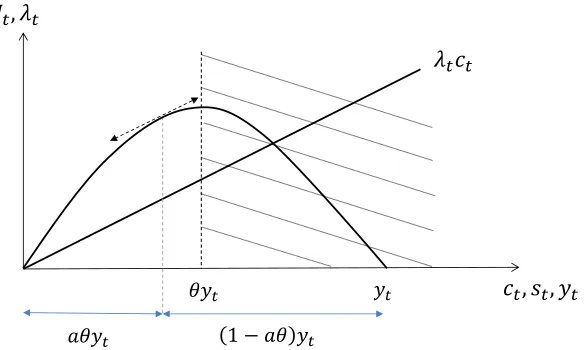
Following the Pontryagin’s Maximum principle, the first order condition implies 𝜕𝑈𝑡⁄𝜕𝑐𝑡 =𝑈𝑐𝑡 = 𝜆𝑡, which means that the static maximization of 𝐻𝑡 is satisfied under the following conditions:
𝑐𝑡 = 𝜃𝑓(𝑘𝑡) 𝑖𝑓 𝜆𝑡 = 0
𝑐𝑡 ∈ [0; 𝜃𝑓(𝑘𝑡)[ 𝑖𝑓 𝜆𝑡 > 0
The Pontryagin’s method requires to substitute a maximizing condition in the expressions that
serve to derive the dynamic equation of the control. In our case, the homothetic property of the
instantaneous Utility function allows us to define a convenient maximizing condition by letting
𝑎 ∈ (0,1) such that4:
𝜆𝑡 = (𝑐𝑠𝑡𝑡) 𝜃
(1−𝑎𝑎 ) ≥ 0 and 𝑐𝑡 𝑠𝑡=
𝑎𝜃 1−𝑎𝜃
Letting 𝑓𝑘=𝜕𝑓(𝑘𝑡)
𝜕𝑘𝑡 , the second condition implies:
(7) (1 − 𝜃)𝑐𝑡𝜃𝑠𝑡−𝜃𝑓𝑘+ 𝜆𝑡(𝑓𝑘− 𝛽 − 𝛿) = −𝜆̇𝑡,
4An excellent reference explaining substitutions of Pontryagin’s maximizers is H.Schättler and U.Ledzewicz (2012), p.96. Techn
A standard resolution that involves the substitution of equation (5) and static equilibrium values
of the co-state and ratio defined above, leads to the dynamic equation of consumption
𝑐𝑡̇ (𝑐𝑡, 𝑘𝑡, 𝑎). To simplify notations, we will omit the arguments.
The resulting differential system is:
(8) 𝑐̇𝑡 =1−𝑎𝜃
1−𝜃 [(2 − 𝑎𝜃 − 𝜃)𝑓𝑘− (1 − 𝑎)(𝛿 + 𝛽)]𝑐𝑡− 𝑎𝜃(𝑛 + 𝛿)𝑓𝑘𝑘𝑡,
𝑘̇𝑡 = 𝑓(𝑘𝑡) − 𝑐𝑡− (𝑛 + 𝛿)𝑘𝑡.
In clear, there can be multiple dynamical systems depending on the value of 𝑎 ∈ (0,1), which
satisfy the first necessary conditions. This means that among all admissible values of 𝑎, or 𝜆𝑡 as
explained by Schättler and Ledzewicz (2012), it remains to determine which one(s) maximize(s)
𝑉𝑡{𝑐𝑡∗, 𝑘𝑡∗}. In that sense, we may now define 𝑎 as being a choice parameter associated to a set of
controlled trajectories, and 𝑎∗ as being the rational choice associated to the optimal one which
maximizes total welfare.
Contrary to the differential equation of consumption (8), the one of the log-transformed Utility
can admit the value of 𝜃 = 1, in which case it simplifies to the standard Ramsey equation. Its
expression is given by:
(9) 𝑐𝑡̇
𝑐𝑡=
1−𝑎𝜃
1+𝑎𝜃(𝑎−2)[2𝑎(1 − 𝜃)𝑓𝑘+ (1 − 𝑎)(𝑓𝑘− 𝛽 − 𝛿)] −
𝑎(1−𝜃)
1+𝑎𝜃(𝑎−2)(𝑛 + 𝛿)𝛼,
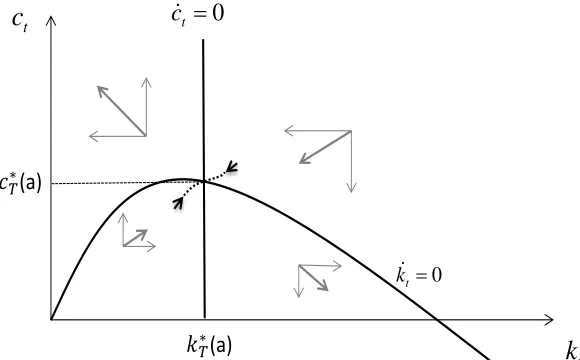
The graphical resolution of the dynamical systems shows that for any 𝑎 ∈ (0,1), there exists a unique saddle path in each case leading to a steady state equilibrium denoted by {𝑐𝑇∗(𝑎), 𝑘𝑇∗(𝑎)}. The phase diagram corresponding to the multiplicative Cobb Douglas case (figure 1), shows that
the parameter a affects only the convexity of the ‘𝑐𝑡̇ = 0 locus’5. The level of consumption increases to the left of this locus, and decreases to the right. For the case of the log-Utility (figure
2), the phase diagram is identical to the standard one except that the vertical ‘𝑐𝑡̇ = 0 locus’
depends now on the parameter 𝑎.
5
Figure 1. Phase Diagram for the Multiplicative Cobb-Douglas Case
Figure 2. Phase Diagram for the Additive Cobb-Douglas Case
Let {𝑐𝑡∗(𝑎), 𝑘𝑡∗(𝑎)} denote any equilibrium (or saddle path) solution that leads to the steady-state at 𝑡 = 𝑇. It can easily be noticed that the transversality condition lim
𝑡→∞𝜆𝑡(𝑎)𝑘𝑡
∗(𝑎)𝑒(𝑛−𝛽)𝑡= 0, is
fulfilled at equilibrium if 𝛽 > 𝑛 because:
lim
𝑡→∞𝜆𝑡(𝑎) = 𝑈𝑐𝑇∗(𝑎), from the first necessary condition,
lim
𝑡→∞𝑘𝑡∗(𝑎)𝑒(𝑛−𝛽)𝑡= 𝑘𝑇∗(𝑎). lim𝑡→∞𝑒(𝑛−𝛽)𝑡= 0, if 𝛽 > 𝑛. t
c
t
k
0
t
k
(a)
if a < 1 0
t
c
0
t
c if
t
c
t
k
0
t
k
(a) (a)
0
t
[image:12.612.166.456.337.517.2]Let the control set be defined by:
𝑍 = {𝑐𝑡∗(𝑎) ∈ ℝ++ / 𝑐𝑡∗(𝑎) < 𝑦𝑡∗(𝑎) ∀ 𝑎 ∈ (0,1)},
such that total welfare 𝑉𝑡{𝑐𝑡∗(𝑎), 𝑘𝑡∗(𝑎)} is restricted to the set of real numbers. We can now
proceed to a formal definition of a feasible optimal solution to the problem.
PROPERTY 1: An admissible controlled trajectory {𝑐𝑡∗(𝑎∗), 𝑘𝑡∗(𝑎∗)} satisfying the necessary
Pontryagin’s conditions ∀ 𝑎∗ ∈ (0,1), 𝑐𝑡∗(𝑎∗) ∈ 𝑍 and 𝑘𝑡∗(𝑎∗) ∈ ℝ++, is an optimal controlled trajectory if and only if 𝑉𝑡{𝑐𝑡∗(𝑎), 𝑘𝑡∗(𝑎)} ≤ 𝑉𝑡{𝑐𝑡∗(𝑎∗), 𝑘𝑡∗(𝑎∗)} ∀ 𝑎 ∈ (0,1) / 𝑎 ≠ 𝑎∗, 𝑐𝑡∗(𝑎) ∈
𝑍, 𝑘𝑡∗(𝑎) ∈ ℝ++.
An important result to keep in mind, is that the rational choice of the optimal trajectory is
determinant for the terminal steady-state {𝑐𝑇∗(𝑎∗), 𝑘𝑇∗(𝑎∗)} reached in the long run.
B. Steady-states and Golden Rule
Contrary to the multiplicative Cobb Douglas Utility function, the log form allows to derive a
steady-state solution analytically, which is:
(10) 𝑘𝑇∗(𝑎) = [ (1−𝑎𝜃)(1−2𝑎𝜃+𝑎)𝛼
𝑎(1−𝜃)(𝑛+𝛿)𝛼+(1−𝑎𝜃)(1−𝑎)(𝛽+𝛿)] 1 (1−𝛼)
.
For any non-corner point (𝜃, 𝑎) ∈ (0,1) × (0,1), the steady-state level of capital (or income) per worker is a decreasing function of the natural growth rate. Hence, as soon as individuals are
assumed to gain some Utility from accumulating or saving, the negative impact of population
growth known from the basic exogenous Solow model is recovered.
There might be two reasons why this result should actually be defended. First, it seems
reasonable to expect that an optimized version of the Solow model, which goal focuses only on
producing an endogenous saving or investment rate along the transition, should preferably
Second, it is well known that ‘wealth-dilution’ is one effect of population growth that has been widely admitted and confirmed empirically; for example, Mankiw, Romer and Weil (1992) might
be one of the most influential contribution in that sense. It seems therefore counterfactual to
admit that the negative impact of high fertility is entirely compensated by an increase in the
investment-output ratio, as predicted by the standard Ramsey model.
Another important static property that plays a crucial role for the dynamics is the one of the
golden rule from Phelps (1961). The Ramsey growth model, as it is used in most macroeconomic
studies, is characterized by a steady-state level of capital per worker that remains always lower
than the consumption maximizing level (and hence, than the over-accumulation one as well). As
explained previously, this constitutes one of the reasons why alternative capitalist spirit models
have been proposed in the literature, following for example Zou (1994) and Corneo and Jeanne
(2001). Before presenting necessary and sufficient conditions for a golden rule steady-state, it
may be preferable to present first a more general property that concerns any ‘terminal’ or
constrained steady-state.
PROPERTY 2: Among all feasible controlled trajectories {𝑐𝑡∗(𝜃, 𝑎), 𝑘𝑡∗(𝜃, 𝑎)} ∈ 𝑍 × ℝ++, converging to a particular steady-state solution { 𝑐̅̅̅̅ , 𝑘𝑇∗ ̅̅̅̅ }𝑇∗ , there exists a preference-choice couple (𝜃∗, 𝑎∗) ∈ (0,1) × (0,1) compatible with an optimizing behavior; ie. which satisfies:
𝑉𝑡{𝑐𝑡∗(𝜃, 𝑎), 𝑘𝑡∗(𝜃, 𝑎)} ≤ 𝑉𝑡{𝑐𝑡∗(𝜃∗, 𝑎∗), 𝑘𝑡∗(𝜃∗, 𝑎∗)}, ∀ (𝜃, 𝑎) ∈ (0,1) × (0,1) / (𝜃, 𝑎) ≠ (𝜃∗, 𝑎∗)
This property resulting directly from the resolution might be viewed as a reciprocal of the first
one. Indeed, a steady-state dynamics is an optimal controlled trajectory as soon as there is no
other ways to reach the same dynamics with a higher total welfare. Suppose for example that the
constrained terminal state corresponds to the solution of the Solow model:
𝑘𝑇∗
̅̅̅̅ = (𝑠̅̅̅𝑇∗
𝑛+𝛿)
1 1−𝛼
where 𝑓𝑘̅̅̅̅𝑇∗ =(𝑛+𝛿)𝛼𝑠 𝑇∗
̅̅̅ and 𝑠̅̅̅ ∈ (0,1)𝑇∗
steady-states. Under cases where both sets offer potential candidates however, the terminal state
assumed can possibly be generated by two different optimal trajectories (or two different rational
behaviors). In such a multiple equilibrium context, the goodness of fit to real data may lastly
decide.
The golden rule steady-state which maximizes consumption is reached if 𝑠̅̅̅𝑇∗ = 𝛼. For the multiplicative Cobb-Douglas form, the following condition must hold:
(11) [1 + 1−𝜃
(1−𝑎𝜃)𝑋𝑎𝜃(𝑛 + 𝛿)] −1
= 𝛼,
where 𝑋 = (2 − 𝑎𝜃 − 𝜃)(𝑛 + 𝛿) − (1 − 𝑎)(𝛿 + 𝛽), and for the log-Utility case,
(12) 1−𝑎𝜃
𝑎(1−𝜃)[1 + 𝑎(1 − 2𝜃) − (1 − 𝑎) 𝛽+𝛿 𝑛+𝛿] = 𝛼.
4. Numerical Analysis of the Dynamics
This section presents results of numerical simulations. The analysis focuses on the additive log
Utility function with no loss of generality concerning the Cobb Douglas form. Following the first
property, the first part analyzes the dynamics of the optimal path. The second addresses the
question of recovering this path starting from a given steady-state. It also compares the dynamics
with those of standard growth models and the one proposed by Zou (1994).
A. General Properties of the Dynamics
The question that comes first is to know how total welfare changes with respect to the
parameter a, which has been defined previously as reflecting the choice of an admissible
trajectory made by the individual. The next interesting step is to understand how the variables
behave along the optimal path6.
Numerical simulations show that for a preference parameter 𝜃 that tends to one, the optimal
value of 𝑎 decreases and the maximum total welfare tends to stabilize for 𝑎 < 𝑎∗. In figure 3 for
example, when 𝜃 = 0.95, the maximum total welfare attains 𝑉∗ = 241.62 at 𝑎∗= 0.71, and
remains almost constant for 𝑎 ≤ 0.71 (precisely, it decreases slowly until 𝑉 = 241.36 at 𝑎 =
6 Numerical computations of saddle paths are made according to the shooting method. A solution 𝑎∗ is considered sufficiently accurate if in its
neighborhood, changes in total welfare become relatively negligible. In this part, parameters kept constant are assigned the following values: 𝛼 =
0.01). As 𝜃 decreases, the value of 𝑎∗ increases but at a much lower rate; for instance 𝑎∗ = 0.76 when 𝜃 = 0.85 and 𝑎∗= 0.78 when 𝜃 = 0.2. This figure shows also that the choice of the right
equilibrium co-state (or value of a) matters much more for lower values of 𝜃. For example, the
size of the welfare gain from an admissible path to the optimal one can exceed 26% in the case
[image:16.612.171.448.209.369.2]where 𝜃 = 0.2.
Figure 3. Total Welfare by Admissible Path
Figure 4. Steady-state Per Capita Capital by Admissible Path
Another result that figure 3 illustrates, is that individuals with different degrees of preference
for saving (or bequeathing) face different levels of total welfare. When 𝜃 remains relatively high,
total welfare is lower than in the standard case where individuals value consumption only. As 𝜃
200 210 220 230 240 250 260
0,1 0,2 0,3 0,4 0,5 0,6 0,6 0,7 0,8 0,9
0 20 40 60 80 100 120 140
[image:16.612.170.460.427.597.2]decreases below a certain cutoff value, total welfare tends to increase back until reaching higher
values than in the standard model. Besides the fact that the steady-state saving rate for such
values of 𝜃 seems unreasonable, as indicated by figure 6, this parameter describing fixed
preferences is conceptually not to be ‘selected’ so that total welfare or even consumption is
maximized7.
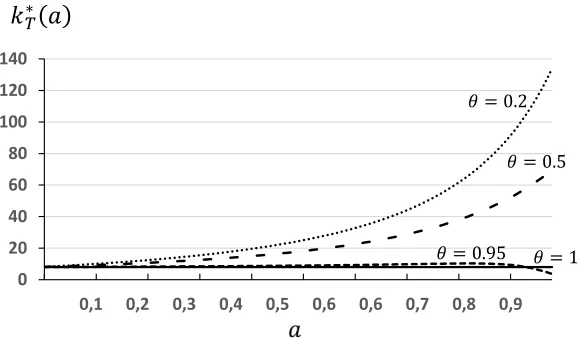
In figure 4, it is interesting to notice that accounting for supplementary (social) motives for
saving, does not always mean a higher steady-state capital per capita than in the standard model.
For values of 𝜃 that are close to one (0.95 in our example), there are some admissible trajectories
(for high values of a) which lead to lower steady-state capital per capita than in the standard case.
This interesting remark will be developed later.
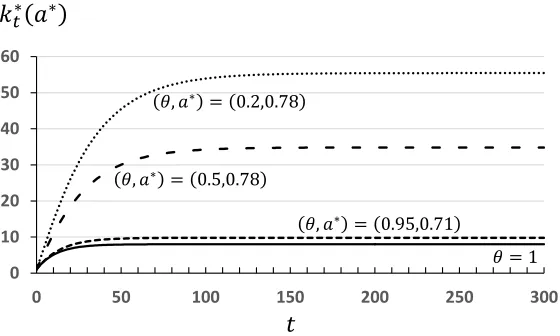
Concerning transitions towards higher-steady-states, figure 5 shows that (unconstrained)
optimal trajectories exhibit a faster growth when preferences for saving for social reasons become
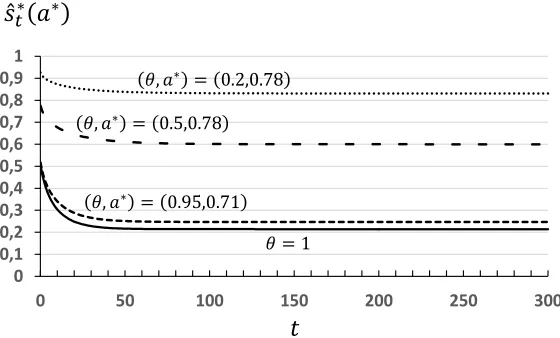
more intense. Interestingly, although the speed of growth increases with such intense preferences,
thrifty individuals appear less sensitive to variations of the interest rate compared to those who
care about consumption only. For instance, figure 6 shows that the magnitude of the variation of
[image:17.612.174.454.432.600.2]the saving rate along the optimal path increases with 𝜃.
Figure 5. Equilibrium Path of Capital Per Capita
7
The golden rule of capital accumulation is indeed not necessarily what individuals prefer. 0
10 20 30 40 50 60
Figure 6. Equilibrium Path of the Saving Rate
B. Dynamics in Constrained Optimization Cases
Suppose for example that individuals are endowed of preferences for consuming and
bequeathing such that future generations benefit from the golden rule steady-state at time T,
where consumption is maximized.
It is well known that for this steady-state to be possible under the standard altruistic case, the
flow of Utility must be augmented to include a direct preference for wealth (or status) as for
example in Zou (1994). A general specification widespread in this literature is:
(13) 𝑊{𝑐𝑡, 𝑘𝑡} = ∫ [𝑢𝑡∞ 𝑡(𝑐𝑡) + 𝑣𝑡(𝑘𝑡)] 𝑒(𝑛−𝛽)𝑡𝑑𝑡
0 ,
where 𝑣𝑡(𝑘𝑡) represents the part of utility derived from the capital stock, with 𝑣𝑘 > 0 and 𝑣𝑘𝑘< 0. Preserving same notations as in the presented paper, the resolution of the program under this
assumption leads to the following rule:
(14) 𝑓𝑘𝑇 = 𝛿 + 𝛽 −𝑣𝑘
𝑢𝑐,
0 0,1 0,2 0,3 0,4 0,5 0,6 0,7 0,8 0,9 1
Hence, given the ratio 𝑣𝑘⁄𝑢𝑐 is always positive, the steady-state capital per capita in such models
will always be greater than in the standard one. The alternative Utility function proposed in this
paper generates a more general version of the neoclassical growth model by contrasting this
result.
For a convenient comparative analysis, suppose the flow of Utility of the capitalist spirit model
of Zou (1994) is given by:
(15) 𝑢𝑡(𝑐𝑡) + 𝑣𝑡(𝑘𝑡) = 𝑙𝑛(𝑐𝑡) + 𝛾𝑙𝑛(𝑘𝑡), where 𝛾 ∈ [0, ∞).
For 𝑛 = 0, it can be shown that the steady-state capital per capita is given by:
(16) 𝑘𝑇 = ( 𝛼+𝛾
(𝛾+1)𝛿+𝛽) 1 1−𝛼
,
and is increasing in γ. The value of this parameter can be easily deduced such as to meet the
[image:19.612.168.451.432.621.2]golden rule steady-state.
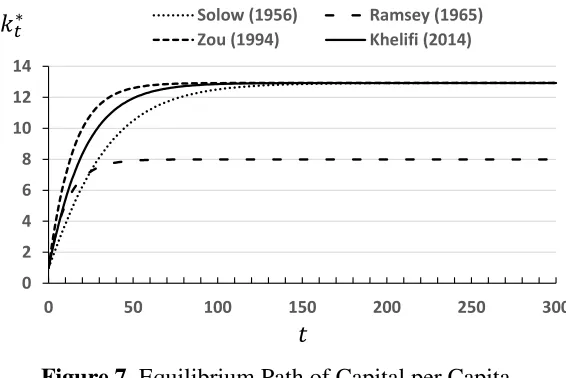
Figure 7. Equilibrium Path of Capital per Capita
Notes: Common parameters in each model are assigned the following values:𝛼 = 0.3, 𝛽 = 0.02, 𝑛 = 0, 𝛿 = 0.05, 𝑘0= 1. The steady-state saving rate associated to the golden rule is therefore 0.3. In the presented model, the optimal pair (𝜃, 𝑎∗) is deduced accordingly and equals (0.901,0.85) and in the model of Zou (1994), 𝛾 = 0.171. The standard Ramsey results have been included in each figure to compare the dynamics; the steady-state level of the saving rate 𝑠̂𝑇∗ equals 0.21 in that model.
0 2 4 6 8 10 12 14
0 50 100 150 200 250 300
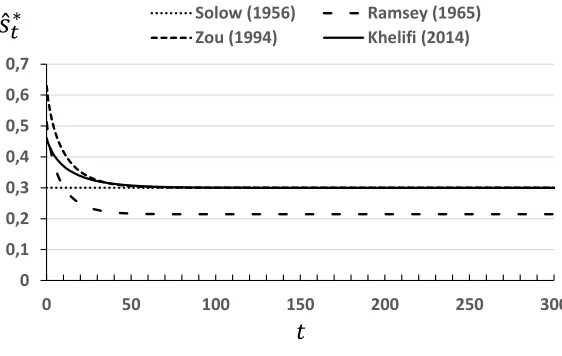
Figure 8. Equilibrium Path of the Saving Rate
Notes: Common parameters in each model are assigned the following values:𝛼 = 0.3, 𝛽 = 0.02, 𝑛 = 0, 𝛿 = 0.05, 𝑘0= 1. The steady-state saving rate associated to the golden rule is therefore 0.3
The slowest transition towards the golden rule steady-state in figure 7 and 8, is unsurprisingly
the Solow one where individuals do not benefit from highest returns initially. In all other cases,
an optimal decision implies a faster speed of growth which differs depending on the type of
preferences assumed. It appears clearly that the model of Zou (1994) generates the faster
transition. In other words, the stock of capital in the Utility function, compared to the
unconsumed part of income, affects more intensively the willingness to accumulate.
Clearly, it is not possible a priori, or theoretically, to determine which one of those augmented
versions of the Ramsey model ensures a superior fit to empirical data. However, every common
parameters equal, the proposed model offers the possibility to adjust a slower dynamics towards
the same steady-state.
An additional particularity of the proposed model shown by figure 4, is to allow for some
admissible controlled trajectories towards lower steady-states as well. Departing from the
standard model, this figure indicates that the steady-state level of capital per capita increases with
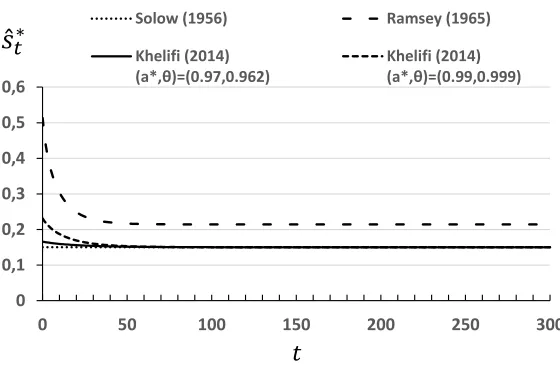
the degree of preference for saving (1 − 𝜃)and with the choice parameter 𝑎, except for few cases where (1 − 𝜃) is relatively low. Figures 9 and 10 present an example of transition towards a lower steady-state. For a ‘terminal’ saving rate 𝑠̂𝑇∗ of 0.15 (versus 0.21 in the standard model), two different optimal trajectories are possible. In both cases, the speed of growth remains
logically greater than in the Solow model. For the case where the value of 𝜃 is higher, the
corresponding value of ‘𝑎’ leading to the specified steady-state with the maximum welfare is also
0 0,1 0,2 0,3 0,4 0,5 0,6 0,7
0 50 100 150 200 250 300
higher and very close to one. Interestingly, the difference between the values of 𝑎 in each case is such that the trajectory of the individual endowed of the higher preference for consumption 𝜃, appears faster than the one who values wealth accumulation more intensively. In that case, the
[image:21.612.169.452.176.363.2]thriftiest individual is again less sensitive to variations of capital returns.
Figure 9. Equilibrium Path of Capital Per Capita
Notes: Common parameters in each model are assigned the following values:𝛼 = 0.3, 𝛽 = 0.02, 𝑛 = 0, 𝛿 = 0.05, 𝑘0= 1. The steady-state saving rate in the Solow model and in the presented one equals 0.15. Two solutions (𝜃𝑖, 𝑎𝑖∗) are compatible with an optimizing behavior towards this steady-state, (0.999,0.99) and (0.962,0.97). The standard Ramsey results are reported for comparisons (in this model, 𝑠̂𝑇∗= 0.21).
Figure 10. Equilibrium Path of the Saving Rate
Notes: Common parameters in each model are assigned the follow values:𝛼 = 0.3, 𝛽 = 0.02, 𝑛 = 0, 𝛿 = 0.05, 𝑘0= 1. The steady-state saving rate in the Solow model and in the presented one equals 0.15
0 2 4 6 8 10
0 50 100 150 200 250 300
Solow (1956) Ramsey (1965)
Khelifi (2014) (a*,θ)=(0.97,0.962)
Khelifi (2014) (a*,θ)=(0.99,0.999)
0 0,1 0,2 0,3 0,4 0,5 0,6
0 50 100 150 200 250 300
Solow (1956) Ramsey (1965)
Khelifi (2014) (a*,θ)=(0.97,0.962)
[image:21.612.171.451.475.663.2]The constrained optimization case should perhaps not be interpreted as one where the
representative household targets the terminal steady-state to reach. Instead, it should simply be
considered as a convenient way to recover the utility function under the assumption of rationality
from the observed empirical data. It might eventually be more useful in cases of relatively low
steady-states like in developing countries, where households can be exposed to constraints
regarding their saving or investment capacities.
5. Conclusion
Is the individual in the Solow model a ‘consumption-lover’ with a saving rate of 50%? Is the preference for accumulating implicitly involved in growth models, and should it be taken into
account independently from personal motives (power, influence, thriftiness, miserliness, gifts,
bequests, etc.)?
No matter what answers are, the standard model generates a steady-state level of capital per
capita bounded by the golden rule level, where the resulting equilibrium saving rate reaches a
maximum value of ‘𝛼’ (roughly estimated at 30%), when the time preference rate tends to its lower bound level n. Another apparent weakness of this model, is that it predicts the
counterfactual result of a wealth-dilution effect totally absorbed by a reduction in the
consumption share.
Capitalist spirit growth models as proposed for example by Zou (1994), offer a reasonable way
to contrast these constraining and counterfactual properties. However, the love of wealth
accumulation as formalized in such models, allows to extend the set of possible dynamics to
efficient and over-accumulation ones only, so that explanations of low GDP levels remain limited
to the time preference rate essentially. If adjusting the time preference rate in the standard model
has been inappropriate to explain differences among ‘rich countries’, and if controlling some additional willingness to invest has proved necessary, then it seems reasonable to admit that same
extensions are required for low GDP countries. The proposed model offers the possibility to
expand the set of steady-states on both sides of the standard version, so that eventual poverty
traps characterized by insufficient investment can also be reconciled in a same way with optimal
growth theory.
Several issues that have been investigated in the literature on the basis of the standard Ramsey
arguably more realistic. An additional advantage that might motivate the use of this model
particularly, concerns the context of an open-economy. Indeed, it is well-known that the standard
dynamics presents the counterfactual result of a consumption and wealth that tend to zero in an
open-economy where the time preference rate exceeds the world interest rate; see for example
Barro and Sala-i-Martin (1995, chapter 3). A recent suggestion from Hof and Wirl (2008) to
overcome this problem, is to augment the Utility function by including absolute or relative wealth
as an argument. Besides the fact that this type of preferences might still be restrictive, as
explained in this paper, the initial level of capital must be greater than a lower bound level to
ensure a possible accumulation towards a steady-state where both capital and consumption are
greater than zero. Such a condition is not required in the proposed model which offers a simpler
framework.
REFERENCES
Andreoni, James. “Impure Altruism and Donations to Public Goods: A Theory of Warm-Glow
Giving.” Economic Journal, June 1990, 100, pp.464-477.
Bakshi, Gurdip; Chen Zhiwu. “The Spirit of Capitalism and Stock-Market Prices.” American Economic Review, March 1996, 86 (1), 133-57.
Barro, Robert. “Are Government Bonds Net Wealth?” Journal of Political Economy, December
1974, 82(6), pp. 1095-1117.
Barro & Sala-i-Martin. “Economic Growth.” Mc Graw Hill, 1995.
Caroll, Christopher. “Why do the Rich Save so Much?” Does Atlas Shrug? The Economic
Consequences of Taxing the Rich, Ed. by Joel B. Slemrod, Harvard University Press, 2000, pp.
465-484
Cornero, Giacomo; Jeanne, Olivier. “Status, the Distribution of Wealth, and Growth.” The
Scandinavian Journal of Economics, June 2001, 103(2), pp. 283-293.
Diamond, Peter. (1965) “National Debt in a Neoclassical Growth Model.” American Economic
Review, December 1965, 55, pp. 1126-1150.
Dynan K., Skinner J. & Zeldes S. “The importance of Bequests and Life-Cycle Saving in Capital
Accumulation: A New Answer.” American Economic Review, May 2002, 92 (2), 274-278.
of the Ramsey Model.” Homo Oeconomicus, 2008, 25(1), pp. 107-128.
Kurz, Mordecai. “Optimal Economic Growth and Wealth Effects.” International Economic
Review, October 1968, 9(3), pp. 348-357
Kuznitz, Arik; Kandel, Shmuel; Fos; Vyacheslav. “A Portfolio Choice Model with Utility from
Anticipation of Future Consumption and Stock Mean Reversion.” European Economic Review,
November 2008, 52(8), pp.1338-1352.
Laitner, John. “Random Earnings Differences, Lifetime Liquidity Constraints, and Altruistic Intergenerational Transfers.” Journal of Economic Theory, December 1992, 58(2), pp. 135-170
Mankiw, Gregory; Romer, David; Weil, David. “A Contribution to the Empirics of Economic Growth.” The Quarterly Journal of Economics, May 1992, 107(2), pp. 407-437.
Modigliani, Franco. “Life Cycle, Individual Thrift, and the Wealth of Nations.” American
Economic Review, June 1986, 76(3), pp.297-313
Modigliani, Franco; Brumberg, Richard. “Utility Analysis and the Consumption Function: An
Interpretation of Cross-Section Data.” In K. Kurihara, Ed., Post-Keynesian Economics. New
Brunswick, New Jersey: Rutgers University Press, 1954.
Phelps, Edmund. "The Golden Rule of Capital Accumulation." American Economic Review,
September 1961, vol. 51, pp 638-643.
Ramsey, Franck. “A Mathematical Theory of the Saving.” Economic Newspaper, December 1928, 38 (152), pp. 543-559
Samuelson, Paul. “A Note on Measurement of Utility.” Review of Economic Studies, February
1937, 4(2), pp. 155-161.
Schättler, Heinz; Ledzewicz, Urszula, “Geometric Optimal Control: Theory, Methods and
Example.” Springer Verlag, 2012.
Solow, Robert. “A Contribution to the Economic Theory of Growth”, Quarterly Newspaper of
Economics, February 1956, 70(1), pp. 65-94.
Weber, Max. “The Protestant Ethic and the Spirit of Capitalism”; Unwin Hyman, London &
Boston, 1930.
Yaari, Menahem. “Uncertain Lifetime, Life Insurance and the Theory of the Consumer.” Review
of Economic Studies, April 1965, 32(2), pp. 137-150.
Zou, Heng-Fu. “'The Spirit of Capitalism and Long-Run Growth”, European Journal of Political
APPENDIX 1: RESOLUTION
For online publication. The social planner solves:
Max𝑐
𝑡 𝑉{𝑐𝑡, 𝑘𝑡} = ∫ 𝑈𝑡(𝑐𝑡, 𝑘𝑡) 𝑒
(𝑛−𝛽)𝑡𝑑𝑡 ∞
𝑡0
s.t. 𝑘𝑡̇ = 𝑓(𝑘𝑡) − 𝑐𝑡− (𝑛 + 𝛿)𝑘𝑡
Resolution for the multiplicative Cobb Douglas case:
𝐻𝑡(𝑐𝑡, 𝑠𝑡) = 𝑐𝑡𝜃[𝑓(𝑘𝑡− 𝑐𝑡)]1−𝜃𝑒(𝑛−𝛽)𝑡+ 𝜆𝑡𝑒(𝑛−𝛽)𝑡[𝑓(𝑘𝑡) − 𝑐𝑡− (𝑛 + 𝛿)𝑘𝑡]
The necessary conditions:
𝑖) 𝐻(𝑡, 𝜆0, 𝜆𝑡, 𝑘𝑡, 𝑐𝑡) = max𝜈𝜖(0;𝜃𝑦
𝑡)𝐻(𝑡, 𝜆0, 𝜆𝑡, 𝑘𝑡, 𝜈)
𝑖𝑖) 𝜕𝐻𝜕𝑘(𝑡, 𝜆0, 𝜆𝑡, 𝑘𝑡, 𝑐𝑡) =𝜕[𝜆𝑡𝑒 (𝑛−𝛽)𝑡]
𝜕𝑡
𝑖𝑖𝑖) 𝜕𝐻𝜕𝜆 (𝑡, 𝜆0, 𝜆𝑡, 𝑘𝑡, 𝑐𝑡) =𝑑𝑘𝑑𝑡 = 𝑘𝑡 𝑡̇
𝑖𝑣) lim𝑡→∞𝜆𝑡𝑒(𝑛−𝛽)𝑡𝑘𝑡 = 0
The first order condition implies: 𝜕𝑈𝑡⁄𝜕𝑐𝑡 =𝑈𝑐𝑡 = 𝜆𝑡. This static maximizing condition is to be substituted in the dynamical expressions that serve to derive the differential equation of the
control. With 𝜆𝑡≥ 0 and 𝑈𝑡 homothetic, we can express an explicit condition in a convenient way
by letting 𝑎 ∈ (0,1) such that: 𝜆𝑡= (𝑐𝑡
𝑠𝑡)
𝜃
(1−𝑎𝑎 ) ≥ 0 and 𝑐𝑡
𝑠𝑡=
Figure A1. Static Equilibrium Condition in the Multiplicative Cobb-Douglas Case
As explained by Schättler and Ledzewicz (2012) p.96, the substitution of the necessary condition
for a static maximization corresponds to a weak formulation of the Pontryagin’s Maximum
Principle. Just like in the standard Ramsey model, it is the necessary condition that is substituted
in our case (for instance, the equilibrium co-state and ratio). This same resolution allows a direct
confrontation of both versions.
ii) (1 − 𝜃) (𝑐𝑡
𝑠𝑡)
𝜃
𝑓′+𝜆
𝑡[𝑓′− 𝛿 − 𝛽] = −𝜆𝑡̇
(1 − 𝜃) (𝑐𝑠𝑡
𝑡) 𝜃
𝑓′+ (1 − 𝑎
𝑎 ) ( 𝑐𝑡
𝑠𝑡) 𝜃
[𝑓′− 𝛿 − 𝛽] = −𝜆 𝑡̇
(𝑐𝑡 𝑠𝑡)
𝜃
[((1 − 𝜃) +1 − 𝑎𝑎 ) 𝑓′−1 − 𝑎
𝑎 (𝛿 + 𝛽)] = −𝜆𝑡̇
Differentiating totally condition (i):
𝜕𝑈𝑐
𝜕𝑐𝑡 𝑐𝑡̇ +
𝜕𝑈𝑐
𝜕𝑘𝑡𝑘𝑡̇ = 𝜆𝑡̇
𝜃(1 − 𝜃) (𝑐𝑠𝑡
𝑡) 𝜃1
𝑐𝑡[(−
𝑠𝑡
𝑐𝑡−
𝑐𝑡
𝑠𝑡− 2) 𝑐𝑡̇ + 𝑓′ (1 +
𝑐𝑡
𝑠𝑡) 𝑘𝑡̇ ] = 𝜆𝑡
Constraining the static maximizing condition by substituting 𝜆𝑡 means that the associated
equilibrium ratio 𝑐𝑡
𝑠𝑡 defined above can be constrained as well. The expression simplifies to:
𝜃(1 − 𝜃) (𝑐𝑠𝑡
𝑡) 𝜃1
𝑐𝑡[(−
1
𝑎𝜃(1 − 𝑎𝜃)) 𝑐𝑡̇ + 𝑓′ 1
1 − 𝑎𝜃 𝑘𝑡̇ ] = 𝜆𝑡̇
Combining this expression with condition (ii) leads to:
𝜃(1 − 𝜃) 𝑎𝜃(1 − 𝑎𝜃)
𝑐𝑡̇
𝑐𝑡= 𝑓′
𝜃(1 − 𝜃)
1 − 𝑎𝜃 𝑘𝑡̇ 1𝑐𝑡+ [
1 − 𝑎𝜃 𝑎 𝑓′−
1 − 𝑎
𝑎 (𝛽 + 𝛿)]
−𝑎𝜃(1 − 𝑎𝜃)𝜃(1 − 𝜃) 𝑐𝑡̇ +𝜃(1 − 𝜃)(1 − 𝑎𝜃) 𝑓′𝑘𝑡̇ = − [1 − 𝑎𝜃𝑎 𝑓′−1 − 𝑎𝑎 (𝛽 + 𝛿)] 𝑐𝑡
𝑓′ [1 − 𝑎𝜃𝑎 𝑐𝑡+𝜃(1 − 𝜃)1 − 𝑎𝜃 𝑘𝑡̇ ] − 1 − 𝑎𝑎 (𝛿 + 𝛽)𝑐𝑡 =𝑎(1 − 𝑎𝜃) 𝑐(1 − 𝜃) 𝑡̇
Introducing condition (iii):
𝑓′ [(1 − 𝑎𝜃)𝑐𝑡+(1 − 𝜃)𝑎𝜃1 − 𝑎𝜃 𝑦𝑡−(1 − 𝜃)𝑎𝜃1 − 𝑎𝜃 𝑐𝑡−(1 − 𝜃)𝑎𝜃1 − 𝑎𝜃 (𝑛 + 𝛿)𝑘𝑡] − (1 − 𝑎)(𝛿 + 𝛽)𝑐𝑡=(1 − 𝑎𝜃) 𝑐(1 − 𝜃) 𝑡̇
𝑓′ [𝑐𝑡[(1 − 𝑎𝜃) +(1 − 𝜃)(1 − 𝑎𝜃)1 − 𝑎𝜃 ] −(1 − 𝜃)𝑎𝜃1 − 𝑎𝜃 (𝑛 + 𝛿)𝑘𝑡] − (1 − 𝑎)(𝛿 + 𝛽)𝑐𝑡=(1 − 𝑎𝜃) 𝑐(1 − 𝜃) 𝑡̇
The resulting dynamical system is:
𝑐𝑡̇ (𝑐𝑡, 𝑘𝑡) =1−𝑎𝜃1−𝜃 [(2 − 𝑎𝜃 − 𝜃)𝑓′− (1 − 𝑎)(𝛿 + 𝛽)]𝑐𝑡− 𝑎𝜃(𝑛 + 𝛿)𝑓′𝑘𝑡
𝑘𝑡̇ (𝑐𝑡, 𝑘𝑡) = 𝑓(𝑘𝑡) − 𝑐𝑡− (𝑛 + 𝛿)𝑘𝑡
Resolution for the additive Cobb Douglas case:
𝜕𝑈𝑡⁄𝜕𝑐𝑡 = 0 implies:
𝜃 𝑐𝑡−
1 − 𝜃 𝑦𝑡− 𝑐𝑡 = 𝜆𝑡
𝜃𝑦𝑡
𝑐𝑡(𝑦𝑡− 𝑐𝑡) −
𝑐𝑡
𝑐𝑡(𝑦𝑡− 𝑐𝑡) = 𝜆𝑡
Defining 𝑐𝑡
𝑠𝑡=
𝑎𝜃
𝑎𝜃𝑦𝑡
𝑎𝑐𝑡(𝑦𝑡− 𝑐𝑡) −
𝑎𝜃
𝑐𝑡(1 − 𝑎𝜃) = 𝜆𝑡
1
𝑎(1 − 𝑎𝜃)𝑦𝑡−
1
(1 − 𝑎𝜃)𝑦𝑡 = 𝜆𝑡
𝜆𝑡 =𝑎(1 − 𝑎𝜃)𝑦1 − 𝑎 𝑡
Differentiating totally the first order condition gives:
[−𝑐𝜃
𝑡2−
1 − 𝜃 (𝑦𝑡− 𝑐𝑡)2] 𝑐̇𝑡+
(1 − 𝜃)𝑓′(𝑘𝑡)
(𝑦𝑡− 𝑐𝑡)2 𝑘̇𝑡= 𝜆̇𝑡 ,
The first term in brackets can for example be expressed more conveniently :
[−𝜃 𝑐𝑡2−
1 − 𝜃 (𝑦𝑡− 𝑐𝑡)2] = −
𝜃(𝑎𝜃𝑦𝑡)2
𝑐𝑡2(𝑎𝜃𝑦𝑡)2−
(1 − 𝜃)[(1 − 𝑎𝜃)𝑦𝑡]2
(𝑦𝑡− 𝑐𝑡)2[(1 − 𝑎𝜃)𝑦𝑡]2= −
𝜃 (𝑎𝜃𝑦𝑡)2−
(1 − 𝜃) [(1 − 𝑎𝜃)𝑦𝑡]2
Following same simplifying tricks, the differentiated condition can be expressed as:
−𝜃(𝑎2𝜃 − 2𝑎𝜃 + 1)
(𝑎𝜃)2(1 − 𝑎𝜃)2𝑦 𝑡2 𝑐̇𝑡+
(1 − 𝜃)𝑓′ (1 − 𝑎𝜃)2𝑦
𝑡2𝑘̇𝑡=
−(1 − 𝜃)𝑓′ (1 − 𝑎𝜃)𝑦𝑡−
(1 − 𝑎) 𝑎(1 − 𝑎𝜃)𝑦𝑡(𝑓
′− 𝛿 − 𝛽)
−(𝑎2𝜃 − 2𝑎𝜃 + 1)
𝑎(1 − 𝑎𝜃) 𝑐̇𝑡
𝑐𝑡+ (1 − 𝜃)𝑓′ [1 −
(𝑛 + 𝛿)𝑘𝑡
(1 − 𝑎𝜃)𝑦𝑡] = −(1 − 𝜃)𝑓′ −
1 − 𝑎
𝑎 (𝑓′− 𝛿 − 𝛽)
−(𝑎2𝜃 − 2𝑎𝜃 + 1)
𝑎(1 − 𝑎𝜃) 𝑐̇𝑡
𝑐𝑡= 𝑓′ [−2(1 − 𝜃) −
1 − 𝑎 𝑎 +
(1 − 𝜃)(𝑛 + 𝛿)𝑘𝑡
(1 − 𝑎𝜃)𝑦𝑡 ] +
1 − 𝑎
𝑎 (𝛽 + 𝛿)
The resulting system is therefore:
𝑐𝑡̇
𝑐𝑡 =
1 − 𝑎𝜃
1 + 𝑎𝜃(𝑎 − 2) [2𝑎(1 − 𝜃)𝑓𝑘+ (1 − 𝑎)(𝑓𝑘− 𝛽 − 𝛿)] −
𝑎(1 − 𝜃)
1 + 𝑎𝜃(𝑎 − 2)(𝑛 + 𝛿)𝛼
APPENDIX 2: SIMULATION (Not for Publication)
Coded on R
The main functions that have been used for the numerical experiments are available in two
separate word files:“Generalized Ramsey (2014)-Constrained-Log Utility” and “Generalized
Ramsey (2014)-Direct-Log Utility”. In each file, two main functions are designed for the
calculation of the optimal path. Given it could take time to iterate on values of the parameter 𝑎 ∈
(0,1), calculations have been separated into two steps.
Concerning the computation of the saddle path, the number of iterations and the length of the
vectors (variable “len”) should be increased for more precision (it becomes necessary when 𝜃 is low, like for example 0.2). Indeed, when the steady-state is very high, the quality of the
convergence is affected. The shooting method is based on the fact that divergence occurs in two
possible ways; if c(0) is too low, the dynamics diverges in the South-East, and if c(0) is too high,
in the North-West.
i) The first function called “localize(𝛼, 𝛿, 𝑛, 𝛽, 𝑠̂∗, 𝑘
0)” gives a good idea of the solution quickly
(< 2 minutes). It calculates the total welfare (from t = 0 to 300) produced by saddle path solutions
for 10 values of the parameter a (from a=1 to 0.1). It selects the solution that maximizes welfare
and exports the dynamics in a CSV file (per default on “My Documents”). In the constrained
case, the saving rate enters as an argument. For example executing the following lines:
localize1 <- localize(0.3,0.05,0,0.02,0.3,1) localize1
displays:
Given the solution lies betwwen a = 0.9 and a = 0.7, the second function takes a last argument
“max_a” to iterate more precisely starting from the upper bound selected (0.9 in this example).
For example typing:
calcul1 <- calcul(0.3,0.05,0,0.02,0.3,1,0.9) calcul1
displays:
param_a root_teta1 tot_welfare1 root_teta2 tot_welfare2 [1,] 0.89 1.030502 0 0.8998355 239.4675 [2,] 0.88 1.037585 0 0.9010512 239.5501 [3,] 0.87 1.045428 0 0.9016989 239.6059 [4,] 0.86 1.053988 0 0.9018263 239.6380 [5,] 0.85 1.063222 0 0.9014840 239.6491 [6,] 0.84 1.073089 0 0.9007205 239.6422 [7,] 0.83 1.083552 0 0.8995809 239.6195 [8,] 0.82 1.094578 0 0.8981045 239.5832 [9,] 0.81 1.106144 0 0.8963253 239.5351 [10,] 0.80 1.118228 0 0.8942720 239.4766 [11,] 0.79 1.130817 0 0.8919682 239.4088 [12,] 0.78 1.143900 0 0.8894332 239.3328 [13,] 0.77 1.157473 0 0.8866825 239.2494 [14,] 0.76 1.171535 0 0.8837285 239.1590 [15,] 0.75 1.186086 0 0.8805808 239.0622 [16,] 0.74 1.201132 0 0.8772468 238.9594 [17,] 0.73 1.216679 0 0.8737317 238.8509 [18,] 0.72 1.232739 0 0.8700391 238.7367 [19,] 0.71 1.249322 0 0.8661713 238.6172
Each function outputs a file containing the dynamics for the maximum welfare. The
unconstrained solution on the other file works exactly the same. It is the preference parameter