INFLUENCE OF CHANGES IN LEVEL OF FEEDING
ON MILK PRODUCTION
B Y F. YATES AND D. A. BOYD, Rothamsted Experimental Station, Harpenden, Herts AND 6 . H. N. PETTIT, School of Agriculture, Cambridge University
(With Eight Text-figures)
1. OBJECTS OF THE INVESTIGATION
The present investigation was undertaken with the object of determining the relationship between the amount of food consumed by a cow and the yield of milk, making use of all available experimental data. It was also found convenient to investigate simultaneously the effect of varying proportions of bulky foods, since many of the experiments con-sidered dealt with both these aspects of the feeding problem. Some consideration of the influence of proportion of bulky foods is in any case necessary, since this proportion, if high, limits the total food intake.
It is well known that as the food intake increases the digestive efficiency of an animal falls off. This has led to the belief that farm animals in general, and dairy cows in par-ticular, should be somewhat strictly rationed so as to keep their digestive efficiency at a high level. Such a procedure overlooks the fact that every animal has a high ' overhead' requirement, which in the case of a dairy cow includes not only the maintenance ration, but also food required during dry periods and for rearing, etc. Consequently it may be expected that a cow should be kept at a high productive level, even though this may lead to some digestive inefficiency.
The customary method of evaluating a dairy cow's food requirements has in fact been to allow a basic maintenance ration depending on the weight of the cow, and an addi-tional ration proporaddi-tional to milk yield, the total ration being determined experimentally on the criterion that the weight remains constant. There is no inherent reason why the over-all efficiency of a cow should be maximum when the weight is constant. Nominal stability in weight means a loss to the cow, since allowance must be made in a pregnant cow for increase in weight of the foetus and associated membranes and tissues. Moreover, • many of the practical feeding trials on dairy cows have (rightly) included immature stock which has not yet completed its full growth. The most efficient level of feeding under any given circumstances can only be determined from the quantitative relationship between food intake and milk output.
The accurate determination of this relationship is of considerable interest at the .present time, as on it depends the most efficient feeding policy. There has been a tendency in certain quarters (e.g. Wright, 1939) to advocate rather stringent rationing of dairy cows and other forms of livestock, on the assumption that such stringent rationing will economize in fopd without materially affecting the yield of milk. This belief does not appear to be substantiated by the experimental results here reviewed.
F. YATES, D. A. BOYD AND G. H. N. PETTIT 429
minerals and vitamins required by the cow for her own needs, for the milk she produces, and for the foetus if she is in calf. This is particularly important at the present time in view of the fact that winter diets of home-produced feeding stuffs tend to be deficient in various factors, particularly in protein.
2. EXPERIMENTAL MATERIAL
(a) Experiments on different levels of feeding
An extensive search of the literature was made. For the benefit of other workers on the subject, a list of the relevant publications is given in an appendix. A surprisingly small amount of material on variation in level of feeding was found. The only experiments which reported total food intake at each level of feeding, and also changes in the weight of the cows, were two sets of Danish experiments, two small American experiments, and two early English experiments.! In addition, some details have been received from R. R. Graves, Chief of the Bureau of Dairy Industry, United States Department of Agriculture, of a set of experiments conducted by his Department. A preliminary report on some of these experiments has already been published by Jensen (1940). Table 1 gives particulars of these various sets of experiments.
Table 1. Experiments on variation in level of feeding
Country Denmark
Denmark
U.S.A.
U.S.A.
U.S.A.
Great Britain
Ref.* B. 136
B. 34
U.S.D.A. (private com-munication) T.B. 724
T.B. 116
Durham C.C.
Date 1922-7
1888-90
c. 1938
1931-4
1927-8
1904-5
No. of
exps.
10
13
9
1
1
2
Total no. of
cows
258
528
508
12
10
20
Table
4
'5 .
6
7
8
9
Nature of experiment
Three levels of mixed rations for periods of 10-22 weeks
Two levels of mixed rations, the lower level with three different proportions of roots and cake, for periods of 60-80 days Six levels of corn feeding over whole
lactations
Alfalfa hay | c
S"!!^ ?"*!* [Same cows in sue-B
ClTX t - i v e lactations
Two levels of concentrates for periods of 84 days
Bulky foods were fed ad lib. in the U.S.A. experiments.
* 'B.' and 'T.B.' stand for Beretn. Vet.- og Landbohejsk., Kbh., and Tech. Bull. U.S. Dep. Agric. respectively.
(6) Experiments on feeding of bulky foods
There has been a considerable number of American experiments designed to test how far cows are capable of producing milk on bulky foods alone. These experiments are listed in Table 13 (§ 10). Two of these experiments, T.B. 724 and T.B. 116 (already listed in Table 1), give the actual amounts of all the food consumed. The remainder only provide information on the reduction in milk yield resulting from the partial or complete omission of concentrates (grain). These experiments are not fully relevant to English conditions, as the bulky foods used were principally alfalfa (lucerne) hay and corn (maize) silage. In many of the experiments periods of pasture are included.
•f The English experiments were not discovered until this paper was at an advanced stage of preparation, and are not plotted on the figures.
Journ. Agric. Sci. 32 28
A
https://www.cambridge.org/core/terms. https://doi.org/10.1017/S0021859600010352
Country Denmark Denmark
Denmark
Denmark
Denmark
Denmark
Denmark
Ref.* B. 34 B. 55
B. 76a
B. 766
B. 76c
B. 144
B. 172 • Date 1888-90 1901
1896-7
1907-10
1908-10
1929-31
1931-6 No.
of exps.
10 12
2
8
4
4
13
No. of cows
258 458
80
166
80
99
220
Table no.
5 14
15
15
15
16
17
There are also seven sets of Danish experiments designed to investigate the partial substitution of concentrates by roots or hay, but apparently none on the complete substitution of concentrates by bulky foods.f All the Danish experiments give full details of the amounts of food consumed and changes in weight of the cows. One set, B. 34, has already been listed in Table 1. Particulars of the others are given in Table 2.
Table 2. Experiments on partial substitution of concentrates by roots and hay
Experimental comparisons See Table 1
A. Low cake, high corn, low roots B. High cake, moderate corn, low roots C. Low cake, moderate corn, high roots D. High cake, low oorn, high roots A. High cake and corn, low roots, low hay B. Moderate cake and corn, low roots, high hay C. Moderate cake and corn, high roots, low hay D. Low cake and corn, high roots, high hay A. High cake and corn, low seeds hay B. Low cake and corn, high seeds hay A. High cake and corn, low lucerne hay B. Low cake and corn, high lucerne hay C. High corn, low roots
A. Moderate corn, moderate roots D. Low corn, high roots
A. High cake and corn, low hay B. Low cake and corn, high hay All experiments were for periods of about 60 days on the experimental rations.
* 'B.' stands for Beretn. Vet.- og Landbohojsk., Kbh.
(c) Details of the Danish experiments
The Danish experiments were carried out by the Animal Husbandry Division of the Royal Danish Veterinary and Agricultural College's Research Laboratory on dairy farms co-operating with the Laboratory. They are based on the 'group system' for experiments on dairy-cattle feeding, which was devised by N. J. Fjord towards the end of last century. By this method groups of cows, each consisting of between eight and twelve beasts, are balanced as closely as possible with respect to milk yield, age, weight, period of lactation, etc. Each group is fed one of the experimental rations, of which there were normally two, three or four.
The essential feature of the method is that the time during which the cows are under experimental control is divided into three distinct periods:
(1) a preparatory period, during which the balance of the groups is adjusted and in which all groups receive the same standard production ration;
(2) an experimental period, when the cows are on the experimental rations;
(3) a final period, in which the groups are again fed the standard ration given in the preparatory period.
In the experiments under consideration the preparatory period covered from 2 to 8 weeks, and the final period was usually of similar length; the duration of the
F. YATES, D. A. BOYD AND G. H. N. PETTIT 431
mental period varied between 8 and 22 weeks. In some of the experiments a transition period of 10 days was inserted between the experimental and preparatory periods to minimize the effects of a sudden change in the amount or type of food.
Subdivision of the experiment into the three periods gave the experimenter an oppor-tunity in the preliminary period to balance the groups of cows and thereby to increase the accuracy of the results. The results of the after-period might also have been of value in determining the efficiency of conversion of live weight into milk, had the live-weight changes in this period be$n given.
The practical side of the experiments was supervised by a manager appointed by the Laboratory for each farm; in addition, a member of the Laboratory staff visited each herd in turn. The manager was expected to carry out on 2, 3 or 4 days each week the sample milkings from which fat contents of the milk were obtained; he also sampled the feeding stuffs for analysis by the Laboratory and weighed out each cow's ration. The beasts were weighed once a month, and also on two or three successive days at the be-ginning and end of the experimental period (always prior to watering and feeding). Concentrates, which included both oil cakes and cereals, were sampled once a fortnight and the bulky foods once a month. The cows had no access to pasture during the pre-paratory or experimental period, but in a number of the experiments they were let out to grass during the after-period. Only the food actually consumed was recorded: from the construction of the stalls it was impossible for cows to snatch any food from their neighbours.
In general the experimental rations were adjusted every 10 or 14 days according to the cow's yield of milk, corrected to 4% fat. The principal exception was that in the series B. 34, 76a and 766, a ration was allotted to each group of cows, to be distributed among the individuals as the supervisor thought fit.
The experiments were run under ordinary Danish farming conditions, on large farms with herds of 100-200 cows. The cows generally weighed between 9 and 11 cwt., and within each group their ages varied widely. Almost all the herds whose breed was specifically mentioned were of the Eed Danish Dairy breed (Rod Danske Malkerace), but the information was not given for all experiments.
(d) Details of the American experiments
The American experiments were carried out on farms run by the State Experiment Stations. In all the experiments summarized in Table 1 the milk yield on 'full feed' (consisting of grain, usually at the rate of 1 lb. to 3 lb. milk, and good-quality mixed roughage) was normally obtained in the cow's first lactation or in her first year with the herd. These results are designed primarily for inheritance studies, but in addition they give a basis for comparison, with the yield of subsequent experimental lactations when the cows are fed reduced rations or roughage alone. To make the relative yields com-parable, all have been converted to maturity by the experimenters. The animals used were in almost every case heavy-milking Holstein-Friesians. They were normally offered slightly more roughage than they would consume, the remainder being weighed back. Provision of mineral licks and of running water is recorded in most cases, and the quality of the feeding stuffs is usually mentioned, occasionally with tabulated analyses.
The actual experimental procedure varied considerably from station to station, and also to a lesser extent between the 'full-feed' lactation and the subsequent lactation(s)
on roughage. Except where otherwise stated the beasts had no access to pasture, but when weather permitted they had exercise in yards. The cow's weight was recorded just before and soon after calving, and in some experiments at monthly intervals also. The actual consumption of food was recorded for only a few of the many experiments com-paring the yield of milk when fed solely on bulky foods with the. yield on 'full feed'. 'From qualitative descriptions it is clear that in almost all cases the foods were of a
high grade.
(e) Details of the English experiments
Two experiments were carried out for the Durham County Council by the Armstrong College in 1904-5 at Offerton Hall. The effect on milk yield of a 50% increase in the concentrate ration was tested. In each experiment sixteen cows (Dairy Shorthorns) were first selected from the herd, and after a preliminary trial lasting 3 weeks the ten most 'regular' cows were fed the experimental rations for a period of 12 weeks. The rations consisted of roots, hay, chopped straw, and concentrates, mainly maize meal and cotton cake. The concentrates were mixed with the straw as a mash fcrowdy'). During the
experiments the cows had no access to pasture; they were milked three times a day and
weighed every 4 weeks and at the beginning and end of the experiment.
3. PROCEDURE FOLLOWED IN ANALYSING THE RESULTS
(a) Allowance for variation in size of cow
Since cows vary greatly in size, it is important, when comparing results from different experiments, to reduce them all to a common basis. Edwards (1936) gives a table of yields of different breeds, which shows that the average milk production of cows of various weights is approximately proportional to their maintenance requirements calcu-lated on the conventional standards. The table of conversion factors shown in Table 3 has been calculated on this basis. The use of these conversion factors has the further advantage that the maintenance requirements are thus standardized for all cows at 6 lb. starch equivalent per day.
Table 3. Maintenance requirements of cows of various weights, and conversion factors for adjusting milk yields to a standard of 1000 lb. cow
rive wt.
lb.
650 700 750 800 850 900 950
1000
1050 1100
S.E. for main-tenance lb. per day
4-38 . 4-62 4-85 5-09 5-33 5-56 5-79
6 0 0
6-20 6-40
Con-version
factor 1-37 1-30 1-24 118 113 1-08 1-04
1 0 0
0-97 0-94
Breed
Dexter
Jersey Kerry
Guernsey Ayrshire
Red Poll
Live wt. lb. 1150
1200 1250
1300 1350 1400 1450 1500
S.E. for main-tenance lb. per day
6-58
6-76 6-93
7-11 7-28 7-44 7-60 7-75
Con-version
factor 0-91
0-89 0-87
0-84 0-82 0-81 0-79 0-78
Breed
Blue Albion, Welsh Black, Devon
Dairy Shorthorn, British Priesian
Lincoln Red, Longhorn'
—
South Devon
(b) Assessment of the comparative energy value of different foods
F. YATES, D. A. BOYD AND G. H. N. PETTIT 433
digestibility, but also for losses in the digestive processes. The Danish system of feed units (F.E.) and Armsby's 'net-energy' system, are similar to the starch-equivalent system, but differ in details. The American 'total digestible nutrients' (T.D.N.) system, which is at present in common use in the United States, does not make any allowance for losses in the digestive processes, the value of food being assessed entirely on the difference between the amount of energy in the food and the amount of energy in the excreted waste products. This system consequently differs radically from the other systems mentioned: in particular, it gives a much higher nutritive value to coarse fodder containing a high proportion of fibre.
For the purpose of our analysis the starch equivalents of the different types of food will be taken as relative measures of their available energy. A comparison of the starch equivalent system with the Danish feed unit system and the T.D.N. system is given later in the paper in the light of the experimental results here reviewed.
In the case of experiments B. 136, in which the F.E. units were reported in detail, the mean value of the conversion factor of the energy value of the foods was 1 kg. F.E.
= 1*528 lb. S.E., and the use of this figure was found to be sufficiently accurate to give the amounts of starch equivalent. In the remaining experiments the starch equivalents have been calculated directly from the weights of the various foods consumed, using analyses of the foods where they were given, and alternatively the average values given by Woodman (1939).
(c) Milk yields
The yield of milk has in all cases been reported by the experimenters themselves in terms of 4% F.C.M., calculated from the formula
4 % F.C.M. = milk yield (0-4 + 0-15 fat percentage).
The whole of the analysis has been conducted in terms of 4% F.C.M. In the dis-cussion on feeding standards, however, results have been converted to 3-7% fat, this being the conventional English standard.
The influence of feeding levels on the fat percentage has not been considered in this paper.
4. DIRECT EFFECT OF CHANGES IN LEVEL OF FEEDING ON THE MILK YIELD
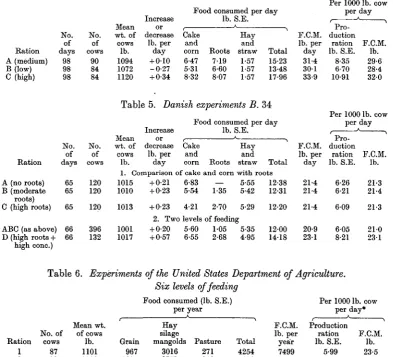
The results of the experiments listed in Table 1 are summarized in Tables 4-9. The two principal series of experiments are the Danish experiments B. 136 and the experiments of the United States Department of Agriculture. The set of experiments B. 34 dealt primarily with the question of variations in the amount of root ration, but as will be shown later these varying proportions of roots have little influence on the results, and the mean of all the varying levels of roots at the low level of feeding has been taken. In experiments T.B. 724 and T.B. 116 no concentrates were fed at the lower levels of feeding.
The last two columns of each table show the values converted to the standard 1000 lb. cow. The conventional maintenance allowance of 6 lb. S.E. per day has been deducted to give the production ration.
The results of these experiments are exhibited in Fig. 1, in which the milk yield is
plotted against the production ration, standardized values being shown.1 The curve
Table 4. Danish experiments B. 136; three levels of feeding Ration A (medium) B (low) C (high) Ration
A (no roots) B (moderate
roots) C (high roots)
ABC (as above) D (high roots + high cone.) No. of days 98 98 98 No. of days 65 65 65 66 66 No. of cows 90 84 84 No. of cows 120 120 120 396 132 T\lT mean wt. ofcows lb. 1094 1072 1120 or decrease lb. per day + 0 1 0 -0-27 + 0-34
Food consumed per
Cake and corn 6-47 5-31 8-32 lb. Roots 719 6-60 8-07 S.E. Hay and straw 1-57 1-57 1-57
Table 5. Danish experiments B.
M wt. of cows lb. or decrease lb. per day
Food consumed per
IK H 17
Cake and corn 1. Comparison of cake 1015 1010 1013 1001 1017 + 0-21 + 0-23 + 0-23 2. Twc + 0-20 + 0-57 6-83 5-54 4-21 ) levels 5-60 6-55 Roots and corr 1-35 2-70 Hay and straw
1 day
Total 15-23 13-48 17-96 34 ' day Total l with roots
5-55 5-42 5-29 of feeding 1-05 2-68 5-35 4-95 12-38 12-31 12-20 1200 1418 F.C.M. lb. per day 31-4 3 0 1 33-9 F.C.M. lb. per day 21-4 21-4 21-4 20-9 2 3 1
Per 1000 lb. cow per Pro-duction ration lb. S.E. 8-35 6-70 10-91 day F.C.M. lb. 29-6 28-4 3 2 0
Per 1000 lb. cow per Pro-duction ration lb. S.E. 6-26 6-21
6 0 9
6 0 5 8-21 day F.C.M. lb. 21-3 21-4 21-3
2 1 0 2 3 1
Table 6. Experiments of the United States Department of Agriculture. Six levels of feeding
Ration 1 2 3 4 5 6 No. of cows 87 89 85 81 66 100 Mean wt. of cows lb. 1101 1099 1136 1147 1174 1211 1 Grain 967 1607 1971 2591 2903 3714
Food consumed (lb. S.E.) per year Hay silage mangolds 3016 2751 2952 2828 2723 2498 Pasture 271 248 295 294 327 282 Total 4254 4606 5218 5713 5953 6494 F.C.M. lb. per year 7499 7991 8787 9274 9585 9855
Per 1000 lb. cow per day* Production ration lb. S.E. 5-99 7-09 9-01 10-57 11-31 13-03 F.C.M. lb. 23-5 2 5 0 27-5 29-0 3 0 0 30-8 * A lactation period of 300 days is assumed, maintenance being allowed for the whole year. The same maintenance (that for rations 1 and 2) is deducted from all rations.
Table 7. Experiment T.B. 724. Comparison of limited grain with bulky foods only. Periods without pasture
Ration Hay only Hay + silage Hay + grain
TLT f
IN O. OI
days mean 196 181 184 Average WT. OI cows lb. 1341 1373 1421 Increase or decreaselb. + 3 - 2 5 - 3 6
Food consumed lb. S.E
Alfalfa Corn hay silage 2532 — 1526 915 2158 — Mixed grain _ — 617 Total 2532 2441 2775 F.C.M. lb. 4269 4492 5356
Per 1000 lb. cow per day Pro-ration lb. S.E. 4-69 5-00 6 0 4 •
F. YATES, D. A. BOYD AND G. H. N. PETTIT 435
Table 8. Experiment T.B. 116. Comparison of limited grain with bulky foods only.
Periods without pasture
Per 1000 ;b. cow* per day
No grain Limited grain
No. of days
201 201
Average wt of
cows
lb.
1240 1333
Increase
decrease
lb. - 2 3
+ 87
Food
Bulkyf foods 2918 2684
consumed
Mixed grain
—
1005 lb. S.E.
^
Total 2918 3689
F.C.M.
lb.
7046 8188
Pro-ration lb. S.E.
6-7 9-4
F.C.M.
lb.
30-5 34-6 Ten Holstein cows (see note on T.B. 724).
* Allowance made for variation in average weight at beginning of period. •f Alfalfa hay, corn silage, beet, and a small amount of dried beet pulp.
Table 9. English experiments; two levels of feeding
Ration Normal High
No.
of
days
84 84
No. of
cows
10 10
Live
wt
lb.' 1099 1132
Daily change in
live wt
lb.
+ 0-12 + 0-52
Cake
6 0 8 9 1 1
S.E. consumed per day (lb.)
Roots
4-38 4-38
Hay 4-04 4 0 4
Straw Total 1-32 15-82 1-32 18-85
F.C.M. Per 1000 lb. cow
per lb.
day i * ,
lb. S.E. F.C.M. 250 8-82 23-4 27-9 11-36 " 25-7
As will be seen from this figure, there is a fairly steady increase in milk yield with increasing food supply up to very high levels of feeding. The increase is greater in the
p
1
40-1
30-
20-
10-0
KEY
Denmark 1922-7
1888-90 U.S.A. Dep. of Agric.
T.B. 116 T.B. 724
English feeding standard Economic curve
0 5 10 IS
lb. starch equivalent (production ration) Fig. 1. Milk yields. Relationship between food and milk.
In the case of the U.S.D.A. experiments, the increase in milk yield, except for the highest level of feeding, remains constant at about 1-15 lb. milk for each additional ' pound of starch equivalent fed. This may be compared with the production ration given by the English feeding standard of approximately 4 lb. of milk for each pound of starch equivalent fed.
The results of experiment T.B. 724, although based on only a few cows and subject to the qualification that in the lower levels of feeding no concentrates were fed, are of interest in that the level of food intake was here very low, and the slope of the curve is much steeper, approximately 4 lb. milk for each pound of starch equivalent fed.
Experiment T.B. 116 appears to be somewhat anomalous in that although the pro-duction ration relative to the level of feeding was very low the slope of the line is not
much greater than that of the U.S.D.A. experiments.
Very high rates of feeding appear to have been adopted in the English experiments. One of the experiments is anomalous in that the cows did not increase in weight in the manner to be expected at these levels of feeding. The report states that this was in part due to one cow in each group •which lost -weight seriously. There are, however, other obscure points, e.g. uncertainty as to whether the cows actually consumed all their rations, and it would be unwise to lay too much stress on the results.
5. PHYSIOLOGICAL EFFICIENCY
Variation in food supply not only results in change in milk yield but also in change in the weight of the cow. The experiments show that when the food supply of a cow is suddenly reduced she will for a time lose weight, but if a low level of feeding is adopted
30-28
26-0 1 2 3 4 5 6 7
Fortnights
Fig. 2. Danish experiments. Yields of milk, at three levels of feeding, over last fortnight of standard feeding and seven fortnights of experiment.
F. YATES, D. A. BOYD AND G. H. N. PETTIT 437
In considering any experimental results on different levels of feeding, therefore, changes in body weight of the experimental animals must be taken into account. First, because' such changes may in themselves affect later food requirements, secondly, because in short-term experiments the changes in weight are in part transient effects representing what would in long-term experiments be changes in yield of milk. The shorter the experimental period the more important is the second factor.
Fig. 2, which shows the milk production in successive fortnights for the three different levels of feeding in the Danish experiments B. 136, illustrates the way in which changes in feeding level only gradually produce their full effect. In studying this figure it must of course be remembered that the differences in quantities of food fed increased as the experiments progressed, since the rations were themselves based on the milk yields.
In determining the efficiency of the digestive processes at various levels of food intake, i.e. in determining what will be termed the curve of physiological efficiency, or
physio-logical curve, it will be necessary to express the resultant products, milk and body weight,
in terms of a single unit. An estimate of the equivalent of body weight in terms of milk has therefore been made by using the recognized feeding standards for fattening bullocks and for milk production, as follows:
I Store 2 ]b. Starch equivalent to produce 11b. live weight \ Fresh 2£ lb.
I Half fat 3 lb. Starch equivalent to produce 10 lb. milk corrected to 4% fat 2-54 lb. Hence 1 lb. live-weight increase is approximately equivalent to 10 lb. milk
A check on this estimate could be made if the composition of the additional weight added to the animal were known.
When the food supply is inadequate and body weight is reconverted into milk there is likely to be some further loss. The determination of the efficiency of this process presents considerable difficulties, and does not appear to have been investigated experi-mentally. From the internal evidence of the Danish experiments B. 136 a provisional estimate of 70% is arrived at, i.e. 1 lb. loss of body weight is equivalent to 7 lb. milk. This is the value which brings the adjusted points representing the three levels of feeding in the Danish experiments B. 136, on to a parabola passing through the origin. It should be emphasized that this estimate cannot lay any claim to accuracy, but considerable changes in the percentage recovery will not seriously affect any of the curves or the conclusions based on them.
In calculating milk yields adjusted for live-weight changes, therefore, an allowance of 10 lb. of milk was made for every 1 lb. increase in live weight. In the Danish experiments B. 136 losses in live weight were allowed for at the rate of 7 lb. of milk for every 1 lb. decrease. In the other experiments, in most of which the individual weights for cows were not available, the over-all allowance of 10 lb. milk for 1 lb. Live weight was used for both losses and gains.
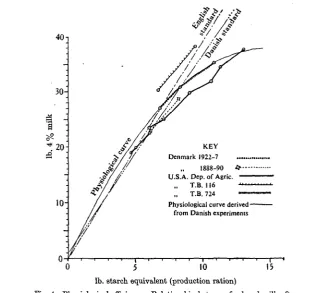
The whole of the results shown in Fig. 1 fall into more orderly sequence when allow-ances for Kve-weight changes are made in this manner. The resultant graph, which
re-
20-
10-Before
20- 10-After:
0 5 10 0 5
Danish feeding units Danish feeding units Fig. 3. Danish experiment K 22. Effect of adjustment for live-weight changes.
10
40
30-
1
0-K E Y
Denmark 1922-7
188890 * — -U . S . A . D e p . of Agric.
T.B. 116 • " ' -T.B. 724 <—"»
Physiological curve derived-from Danish experiments
0 5 10 15
1b. starch equivalent (production ration)
Fig. 4. Physiological efficiency. ^Relationship between food and milk after adjustment of milk yields for changes in live-weight.
F. YATES, D. A. BOYD AND.G. H. N.-PETTIT 439
the changes in weight of those on the higher rations were equal to twice the difference of the mean weights from the mean weights of those on rations 1 and 2, the change for ration 3, for example, being 2 (1136 —1100) = 72 lb. This may account for some of the local irregularities exhibited by the results of the U.S.D.A. experiments.*
n—>—i—'—r 120 130 140 150 Percent of English standard
160 170
Denmark ••••••• U.S.A. Dep. Agric.
Fig. 5. Live-weight changes and feeding. Relation between mean daily change in weight and the feeding rate (production ration) expressed as a percentage of the English standard.
Apart from this it will be seen that each set of points lies approximately on one of a series of similar parabolas through the origin. The parabola passing through the Danish series B. 136 is shown.
The actual changes in weight in experiments B. 136 and the estimated changes in the U.S.D.A. experiments are shown in Fig. 5.
6. ECONOMIC EFFICIENCY •
From the point of view of milk production gain in weight during lactation is of no immediate value. Excessive gain in weight may, of course, even be deleterious to subse-quent milk production. On the other hand, moderate gain in weight will probably give a subsequent saving in food during the dry period, when it is important to feed fairly liberally in order to ensure that the cow is in good condition at calving. Consequently, though the physiological curve will over-estimate the efficiency, of the digestive processes in converting food into milk, some allowance must be made for gain in weight. It appears best to make this allowance in terms of food rather than milk. On the assumption that the digestive efficiency of the cow during the dry period is that given by the English feeding standards, and taking 1 lb. live weight to equal 10 lb. 4% milk, the equivalent is 2-54 lb. S.E.'. per 1 lb. live weight. Thus in determining what may be termed the
economic curve, a cow gaining 0-1 lb. per day will be reckoned to be consuming a net
quantity of starch equivalent of 0-25 lb. less than that actually consumed.
Loss in weight must be treated differently, since any such loss is an indication that the cow will suffer a loss in milk production if the low rate of feeding continues. The
economic curve, therefore, may be taken as identical with the physiological curve at the lower levels of feeding.
More complicated situations may arise in practice if the food supply is plentiful at one season, but scarce at another. In such a case additional weight put on in the season when the food is scarce may be of little value if it results in a saving of food only in the season when food is plentiful. Conversely, additional weight put on in the season when food is plentiful may be of great value in saving food later. We do not propose to discuss these situations here. The data and curves presented will enable such cases to be studied as required.
Fig. 6 shows, a graph of economic efficiency constructed on the above lines. The economic curve for the Danish experiments is drawn. As already explained this is made identical
30-
20-
1
0-KEY / Denmark 1922-7
1888-90 •*• — U.S.A. Dep. of Agric. —
T.B. 116 •"-T.B. 724 •—
English feeding standard Economic curve derived
from Danish experiments
0 5 10 15
lb. starch equivalent (production ration)
Fig. 6. Economic efficiency. Relationship between food and milk after adjustment of food intake for changes in live weight.
with the curve of physiological efficiency from the origin to the point where it crosses the line representing the English feeding standard. Subsequent to this it is drawn so as to pass through the points given by the experiment.
A further complication arises in determining the economic curve from short-term experiments, owing to the fact that the full increase in milk production will not take place immediately. In other words some of the food which in a long-term experiment, extending over the whole of a lactation, would be converted into milk, is in a short-term experiment converted into body weight. This will have the effect of reducing the apparent economic efficiency determined from short-term experiments in the manner adopted above at the high levels of feeding.
F. YATES, D. A. BOYD AND G. H. N. PETTIT 441
through the point representing the lowest level of feeding in the U.S.D.A. experiments on the graph of actual milk yields (Fig. 1) passes somewhat below the points representing the highest levels.
On the other hand, it may be questioned whether any allowance in terms of food should be made for the very large gains in live weight that apparently occur at the highest levels of feeding in the U.S.D.A. experiments. Indeed, such gains may, in the long run, be actually deleterious.
Nevertheless, the American experiments do demonstrate that it is possible temporarily to increase milk production very substantially, when food is plentiful, by increasing the level of feeding without any appreciable loss of efficiency. The actual increase in pro-duction, from the lowest to the highest level of feeding, was from 23-5 to 30-8 lb. F.C.M. per day, i.e. 3 1 % . The full report of these experiments will be of the greatest interest.* The subsequent discussion is based on the economic curves derived from the Danish experiments, and shown in Figs. 1 and 6. Even if fuller reports of the American experi-ments show that these curves are unduly conservative at high levels of feeding, the general conclusions will not be greatly modified. In particular, the level of feeding which is most efficient will be slightly raised.
7. CURVES FOR INDIVIDUAL COWS
In the above discussion only means of groups of cows on different treatments are con-sidered. In so far as given feeding standards were followed in the experiments, the points representing individual cows on a given production ration necessarily lie approximately on a line passing through the origin of a graph showing actual milk yield and food con-sumption. Thus any curve derived from the means of numbers of cows on the same levels of feeding represents an approximation to the curve obtained by taking averages of the curves for individual cows along lines radiating from the origin.
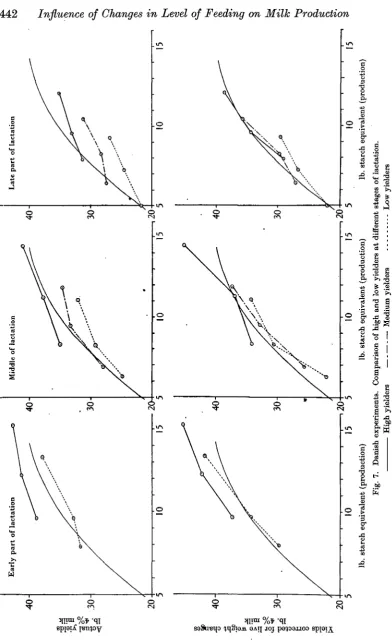
Since cows are of very different yielding capacity it is important to form at least a rough idea of the physiological and economic curves appropriate to cows of different capacities. With this object in view the cows of the Danish experiments B. 136 were sorted according to stage of lactation, and these groups were subdivided into groups of high-, medium- and low-yielding capacity. Only mature cows of from 6 to 9 years inclusive were included, and only two subgroups were formed for the first stage of lactation.
Fig. 7 shows the actual and adjusted milk yields of these groups, plotted against food consumed. No great accuracy can be claimed for the separate groups, since each point represents the average of only three to ten cows, but taken as a whole these graphs, and those already shown, indicate that it is reasonable to assume that a series of curves, derived by magnification and reduction (with reference to the origin) of the curves already obtained, give a tolerable approximation to the behaviour of cows of different yielding capacity, and at different stages of lactation.
8. DETERMINATION OF THE MOST EFFICIENT FEEDING RATES
The determination of the most efficient feeding rates for dairy cows is a complicated problem, which will be discussed in more detail elsewhere. The rate will vary somewhat with season, stage of lactation, and varying conditions of food supply. We will here consider only the main implications of the results on general feeding policy.
Lat
e par
t o
f lactatio
n
10
1
5
5
1
0
1
5
5
1
0
1
5
lb
. starc
h
equivalen
t (production
) lb
. starc
h
equivalen
t (production
) lb
. starc
h
equivalen
t (production
)
Fig
. 7
. Danis
h
experiments
. Compariso
n
o
f hig
h
an
d
lo
w
yielder
s a
t differen
t stage
s o
f lactation
.
Hig
h
yielder
s Mediu
m
yielder
s Lo
w
yielder
s
f
>s>.
F. YATES, D. A. BOYD AND G. H. N. PETTIT 443
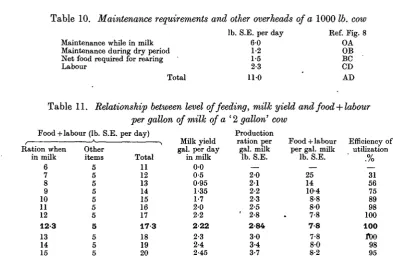
To determine the optimal level of feeding, maintenance requirements and other over-heads must be taken into account. Besides the maintenance requirements of 6-0 lb. S.E. per day of a cow while she is in milk, the food consumed in the dry period must be allowed for, and also the food for rearing (less a suitable allowance for subsequent meat production from old cows). Some allowance should also be made for labour, since labour freed from work in the cowshed can be diverted to the production of extra food. Assess-ments in terms of food of these various items of overhead are shown in Table 10.
Table 10. Maintenance requirements and other overheads of a 1000 lb. cow
Maintenance while in milk Maintenance during dry period Net food required for rearing Labour
Total
lb. S.E. per day 6 0 1-2 1-5 2-3 110
Eef. Fig. : OA
OB BC CD AD
Table 11. Relationship between level of feeding, milk yield and food + labour per gallon of milk of a'2 gallon' cow
Food + labour (lb. S.E.
Ration when in milk 6 7 8 9 10 11 12 12-3 13 14 15 Other items 5 5 5 5 5 5 5 5 5 5 5 per day) Total 11 12 13 14 15 16 17 17-3 18 19 20 Milk yield gal. per day
in milk 0 0 0-5 0-95 1-35 1-7 2-0 2-2 2 22 2-3 2-4 2-45 Production ration per gal. milk lb. S.E. — 2 0 2 1 2-2 2-3 2-5 ' 2-8 2-84 30 3-4 3-7
Food + labour per gal. milk
lb. S.E. — 25 14 10-4 8-8 8-0 7-8 7-8 7-8 8-0 8-2 Efficiency of utilization 0/ ./o 31 56 75 89 98 100
1 0 0
foo
98 95
Table 11, derived from the 'economic curve', gives the yield of milk, at various levels of feeding, of a cow which is capable of giving an average of 2 gal. a day when fed at the standard rate of 2-5 lb. S.E. per gallon of milk. The table also shows the 'production ration* and the total food+labour consumed per gallon. The last column gives the efficiency of utilization, expressed as a percentage of the maximum efficiency. The efficiency is maximum with an input of 12-3 lb. S.E. per day, corresponding to a pro-duction ration of 2-84 lb. S.E. per gallon of milk.
The situation is represented graphically in Fig. 8 which shows the economic curves . for cows averaging 1J, 2, and 2f gal. a day, or 400, 600 and 800 gal. a year.
The return in milk per unit of food + labour at a feeding level represented by any point on the curve is given by the slope of the line joining this point to the point D. This slope is maximum when the line is tangential to the curve, i.e. when the feeding levels are those given by the points Q1} Q2,
. For purpose of illustration a food supply of 1440 lb. starch equivalent per day may be assumed. This is sufficient to maintain a herd of 100 '2 gallon' cows, five-sixths of them being in milk and at the optimal rate of production. Table 12 shows the effects of varying the cows from 90 to 150. Allowance for food supplies to young stock and labour has been taken as proportionate to the number of mature cows, and is made at the rate shown in Table 10.
Table 12. Effect of variation in number of cows upon feeding levels, yields and efficiency when a given amount of food + labour (1440 lb. starch equivalent per day) is available (calculated for the C2 gallon' cow)
No. Actual (i) 90 95 100 105 110 120 130 140 150 of cows Difference from optimal % (2) - 1 0 - 5 Optimal + 5 + 10 + 20 + 30 + 40 + 50 Food per i lb. S.E. per day (3) 14-2 13-2 12-3 11-5 10-7 9-4 8-3 7-4 6-5
cow in milk ^ Difference from optimal % (4) + 15 + 7 Optimal - 7
- 1 3 - 2 4 - 3 3 - 4 0 - 4 7
Milk 1 Per cow in milk - (5) 2-40 2-32 2-22 2-10 1-94 1-50 1-06 0-66 0-25 yields (gal. Total yield (6) 180 183 185 183 177 150 115 77 32 per day) Difference from maximum % (7) - 3 - l Maximum - 1 - 4
- 1 9 - 3 8 - 5 9 - 8 3
Production ration lb. S.E. per gal. (8) 3-4 3 1 2-8 2-6 2-4 2-3 2-2 2 1 2 0
As the number of cows is increased the food available for each cow in milk falls off as shown in cols. 3 and 4 of Table 12. This results in the reductions in the yield per cow shown in col. 5. The total yield from the herd is obtained by multiplying the yield per cow in milk by five-sixths of the actual number of cows, and is shown in col. 6. The percentage difference from the maximum total yield is shown in col. 7.
A difference of 5% from the optimal number of cows in either direction produces a drop in total yield of only 1 %, a difference of 10 %, a drop of only 3 or 4 %. Beyond this point increase in number produces a rapid fall in total yield. An additional twenty cows can only be maintained by the sacrifice of 19 % of the milk yield, an additional thirty cows by the sacrifice of 38 % of the milk yield.
The last column shows the feeding rates per gallon of milk after making the accepted allowances for maintenance. It illustrates the point that once the rate falls below the English standard of 2-5 lb. S.E. per gallon serious reduction in yield is likely to ensue. The feeding' rate when 120 cows are carried, for example, is 2-3 lb. S.E. per gallon, but production is reduced by 19%.
The table has been calculated throughout on the assumption that five-sixths of the cows are in milk. In practice, a greater proportion of the cows would be dry when the numbers considerably exceeded the optimum. The total milk yield, however, would be similar to that shown.
F. YATES, D. A. BO YD AND G. H. N. PETTI? 445
the standard rate of 2-5 lb. S.E. per gallon is not the slight gain in efficiency which results if the herd is of average efficiency, but the fact that any slight reduction in digestive efficiency or errors in rationing will not then result in any serious loss in milk yield or over-all efficiency.
The table itself, and the curves for individual cows shown in Fig. 7, suggest that condition must always supplement milk yields in determining the rations of individual cows. The loss resulting from under-feeding a cow is in general likely to be much more serious than that from over-feeding. This should not be taken to imply that the weighing of rations is not advisable. Obviously, such weighing or measuring enables a better general control of the feeding to be maintained and avoids irregularity of feeding from day to day, which is almost bound to decrease the efficiency of the digestive processes.
9. ACTION OF INDIVIDUAL FARMERS WHEN FOODS MAY BE FREELY BOUGHT AND SOLD
When food is purchasable on the open market the most economic feeding of an individual cow, i.e. that showing maximum financial return to the farmer, is given by the point where the slope of the production curve is such that the income arising from an addi-tional unit of food is equal to its cost.
The same situation holds when part of the home-produced food which can be con-sumed by the dairy herd is readily saleable on the open market. Since there is in general a price margin between the selling and buying price of a given food, the cost of home-grown saleable foods chargeable against the dairy herd will be somewhat less than if they are purchased on the open market, and consequently when such foods are available the economic level of feeding of an individual cow will be slightly higher than when the foods have to be purchased.
The points Plt P2! Ps (Fig. 8) give the most economic levels of feeding for high, medium and low producers when home-grown concentrates in the form of cereals at
. per lb. starch equivalent are available, and the average net farm price of milk is . per gallon (approximate 1941-2 prices). The corresponding points W1; W2, W3 for winter feeding, and S1; *Sa, S3 for summer feeding, are also shown for comparison. It is interesting to note that all these points, and the points Q1; Q2, Q3 giving maximum production for a given quantity of food, are very close to one another. There is thus no economic inducement to push feeding to levels giving low productive efficiency.
If all the food costs the same amount the margin from a single high-production cow,
before deducting fixed overheads, will be equivalent to the income from DTlt with
average prices for milk and with starch equivalent at 2\d. per lb. There will consequently be a tendency to increase the number of cows, provided unlimited supplies of food at this price are available. The limit will be reached when the increase in overhead due to
an additional cow equals DTX. This additional overhead must include allowances for
such items as additional equipment, if not already available, and expectation of greater depreciation charges upon the additional cows, owing to their greater cost. Under con-ditions of free economic competition the situation is essentially one which leads to oscillations of the familiar type between supply and demand.
In the case of a low-production cow T3 falls below D and there will be a loss equivalent to DT3 if all the food costs the same amount. In practice, however, even low producers can be kept profitably, since a considerable part of the food of the cow consists of pasture,
hay, etc., which must be consumed on the farm and which is usually of relatively low cost. In this case the proper course for the farmer to pursue is to adjust the numbers in the herd so that there is sufficient cheap food for feeding all cows at the level of
pro-duction given by Q3, the point of the contact of the tangent from D, any concentrates
produced on the farm being sold. If the cows .cannot consume so great a volume of bulky foods, then some concentrates must be fed, but the economic level of feeding will be slightly lower than that given by the point P3, owing to the fact that the feeding of
concentrates necessarily reduces the intake of bulky foods.
5 0
Net food Labour | for | Dry I
rearing
10 15
Ib. stated equivalent - - Iu milk
Maintenance Production
Fig. 8. Economic relations for 1000 lb. cow. Economic curves for cows yielding respectively 800, 600, 400 gallons 3-7% milk per year, when on standard feeding rate.
Levels of feeding which give maximum production for a given amount of food + labour are represented by the points of contact Qlt Q2, Q3 of the tangents from D; levels which give maximum profit per cow by 8lt Slt S3
(summer prices of milk), TP1( Wa, W3 (winter prices), Plt Piy P , (mean of summer and winter prices).
The profit or loss per cow (excluding fixed overheads) when all food costs the same amount is represented
by T,A TtD, T3D.
The economic level to which it is profitable to push the production of home-grown
bulky foods can also be determined. In the case of high producers, with Tx above D,
it will be economic to increase production until the point is reached where one additional unit of food costs as much to produce as it would to buy (that is, assuming that there are sufficient cows to consume all the bulky foods produced). In the case of low pro-ducers, with T3 below D, a slightly lower level of production will be most economic.
P. YATES, D. A. BOYD AND G. H. N. PBTTIT 447
10. REDUCTION IN MILK YIELD RESULTING PROM THE FEEDING OP BULKY POODS ONLY
Bulky foods from arable crops, such as mangolds and kale, yield roughly twice as much starch equivalent per acre as cereals, allowing for the fact that only part of the straw is consumed. Also, silage and kale are of special value on account of their comparative richness in protein. It is therefore important to know how far bulky foods can replace concentrates in the dairy cow's ration.
Increase in the proportion of bulky foods can influence production in two ways. First, the total energy intake may be reduced, owing to the inability or disinclination of the cow to eat a sufficiency of bulky foods, and secondly, the digestive efficiency may be lowered, so that the energy equivalent of a heavy ration containing a large proportion of bulky foods may not be accurately represented by its nominal starch equivalent.
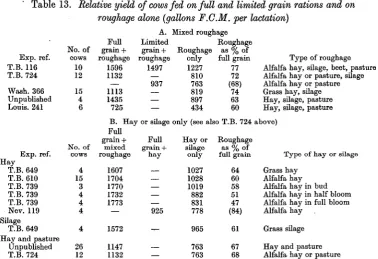
The results of the relevant American experiments on the first point are summarized in Table 13, which shows the milk yield resulting from feeding bulky foods only, com-pared with that obtained on a full-grain ration, and in some cases on a limited grain ration.
Table 13. Relative yield of cows fed on full and limited grain rations and on
roughage alone (gallons F.C.M. per lactation)
Exp. ref. T.B. 116 T.B. 724 Wash. 366 Unpublished Louis. 241 Exp. ref. Hay T.B. 649 T.B. 610 T.B. 739 T.B. 739 T.B. 739 Nev. 119 bilage T.B. 649 Hay and pasture
Unpublished T.B. 724 No. of cows 10 12 15 4 6 No. of cowa 4 15 3 4 4 4 4 26 12 Full grain + roughage 1596 1132 — 1113 1435 725 B. Hay Full grain + mixed roughage 1607 1704 1770 1732 1773 — 1572 1147 1132 A. Limited grain + roughage 1497 — 937 — — or silage Full grain +
h a y
— 925 — Mixed roug Roughage only 1227 810 763 819 897 434 hage Roughage
as % of full grain 77 72 (68) 74 63 60 only (see also T.B. 724
Hay or silage only 1027 1028 1019 882 831 778 965 763 763 Roughage as % of full grain 64 60 58 51 47 (84) 61 67 68
Type of roughage Alfalfa hay, silage, beet, pasture Alfalfa hay or pasture, silage Alfalfa hay or pasture Grass hay, silage Hay, silage, pasture Hay, silage, pasture above)
Type of hay or silage Grass hay
Alfalfa hay Alfalfa hay in bud Alfalfa hay in half bloom Alfalfa hay in full bloom Alfalfa hay
Grass silage
Hay and pasture Alfalfa hav or pasture
In all cases the different rations were fed to the same cows in different lactations. The full grain rations were fed to the cows in the first of the experimental lactations, usually when the cows Were immature, and a cor-rection for age has been made by the experimenters.
In studying this table, it should be borne in mind that the full-grain ration was fed at an early stage in the cow's life, usually the first lactation, this being part of the normal programme of the experiment stations. The yields have therefore been adjusted for age. These adjustments, which are often very substantial, are made in the original reports, but no opinion can be expressed as to their correctness, though they are similar to values given by Sanders (1927-8).
Clearly experiments of this type cannot be regarded as wholly satisfactory, but they appear to indicate a reduction of about 30 % in milk yield when only hay and silage are fed, and of about 40 % when hay only is fed.
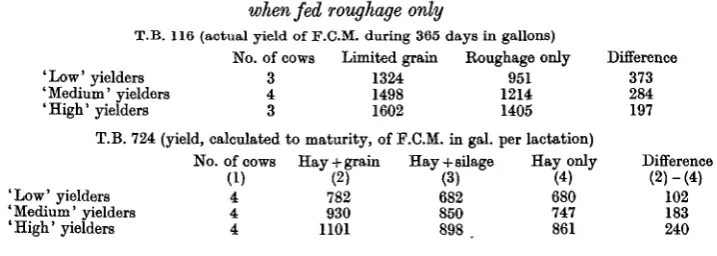
Most of the cows included in the experiment were very heavy yielders with lactation averages up to nearly 1800 gal. on the full-grain ration, but the four experiments with average yields of less than 1200 gal. show similar percentage reductions to the others. A detailed examination of performances in experiments T.B. 116 and T.B. 724 is shown in Table 14, in which the mean yields of the 'low', 'medium' and 'high' performance cows in each experiment are shown separately, the classification being made on the mean of their yields on all rations. In experiment T.B. 116 the 'low' yielders have actually shown a bigger absolute drop in yield than the 'high' yielders. In experiment T.B. 724 the 'high' yielders have shown a bigger drop, absolutely and relatively, than the 'low' yielders.
Table 14. Changes in yield of'low', 'medium' and 'high' yielders when fed roughage only
T.B. 116 (actual yield of F.C.M. during 365 days in gallons)
No. of cows Limited grain Roughage only Difference 'Low' yielders 3 1324 951 373 'Medium' yielders 4 1498 1214 284 'High' yielders 3 1602 1405 197
T.B. 724 (yield, calculated to maturity, of P.C.M. in gal. per lactation)
No. of cows Hay + grain Hay + silage Hay only Difference (1) (2) (3) (4) (2)-(4) 'Low' yielders 4 782 682 680 102 'Medium' yielders 4 930 850 747 183 'High' yielders 4 1101 898 861 240
Table 15. Decrease in milk yields as lactation progresses. Experiment T.B. 724
Decrease per month in daily yield in lb. (not corrected to F.C.M.) over first 10 months of lactation, grazing periods included.
Hay + grain Hay + silage Hay only Mean 'Low' yielders 3-6 3-0 2-9 3-2 'Medium' yielders 3-7 2-9 2-8 3-1 'High' yielders 2-8 2-4 3 0 2-7 Mean- 3-4 2-8 2-9 3-0
F. YATES, D. A. BOYD AND G. H. N. PETTIT 449
11. EFFECT OF CHANGES IN THE PROPORTION OF BULKY FOODS AND CONCENTRATES
The effect on milk yield of the substitution of roots and hay for part of the concentrate ration is shown in Tables 5 and 16-19, which give the results of the Danish experiments listed in Table 2.
Table 16. Danish experiments B. 55 (1900-1)
Food consumed per day (lb. S.E.)
Ration No. No. of of days cows Increase Mean or wt. of decrease
cows per day lb. lb. Cake
B. Low roots 54 C. High roots, 54
low cake D. High roots, 54
low com
A. Low cake B. High cake
52 52 122 122 Hay Corn, and etc. Boots straw
Per 1000 lb. cow per day
A
Pro- ' duction Total F.C.M. ration F.C.M.
S.E. lb. lb. S.E. lb. (1) Comparison of roots with cake or corn
•1047 +0-31 3-43 2-63 2-89 506 1048 - 0 0 7 1-11 2-82 4-89 4-97 140113-79
23-3 21-9 7-597-36
22-6 21-3
122 1054 +0-30 3-43 ' 0-52 4-89 4-99 13-83 23-2 7-39 22-5
(2) Comparison of cake with corn
92 1046 +0-09 1-29 504 2-79 4-88 14-00 21-4 7-59 20-8 92 1039 +0-31 3-62 2-71 2-79 4-90 14-02 22-9 7-62 22-2
Table 17. Danish experiments B. 76
Ration
A. Low roots, low hay B. Low roots,
high hay C. High roots,
low hay D. High roots,
high hay No. of days 60 60 60 60
A. Low hay 56 B. High hay 56
A. Low hay B. High hay
56 56
Food consumed (lb. S.E. per day)
Cake
and Total corn Roots Hay Straw S.E. B. 76 a. Comparison of cake and corn with roots and hay 10 1041 +003 6-92 1-54 1-81 2-23 12-50
Increase Mean or No. wt. of decrease
of qows per day cows lb. lb.
10
10
10
1067 +0-22
1036 +006
1043 + 0 1 3 5-47 5-47 401 1-54 2-82 2-82 3-48 1-81 348 2-20 12-69 2-31 12-41 1-98 12-29
Per 1000 lb. cow per day i ^
Pro-duction F.C.M. ration F.C.M.
lb. lb. S.E. lb.
22-3 615 21-6
22-0 6-10 20-9
22-2 608 21-5
22-6 5-94 21-9
B. 76 6. Comparison of cake and corn with seeds hay 83 1047 + 0 0 8 4-61 5-19 1-65 1-66 1311 83 1044 +0-22 3-20 5-19 3-67 1-46 13-52 B. 76 c. Comparison of cake and corn with lucerne hay 40 1041 + 0 0 1 4-59 4-85 1-57 1-63 12-64 40 1039 - 0 0 1 2-89 4-85 3-54 1-34 12-62
23-9 240 23-2 23-3 6-70 709 6-28 6-24 23-2 23-3 22-6 22-7
Table 18. Danish experiments B. 144. Comparison of roots with corn
c.
A. D. Ration Low roots Moderate roots High roots No. of' days 56 56 56 No. of' cows 331 331f
33 J Mean Wu. OI COWS lb. approx. 1142 Increase or U.CL'i CClOC per day lb. + 0-29 + 0-18- 0 1 0
Food
Cake 4-20 4-27
4-27
consumed per day (lb.
Corn 5-97 3-22 6-44 Roots 3-20 519 7-73 Straw 2-32 2-32 2-32 S.E.) Total S.E. 15-69 1500 14-76 F.C.M. lb. 32-3 31-3 300
Per 1000 lb. cow per day
Pro-duetion
U U V V4VU
Table 19. Danish experiments B. 172. Comparison of cake and corn with hay Per 1000 lb. cow per day Increase Food consumed per day (lb. S.E.)
Mean or , A >
Pro-No. Pro-No. wt. of decrease Cake duction of of cows per day and Total F.C.M. ration F.C.M. Ration days cows lb. lb. corn Roots Hay Straw S.E. lb. lb. S.E. lb. A. Low hay 53 110) approx. +001 5-71 5-20 0-60 1-86 13-37 23-5 6-43 21-8 B. High hay 53 110J 1116 +005 2-63 4-89 7-29 006 14-87 23-8 7-82 221
In all these experiments, with the exception of B. 55 and B. 144, which are discussed in the next section, there is only a slight difference in milk yield with increased pro-portion of bulky food.
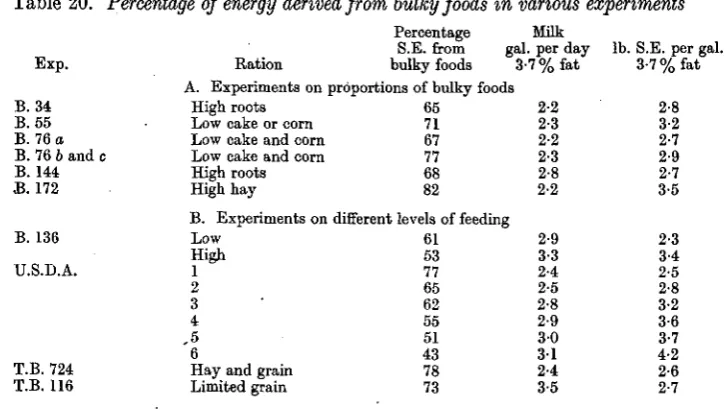
The actual percentages of starch equivalent obtained from bulky foods in a selection of the rations in the various experiments, including those on varying levels of feeding, are shown in Table 20. Most of the cows appear to have been yielding near the limit of their capacity, as is indicated by the column showing the pounds of starch equivalent consumed per gallon of milk, after allowing for maintenance. All the experiments were on groups of cows, and it is reasonable to assume that some cows in each group were yielding up to 4 gal. daily, while it is clear that a high proportion of bulky foods is com-patible with an over-all average of from 2 to 3 gal. daily.
Table 20. Percentage of energy derived from bulky foods in various experiments
Exp.
B. 34 B. 55 B. 76 a B.76 b and c B. 144 B. 172
B. 136
U.S.D.A.
T.B. 724 T.B. 116
Ration A. Experiments on
High roots Low cake or corn Low cake and corn Low cake and corn High roots High hay
B. Experiments or
Low
High
1 2 3 4 , 5 6
Hay and grain Limited grain
S.E. from
bulky foods gal. per day3-7% fat proportions of bulky foods
65 71 67 77 68 82
2-2 2-3 2-2 2-3 2-8 2-2
i different levels of feeding
61 53 77 65 62 55 51 43 78 73
2-9 3-3 2-4 2-5 2-8 2-9 3 0 3 1 2-4 3-5
lb. S.E. per gal 3-7% fat
2-8 3-2 2-7 2-9
2-7 •
3-5
2-3 3-4 2-5 2-8 3-2 3-6 3-7 4-2 2-6 2-7
Detailed information on the feeding of individual cows in the Danish experiments is available only for experiment B. 136. In,this experiment the heavier rations included a larger amount of roots as well as of concentrates. The heavier yielders on a given ration also received more roots than the low yielders, though the increase was not proportional to the total increase in energy value.
F. YATES, D. A. BOYD AND G. H. N. PETTIT 451
12. CAPACITY TO INCREASE CONSUMPTION OP BULKY FOODS WHEN LESS CONCENTRATES ARE FED
In the American experiments the feeding of bulky foods was in general ad lib. The experiments, therefore, provide evidence on how far the appetite of the cow is sufficient to stimulate increased consumption of bulky foods when concentrates are reduced or withheld entirely. Table 21 summarizes the relevant information on this point. From these results it may be concluded that the increase in bulky foods was sufficient to compensate for the nutritive value of between one-third arid one-fifth of the total grain ration. The results already presented in Table 20 show, however, that adequate food intake can in general be reached with a high proportion of bulky foods in the ration, so that in general appetite will not be a limiting factor of any consequence, provided a moderate amount of concentrates is fed.
Table 21. Increase in consumption of bulky foods (fed ad lib.)
when less concentrates are fed
Bulky foods % concentrates lb. S.E. per day replaced by
: „„ • bulky foods 36 Grain (lb. S.E. per day)
Exp. T.B. 724 T.B. 116 U.S.D.A.
High 3-35 500 1018
Low Nil NU 2-65
Decrease 3-35 500 7-53
increase 119 117
1-39 2318
13. EFFECT OF CHANGES IN PROPORTION OF BULKY FOODS ON EFFICIENCY OF UTILIZATION
It is clear from Tables 5 and 16-19 that efficiency of utilization, assessing foods in terms of their starch equivalent, is much the same for all the varying proportions of concen-trates and bulky foods included in the experiments. A more exact comparison can be made by allowing for the small differences in starch equivalent of the different rations in the same experiment and adjusting the milk yields by means of the physiological curve of Fig. 4. This adjustment, together with allowance for differences in changes of live weight, gives the results shown in Table 22 (which includes also two comparisons of cake v. corn from experiment B. 55). The + sign indicates that there is a gain in efficiency
Table 22. Efficiency of utilization of different types of food. Differences in adjusted milk production, after allowing for changes in live weight and differences in amount of starch
equivalent, feed units or total digestible nutrients consumed
Difference in adjusted milk No. of production (lb. F.C.M. per day)
Exp. Comparison B. 34 Cake and corn v. roots B. 55 Corn v. roots
B. 76 a Cake and corn v. roots and hay B. 766 Cake and corn v. seeds hay B. 76 c Cake and corn v. lucerne hay B. 172 Cake and corn v. hay
B. 144 Corn v. roots
B. 55 Cake v. corn (low roots) B. 55 Cake v. corn (high roots)
ations A-C B-D A-D A-B • A-B A-B Mean C-D B-A D-C
treat-ment
120 122 10 83 40 110 485 33 92 122
S.E. equalized
-0-5 -0-1
- 1 0
-0-4
0 0
+ 0-4 - 0 1 5 + 3 1 + 3-6 + 4-9
F.E. equalized
- 1 0
-0-6 -1-6 -0-8 -0-7 -0-2 -0-67 + 2-6 + 30 + 4-1
T.D.N. equalized
of utilization when the smaller proportion of bulky foods is fed. The table-also shows the results which are obtained by equalizing the feed units and total digestible nutrients instead of the starch equivalents.
Except for the last three comparisons all the experiments agree in showing that, when the relative food values are assessed on the starch equivalent system, the efficiency of utilization is unchanged by differences in the proportion of bulky foods. This implies that the starch equivalent system gives a very good measure of the comparative feeding values of different types of food, provided protein supply is adequate.
The three comparisons shown at the foot of the table are particularly interesting. Those for experiment B. 55 include the only two rations where the protein was appre-ciably less than the English standard of 0-6 lb. per gallon. The actual amounts of protein equivalent fed per gallon P.CM., after allowing for maintenance, ar.e shown in Table 23. It is clear that the poor performance of the cows on rations A and C of experiment B. 55 is due to inadequate protein supply and not to excess of bulky food.
Table 23. Protein intake in the Danish experiments. Amount of protein equivalent (lb.) per gallon F.C.M. (excluding standard maintenance allowance)
Ration
Exp. B.34 B. 55 B. 76o B. 766 B. 76c
B. 144 B. 172
A
0-66 0-36 0-58 0-90 0-97 0-63 0-75
B
0-58 0-70 0-64 0-78 0-82
0-75
C
0-54 0-31 0-55
.
0-64
D
0-65 0-60
0-62
In the case of experiment B. 144 (Table 18) the difference cannot be accounted for in terms of inadequate over-all protein ration. Four separate experiments are involved, in three of which mangolds were fed, and in the fourth of which swedes were fed. The most serious failure of ration D occurred in two of the mangold experiments. In these experiments no hay was fed and the amount of roots fed in ration D was as large as 1 cwt. daily. Also, feeding commenced rather early in the season (mid-December). The cows on the high root ration not only gave a lower yield of milk, but also lost weight. The two most probable explanations are:
(a) That the ration of immature roots was excessive and caused the animals to scour. (b) That although the over-all ration of 'protein equivalent' appears adequate, there
were in fact deficiencies due to one-quarter of the protein equivalent being derived from immature roots containing a high proportion of non-protein nitrogenous compounds.
14. COMPARISONS OF VARIOUS SYSTEMS OF MEASURING THE ENERGY VALUE OF FOODS
Experiments on the substitution of one type of food for another provide experimental evidence of the relative merits of the different systems of measuring energy value.
The relevant comparisons are set out in Table 22. From these it is evident that while equalization of the starch equivalent results in almost exact equalization of the adjusted milk yields, provided protein requirements are satisfied, equalization of the food units (F.E.) results in a somewhat lower yield from the high concentrate rations.
F. YATES, D. A. BOYB AND G. H. N. PETTIT 453
(1-43 times an equal weight of carbohydrate, as against 0-95 in the starch equivalent system); apart from this the two systems are identical. This higher value for protein was introduced for dairy-cow rationing in the belief that protein provided more energy value in milk production than in the production of fat. The results given in Table 22 show that this belief is unfounded.
There has also been some confusion in the F.E. system as to the energy value of roots. This arose from the use in the early experiments of an empirical equivalent of 1*1 kg. of dry matter in roots = 1 F.E. The correct value for mangolds is 1-4-1-5, and for swedes 1-1-1-2. This empirical equivalent is quoted in some of the later reports, even where the published values of the F.E. show that the correct equivalents were used.
Equalization of the total digestible nutrients (T.D.N.) produces similar differences in the opposite direction. This of course must occur if the starch equivalent system is correct, since the T.D.N. system over-values the coarse fodders relative to the S.E. system.
Table 24. Comparative values of starch equivalents, feed units, and total
1
digestible nutrients (based on analyses given by Woodman (1939))
Ground-nut cake (decorticated) Coconut cake
Cotton cake (decorticated) Palm-nut kernel cake Rape cake Sunflower cake Wheat Barley Oats Wheat straw Oat straw Turnips Mangolds Swedes Meadow hay Lucerne hay S.E. 73 77 68 73 60 72 72 71 60 13 21 4-4 6-8 7-3 30 32
F.E. x 0-75 93 84 84 81 71 87 76 74 63 13 21 4-5 6-9 7-4 co m T.D.N. 78 77 72 74 68 79 77 74 64 34 40 6 1 10-4 9-4 44 47
Value relative to S.E. (decorticated ground-nut
cake as standard)
F.E. OOOOJOOffl O 84 82 84 79 80 80 79 80 82 87 T.D.N. 100 94 100 95 108 103 102 97 102 250 188 132 143 121 140 138
The actual differences in the value set on different types of food in the three systems are shown in Table 24. The F.E. values are calculated in precisely the same manner as the S.E. values, except for the difference in the value of protein noted above. These calculations give values of 0-75 x F.E., which are the values tabulated. The conventional divisor 0-75 is introduced in the F.E. system so as to make the F.E. of 1 kg. of barley approximately equal to unity (1 F.E. was originally denned as the energy value of 1 kg. of barley). In making the comparisons shown in the last two columns decorticated ground-nut cake has been taken as standard.
15. SUMMARY
The influence upon milk production of changes in level of feeding and in proportion of bulky foods has been investigated, using all available experimental material.
The experimental results show that increases in level of feeding, to rates well in excess of conventional English standards, are capable of giving substantial increases in milk production (Fig. 1).
It is shown that physiological efficiency falls off as food intake is increased. A curve representing physiological efficiency has been constructed by taking account of changes in live weight as well as changes in yield of milk (Fig. 4).
The question of the most efficient feeding rate is discussed. Owing to the high over-head and maintenance requirements of the cow, a fairly high level of feeding of about 2-8 lb. starch equivalent per gallon of milk, gives maximum efficiency. This is so in spite of lower physiological efficiency at high levels of feeding and additional loss re-sulting from the utilization of part of the food supply to increase body weight. This feeding rate approximates to the rate which would have given maximum profit at 1941-2 prices if foods could have been freely bought and sold. There is thus no economic induce-ment to feed at excessive rates, and the chief danger appears to be under-feeding, due either to too stringent rationing or to an attempt to keep too many animals in times of general food stringency.
The feeding of bulky foods alone may reduce yield owing to limitation of total energy intake. Provided total energy intake is maintained, substitution of part of the concen-trate ration by bulky foods such as roots or hay, on an equal starch-equivalent basis, does not influence milk yield.
The results of these experiments show that the starch-equivalent system gives a better assessment of the relative energy values of different foods than does the food unit (F.E.) system or the total digestible nutrients (T.D.N.) system.
Our acknowledgements and thanks are due to K. R. Graves, Chief of the Bureau of Dairy Industry, for a preliminary report on the results of the United States Department of Agriculture experiments, which greatly increased the scope of the material available for the preparation of this paper.
ADDENDUM