Open Access
Review
Predicting the conformations of peptides and proteins in early
evolution
E James Milner-White*
1and Michael J Russell
2Address: 1Institute of Biomedical and Life Sciences, University of Glasgow, G12 8QQ, UK and 2Jet Propulsion Laboratory, California Institute of Technology, Pasadena, CA, 91125, USA
Email: E James Milner-White* - [email protected]; Michael J Russell - [email protected] * Corresponding author
Abstract
Considering that short, mainly heterochiral, polypeptides with a high glycine content are expected to have played a prominent role in evolution at the earliest stage of life before nucleic acids were available, we review recent knowledge about polypeptide three-dimensional structure to predict the types of conformations they would have adopted. The possible existence of such structures at this time leads to a consideration of their functional significance, and the consequences for the course of evolution.
This article was reviewed by Bill Martin, Eugene Koonin and Nick Grishin.
Text
In the quest for the origins of life, bioscientists, retracing genetic steps, seek its source in an RNA world [1,2]. Con-sidering the earliest, pre-RNA, period of evolution, earth scientists prospect for the free energies and the mineral catalysts that promoted reactions between oceanic dis-solved CO2 and submarine alkaline hydrothermal efflu-ents of H2, NH3 and CH3S- issuing at ≤120°C into the
inorganic pores of an ocean floor hydrothermal mound. It is suggested that a gradual organic takeover of inorganic, probably Fe > Ni sulfide, compartments at such a mound, was effected as carbon dioxide was reduced with hydro-thermal hydrogen to simple organic molecules, including amino acids and short peptides [3-6]. That amino acids and peptides can be produced under the conditions expected at hydrothermal systems has been demonstrated experimentally [7,8]. As with other organic molecules, their concentrations are likely to have been concentrated by thermal diffusion with the inorganic pores occupying the mound [9]. Previously we pointed to the likely
signif-icance of nests (3–6 residue peptides whose mainchain NH groups bind anionic atoms or groups) at the earliest stage of evolution [10]. Here the entire range of possible polypeptide conformations are considered, focusing on those expected to have been common and to have encour-aged such suboceanic hydrothermal systems to evolve.
The multi-layer β-sheet of mature amyloid may have formed the material of the earliest organic membranes. There would have been a high proportion of enantiomeric polypeptides (where the main chain atoms of successive amino acids are enantiomers). Nests would have been prominent and used for binding phosphates, pyrophos-phates and iron-sulphur centres such as the water soluble [Fe4S4(CH3S)4]2- cluster assembled abiotically in aqueous
media [11]. Their evolutionary relics are detectable in present day proteins [11-13]. Multi-layer α-sheet would have formed readily, possibly generating cation and pro-ton ion channels at its margins. On the other hand, the proportion of α-helix and polyproline type II helix would
Published: 28 January 2008
Biology Direct 2008, 3:3 doi:10.1186/1745-6150-3-3
Received: 13 November 2007 Accepted: 28 January 2008 This article is available from: http://www.biology-direct.com/content/3/1/3
© 2008 Milner-White and Russell; licensee BioMed Central Ltd.
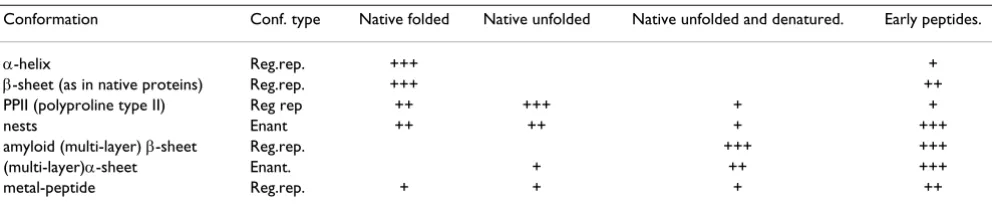
have been lower than in present-day folded proteins. The different conformations are listed in Table 1.
Evidence for early peptide formation
The first sulfide to precipitate on the mixing of the HS-
-bearing hydrothermal fluid and Fe2+-bearing ocean water
upon the mound would be nanometric particles of the layered mineral mackinawite [Fe >> Ni > Co)S] organised as rather leaky membranes [4,14-17]. Glycines (NH3+CH
2COO-) and other simple amino acids may have
been condensed with pyrophosphate [3]. (Condensation with gaseous carbonyl sulphide has been demonstrated [18] although as COS is extremely unstable in alkaline solution [19] we do not consider it a viable mechanism). PPi, acting as the first condensing agent in place of ATP [20], could have been recharged variously by the natural protonmotive force operating across the inorganic mem-brane (pKa~9 at low water activity [3]), or through the reaction between acetyl phosphate and inorganic mono-phosphate in the mound [6,21].
The reductive amination of the appropriate α-keto acids, synthesised under simulated hydrothermal conditions, has been demonstrated [22]. Alanine, glutamate, phenyla-lanine and tyrosine yields of up to ~50% in the presence of freshly precipitated FeS at 50° and 75°C has been achieved [8]. It is notable that high amino acid yields required a pH of 9 ± 0.3, presumably because the uncharged form of ammonia acts as the nucleophile (pKa of ammonia = 9.25; [8]).
Peptides have been generated [7,23] by activating 500 mM of glycine, phenylalanine and tyrosine with CO at 1 bar with 1 mM of freshly precipitated (Ni, Fe)S, and meth-ane thiol or H2S as catalyst at 100°C. Significant yields of glycylglycine (≤11%), phenylalanylphenylalanine (≤8%), and tyrosyltyrosine (≤3%) were produced in one day, also at a pH of ~9.1. A 6 ppm yield of tyrosine tripeptide was
realized within 4 days. Finding that, as with their amino acid syntheses, alkaline conditions (pH range 8 to 9.5) were a prerequisite for high yields, solutions were buff-ered [23] with Mg(OH)2, a serendipitous choice since, as the mineral brucite (Mg(OH)2), it buffers off-ridge hydro-thermal systems at high pH [16,24,25]. Although starting with enantiomerically pure (L) amino acids, both the phe-nylalanine and tyrosine dipeptides had epimerized to pure L, D, and mixed L and D dimers in a few days. Huber and Wächtershäuser [7] concluded that at the origin of life amino acids would be racemic.
Longer peptides have been produced abiotically, though so far in rather extreme conditions. For example, thermal cycling at pH 2.5 between 0 and 250°C oligomerizes gly-cine up to hexaglygly-cine [26]. Also, oligomerization of glutamic acid has been effected using carbonyl di-imida-zole as the condensing agent [27]. The synthesis of pep-tide polymers of up to 10-mer are possible in solution, but longer polymers of between 30 and 50-mer adsorb onto the required solid phase (non-catalytic) surface of montmorillonite, though this is a smectite clay mineral to be expected in alkaline hydrothermal submarine mounds [28]. Pressures up to 25 MPa (~250 atmospheres) are expected to encourage the rapid 2- to 10-mer polymeriza-tion of dry glycine at 150°C [29]. Ferris et al. [27] imagine mineral surfaces covered "by polymers of enormous length". Such peptides could contribute to the generation of protoenzymes as well as to membrane and cell wall structure of the earliest cells.
Early polypeptide conformations
Here we consider the likely conformations of short polypeptides composed randomly of D and L amino acids and with high glycine content. To crystallographers, short polypeptides are notoriously structureless, in that they tend to flicker between conformations rather than staying fixed in one. It could be said they more often belong to the
Table 1: The major categories of protein conformations:
Conformation Conf. type Native folded Native unfolded Native unfolded and denatured. Early peptides.
α-helix Reg.rep. +++ +
β-sheet (as in native proteins) Reg.rep. +++ ++
PPII (polyproline type II) Reg rep ++ +++ + +
nests Enant ++ ++ + +++
amyloid (multi-layer) β-sheet Reg.rep. +++ +++
(multi-layer)α-sheet Enant. + ++ +++
metal-peptide Reg.rep. + + + ++
"natively unfolded" category [30] than native proteins do. However, many exhibit particular structures and this is what we shall consider. One categorization of relevance to early evolution is the distinction between regularly-repeating polypeptides and enantiomeric ones. This refers to the main chain atoms of successive amino acids, which have identical conformations in the regularly repeating category but are enantiomeric, meaning mirror images, in that category. Of course another category – neither of these – also occurs commonly but is not given a particular name.
a. Regularly repeating peptides
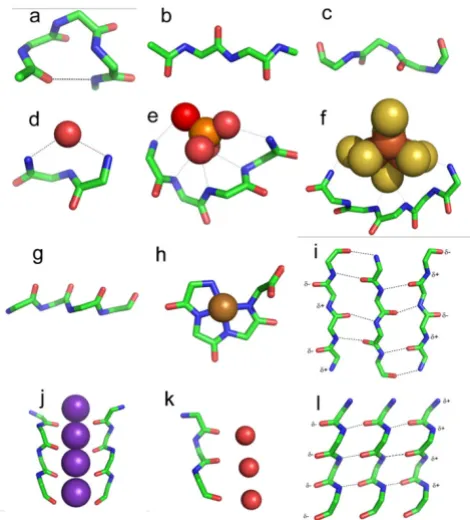
About two thirds of polypeptides in existing native folded proteins occur as α-helix, as in Fig 1a, or β-sheet, shown in Fig 1b. Native proteins also have a few percent of short pieces of polyproline type II helix (PPII; polypeptides with this conformation, in spite of the name, are not necessar-ily composed of prolines), as in Fig 1c. However, when it comes to unfolded native proteins, or to short polypep-tides, evidence [31] suggests that PPII is the most com-mon conformation. At first sight, it might seem likely that the earliest proteins would also tend to consist of PPII. However, the earliest peptides are expected to be made of mixtures of L and D amino acids [7]. In the same peptide, they would be incompatible with the chiral PPII helical structure. The same applies for chiral α-helix. This leads us to consider enantiomeric peptides, which tolerate, and can be favored by, such amino acid compositions.
b. Enantiomeric peptides
In regularly-repeating polypeptides the main chain con-formations of successive amino acids are the same, or at least roughly so. Polypeptides can also fold to form a dif-ferent type of structure where the main chain conforma-tions of successive amino acids are enantiomers (mirror images). The φ, ψ values of one amino acid (the φ, ψ tor-sion angles, measuring rotation about the N傼Cα and Cα傼C bonds, are major determinants of polypeptide con-formation) are equal to the φ, ψ values of its neighbour multiplied by -1. Such polypeptides [32,33] are achiral and without pitch, forming rings or chains, but not heli-ces, as in Figs 1d–g and 1j–l; they are expected to be favored by achiral or alternating racemic amino acids. This may be contrasted with the various chiral helices (strands of β-sheet are geometrically types of helix) observed in modern proteins with mainly chiral amino acids. Enantiomeric polypeptides occur as two kinds, nests and α-sheet, described below.
c. Nests
Nests are motifs made from 3–6 amino acid residues where successive main chain NH groups bind anionic atoms or groups [34-39]. One with 3 residues is shown in Fig 1d. Currently, 5–8% of residues in proteins belong to
nests [34,36]. Their residues have main chain φ, ψ confor-mations alternating between about -90°, 0° and +90°, 0°. In most nests an anionic atom or molecule is firmly hydrogen bonded to the NH groups of residues i and i+2 and less strongly or hardly at all to the i+1 NH group, which often points slightly away. In typical present day nests glycine is preferred at alternating residues resulting in a conformation where the anion is partially encircled. This is because glycines are achiral, and can adopt the φ = 90°, ψ = 0° conformation favoured by D-amino acids equally with the φ = -90°, ψ = 0° one favoured by L-amino acids, i.e., they can behave like the D enantiomer. As gly-cine was probably the main amino acid generated within the hydrothermal reactor [40], it is likely nests were more abundant in early peptides than in present day proteins. But equally the synthesis of alternating L-amino acid/gly-cine, D-amino acid/glycine or L-amino acid/D-amino
Polypeptide conformations Figure 1
Polypeptide conformations. Stick pictures show main chain atoms of polypeptides; side chains are omitted; colors: carbon, green; oxygen, red; iron, rust; nitrogen blue; phos-phorus, orange; sulphur, yellow; nickel, brown; potassium, purple. a) α-helix b) β-strand, as in i c) polyproline type II helix d) RL nest e) phosphate bound to LRLR nest f) Fe3S4
acid peptides [41] in the mound would give rise to nest conformations with anion binding capacity.
The clue as to how inorganic phosphate was first ligated is given by the P-loop, the commonest and best known of the protein motifs that bind ATP/ADP or GTP/GDP [12], occurring in a wide variety of intracellular enzymes. It has been referred to as a giant anion hole [13] and has a char-acteristic GxxxxGKS/T consensus sequence [34]. Fig 1e shows that the P-loop has a nest incorporated within it made from five successive main chain NH groups which wrap around the β-phosphate of the nucleotide phate ligand, forming hydrogen bonds with the phos-phate oxygen atoms. It seems probable that, in the earliest proteins, nests formed binding sites for the anionic groups of polyphosphate and acetyl phosphate (for immediate energy provision) and nucleoside polyphos-phate (later, for coenzyme and RNA synthesis).
In about a half of all current protein 3D structures with iron-sulfur centres, nests with between 3 to 6 adjacent main chain NH groups are employed to help bind the Fe2S2 or Fe4S4 centres [34]. One is illustrated in Fig 1f. Like
the P-loop, these features could also be evolutionary rel-ics. Centers bound to two separate nests are not unusual. Fig 1c shows a cubane iron-sulfur center in the protein ferredoxin bound by a 6 amino acid nest. Most iron-sulfur centres are bound by cysteine thiol groups. In the earliest stages of evolution it seems probable the places of the cysteine thiol groups were occupied by organic sulphides from the hydrothermal fluid [11,42], and that cysteine binding was a later development. Nanocrystals of FeS are assembled from [2Fe-2S] rhombs [14]. The first step in growth to a potential active center is the formation of [Fe2S2] and [Fe4S4] clusters. At this stage hydrothermal thi-ols (RS-) tend to inhibit further growth as they sequester the rhombs as [Fe2S2(SR)4]1-/2- and the cubanes as
[Fe4S4(SR)4]2-/3- in what may be termed
"protoferredox-ins" [11,43]. The sulfur atoms confer an overall negative charge to the complexes, complementing the δ+ on the NH hydrogen atoms of the nests. It seems likely nickel-bearing FeS clusters are sequestered similarly.
d. Amyloid
Amyloid is the name given to characteristic insoluble teinaceous fibres that are resistant to detergents and pro-teases. Amyloid is thought to be the primary cause of many diseases, called amyloidoses, including Alzhe-imer's, Parkinsons', Type II diabetes and CJD. The amy-loid of prions, as in CJD, is special in being highly infective because their fibres propagate as well as being self-templating [44]. In each of these diseases, a particular protein slowly becomes converted into amyloid, giving rise to the typical late onset condition. It appears, how-ever, that amyloid is more than an aberrant form of
cer-tain proteins produced in diseases but rather a major alternative form of most, if not all, proteins. A few native proteins do form amyloid naturally for functional rea-sons, such as some spider silk and bacterial surface fibrils, but these are the exception. The majority of native pro-teins fold to form complex, but well defined and soluble, three-dimensional structures often with α-helices and rel-atively small clumps of β-sheet (1–4 sheets, each clump having only 10–300 amino acids). However, most of these proteins left in aquaeous solution away from organ-isms eventually turn into amyloid. It seems that evolu-tionary pressure has ensured the majority of native proteins produced in organisms avoid turning into amy-loid in vivo.
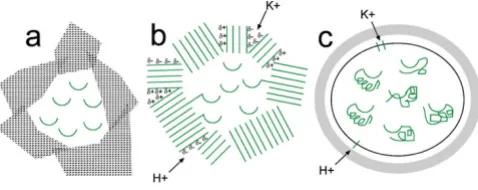
The insoluble fibres of mature amyloid are thought to consist of stacks of say hundreds of β-sheets each with hundreds of long β-strands. Its size differentiates it from the β-sheet of soluble proteins. A small portion of a β -sheet is in Fig 1i. Current work [45,46] favours parallel β -sheet, with the in-register strands perpendicular to the fibre axis. A feature making amyloid specially suitable in early evolution was shown [47] by randomly shuffling yeast prion domains and finding they still form amyloid. It seems the amino acid composition rather than the sequence is all that is needed to form amyloid. Amyloid three-dimensional structure is simpler than the compli-cated arrangements of native proteins, yet, because it is sticky and does not crystallise easily, precise knowledge about its structure has been difficult to gather and still presents problems for scientists. However, in early evolu-tion this stickiness of amyloid is likely to have been useful in forming protective insulating layers, so is a plausible candidate for the material of the first proper organic mem-branes, as has been suggested [48-50]. This idea is illus-trated in Fig 2b.
e. α-sheet
Certain short, non-native, polypeptides form a substance called α-sheet [51-54]. Conformationally, a single polypeptide chain of it is another example of an enantio-meric polypeptide and, as seen in Fig 1g, looks like a flat-tened version of the nest. Typical φ, ψ angles are 60°, -60°; 60°, 60°. Like nests, polypeptides consisting of reg-ularly-repeating D and L amino acids favour this confor-mation. Multiple-stranded α-sheet resembles β-sheet, except that it is polar. One edge has a row of δ- charges, and the opposite edge has a row of δ+ charges, as in Fig 1l.
native proteins, peptide plane flipping of this sort occurs commonly [56], providing support for this amyloid for-mation pathway. The special charge distribution men-tioned may underlie its toxicity on the one hand and its ability to polymerize on the other.
The rarity of α-sheet in native proteins compared to its rel-ative stability and ease of formation in small polypeptides is striking. In any case, from the expected φ, ψ angles it would be expected to be more common than it is in native proteins. This apparent anomaly could be explained [56,57,45] by it being so toxic as an amyloid precursor that natural selection has eliminated most proteins that form α-sheet. Overall, whether or not α-sheet does prove to be the main precursor to amyloid, it seems likely it was a common conformation of the earliest peptides.
f. Cation, proton and water channels
One problem when considering the nature of early mem-branes is that the constituent materials are either too per-meable or too imperper-meable to ions and water molecules. What is needed is a semi-permeable membrane, the tradi-tional name for the plasma membranes of existing living cells.
Although α-sheet with hydrogen bonds between strands is rare in native proteins in their natural state, polypeptides with the same conformation but not arranged as α-sheet do occur in some integral membrane proteins. A group of
four strands four amino acids long line the selectivity filter of the potassium channel such that the main chain carbo-nyl oxygen atoms form a cation channel [58,59], as shown in Fig 1j. A feature of this sort between blocks of α -sheet as in Fig 3a might have been used for cation trans-port early in evolution. In the water-transtrans-porting protein aquaporin a single strand with the same conformation lines one side of its water channel [60]. The row of main chain carbonyl oxygen atoms in this strand binds the δ+ protons of a corresponding row of water molecules in the channel, as in Fig 1k. Such channels can transport either protons (via a so-called proton wire) or water molecules, depending on the organisation. Aquaporin has two appar-ently similar but opposing channels arranged head to head such that water, rather than proton, transport is favored.
These observations, deriving from the polarity of α-sheet, lead to the idea that the edges of randomly arranged blocks of otherwise impermeable α-sheet would be likely to spontaneously form either proton, water or cation channels. In a membrane α-sheet has to be in one polarity or the other. Blocks of sheet that grow independently may happen to meet another block so that the electrostatic interaction between them, δ+ to δ-, is favorable. In this case they combine to form a larger sheet as in Fig 3b. However, if they meet in the δ- to δ- orientation, a poten-tial cation channel is formed as in Fig 3a, whereas, if they meet side-on as in Fig 3c, a proton or water channel is lia-ble to be formed. These effects are also indicated in Fig 2b.
g. Metal-peptide amide nitrogen complexes
Copper, nickel, cobalt and iron cations readily complex with peptides in alkaline solutions by binding to succes-sive main chain amide nitrogen atoms [61]. Amide NH protons are displaced by the metal during the formation of these tight complexes in which the main chain atoms adopt a flat conformation (φ = 180°, ψ = 0°), as in Fig 1h. Such complexes, with up to four amide protons substi-tuted by metals, also occur naturally within a number of native proteins (prion protein of CJD) and enzymes (acetyl CoA synthase), sometimes at active sites. The Ni-tetraglycine complex of Fig 1h[62] exhibits a remarkable similarity to present day macrocyclic tetrapyrrole cofac-tors. Also the analogous Co-tetraglycine resembles a corri-noid group. In these types of complex the metal has octahedral coordination to four planar nitrogens with two positions free to assist in catalytic reactions. The peptide ones could thus have performed much the same catalytic functions as hemes, corrinoids and F430, before being largely, but not entirely, superceded by them. Coenzyme F430 is a nickel tetrapyrrole with the ability to bind and reduce methyl groups. As such it is an essential cofactor in two enzymes in the methanogenic branch of the acetyl-coenzyme A pathway, considered to be one of the earliest
A scheme for cell evolution Figure 2
A scheme for cell evolution. Polypeptides are in green. a)
pathways at the origin of life [63,64]. The simpler, ace-togenic branch of the acetyl coenzyme-A pathway involves an iron-sulfur protein with a corrinoid cofactor – a cobalt-tetrapyrrole – that transfers a methyl group to acetyl coenzyme-A synthetase [64-66].
Conformations for protoenzymes and
membranes
Table 1 summarizes the frequencies we expect, providing comparisons with conformations of native and unfolded present-day proteins. Three conformations, amyloid β -sheet, α-sheet and nests are predicted to be the common-est in early evolution, while structures where amino acids are markedly of one chirality, such as PPII and α-helix, would have been less common then than now.
An important function of the β-sheet of mature amyloid is proposed to be the coating, and partially clogging up, of pores in the submarine mineral chambers. Such sticky amyloid peptides would have constituted the beginnings of a cell membrane, combining both strength as in a cell wall and impermeability as in a cell membrane. That some kind of peptidic membrane encapsulated early microbes is suggested by the fact that the biosynthesis of the fatty acid ester membranes of the bacteria and of the isoprenoid ether membrane of the archaea clearly post-dated the differentiation of these two domains [67,68,5].
E. coli can produce extracellular fimbriae-like amyloidal structures [69]. These polymers colonize inert surfaces by forming biofilms. The filaments grow by addition of mon-omers to their free growing ends [70,71]. If amyloid formed the earliest membranes, which were then super-ceded by phospholipid ones, it is not unexpected that amyloid would interfere with phoshopholipid mem-branes in some way as indeed it does.
Another in the common category is α-sheet, an enantio-meric structure, which is observed in short polypeptides [52,54], though not in those found in vivo. α-sheet is sug-gested to be the precursor to amyloid by forming readily from unfolded peptides and converting directly into the mature β-sheet form. Given that amyloid is difficult to study by crystallography, there is a lack of biophysical techniques that reliably distinguish α- and β-sheet [54]. Indeed they may continuously interconvert. Another point about α-sheet is that the edges of this material might naturally form cation, proton or water channels through membranes. Amyloidogenic aggregates readily bind to biological and artificial phospholipid membranes [72]. They can insert themselves into the membranes altering their fluidity, and also giving rise to ion channels, result-ing, it is thought, in cell toxicity [57,73]. It should be reit-erated that the beguiling idea that α-sheet is the material of the prefibrillar intermediate responsible for such alter-ations to membranes is not yet generally accepted, but the effects of what may be an earlier type of membrane, what-ever its molecular nature, on present-day membranes are clearly of interest.
Nests are are useful for ligand-binding, particularly phos-phate groups and iron-sulfur centers. On the early Earth the polymerization of inorganic phosphate would have been important to the energetics of the first cells. The pre-cursor molecules of metabolism, viz., the transition metal sulfide thiolates, the phosphates (CH3OPO32-, HP
2O7
3-and HPO42-), and also short achiral peptides, would be
retained within the metal sulfide compartments as in Fig 2a. Another peptide conformation, which, though not necessarily quantitatively large, could have been critical, are the (Fe, Ni, Co)-peptide complexes described earlier as
Arrangements of α-sheet blocks Figure 3
these would have provided many of the catalytic and binding functions of present-day tetrapyrroles.
Nests, collecting on the inner walls of the initially inor-ganic membrane, would have spaced and insulated the active [4Fe-4S]-centers at the distances of several Å suita-ble for the storage and transfer of electrons. Pyro- and acetyl-phosphate could also be retained within the mem-brane to act as phosphorylating and/or condensing agents. In the absence of nests, active catalytic metal sulfide and pyrophosphate sites would loose their activi-ties on hydration and/or ripening through a nanocrystal-line stage. Crystalnanocrystal-line precipitates typical of hydrothermal ore deposits [cf. [74]] would result. Alternatively they would dissolve as pH dropped in the membrane. Nests would also alter electrochemical properties by stabilizing the reduced, more than the oxidized, forms of iron-sulfur centers and thereby reduce the Eh values of these protoen-zymes.
Conclusion
We have considered, given that glycine-rich and otherwise heterochiral peptides emerged at an early stage in evolu-tion, what polypeptide conformations might have pre-dominated and with what functional effects. Current knowledge about protein and peptide 3D structure indi-cates that such peptides naturally form themselves under the prevailing conditions into nest, α-sheet, amyloid and metal-peptide structures, but less often into α-helix and polyproline type II helices. Enantiomeric structures are favored at the expense of helical conformations. The evo-lution scenario goes thus: Starting from a largely inorganic world, the organic products of an Fe(Ni)S protometabo-lism, developing in a submarine hydrothermal reactor, complicate the system in such a way as to enhance its effi-ciency. Acetate is considered the most likely initial prod-uct of metabolism, with amino acids and some peptide being uncommon by-products at first.
The percentage conversion of acetate from reactants CO2, HCOO- and H
2 is low because most of the metal sulfide
had low catalytic activity. However, once significant amounts of short peptides appear the situation changes. The ability to bind and stabilise these catalysts improves the efficiency of acetate and amino acid production. There is now a virtuous circle: peptides promote Fe(Ni)S nano-clusters which in turn catalyse amino acid and peptide synthesis. In the absence of the protection offered by nests, metal sulfide and pyrophosphate clusters lose their activities on hydration, dissolution or by ripening through a nanocrystalline stage to crystalline precipitates with the relatively low surface-to-volume ratios typical of hydrothermal minerals. Metal-peptides also form, provid-ing primitive tetrapyrrole-like groups useful for other sorts of catalysis. Next, the peptides form into sticky blocks of
amyloid that clump together. Some of these clumps have spaces within them acting as cells, bounded by amyloid semi-permeable membranes as in Fig 2b. The membranes have pores within them that exert some control over the passage of cations and water, maintaining a more con-stant environment for the developing metabolisms. In later cells the membrane functions are taken over by membranes of phospholipid or etherlipids plus cell walls, as in Fig 2c, although key parts of the old channels remain incorporated in the ion transporters and aquaporins. Amyloid, because it interferes with the new membranes, is largely eliminated by evolution, except for a few special-ized purposes, though it continues to threaten aged organ-isms, to which the selection process hardly applies, with ailments such as Alzheimer's. The functions of metal-pep-tides are taken over by tetrapyrroles. Nests, on the other hand, become embedded within proteins. Phosphate-binding P-loops and loops of some iron-sulfur Phosphate-binding proteins retain the traces of their previous existence.
Competing interests
The author(s) declare that they have no competing inter-ests.
Reviewers' comments
Bill Martin
This is an interesting paper pointing out the possible types of interactions that could have taken place between short heterochiral peptides and inorganic catalysts during chemical evolution. It makes several novel and worth-while points.
Eugene Koonin
The biggest remaining question is how did the transition from the abiogenic, enantyomeric was brought about. Recently, we outlined a scenario under which the utility of amino acid and peptides in the emerging biological sys-tems drove the evolution of translation, through the inter-mediate stage of peptide ligases (Wolf, Koonin, On the origin of the translation system and the genetic code in the RNA world by means of natural selection, exaptation, and subfunctionalization. Biol Direct 2007 May 31;2:14). I believe that, at least, conceptually, this line of thinking about the origin of life is remarkably well compatible with the ideas on the role of abiogenic peptides in primordial biochemistry developed by Milner-White and Russell. Perhaps, this connection could be briefly discussed in the paper.
Nick Grishin
In a somewhat unusual review, the authors discuss poten-tial conformations of ancient pre-biotic peptides and present hypotheses about their possible interactions and functions. While nothing in the manuscript contradicts the main principles of physics and evolution, I am left with a mixed feeling. Why would the conformation of early peptides (obviously prebiotic, since they are DL mixes) be of interest when we are not sure whether the hypothesis about the importance of pre-biotic peptides has any merit? We know that chemical, pre-biotic peptide formation is not an easy process (e.g. experimental papers the authors cite), so there is no basis to believe that polypeptides of reasonable length were any abundant, and that they have played a significant role early on in prebiotic evolution. It is equally not clear why regular DLDLDL mixtures should form in pre-biotic conditions. Thus, it seems to me that prior to addressing the question about conformations, it would be nice to discuss these questions. The hypothesis that polypeptides were rare and not significance in prebiotic evolution makes better sense to me. The fact that peptides are so common and impor-tant today, does not imply that they were significant early on. In any case, this is such an imprecise area of research, that it would be good to describe any alternative scenarios and potential pitfalls, other hypotheses and rationaliza-tions. Presentation of these alternatives would make for a more interesting reading.
Acknowledgements
MJR's research was carried out at the Jet Propulsion Laboratory, California Institute of Technology, under a contract with the National Aeronautics and Space Administration.
References
1. Koonin E, Martin W: On the origin of genomes and cellls within inorganic compartments. Trends Genet 2005, 21:647-654. 2. Wolf YI, Koonin EV: On the origin of the translation system
and the genetic code in the RNA world by means of natural selection, exaptation and subfunctionalization. Biol Direct
2007, 2:14.
3. Russell MJ, Hall AJ: The emergence of life from iron monosul-phide bubbles at a submarine hydrothermal redox and pH front. J Geol Soc Lond 1997, 154:377-402.
4. Russell MJ, Hall AJ: The onset and early evolution of life. Evolu-tion of Early Earth's Atmosphere, Hydrosphere, and Biosphere – Constraints from Ore Deposits, Geological Society of America, Memoir 2006,
198:1-32.
5. Martin W, Russell MJ: On the origin of cells: An hypothesis for the evolutionary transitions from abiotic geochemistry to chemoautotrophic prokaryotes, and from prokaryotes to nucleated cells. Phil Trans R Soc Lond Ser B 2003, 358:27-85. 6. Martin W, Russell MJ: On the origin of biochemistry at an
alka-line hydrothermal vent. Phil Trans R Soc Lond (Ser B) 2007,
362:1887-1925.
7. Huber C, Wächtershäuser G: Peptides by activation of amino acids on (Fe, Ni)S surfaces: Implications for the origin of life.
Science 1998, 281:670-672.
8. Huber C, Wächtershäuser G: Primordial reductive amination revisited. Tetrahed Lett 2003, 44:1695-1697.
9. Baaske P, Weinert FM, Duhr S, Lemke KH, Russell MJ, Braun D:
Extreme accummulation of nucleotides in simulated hydro-thermal pore systems. Proc Nat Acad Sci USA 2007,
104:9346-9351.
10. Milner-White EJ, Russell MJ: Nests as sites for phosphates and iron-sulfur thiolates in the first membranes: 3 to 6 residue anion-binding motifs. Origins Life Evol Bios 2005, 35:19-27. 11. Bonomi F, Werth MK, Kurtz DM: Assembly of FenSn(SR)2- (n = 2,
4) in aqueous media from iron salts, thiols and sulfur, sulfide, thiosulfide plus rhodonase. Inorg Chem 1985, 24:4331-4335. 12. Via A, Ferre F, Brannetti B, Valencia A, Hemer-Citterich M:
Three-dimensional view of the surface motif associated with the P-loop Structure. J Mol Biol 2000, 303:45-465.
13. Dreusicke D, Schulz GE: The glycine-rich loop of adenylate kinase forms a giant anion hole. FEBS Lett 1986, 208:301-304. 14. Wolthers M, Van der Gaast SJ, Rickard D: The structure of
disor-dered mackinawite. Am Mineral 2003, 88:2007-2015.
15. Filtness MJ, Butler IB, Rickard D: The origin of life: The proper-ties of iron sulphide membranes. Trans Inst Min Metal Appl Earth Science 2003, 112B:171-172.
16. Russell MJ: On the importance of being alkaline. Science 2003,
302:580-581.
17. Rickard D, Luther GW: Chemistry of iron sulfides. Chem Rev
2007, 107:514-562.
18. Leman L, Orgel L, Ghadiri MR: Carbonyl sulfide-mediated preb-iotic formation of peptides. Science 2004, 306:283-286. 19. Rhodes C, Riddel SA, West J, Williams BP, Hutchings GJ: The
low-temperature hydrolysis of carbonyl sulfide and carbon disulfide: a review. Catalysis Today 2000, 59:443-464.
20. Baltscheffsky M, Baltscheffsky H: Inorganic pyrophosphate and inorganic pyrophosphatases. Molecular Mechanisms in Bioenerget-ics 1992:331-348.
21. de Zwart II, Meade SJ, Pratt AJ: Biomimetic phosphoryl transfer catalyzed by iron(II)-mineral precipitates. Geochim Cosmochim Acta 2004, 68:4093-4098.
22. Cody GD, Boctor NZ, Filley TR, Hazen RM, Scott JH, Sharma A, Yoder HS: Primordial carbonylated iron-sulfur compounds and the synthesis of pyruvate. Science 2000, 289:1337-1340. 23. Huber C, Eisenreich W, Hecht S, Wächtershäuser G: A possible
primordial peptide cycle. Science 2003, 301:938-940.
24. Palandri JL, Reed MH: Geochemical models of metasomatism in ultramafic systems: Serpentinization, rodingitization, and sea floor carbonate chimney precipitation. Geochim Cosmochim Acta 2004, 68:1115-1133.
25. Bach W, Paulick H, Garrido CJ, Ildefonse B, Meurer WP, Humphris SE: Unraveling the sequence of serpentinization reactions: petrography, mineral chemistry, and petrophysics of serpen-tinites from MAR 15°N (ODP Leg 209, Site 1274). Geophys Res Lett 2006, 33:L13306. doi:101029/2006GL025681.
26. Imai E, Honda H, Hatori K, Brack A, Matsuno K: Elongation of oli-gopeptides in a simulated submarine hydrothermal system.
Science 1999, 283:831-833.
27. Ferris JP, Hill AR, Liu R, Orgel LE: Synthesis of long prebiotic oli-gomers on mineral surfaces. Nature 1996, 381:59-61. 28. Marteinsson VTh, Kristjánsson JK, Kristmannsdöttir H, Dahlkvist M,
Eyjafjor-dur, Northern Iceland, and a novel thermal microbial habi-tat. Appl Environ Microbiol 2001, 67:827-833.
29. Ohara S, Kakegawa T, Nakazawa H: Pressure effects on the abi-otic polymerization of glycine. Origins Life Evol Bios 2007,
37:215-223.
30. Uversky VN: Natively unfolded proteins: Where biology waits for physics. Protein Science 2002, 11:739-756.
31. Shi Z, Chen K, Liu Z, Kallenbach NR: Conformation of unfolded proteins. Chem Rev 2004, 106:1877-1897.
32. Milner-White EJ, Watson JD, Qi G, Hayward S: Amyloid formation may involve α- to β-sheet interconversion via peptide plane flipping. Structure 2006, 14:1369-1376.
33. Ranbhor R, Ramakrishnan V, Kumar A, Durani S: The interplay of sequence and stereochemistry in defining conformation in proteins and polypeptides. Biopolymers 2006, 83:537-545. 34. Watson JD, Milner-White EJ: A novel main chain anion binding
site in proteins: the nest. A particular combination of φ, ψ angles in successive residues gives rise to anion-binding sites that occur commonly and are found often at functionally important regions. J Mol Biol 2002, 315:199-207.
35. Watson JD, Milner-White EJ: The conformations of polypeptide chains where the φ, ψ values of alternating residues are enan-tiomeric. Their occurrence in cation and anion binding regions of proteins. J Mol Biol 2002, 315:187-198.
36. Pal D, Sühnel J, Weiss MS: New principles of protein structure: Nests, eggs and then what? Angew Chemie 2002, 41:4663-4665. 37. Pajewski R, Ferdani R, Pajewska J, Li R, Gokel W: Cation
depend-ance of chloride ion complexation by open-chained receptor molecules. J Am Chem Soc 2005, 127:18281-18295.
38. Berkessel A, Koch B, Toniolo C, Rainaldi M, Broxterman QB, Kaptein B: Asymmetric enone epoxidation by solid phase bound pep-tides: further evidence for catalyst helicity and catalytic activity of individual strands. Biopolymers 2006, 84:90-96. 39. Hirsch AK, Fischer FR, Diederich F: Phosphate recognition in
structural biology. Angew Chem Int Ed 2007, 46:338-352. 40. Hennet RJ-C, Holm NG, Engel MH: Abiotic synthesis of amino
acids under hydrothermal conditions and the origin of life: A perpetual phenomenon? Naturwissens 1992, 79:361-365. 41. Milner-White EJ, Nissink WM, Allen FH, Duddy WJ: Recurring
main chain anion-binding motifs in short polypeptides. Acta Cryst 2004, D60:1935-1942.
42. Heinen W, Lauwers AM: Organic sulfur compounds resulting from the interaction of iron sulfide, hydrogen sulfide and car-bon dioxide in an anaerobic aqueous environment. Origins Life Evol Bios 1996, 26:131-150.
43. Stevens WC, Kurtz DM: Assembly of [FenSn(SPh)4]2- (n = 2,4) and their iron-thiolate precursors in aqueous media. J Am Chem Soc 1985, 24:3444-3449.
44. Tessier PM, Lindquist S: Prion recognition elements govern nucleation, strain specificity and species barriers. Nature
2007, 447:556-561.
45. Chiti F, Dobson CM: Protein misfolding, functional amyloid and human disease. Adv Prot Chem 2006, 75:333-366.
46. Nelson R, Eisenberg D: Structural models of amyloid-like fibrils.
Adv Prot Chem 2006, 73:235-282.
47. Ross ED, Minton A, Wickner RB: Prion domains: sequences, structures and interactions. Nature Cell Biology 2005,
7:1039-1044.
48. Zhang S, Holmes T, Lockshin C, Rich A: Spontaneous assembly of a self-complimentary oligopeptide to form a stable macro-scopic membrane. Proc Natl Acad Sci USA 1993, 90:3334-3338. 49. Chernoff YO: Amyloidogenic domains, prions and structural
inheritance: Rudiments of early life or recent acquisition?
Curr Opin Chem Biol 2004, 8:665-671.
50. Carny O, Gazit E: A model for the role of short self-assembed peptides in the very early stages of the origin of life. FASEB J
2005, 19:1051-1055.
51. Heitz F, Detriche G, Vovelle F, Spach G: Sheet Structures in Alternating Poly(D, L-Peptides). Macromolecules 1981,
14:47-50.
52. Diblasio B, Saviano M, Fattorusso R, Lombardi A, Pedone C, Valle V, Lorenzi GP: A Crystal-Structure with features of an antiparal-lel alpha-pleated sheet. Biopolymers 1994, 34:1463-1468. 53. Di Simone G, Lombardi A, Galdiero S, Nastri F, Di Costanzo L,
Gohda S, Sano A, Yamada T, Pavone V: The crystal structure of a Dcp-containing peptide. Biopolymers 2000, 53:182-188.
54. Daggett V: Alpha-sheet: The toxic conformer in amyloid dis-eases? Acc Chem Res 2006, 39:594-602.
55. Armen RS, Alonso DOV, Daggett V: Anatomy of an amyloidog-enic intermediate: Conversion of β-sheet to α-sheet in tran-sthyretin. Structure 2004, 12:1847-1863.
56. Dobson CM: Protein misfolding, evolution and disease. Trends Biochem Sci 1999, 24:329-332.
57. Stefani M, Dobson CM: Protein aggregation and aggregate tox-icity: new insights into protein folding, misfolding diseases and biological evolution. J Mol Med 2003, 81:678-699.
58. Doyle DA, Cabral JM, Pfuetzner RA, Kuo A, Gulbis JM, Cohen SL, Chait BT, MacKinnon R: The structure of the potassium chan-nel: Molecular basis of K+-conduction and selectivity. Science
1998, 280:69-77.
59. Jiang Y, Lee A, Chen J, Cadene M, Chait BT, MacKinnon R: Crystal structure and mechanism of a calcium-gated potassium channel. Nature 2002, 417:515-522.
60. Sui H, Han B.-G, Lee JK, Wallan P, Jap BK: Structural basis of water-specific transport through the AQP1 water channel.
Nature 2001, 414:872-878.
61. Harford C, Sarkar B: Amino terminal Cu(II) and Ni(II) binding ATCUN motif of proteins and peptides. Acc Chem Res 1999,
30:123-130.
62. Freeman HC, Taylor MR: Crystallographic studies of metal pep-tide complexes III Disodium glycylglycylglycylglycino cuprate decahydrate. Acta Cryst 1965, 18:939-952.
63. Ermler U, Grabarse W, Shima S, Goubeaud M, Thauer RK: Crystal structure of methyl-coenzyme M reductase: the key enzyme of biological methane formation. Science 1997, 278:1457-1462. 64. Thauer RK: Biochemistry of methanogenesis. Microbiology 1998,
144:2377-2406.
65. Darnault C, Volbeda A, Kim EJ, Legrand P, Vernède X, Lindahl PA, Fontecilla-Camps JC: Ni-Zn-[Fe4-S4] and Ni-Ni-[Fe4-S4] clus-ters in closed and open a subunits of acetyl-CoA synthase/ carbon monoxide dehydrogenase. Nature Struc Biol 2003,
10:271-279.
66. Müller V: Energy conservation in acetogenic bacteria. App Envi-ron Microbiol 2003, 69:6345-6353.
67. Kates M: The phytanyl ether-linked polar lipids and isopre-noid neutral lipids of extremely halophilic bacteria. Prog Chem Fats Other Lipids 1979, 15:301-342.
68. Kandler O: The early diversification of life and the origin of the three domains: a proposal. In Thermophiles: the keys to molec-ular evolution and the origin of life Edited by: Wiegel J, Adams MWW. Washington DC: Taylor & Francis; 1998:19-31.
69. Chapman MR, Robinson LS, Pinkner JS, Roth R, Heuser J, Hammar M, Normark S, Hultgren SJ: Role of Escherichia coli Curli Operons in Directing Amyloid Fiber Formation. Science 2002,
295:851-855.
70. Hammar M, Bian Z, Normark S: Nucleator-dependent intercel-lular assembly of adhesive curli organelles in Escherichia coli.
Proc Natl Acad Sci USA 1996, 93:6562-6566.
71. Wang X, Smith DR, Jones JW, Chapman MR: In vitro polymeriza-tion of a funcpolymeriza-tional E coli amyloid protein. J Biol Chem 2007,
282:3713-3719.
72. Hou X, Richardson S, Aguilar M-I, Small DH: Binding of amyloidog-enic transthyretin to the plasma membrane alters mem-brane fluidity and induces neurotoxicity. Biochemistry 2005,
44:11618-11627.
73. Caughey B, Lansbury P: Protofibrils, pores, fibrils and neurode-generation: Separating the responsible protein aggregates from the innocent bystanders. Ann Rev Neurosci 2003,
26:267-298.