Introduction
Vitamin C is a common name of L-ascorbic acid (AsA) that derived from a six-carbon sugar (L-threo-hex-2-enono-1,4-lactone).1 Vitamin C is a water-soluble antioxidant that has a predominantly protective role and acts as a cofactor in the synthesis of carnitine and collagen requirement of cardiovascular function, repair, and maintenance of cartilage, bone, and teeth. It also acts as an important component of the skin, scar tissue, tendons, ligaments and blood vessels, as well as the development of immune cells and iron absorption, and is necessary for healing. Human beings with other primates, bats, and guinea pigs aren’t able to synthesize it, so they have to obtain through food sources.2,3 As vitamin C is soluble in water, it would easily dispose of the body and is not stored. Therefore, it must be supplied by food sources.
Although we can obtain vitamin C from fresh meat, it degrades by warming the meat and usually vitamin C
provided from plant sources. There is a high level of vitamin C in vegetables and fruits while usually seeds and dry seeds have a low level of vitamin C.2,4
The Smirnov-Wheeler pathway is one of the most important pathways for ASA biosynthesis in plants which consists of GDP-D-mannose and contains L-galactose arrangement.5 GDP-L-galactose phosphorylase (GGP) enzyme is responsible for conversion of GDP-L-galactose to L-galactose-1-P in the first step of the Smirnov-Wheeler pathway in plants. This enzyme is coded by GGP and also called VTC2, knows as first regularly point in vitamin C pathway (Figure 1).
In this regard, over-expression of GGP in plants can significantly increase the concentration of ascorbate in the tissues.6,7 In order to increase vitamin C, GGP gene was isolated from kiwi and transferred to the Arabidopsis plant As a result, increasing the expression of GGP gene increased the content of vitamin C in the Arabidopsis leaf up to
Isolation and Characterization of GDP-L-Galactose
Phosphorylase Gene of Vitamin C Biosynthesis Pathway
from Kiwi
Soraya Shiri1, Alireza Zebarjadi1*
1Campus of Agriculture and Natural Resources, Razi University, Kermanshah, Iran
Corresponding Author: Alireza Zebarjadi, PhD, Associate Professor, Campus of Agriculture and Natural Resources, Razi University, Kermanshah, Iran. Email: [email protected]
Copyright © 2018 The Author(s). This is an open-access article distributed under the terms of the Creative Commons Attribution License (http://
Abstract
Introduction: Vitamin C is a major antioxidant in plants and plays an important role in reducing the activity of reactive oxygen species. In humans, the main role of this molecule is the elimination of activity of active oxygen species along with being cofactor for many enzymes. Human is one of the few mammalian species that can not synthesize this vitamin and needs to get it through food sources. The GDP-L-galactose phosphorylase (GGP) gene is one of the most important genes in the biosynthetic pathway of vitamin C, which codes for the GDPL-galactose phosphorylase enzyme. Isolation of GGP gene is an important step in transferring it to elevate vitamin C biosynthesis in plants.
Materials and Methods: In current study, the isolation of this gene from kiwi plant was carried out and then was cloned in the pTG19-T plasmid via T/A cloning and subsequently sequenced to confirm it.
Results: Sequencing analysis of the GGP gene showed that this fragment contains 1383 bp and the start and stop codons were ATG and TGA, respectively. The bioinformatics analysis of this gene can provide important information on gene and protein structure. The alignment of cloned sequence was done with other Actinidia DNA sequences. The results based on neighbor-joining alignment showed that some of the mutations in nucleotides were related to the third nucleotide in a specific codon. Also, the minimum distance of protein sequences was observed between isolated GGP and Actinidia chinensis.
Conclusions: Based on analyses, isolated gene (GGP) can be used for increase vitamin C content in other plants such as cucumber and for resistance to environmental stresses in different plants.
Keywords:Actinida deliciosa, GDP-L-galactose phosphorylase (GGP) gene, Kiwi, T/A cloning, Vitamin C
Citation: Shiri S, Zebarjadi A. Isolation and characterization of GDP-L-galactose phosphorylase gene of vitamin C biosynthesis pathway from Kiwi. J Appl Biotechnol Rep. 2018;5(2):59-63. doi:10.29252/jabr.05.02.04.
Received January 25, 2017; Revised March 10, 2018; Accepted April 5, 2018; Online Published June 20, 2018 J Appl Biotechnol Rep. 2018 June;5(2):59-63
Original Article
10.29252/jabr.05.02.04doi
Applied Biotechnology
Reports
4-folds.7 The purpose of this study was isolation, cloning and characterization of the gene encoding the GGP enzyme.
Materials and Methods
Experimental Reagents
T4 DNA ligase, Taq DNA polymerase, DNA restriction enzymes, One Step RT-PCR Master Mix, RNA extraction and DNA gel extraction kits were supplied from Ferments Company. The Escherichia coli DH5 <alpha> was used in all molecular biological experiments. Plasmid of pTG19 was used for cloning and sequencing.
RNA Isolation
Total RNA was isolated from Actinida deliciosa by RNA extraction RibospinTM Plant kit. Its quality and quantity were analyzed by gel electrophoresis and spectrophotometer, respectively. Total extracted RNA was used as template for Reverse transcription polymerase chain reaction (RT-PCR) reaction to make cDNA. The cDNA was used as template for PCR reaction for isolate GGP gene.
Primer Design and PCR Amplification
The GGP gene of A. deliciosa amplified by PCR using EX Taq DNA polymerase and specific primers GGPF: 5’ aga GGATCC actagt ATG ttg aag atc aag agg gtt c 3′ with a BamHI and SpeI site at the 5′ end (underlined) and GGPR: 5′ cat GAGCTC cacgtg TCA gtg ctg aac tag gca t 3′ with SacI and PmlI site at the 5′ end (underlined). These primers were synthesized based on the reported GGP gene sequences of kiwifruit available at NCBI (GenBank accession number: GU339036, KC146048.1, KC146049.1, EF379384.1).
Cloning and Sequencing
The PCR product was extracted by a DNA gel extraction kit (South Korea’s GeneAll Company’s DN kit) and ligated to
pTG19 plasmid with T4 DNA ligase and then transferred to competent cells of E. coli by means of heat shock method. For transformation 200 μL of competent cells and 20 μl of recombinant vector (pTG19 + Insert) were placed on ice for 30 minutes, followed by a heat shock at 37°C for 5 minutes and placed back on ice for 2 minutes. Then 1ml of LB medium without antibiotic was added and incubated at 37°C for 2 hours with 180 rpm agitation. The bacterial solution was separated on a selectable solid LB medium containing 100 mg l−1 ampicillin and incubated at 37°C for 16 hours for selection of recombinant bacteria. Molecular analyses (such as; colony PCR, digestion with restriction enzyme and sequencing) were performed to verify the presence of the distinct insert. Plasmid was purified for sequencing using the standard method.9 Sequencing was performed with M13F and T7 standard primers, using the capillary method with ABI system by Macro gene, Korea.
Ethical Considerations
This article does not contain any studies with human participants or animals performed by any of the authors.
Results
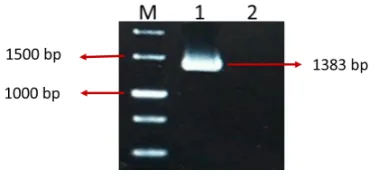
The GGP gene fragment (1383 bp) was obtained by PCR reaction via specific primers GGPF and GGPR (Figure 2). The GGP was cloned into the pTG19 plasmid. The positive colonies were confirmed by colony PCR, digestion with restriction enzymes (BamHI and SacI) and sequencing with M13F and T7 standard primers. Sequencing analysis of the
GGP gene showed that this fragment contains 1383 bp and the start and stop codons were ATG and TGA respectively (Figure 3).
Our sequence was submitted to NCBI server (https://www. ncbi.nlm.nih.gov) for blasting. Various GGP sequences (18 accession numbers) were extracted from GenBank. Four
sequences belonged to Actinidia (GU339036, KC146048.1, KC146049.1 and EF379384.1). After studying the available sequences in the NCBI data bank, 18 sequences were chosen based on the complete encoding sequence (Table 1).
The alignment of our sequence was done with other
Actinidia DNA sequences. The results based on Neighbor-Joining alignment showed that some of the mutations in nucleotides were related to the third nucleotide in a specific codon; in fact, with the nucleotide change, only codon usage changed and the amino acid remained unchanged. We see a change in the type of amino acid that is identified in yellow (Table 2).
Also, the nucleotide position number 745 that shown by R in NCBI bank had the high exchange rate of nucleotide.6
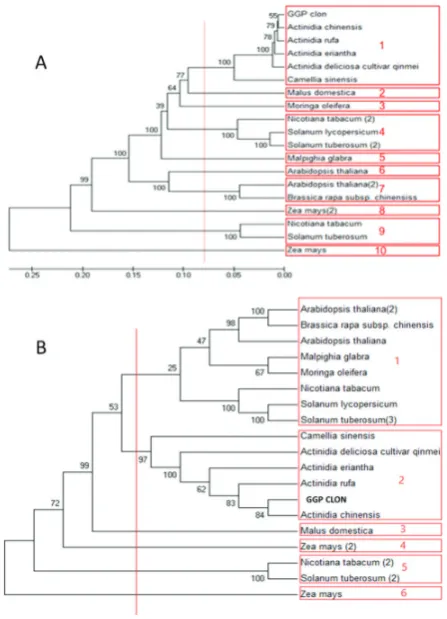
We used a web based translation tool(https://web.expasy. org/translate) for translating our sequence to protein sequence (Figure 3), then we aligned all 18 chosen protein sequences and our protein sequence by UPGMA method. The phylogenic tree showed that the 18 sequences were placed into six groups, our sequence and five of them (Actinidia deliciosa,
Actinidia eriantha, Actinidia rufa, Camellia sinensis, Actinidia chinensis), were located into a group (group 2). Also, the minimum distance of sequences was observed between GGP
CLON and Actinidia chinensis. The highest distance between
GGP CLON, Actinidia chinensis, Zea mays was observed (Figure 4).
After studying the reported sequences for GGP gene in NCBI, 18 sequences were chosen (Table 1) and they were aligned by the MEGA7 software and based on UPGMA method with our sequence the phylogenic tree was reconstructed (Figure 4). The Phylogenic tree showed that 18 sequences were placed into ten groups, our sequence and five of them (A. deliciosa,
A. rufa, A. chinensis, A. eriantha and C. sinensis) were located in the same group (group 1).
The studies showed that phylogenic trees (for DNA and protein) have different groups. Also, Zea mays, Zea mays(2)
and Malus domestica plants separately formed a group.
In the protein phylogenic tree, Moringa oleifera and
Malpighia glabra were grouped in one group that indicates, they have more similarity in protein sequences, despite the difference in their DNA sequences.
Discussion
In this research, the GGP gene was isolated from the cDNA of A. deliciosa and subcloned into pTG19-T vector for sequencing. Result of sequencing showed the cDNA of AcGGP
had a 1383 bp open reading frame (ORF). Whereas, Linster Figure 2.GGP Gene Amplification. M: DNA size Marker (1 Kb), PCR
amplification of this gene is shown in lane 1 and Negative control in lane 2.
Figure 3. Sequence Analysis of GGP Gene and Predicted Protein Sequence. A: DNA sequence with primers site, start and stop codons and restriction
enzyme sites. B: predicted protein sequence of GGP gene (https://web.
expasy.org/translate).
Table 1. Information Sequences Used for Alignment
Plant Gene bank Pro ID Plant Gene bank Pro ID
Our GGP Clone - - Arabidopsis thaliana AF508793.1 AAM34266.1
Actinidia deliciosa GU339036.1 ADB85572.1 Arabidopsis thaliana NM_124894.5 NP_200323.1
Actinidia rufa KC146048.1 AGO32051.1 Nicotiana tabacum NM_001324638.1 NP_001311567.1
Moringa oleifera AB924665.1 BAP76192.1 Nicotiana tabacum KJ808752.1 AII99836.1
Brassica rapa JN157614.1 AET14214.1 Actinidia eriantha KC146049.1 AGO32052.1
Camellia sinensis KC505203.1 AGI78464.1 Actinidia chinensis EF379384.1 ABP65665.1
Malpighia glabra EU683446.1 ACG75920.1 Solanum lycopersicum JQ517313.1 AFD54988.1
Malus domestica NM_001293885.1 NP_001280814.1 Zea mays EU966173.1 ACG38291.1
Solanum tuberosum NM_001288371.1 NP_001275300.1 Zea mays EU961505.1 ACG33623.1
Table2 . Mutation Point in all Actinidia Species
Nucleotide Number Clone GGP Actinidia deliciosa Actinidia rufa Actinidia eriantha Actinidia chinensis
33 T T T T C
60 C A C C G
75 T T T T C
129 G G A G G
159 T G T T A
181 G T G G T
190 C G C C G
196 A G A A G
220 T T C T T
228 A G G A A
234 C T T C T
276 T C C C C
312 G A A G A
337 C C C C T
387 C C T T C
423 T T T C T
473 A A A T A
492 C C C T C
507 T T T T G
586 C T C C C
587 G C G G G
608 A G A A A
669 A G G G G
708 C A C C C
723 T T T T A
744 G G A A A
745 G R G G G
747 T C T T T
756 T C T T T
765 G G A G G
770 C T C C C
819 T G T G T
821 C T T T T
865 T A T T T
888 C A C C C
889 G G A G G
916 G G G A G
961 C C C C T
963 T G T C T
972 C T C C C
978 G A G A G
984 C T C T C
987 C C C T C
999 G G G A G
1018 T T C T T
1020 C T C C C
1023 T G T G T
1099 G G C C G
1107 G G A G G
1164 C C T C C
1213 A G A A A
1227 G A G G G
1240 C C C G C
1255 G G G A G
1257 C T A C C
1258 A A A G A
1263 A T A T A
1271 G G A G G
1272 C T T T C
1273 A G G G A
1277 T A T T T
1279 G G A G G
1281 G A G G G
1301 G G G C G
1309 C T C C C
1311 A T A A A
1323 A G A A A
1326 G A G G G
et al isolated GGP gene (VTC2 which encodes a GDP-L-galactose phosphorylase) from cDNA of Arabidopsis thaliana
and then cloned in Champion pET100/D-Topo vector. They aligned A. thaliana VTC2 sequence (amino acids) with
Oriza sativa, Homo sapines, Caenorhabditis elegans and
Drosophila melanogaster.10 They found apparent orthologs in invertebrates, vertebrates and plants, including the VTC2
gene product of A. thaliana.10
In a research, the leaves of the M.oleifera used for RNA extraction and cDNA synthesis for isolation of partial GGP gene with primers that was designed based on the conserved amino acid sequences of plant AsA biosynthesis enzymes. The isolated gene was subcloned into the pGEM-T Easy vector and sequenced. Then the gene-specific primers were designed and used for 5’- and 3’-rapid amplification of cDNA ends (RACE) to determine full-length cDNA sequences for
Moringa GGP. The cDNA of MoGGP had a 1320 bp ORF that was predicted to encode a protein of 440 amino acids with a calculated molecular mass of 48963 Da.11 Primary structure analysis using the Conserved Domain Database (CDD) suggested that MoGGP contains a histidine triad motif found in A. thaliana GGP.11 Also they cloned and sequenced the
MoringaGGP form genomic sequence.11
In a study, Urzica et al reported that the L-galactose pathway of ascorbate biosynthesis described in higher plants is conserved in green algae. They characterized recombinant
Chlamydomonas reinhardtii VTC2 as an active GDP-L-galactose phosphorylase. The VTC2 cDNA was completely sequenced. It contains the entire predicted VTC2 open
Figure 4. DNA and protein phylogenic tree, A: DNA tree with 10 groups, B: protein tree with 6 groups (by UPGMA method).
reading frame, 1857 bp long, encoding a protein of 618 amino acids. BLASTp searches identified a VTC2 homolog in C. reinhardtii exhibits 46% amino acid sequence identity to A. thaliana VTC2.12
Conclusions
Finally, according to our results, isolated GGP gene is a key enzyme in the biosynthetic pathway of L-ascorbic acid and it can be used to express in different plants for increasing vitamin C content.
Authors’ Contributions
All authors contributed equally to this research.
Conflict of Interest Disclosures
The authors declare they have no conflicts of interest.
Acknowledgments
The authors would like to acknowledge all of their friends in the Department of Agronomy and Plant Breeding, Campus of Agriculture and Natural Resources, for their help. The financial support for this work was provided by the Razi University Grant No. 56747.
References
1. Cruz-Rus E, Amaya I, Valpuesta V. The challenge of increasing
vitamin C content in plant foods. Biotechnol J.
2012;7(9):1110-1121. doi:10.1002/biot.201200041.
2. Gallie DR. L-ascorbic Acid: a multifunctional molecule
supporting plant growth and development. Scientifica (Cairo).
2013;2013:795964. doi:10.1155/2013/795964.
3. Gallie DR. Increasing vitamin C content in plant foods to improve
their nutritional value-successes and challenges. Nutrients.
2013;5(9):3424-3446. doi:10.3390/nu5093424.
4. Hancock RD, Viola R. Biosynthesis and catabolism of L-ascorbic
acid in plants. Critical Reviews in Plant Sciences.
2005;24(3):167-188. doi:10.1080/07352680591002165.
5. Wheeler GL, Jones MA, Smirnoff N. The biosynthetic pathway of
vitamin C in higher plants. Nature. 1998;393(6683):365-369. doi:10.1038/30728.
6. Li M, Ma F, Liang D, Li J, Wang Y. Ascorbate biosynthesis during
early fruit development is the main reason for its accumulation
in kiwi. PLoS One. 2010;5(12):e14281. doi:10.1371/journal.
pone.0014281.
7. Bulley SM, Rassam M, Hoser D, et al. Gene expression studies in
kiwifruit and gene over-expression in Arabidopsis indicates that GDP-L-galactose guanyltransferase is a major control point of
vitamin C biosynthesis. J Exp Bot. 2009;60(3):765-778. doi:10.1093/
jxb/ern327.
8. Venkatesh J, Park SW. Role of L-ascorbate in alleviating abiotic
stresses in crop plants. Bot Stud. 2014;55(1):38. doi:
10.1186/1999-3110-55-38.
9. Sambrook JR, Russell DW. Molecular cloning: a laboratory manual.
Q Rev Biol. 2001;76:348-349.
10. Linster CL, Gomez TA, Christensen KC, et al. Arabidopsis VTC2 encodes a GDP-L-galactose phosphorylase, the last unknown enzyme in the Smirnoff-Wheeler pathway to ascorbic acid in
plants. J Biol Chem. 2007;282(26):18879-18885. doi:10.1074/jbc.
M702094200.
11. Kondo T, Fujikawa Y, Ueda A, et al. Cloning and gene expression analysis of ascorbic acid biosynthesis enzymes in Moringa
oleifera. Afr J Agric Sci. 2015;10(22):2274-2285. doi:10.5897/
AJAR2014.9306.
12. Urzica EI, Adler LN, Page MD, et al. Impact of oxidative stress on ascorbate biosynthesis in Chlamydomonas via regulation of the VTC2 gene encoding a GDP-L-galactose phosphorylase. J Biol Chem.
2012;287(17):14234-14245. doi:10.1074/jbc.M112.341982.
13. Hemavathi, Upadhyaya CP, Akula N, et al. Enhanced ascorbic acid accumulation in transgenic potato confers tolerance to various
abiotic stresses. Biotechnol Lett. 2010;32(2):321-30. doi:10.1007/