Summary
The aim of this study was to explore the relationships among empathy processes in terms of self-report empathy evaluation and recognition of emotional cues and Theory of Mind com-ponents. We used the Empathy Quotient – short form (EQ-s), the Pictures of Facial Affect (POFA) system, a (ToM) Irony ap-preciation task and the Wisconsin Card Sorting Test (WCST), re-spectively. The Positive and Negative Symptoms Scale (PANSS) and Global Assessment of Functioning (GAF) were also used to investigate the relationship with symptomatology and function-ing. The sample consisted of 30 participants with diagnosis of schizophrenia. Our results found no significant correlations be-tween EQ-s and other cognitive or clinical variables. PoFA total score and recognition of fear correlated with time spent to give a correct response to the ToM irony comprehension. Time spent
to correctly respond to both ToM and physical vignettes corre-lated with negative symptoms. Positive, negative and cognitive clusters of the PANSS correlated with the GAF. The relationships we found among the considered constructs suggest that em-pathic processing acts on functionality improving the personal efficiency, in terms of readiness and rapidity, to cope with one’s environment, in the multifaceted social setting. Given that emo-tion percepemo-tion in particular has been connected to social com-petence, independent living and community functioning, it is conceivable that emotion processing may be a potential cata-lyst within the mindreading process, which can have an impact both on symptomatology and social functioning.
Key words
Theory of Mind • Irony • Pictures of Facial Affect • Social Functioning
Empathic and cognitive processing in people with schizophrenia:
a study on an Italian sample
I. Riccardi1,2, A. Carcione2, M. D’Arcangelo1, R. Rossi3, G. Dimaggio4, P.H. Lysaker5, P. Stratta6
1 Department of Applied Clinical Sciences and Biotechnology, University of L’Aquila, L’Aquila, Italy; 2 Terzo Centro di Psicoterapia Cognitiva,
Associazione di Psicologia Cognitiva, Rome, Italy; 3 Laboratory of Molecular and Translational Psychiatry, Department of Neuroscience,
University School of Medicine “Federico II”, Naples, Italy; 4 TMI Centro di Terapia Metacognitiva, Roma, Italy; 5 Indiana University School
of Medicine, Indianapolis, IN, USA; 6 Department of Mental Health, ASL 1, L’Aquila, Italy
Correspondence
I. Riccardi, Department of Applied Clinical Sciences and Biotechnology, University of L’Aquila, Italy • E-mail: [email protected]
Introduction
People interact in social settings ascribing mental states (such as beliefs, desires, intentions, emotions) to others, often with no significant mental effort, despite the com-plexity of the task. Nevertheless, a complex network of systems exists which allows humans to make inferences in social situations about the other mental states, i.e. have a Theory of Mind (ToM), as well as inferring emotions from nonverbal cues, such as prosody and facial expres-sions and eventually empathise with the person engaged in the interaction 1-3.
To explore this complex phenomenon in schizophrenia, the issues we considered are: i) the role played by ToM, Empathy and Emotion Recognition constructs in social understanding, reporting evidence and considerations on their interactions; ii) the role of these components in rela-tion to the symptoms of schizophrenia and funcrela-tioning. Previous studies on the relationships among these con-structs have yielded inconsistent results. On one hand, they seem to work independently; indeed as Baron-Co-hen 4 hypothesised, both cognitive ToM and the ability to
correctly grasp emotions from persons’ facial expressions are independent contributors to empathy. In addition, Benedetti et al. 5, by using a task requiring individuals
to empathise with the affective states of the characters of stories, reported empathy deficits in schizophrenia. On the other hand, it is possible to hypothesise a recipro-cal influence between the constructs. As Derntl and col-leagues 6 found, patients reported difficulties with
empa-thy which correlated with poor emotion recognition and perspective-taking, as well as poor affective responsive-ness. Of note, while some have presented data suggesting that cognitive and affective components of ToM are dis-sociable (e.g. Shamay-Tsoory et al. 7), other studies show
how ToM and affective components can be reduced to a single factor 8 9.
Following this path, we can argue that the mental state of reasoning, which taps the cognitive aspect of ToM, and the mental state of ‘emotional’ decoding, or the ability to automatically infer what the other is feeling based on nonverbal cues 10 11, may represent different, but
recipro-cally interacting, aspects of the mindreading process 12.
the community with antipsychotic therapy provided by the outpatient facilities of the Villa Serena Medical Cen-tre.
The sample consisted of 21 males and 9 female partici-pants. Ages ranged from 21-66 years, with a mean of 37.8 (SD 10.7). Mean education level was 9.9 years (SD 2.8). All were in a post-acute phase of illness defined by no changes in medication with no changes for at least six months. None of the patients had ever been hospital-ised for more than six consecutive months. The average participant had had 10.03 (SD 7.15) lifetime psychiatric hospitalisations, with a length of illness of 13.87 years (SD 6.20).
Exclusion criteria were major physical illness requiring constant medical care, neurological disease, alcohol or substance abuse, and mental retardation (IQ < 75). All participants provided written informed consent after a complete description of the study, in accordance with the local ethics committee which approved the study.
Procedures
Testing was conducted in two sessions, by a resident clin-ical psychologist (MDA), in which tasks were presented in a random order.
Empathy Quotient – short form (EQ-s) – Italian version. The EQ-s is a self-report questionnaire developed by Bar-on-Cohen to measure empathising capacity 30. The
origi-nal form contained 60 items, which Wakabayashi et al. 31
shortened to a more efficient 22-item scale. The EQ em-pathy questions target both the emotional and cognitive components of empathy. The EQ has a forced choice for-mat; the participant must choose one of four responses. The item is scored two points if the respondent records the behaviour strongly or one point if the respondent re-cords the behaviour mildly.
Pictures of Facial Affect (POFA) system 32. Thirty-six slides
of human faces portraying surprise, happiness, fear, dis-gust, sadness and anger were presented in a random order that was the same from participant to participant. Each participant was first shown six cards on which each of the emotions was written down. After insuring that the participant knew what the words meant, he was told that he would see a face for a few seconds and then asked to answer what kind of emotion was displayed. Stimulus exposure was set at 10 seconds.
Irony appreciation task. We used a version of 30 visual jokes from the Marjoram et al. 33 paradigm. Two sets of
jokes were shown: a ‘Physical set’ of slapstick humour that did not require ToM capabilities to understand the joke contained within the picture and a ‘ToM set’ in which an appreciation of the mental states of the char-acters (i.e. false belief and deception) were required; the ‘Physical set’ is used as a control condition of the ToM kind of ‘first glance’ empathy, is essential to infer with
immediacy some mental states. Since this ability re-quires ‘gut feelings’ rather than effortful verbal process-ing, it may be more closely related to social perception and functioning 11 13. Moreover, irony is an ability well
considered to be related both to ToM and empathy, with reasoning (i.e. cognitive) and decoding (i.e. emotional) components 14-16. From this perspective, the reasoning
component fits well with the social cognitive aspect of ToM 17, while the decoding component fits well with the
social perceptual aspect of ToM 7 18.
How do these variables interact? Specifically, it has been suggested that a poor understanding of others’ minds can affect empathy. In fact, ToM appears to involve the ca-pacity to reason about mental states and the ability in decoding mental states, that is, to form quick impression of what others think and feel. On the other hand, the op-posite can be possible: to infer the others’ states of mind, the person first needs to intuit what the others feel, think and wish, and then to put oneself in the others’ shoes, seeing things from a different and decentred stance 19 20.
Finally, burgeoning evidence suggests that impaired the cognitive and emotional aspects of ToM bear effects on symptoms and functioning 3 8 21-24. Intentions inferring
def-icits have been found to correlate with thought disorder and negative symptoms 25 26. Deficits in understanding
others’ intentions through indirect hints 27 and irony
un-derstanding 28 seem to be related to negative and
behav-ioural signs of schizophrenia 14 30. Recent findings have
also demonstrated relationships between ToM deficits and persecutory delusions 29.
Aim of the study
Supported by these observations and hypotheses derived from the literature, we speculated that multiple interact-ing abilities intervene to cope with one’s environment. ToM, emotional inference from non verbal hints and em-pathy allow one to grasp cues that lead the person to be efficient i.e. efficacious and ready in social context. We aimed to explore the relationships among these pro-cesses as well as their associations with symptomatology and functional outcomes.
We hypothesised that empathy and emotional process-ing can be related to cognitive processprocess-ing speed and the readiness that environmental functioning requires.
Methods
SubjectsStatistical analysis
Because some continuous measures were not normally distributed (Kolmogorov-Smirnov test: p < .01), Spear-man’s correlation was used. The level of significance was set at p = .05.
Results
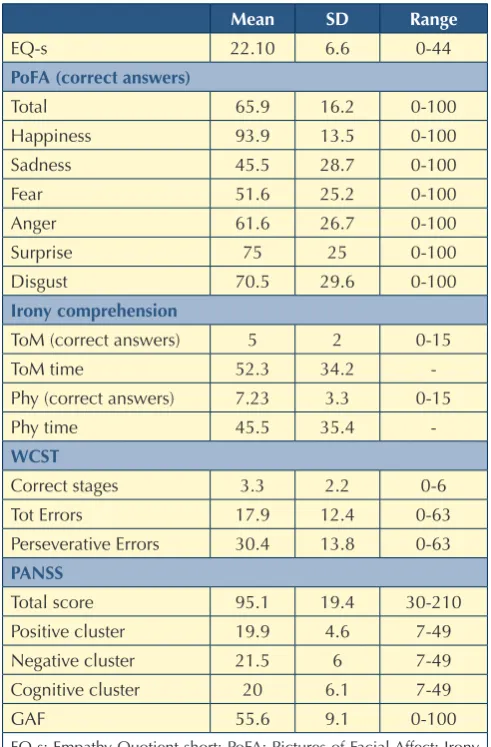
The data (means and standard deviations) of the sample are reported in Table I. No significant correlations were found between EQ-s and any other cognitive or clinical variable.
PoFA total score correlated with time spent to give a cor-rect response to the ToM irony comprehension and with irony task. Fifteen single-image cartoon jokes were
pre-sented one at a time for each condition (an example of the two conditions is reported in Figure 1). The participant was instructed to indicate when he understood the jokes’ meaning: the interval from vignette administration and appreciation constitutes the ‘Time for correct response’. The participant was then required to report his interpre-tation. For the interpretation response to be considered correct, the participant had to appropriately interpret the characters’ mental state for ToM jokes, or describe the scenario for Physical joke. The examiner scored one for a correct answer and zero for an incorrect one. The sum of the reported scores and time spent to give the correct response for each condition (i.e., ToM and Physical) con-stituted the scores.
Wisconsin Card Sorting Test (WCST), for the executive functions evaluation. This is a neuropsychological test of strategic planning, organised searching, utilising environ-mental feedback to shift cognitive sets, directing behav-iour toward achieving a goal, and modulating impulsive responding. A number of stimulus cards are presented to the participant telling him/her to match the cards, but not how to match; however, the subject is told whether the match is right or wrong. It was administered with the standard instructions described by Heaton 34 using a
computerised version. Performances were automatically scored by the computer and were based on number of stages achieved, number of total and perseverative errors.
Clinical evaluation
A senior psychiatrist (A.R.) and a clinical psychologist (I.R.) blind to performances on the tasks clinically evalu-ated participants for symptomatology and global func-tioning. The current symptoms of the patients with schiz-ophrenia were assessed using the PANSS 35, a 30-item,
7-point rating instrument, in Italian version. Each item on the PANSS is accompanied by a complete definition as well as detailed anchoring criteria for all seven rating points, which represent increasing levels of psychopa-thology. Of the 30 psychiatric parameters assessed on the PANSS, seven constitute a Positive Scale, seven a Nega-tive Scale and the remaining 16 a General Psychopathol-ogy Scale. The PANSS cognitive component was calculat-ed by summing the 7 items according to Bell et al. (1994) and Daneluzzo et al. 36.
Patient’s functioning was rated using Italian version of The Global Assessment of Functioning (GAF) Scale 37 as the
Axis V of DSM-IV reflects global functioning. The GAF is the standard method for representing a clinician’s judg-ment of a patient’s overall level psychological, social, and occupational functioning. In DSM-IV, the rating is made on a scale from 1 to 100, from severe impairment to su-perior functioning.
TablE I.
Cognitive and clinical characteristics of the sample.
Mean SD Range
EQ-s 22.10 6.6 0-44
PoFa (correct answers)
Total 65.9 16.2 0-100
Happiness 93.9 13.5 0-100
Sadness 45.5 28.7 0-100
Fear 51.6 25.2 0-100
Anger 61.6 26.7 0-100
Surprise 75 25 0-100
Disgust 70.5 29.6 0-100
Irony comprehension
ToM (correct answers) 5 2 0-15
ToM time 52.3 34.2
-Phy (correct answers) 7.23 3.3 0-15
Phy time 45.5 35.4
-WCST
Correct stages 3.3 2.2 0-6
Tot Errors 17.9 12.4 0-63
Perseverative Errors 30.4 13.8 0-63
PaNSS
Total score 95.1 19.4 30-210
Positive cluster 19.9 4.6 7-49
Negative cluster 21.5 6 7-49
Cognitive cluster 20 6.1 7-49
GAF 55.6 9.1 0-100
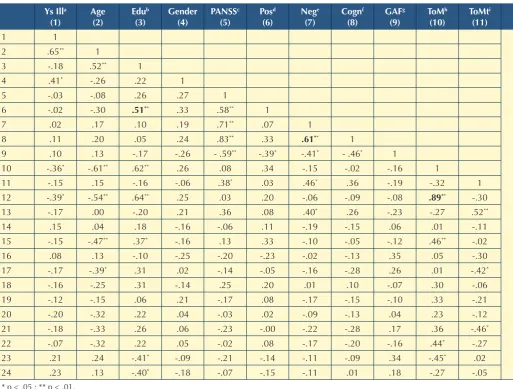
appreciation of humour in the physical vignettes (Table II). Observing the coefficients for single emotions, recognition of fear correlated with time spent (ToM irony comprehen-sion), while anger correlated with appreciation of physical irony (irony not requiring ToM ability). No other significant correlations were seen for the remaining emotions.
ToM irony comprehension score correlated with WCST index. This correlation reached statistical significance even partialling out for education level (vs. WCST num-ber of stages rho = 0.41 p < 0.05).
With regard to symptoms and functioning, time spent to correctly respond to both ToM and physical vi-gnettes correlated with negative symptoms (rho = 0.46
and rho = 0.40, p < 0.05). Positive, negative and cog-nitive clusters of the PANSS correlated with the GAF (rho = -0.39, rho = -.41 and -0.46, p < 0.05 respectively).
Discussion
In this study, we sought to explore if some relations be-tween different abilities, i.e. empathy, ToM and emotion recognition, exist, and if these abilities are correlated to symptomatology and global functioning.
The hypothesis we made of a relationship between em-pathy, emotional processing and cognitive processing speed and the readiness required by the environment
TablE II.
Correlations between participants demographics. Clinical/functional characteristics and tasks measures.
Ys Illa (1)
age (2)
Edub (3)
Gender (4)
PaNSSc (5)
Posd (6)
Nege (7)
Cognf (8)
GaFg (9)
ToMh (10)
ToMti (11)
Phyl (12)
Phytm (13)
EQsn (14)
Hapo (15)
Sadp (16)
Fearq (17)
angr (18)
Surs (19)
Dist (20)
PoFau (21)
Stagesv (22)
NTotErrw (23)
NErrPersx (24)
1 1
2 .65** 1
3 -.18 .52** 1
4 .41* -.26 .22 1
5 -.03 -.08 .26 .27 1
6 -.02 -.30 .51** .33 .58** 1
7 .02 .17 .10 .19 .71** .07 1
8 .11 .20 .05 .24 .83** .33 .61** 1
9 .10 .13 -.17 -.26 - .59** -.39* -.41* - .46* 1
10 -.36* -.61** .62** .26 .08 .34 -.15 -.02 -.16 1
11 -.15 .15 -.16 -.06 .38* .03 .46* .36 -.19 -.32 1
12 -.39* -.54** .64** .25 .03 .20 -.06 -.09 -.08 .89** -.30 1
13 -.17 .00 -.20 .21 .36 .08 .40* .26 -.23 -.27 .52** -.23 1
14 .15 .04 .18 -.16 -.06 .11 -.19 -.15 .06 .01 -.11 .07 -.18 1
15 -.15 -.47** .37* -.16 .13 .33 -.10 -.05 -.12 .46** -.02 .36 -.09 .33 1
16 .08 .13 -.10 -.25 -.20 -.23 -.02 -.13 .35 .05 -.30 .20 .04 .15 .07 1
17 -.17 -.39* .31 .02 -.14 -.05 -.16 -.28 .26 .01 -.42* .24 -.28 .05 -.01 .32 1
18 -.16 -.25 .31 -.14 .25 .20 .01 .10 -.07 .30 -.06 .47** -.12 .14 .32 .42* .38* 1
19 -.12 -.15 .06 .21 -.17 .08 -.17 -.15 -.10 .33 -.21 .30 -.26 -.33 .32 -.05 -.13 .01 1
20 -.20 -.32 .22 .04 -.03 .02 -.09 -.13 .04 .23 -.12 .31 -.17 -.08 .35 .12 .41* .46* .18 1
21 -.18 -.33 .26 .06 -.23 -.00 -.22 -.28 .17 .36 -.46* .47** -.32 -.04 .42* .51** .58** .59** .43* .65** 1
22 -.07 -.32 .22 .05 -.02 .08 -.17 -.20 -.16 .44* -.27 .42* -.23 .24 .33 -.08 -.01 .10 .31 .13 .17 1
23 .21 .24 -.41* -.09 -.21 -.14 -.11 -.09 .34 -.45* .02 -.31 -.19 -.00 -.20 .23 .23 .15 .04 .21 .26 -.43* 1
24 .23 .13 -.40* -.18 -.07 -.15 -.11 .01 .18 -.27 -.05 -.17 -.28 .17 -.06 .23 .21 .30 -.01 .22 .22 -.11 .85** 1
* p < .05 ; ** p < .01.
a Duration of the illness-years; b Years of education; c Positive and Negative Symptoms Scale- Total Score; d PANSS Positive Symptoms Cluster;
e PANSS Negative Symptoms Cluster; f PANSS Cognitive Symptoms Cluster; g Global Assessment of Functioning; h ToM Comprehension – Total score
(Irony ToM Task); i Total Time spent to give correct response to ToM Comprehension; l Physical Comprehension-Total score (Irony Physical Task);
m Total Time spent to give correct response to Physical Comprehension; n Empathy Quotient short version; o Happiness (Pictures Of Facial Affects);
p Sadness (Pictures Of Facial Affects); q Fear (Pictures Of Facial Affects); r Anger (Pictures Of Facial Affects); s Surprise (Pictures Of Facial Affects);t
Dis-gust (Pictures Of Facial Affects); u Pictures Of Facial Affects – Total Score; v Number of Stages-Wisconsin Cards Sorting Task; w Number of Total
time spent in irony detection and recognition of emo-tion in general may tap a possible shared mechanism for fast attributions of intentions to others. It is conceivable that patients with schizophrenia are particularly compro-mised when they have to “mentalise on the spot” under time pressure, as hypothesised by Corcoran and Frith 27,
to grasp both states of mind and some relevant emotional expressions of others. They need to employ ToM and fa-cial emotion recognition to correctly perform ‘on-line’ social tasks 27 as they would in a real-life situation. This
lack of steady attributions may contribute to generate the communicative failures these persons suffer from. Of note, on one hand the absence of a significant correla-to have a good functioning was partially confirmed.
Al-though no correlations were found between self-reported empathy and other variables, emotion recognition and understanding of irony were indeed related, suggesting that affective and cognitive components of understanding the mental state of the others may interact with each
oth-er 30 38. According to our results of a correlation between
time spent to give a correct response to the ToM task and the recognition of emotions, specifically of fear, it seems that a poor ‘first glance’ intention grasping, i.e. poor emo-tional recognition, corresponds to a long latency before correctly understanding the mental processes underlying ironic vignettes. If so, the negative correlation between
TablE II.
Correlations between participants demographics. Clinical/functional characteristics and tasks measures.
Ys Illa (1)
age (2)
Edub (3)
Gender (4)
PaNSSc (5)
Posd (6)
Nege (7)
Cognf (8)
GaFg (9)
ToMh (10)
ToMti (11)
Phyl (12)
Phytm (13)
EQsn (14)
Hapo (15)
Sadp (16)
Fearq (17)
angr (18)
Surs (19)
Dist (20)
PoFau (21)
Stagesv (22)
NTotErrw (23)
NErrPersx (24)
1 1
2 .65** 1
3 -.18 .52** 1
4 .41* -.26 .22 1
5 -.03 -.08 .26 .27 1
6 -.02 -.30 .51** .33 .58** 1
7 .02 .17 .10 .19 .71** .07 1
8 .11 .20 .05 .24 .83** .33 .61** 1
9 .10 .13 -.17 -.26 - .59** -.39* -.41* - .46* 1
10 -.36* -.61** .62** .26 .08 .34 -.15 -.02 -.16 1
11 -.15 .15 -.16 -.06 .38* .03 .46* .36 -.19 -.32 1
12 -.39* -.54** .64** .25 .03 .20 -.06 -.09 -.08 .89** -.30 1
13 -.17 .00 -.20 .21 .36 .08 .40* .26 -.23 -.27 .52** -.23 1
14 .15 .04 .18 -.16 -.06 .11 -.19 -.15 .06 .01 -.11 .07 -.18 1
15 -.15 -.47** .37* -.16 .13 .33 -.10 -.05 -.12 .46** -.02 .36 -.09 .33 1
16 .08 .13 -.10 -.25 -.20 -.23 -.02 -.13 .35 .05 -.30 .20 .04 .15 .07 1
17 -.17 -.39* .31 .02 -.14 -.05 -.16 -.28 .26 .01 -.42* .24 -.28 .05 -.01 .32 1
18 -.16 -.25 .31 -.14 .25 .20 .01 .10 -.07 .30 -.06 .47** -.12 .14 .32 .42* .38* 1
19 -.12 -.15 .06 .21 -.17 .08 -.17 -.15 -.10 .33 -.21 .30 -.26 -.33 .32 -.05 -.13 .01 1
20 -.20 -.32 .22 .04 -.03 .02 -.09 -.13 .04 .23 -.12 .31 -.17 -.08 .35 .12 .41* .46* .18 1
21 -.18 -.33 .26 .06 -.23 -.00 -.22 -.28 .17 .36 -.46* .47** -.32 -.04 .42* .51** .58** .59** .43* .65** 1
22 -.07 -.32 .22 .05 -.02 .08 -.17 -.20 -.16 .44* -.27 .42* -.23 .24 .33 -.08 -.01 .10 .31 .13 .17 1
23 .21 .24 -.41* -.09 -.21 -.14 -.11 -.09 .34 -.45* .02 -.31 -.19 -.00 -.20 .23 .23 .15 .04 .21 .26 -.43* 1
24 .23 .13 -.40* -.18 -.07 -.15 -.11 .01 .18 -.27 -.05 -.17 -.28 .17 -.06 .23 .21 .30 -.01 .22 .22 -.11 .85** 1
* p < .05 ; ** p < .01.
a Duration of the illness-years; b Years of education; c Positive and Negative Symptoms Scale- Total Score; d PANSS Positive Symptoms Cluster;
e PANSS Negative Symptoms Cluster; f PANSS Cognitive Symptoms Cluster; g Global Assessment of Functioning; h ToM Comprehension – Total score
(Irony ToM Task); i Total Time spent to give correct response to ToM Comprehension; l Physical Comprehension-Total score (Irony Physical Task);
m Total Time spent to give correct response to Physical Comprehension; n Empathy Quotient short version; o Happiness (Pictures Of Facial Affects);
p Sadness (Pictures Of Facial Affects); q Fear (Pictures Of Facial Affects); r Anger (Pictures Of Facial Affects); s Surprise (Pictures Of Facial Affects);t
Dis-gust (Pictures Of Facial Affects); u Pictures Of Facial Affects – Total Score; v Number of Stages-Wisconsin Cards Sorting Task; w Number of Total
colleagues 6 found no significant correlations between
empathy deficits and clinical symptoms, though a sub-group of patients with prominent negative symptoms had better empathic performance than other groups with pre-dominant positive or mixed symptomatology. In any case, our results are in line with Brune and colleagues 23, who
failed to find significant correlations of this type.
The relationships we found among the variables consid-ered can suggest that empathic processing acts on func-tionality improving the mentalisation efficiency, in terms of readiness and rapidity. Given that emotion perception in particular has been connected to social competence, independent living and community functioning 52, it is
conceivable that emotion processing within empathy may be a potential catalyst within the process of compre-hension of the minds of others, which can have an impact both on symptomatology and functioning 53.
There are some limitations to our study. First, the sample size is relatively small, but could be sufficient for a pre-liminary test of heuristic value hypotheses. Second, there was no control group so the difference in the battery we adopted that would have emerged in comparison to a non-clinical population has not been assessed. Third, the correlations between empathy and ToM need to be further investigated possibly using information from rela-tives or specific tasks for empathy performance involving affective responsiveness simulating real-life situations. A fourth limitation is the use of self-report instrument, instead of the rating of the clinician, in order to detect empathy abilities. It is possible that a measure of such a complex mentalistic ability, self-reported by people who often do not have good self-reflection 47 48 could generate
a biased description of true empathic ability even if some self-report questionnaires to measure self reflection abili-ties are widely used (e.g. Toronto Alexithymia Scale 54).
Further, we did not apply a correction for multiple cor-relations. Nevertheless, due to the exploratory intent of the study supported by hypotheses derived from the lit-erature, in which data are collected with an objective although with the a priori key hypothesis we stated, mul-tiple test adjustments may not be strictly required with a flexible approach for design and analysis. Moreover, each variable we considered was of interest in its own, so we chose to report all individual p-values and make separate considerations in relation to our hypotheses. When mul-tiple test results have implications on specific responses, correction for multiple comparisons can be unnecessary, as it is more relevant to know the strength of evidence for testing individual hypotheses 55.
This was a correlational study, so that no causal links can be derived from this experimental design. These findings, how-ever, can be of heuristic value for the hypothesis of a parallel intervention of different constructs in the social adaptation. tion between ToM comprehension and emotions
recogni-tion we found is in line with 39 and could be interpreted
in a way as supporting Frith and Frith’s 40 41 neurocognitive
model of social interaction. On the other hand, the rela-tion between time spent to give a correct ToM response and emotion recognition is in line with Besche-Richard et al. 42 who found that performances in the facial emotion
recognition are the best predictor of performances in the attribution of beliefs. Regarding the correlation specifi-cally with fear, data exists on an impairment of facial ex-pression of fear, anger and disgust in people with schizo-phrenia 43 44, but to the best of our knowledge, there are
no studies about the possible relation between impair-ments of specific emotions and ToM ability. Accordingly, this issue deserves further research.
Exploring the correlations between self-reported empa-thy and other variables, we found it was neither related to facial emotion recognition nor to comprehension of irony, supporting previous evidence of these elements be-ing dissociable 7 19 45 46. This may be due to empathy being
a complex ability that includes more than recognition of mental states. One may fully understand what the other is feeling and thinking, but be cold, detached, or even hostile, preventing the individual from being able to fully assume the other’s perspective.
Correlations between cognitive ToM performance and poor mental flexibility (i.e. WCST) is a result consistent with previous literature findings suggesting that intact neu-rocognition is needed for at least the more basic aspects of the mentalistic system to work appropriately 7 15 47-49. Some
studies did not find, however, such a link 50.
Considering correlations with symptoms and social func-tioning, we found a significant correlation between time spent in appreciating both ToM or physical irony and negative symptoms. This may suggests that even if these patients can understand irony and the character’s mental states, their slowing down is associated with symptoma-tology, interfering with the fast and natural interactions that social functioning requires. These patients are likely to require an extra-reasoning effort that would make them feel constantly out of synchrony with the rapid shifts be-tween serious statements and jokes that form everyday conversations with relatives and peers. This delay in un-derstanding mental states hampers the ability to main-tain and support social contact during the demanding challenges of real-life social situations 51. Alternative or
integrative hypothesis may be that avolition, anhedonia and passivity could be an indirect sign of depression that would reduce the sensitivity to funny stories, and a pos-sible marker of less desire for social contact.
15 Langdon R, Coltheart M. Recognition of metaphor and irony in young adults: the impact of schizotypal personality traits.
Psychiatry Res 2004;125:9-20.
16 Stratta P, Riccardi I, Mirabilio D, et al. Exploration of irony ap-preciation in schizophrenia: A replication study on an italian sample. Eur Arch Psychiatry Clin Neurosc 2007;257:337-9. 17 Shuliang M, Yanjie S, Chan CKR, et al. Comprehension of
metaphor and irony in schizophrenia during remission: the role of theory of mind and iq. Psychiatry Res 2008;157:21-9. 18 Bell EM LR, Siegert R, Pete M, et al. The assessment of theo-ry of mind in schizophrenia. Metacognition and severe adult mental disorders: from research to treatment. London:
Rout-ledge 2010, pp. 115-33.
19 Bora E, Yucel M, Pantelis C. Theory of mind impairment in schizophrenia: meta-analysis. Schizophr Res 2009;109:1-9. 20 Preston SD, de Waal FB. Empathy: its ultimate and proximate
bases. Behav Brain Sci 2002;25:1-20; discussion 20-71. 21 Nuechterlein KH GM, Kern RS, Baade LE, et al. The
func-tional relevance of affect recognition errors in schizophre-nia. J Intern Neuropsychol Soc 2000;6:649-58.
22 Cavallaro R, Anselmetti S, Poletti S, et al. Computer-aided neurocognitive remediation as an enhancing strategy for schizophrenia rehabilitation. Psychiatry Res 2009;169:191-6. 23 Brune M. “Theory of mind” in schizophrenia: a review of
the literature. Schizophr Bull 2005;31:21-42.
24 Montag C, Heinz A, Kunz D, et al. Self-reported empathic abilities in schizophrenia. Schizophr Res 2007;92:85-89. 25 Langdon R, Ward P. Taking the perspective of the other
con-tributes to awareness of illness in schizophrenia. Schizophr
Bull 2009;35:1003-11.
26 Sprong M, Schothorst P, Vos E, et al. Theory of mind in schizo-phrenia: meta-analysis. Br J Psychiatry 2007;191:5-13. 27 Corcoran R, Mercer G, Frith CD. Schizophrenia,
symptom-atology and social inference: Investigating “theory of mind” in people with schizophrenia. Schizophr Res 1995;17:5-13. 28 Mitchley NJ, Gray JM, Brooks DN, et al. Comprehension of
irony in schizophrenia. Cogn Neuropsychiatry 1998;3:127-38. 29 Kohler CG, Walker JB, Martin EA, et al. Facial emotion per-ception in schizophrenia: a meta-analytic review. Schizophr
Bull 2010;36:1009-19.
30 Baron-Cohen S. The empathy quotient: an investigation of adults with asperger syndrome or high functioning au-tism, and normal sex differences. J Autism Dev Disord
2004;34:163-75.
31 Wakabayashi A, Baron-Cohen S, Wheelwright S, et al. De-velopment of short forms of the empathy quotient (eq-short) and the systemizing quotient (sq-short). Personality Indiv
Diff 2006;41:929-40.
32 Ekman P, editor. Pictures of facial affect. California, CA:
Consulting Psychologists Press 1976.
33 Marjoram D, Tansley H, Miller P, et al. A theory of mind investigation into the appreciation of visual jokes in schizo-phrenia. BMC Psychiatry 2005;5:12.
Further studies are needed, possibly with multi-modal assessment of empathy, to better understand the role of an empathy deficit in schizophrenia and its relation to aspects of the mental state understanding systems, as well as its possible role in explaining the social dysfunction from which these persons suffer.
Conflicts of interest
None.
References
1 Beer JS, Ochsner KN. Social cognition: a multi level analysis.
Brain Res 2006;1079:98-105.
2 Stratta P, Bustini M, Daneluzzo E, et al. Deconstructing theo-ry of mind in schizophrenia. Psychiattheo-ry Res 2011;190:32-6. 3 Stratta P, Daneluzzo E, Riccardi I, et al. Metacognitive ability
and social functioning are related in persons with schizo-phrenic disorder. Schizophr Res 2009;108:301-2.
4 Baron-Cohen S. The empathizing system: a revision of the 1994 model of the mindreading system. Origins of the social mind. New York: Guilford Press 2005, pp. 468-92.
5 Benedetti F, Bernasconi A, Bosia M, et al. Functional and structural brain correlates of theory of mind and empathy deficits in schizophrenia. Schizophr Res 2009;114:154-60. 6 Derntl B, Finkelmeyer A, Toygar TK, et al. Generalized
defi-cit in all core components of empathy in schizophrenia.
Schizophr Res 2009;108:197-206.
7 Shamay-Tsoory SG, Shur S, Barcai-Goodman L, et al. Dis-sociation of cognitive from affective components of theory of mind in schizophrenia. Psychiatry Res 2007;149:11-23. 8 Lysaker PH, Dimaggio G, Carcione A, et al.
Metacogni-tion and schizophrenia: the capacity for self-reflectivity as a predictor for prospective assessments of work performance over six months. Schizophr Res 2010;122:124-30.
9 Lysaker PH, Salvatore G, Grant ML, et al. Deficits in theory of mind and social anxiety as independent paths to paranoid features in schizophrenia. Schizophr Res 2010;124:81-5. 10 Anderson C, Keltner D. The role of empathy in the formation and
maintenance of social bonds. Behav Brain Sci 2002;25:21-2. 11 Bora E, Eryavuz A, Kayahan B, et al. Social functioning,
the-ory of mind and neurocognition in outpatients with schizo-phrenia; mental state decoding may be a better predictor of social functioning than mental state reasoning. Psychiatry
Res 2006;145:95-103.
12 Blair RJ. Facial expressions, their communicatory functions and neuro-cognitive substrates. Philos Trans R Soc Lond B
Biol Sci 2003;358:561-72.
13 Besel LDS YJ. Individual differences in empathy: The role of fa-cial expression recognition. Pers Individ Diff 2010;49:107-12. 14 Langdon R, Coltheart M, Ward PB, et al. Disturbed
46 Shamay-Tsoory SG, Aharon-Peretz J, Perry D. Two systems for empathy: a double dissociation between emotional and cognitive empathy in inferior frontal gyrus versus ventrome-dial prefrontal lesions. Brain 2009;132:617-27.
47 Lysaker PH, Carcione A, Dimaggio G, et al. Metacognition amidst narratives of self and illness in schizophrenia: asso-ciations with neurocognition, symptoms, insight and quality of life. Acta Psychiatr Scand 2005;112:64-71.
48 Lysaker PH, Dimaggio G, Buck KD, et al. Metacogni-tion within narratives of schizophrenia: associaMetacogni-tions with multiple domains of neurocognition. Schizophr Res
2007;93:278-87.
49 Lysaker PH, Warman DM, Dimaggio G, et al. Metacognition in schizophrenia: associations with multiple assessments of executive function. J Nerv Ment Dis 2008;196:384-9. 50 Pickup GJ. Relationship between theory of mind and
execu-tive function in schizophrenia: a systematic review.
Psycho-pathology 2008;41:206-13.
51 Salvatore G, Dimaggio G, Popolo R, et al. Deficits in min-dreading in stressful contexts and their relationships to so-cial withdrawal in schizophrenia. Bull Menninger Clinic
2008;72:191-209.
52 Mueser KT, Doonan R, Penn DL, et al. Emotion recognition and social competence in chronic schizophrenia. J Abnorm
Psychol 1996;105:271-5.
53 Sparks A, McDonald S, Lino B, et al. Social cognition, empa-thy and functional outcome in schizophrenia. Schizophr Res
2010;122:172-8.
54 Bagby RM, Parker JD, Taylor GJ. The twenty-item toronto alexithymia scale--I. Item selection and cross-validation of the factor structure. J Psychosomatic Res 1994;38:23-32. 55 Cook RJ, Farewell VT. Multiplicity considerations in the
de-sign and analysis of clinical trials. J Royal Statistical Soc
Se-ries 1996;159:93-110.
34 Heaton RK. Wisconsin card sorting test manual. Odessa:
1981.
35 Kay SR, editor. Positive and negative syndromes in schizo-phrenia. New York: Routledge 1992.
36 Daneluzzo E, Arduini L, Rinaldi O, et al. Panss factors and scores in schizophrenic and bipolar disorders during an in-dex acute episode: a further analysis of the cognitive com-ponent. Schizophr Res 2002;56:129-36.
37 American Psychological Association. Diagnostic and statis-tical manual of mental disorders - 4th Edition. Washington DC: APA 1994.
38 Lysaker PH, Olesek KL, Warman DM, et al. Metacognition in schizophrenia: correlates and stability of deficits in theory of mind and self-reflectivity. Psychiatry Res 2011;190:18-22. 39 Bora E, Gökçen S, Veznedaroglu B. Empathic abilities in peo-ple with schizophrenia. Psychiatry Research 2008;160:23-9. 40 Frith CD, Frith U. Interacting minds-a biological basis.
Sci-ence 1999; 286:1692-5.
41 Frith U, Frith CD. The biological basis of social interaction.
Current Direct Psycholog Sc 2001;10:151-55.
42 Besche-Richard C, Bourrin-Tisseron A, Olivier M, et al. Rec-ognition of facial emotions and theory of mind in schizo-phrenia: could the theory of mind deficit be due to the non-recognition of facial emotions? Encephale 2012;38:241-7. 43 Goghari VM, Sponheim SR. More pronounced deficits in
facial emotion recognition for schizophrenia than bipolar disorder. Compr Psychiatry 2013;54:388-97.
44 Kohler CG, Turner TH, Bilker WB, et al. Facial emotion rec-ognition in schizophrenia: intensity effects and error pattern.
Am J Psychiatry 2003;160:1768-74.
45 Koelkebeck K, Suslow T, Kueppers KA, et al. Theory of mind in first-episode schizophrenia patients: correla-tions with cognition and personality traits. Schizophr Res