R E S E A R C H A R T I C L E
Open Access
Gene expression profiling of subcutaneous
adipose tissue in morbid obesity using a focused
microarray: Distinct expression of cell-cycle- and
differentiation-related genes
Sara Rodríguez-Acebes
1,2, Nuria Palacios
3, José I Botella-Carretero
2,3, Nuria Olea
1, Lorena Crespo
1,
Roberto Peromingo
4, Diego Gómez-Coronado
1,2, Miguel A Lasunción
1,2,5, Clotilde Vázquez
2,3,
Javier Martínez-Botas
1,2*Abstract
Background:Obesity results from an imbalance between food intake and energy expenditure, which leads to an excess of adipose tissue. The excess of adipose tissue and adipocyte dysfunction associated with obesity are linked to the abnormal regulation of adipogenesis. The objective of this study was to analyze the expression profile of cell-cycle- and lipid-metabolism-related genes of adipose tissue in morbid obesity.
Methods:We used a custom-made focused cDNA microarray to determine the adipose tissue mRNA expression profile. Gene expression of subcutaneous abdominal fat samples from 15 morbidly obese women was compared with subcutaneous fat samples from 10 nonobese control patients. The findings were validated in an independent
population of 31 obese women and 9 obese men and in an animal model of obesity (Lepob/obmice) by real-time
RT-PCR.
Results:Microarray analysis revealed that transcription factors that regulate the first stages of adipocyte
differentiation, such as CCAAT/enhancer binding protein beta (C/EBPb) and JUN, were upregulated in the adipose
tissues of morbidly obese patients. The expression of peroxisome proliferator-activated receptor gamma (PPARg), a
transcription factor which controls lipid metabolism and the final steps of preadipocyte conversion into mature adipocytes, was downregulated. The expression of three cyclin-dependent kinase inhibitors that regulate clonal expansion and postmitotic growth arrest during adipocyte differentiation was also altered in obese subjects: p18 and p27 were downregulated, and p21 was upregulated. Angiopoietin-like 4 (ANGPTL4), which regulates
angiogenesis, lipid and glucose metabolism and it is know to increase dramatically in the early stages of adipocyte
differentiation, was upregulated. The expression of C/EBPb, p18, p21, JUN, and ANGPTL4 presented similar
alterations in subcutaneous adipose tissue of Lepob/obmice.
Conclusions:Our microarray gene profiling study revealed that the expression of genes involved in adipogenesis is profoundly altered in the subcutaneous adipose tissue of morbidly obese subjects. This expression pattern is consistent with an immature adipocyte phenotype that could reflect the expansion of the adipose tissue during obesity.
* Correspondence: [email protected] 1
Servicio de Bioquímica-Investigación, Hospital Ramón y Cajal, IRYCIS, Madrid, Spain
Full list of author information is available at the end of the article
Background
Obesity is the most common nutritional disorder in Western societies and is reaching epidemic proportions [1]. Obesity results from an imbalance between food intake and energy expenditure, which leads to an excess of white adipose tissue. Adipocytes are highly active endocrine cells that secrete many factors, including hor-mones, cytokines, growth factors, acute phase reactants, complement-related proteins, and extracellular matrix proteins, which can have an important impact on other organs and play a central role in the regulation of energy balance and insulin sensitivity [2]. Consequently, an excess of adipose tissue and adipocyte dysfunction are associated with an increased risk of developing type 2 diabetes mellitus, hypertension, dyslipidemia, stroke, cardiovascular disease, and a variety of cancers [3-5]. The metabolic risks associated with obesity correlate strongly with central adiposity, and subcutaneous trun-cal fat plays a major role in the pathophysiology of obe-sity complications, especially insulin resistance [6-8].
Excess adipose tissue is linked to the abnormal regula-tion of adipogenesis and adipocyte hypertrophy, and also to cell hyperplasia in more severe forms of obesity [9]. Adipocyte hyperplasia requires the recruitment and proliferation of preadipocytes present in the vascular stroma of adipose tissue [10]. Adipocyte differentiation is a complex process regulated by a number of tran-scriptional factors acting coordinately [11]. Most studies investigating adipocyte differentiation have been per-formed in murine preadipocyte cell lines and in animal models. In these models, adipocyte differentiation begins with a proliferative event known as clonal expansion, in which the cells undergo one or two rounds of cell divi-sion. They then exit the cell cycle and initiate terminal differentiation. Two families of transcription factors are the key regulators of this process and are responsible for activating the adipogenic gene program: the CCAAT/enhancer-binding proteins (C/EBPs) and per-oxisome proliferator-activated receptors (PPARs) [12]. Clonal expansion and subsequent growth arrest are associated with changes in the expression of cyclin-dependent kinase inhibitors (CDKIs), which inhibit the cyclin-CDK complexes and thus control cell-cycle pro-gression [13,14].
Much less is known about adipocyte differentiation in humans and its relation to development of obesity. The adipogenic program in human seems to be similar to that of murine cell lines [15], although in vitro human preadipocytes do not require clonal expansion to differ-entiate [16]. Genome-wide microarray analysis has been previously used in adipose tissue of human obese sub-jects to identify new candidate genes with abnormal expression, to explore the differences between distinct fat depots or to address the response to pharmaceutical
or nutritional intervention [17-20]. In the present study, we sought to investigate the relation between obesity and adipocyte differentiation in vivo. For this purpose we analyzed the gene expression profile of abdominal subcutaneous adipose tissue in human morbid obesity using a custom-made focused cDNA microarray com-posed of 319 cDNA probes corresponding to genes involved in cell cycle, adipocyte differentiation and lipid metabolism [21]. We found that the expression of genes involved in adipogenesis, such as C/EBPb, JUN, PPARg, CDKN1A (p21), CDKN2C (p18) and ANGPTL4, is pro-foundly altered in the subcutaneous adipose tissue of morbidly obese subjects. This expression pattern could reflect the expansion of the adipose tissue during obesity.
Results
Patient characteristics
Subcutaneous fat samples from 15 morbidly obese women undergoing bariatric surgery were compared with subcutaneous fat samples from 10 nonobese control women. The patient characteristics are shown in Table 1. All the obese patients had BMI > 35 kg/m2, whereas the control subjects had BMI < 25 kg/m2. Fasting glucose levels were higher in morbidly obese patients, and two had a clinical diagnosis of diabetes (fasting glucose > 125 mg/dL), whereas all the control subjects had normal fast-ing glucose. Plasma triglyceride levels were significantly higher in obese patients and no differences were observed for cholesterol levels. As expected, systolic, diastolic, and mean blood pressures were higher in the obese indivi-duals than in the controls (Table 1).
Table 1 Clinical and biochemical characteristics of women of the microarray study
Patients (n = 15)
Controls (n = 10)
P*
Current smokers, n (%) 3 (20) 0 (0) 0.237
Age (years) 49.6 ± 8.7 47.0 ± 17.4 0.770
Body mass index (Kg/m2) 48.1 ± 6.1 22.7 ± 3.4 < 0.001 Systolic blood pressure (mmHg) 137.7 ± 15.1 117.8 ± 9.7 0.001 Diastolic blood pressure (mmHg) 82.3 ± 10.7 64.4 ± 11.0 0.002 Mean blood pressure (mmHg) 100.8 ± 10.5 82.2 ± 10.3 < 0.001 Serum creatinine (mg/dL) 0.81 ± 0.08 0.78 ± 0.10 0.215 Aspartate aminotransferase (U/L) 21.1 ± 8.8 17.7 ± 2.5 0.174 Alanine aminotransferase (U/L) 27.9 ± 17.2 15.0 ± 5.4 0.007 Fasting glucose (mg/dL) 106.0 ± 22.6 93.0 ± 4.0 0.030 Total cholesterol (mg/dL) 204.9 ± 38.1 206.9 ± 36.8 0.728 Triglycerides (mg/dL) 150.0 ± 97.0 62.7 ± 21.9 0.001
Data are means ± SD unless otherwise stated.
Differential gene expression
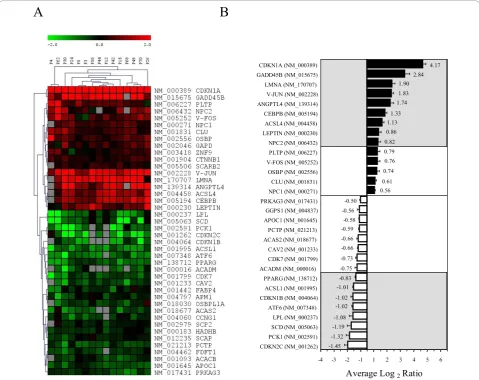
Subcutaneous fat gene expression profile in each of the obese patients was compared to a pool of nonobese con-trol samples to minimize the influence of individual variability in controls. Of the 319 probes on the micro-array, 42 remain after filtering for detectable expression, consistency of replicates and statistical significance (p < 0.001) (Figure 1A).
Of these, 9 were upregulated and 8 were downregu-lated in obese patients compared to the controls using a differential cut-off average log2 ratio of 0.8 (Figure 1B).
Among these 17 genes, 4 were genes involved in cell-cycle regulation. The expression of cyclin-dependent kinase inhibitor 1A (CDKN1A/p21) and growth arrest
and DNA-damage-inducible b(GADD45B) were upre-gulated, whereas that of cyclin-dependent kinase inhibi-tor 2C (CDKN2C/p18) and cyclin-dependent kinase inhibitor 1B (CDKN1B/p27) were downregulated in obese patients compared with control subjects (Figure 1). As regards genes involved in lipid metabolism, those encoding fatty-acid-CoA ligase long-chain 4 (ACSL4), leptin (LEP), and Niemann-Pick disease type C2 (NPC2) were upregulated, whereas those encoding stearoyl-CoA desaturase (SCD), lipoprotein lipase (LPL), and fatty-acid-CoA ligase long-chain 1 (ACSL1) were downregu-lated. The expression of transcription factors such as JUN and CCAAT/enhancer binding protein b(CEBPb) was increased, whereas that of PPARg was decreased.
A
B
CDKN2C (NM_001262) PCK1 (NM_002591) SCD (NM_005063) LPL (NM_000237) ATF6 (NM_007348) CDKN1B (NM_004064) ACSL1 (NM_001995) PPARG (NM_138712) ACADM (NM_000016) CDK7 (NM_001799) CAV2 (NM_001233) ACAS2 (NM_018677) PCTP (NM_021213) APOC1 (NM_001645) GGPS1 (NM_004837) PRKAG3 (NM_017431) NPC1 (NM_000271) CLU (NM_001831) OSBP (NM_002556) V-FOS (NM_005252) PLTP (NM_006227) NPC2 (NM_006432) LEPTIN (NM_000230) ACSL4 (NM_004458) CEBPB (NM_005194) ANGPTL4 (NM_139314) V-JUN (NM_002228) LMNA (NM_170707) GADD45B (NM_015675) CDKN1A (NM_000389)
-1.45 -1.32
-1.19 -1.08
-1.02 -1.02 -1.01 -0.83 -0.75 -0.73 -0.66 -0.66 -0.59 -0.58 -0.56 -0.50
0.61 0.74 0.76 0.79 0.82 0.86 1.13 1.33
1.74 1.83 1.90
2.84 4.17
0.56
-4 -3 -2 -1 1 2 3 4 5 6
Average Log 2Ratio
FOS expression tended to be upregulated, although did not meet the log2 cut-off ratio of 0.8 (Figure 1B).
Phos-phoenolpyruvate carboxykinase 1 (PCK1), a key enzyme of gluconeogenesis, was downregulated. Moreover, he expression of the cytoskeleton gene lamin A/C (LMNA) and the angiogenesis-related gene angiopoietin-like 4 (ANGPTL4) was also upregulated. Finally, the expres-sion of the activating transcription factor 6 (ATF6), which is involved in the unfolded protein response, was lower than in control subjects.
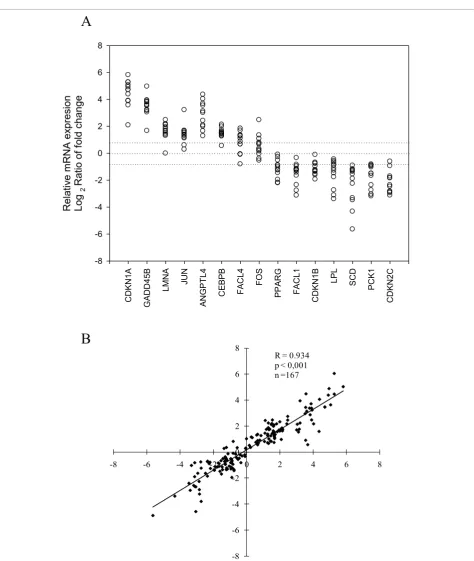
To validate the microarray results quantitatively, we selected 15 genes on the basis of their ratio ranking or their biological interest and we analyzed their expression by real-time RT-PCR in the same samples previously analyzed by the microarray. In all cases, a strong corre-spondence between the real-time RT-PCR results and the microarray data was observed (Figures 1B and 2A). Linear regression analysis of the log2 ratios obtained by
microarray analysis and the log2 of the relative mRNA
expression determined by real-time RT-PCR showed a highly statistically significant correlation (r = 0.934,P < 0.001, n = 167) (Figure 2B).
Confirmation of the results in an independent set of morbidly obese patients
To confirm the differential gene expression profiles pre-viously observed, we analyzed gene expression by real-time RT-PCR in an independent set of morbidly obese patients. First, we chose 31 morbidly obese women, all with a BMI > 35 kg/m2, and 10 nonobese controls (BMI < 25 kg/m2). The patient characteristics are shown in Table 2. We measured the mRNA levels for CDKN1A, GADD45B, LMNA, JUN, ANGPTL4, CEBPB, CDKN2C, PCK1, SCD, and LPL in their subcutaneous abdominal adipose tissue as before (Figure 3).
In agreement with the previous results, the expression of CDKN1A, GADD45B, JUN, ANGPTL4, and CEBPB was significantly higher and that of CDKN2C, PCK1, and LPL was significantly lower in the obese subjects than in the control women. Moreover, the LMNA and SCD mRNA levels showed similar trends to those obtained by microarray analysis, but the differences were not statistically significant (Figure 3).
PPARg encodes two protein isoforms, PPARg1 and PPARg2 [22]. Both isoforms have identical sequences except for an additional 30 amino acids at the N-terminus of PPARg2. Four major transcripts are produced from the same gene. PPARG mRNA variants 1, 3, and 4 differ only in the 5’untranslated region and encode the PPARg1 isoform. PPARG mRNA variant 2 encodes the PPARg2 iso-form [23]. The PPARG cDNA probe used in the microarray does not distinguish the different PPARG mRNA isoforms, and the primers used to validate these results by real-time RT-PCR are located in the common transcript region of
both PPARgisoforms. Therefore, the data obtained pre-viously (Figures 1 and 2) correspond to total PPARG expression. Because both isoforms are differentially regu-lated [23-25], we next used a specific set of primers for PPARg1 and PPARg2. As shown in Figure 3, PPARg1 mRNA was significantly downregulated in morbidly obese women compared with the controls, whereas PPARg2 mRNA levels did not differ between the two groups.
Next, we asked whether the changes observed in the adipose tissues of obese women also occur in obese men. Therefore, we studied 9 morbidly obese men and 8 nonobese men as controls, whose characteristics are shown in Table 2. As shown in Figure 4, the expression of CDKN1A, LMNA, ANGPTL4, and CEBPB was signif-icantly upregulated, whereas that of CDKN2C, PCK1, and PPARg1 was significantly downregulated in the adi-pose tissue of male obese subjects. JUN and GADD45B mRNA levels in male patients showed similar trends to those observed in female patients, but the differences were not statistically significant. Unlike obese women, obese men had SCD mRNA expression significantly upregulated, whereas LPL expression did not differ between obese men and control men (Figure 4).
Gene expression analysis in a mouse model of obesity
Finally, we wanted to confirm these results in a mouse model of obesity, such as the Lepob/ob mouse, first, because the sample collection procedure and the homo-geneity of experimental groups can be better controlled in mice and, second, because some differences have been described in the adipocyte differentiation process between human and mouse. For this, we analyzed the subcutaneous adipose tissue from 4 female Lepob/ob mice and 4 female C57BL/6J control mice.
As observed in the female and male obese patients, Cdkn1a, Lmna, Jun, Angptl4, and Cebpb were highly overexpressed, whereas Cdkn2c mRNA expression was highly downregulated in Lepob/ob mice as compared with control mice (Figure 5). Interestingly, and in con-trast to the obese humans, the expression of Pparg1 was significantly higher in Lepob/ob mice than in control mice, and the expression of Pparg2 also tended to be higher in the former. Also unlike what was found in human subjects, Gadd45b, Pck1, and Lpl mRNA expres-sion did not differ between obese and control mice. Finally, Scd1 mRNA levels were slightly higher in Lepob/ob mice than in control mice, but the difference was not statistically significant.
Discussion
CDK
N
1A
GA
DD45B LMNA
JUN
AN
GPT
L4
C
E
BPB
FA
CL
4
FOS
PPAR
G
FA
CL
1
CDK
N
1B LPL
SC
D
PC
K1
CDK
N
2C
R
el
at
ive
m
RNA
ex
pres
ion
Log
2
Ratio of
f
old change
-8 -6 -4 -2 0 2 4 6 8
A
B
-8 -6 -4 -2 0 2 4 6 8
-8 -6 -4 -2 0 2 4 6 8
R = 0.934 p < 0,001 n =167
by using a focused microarray especially designed to study cell-cycle- and lipid-metabolism-related genes. We analyzed subcutaneous adipose tissue, which is the lar-gest adipose depot in the body, accounting for approxi-mately 80% of the total body fat. The metabolic complications associated with obesity correlate strongly with central obesity [26]. Subcutaneous abdominal fat, as a component of central adiposity, has a strong asso-ciation with insulin resistance and plays an important role in the pathophysiology of obesity [6-8].
Present microarray analysis revealed that in the subcu-taneous adipose tissues of morbidly obese patients the expression of genes known to be involved in adipocyte differentiation and cell-cycle control is profoundly altered. We found that the expression of C/EBPband JUN, which are transcription factors that regulate the first stages of adipocyte differentiation, was increased in the adipose tissue of morbidly obese patients. Conversely, the expression of PPARg1, a transcription factor that controls the final steps of preadipocyte conversion into mature adipocytes, was reduced. C/EBPbis not only an important regulator of adipocyte terminal differentiation since, in addition, it is a critical regulator of body weight, adiposity and tumour growth [27]. C/EBPbdeletion in Leprdb/dbmice reduces obesity, fatty liver, and diabetes [28]. Leptin levels are also modulated by C/EBPb, and mice lacking C/EBPbhave severely reduced leptin levels [27]. Consistently with this, we found an increase in both C/EBPband leptin mRNA levels in obese patients.
In the different study subsets performed in the present work, the expression of PPARg1 in adipose tissue was reduced in obese subjects as compared to controls, whereas no statistically significant differences were observed for PPARg2. In Lepob/ob mice, however, both
PPARg1 and PPARg2 were overexpressed. Although PPARgis a well-characterized regulator of energy meta-bolism, the relationship between PPARgexpression and obesity is not clear. In fact, previous studies by others have produced conflicting results regarding the associa-tion between PPARg and obesity in both humans and animals. Some studies have shown changes in PPARg1, PPARg2, or total PPARgexpression in subcutaneous adi-pose tissue [29-33], whereas others have reported no changes [30,34,35]. The different characteristics of the populations and the different methodologies used to determine PPARg expression in these studies could explain these discrepancies. Addressing this issue, Sew-ter et al. also found a decrease in PPARg1 mRNA expression in subcutaneous adipocytes from morbid obese compared with lean subjects, and a strong inverse correlation between BMI and PPARg1 mRNA levels. In contrast, they found a significant increase in PPARg2 mRNA expression in the morbid obese group [33]. The reduction in PPARg1 expression in obese patients found in our study is consistent with the increase in Leptin mRNA expression also found herein, since it has been described that Leptin suppress the expression of PPARg in adipocytes [36].
Cyclin-dependent kinase inhibitors (CDKIs) play an important role in cell cycle regulation and some of them are especially involved in adipocyte differentiation. In the present work we describe for the first time that the expression of three CDKIs is altered in human adipose tissue from morbid obese patients: CDKN1A (p21) was increased whereas CDKN2C (p18) and CDKN1B (p27) were decreased. Morrinson et al. were the first to demon-strate that these CDKIs are highly regulated in 3T3-L1 preadipocytes differentiation. Thus, p18 mRNA is
Table 2 Clinical and biochemical characteristics of an independent set of male and female subjects
Females (n = 41) Males (n = 17)
Patients (n = 31) Controls (n = 10) Patients (n = 9) Controls (n = 8)
Current smokers, n (%) 13 (41.9) 0 (0)* 4 (44.4) 1 (12.5)*
Age (years) 36.4 ± 10.3 49.6 ± 14.9* 37.0 ± 12.6 51.3 ± 12.4*
Body mass index (kg/m2) 49.5 ± 7.3 23.4 ± 3.1* 49.3 ± 7.2 23.9 ± 1.6*
Systolic blood pressure (mmHg) 128.1 ± 13.6 121.1 ± 11.7 131.3 ± 11.3 128.0 ± 8.2
Diastolic blood pressure (mmHg) 76.7 ± 9.7 66.7 ± 9.7* 83.1 ± 13.3 62.0 ± 3.8*
Mean blood pressure (mmHg) 84.7 ± 29.7 84.8 ± 9.7 88.1 ± 34.8 73.5 ± 30.1*
Serum creatinine (mg/dL) 0.79 ± 0.10† 0.76 ± 0.10† 1.15 ± 0.38 1.02 ± 0.13
Aspartate aminotransferase (U/L) 22.7 ± 9.9 17.1 ± 2.0 34.0 ± 28.0 19.2 ± 3.1
Alanine aminotransferase (U/L) 36.6 ± 32.8 14.6 ± 5.5* 61.3 ± 54.4 16.5 ± 2.8*
Fasting glucose (mg/dL) 99.5 ± 29.5 96.7 ± 8.9 120.6 ± 89.6 98.3 ± 10.7
Cholesterol (mg/dL) 190.8 ± 36.8 204.8 ± 39.9 199.6 ± 34.1 195.0 ± 19.3
Triglycerides (mg/dL) 118.1 ± 52.8 66.0 ± 20.9* 175.8 ± 99.3 104.1 ± 62.3
Data are means ± SD unless otherwise stated.
expressed only during terminal differentiation, p27 mRNA is highly expressed during the whole differentiation pro-cess except in S phase, and p21 mRNA is expressed in G1 phase, decreases in S phase, and increases again at postmi-totic growth arrest [14]. The importance of these CDKIs
has been underscored recently in knockout mice lacking p21 and p27. Loss of one or both CDKIs, results in adipo-cyte hyperplasia, obesity and insulin resistance [37]. These results suggest that theses CDKIs are major regulators of adipocyte number in vivo and can have an important role CDKN1A Control MO mRNA ex pression (CDKN1A /RP L P 0 ) 0 2 4 6 8 10 12
**
LMNA Control MO mRNA ex pression (LMNA/RPLP0) 0 1 2 3 4 5 JUN Control MO mRNA ex pression (JUN/RPLP0) 0 2 4 6 8*
ANGPTL4 Control MO mRNA expression (A N G PTL4/ R PLP0) 0 2 4 6 8*
CEBPB Control MO mRNA ex pression (CEB PB/RPLP0) 0 2 4 6 8**
CDKN2C Control MO mRNA ex pression (CDKN2C/RPLP0) 0 1 2 3 4 5**
SCD Control MO mRNA ex pression (S CD/RPLP 0) 0 1 2 3 4 LPL Control MO mRNA ex pression (LPL/ R PLP0) 0 1 2 3 4 5*
PPARG1 Control MO mRNA ex pression (P PARG1/RP L P 0 ) 0.0 0.2 0.4 0.6 0.8 1.0 1.2 1.4 1.6 1.8 2.0*
PPARG2 Control MO mRNA ex pression (P PARG2/RP L P 0 ) 0.0 0.5 1.0 1.5 2.0 2.5 3.0 GADD45B Contol MO mRNA ex pression (GA DD45B /RP L P 0 ) 0 10 20 30***
PCK1 Contol MO mRNA ex pression (PCK1/RP LP0) 0.0 0.5 1.0 1.5 2.0***
CDKN1A Control MO mRNA ex pression (CDKN1A /RP L P 0 ) 0 2 4 6 8 10 12**
CDKN1A Control MO mRNA ex pression (CDKN1A /RP L P 0 ) 0 2 4 6 8 10 12**
LMNA Control MO mRNA ex pression (LMNA/RPLP0) 0 1 2 3 4 5 JUN Control MO mRNA ex pression (JUN/RPLP0) 0 2 4 6 8*
JUN Control MO mRNA ex pression (JUN/RPLP0) 0 2 4 6 8*
ANGPTL4 Control MO mRNA expression (A N G PTL4/ R PLP0) 0 2 4 6 8*
ANGPTL4 Control MO mRNA expression (A N G PTL4/ R PLP0) 0 2 4 6 8*
CEBPB Control MO mRNA ex pression (CEB PB/RPLP0) 0 2 4 6 8**
CEBPB Control MO mRNA ex pression (CEB PB/RPLP0) 0 2 4 6 8**
CDKN2C Control MO mRNA ex pression (CDKN2C/RPLP0) 0 1 2 3 4 5**
CDKN2C Control MO mRNA ex pression (CDKN2C/RPLP0) 0 1 2 3 4 5**
SCD Control MO mRNA ex pression (S CD/RPLP 0) 0 1 2 3 4 LPL Control MO mRNA ex pression (LPL/ R PLP0) 0 1 2 3 4 5*
LPL Control MO mRNA ex pression (LPL/ R PLP0) 0 1 2 3 4 5*
PPARG1 Control MO mRNA ex pression (P PARG1/RP L P 0 ) 0.0 0.2 0.4 0.6 0.8 1.0 1.2 1.4 1.6 1.8 2.0*
PPARG1 Control MO mRNA ex pression (P PARG1/RP L P 0 ) 0.0 0.2 0.4 0.6 0.8 1.0 1.2 1.4 1.6 1.8 2.0*
PPARG2 Control MO mRNA ex pression (P PARG2/RP L P 0 ) 0.0 0.5 1.0 1.5 2.0 2.5 3.0 GADD45B Contol MO mRNA ex pression (GA DD45B /RP L P 0 ) 0 10 20 30***
GADD45B Contol MO mRNA ex pression (GA DD45B /RP L P 0 ) 0 10 20 30***
PCK1 Contol MO mRNA ex pression (PCK1/RP LP0) 0.0 0.5 1.0 1.5 2.0***
PCK1 Contol MO mRNA ex pression (PCK1/RP LP0) 0.0 0.5 1.0 1.5 2.0***
in the development of adipose tissue hyperplasia during obesity. Moreover, p21 has been involved in adipocyte hypertrophy since it protected the hypertrophied adipo-cytes against apoptosis [38]. However, the precise contri-bution of these CDKIs to obesity development in humans
is unclear. In this context, it is worth to note that GADD45B, a member of the growth arrest and DNA-damage-inducible gene family, also was overexpressed in the adipose tissues of morbidly obese subjects. This gene is involved in terminal myeloid differentiation and growth CDKN1A
Control MO
mRNA expression (CDK
N1 A /RP LP 0) 0 10 20 30 40 50 60
***
LMNA Control MO mRNA ex pression (LMNA/ RPLP0) 0 2 4 6 8 10***
JUN Control MO mRNA ex pression (JUN/RPLP0) 0 2 4 6 8 ANGPTL4 Control MO mRNA ex pression (A N G PT L4 /R PL P0 ) 0 10 20 30 40 50*
CEBPB Control MO mRNA ex pression (C EBPB/ R P L P 0 ) 0 5 10 15**
CDKN2C Control MO mRNA ex pression (CDKN2C/RPLP0) 0.0 0.5 1.0 1.5 2.0 2.5**
SCD Control MO mRNA ex pression (S CD/RPLP 0) 0 2 4 6 8 10 12 14 16 18**
LPL Control MO mRNA ex pression (LPL/ R PLP0) 0 2 4 6 8 PPARG1 Control MO mRNA ex pression (P PARG1/RP L P 0 ) 0.2 0.4 0.6 0.8 1.0 1.2 1.4 1.6 1.8*
PPARG2 Control MO mRNA ex pression (P PARG2/RP L P 0 ) 0.0 0.5 1.0 1.5 2.0 2.5 GADD45B Contol MO mRNA ex pression (GA DD45B /RP L P 0 ) 0 2 4 6 8 10 PCK1 Contol MO mRNA ex pression (PCK1/RPLP 0) 0 2 4 6 8*
CDKN1A Control MOmRNA expression (CDK
N1 A /RP LP 0) 0 10 20 30 40 50 60
***
CDKN1A Control MOmRNA expression (CDK
N1 A /RP LP 0) 0 10 20 30 40 50 60
***
LMNA Control MO mRNA ex pression (LMNA/ RPLP0) 0 2 4 6 8 10***
LMNA Control MO mRNA ex pression (LMNA/ RPLP0) 0 2 4 6 8 10***
JUN Control MO mRNA ex pression (JUN/RPLP0) 0 2 4 6 8 ANGPTL4 Control MO mRNA ex pression (A N G PT L4 /R PL P0 ) 0 10 20 30 40 50*
ANGPTL4 Control MO mRNA ex pression (A N G PT L4 /R PL P0 ) 0 10 20 30 40 50*
CEBPB Control MO mRNA ex pression (C EBPB/ R P L P 0 ) 0 5 10 15**
CEBPB Control MO mRNA ex pression (C EBPB/ R P L P 0 ) 0 5 10 15**
CDKN2C Control MO mRNA ex pression (CDKN2C/RPLP0) 0.0 0.5 1.0 1.5 2.0 2.5**
CDKN2C Control MO mRNA ex pression (CDKN2C/RPLP0) 0.0 0.5 1.0 1.5 2.0 2.5**
SCD Control MO mRNA ex pression (S CD/RPLP 0) 0 2 4 6 8 10 12 14 16 18**
SCD Control MO mRNA ex pression (S CD/RPLP 0) 0 2 4 6 8 10 12 14 16 18**
LPL Control MO mRNA ex pression (LPL/ R PLP0) 0 2 4 6 8 PPARG1 Control MO mRNA ex pression (P PARG1/RP L P 0 ) 0.2 0.4 0.6 0.8 1.0 1.2 1.4 1.6 1.8*
PPARG1 Control MO mRNA ex pression (P PARG1/RP L P 0 ) 0.2 0.4 0.6 0.8 1.0 1.2 1.4 1.6 1.8*
PPARG2 Control MO mRNA ex pression (P PARG2/RP L P 0 ) 0.0 0.5 1.0 1.5 2.0 2.5 GADD45B Contol MO mRNA ex pression (GA DD45B /RP L P 0 ) 0 2 4 6 8 10 PCK1 Contol MO mRNA ex pression (PCK1/RPLP 0) 0 2 4 6 8*
PCK1 Contol MO mRNA ex pression (PCK1/RPLP 0) 0 2 4 6 8*
suppression [39], but its relationship to adipocyte differen-tiation has not been established. It appears, thus, that the expression of CDKIs and GADD45B, all of which regulate cell cycle and differentiation, is altered in human adipose tissue from morbid obese patients, which may reflect the
relative abundance of a characteristic adipocyte subtype in fat depots from obese.
Most of our knowledge of adipogenesis is based on stu-dies in murine-derived embryonic 3T3-L1 cells and much less in known about adipocyte differentiation in Cdkn1a Contol Ob/Ob mRNA ex pression (Cdkn1a/cy clophilin B ) 0 50 100 150 200 250
*
Lmna Contol Ob/Ob mRNA ex pression (Lm n a/cy clophilin B ) 0 20 40 60 80 100 120 140 160 180*
Jun Contol Ob/Ob mRNA ex pression (Jun/cy clophilin B ) 0 50 100 150 200 250 300*
Angptl4 Contol Ob/Ob mRNA ex pression (A ngptl4/cy clophilin B ) 0 50 100 150 200 250 300*
Cebpb Contol Ob/Ob mRNA ex pression (Cebpb/cy clophilin B ) 0 50 100 150 200*
Cdkn2c Contol Ob/Ob mRNA ex pression (Cdkn2c/cy clophilin B) 0.0 0.5 1.0 1.5*
Scd1 Contol Ob/Ob mRNA ex pression (S cd1/cyclophilin B ) 0 2 4 6 8 10 Lpl Contol Ob/Ob mRNA ex pression (Lpl/cyclophilin B) 0 1 2 3 Pparg1 Contol Ob/Ob mRNA ex pression (P parg1/cy clophilin B ) 0 2 4 6 8 10*
Pparg2 Contol Ob/Ob mRNA ex pression (Pparg2/cyclophilin B) 0 1 2 3 4 5 6 Pck1 Contol Ob/Ob mRNA ex pression(Pck1/cyclophilin B) 0 1 2 3 4 Gadd45b Contol Ob/Ob mRNA ex pression (Gadd45b/cy clophilin B) 0.0 0.5 1.0 1.5 2.0 2.5 Cdkn1a Contol Ob/Ob mRNA ex pression (Cdkn1a/cy clophilin B ) 0 50 100 150 200 250
*
Cdkn1a Contol Ob/Ob mRNA ex pression (Cdkn1a/cy clophilin B ) 0 50 100 150 200 250*
Lmna Contol Ob/Ob mRNA ex pression (Lm n a/cy clophilin B ) 0 20 40 60 80 100 120 140 160 180*
Lmna Contol Ob/Ob mRNA ex pression (Lm n a/cy clophilin B ) 0 20 40 60 80 100 120 140 160 180*
Jun Contol Ob/Ob mRNA ex pression (Jun/cy clophilin B ) 0 50 100 150 200 250 300*
Jun Contol Ob/Ob mRNA ex pression (Jun/cy clophilin B ) 0 50 100 150 200 250 300*
Angptl4 Contol Ob/Ob mRNA ex pression (A ngptl4/cy clophilin B ) 0 50 100 150 200 250 300*
Angptl4 Contol Ob/Ob mRNA ex pression (A ngptl4/cy clophilin B ) 0 50 100 150 200 250 300*
Cebpb Contol Ob/Ob mRNA ex pression (Cebpb/cy clophilin B ) 0 50 100 150 200*
Cebpb Contol Ob/Ob mRNA ex pression (Cebpb/cy clophilin B ) 0 50 100 150 200*
Cdkn2c Contol Ob/Ob mRNA ex pression (Cdkn2c/cy clophilin B) 0.0 0.5 1.0 1.5*
Cdkn2c Contol Ob/Ob mRNA ex pression (Cdkn2c/cy clophilin B) 0.0 0.5 1.0 1.5*
Scd1 Contol Ob/Ob mRNA ex pression (S cd1/cyclophilin B ) 0 2 4 6 8 10 Lpl Contol Ob/Ob mRNA ex pression (Lpl/cyclophilin B) 0 1 2 3 Pparg1 Contol Ob/Ob mRNA ex pression (P parg1/cy clophilin B ) 0 2 4 6 8 10*
Pparg1 Contol Ob/Ob mRNA ex pression (P parg1/cy clophilin B ) 0 2 4 6 8 10*
Pparg2 Contol Ob/Ob mRNA ex pression (Pparg2/cyclophilin B) 0 1 2 3 4 5 6 Pck1 Contol Ob/Ob mRNA ex pression(Pck1/cyclophilin B) 0 1 2 3 4 Gadd45b Contol Ob/Ob mRNA ex pression (Gadd45b/cy clophilin B) 0.0 0.5 1.0 1.5 2.0 2.5
humans [40,41]. It has been established that most of the adipogenic program is similar in murine and human cells, since the expression pattern of the adipocyte differ-entiation-specific transcription factors C/EBPb, C/EBPδ, PPARg, and C/EBPawas similar in both species [15,42]. However, in contrast to murine preadipocytes, human preadipocytes do not require clonal expansion to enter the differentiation process in vitro, and they differentiate directly in response to stimulus [16]. It has been sug-gested that this phenomenon could reflect that adipocyte precursor cells from human adipose tissue have already undergone critical cell divisions and may be in a late stage of adipocyte differentiation [16]. In agreement with this hypothesis, it has recently been established that in humans the number of adipocytes is set during childhood and adolescence and it stays constant in adulthood [43]. However, the gene expression pattern found herein could reflect an increase in undifferentiated adipocytes as a consequence of the increased renewal rate in obese indi-viduals. Consistently with this, Spalding et al demon-strated that obese individuals generate significantly more adipocytes per year than lean individuals [43]. Based on the relationship between adipocyte size and total body fat, they also developed a method to quantitatively esti-mate adipose morphology [44]. They describe that sub-jects can be categorized as having different degrees of either adipose hypertrophy or hyperplasia, and demon-strate that low generation rates of adipocytes are asso-ciated with adipose tissue hypertrophy whereas high generation rates are associated with adipose hyperplasia [44]. In morbid obese individuals, such as those studied herein (BMI > 35 kg/m2), coexist both hypertrophy and hyperplasia, however in these severe forms of obesity hyperplasia became most predominant [9,45]. It is impor-tant also to keep in mind that although the principal cel-lular component of the adipose tissue are the adipocytes other cellular components are also present, such as smooth muscle cells, endothelial cells, fibroblasts, and blood cells [46-48] and, thus, a contribution of these cells to this expression pattern cannot be ruled out.
Strong similarities in the expression pattern of adipo-genic genes such as Jun, C/EBPb, p21, and p18 were observed in subcutaneous adipose tissue from obese Lepob/ob mice as compared to human obese subjects. However, a major difference between both species occurs in PPARg1 expression. Given that PPARg1 is one of the master regulators of the adipocyte differentiation, differences in this gene may be involved in the differ-ences observed between human and mouse adipogenesis and could be characteristic of adipocyte precursors of hypertrophic and hyperplasic adipose tissue of each spe-cies. The possibility exists, however, that the increase in PPARg1 in Lepob/ob mice is just a consequence of the absence of leptin in this mouse model, given the role of
this hormone in the regulation of PPARgexpression in adipocytes [36].
A notable finding of this work is the up regulation of ANGPTL4 expression in the adipose tissue from obese subjects, which was also found in obese mouse. This protein is a member of the angiopoietin-like family of proteins, which regulate angiogenesis [49] and may have a role in the stimulation of endothelial cell growth necessary for adipose tissue expansion [50]. ANGPTL4 is predominately expressed in adipose tissue and liver and its mRNA expression increases dramatically in the early stages of adipocyte differentiation and in the adi-pose tissue of diabetic (Leprdb/db) and obese (Lepob/ob) mice [51]. More recently, ANGPTL4 has been shown to be involved in the regulation of lipid and glucose meta-bolism, independently of its angiogenic effects. Thus, Angptl4-deficient mice are hypolipidemic and have increased lipoprotein lipase activity [52], whereas Angptl4 adenovirus-mediated overexpression potently increases plasma triglycerides, decreases blood glucose, and improves glucose tolerance [53,54]. Hence, our results indicate that ANGPTL4 may be relevant to human obesity and, together with previous findings, point to this protein as a potential therapeutic target for obesity and obesity-related complications [54,55].
Although not consistently found in every group of obese patients of this study, the expression of LMNA is also upregulated in obesity. LMNA encodes the nuclear structural proteins lamin A and C produced by alterna-tive splicing, which are members of the intermediate filament family of the nuclear lamina. Mutations in LMNA have been associated with a number of disor-ders, including familial partial lipodystrophy (OMIM 151660). Sequence variations in LMNA are also asso-ciated with greater susceptibility to the development of metabolic syndrome, dyslipidemia, insulin resistance, diabetes, and obesity [56,57]. The significance of its ele-vated expression in obesity remains to be established.
PCK1 gene was found to be significantly downregulated in human obese adipose tissue, whereas its expression was normal in obese mice. PCK1 encodes the cytosolic isozyme of phosphoenolpyruvate carboxykinase, which is the main enzyme controlling gluconeogenesis in the liver and kidney [58]. However, the major role of PCK1 in white adipose tissue seems to be glyceroneogenesis for reesterification of free fatty acids [59,60]. The reduction of PCK1 expression in obesity could be the consequence of the excess of triglyceride storage and the adaptation of adipocytes to get rid of some of these triglycerides throught lipolysis, perhaps mediated by glucocorticoids, which downregulate PCK1 in adipose tissue [61].
obese patients there were no differences in male obese patients. Sex differences in mRNA LPL expression and activity have been previously reported [62]. The differ-ences between sexes were more pronounced in SCD: while SCD expression in obese female was lower than in control females, in obese males it was clearly upregu-lated. SCD expression is regulated by many dietary, hor-monal and environmental factors that could explain the sex differences observed in our study [63]. Though, we cannot exclude the possibility that some of the sex dif-ferences were influenced by difdif-ferences in the glucidic and triglyceride metabolism (Table 2).
We also found differences in other genes involved in lipid metabolism such as NPC2, ACSL1 and ACSL4, although we have not confirmed these results in an inde-pendent population of obese patients. Acyl-CoA synthe-tase (ACS) enzymes are essential for de novo lipid synthesis and fatty acid catabolism. This complex family of proteins catalyzes the activation of fatty acids neces-sary for their metabolism. Among these, the long-chain acyl-CoA synthetases (ACSL) activate fatty acids with chain lengths of 12 to 20 carbon atoms [64]. ACSL1 is the major form in adipocytes and it has been proposed that it mediates free fatty acid reesterification, efflux and lipid-mediated signal transduction [65]. ACSL4 is also expressed in adipocytes and it has been described that associates with lipid droplets after the lipolytic stimula-tion of 3T3-L1 adipocytes in vitro [66]. Interestingly, these two isoforms of ACLS presented a different pattern of expression in obese patients: ACLS1 was downregu-lated whereas ACLS4 was found to be overexpressed.
NPC2 is a small secreted glycoprotein that binds lesterol and plays an important role in intracellular cho-lesterol trafficking [67]. The upregulation of NPC2 in obese subjects as found herein may relate with the novel role of NPC2 in adipocyte differentiation and the main-tenance of the metabolic state of mature adipocytes [68]. These novel roles of NPC2 open a new perspective in the study of the adipocyte dysfunction associated with obesity that needs to be studied in more detail.
Conclusions
Our study revealed that the subcutaneous adipose tissue of morbidly obese subjects exhibits a gene expression pattern consistent with an immature adipocyte pheno-type, with augmented mRNA levels of genes involved in the early stages of adipocyte differentiation and reduced mRNA levels of genes involved in the final stages of dif-ferentiation. These findings may help to extend our understanding of the mechanisms regulating the hyper-trophy and hyperplasia that occurs in obesity, and their relationship with increased adipose mass. Finally, the upregulation of ANGPTL4, found consistently in the adipose tissue of morbidly obese women and men, and
of Lepob/obmice, supports the notion that this adipokine plays a crucial role in lipid and glucose metabolism in obesity. Further investigation is required to determine the role of ANGPTL4 in obesity and obesity-related metabolic abnormalities, such as diabetes.
Methods Subjects
The subjects were recruited from morbidly obese patients undergoing bariatric surgery at the Hospital Ramón y Cajal from Madrid (Spain). Extensive clinical and laboratory data were collected on each patient after his/her informed con-sent had been given. Patients were excluded if they pre-sented with severe renal or hepatic failure, recent acute cardiac failure or coronary heart disease, any known malig-nancy, or any other condition that made them ineligible for bariatric surgery. Subcutaneous fat specimens were obtained from each subject at the time of the laparoscopic gastric bypass surgery from the peri-umbilical area. All patients were operated on by the same surgeon (R.P.) and the procedure was standardized as follows. First, the skin was cleaned and covered with special surgical drapes. After abdominal incision with cold scalpel, about 1-2 cm3 (corre-sponding approximately to 1-2 g) of adipose tissue were removed, washed in physiologic serum, immediately snap frozen, and stored at -80°C until analysis. Control samples of subcutaneous fat were obtained from nonobese patients (BMI < 25 kg/m2) undergoing inguinal hernia repair sur-gery at the Hospital Ramón y Cajal. The study protocol was in compliance with the Helsinki Declaration and approved by the Ethics Committee for Clinical Investiga-tion of the Hospital Ramón y Cajal (reference number: 065/03). Written informed consent was obtained.
Mice
Eight-week-old female B6.V-Lepob mice and C57BL/6J control mice were obtained from Harlan Interfauna Ibérica (Barcelona, Spain). After two weeks of adapta-tion, the animals were killed, and their subcutaneous adipose tissue from the abdominal region was removed, immediately snap frozen, and stored at -80°C until the RNA was extracted. All experimental procedures were performed in accordance with the guidelines for the care and use of laboratory animals of the Animal Ethics Committee of the Hospital Ramón y Cajal.
Microarrays
(M13 universal forward [-21] 5’
-TGTAAAACGACGGC-CAGT-3’ and M13/pUC reverse 5’
-CAGGAAACAGC-TATGACC-3’) and the quality of the PCR products was routinely checked by agarose gel electrophoresis with ethidium bromide staining (E-Gel® 96, Invitrogen, Cali-fornia) and sequencing before spotting. Each PCR sam-ple was purified with the MinElute 96 UF PCR Purification Kit (Qiagen, Valencia, California), resus-pended in Pronto!™ Universal Slide Spotting Solution (Corning, NY), and spotted three times onto two differ-ent locations on Superchip I aminopropylsilane glass slides (PerkinElmer). We checked the quality of the spotting by staining one microarray with SYBR Green and one with M13-Cy5 universal primer for each batch of microarrays produced. The Lucidea Universal Score-Card probes (Amersham-GE, Buckinghamshire, UK) were spotted three times at the beginning and end of each subarray and were used to validate the quality of the hybridizations. The microarray contained a total of 2600 spots distributed in four subarrays.
RNA extraction
Total RNA from the subcutaneous adipose tissues was extracted using TriReagent (Sigma, St. Louis, MO, USA), according to the manufacturer’s protocol. Poly (A)+RNA was purified using a GenElute mRNA Miniprep Kit (Sigma), according to the manufacturer’s protocol.
mRNA labeling and microarray analysis
The mRNA was labeled using the MICROMAX™ASAP
RNA Labeling Kit (PerkinElmer), according to the man-ufacturer’s instructions. Typically, 500 ng of mRNA was labeled with cyanine 3 or cyanine 5 chemical-labeling reagents at 85°C for 15 min in a thermal cycler (MJ Research). Lucidea™Universal ScoreCard™ (Amersham-GE) mRNA spike mixes were added to the labeling reac-tions of both the control and test samples. The com-bined cyanine 3 and cyanine 5 reactions were purified using CyScribe™ GFX™ purification columns (Amer-sham-GE) and dried in a vacuum centrifuge. The mix-ture was resuspended in 20μL of hybridization buffer containing 0.4μg/μL poly(dA) (Sigma) and 0.08 μg/μL human Cot-1 DNA® (Invitrogen) and pipetted onto the microarrays. The arrays were incubated at 55°C for 16 h and then washed with ArrayIt® Microarray Wash Buffers A, B, and C. The microarrays were scanned using the PerkinElmer ScanArray Express instrument with the adaptive circle method. The background-corrected data were normalized using the Gene Expression Pattern Analysis Suite v3.1 (GEPAS, http://www.gepas.org) and the global loess method [69]. Each of the six replicate spots were filtered for inconsistent replicates, merged, and log2 transformed with the GEPAS Preprocessing
tool. The resulting data were clustered and visualized
using the Mev v3.1 software. For considering a gene as differentially expressed we used a differential cut-off average log2ratio value of 0.8. Pathway analysis was
per-formed using the Ingenuity Pathway Analysis software (Ingenuity Systems, Redwood City, California, USA).
Real-time quantitative reverse transcription (RT)-PCR
To validate microarray data, 50 ng of poly(A)+RNA was reverse transcribed using M-MLV reverse transcriptase enzyme (Promega, Wisconsin, USA) in the presence of the ribonuclease inhibitor RNAsin (2 U/μL) (Promega). Real-time PCR amplification was performed with the SYBR Premix Ex Taq kit (Takara, Kyoto, Japan) on a LightCycler 2 (Roche Applied Science, Indianapolis, USA). The initial denaturation step was at 95°C for 10 s, followed by 40 cycles of amplification at 95°C for 3 s and 60°C for 40 s. To confirm the results in an indepen-dent set of obese patients and in mice, 2 μg of total RNA was reverse transcribed as described above and real-time PCR amplification was performed on a Light-Cycler 480 using the SYBR Green I Master kit (Roche Applied Science). The initial denaturation step was at 95°C for 5 min, followed by 45 cycles of amplification at 95°C for 10 s, 60°C for 10 s, and 72°C for 10 s.
The melting curves were evaluated for each gene and the PCR reaction products were separated on a 2% agar-ose gel and stained with ethidium bromide to confirm the presence of a single product. The efficiency of the reaction was evaluated by amplifying serial dilutions of cDNA (1:10, 1:100, 1:1000, and 1:10,000). We ensured that the relationship between the threshold cycle (Ct) and the log(RNA) was linear (-3.6 < slope < 3.2). All analyses were performed in triplicate, and the relative amounts of target genes were normalized against the expression of the housekeeping gene RPLP0 (encoding ribosomal protein large P0) for human samples and against CypB (encoding cyclophilin B) for mouse sam-ples. The primers used in the real-time PCRs are shown inAdditional file 1: Table S1.
Statistical methods
The results are expressed as means ± SD unless other-wise stated. Clinical phenotypes were analyzed using SPSS software version 11.0 (SPSS Inc., Chicago, Illinois). The Kolmogorov-Smirnov statistical test was used for continuous variables. Logarithmic or square root trans-formations were applied as needed to ensure the normal distributions of the variables. The groups were com-pared at baseline using an unpairedttest or the Mann-WhitneyUtest, as appropriate for continuous variables, and the c2 test or Fisher’s exact test for discontinuous variables.
MultiExperiment Viewer (Mev v3.1) software [70] and statistical significance was set-up at the p < 0.01 level.
Statistical analysis of real time RT-PCR gene expres-sion was performed using Mann-Whitney test with Sig-maStat software (SPSS Inc.).
Additional material
Additional file 1: Table S1. Real-time PCR primers Description: Sequence of PCR primers used in quantitative real-time PCR.
Acknowledgements
This study was supported by grants from the Fondo de Investigación Sanitaria (PI081063), Ministerio de Ciencia y Tecnología (SAF2005-07038), and Beca Novartis from the S.E.A./F.E.A 2003. We thank Biotools B&M Labs for their support. J.M.B. is an investigator for FIBio-HRC, supported by Comunidad Autónoma de Madrid. The“CIBER de Fisiopatología de la Obesidad y Nutrición”is an initiative of the Instituto de Salud Carlos III.
Author details
1Servicio de Bioquímica-Investigación, Hospital Ramón y Cajal, IRYCIS, Madrid, Spain.2CIBER de Fisiopatología de la Obesidad y Nutrición (CIBEROBN), Instituto de Salud Carlos III, Madrid, Spain.3Unidad de Cirugía de la Obesidad, Unidad de Nutrición Clínica y Dietética, Servicio de Endocrinología y Nutrición, Hospital Ramón y Cajal, Madrid, Spain.4Unidad de Cirugía de la Obesidad, Servicio de Cirugía General Digestivo, Hospital Ramón y Cajal, Madrid, Spain.5Departamento de Bioquímica y Biología Molecular, Universidad de Alcalá, Alcalá de Henares, Spain.
Authors’contributions
SRA contributed to study design, validation of gene expression and manuscript drafting. NP contributed to patient recruitment and clinical data analysis. JIB contributed to clinical data analysis and manuscript revision. NO contributed to microarray sample processing and validation of gene expression. LC contributed to sample processing and validation of gene expression. RP provided the clinical samples. DGC and MAL contributed to study design and manuscript revision. CV contributed to conception and design of the study and coordination of patient recruitment. JMB
contributed to conception and design of the study, coordination, analyses of results and manuscript drafting. All authors read and approved the final manuscript.
Competing interests
The authors declare that they have no competing interests.
Received: 9 July 2010 Accepted: 23 December 2010 Published: 23 December 2010
References
1. Mokdad AH, Bowman BA, Ford ES, Vinicor F, Marks JS, Koplan JP:The continuing epidemics of obesity and diabetes in the United States.Jama 2001,286(10):1195-1200.
2. Ahima RS, Flier JS:Adipose tissue as an endocrine organ.Trends Endocrinol Metab2000,11(8):327-332.
3. Must A, Spadano J, Coakley EH, Field AE, Colditz G, Dietz WH:The disease burden associated with overweight and obesity.Jama1999,
282(16):1523-1529.
4. Kopelman PG:Obesity as a medical problem.Nature2000, 404(6778):635-643.
5. Renehan AG, Tyson M, Egger M, Heller RF, Zwahlen M:Body-mass index and incidence of cancer: a systematic review and meta-analysis of prospective observational studies.Lancet2008,371(9612):569-578. 6. Goodpaster BH, Thaete FL, Simoneau JA, Kelley DE:Subcutaneous
abdominal fat and thigh muscle composition predict insulin sensitivity independently of visceral fat.Diabetes1997,46(10):1579-1585.
7. Abate N, Garg A, Peshock RM, Stray-Gundersen J, Grundy SM:Relationships of generalized and regional adiposity to insulin sensitivity in men.J Clin Invest1995,96(1):88-98.
8. Smith SR, Lovejoy JC, Greenway F, Ryan D, deJonge L, de la Bretonne J, Volafova J, Bray GA:Contributions of total body fat, abdominal subcutaneous adipose tissue compartments, and visceral adipose tissue to the metabolic complications of obesity.Metabolism2001,
50(4):425-435.
9. Hirsch J, Batchelor B:Adipose tissue cellularity in human obesity.Clin Endocrinol Metab1976,5(2):299-311.
10. Van RL, Bayliss CE, Roncari DA:Cytological and enzymological characterization of adult human adipocyte precursors in culture.J Clin Invest1976,58(3):699-704.
11. Gregoire FM:Adipocyte differentiation: from fibroblast to endocrine cell. Exp Biol Med (Maywood)2001,226(11):997-1002.
12. Rosen ED, Walkey CJ, Puigserver P, Spiegelman BM:Transcriptional regulation of adipogenesis.Genes Dev2000,14(11):1293-1307. 13. Phelps DE, Xiong Y:Regulation of cyclin-dependent kinase 4 during
adipogenesis involves switching of cyclin D subunits and concurrent binding of p18INK4c and p27Kip1.Cell Growth Differ1998,9(8):595-610. 14. Morrison RF, Farmer SR:Role of PPARgamma in regulating a cascade expression of cyclin-dependent kinase inhibitors, p18(INK4c) and p21 (Waf1/Cip1), during adipogenesis.J Biol Chem1999,
274(24):17088-17097.
15. Tomlinson JJ, Boudreau A, Wu D, Atlas E, Hache RJ:Modulation of early human preadipocyte differentiation by glucocorticoids.Endocrinology 2006,147(11):5284-5293.
16. Entenmann G, Hauner H:Relationship between replication and differentiation in cultured human adipocyte precursor cells.Am J Physiol 1996,270(4 Pt 1):C1011-1016.
17. Mutch DM:Identifying regulatory hubs in obesity with nutrigenomics. Current Opinion in Endocrinology, Diabetes and Obesity2006,13(5):431-437. 18. Linder K, Arner P, Flores-Morales A, Tollet-Egnell P, Norstedt G:Differentially
expressed genes in visceral or subcutaneous adipose tissue of obese men and women.J Lipid Res2004,45(1):148-154.
19. Corton M, Botella-Carretero JI, Benguria A, Villuendas G, Zaballos A, San Millan JL, Escobar-Morreale HF, Peral B:Differential gene expression profile in omental adipose tissue in women with polycystic ovary syndrome. J Clin Endocrinol Metab2007,92(1):328-337.
20. Mutch DM, Temanni MR, Henegar C, Combes F, Pelloux V, Holst C, Sorensen TI, Astrup A, Martinez JA, Saris WH,et al:Adipose gene expression prior to weight loss can differentiate and weakly predict dietary responders.PLoS One2007,2(12):e1344.
21. Sanchez AM, Martinez-Botas J, Malagarie-Cazenave S, Olea N, Vara D, Lasuncion MA, Diaz-Laviada I:Induction of the endoplasmic reticulum stress protein GADD153/CHOP by capsaicin in prostate PC-3 cells: a microarray study.Biochem Biophys Res Commun2008,372(4):785-791. 22. Elbrecht A, Chen Y, Cullinan CA, Hayes N, Leibowitz M, Moller DE, Berger J:
Molecular cloning, expression and characterization of human peroxisome proliferator activated receptors gamma 1 and gamma 2. Biochem Biophys Res Commun1996,224(2):431-437.
23. Montague CT:Adipose depot-specific effects of PPAR gamma agonists: a consequence of differential expression of PPAR gamma in adipose tissue depots?Diabetes Obes Metab2002,4(6):356-361.
24. Werman A, Hollenberg A, Solanes G, Bjorbaek C, Vidal-Puig AJ, Flier JS: Ligand-independent activation domain in the N terminus of peroxisome proliferator-activated receptor gamma (PPARgamma). Differential activity of PPARgamma1 and -2 isoforms and influence of insulin.J Biol Chem 1997,272(32):20230-20235.
25. Ren D, Collingwood TN, Rebar EJ, Wolffe AP, Camp HS:PPARgamma knockdown by engineered transcription factors: exogenous
PPARgamma2 but not PPARgamma1 reactivates adipogenesis.Genes Dev 2002,16(1):27-32.
26. Van Gaal LF, Mertens IL, De Block CE:Mechanisms linking obesity with cardiovascular disease.Nature2006,444(7121):875-880.
27. Staiger J, Lueben MJ, Berrigan D, Malik R, Perkins SN, Hursting SD, Johnson PF:C/EBPbeta regulates body composition, energy balance-related hormones and tumor growth.Carcinogenesis2009,30(5):832-840. 28. Schroeder-Gloeckler JM, Rahman SM, Janssen RC, Qiao L, Shao J, Roper M,
CCAAT/enhancer-binding protein beta deletion reduces adiposity, hepatic steatosis, and diabetes in Lepr(db/db) mice.J Biol Chem2007,282(21):15717-15729. 29. Montague CT, Prins JB, Sanders L, Zhang J, Sewter CP, Digby J, Byrne CD,
O’Rahilly S:Depot-related gene expression in human subcutaneous and omental adipocytes.Diabetes1998,47(9):1384-1391.
30. Vidal-Puig AJ, Considine RV, Jimenez-Linan M, Werman A, Pories WJ, Caro JF, Flier JS:Peroxisome proliferator-activated receptor gene expression in human tissues. Effects of obesity, weight loss, and regulation by insulin and glucocorticoids.J Clin Invest1997, 99(10):2416-2422.
31. Redonnet A, Bonilla S, Noel-Suberville C, Pallet V, Dabadie H, Gin H, Higueret P:Relationship between peroxisome proliferator-activated receptor gamma and retinoic acid receptor alpha gene expression in obese human adipose tissue.Int J Obes Relat Metab Disord2002, 26(7):920-927.
32. Bortolotto JW, Margis R, Ferreira AC, Padoin AV, Mottin CC, Guaragna RM: Adipose tissue distribution and quantification of PPARbeta/delta and PPARgamma1-3 mRNAs: discordant gene expression in subcutaneous, retroperitoneal and visceral adipose tissue of morbidly obese patients. Obes Surg2007,17(7):934-940.
33. Sewter C, Blows F, Considine R, Vidal-Puig A, O’Rahilly S:Differential effects of adiposity on peroxisomal proliferator-activated receptor gamma1 and gamma2 messenger ribonucleic acid expression in human adipocytes.J Clin Endocrinol Metab2002,87(9):4203-4207.
34. Vidal-Puig A, Jimenez-Linan M, Lowell BB, Hamann A, Hu E, Spiegelman B, Flier JS, Moller DE:Regulation of PPAR gamma gene expression by nutrition and obesity in rodents.J Clin Invest1996,97(11):2553-2561. 35. Rieusset J, Andreelli F, Auboeuf D, Roques M, Vallier P, Riou JP, Auwerx J,
Laville M, Vidal H:Insulin acutely regulates the expression of the peroxisome proliferator-activated receptor-gamma in human adipocytes. Diabetes1999,48(4):699-705.
36. Kim WK, Lee CY, Kang MS, Kim MH, Ryu YH, Bae KH, Shin SJ, Lee SC, Ko Y: Effects of leptin on lipid metabolism and gene expression of
differentiation-associated growth factors and transcription factors during differentiation and maturation of 3T3-L1 preadipocytes.Endocr J2008, 55(5):827-837.
37. Naaz A, Holsberger DR, Iwamoto GA, Nelson A, Kiyokawa H, Cooke PS:Loss of cyclin-dependent kinase inhibitors produces adipocyte hyperplasia and obesity.Faseb J2004,18(15):1925-1927.
38. Inoue N, Yahagi N, Yamamoto T, Ishikawa M, Watanabe K, Matsuzaka T, Nakagawa Y, Takeuchi Y, Kobayashi K, Takahashi A,et al:Cyclin-dependent kinase inhibitor, p21WAF1/CIP1, is involved in adipocyte differentiation and hypertrophy, linking to obesity, and insulin resistance.J Biol Chem 2008,283(30):21220-21229.
39. Liebermann DA, Hoffman B:Myeloid differentiation (MyD) primary response genes in hematopoiesis.Blood Cells Mol Dis2003,31(2):213-228. 40. Ntambi JM, Young-Cheul K:Adipocyte differentiation and gene
expression.J Nutr2000,130(12):3122S-3126S.
41. Gregoire FM, Smas CM, Sul HS:Understanding adipocyte differentiation. Physiol Rev1998,78(3):783-809.
42. Harp JB, Franklin D, Vanderpuije AA, Gimble JM:Differential expression of signal transducers and activators of transcription during human adipogenesis.Biochem Biophys Res Commun2001,281(4):907-912. 43. Spalding KL, Arner E, Westermark PO, Bernard S, Buchholz BA, Bergmann O,
Blomqvist L, Hoffstedt J, Naslund E, Britton T,et al:Dynamics of fat cell turnover in humans.Nature2008,453(7196):783-787.
44. Arner E, Westermark PO, Spalding KL, Britton T, Ryden M, Frisen J, Bernard S, Arner P:Adipocyte turnover: relevance to human adipose tissue morphology.Diabetes2010,59(1):105-109.
45. Arner P, Spalding KL:Fat cell turnover in humans.Biochem Biophys Res Commun2010,396(1):101-104.
46. Gomillion CT, Burg KJ:Stem cells and adipose tissue engineering. Biomaterials2006,27(36):6052-6063.
47. Wellen KE, Hotamisligil GS:Obesity-induced inflammatory changes in adipose tissue.J Clin Invest2003,112(12):1785-1788.
48. Weisberg SP, McCann D, Desai M, Rosenbaum M, Leibel RL, Ferrante AW Jr: Obesity is associated with macrophage accumulation in adipose tissue. J Clin Invest2003,112(12):1796-1808.
49. Hato T, Tabata M, Oike Y:The role of angiopoietin-like proteins in angiogenesis and metabolism.Trends Cardiovasc Med2008,18(1):6-14. 50. Gealekman O, Burkart A, Chouinard M, Nicoloro SM, Straubhaar J, Corvera S:
Enhanced angiogenesis in obesity and in response to PPARgamma activators through adipocyte VEGF and ANGPTL4 production.Am J Physiol Endocrinol Metab2008,295(5):E1056-1064.
51. Yoon JC, Chickering TW, Rosen ED, Dussault B, Qin Y, Soukas A, Friedman JM, Holmes WE, Spiegelman BM:Peroxisome proliferator-activated receptor gamma target gene encoding a novel angiopoietin-related protein associated with adipose differentiation.Mol Cell Biol2000, 20(14):5343-5349.
52. Koster A, Chao YB, Mosior M, Ford A, Gonzalez-DeWhitt PA, Hale JE, Li D, Qiu Y, Fraser CC, Yang DD,et al:Transgenic angiopoietin-like (angptl)4 overexpression and targeted disruption of angptl4 and angptl3: regulation of triglyceride metabolism.Endocrinology2005, 146(11):4943-4950.
53. Ge H, Yang G, Yu X, Pourbahrami T, Li C:Oligomerization state-dependent hyperlipidemic effect of angiopoietin-like protein 4.J Lipid Res2004, 45(11):2071-2079.
54. Xu A, Lam MC, Chan KW, Wang Y, Zhang J, Hoo RL, Xu JY, Chen B, Chow WS, Tso AW,et al:Angiopoietin-like protein 4 decreases blood glucose and improves glucose tolerance but induces hyperlipidemia and hepatic steatosis in mice.Proc Natl Acad Sci USA2005, 102(17):6086-6091.
55. Desai U, Lee EC, Chung K, Gao C, Gay J, Key B, Hansen G,
Machajewski D, Platt KA, Sands AT,et al:Lipid-lowering effects of anti-angiopoietin-like 4 antibody recapitulate the lipid phenotype found in angiopoietin-like 4 knockout mice.Proc Natl Acad Sci USA2007, 104(28):11766-11771.
56. Hegele RA, Anderson CM, Wang J, Jones DC, Cao H:Association between nuclear lamin A/C R482Q mutation and partial lipodystrophy with hyperinsulinemia, dyslipidemia, hypertension, and diabetes.Genome Res 2000,10(5):652-658.
57. Wegner L, Andersen G, Sparso T, Grarup N, Glumer C, Borch-Johnsen K, Jorgensen T, Hansen T, Pedersen O:Common variation in LMNA increases susceptibility to type 2 diabetes and associates with elevated fasting glycemia and estimates of body fat and height in the general population: studies of 7,495 Danish whites.Diabetes2007,56(3):694-698. 58. Beale EG, Harvey BJ, Forest C:PCK1 and PCK2 as candidate diabetes and
obesity genes.Cell Biochem Biophys2007,48(2-3):89-95. 59. Reshef L, Hanson RW, Ballard FJ:A possible physiological role for
glyceroneogenesis in rat adipose tissue.J Biol Chem1970, 245(22):5979-5984.
60. Ballard FJ, Hanson RW, Leveille GA:Phosphoenolpyruvate carboxykinase and the synthesis of glyceride-glycerol from pyruvate in adipose tissue. J Biol Chem1967,242(11):2746-2750.
61. Nechushtan H, Benvenisty N, Brandeis R, Reshef L:Glucocorticoids control phosphoenolpyruvate carboxykinase gene expression in a tissue specific manner.Nucleic Acids Res1987,15(16):6405-6417.
62. Arner P, Lithell H, Wahrenberg H, Bronnegard M:Expression of lipoprotein lipase in different human subcutaneous adipose tissue regions.J Lipid Res1991,32(3):423-429.
63. Ntambi JM, Miyazaki M:Regulation of stearoyl-CoA desaturases and role in metabolism.Prog Lipid Res2004,43(2):91-104.
64. Soupene E, Kuypers FA:Mammalian long-chain acyl-CoA synthetases.Exp Biol Med (Maywood)2008,233(5):507-521.
65. Lobo S, Wiczer BM, Bernlohr DA:Functional analysis of long-chain acyl-CoA synthetase 1 in 3T3-L1 adipocytes.J Biol Chem2009,
284(27):18347-18356.
66. Brasaemle DL, Dolios G, Shapiro L, Wang R:Proteomic analysis of proteins associated with lipid droplets of basal and lipolytically stimulated 3T3-L1 adipocytes.J Biol Chem2004,279(45):46835-46842.
67. Xu Z, Farver W, Kodukula S, Storch J:Regulation of sterol transport between membranes and NPC2.Biochemistry 2008,
47(42):11134-11143.
69. Montaner D, Tarraga J, Huerta-Cepas J, Burguet J, Vaquerizas JM, Conde L, Minguez P, Vera J, Mukherjee S, Valls J,et al:Next station in microarray data analysis: GEPAS.Nucleic Acids Res2006,34 Web Server:W486-491. 70. Saeed AI, Sharov V, White J, Li J, Liang W, Bhagabati N, Braisted J, Klapa M,
Currier T, Thiagarajan M,et al:TM4: a free, open-source system for microarray data management and analysis.Biotechniques2003, 34(2):374-378.
Pre-publication history
The pre-publication history for this paper can be accessed here: http://www.biomedcentral.com/1755-8794/3/61/prepub
doi:10.1186/1755-8794-3-61
Cite this article as:Rodríguez-Acebeset al.:Gene expression profiling of subcutaneous adipose tissue in morbid obesity using a focused microarray: Distinct expression of cell-cycle- and differentiation-related genes.BMC Medical Genomics20103:61.
Submit your next manuscript to BioMed Central and take full advantage of:
• Convenient online submission
• Thorough peer review
• No space constraints or color figure charges
• Immediate publication on acceptance
• Inclusion in PubMed, CAS, Scopus and Google Scholar
• Research which is freely available for redistribution