TITLE-DERIVATIVE PRINTED INDEXES FO R ARABIC PERIOD ICA L ARTICLES
BY
IMAD A.M. BACHIR
A thesis submitted to the University of London in fulfilment of the requirement for the degree of Doctor of Philosophy
in Library and Information Studies
School of Library, Archive and Information Studies University of London
ProQuest Number: 10105633
All rights reserved
INFORMATION TO ALL USERS
The quality of this reproduction is dependent upon the quality of the copy submitted.
In the unlikely event that the author did not send a complete manuscript and there are missing pages, these will be noted. Also, if material had to be removed,
a note will indicate the deletion.
uest.
ProQuest 10105633
Published by ProQuest LLC(2016). Copyright of the Dissertation is held by the Author.
All rights reserved.
This work is protected against unauthorized copying under Title 17, United States Code. Microform Edition © ProQuest LLC.
ProQuest LLC
789 East Eisenhower Parkway P.O. Box 1346
\
Acknowledgments
I am grateful to Dr. Andrew Buxton for supervising this research, and for his continuous encouragement in carrying it out. I also thank the Lecturers and the secretaries at the School of Library, Archive and Information Studies for their kindness. The people with whom I have had useful communications and discussions, in particular my former teachers at the Lebanese University M r ’Ahmad Talib, Dr Maude Estefan, Mrs ‘Ayda N u‘man and my professional colleague M r ’Ubaydli ’Ubaydli are also thanked for their encouragement. My warm thanks are also extended to the staff and indexers of al-Fihrist Academic Research Institute for their assistance and for Mrs Helen Robbins, Head of Reader Services at BLISS, for proofreading the thesis.
My gratitude is also extended to the Hariri Foundation for supporting me during my study period in Britain and to the staff at London and Paris offices for their care.
Finally, I praise God for his grace and for giving me the strength and determination to complete this reseaich.
I dedicate this work to my wife Batoul for her patience and encouragement and to my son Hassan for being born within the course of my study.
Parts of this thesis have been published as :
- The information content of titles of Arabic periodical articles. Journal o f
Information Science, 17 (1) (1991), pp.57-63.
Abstract
This thesis investigates the issue of using titles of Arabic academic periodical articles as a basis for printed indexes generated automatically by means of computers. The informativeness of the Arabic titles is examined by counting the number of their keywords in 16 disciplines and comparing the results with those for English periodical articles in the same subjects. Arabic titles are found to be as informative as English titles. The representation of the titles of their accompanying articles is examined by matching between the titles and their corresponding subject headings assigned by indexers in 10 subjects. To support the encouraging results of the title keywords and subject headings matching process, a separate study evaluates the representation of titles by comparing the keywords found in titles to the content of their accompanying topic sentences in the introduction and objectives parts of articles in 5 disciplines.
The practical side of the issue is also observed by the actual production of two types of printed indexes : one conventional, representing al-Fihrist which is the m ost used A rabic index in the A rab countries, and another unconventional KW OC type, representing the title keyw ord indexing technique with the assistance of the Arabic version of OMNIS 3.3. The retrieval effectiveness of the two types is examined by commissioning 20 Arab users to retrieve relevant articles to 9 queries composed to embody the various cases of retrieval difficulty.
Contents
Acknowledgments...2
Abstract... 3
Tables... 15
Figures... 18
Part one : Arabic periodical indexing and title-derived printed indexes Chapter one : Introduction... 20
1.1 W hat is a periodical printed index ?... 21
1.2 Conventional and unconventional periodical indexing...22
1.3 Incentives of this research... 23
1.4 Purpose of this research... 25
1.5 Article titles and their importance... 25
1.6 Rotation and permutation techniques... 28
1.7 Components of this thesis...30
Chapter two : Arabic literature indexing and Arabic periodical printed indexes...34
2.1 Introduction... 35
2.2 History of Arabic periodical indexing...36
2.2.1 Printed indexes to the contents of daily newspapers... 40
2.2.2 Printed indexes to the contents of individual periodicals... 40
2.2.3 Printed indexes to the contents of a general group of periodicals... 44
of periodicals... 44
2.2.5 Printed indexes to the contents of collections of periodicals published by specific organizations... 47
2.2.6 Printed indexes to the contents of collections of periodicals published in specific countries... 48
2.3 Arabic indexes to the contents of a group of periodicals... 49
2.3.1 The retrospective Arabic printed indexes...50
2.3.1.A Alphabetical subject indexes...51
2.3.1.B Classified indexes... 54
2.3.2 The current Arabic printed indexes... 57
2.3.2.A Ceased publication indexes...57
2.3.2.A.1 The Analytical Index of Arabic Newspapers and Journals... 58
2.3.2.A.2 The Educational Index of Periodical Articles in the United Arab Republic... 59
2.3.2.B Current publication indexes...63
2.3.2.B.1 The Analytical Index of Iraqi Journals...64
2.3.2.B.2 Al-Fihrist... 65
2.3.2.B.3 The Analytical Index of the Arabic and Foreign Periodicals and Bulletins Available at the Information and Documentation Centre of the Gulf Cooperation Council Secretariat G eneral...69
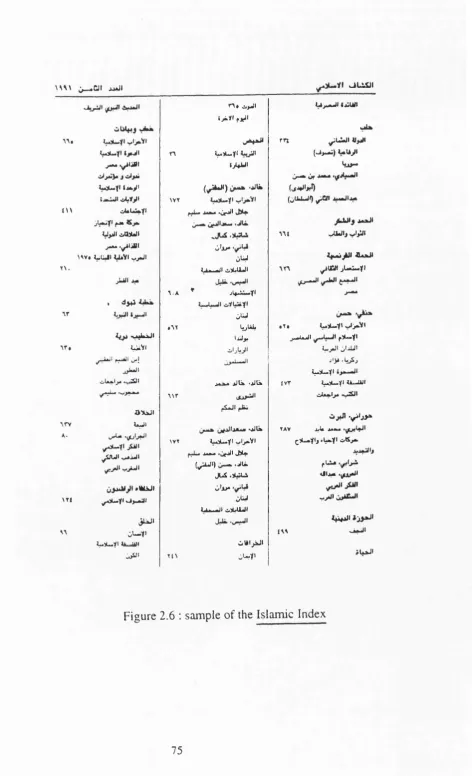
2.3.2.B.4 The Islamic Index... 72
2.3.2.B.5 The Palestine Record... 76
2.4 Other printed bibliographical services... 79
2.5 Arabic subject heading lists and thesauri... 82
2.5.1 Arabic subject heading lists...82
2.6 Conclusion...86
Chapter three : Keyword indexing techniques and the case for Arabic literature...88
3.1 Introduction... 89
3.2 History of keyword indexing... 90
3.2.1 Concordances...90
3.2.2 Abstracts...91
3.2.3 Titles 92 3.3 Computer characteristics... 97
3.3.1 Speed... 98
3.3.2 Accuracy... 98
3.3.3 Reliability... 99
3.3.4 Cost... 99
3.4 Title-derivative indexes generated by computers... 99
3.4.1 Indexes using the rotation of title KeyWords-In-and -Out-of-Context... 100
3.4.1. A Key Word-In-Con text (KWIC)...101
3.4.1.B KeyWord-Out-of-Context (KWOC)... 101
3.4.1.C W ord and Author inDEX (WADEX)... 101
3.4.1.D Author and KeyWord-In-Context (AKWIC)... 102
3.4.1.E Online KeyWord-In-Context (OKWIC)...102
3.4.2 Indexes using the rotation of enriched title Key Words In-and -Out-of-Context... 110
3.4.2.A Key Word-With-Con text (KWWC)... 110
3.4.2.B Enriched Title-based-KeyWord (ETKW )...110
3.4.3 Indexes employing title keywords coordination... 114
3.4.3.B DOuble-KWIC coordination index (DOKWIC)...115
3.4.3.C PANDEX index... 115
3.5 Title keyword indexing and Arabic articles...119
3.6 Arabic title keyword indexing tools...119
3.7 Instructions to authors about titles...121
3.7.1 English language journals and books...121
3.7.2 Arabic language journals and books...125
3.8 Functions of titles of Arabic periodical articles... 126
3.8.1 In the primary journals...127
3.8.1.A In content lists... 127
3.8.1.B In reference lists... 129
3.8.2 In the secondary services... 129
3.8.2.A In the reproduction of contents pages... 129
3.8.2.A.1 Contents of Arabic Periodicals (CAP)...130
3.8.2.A.2 In journals and daily newspapers...131
3.8.2.B In conventional indexes arranged by subject headings...131
3.8.2.C General and specialized bibliographies...131
3.8.2.D Titles indexes...132
3.8.2.E In machine-readable databases...132
3.9 Advantages and drawbacks of title keyword indexing...135
3.9.1 Advantages...135
3.9.2 Drawbacks...136
3.10 Conclusion...137
4.1 Literature survey... 140
4.1.1 English titles...140
4.1.2 Arabic titles...156
4.2 A study of the information content of Arabic titles...157
4.2.1 Objectives of the study...157
4.2.2 Method and samples...157
4.2.3 Arabic stopwords list...161
4.2.4 Results...163
4.3 A study of the information content of English titles... 165
4.3.1 Objectives of the study...165
4.3.2 Method and samples...165
4.3.3 Results...166
4.4 Comparison between the results of the two studies using the T test...168
4.5 Discussion of the results for the two studies...170
4.6 Conclusion...172
Chapter five : Matching title keywords of Arabic articles and their corresponding subject headings in an interdisciplinary printed index...173
5.1 Introduction...174
5.2 Previous studies...174
5.3 Interdisciplinary studies...176
5.4 Criticism of these studies...178
5.5 Criticism of the criticism...180
5.6 New study for titles of Arabic periodical articles...181
5.7 Objectives of the study...181
5.8.1 Sample determination... 182
5.8.2 Categories of analysis... 184
5.8.3 Definitions of categories with Arabic examples...185
5.8.3.A Exact match : entire heading...185
5.8.3.B Exact match : access point only...185
5.8.3.C Stem match : access point... 186
5.8.3.D Synonym match : access point...186
5.8.3.E No match...187
5.8.3.F Subdivisions match... 187
5.9 Results and analysis...189
5.10 Discussion... 196
5.10.1 Single categories...196
5.10.1.A Exact match : entire heading...196
5.10.1.B Exact match : access point only...196
5.10.1.C Stem match ; access point...198
5.10.1.D Synonym Match : access point...198
5.10.1.E No match...198
5.10.1.F Subdivisions match...199
5.10.2 Combined categories...199
5.11 Conclusion...203
Chapter Six : The occurrence of title keywords in their article's topic sentences... 206
6.1 Introduction... 207
6.2 Objectives... 207
6.3 Usage of topic sentences...208
6.3.1 The use of topic sentences in this study... 208
6.4 Method and samples... 213
6.4.1 The location of topic sentences... 213
6.4.2 The matching criteria... 214
6.4.3 The recognition of anaphors... 215
6.4.4 Samples and data gathering... 218
6.5 Results 219 6.6 Discussion... 227
6.7 Conclusion... 233
Part three : Arabic language characteristics and the efficiency of title-derivative printed indexes Chapter Seven : Producing an Arabic title-derivative printed index and users' evaluation... 235
7.1 Bibliographic information systems and Arabization...236
7.2 The use of computers to produce Arabic printed indexes...239
7.3 Title keword derivation techniques and the Aiabic language...241
7.3.1 The rotation technique and the Arabic language...242
7.3.2 The permutation technique and the Arabic language...243
7.4 The title-derivative index types and the Arabic language...243
7.4.1 The KWIC type and the Arabic language...244
7.4.2 The KWOC type and the Arabic language...248
7.4.3 The PSI type and the Arabic language... 249
7.5 Producing a title-derivative printed index for Arabic articles...251
7.5.1 Choosing the software...251
7.5.2 The production process of the KWOC type index...257
7.5.3 Problems involved in the production process...261
7.5.3.B The various types of the Arabic ‘alif character...262
7.5.3.C Voweling m arks... 264
7.5.3.D Indian numbers... 265
7.6 Comparison of two types of Arabic printed indexes...265
7.6.1 The evaluation process... 266
7.6.2 Producing an al-Fihrist type comparable index...267
7.7 Methodology of the comparison between al-Fihrist and the KWOC types... 271
7.8 Results of the comparison... 275
7.8.1 The al-Fihrist type index (category A)...277
7.8.2 The Arabic KWOC type index (category B )... 280
7.9 Discussion... 283
7.10 Conclusion of the comparison process...289
Chapter eight : Characteristics of the Arabic language and problems of retrieval from an Arabic title keyword printed index...291
8.1 Introduction...292
8.2 Arabic alphabet... 293
8.3 Arabic language features... 295
8.4 Retrieval problems... 295
8.4.1 Retrieval problems handled at the input stage...296
8.4.1.A Usage of voweling marks... 297
8.4.1.B Inseparable prepositions... 301
8.4.1.C Variation in the orthography of some letters...301
8.4.2 Retrieval problems requiring sophisticated software...306
8.4.2.A The definite article... 306
for the same keywords... 309
8.4.2.D Use of different spellings for the same k ey w o rd ... 310
8.5 Conclusion...311
Chapter nine : Conclusions and recommendations...313
9.1 Background to the study...313
9.2 Procedures followed in the thesis... 314
9.3 Findings of the thesis... 314
9.3.1 Arabic periodical indexes...315
9.3.2 Titles of Arabic articles...315
9.3.3 Informativeness of Arabic titles...315
9.3.4 Representativeness of Arabic titles...316
9.3.5 Arabic KWOC evaluation...317
9.4 Conclusions... 318
9.5 Recommendations...321
9.6 Future studies... 323
Appendices and references Appendix 1.1 : The Library of Congress transliteration system for Arabic letters... 325
Appendix 1.2 : List of the Arabic indexing tools which were mentioned in the thesis and their English transliteration... 326
Appendix 4.1 : List of the Arabic periodicals which were used to study the informativeness of Arabic article titles...329
Appendix 4.2 : The stopwords list which was used to study the information content of titles of Arabic periodical aiticles... 331
Appendix 5.1 : List of the Arabic periodicals used in the matching process between titles of Arabic articles and their corresponding subject
headings...335
Appendix 6.1 ; List of the Arabic phrases found at the beginning of the examined Arabic topic sentences... 336
Appendix 6.2 : List of the Arabic periodicals from which the samples of titles and topic sentences were selected... 337
Appendix 7.1 : Copy of the form which was distributed to the searchers of al-Fihrist type index...338
Appendix 7.2 : Copy of the form which was distributed to the searchers of the Arabic KWOC type index... 343
Appendix 8.1 : The Arabic characters and their various shapes within a word, taken from W right (1933)...348
Tables
Table 2.1 : number of periodicals in each Arab G ulf State alongside the number of individual printed indexes which they publish... 43
Table 4.1: composite of the prior researches which examined the information content of titles of English periodical articles...141
Table 4.2 : the num ber of substantive words found in titles of chemical articles during the selected years - Tocatlian (1970)...143
Table 4.3 : the difference in means found between the selected years - Tocatlian (1970)...143
Table 4.4 : average of titles length for the four selected journals - Bird and Knight (1975)... 145
Table 4.5 : average of titles length in Nature - Bird and Knight (1975)... 145 Table 4.6 : average of titles length in chemical literature - Bird and Knight (1975)...145
Table 4.7 : Buxton and M eadow s’s (1977) results for titles in scientific journals... 148
Table 4.8 : Buxton and Meadows's (1977) results for titles in non- scientific journals... 148
Table 4.9 : Balog’s (1981) results for titles in New Zealand Journal of Agricultural Research...150
Table 4.10 : Diodato’s (1982) results for titles in five selected journals... 151 Table 4.11 : sample of an Arabic keyword with three inseparable
prepositions...161
Table 4.12 : the mean and standard deviation values of contents of Arabic scientific article titles in five disciplines... 163
Table 4.13 : the mean and standard deviation values of contents of Arabic non-scientific article titles in eleven disciplines... 164
Table 4.15 : the mean and standard deviation values of contents of English non-scientific article titles in eleven disciplines... 167
Table 4.16 : values of T for differences between scientific titles of English and Arabic articles... 168
Table 4.17 : values of T for differences between non-scientific titles of English and Arabic articles...169
Table 5.1 : Sedano's (1964) results of comparisons of title words and subject headings...177
Table 5.2 : Lane's (1964) results of comparisons of title words and subject headings...178
Table 5.3 : number of sample articles and their allocated subject headings in 10 subjects taken from al-Fihrist...183
Table 5.4 : number and percentage of access points and subdivisions for su b ject h eadings w hich m atched k ey w o rd s in titles o f A rabic articles...191
Table 5.5 : overall number of access points which m atched keywords in Arabic titles and their percentage...193
Table 5.6 : number and percentage of similar words between title keywords o f A rabic articles and their corresponding subject headings in 10 subjects...194
Table 5.7 : average number of keywords per Arabic title and subject headings per article in 10 fields... 195
Table 5.8 : percentage of similarities between title keywords and words in subject headings in 10 fields...201
Table 5.9 : num ber and percentage of subject headings according to categories of matches... 202
Table 5.10 : number and percentage of matches according to their discipline groups...203
Table 6.2 : num ber of sample, substantive words in topic sentences; substantive words in titles; substantive words which matched; proportion of substantive words which matched; and proportion of substantive words in titles of library and information science...221
Table 6.3 : num ber of sample, substantive words in topic sentences; substantive words in titles; substantive words which matched; proportion of substantive words which matched; and proportion of substantive words in titles of linguistics...222
Table 6.4 : num ber of sample, substantive words in topic sentences; substantive words in titles; substantive words which matched; proportion of substantive words which matched; and proportion of substantive words in titles of philosophy... 223
Table 6.5 : num ber of sample, substantive words in topic sentences; substantive words in titles; substantive words which matched; proportion of substantive words which matched; and proportion of substantive words in titles of sociology...224
Table 6.6 : mean and standard deviation value of the relative matching in titles of each of the examined subjects, ananged according to their mean values...226
Table 6.7 : mean and standard deviation values of the absolute matching in titles; substantive words in titles; and substantive words in topic sentences, arranged according to the mean values of their absolute matching 226 Table 6.8: number and percentage of representative and non-representative titles in the five selected subjects... 230
Table 7.1 : the average recall and precision of the al-Fihrist type searchers category...278
Table 7.2 : the average time taken by searchers of the a l-F ih rist type category...279
Table 7.3 : the average recall and precision of the K W O C type searchers category...281
Figures
Figure 2.1 : sample of the Index of Articles in Saudi Periodicals
specialized in Libraries and Information...52
Figure 2.2 : sample of Index Arabicus... 56
Figure 2.3 : sample of the Analytical Index of Arabic Newspapers and Journals...61
Figure 2.4 : sample of the Educational Index of Periodical Articles in the United Arabic Republic... 62
Figure 2.5 : sample of the al-Fihrist... 71
Figure 2.6 : sample of the Islamic Index...75
Figure 2.7 : sample of the Palestine Record... 78
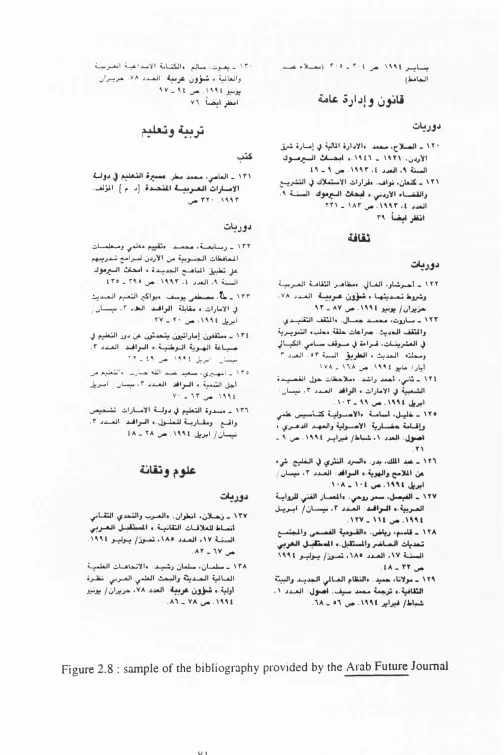
Figure 2.8 : sample of the bibliography provided by the Arab Future Journal...81
Figure 3.1 : sample of Watt's Bibliothica Britannica, taken from Craven (1986)... 95
Figure 3.2 : sample of the Manchester Public Libraiy catalogue by Crestadoro (1856)...96
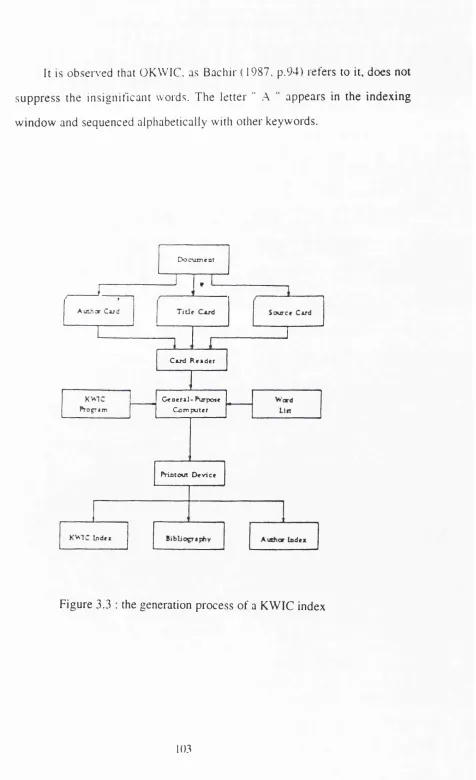
Figure 3.3 : the generation process of a KWIC index... 103
Figure 3.4 : Scunple of a KWIC type index... 104
Figure 3.5 : sample of a KWOC type index with indexing window at the left m argin...105
Figure 3.6 : sample of a KWOC type index with indexing window above the index line entry...106
Figure 3.7 : sample of a WADEX type index... 107
Figure 3.8 : sample of an AKWIC type index... 108
Figure 3.9 : sample of an OKWIC type index...109
Figure 3.10 : sample of a KWWC type index...112
Figure 3.11 : sample of an ETKW type index showing the process of title enrichment...113
Figure 3.12 : sample of the final output of a ETKW type index, taken from Rajendran (1986)...113
Figure 3.13 : sample of a PSI type index... 116
Figure 3.14 : sample of a DOKWIC type index...117
Figure 3.15 : sample of a PANDEX type index... 118
Figure 3.16 : sample of "IBN ALNADEEM" search result...120
Figure 3.17 : samples of instructions to authors on the composition of titles, collected by Feinberg (1973)...124
Figure 3.18 : cover of the Arabic Journal of Information Science showing titles of articles in the issue...128
Figure 3.19 : sample of the Bibliography of the Islamic Maghrébin... 133
Figure 3.20 ; sample of the Message of the Library's title index... 134
Figure 7.1 : sample of Index of Events Section in the Panorama of Events Journal...245
Figure 7.3 : Salem's KWIC list of Arabic medical terminology...247 Figure 7.4 : sample of the KWOC index to the al-Jam i‘a thesaurus 250 Figure 7.5 : sample of KWIC type index produced by
Dobis system... 253
Figure 7.6 : sample of the Arabic KWOC type index produced for this study... 260
Figure 7.7 : sample of the al-Fihrist type index produced for this study... 270
Figure 8.1 : sample of al-Fihrist index showing the use of scope notes beside ambiguous subject headings... 299 Figure 8.2 : sample of the Islamic Index showing the use of
scope notes beside ambiguous keywords... 300
Chapter one
Introduction
1.1 W h at is a periodical p rin ted index ?
W agner (1960), H arrod (1977, p.412), the A m erican L ibrary A ssociation (1983, p .116), British Standards Institution (1988, p.2), and Cleveland (1990, p.26) generally agree that an index is a systematic guide to the contents of items or documents : it guides users to the items that they are looking for or interested in by means of keywords or subject headings arranged in a known order. This systematic guide offers access to to the huge volume of literature by communicating the existence of items in the current literature from one side and by making past literature available through facilitation of retrospective searching from the other side. Thus, a periodical index can be defined as an orderly bibliographic tool to the intellectual content and physical location of indexed articles. It is only a guide and as such it does not provide the desired article itself, but it employs a set of bibliographic tags which refer to the source of information for which the user is searching. Printed periodical indexes are of many kinds. However, this thesis is looking into one type of them often called title-derivative printed indexes, which normally employ the rotation and the permutation techniques in the process of their generation.
As for the basic components of such printed indexes, Azgaldov (1969) and Campey (1972, p.3) gave a considerable description of printed subject indexes, but it is convenient in this section to mention only those of derived printed indexes, which are the following :
a - The entry point part (title keywords).
d - Reference code which can be ;
i - A numeric reference num ber to an associated or separated bibliographic list.
ii - An alphanumeric code which can also be to an associated or separated bibliographic list.
iii - An author's name.
1.2 Conventional and unconventional periodical indexing
1.3 Incentives of this research
M ost of the Arabic periodical indexing systems which are being used to
analyse the growing numbers of Arabic periodical articles are conventional.
Only few have recently started to rely on com puter facilities to produce
printed indexes with the subject headings assigned by an indexer, e.g. the
Islamic Index uiLltXJ I). In such cases com puter facilities are used
only to perform purely clerical operations like storing the data and then
sorting them out according to a specific order. As a m atter of fact, it has not
been until recently that indexing services have been available for the contents
of Arabic periodicals published in the Arabic language. In the early 1980s
conventional indexing services for cunent Arabic periodicals were introduced
with the publication of individual periodical indexes by a number of research
periodicals such as W orld of Thought ( j < à l l ^JLc) ; Arab G ulf Journal
( ^ ^ ^ 1 ; and the Jordanian periodical Studies (d»Luul j j ) .
A proper index for Pan-Arabic periodicals was not begun until 1981
with the publication of al-Fihrist It is a quaiterly index to the
contents of academic and research Arabic periodicals ranging from monthlies
to annuals. Despite the fact that many trials to produce indexes for Arabic
periodicals were carried out before its appearance, a l-F ih rist is widely
considered as the first effort of its kind in the Arab world. A lthough the
p u b licatio n of a l - F i h r i s t does fill a serious gap in existing A rabic
bibliography, it is not a perfect tool to index the contents of A rabic
periodicals and has not succeeded in being current. Some of the reasons
behind this failure are the shortage of professional Arab indexers and the fact
that conventional indexing consumes time and is expensive to keep updated.
1.4 Purpose of this research
As a remedy for the poor bibliographic control with regard to Arabic periodicals in the Arab world and to the weakness and inadequacy of the current Arabic periodical indexing tools, this thesis is investigating the possibility and relevance of using unconventional indexing techniques to enable users to satisfactorily keep abreast and to assist publishers in overcoming the existing limitations of current Arabic periodical indexing. One sort of unconventional indexing techniques which can be employed in such circum stances is the use of keywords of article titles to produce title-derivative printed indexes.
It is generally known that one pait of the article in which the author usually attempts to indicate the subject m atter is the title. However, this function of the title is sometimes used improperly by authors who are exploiting it in order to tempt readers by providing attractive but unindicative titles. The objective of this research is to provide an answer to the question of whether titles of Arabic periodical articles can be relied on as a basis for title word indexing techniques. To investigate this possibility, the thesis assumes that restrictions which formerly prevented the use of computers to generate automatic title-derivative printed indexes are diminishing, and claims that if titles of Arabic periodical articles are found adequate, then the use of such indexing techniques will enhance the dissem ination of Arabic periodical literature to a larger audience.
1.5 Article titles and their importance
by means of computer, it is relevant to cite some of the definitions and quotations concerning the titles of academic articles and show their vital importance in information retrieval processes.
Rowley (1992, p. 145) defines the title of a work as a " word, phrase, character, or group of characters, normally appearing in an item, naming the item or the work contained in it Thus the title is a label associated with a work, especially if this work is a journal article. It is the first thing that we read when we scan a periodical's list of contents, and as Bottle and Seeley (1970) say " the title of a document or paper is probably the first thing about that document or paper that really registers in our minds unless one of the authors has an exceptionally well-known name ".
The title of a journal article is the m ost im portant among other bibliographic information contained in articles as printed in the primary journals. These other elements could be :
a - Author's name and affiliation b - Abstracts
c - Keywords d - References
It is more important because it is usually more indicative of the content of its corresponding article than the author's name, which is not known in m ost cases. Unlike the abstract, keywords, and references, the title of an article alw ays accom panies the article, and is one of the item s of bibliographic information in both primary and secondary printed journals.
in his chapter " writing the first draft " . He says " all journal papers carry titles, and m ost include abstracts Moreover, an author of a paper m ight be lucky to find a journal that considers his abstractless or referenceless paper for publication. But his luck will not help him in getting a journal which accepts an article without a title for publication. Mullins (1977, p.248) asks authors to make the titles of their papers clear and descriptive so that the editor will be helped to choose the appropriate referees.
In fact, the importance of the title is acknowledged by the authors themselves. It is in this part, which is a key element for the readers, that they usually attempt to indicate the subject matter of the content of their articles. However, it could be used improperly by some authors who exploit it in order to tempt the readers by providing attractive but unindicative titles. It is a key elem ent to the readers because it is on the basis of the title that they frequently make decisions on whether or not to read the article's abstract, look at the list of references, or skim through its full text. It is believed that the cases where readers make further reference to the journal article on the basis of its author's name are fewer than those in which readers usually would find out " who has written a specific article " rather than " what has been written by a specific author ". There are in fact indications that in many situations a reader is likely to remember a title better (Ayres et al, 1968).
of documents that we do not require. Thus for the majority of documents, the titles of which we scan, information transfer in a negative sense occurs through their titles Many scholars will not read articles whose titles do not show clearly that the subject matter is related to their interests.
1.6 Rotation and permutation techniques
It was mentioned earlier in this chapter that title-derivative printed indexes normally employ rotation and permutation techniques in the process of their generation by means of computer. Since a confusion is found in English and Arabic indexing literature regarding these two techniques, it is useful to clarify this issue before getting to the various types of title-derivative printed indexes which use them.
indexing position
W hereas in permuted printed indexes, all possible perm utations of the
title's keywords are used as access points. To give an exam ple in symbolic
form, if the same keywords as above are chosen ’alif (1), b (c j), t (cu) and th
(vl») then reference to them would be from the following index entries:
I I:,
* # f
lit 1:1 ** â! t j i ** I : I : i ** t : t
I:,
The num ber of perm utations that can be m ade of n keyw ords is n!
(factorial n). For the above symbolic title keyw ords which are 4, n! is 24
permutations.
It is important not to confuse these two techniques with each other, an
eiTor into which many Arab and English authors and publishers have fallen.
For instance several authors referred to KW IC (K eyW ord-In-Context) and
in fact they are rotated indexes. For more details about such confusion, reference to Kemp et al (1972) and Foskett (1982, p.97) is advised.
1.7 Components of this thesis
This thesis is structured to consider the deficiency of Arabic periodical indexing and the solution to this problem. It consists of three parts.
The first part contains three chapters and provides a thorough and comprehensive introduction to the issue of Arabic periodical indexing and the hurdles to the objectives of the printed Arabic periodical indexes to be current and up-to-date indexing tools. It also intends to give a general overview of title keyw ord indexing and the ways in which the various types of title-derivative printed indexes aie produced.
The second chapter of part one represents a state of the art report for Arabic indexing and Arabic printed indexes. It casts light on the history of Arabic periodical indexing and surveys the indexing products including the printed indexes which have ceased publication as well as the current ones. It concentrates on the current Arabic periodical indexes to show their deficiency and inadequacy in covering the contents of Arabic periodical articles and reveals the reasons behind this deficiency to conclude that a new indexing system is now needed.
articles, and ends with a condensed review of what has been said about the advantages and drawbacks of title keyword indexing techniques.
Part two of this thesis also consists of three chapters. It aims to provide the answer to the issue of the informativeness and representativeness of Arabic article titles. Since the proposed indexing m ethod depends on keywords found in titles of Arabic articles, the quality of such printed indexes relies to a great extent on how well the titles of Arabic periodical articles are constructed by their authors. Three consecutive chapters are devoted to investigating the informativeness and representativeness of Arabic article titles. Informativeness is different from representativeness and informative titles may not be representative, a difference that was not noticed in many of the previous studies which dealt with the relevance of article titles for indexing.
Chapter four of this thesis is devoted to the study of the information content of titles of Arabic periodical articles and aims to find out how well Arab authors compose the titles for their articles in terms of the number of informative words. It determines the average length of Arabic article titles and the number of substantive words they include in contrast with the number of non substantive words in 16 various fields. A sim ilar study o f the information content of English article titles was carried out for the purpose of comparison. English periodical articles have already been investigated and claimed to be informative according to previous studies.
indexer-assigned subject headings for the same articles in 10 various fields taken from al-Fihrist (cj-uuj^U I) index. Another objective for this chapter is to determine the average number of subject headings assigned to Arabic articles and compare it with the average number of access points (keywords) found in the titles of the same Arabic articles.
Chapter six is also devoted to the examination of titles' representation of their accompanying articles. To overcome the criticism of the previous titles' representation study in chapter five, this chapter tries to follow a completely different approach. For this, it assumes that authors normally express the subject of their articles in what is known as the " topic sentence ", often found in the " introduction " or " objectives " parts of an article. This chapter matches the keywords found in titles and the keywords found in the topic sentences manually extracted from the selected articles. It starts with defining the expression " topic sentence " and the boundaiies of its use as well as reviewing its previous usage in the libraiy and information science literature. Then the matching process is carried out with attention to other aspects that may affect the results and the chapter ends with a conclusion to the whole process.
latter is a conventional index to the same articles. These two types are then shown to a number of Arab users in a process to study the retrieval efficiency of the first in com parison to the conventional index. In this chapter, consideration is given to the Arabization activities for computer programs and the use of Arabized computer packages in librarianship and information work in the Arab institutions inside and outside the Arab countries.
Chapter eight is allocated to the study of the characteristics of the Arabic language and the problem s involved if users depend on Arabic title-derivative printed indexes to search for their required articles. It provides some suggestions in this domain.
Chapter two
Arabic literature indexing and
Arabic periodical printed indexes
2.1 Introduction
Before starting the next part which is concerned with Arabic periodical
printed indexes, it is relevant to mention that cooperation am ong Arab
countries to produce general and specialized regional bibliographies was not
remarkable until late 1972, when ALECSO (the Arab League for Education,
Culture and Sciences Organization) published the first issue of the A rabic
Publications Bulletin (cuLcj iL ^ 11 I 6 j2a \l I). This bulletin constitutes
an accumulation and coordination for the contents of other available Arabic
national bibliographies as well as bibliographic descriptions and details on
publishing activities given by Arab countries which do not have national
bibliographies. This unprecedented effort in the Arab world is not ideal and
still carries some drawbacks in its com ponents. It only covers books and
periodical articles and neglects other types of m aterials. Also it does not
report the publishing activities in all Arab countries. In addition, the
inegularity of its publication has turned it into more of a retrospective than a
c u n en t bibliographic tool. The progress of this regional bulletin depends to a
great extent on the commitment to the legal deposit system in the countries
where it exists, or perhaps on making this system com pulsory to authors, as
well as the establishing of national libraries in the countries w hich are
dropping behind. One more condition towards the developm ent of such tools
is the standardization of rules for the preparation of national bibliographies in
the Arab States.
The rem aining part of this chapter is not going to explore more such
recent bibliographical works, and will skip the Arabic national and other
specialized bibliographies because their coverage extends to monographs and
m ostly annotated. In addition to that, m ost of these bibliographies are retrospective and do not have the characteristics of periodical article indexes which form the core of this thesis.
2.2 History of Arabic periodical indexing
The process of indexing the content of Arabic periodical articles is relatively new to the Arab world and the analysis and recording of m ost indexing products in the Arab world have been almost entirely neglected. The num ber of studies and essays by Arab authors which evaluate such products as to their efficiency and perform ance is alm ost nothing in comparison to other studies done on Western products by Western specialists. The bibliographical works of compilers interested in Arabic librarianship - Abdul Huq and Aman (1977) who cited 1475 titles, Pantelidis (1979) who cited 1047 titles, ‘Abd al-Hadi (1981, 1987, 1988, 1989a, 1989b, ) who cited almost 10377 titles, Anwar (1985) who cited 338 titles in Arabic librarianship and information studies in the Arab world since 1900 until 1983, Tameem (1988) who cited 71 titles, and M ustafa (1991) who cited 349 titles in universities and institutional libraries - were consulted for studies on Arabic periodical indexing for that period. These bibliographies cover all possible printed materials including books, periodical articles, dissertations, theses, pamphlets and unpublished special mission reports.
The result showed that Arab and non-Arab authors had little interest in
this topic at the beginning and that their interest, although unrem arkable,
staited to be seen through the bibliographic records of the 1980s onwards.
Ham dy (1980) refers the desire for progress on the front of Arabic
bibliography and its controlling tools for many reasons. Some of these were :
the involvem ent of UNESCO (the United Nations Educational, Scientific,
and Cultural Organization) and other national and international organizations
in developing the library systems in the Arab world and then the return of
several Arab librarians trained in Europe and the United States to their native
countries. This need for controlling tools was expressed in local m eetings,
national seminars, and regional conferences on libraries and librarianship in
the Arab world. Three of these early seminars in particular, one held in Beirut
1959, one held in Cairo 1962, and one held in Riyadh 1973, discussed the
problem s of bibliographic control of Arabic m aterials and the need for
professional tools, which is one of the major problems standing in the way of
library and information services development in the Arab world. In addition
to other m ajor librarianship issues, all three sem inars recom m ended
establishing tools and standards for the production of indexes.
In the Arabic literature of library and information science, the Arabic
word kashshaf ( is used to match the English term (index) and the
word fahrass j_ ^ ) is used to express the meaning of the English word
(catalogue). Musa (1973, p.2) and al-Hajrasy (1974a, p.82) mentioned that in
the literature of librarianship in the Arab world the convention has settled on
the usage of the Arabic word kashshaf ( e iL i^ ) to be equivalent to the English
term (index).
The confusion in using both Arabic terms index (<_âLl^) and catalogue
Some specialists use the word fahrass (catalogue, j-h ) to describe the
product of indexing the contents of one or many journals. Some others use the
word kashshaf (index, to describe similai* products. The word fahrass
(catalogue, ^ has been in use for long in Arabic literature concerned
with bibliography. It is an Arabization of the Persian term fihrist
w hich was used in the title of the oldest Arabic bibliography " F ih ris t
a l-‘U lum " compiled by Tbn al-Nadim. W hereas the word kashshaf (index,
is recent in Arabic and according to the published Arabic indexes, the
first bibliographic product to use this word is " the E ducational Index of
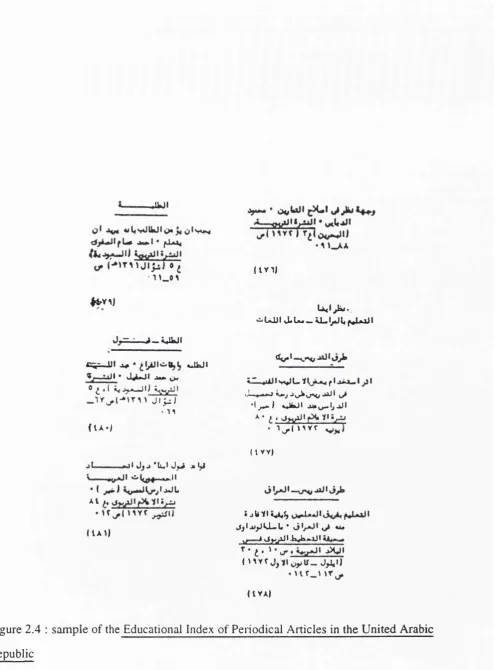
Periodical Articles in the United Arab Republic " (cl.VULL c J L l U l
6,\ ^ j j ^ c u L j j j J I ) launched in 1961 by the Centre
for Educational Documentation as a semi-annual index and ceased in 1967.
For the history of indexing and the printed indexes in the W estern world it is
advised to see Cornog (1983) and W ellisch (1983) who wrote extensive
articles about this matter.
The confusion between what is an index and what is a catalogue is not
Arab made. In the literature of library and information studies, a distinction is
som etim es m ade betw een the two term s subject indexing and subject
cataloguing. Thus, the same distinction is made between the output of the first
process and the output of the latter. Usually the first output is called an index
whereas the latter is called a catalogue. Lancaster (1991, p. 14) stated that "
subject cataloguing usually refers to the assignm ent of subject headings to
represent the overall contents of com plete bibliographic items within the
catalogue of a library. Subject indexing is a term used more loosely ; it may
refer to the representation of the subject m atter o f parts of com plete
bibliographic items as in the case of an index at the back of a book ". He sees
inconsistent and only serves to cause confusion. He furthermore believes that " the process by which the subject m atter of bibliographic item s is represented in published databases printed or m achine-readable form is almost invariably referred to as subject indexing, whether overall items or their parts are being discussed ‘Abd al-Hadi (1982, p.lS ), an Arab scholar in this field described the difficulty of distinguishing between these two processes, although there is a trend to use the term subject cataloguing
(Luij4^) to represent the subject matter of complete bibliographic items and to use the term subject indexing (<., a to describe the contents of parts which form larger or com plete items. ‘Abd al-Hadi added that if the catalogue guides the user to both the bibliographic descriptions and subject cataloguing as well as to the location of the book in a library collection, the index reveals the analysed contents of a single or many books in specific groups or to one or more periodicals. On this inteipretation, he believes that the difference between an index and a catalogue is a difference in the degree of analysis and not in the type. The cuiTent inconsistency in the Arab world between w hat is an index and what is a catalogue is likely to survive throughout the coming years.
To overcom e the confusion in the nom ination of the A rabic bibliographical products, this thesis considers relevant and falling inside its scope every product that meets the characteristics of printed indexes to periodical articles and uses the word index to describe such bibliographic tools.
2.2.1 P rin ted indexes to the contents of daily new spapers
These are indexes to the current affairs news published in dailies. They are not many in the Arab world, although currently there is a general trend towards the indexing of daily newspapers and weekly journals with the introduction of certain bibliographic retrieval systems which accept Arabic scripts. Unless leading Arabic daily newspapers take the lead in doing so, and establish indexes which cover the contents of all newspapers in each Arab country, there will be repetition of indexed news items on the country level. Some of the current and retrospective bibliographic tools which represent these indexes in the Arab world are the following :
a - The al-*Ahram Index (^1 jJhVI It is a monthly index to the content of the Egyptian daily al-’Ahram (^1 j-aVI). Al-Qadi (1974) mentioned
in the introductory article of the first yearly cumulated printed issue of this index that the regular monthly issues of the al-’Ahram Index started to appear in January 1974.
b - The Yearly Analytical Index of ’Um m al-Oura Gazette («-iLiJll I Badran and Tashkandi (1978) stated that this is a yearly index to the contents of the Saudi weekly official Gazette
'U m m al-Oura ((^ jU I ^1) and started publication in 1977.
2.2.2 P rin ted indexes to the contents of individual periodicals
that proceeds from 1958 to 1983, and al-Darah (S jlaJI) which has one that proceeds from 1975 to 1980. Both indexes have subject, author and title entries. Undoubtedly, the preparation of such indexes is an easy process in comparison to other available conventional indexes and its retrieval value is not as effective as in multiperiodical indexes. The individual indexes for Arabic periodicals currently appear in two forms :
a - A printed yearly index which is more or less a combination of the lists of contents that appeared in the periodical throughout the year. The index lists only the content lists of each separate issue of the periodical in one consecutive order according to the publication dates. These kinds of indexes are the m ost elementary guides to the contents of their periodicals. They are elementary because such a listing of contents pages is a page by page guide to the articles appearing in every single issue of the indexed periodical. Obviously this kind of index lacks essential features for the indexing process and should rather be called a collection of contents lists. One example of periodicals using this technique is the Index of the Maghrébin History Journal ( 2 j II <JLaJll which was published in 1988 to list the contents pages of the Journal from issue number 1 to issue number 50 for the period between 1974 -1988.
academic and many of them had their individual printed indexes done after quite a long tim e of their appearance or even after they had ceased publication. One of the oldest Arabic journals which had its cumulative individual printed index done after it had stopped publication is al-M uqtataff (i.&LlÂlI). The index was cumulated by F u ’ad Sarruf and Linda Sadaqah of the Am erican U niversity of Beirut and was published in 1967-1968. It covered the contents of the journal since it first appeared in June 1876 until December 1952. ‘Abd al-Majid (1989) mentioned that the Arab Gulf States Inform ation Docum entation Centre has prepared individual retrospective printed indexes for nine current academic Arabic journals.
Country Periodicals Indexes
Bahrain 44 3
Iraq 213 17
Kuwait 141 12
Oman 27 2
Qatar 31 4
Saudi Arabia 185 19
United Arab Emirates 86 6
Total 727 63
Previously al-Sammadi (1983) stated that apart from the individual indexes which are included as a part of certain issues of periodicals at the end of each year, the number of indexing tools canied out in the Arab Gulf States for Arabic periodicals is 53. He provided a table which showed the different kinds of these tools and their geographical distribution. As far as the other Arab States are concerned it was not possible to construct similar tables from the available guides to their periodicals.
2.2.3 P rin ted indexes to the contents of a general group o f periodicals These are m ultidisciplinary indexes which analyse the contents of a group of different periodical titles by isolating the specific item s of inform ation w ithin particular issues of periodicals both current and retrospective. Such printed indexes aie usually approached by subject and in some cases by author name as well. The Arab world witnessed very few indexes in this category and m ost of them were short lived. Since this category forms the core of this thesis, it is going to be deeply studied and discussed in a separate section (see section 2.3 ).
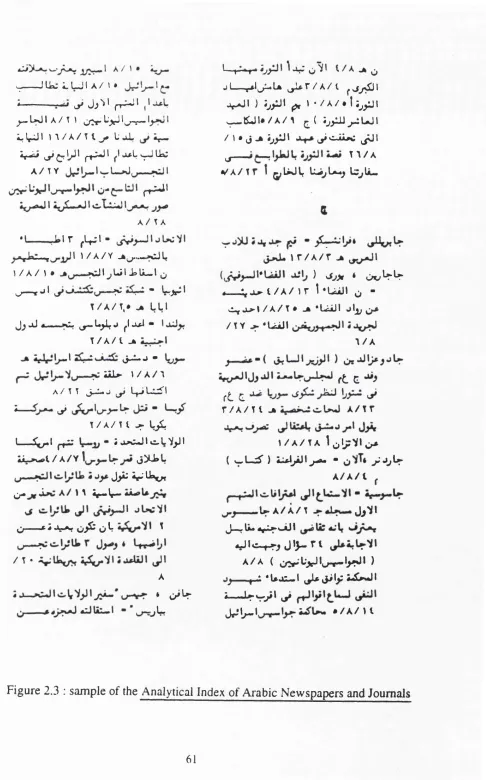
which started in 1961 to cover the contents of 13 Arabic periodicals specializing in education, and was published by the Centre for Educational Documentation. Al-Hajrasi (1974b, p.35) mentioned this semi-annual index which ceased publication in 1967.
The other Arabic specialized printed indexes for retrospective literature in Arabic periodical articles were not many but they did cover quite a large period from the life of their chosen fields. Two retrospective specialized Arabic indexes prepared under the supervision of ALECSO (the Arab League for Education, Culture and Sciences Organization) are the following :
a - The Arab Subject Bibliography ( < ^jjlÏ I >1 ^ >H) : The idea behind this retrospective Arab Bibliography is to produce specialized bibliographies in different fields. It started in 1976 with the coverage of more than 60 different specialized Arabic periodicals which deal with Islamic subjects. ’Abu al-Nur (1978), (1980) mentioned that the first output of this project was six printed volumes of indexed articles which cover Islam in general and some related subjects and a seventh volume with authors' names arranged in alphabetical order. The Arab Subject Bibliography : Islamic Religion ^ j l c : <..ac j-l l
^^LuuVI) constitutes a classified subject bibliography according to the Islamic Religion Classification Scheme ^ t.a j \^^1) adopted by ALECSO, with an alphabetical subject index at the back of each volume.
arranged in alphabetical order according to authors' names and sometimes by article titles under standardized specific subject headings. It uses cross-references and provides two separate author and title indexes.
b - The Bibliographical Guide to the Arabic W ritings on Libraries and
Documentation C I L ^ \
<3^ 3 1II j Cjl : this index covers what was published in Arabic in the fields of librarianship, documentation and information science inside and outside the Arab w orld during the tw entieth century until 1976. The bibliographical entries were arranged alphabetically according to specialized subject headings. The index included bibliographic details on periodical articles, special reports, conferences and seminar proceedings as well as a few original and translated books. Afterwards, ALECSO published other bibliographical guides which cover the Arabic literature on librarianship and information science until 1985.
sorted alphabetically by means of computer.
A u ch terlo n ie (1 9 9 0 a) rev iew ed the in d ex and stated th at notwithstanding his criticisms, the index " is a very welcome addition to the all-too-select band of Arabic periodical indexes". The number of periodicals covered in this index seems to be enlarging. Farraj (1991) who reviewed the third issue of the index, stated that " the number of periodicals covered was 45 ". In the first issue it was 42.
D ilm un's second indexing product P a lestin e R ecord ( &
< j 11 ) published its zero issue in July 1992 to select and analyse the
contents of 46 Arabic periodicals covering and discussing the Palestinian problem and the issues related to the Arab-Israeli conflict in the Middle East. The indexing technique followed in Palestine Record is similar to that used in Dilmun's first product the Islamic Index. Bachir (1992) reviewed the zero issue and mentioned that despite the shortcomings and deficiencies which exist in that issue, it covers a wide gap in the process of controlling the Arabic literature on the above matters and makes the retrieving process of required items much easier.
2.2.5 Printed indexes to the contents o f collections o f periodicals
published by specific organizations
General Committee for the Book. The indexed journals are the following :
Future o f Education I . I t .«). U N E S C O M essage (LI
j<juu *1 I), Science and Society ( ^ ^ 1 -vlI j I), the International Journal
of Social Sciences ( < ^ j J I <Ld\) and UNESCO Journal
of Information Science. Librarianship and Archives Adm inistration ( < L ^
t..fl t- tljV lJ d ll 1 1 < U J d i L o ^ m i 6 jIjV j / L u 'i j _ J I ) . Another recent
retrospective index is the printed index to the contents of Arabic periodicals
published by King ‘Abd al-‘Aziz University in Saudi Arabia. The Analvtical
Index of King ‘Abd al-‘Aziz University Journals ( d i \ W c J L l U l
,i 1 f viLUll was published late in 1992 by the King Eahd
National Library. It covers the contents of all the periodicals published by the
U niversity from 1973 to 1983. In addition to the subject main entries, the
index includes an author index and gives full bibliographic details of the
indexed items.
2.2.6 Printed indexes to the contents o f collection s o f p eriodicals
published in specific countries
This category of printed indexes is rare in the Arab world and is mostly
prepared for retrospective searching. In Iraq, the C entre for Scientifc
D ocum entation produces the A nalvtical Index of Iraqi Journals t»_ilA < ll
-kill) inegulai'ly since 1979. In Kuwait the analytical
retrospective index the Kuwaiti Press in 25 Years L ila . ^ 1 1
( j j J ^ j ) covers what was written about Kuwait in 51 Kuwaiti newspapers
and periodicals since Decem ber 1946 to Septem ber 1972. This index was
com piled by M.H. 'Abd 'A llah and published in 1974. In Saudi A rabia , a
recent exam ple of this category is the Index of Saudi periodicals ( e iL l<
published by the King Fahd National Library. Its introduction included statements clarifying the aims and the scopes of the index. Currently it covers the contents of some retrospective Saudi journals published by Saudi U niversities. How ever, this is only a step towards covering all Saudi periodicals. Sharaf al-Din (1982) and al-‘Annani (1989, p .l6 3 ) respectively carried out studies regarding printed indexes which cover Saudi and Kuwaiti periodicals. This kind of index is as important as other kinds in controlling the Arabic literature published in Arabic periodicals.
2.3 Arabic indexes to the contents o f a group of periodicals
In the previous sections, almost all kinds of Arabic printed indexes for periodical articles were approached. However, due to their reorganization according to other criteria, some of them will be mentioned in this section which is devoted to reviewing the state of the ai t of Arabic printed indexes to the contents of a selection of periodicals.
Indexes, in this section, are divided into two categories : retrospective which only includes indexes dealing with the contents of retrospective or non-up-to-date issues of a group of periodicals ; and current which is issued periodically and analyses the contents of articles taken from various current periodical issues.
current regular indexes are cumulated into annual or larger volumes further to enhance searching efficiency. Such tools vary in the subject and coverage size, some are vast enterprises with no subject lim itations and others are small and restricted to a certain specializations. In the Arabic language the largest multidiscipline current index is al-Fihrist (cn-u< I) and the smallest specialized one is Palestine Record (< \ \ x Uxü ( ill I W hereas the largest m ultidiscipline retropspective Arabic index is the Index Arabicus :
1876-1984 (\^A 1-\A V 1 : c ü L jjü J I and the smallest one is the Subject Index of the Two Periodicals of the Institute of Public
Administration ( CaUJI ^
2.3.1 The R etrospective A rabic p rin ted indexes
These are usually alphabetical subject analyses to the contents of given lists of reti'ospective issues of cuixent or ceased publication periodicals. They vary in size and subject coverage and their subject indexing is generally done by professionals according to adopted rules with regard to subject headings assignment and bibliographic descriptions provided with their entries. By retrospective indexing is meant the subject indexing of back issues of live or dead periodicals.
appear under humanly assigned subject headings arranged in alphabetical order. Article entries of this type are usually duplicated under more than one subject heading and cross-references are used both to link related subject entries, see also , and to provide alternative subject access used in the index,
see. M ost of such indexes include author indexes in separate sections. In the other m ajor approach a form of classification is used. B ibliographic descriptions of articles are arranged under specific classification numbers or grouped under broad subject categories. For this indexing approach in the Arab world, subject indexes, although necessai^y, are not always provided to allow alternative subject approaches.
2.3.1.A A lphabetical subject indexes
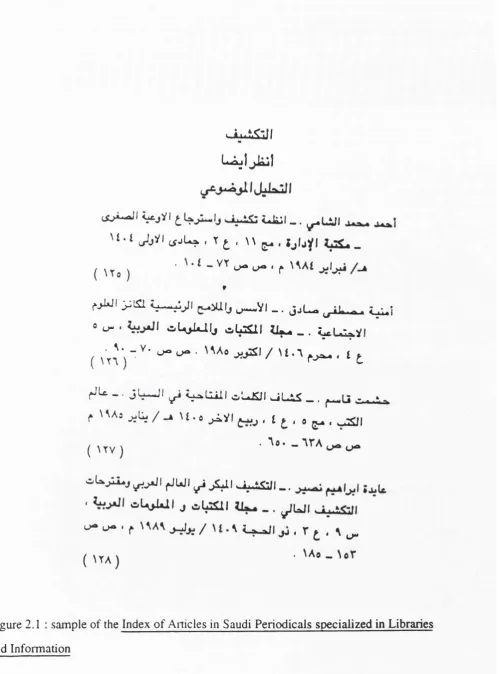
One example of this approach is the recent retrospective index to the contents of Saudi periodicals specializing in library and information studies Index o f A rticles in Saudi Periodicals Specialized in L ibraries and Information ^—w* jun ^ l i I ^ j j • Ai<„lI cjVIJLLLj uJl «t, ^ d i L a jI x I l j d ll This index includes 378 entries to articles which previously appeared in three Saudi librarianship journals : Institute of Public A dm inistration Library Bulletin { I j IjV I < \ 1<A), W orld of Books ( |J U * n and the Arabic Journal of Libraiies and Information 11 < L ^
u u ^ l
L ^ i j k l l
Ÿ : j V I (_ W U I _ . ^ U J I ' ^ • ‘ Jj>fl (j jU^ ■ r I . W t j l j ^ l _
( \To ) • u - c > - • f f
f A ll > 1 ^ S - '- 'ÿ ^ ' u — VI _ , j jU . t ^ i
0 ^
c Uj Ul l j
o U m i l i ^ _ . l y i . T . y ,( \ T ^ ) ~ '^ ' ‘^ ‘^ ’ ' ‘ ’ ■'r>=«< i t
fJU _ . J L ^ I ^ i ^ U i l l o L J S l I U L i^ _ , ... ■ V .
f.
\ \ A « j u l L / _ . M . 0 _ ^ y I . I , 0 £ . , . ^ 1( '^ V )
. ^ 0. « ITA (jA
^ .W l (JUJI ^ jS J I _ i ^ l _ .
■ o U > U I J * 1 ^ 1 _ . y t a j i .
U . . \AA\ > J j ; / i j ^ l j i . r ^ \ ^
( \TA ) ' '''*
-Figure 2.1 : sample of the Index of Anicles in Saudi Periodicals specialized in Libraries
Various characteristics of this index are worth attention ;
a - Specific subject headings are used.
b - Full bibliographic details are provided for each entry.
c - Bibliographic descriptions are duplicated under more than one entry,
i.e. more than one subject heading is assigned to each aiticle.
d - Cross-references see and see also are often used throughout the
subject index.
e - Provides a separate, but not self-contained author index to the
associated subject index.
O ther Arabic printed indexes which m ore or less enjoy the same
characteristics are briefly mentioned hereafter according to their publication
dates :
- Index of Saudi Periodicals ( o j 1 1 j j j J I Published by
King Fahd National Library in 1991 as a pilot study.
- The Analytical Index of King ‘Abd a l-‘A ziz U niversity Journals :
1393-1404 AH 0 9 7 3 - 1983) .iiUI cuyW 1 11 U L A U I
M . l - \T^T : Published in 1992 by King Fahd National
Library.
- Index of Arabic Periodicals at the Library of the Institute of Public
Administration (L x L JI î j l j y i ^ d j L j j a J I L_àlJw<).
Published by the Institute in 1988.
- Index of Journals of Tmam M uhammad Ibn S a‘ud Islamic University
Journals : 1390-1403AH(1970-1983) ^ u i L î ^ )
^ J ^ A Nl . T — I j j « )
- The Subject Index to of the Two Periodicals of the Institute of Public
Administration (5-oL*JI &j LVI a** a ^ j _ l l I). Published
- Researches and Articles of Arabic Educational Journals at the Library of Educational Documents : Subject Index (crjSUil cuVULoj
L_â 1 Ml ^ I I < I < \ Jj_*J I). Published by the Centre for Statistical Data and Educational Documentation in Saudi Arabia, first in 1978 then in 1982.
- The A nalytical Bibliography of A rticles published in the Arabic Periodicals at the Periodicals Library of the Faculty of Commerce in Kuwait University. (c ijL jjjjJ I Â JjljJI cliVLJLoJLI < jl jI i l l % jJI i~ 1 j I < * .A La> — 6 J L .‘V *\J I 4 *1^1 (JiiLj J J jJ 1 4 \ "\^A\ 4 i I). Published by the University in 1977 and 1979.
- The Bibliographical Guide to the Arabic W ritings on Libraries and
Documentation ( J L a ^ \
(3^ ^3111J c jL lIH I). Published by ALECS O in 1976, then in 1981 and 1987.
2.3.l.B Classified indexes
From amongst the totality of retrospective Arabic printed indexes, two types of retrospective classified Arabic printed indexes were seen. In the first, article entries appear under highly specific classification numbers usually derived from a general or special purpose Arabic classification schemes. An example of this type is the Arab Subject Bibliographv : Islamic Religion
^ j J I This
the class number of each record is shown alongside its subject heading. For further details see section 2.2.4 of this chapter.
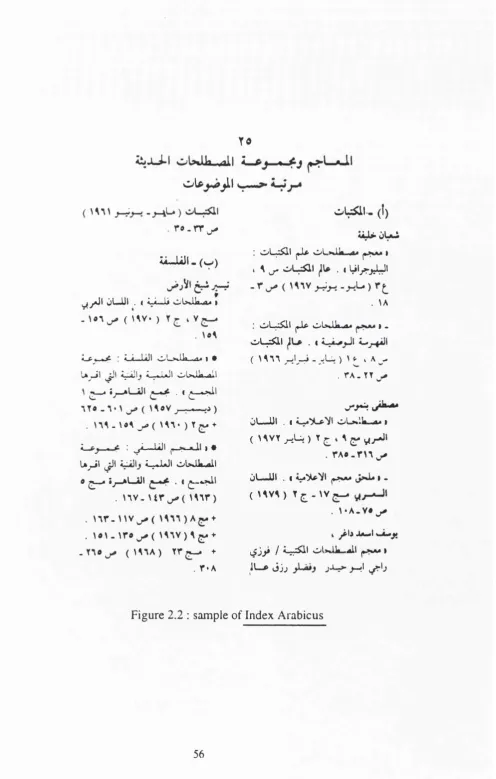
In the second type, article entiies appear under broad subject categories with specific subdivisions. An example is Index Arabicus : 1876-1984
c jLj j j jJI). It is a retrospective printed classified
index of articles relating to Arabic and Islamic studies published in Arabic scholarly periodicals. It was compiled by ‘Abd al-Rahm an (1989) and published in Baghdad by the Arab Gulf States Information Documentation Centre. It analyses in four volumes, the contents of about 250 periodical articles as well as items from about 50 collective works and conference proceedings. The com piler of this index has chosen to index Arabic periodicals which appear no more than once a month except for the weeklies the the Culture I) and the Message (<J LujjJ I).