R E S E A R C H
Open Access
Effect of explicit visual feedback distortion on
human gait
Seung-Jae Kim
1*and Dieudonne Mugisha
2,3Abstract
Background:Gait rehabilitation often utilizes correction of stepping movements, and visual feedback is one of the interactive forms that can be used for rehabilitation. We presented a paradigm called visual feedback distortion in which we manipulated the visual representation of step length. Our previous work showed that an implicit distortion of visual feedback of step length entails unintentional modulations in the subjects’gait spatial pattern. Even in the presence of cognitive load through a distraction task, distortion of visual feedback still induced modulation of gait step length. In the current study, subjects were aware of the imposed distortion of visual feedback and they were instructed to maintain their natural gait symmetric pattern during trials. We then studied whether such an explicit“visual feedback distortion”would still influence gait spatial pattern.
Methods:Nine healthy subjects participated in the treadmill walking trial. The step length was defined as the distance between each foot. The on-line visual feedback showing right and left step length information as bar graphs was displayed on a computer screen. When distorting the visual feedback, the height of the bar for only one side was manipulated, so that subjects perceived their step length as being asymmetric. Actual step lengths were measured during trial and analyzed to see the effects of visual feedback distortion.
Results:Our results showed that a gradual distortion of visual feedback systematically modulated gait step length away from symmetry even at the expense of an opposing apparent task goal. It was also observed that the amount of induced gait modulation was reduced during the explicit condition compared to the implicit condition where subjects were not aware of distortion.
Conclusions:Our study demonstrated that although the visual feedback display used in this study did not alter visual space or evoke illusions of motion, perturbation of visual information about subjects’movement can cause unintentional motor functions. This suggests that the effect of visual feedback distortion is spontaneous and a gait training involving the visual distortion paradigm may provide an effective way to help subjects correct gait patterns by driving implicit motor functions, thereby bringing benefits to rehabilitation.
Background
Gait restoration is an integral part of rehabilitation for people with brain lesions, spinal cord injuries, and trau-matic accidents involving the hip or lower limbs [1-3]. Gait training that uses passive movements or treadmill training with weight-support can provide repetitive stepping move-ments, thereby promoting activity-dependent plasticity in the central nervous system. This eventually enhances the speed and efficacy of walking in people with disorders [4]. However, the functional gains from gait training have been
shown to be moderate. Perhaps this is because the present forms of gait training may not be interactive enough to promote an efficient motor learning process [5,6].
To help enhance the effectiveness of gait rehabilitation, visual feedback can be implemented into the training, so that not only can subjects monitor their own movements, but also keep them engaged. In particular, visual feedback provided during therapeutic training helps subjects be-come aware of how they move and correct any compensa-tory strategies, which in turn stimulates the motor learning process and leads to better functional outcomes [7-9]. Fur-thermore, a paradigm called visual feedback distortion, where visual feedback is distorted or manipulated, has been proposed for rehabilitation therapy with a potential * Correspondence:[email protected]
1
Department of Biomedical Engineering, California Baptist University, 8432 Magnolia Avenue, Riverside, CA 92504, USA
Full list of author information is available at the end of the article
benefit. Brewer et al. [10] showed, in a finger-motion re-habilitation trial, that there was a considerable physical gain in using visual feedback that distorted the information about the force being exerted by a subject’s fingers.
As a prelude to developing such a paradigm for utiliz-ing visual feedback distortion in the context of gait re-habilitation, we have previously proposed a novel and simple method of providing visual feedback of subjects’ step lengths. In the previous study, the right and the left step lengths during treadmill walking were measured and represented by vertical bar graphs. This on-line vis-ual feedback was displayed to subjects. Then, we impli-citly distorted the visual feedback of the step lengths while the subjects were unaware of the manipulation. For distortion of visual feedback, we changed the scaling factor between the actual step length and the displaying bar height for only one side of the leg so that subjects perceived their step lengths as being asymmetric. The applied distortion level was adjusted during trial. Our previous study showed that the implicit visual feedback distortion affected gait symmetry. Even with a distrac-tion task added, subjects spontaneously modulated their gait symmetric pattern away from actual symmetry in re-sponse to the implicit distortion of visual feedback [11]. This suggests that the effect of visual feedback distortion on changes in step symmetry involves implicit or unin-tentional resources, but still posed the question whether or not some sort of cognitive action was also employed in the modulation of gait symmetry.
In the current study, we expanded on our study by testing healthy subjects using an explicit condition, where we informed them of the imposed distortion of the visual feedback and also instructed them to maintain their natural step symmetric pattern during treadmill walking. Our hypothesis was that the explicit visual feed-back distortion could still affect the stepping pattern of
subjects. A positive outcome of this study would suggest the importance of unintentional processes in gait adap-tation to visual feedback distortion and the potential use of visual feedback distortion may be of value for gait rehabilitation.
Methods Subject
Nine healthy subjects (five men and four women; 19–41 years of age) participated in the experiment with explicit visual feedback distortion. All of the subjects were familiar with walking on a treadmill, and gave informed written consent before participating. The experimental protocols were approved by the California Baptist University Institu-tional Review Board.
General experiment setup
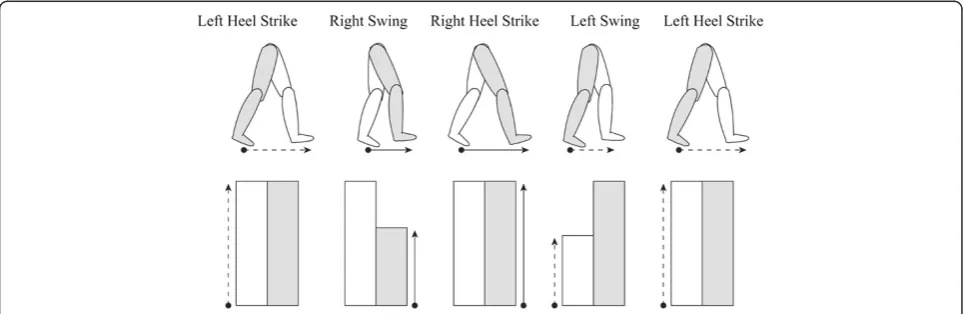
All of the subjects practiced walking on a treadmill for more than ten minutes and chose their natural walking speed which varied between 2.0 mph and 2.4 mph. They continued to walk on the treadmill with a visual display representing their step lengths. The on-line visual feedback system, placed in front of the treadmill displayed vertical bar graphs corresponding to the subjects’step length. Step length was defined as the distance between feet and was mapped to the visual feedback bars (Figure 1). During the swing phase of a leg, the step length increases. Likewise, the bar corresponding to the leg in swing phase increases in height. When the heel of the leg strikes the treadmill floor, the bar remains at its maximum for the whole stance phase until the next swing phase begins. Thus, at every heel strike, whether it is from the left or the right leg, it is possible to observe the maximum length of both the right and the left steps side by side. We explained to the sub-jects the meaning of the bar graphs and they clearly under-stood it during the initial practice without any distortion.
During the explicit distortion trial, we distorted the length of the right bar in increments of 102%, 104%, 108%, and 116% of the actual step length. For example, 104% distortion changed the scaling factor between the actual right step length and the displayed bar height from 100% to 104%. In other words, a distortion of 104% displays a stride length bar that is 1.04 times the height of the actual stride. In this way, subjects visually perceived that their right step length was 4% longer than the actual length during visual distortion. All of the sub-jects were clearly informed that the visual representation of their right step length would be distorted in such a way and we instructed them to maintain their natural step symmetric pattern during the trial. Subjects were able to distinguish the distortion from their own vari-ability at 104% and greater distortion levels.
Actual step length was measured using an optometric tracking system (OPTOTRAK system, Northern Digital Inc., Canada). Two infrared markers were attached on the heel sides of the subjects’shoes. The markers emit infrared light that is seen by a 3-D camera to locate their position. The position data of the markers was retrieved by a PC in real time using a program constructed within LabVIEW to graphically represent the step length measurements.
Procedure
The experimental trial lasted 10.5 minutes. While walk-ing on the treadmill, subjects continued to look at the visual feedback display over the entire period. During each trial, three different profiles of distortion adjust-ment were applied to see the effects of changing the rate of distortion level on the change in step length sym-metry (Figure 2). The periods over which different dis-tortion profiles were applied were referred to as block 1, block 2, and block 3, respectively. The entire 10.5 minute trial started and ended with one minute of no-distortion period (100% distortion level); each block in the trial was also separated by one minute of no-distortion period. In the first block, the distortion was increased by increments of 2% up to 108%, and then decreased by the same rate down to 100%. In the second block, the
distortion was increased by increments of 8% up to 116% and then reduced by the same scale down to 100%. In the last block, the distortion increased by 4% up to 108% and then decreased down to 100% with the same rate. Each distortion level lasted for 30 seconds. Subjects practiced walking on a treadmill for more than ten minutes to familiarize themselves with walking on a treadmill while looking at a computer screen.
Data analysis
The measurement of interest in this study was the step length symmetry. This value was calculated as the ratio (%) between the left step length and the right step length calculated as Step Length Symmetry (%) =100 * (the left step length/the right step length). Thus, a step sym-metry value smaller than 100% meant that the right step was longer than the left step and vice versa for values greater than 100%. The mean step symmetry values (the symmetry metric) over distortion levels (with 30-second period at each level) were calculated per subject and used to test the changes in step symmetry induced by the explicit visual distortion. The repeated-measured Analysis of Variance (ANOVA) was employed to exam-ine whether there was a change in the symmetry metric for different visual distortion levels. With paired t-test, we also examined the minimum distortion level that had induced significant changes in step symmetry from the initial 100% period.
In the current study, we tried to compare the extent of gait modulation in response to the explicit and implicit distortion for further discussion. For the purpose of this comparison, we used the naïve (implicit) group data from our previous study [11]. The naïve group refers to the group tested under implicit visual distortion condi-tion where subjects were unaware of the imposed distor-tion of visual informadistor-tion about their step length during the trial. Because the experimental procedures were not identical between the two conditions (explicit or in-formed group vs. implicit or naïve group), the compari-son was done only for the period when the distortion level was increased from 100% to 108%. We employed two separate analyses using a two-factor ANOVA
comparing the two data sets to examine whether there was a significant effect of distortion level and instruction (explicit or implicit) on the changes in step length sym-metry. The first comparison was performed with the ‘naïve with distraction’ with ‘explicit (informed)’. The second comparison used the‘naïve with no-distraction’ with‘explicit (informed)’.
Results
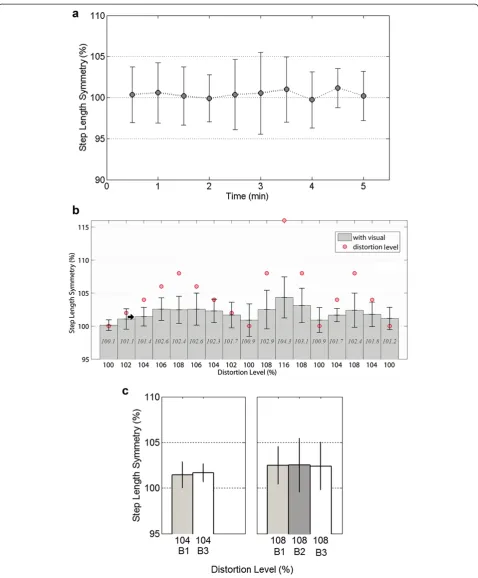
Figure 3a shows an example of the variability in step length symmetry over a five minute period of normal walking on a treadmill. The data was obtained from a control setting where subjects walked on the treadmill without visual feedback. The horizontal axis corresponds to time and the vertical axis represents step symmetry ratio. The solid circles represent the mean step sym-metry value, averaged across nine subjects over subse-quent 30 seconds intervals. Error bars indicate ± one standard deviation (σ). The changes of step length sym-metry indicate a small degree of fluctuation over time. For instance, the lowest value was 99.9% while the high-est value was 101.2%. The highhigh-est standard deviation was 4.7%. No pattern was found in the changes of step length symmetry over the five minutes of normal walking.
In order to investigate how the explicit visual feedback distortion affected the stepping pattern of subjects, we plotted the acquired data during the 10.5-minute session of visual feedback distortion. The entire session contains three block periods (B1: 2% change of distortion level, B2: 8% change, and B3: 4% change) depending on differ-ent incremdiffer-ents/decremdiffer-ents of distortion. Figure 3b shows the changes in step length symmetry under the explicit visual distortion, averaged across nine subjects, as a function of varying feedback distortion. The hori-zontal axis shows changes in the distortion level and the vertical axis shows the step length symmetry. The solid bars show the percentage of mean symmetry where 100% is the perfect symmetry between the left and the right step lengths. The thin vertical lines show the stand-ard deviation (σ) among the nine subjects for each dis-tortion level. The solid circle show the disdis-tortion level applied at given periods. The solid arrow was marked at the distortion level where the induced step symmetry values were first found to be significantly different from the initial 100% period (p < 0.001). From the data in Figure 3b, it was observed that the mean step length symmetry in-creased and then dein-creased according to the imposed distortion levels. For instance, the highest distortion (116%) affected the step symmetry the most yielding an induced gait asymmetry value of 104.3%. The repeated-measures ANOVA test showed significant effects of visual distortion on the dependent variable (step length sym-metry), F(4.196, 33.371) = 2.818, p < 0.05. Significant
changes in step length symmetry were found at as low as 104% distortion level (marked by the solid arrow in figure) compared to the initial 100% baseline. P-values from pair-wise t-test between the initial step length symmetry and the step length symmetry at each different distortion level (102%, 104%, 106%, 108%, 106%, 104%, 102%, 100%, 108%, 116%, 108%, 100%, 104%, 108%, 104%, and 100%) over the entire trial were 0.0135, <0.0001, 0.0003, 0.0215, 0.0287, 0.0132, 0.0340, 0.4619, 0.0481, 0.0019, 0.0218, 0.3169, 0.0096, 0.0613, 0.1135, and 0.1872, respectively. These re-sults indicate that subjects were unable to sustain explicit control of maintaining natural symmetric gait pattern in response to visual feedback distortion.
Figure 3c shows the effect of the increased rate of dis-tortion level on the change in step length symmetry. The bars represent the mean symmetry values at the same distortion levels (104% and 108%) in three different blocks (B1: 2% change of distortion level, B2: 8% change, and B3: 4% change) over the distortion-increasing ses-sion. Thus, this plot simply shows the mean step length symmetry values in different blocks (B1, B2, and B3) at the same distortion levels during the period when the distortion increased only. It appeared that the rate of change of distortion level did not affect the change in gait modulation. The ANOVA test showed no significant differences.
Discussion
Effects of distorting visual feedback on step length symmetry
any illusion in the visual field on the retina, all of the subjects spontaneously modulated their gait step pattern according to the visual feedback distortion.
In our previous study, we implicitly distorted the vis-ual information. We told subjects to walk normally and they were not aware of the imposed distortion of visual information about their step length. Subjects spontan-eously modulated their spatial gait pattern to compen-sate for the asymmetric representations of their step lengths. They were also completely unaware of the na-ture of their gait modulation induced by the visual dis-tortion. However, since such effects of visual feedback distortion might entail subjects’conscious-compensating processes for the asymmetric representations of step length, we included a distraction task that might help to remove subjects’volitional or cognitive control to some extent. Although the amount of the induced step sym-metry was reduced during the distraction task, we found that visual feedback distortion still influenced step sym-metry. These findings imply that the visual feedback distortion used in our study entails unintentional or im-plicit processes. However, we could not eliminate the possibility that the effect was still partly the consequence of any remaining cognitive or conscious strategy because the distraction task might not have removed the sub-jects’potential conscious control completely.
Effects of explicit visual feedback distortion on gait symmetry
The current experiment sought to investigate the effect of explicit visual feedback distortion on gait modulation. The experimental paradigm was to place explicit strategy during treadmill walking under visual feedback distor-tion. We informed subjects of the imposed distortion of visual feedback of step lengths and told them not to be misled by the visual feedback and also to maintain their natural gait symmetric pattern. We investigated the role of explicit visual information in spatial gait pattern using a paradigm of visual feedback distortion. Surprisingly, despite subjects’explicit strategy, the visual feedback dis-tortion influenced them to spontaneously modulate the gait step symmetry (Figure 3b). When the distortion level was varied systematically, the amount of the in-duced gait modulation changed accordingly. Subjects were interviewed after the experiment, and they de-scribed that they were unaware of the changes in their gait symmetry during the trial.
The lower limbs and their movement during walking are essentially bilaterally symmetrical perhaps due to inherently symmetrical organization of neural circuits within the nervous system [16]. Proprioceptive feedback from the lower limbs plays an important role in gait symmetry control [17,18]. However, the observation
that subjects were unable to maintain the same motor command under the condition of explicit visual distor-tion implies that the role of supraspinal funcdistor-tion through visual system may be a dominant form of feed-back in gait control [19]. It should also be noted that the characteristics of supraspinal, e.g., visual influence, are not necessarily confined to conscious or voluntary action.
Visual influence on human locomotion has been previ-ously reported in the field of gait and posture [12-15,19,20]. In these studies, a wedge prism model or artificial optic flow patterns were used to alter the sensation of self-motion of subjects through the environments. For ex-ample, since light passing through the prism is bent, a wedge prism causes the visual world to appear displaced to one side of where it would normally appear without the prism. For another technique, artificial optic flow patterns are projected onto a large screen, evoking the illusion of motion along the line of walking. During locomotion, adaptation induced by such visual perturbations in general may be attributed to an interaction between two different modalities, visual and proprioceptive information [21]. The visual perception of motion and/or position may play a proprioceptive role, thereby interacting with other proprioceptive information and modifying loco-motion activity on a spinal level [14]. However, there are crucial differences between these studies and the current one. The visual feedback used in our study did not generate the visual perception of motion or position at all. It simply provided subjects with the visual infor-mation about their step lengths. Nevertheless, subjects were not able to perform the task, which was to main-tain natural symmetric gait pattern, when the visual feedback distortion was imposed.
Effects of increasing rate of distortion level on the amount of induced gait symmetry
In our experiment, the visual distortion level went up by three different increments; 102%, 104%, and 108% (Figure 2). It appeared that a small change of the distor-tion level, such as 102% change of step length mapped to the visual bar, was hardly noticed by subjects, whereas lar-ger distortion levels higher than 2% were easily noticed. Thus, we examined the effects of the increasing rate of distortion level on the amount of induced step symmetry (Figure 3c). During the period when the distortion was increased, there were no significant differences in the amount of induced gait symmetry among different rate changes of distortion level. Although the evidence is not yet conclusive, this observation indicates that the extent of gait modulation induced by visual distortion may be inde-pendent of the rate changes of distortion level. This may also imply that the induced gait modulation bears on un-intentional or implicit strategy because the amounts of in-duced gait asymmetry were similar at the same distortion levels regardless of whether or not subjects were able to easily notice the change of the distortion.
Comparison of visual distortion effects between implicit and explicit conditions
In order to understand how the explicit visual distortion influenced the gait symmetry differently from the impli-cit visual distortion, we tried to compare our results with those obtained from our previous study in which sub-jects were not aware of the distortion [11]. The implicit condition was again divided into two different conditions (no-distraction and with-distraction conditions). The dis-traction task consisted in asking subjects to subtract 7 out loud starting at 1000 [23]. Figure 4 shows the changes in step length symmetry under three different conditions (naïve with no distraction, naïve with distraction, and in-formed with no distraction) during the period when the distortion was increased only. Since the applied distortion profile used for the explicit condition (informed with no distraction) was not identical to that used for the implicit one (naïve group) from the previous study, only the results from the same distortion levels were compared among three different conditions. The naïve group refers to the group tested under the implicit visual distortion condition. Subjects were not informed of the manipulation of visual feedback under the implicit condition whereas the in-formed group were aware of the imposed visual distortion during each trial. The data for the naïve group (n = 12) was cited for the purpose of the comparison from our pre-vious study [11].
As shown in Figure 4, although subjects did not intentionally correct their stepping movements accord-ing to the distorted visual feedback, the induced step asymmetry under the implicit condition (naïve with no
distraction) was observed to be slightly greater than under the explicit condition. This discrepancy might have been significant at higher distortion level consider-ing that the t-test found a significant difference at the level of 108%. This suggests that the effect of the impli-cit visual feedback distortion without distraction may involve some cognitive functions, which is not necessar-ily confined to conscious or voluntary action. It should be also noted that the amounts of induced gait asym-metry induced by the explicit condition and the implicit condition combined with distraction (naïve with distrac-tion) appeared to be similar. There were no significant differences found in step length symmetry between these two conditions. This observation corroborates that unintentional or implicit adaptation processes were driven by the explicit visual feedback distortion.
Utilizing visual feedback distortion as a rehabilitation intervention
Understanding the adaptation for locomotion is import-ant for rehabilitation. In therapeutic training settings, patients are commonly instructed to consciously correct or change their walking pattern after an injury. Motor learning in such an explicit manner may result in more transient changes than those driven in an implicit man-ner [24]. With the realization that the visual feedback distortion we provided here can drive implicit gait adap-tation, the potential of using such systems for the future gait therapy can be highlighted because it may not only
produce longer retention of motor learning after training but also help subjects’execute movements beyond their volitional efforts.
Conclusions
The present study investigated the effect of an explicit visual feedback distortion paradigm on influencing modu-lation of step length symmetry (a spatial gait pattern). The visual information used in this study was simple bar graphs, not altering visual space nor evoking illusions. Subjects were told to maintain their natural gait symmet-ric pattern and also informed of the distortion of visual feedback. The results of this study showed that subjects spontaneously modulated their gaits’ symmetric pattern away from symmetry according to the distortion of visual feedback even at the expense of an opposing explicit task goal. The effect of visual feedback distortion on changes in step symmetry appears to involve unintentional or im-plicit motor functions that may be enhanced by conscious involvement. These results suggest that the effect of visual feedback during gait is unnoticed and spontaneous and also that a paradigm of using such visual feedback distor-tion may be potentially useful as a supplemental thera-peutic intervention for gait rehabilitation.
Competing interests
The authors declare that they have no competing interests.
Authors’contribution
SK carried out the experiments and drafted the manuscript. DM helped to collect and analyze experimental data. Both authors read and approved the final manuscript.
Acknowledgments
This work was supported by the College of Engineering at California Baptist University and the authors appreciate valuable inputs from Tyler Susko and David Saito on this study.
Author details
1Department of Biomedical Engineering, California Baptist University, 8432
Magnolia Avenue, Riverside, CA 92504, USA.2Department of Electrical and Computer Engineering, California Baptist University, Riverside, CA 92504, USA. 3
Department of Electrical and Computing Engineering, Utah State University, Logan, UT 84322, USA.
Received: 25 November 2013 Accepted: 14 April 2014 Published: 28 April 2014
References
1. Schmidt H, Werner C, Bernhardt R, Hesse S, Kruger J:Gait rehabilitation machines based on programmable footplates.J Neuroeng Rehabil2007,4:2. 2. Dietz V, Harkema SJ:Locomotor activity in spinal cord-injured persons.
J Appl Physiol2004,96:1954–1960.
3. Goldshmit Y, Lythgo N, Galea MP, Turnley AM:Treadmill training after spinal cord hemisection in mice promotes axonal sprouting and synapse formation and improves motor recovery.J Neurotrauma2008,25:449–465. 4. Plummer P, Behrman AL, Duncan PW, Spigel P, Saracino D, Martin J, Fox E,
Thigpen M, Kautz SA:Effects of stroke severity and training duration on locomotor recovery after stroke: a pilot study.Neurorehabil Neural Repair 2007,21:137–151.
5. Hornby TG, Campbell DD, Kahn JH, Demott T, Moore JL, Roth HR:Enhanced gait-related improvements after therapist- versus robotic-assisted locomotor training in subjects with chronic stroke: a randomized controlled study.Stroke2008,39:1786–1792.
6. Krebs HI, Volpe BT, Aisen ML, Hogan N:Increasing productivity and quality of care: robot-aided neuro-rehabilitation.J Rehabil Res Dev2000, 37:639–652.
7. Winstein CJ:Knowledge of results and motor learning–implications for physical therapy.Phys Ther1991,71:140–149.
8. Young DE, Schmidt RA:Augmented kinematic feedback for motor learning.J Mot Behav1992,24:261–273.
9. Thikey H, Grealy M, van Wijck F, Barber M, Rowe P:Augmented visual feedback of movement performance to enhance walking recovery after stroke: study protocol for a pilot randomised controlled trial.Trials2012, 13:163.
10. Brewer BR, Klatzky R, Matsuoka Y:Visual feedback distortion in a robotic environment for hand rehabilitation.Brain Res Bull2008,75:804–813. 11. Kim SJ, Krebs HI:Effects of implicit visual feedback distortion on human
gait.Exp Brain Res2012,218:495–502.
12. Patla AE:How is human gait controlled by vision?Ecol Psychol1998, 10(3–4):287–302.
13. Pailhous J, Ferrandez AM, Fluckiger M, Baumberger B:Unintentional modulations of human gait by optical flow.Behav Brain Res1990, 38:275–281.
14. Prokop T, Schubert M, Berger W:Visual influence on human locomotion. Modulation to changes in optic flow.Exp Brain Res1997,114:63–70. 15. Rossignol S:Visuomotor regulation of locomotion.Can J Physiol Pharmacol
1996,74:418–425.
16. Sadeghi H, Allard P, Prince F, Labelle H:Symmetry and limb dominance in able-bodied gait: a review.Gait Posture2000,12:34–45.
17. Rossignol S, Dubuc R, Gossard JP:Dynamic sensorimotor interactions in locomotion.Physiol Rev2006,86:89–154.
18. Andersson O, Forssberg H, Grillner S, Wallen P:Peripheral feedback mechanisms acting on the central pattern generators for locomotion in fish and cat.Can J Physiol Pharmacol1981,59:713–726.
19. Varraine E, Bonnard M, Pailhous J:Interaction between different sensory cues in the control of human gait.Exp Brain Res2002,142:374–384. 20. Lamontagne A, Fung J, McFadyen BJ, Faubert J:Modulation of walking
speed by changing optic flow in persons with stroke.J Neuroeng Rehabil 2007,4:22.
21. Bedford FL:Keeping perception accurate.Trends Cogn Sci1999,3:4–11. 22. Mazzoni P, Krakauer JW:An implicit plan overrides an explicit strategy
during visuomotor adaptation.J Neurosci2006,26:3642–3645. 23. Yogev G, Giladi N, Peretz C, Springer S, Simon ES, Hausdorff JM:Dual
tasking, gait rhythmicity, and Parkinson’s disease: which aspects of gait are attention demanding?Eur J Neurosci2005,22:1248–1256.
24. Malone LA, Bastian AJ:Thinking about walking: effects of conscious correction versus distraction on locomotor adaptation.J Neurophysiol 2010,103:1954–1962.
doi:10.1186/1743-0003-11-74
Cite this article as:Kim and Mugisha:Effect of explicit visual feedback distortion on human gait.Journal of NeuroEngineering and Rehabilitation
201411:74.
Submit your next manuscript to BioMed Central and take full advantage of:
• Convenient online submission
• Thorough peer review
• No space constraints or color figure charges
• Immediate publication on acceptance
• Inclusion in PubMed, CAS, Scopus and Google Scholar
• Research which is freely available for redistribution