A Novel Analytical Framework Combining the
Concepts of Credibility and Aspect based Opinion
Mining
Hossein Abbasimehr*
Faculty of Information technology and Computer Engineering, Azarbaijan Shahid Madani University,
Tabriz, Iran [email protected]
MohammadJafar Tarokh
IT Group, Industrial Engineering Department, K.N. Toosi University of Technology,
Tehran, Iran [email protected]
Received:2019/06/11 Revised:2019/08/20 Accepted:2019/12/25
Abstract— With the emergence of Web 2.0, user generated content in the form of online product reviews has proliferated. Although product reviews contain valuable information, they vary greatly in terms of quality and credibility. This study presents an opinion mining framework - Cred-OPMiner (Credibility-Specific-Opinion Miner) - by combining the concepts of credibility and aspect based opinion mining. Cred-OPMiner performs three main tasks. The first task is to group reviewers based on the credibility dimensions. The second critical task is aspect extraction in which aspects of a given product are identified using a novel hybrid and domain independent algorithm. The final task is the sentiment prediction task where the sentiment on each aspect is computed. The key novelty is utilizing source credibility concepts for online reviewer clustering. Source credibility dimensions including trustworthiness and expertise are quantified using reviewers’ data. In addition, a new aspect extraction technique is developed and incorporated in the Cred-OPMiner. Cred-OPMiner was tested using data crawled from epinions.com. It groups reviewers and then performs aspect based opinion mining by differentiating among opinions of various reviewer groups.
Keywords— Online Review, Aspect based Opinion Mining, Trust Network, Reviewer Credibility
1. INTRODUCTION
Web 2.0 [1] technologies have brought much number of opportunities for both consumers and firms. For consumers, Web 2.0 offers the opportunity to exchange their opinions in social media [2]. Social media platforms such as epinions.com, yelp.com enables customers to share their opinions about particular products. Reviews written by users about a specific product are considered as valuable sources of information for other users in case of decision making about purchasing that product. In addition, for the firms, the product reviews are a growingly significant type of user-generated content (UGC) as they are regarded as valuable information that helps firms to understand their consumers’ sentiments, attitudes, needs and preferences regarding their products So far, many researches have been performed in the
context of opinion mining and sentiment analysis (e.g. [3-18]).
One notable problem of online review mining systems is that they analyze the reviews generated by all of the reviewers and they don’t distinguish between various groups of reviewers. As online reviewers may differ in terms knowledge and expertise, for businesses it is important to gain knowledge about different groups of reviewers. Therefore, motivated by the importance of reviewer-specific opinion mining, in this study, we propose an opinion mining framework - Cred-OPMiner (Credibility-Specific-Opinion Miner) - by combining the concepts of credibility and aspect-based opinion mining [12] to analyze opinions of different groups of reviewers.
The main tasks of the proposed analytical framework are as follows: (1) crawling and preprocessing data from Web including data of users (e.g. reviewer’s past activity, reviewer’s profile, reviewer’s Web of trust) [19] and data of online reviews. (2) Deriving and constructing features describing reviewers corresponding to source credibility dimensions and then grouping reviewers based using clustering techniques (3) extracting product aspects and opinions, (4) selecting reviews corresponding to the groups reviewers and finally performing reviewer group-specific aspect-based opinion mining as well as analyzing the results.
The main contributions of this paper are four-fold:
• First, we propose a novel analytical framework(Cred-OPMiner) by combining the concepts of credibility and aspect-based opinion mining to analyze opinions of different groups of reviewers. To the best of our knowledge, this is the first study that proposes a system that accomplishes aspect-based opinion mining by distinguishing among different reviews authored by different reviewers.
40 reviewers is performed based on the well-studied concepts. We map qualitative reviewer credibility dimensions into some useful quantitative features. Social network analysis techniques and methods are employed for this purpose.
• We propose a combined three-stage aspect extraction [3] approach. This method firstly extracts the candidate aspects using both frequency-based and relation-based method and then selects top K useful aspects using an iterative bootstrapping algorithm. The algorithm employs the ACO (Aspect Co-Occurrence) metric, which is another contribution of this study, to compute the score of each candidate aspect. The proposed aspect extraction method, performs better than its comparison partner in terms of performance metrics.
• We conducted an experiment to demonstrate the usefulness of the proposed analytical framework. The rest of the paper is organized as follows. In section2, we give some background on the opinion mining. Section 3 describes our proposed framework (Cred-OPMiner) and its constituting components; also, the new proposed algorithms for aspect extraction are given in this section. Section 4, demonstrates a case study in which the presented framework was applied, besides the obtained results are analyzed and discussed. In section 5, we draw the conclusions.
2. RELATED WORKS
The related literatures are reviewed from the following three areas: opinion mining, aspect extraction and sentiment classification.
2-1.Opinion mining
Opinion mining has been investigated mainly at three levels:
(a) Document level: In this level, the task is to determine whether a whole opinion document expresses a positive or negative sentiment [20, 21]. For example, considering a product review, the task is to determine whether the review expresses a general positive or negative opinion about the product.
(b) Sentence level: the task at this level goes to the sentences and determines whether each sentence expressed a positive, negative, or neutral opinion.
(c) Aspect level: both the document level and the sentence level opinion mining do not provide exact information about what people like or did not like. Aspect level that was earlier called feature level opinion mining performs finer-grained analysis. Because, in this study we performed aspect-based opinion mining, in the following, we will review some studies that have been conducted in the aspect level opinion mining context.
Although opinion mining at the document-level or sentence-level is effective and useful for many cases, these types of mining opinions are improper for the process of decision-making (for example, in cases of
purchasing decisions). For example, a positive opinion on a product does not mean that the opinion holder likes every aspect of that product. In a typical review, the reviewer usually mentions both positive and negative aspects of the reviewed item, though his general opinion on the item may be positive or negative. Therefore, to obtain detailed information regarding users’ opinions, it is necessary to perform finer level opinion mining, which is called aspect-based opinion mining [22, 23].
2-2.Aspect-based opinion mining
According to [22, 23], aspect extraction, and aspect sentiment prediction are two main tasks of aspect-based opinion mining. In the following, we will separately review some important research belonging to these essential tasks.
1) Aspect extraction
There are three main approaches in literature for extracting aspects of products from reviews, including frequency-based, relation-based and model-based methods. A summary of aspect detection approaches is illustrated in Table 1. In the following, we will describe these methods.
TABLE 1.A SUMMARY OF ASPECT EXTRACTION APPROACHES
Aspect extraction approach
Description research
Frequency based methods
These methods are based on finding frequent noun and noun-phrases
[24] [25] [26] [27] [28, 29]
[30]
Relationship-based methods
These methods utilize the relationships between aspects and sentiments to extract new aspects and sentiments
[31-36]
Model-based approach- Supervised learning
These methods formulate aspect detection as a supervised learning problem
Some of the proposed models based on supervised learning techniques are Hidden markov model (HMM) [37, 38] and conditional Random Field (CRF)[39, 40].
Model-based approach-topic modeling
These methods apply topic-modeling concepts to extract aspects
a) Frequency-based methods
Frequency-based methods are based on finding frequent noun and noun-phrases. According to [48] the 60-70% of the aspects are explicit nouns. [24] is the first study that employed a frequency-based method. Authors in [24] counted the occurrence frequencies of each noun and noun phrase and retained only the frequent ones. Although this method is very simple, it is quite effective. Popescu and Etzioni [25] improved the method of Hu and Liu [24] by presenting an algorithm that evaluated each discovered noun phrase by calculating a pointwise mutual information (PMI) score [28, 29] between the phrase and some meronymy discriminators associated with the entity class.
Blair-Goldensohn, et al. [26] modified the frequent noun and noun phrase method by taking into account mainly those noun phrases that are in sentiment bearing sentences. Moghaddam and Ester [27] enhanced the frequency-based method with an additional pattern-based filter to omit some non-aspect noun phrases. Zhu, et al. [30] proposed a method based on Cvalue from [49] for extracting multi-word aspects. In addition, a bootstrapping method with RlogF metric was proposed to learn the final list of aspects.
b) Relation-based methods
These methods exploit the relationships between aspects and sentiments to extract new aspects and sentiments.
c) Model-based approaches
According to [22, 23] model-based methods are divided into two categories, including supervised learning techniques and topic modeling techniques.
• Supervised learning
Since aspect extraction can be viewed as a special case of the general information extraction problem so algorithms developed to be utilized in information extraction such as supervised learning techniques can be applied on reviews to detect aspects.
• Topic modeling techniques
Topic modeling is an unsupervised learning method that assumes each document consists of a mixture of topics, and each topic is a probability distribution over words [23]. Intuitively topics from topic models are aspects in sentiment analysis context. Therefore, topic modeling can be applied in aspect extraction context. Liu [23] in his book argued that the topic modeling based aspect extraction approaches are too statistics centric and he recommends that it is useful to integrate topic modeling with natural language and knowledge centric to use a balanced approach.
2) Aspect sentiment classification
Sentiment classification is the task of determining the orientation of sentiment expressed on each aspect in a sentence. Sentiment classification approaches fall into two main categories, i.e. the supervised learning approach and the lexicon-based approach.
There exist some researches that have exploited a supervised learning approach to determine aspect sentiment polarity, e.g. [50-52]
The major drawback of this approach is that it cannot be scale up to a large number of application domains, as it is dependent on the training data.
The lexicon based methods [24, 53] which are typically unsupervised can perform quite well in a large number of domains. Lexicon based methods use a sentiment lexicon, composite expressions, rules of opinions and the sentence parse tree to determine the sentiment orientation on each aspect in a sentence.
3. THE PROPOSED METHOD
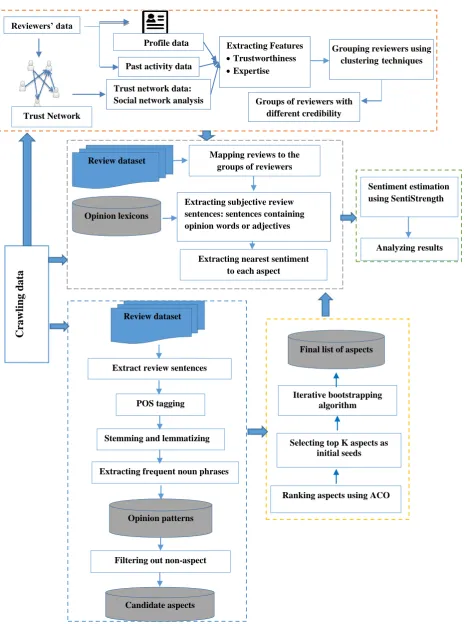
The analytical framework of Cred-OPMiner (Credibility specific opinion miner) is illustrated in Figure 1.
The main steps are as follows: (1) crawling and preprocessing data from Web, such as data of users and online reviews. (2) Deriving and constructing features describing reviewers based on source credibility dimensions as well as grouping reviewers using clustering techniques, (3) extracting product aspects and opinions, selecting reviews corresponding to the groups of reviewers and (4) finally performing reviewer group-specific aspect-based opinion mining as well as analyzing the results.
3-1.Crawling data from Web
Crawling data from Web is one of the basic tasks of the Cred-OPMiner. Data of reviewers such as reviewers trust network data, profile and past activity are crawled. In addition, as the essential task of cred-OPMiner is mining reviews, we need to crawl online reviews of certain products.
3-2.Grouping reviewers based on features corresponding to the credibility of reviewers
One of the important tasks of Cred-OPMiner is grouping reviewers in terms of credibility. For this purpose, we adopt the concept of source credibility and attempt to use it to describe reviewers in terms of credibility. That is, we aim to map source credibility concepts into some measurable features derived from reviewers’ data. In the following, we will describe source credibility concepts.
1) Source credibility
In this study, we use the two main dimensions of source credibility that were proposed by Hovland, et al. (as cited in [54]). In [55, 56] the detailed definitions of expertise and trustworthiness were described.
42 feature values describing the reviewers. After obtaining clusters, the next step is ranking the obtained cluster. 3-4.Aspect extraction
To perform aspect-based opinion mining the first step is to identify the given product aspects and then accomplishing sentiment polarity computation for each aspect. The aspect detection component of Cred-OPMiner performs the vital task of identifying products’ aspects (features). The component performs the detection in three main stages: (1) extracting frequent noun phrases (2) filtering the extracted frequent noun phrases using opinion patterns and obtaining candidate aspects (3) applying the proposed bootstrapping algorithm with Aspect Co-Occurrence (ACO) metric to rank candidate aspect; and finally selecting top K aspects.
As illustrated in Figure 1Fig 1 the input to this component is a set of reviews gleaned from the Web and its output is a set of aspects that will be used for aspect-based opinion mining.
1) Extracting frequent noun phrases
To extract frequent noun phrases, firstly, the component performs Part-Of-Speech (POS) tagging on the collection of reviews to determine the POS tag of each word (i.e. to determine the category of each word, e.g. noun verb adjective etc.). NLTK1 provides the necessary tools for tagging text. The component utilizes the POS tagger which is a built in one in NLTK to determine the POS tag of each word.
After performing POS tagging the component determines the stem of each noun using the Porter Stemming algorithm [57]. Furthermore, it eliminates all stop words. Stop words are some extremely common words which do not contain important significance in helping select documents matching a user need [58]. According to the pattern shown in Table 2, the frequent noun phrases are extracted. Similar to the previous researches [22, 32] we use 1% as the minimum support for selecting candidate aspects. Since different people
usually express an aspect with different words, so it is likely that a useful aspect be eliminated by putting the minimum support constraint for selecting candidate aspects.
For example, “price” and “cost” are the two synonymous words, and their individual frequencies may not satisfy the minimum support constraint. However, when grouping them the frequency of the resulted group satisfies the minimum support. We group synonymous words using WordNet [59] and select one of the grouped words as representative aspects to use in the next analysis. 2) Filtering frequent noun phrases using opinion patterns
In this stage, the aspect detection component uses a set of opinion patterns to exclude non-aspects. We adopted the frequent opinion patterns mined in [22]. These patterns are shown in Table 3 To refine the list of candidate aspects, we count the number of opinion patterns that are 1http://www.nltk.org/
matched at least once by each candidate aspect. Afterward, we filter out those candidate aspects that their count of patterns is less than a threshold.
3) Ranking aspects with iterative bootstrapping Although by applying the previous steps, many non-aspects are excluded from the candidate aspect list; not all aspects detected by the previous techniques are true aspects. Therefore, it is necessary to use an additional procedure to refine candidate aspect list and consequently to obtain a list of true aspects.
a) ACO (Aspect Co-Occurrence)
In this paper, we introduce a new approach for ranking candidate aspects the ACO. ACO metric is the modified version of A-score metric proposed in [3]. A-score is based on both frequency-based and inter-relation information between candidate aspects. However, we experimentally found that by considering the frequency-based information, some more frequent non-aspects appearing in the aspect list. Therefore, we modified A-score to consider only the inter-relation information between aspects. Each candidate aspect ais scored with ACO metric defined as:
2
( , )
log 1
( ( )
) ( )
i i
i A
a f a b
N
f f b
CO a +
=
(1) Where a is the current aspect f a( ) is the number of sentences that containa. f a b( , )i is the frequency of sentences that contains both aand bi. biis the ith aspect in the candidate aspect list and N is the number of review sentences. According to the Equation (1), ACO is based on the mutual information between an aspect and a list of aspects.
a) Iterative bootstrapping algorithm for detecting true aspect
The bootstrapping algorithm uses initial seed aspects to learn the final list of aspects. Bootstrapping can be described as an iterative clustering technique for which in each iteration the most valuable candidate in terms of a defined measure is selected to augment the current seed set [3, 60]. Computing the value score of each candidate in each iteration of an iterative bootstrapping algorithm is an essential task. The bootstrapping algorithm continues until a chosen criterion for stopping is satisfied [3, 60].
TABLE 2.COMBINATION OF POS PATTERNS TO EXTRACT NOUN PHRASES
Pattern Description
(NN.*|JJ.*)*(NN.*) noun phrase
TBALE 3.FREQUENT OPINION PATTERNS MINED IN [22]
Opinion Patterns
JJ-ASP ASP-IN-NP-VB-JJ JJ-NP-VB-ASP
ASP-VB-JJ JJ-NP-IN-ASP JJ-ASP-CC-ASP
Fig 1. The Proposed method
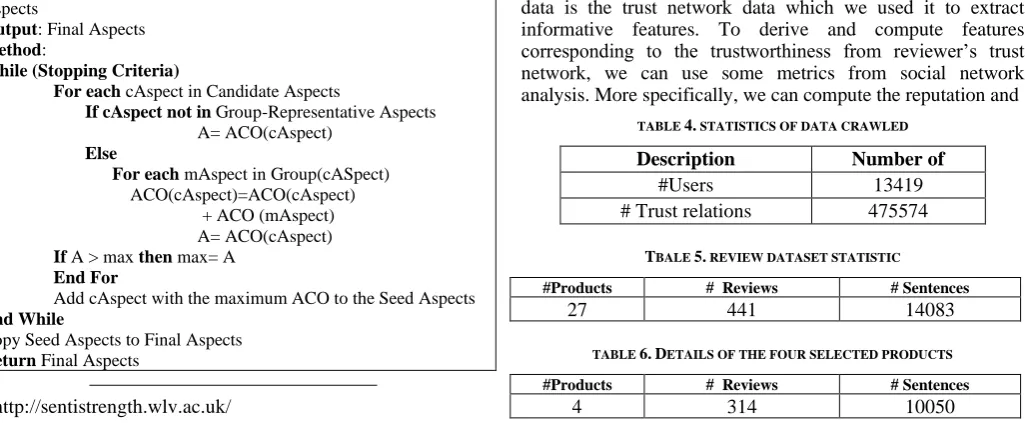
The presented iterative bootstrapping algorithm for identifying true aspects is illustrated in Algorithm 1. In this algorithm, we employ ACO to compute the score of each candidate aspect in each iteration.
3-5.Sentiment prediction
After describing the aspect extraction component, we describe the sentiment polarity detection component of Cred-OPMiner. To compute sentiment polarity on each aspect Extracting subjective review
sentences: sentences containing opinion words or adjectives Review dataset Mapping reviews to the
groups of reviewers
Opinion lexicons
Extracting nearest sentiment to each aspect
Analyzing results Sentiment estimation using SentiStrength
C
rawli
ng d
at
a
Review dataset
Extract review sentences
Extracting frequent noun phrases POS tagging
Stemming and lemmatizing
Filtering out non-aspect Opinion patterns
Candidate aspects
Selecting top K aspects as initial seeds Iterative bootstrapping
algorithm Final list of aspects
Ranking aspects using ACO Profile data
Past activity data
Extracting Features
•Trustworthiness
•Expertise
Grouping reviewers using clustering techniques
Groups of reviewers with different credibility
Reviewers’ data
Trust network data: Social network analysis
in a sentence, we utilized SentiStrength2. SentiStrength is a lexical-based sentiment analysis program that is developed to detect the strength of sentiments expressed in online reviews [61]. SentiStrength reports two sentiment strengths, for negative sentiment it uses a range from -1 (not negative) to -5 (extremely negative) and to compute positive sentiment it uses a range from 1 (not positive) to 5 (extremely positive).
A review
Rcan be viewed as aspect-opinion pairs
1 1 2 2
{ ,s , ,s ,...., n,sn }
R= a a a
in which
ai is one ofthe aspects, and si is the sentiment on ai . By computing
sentiment score, R is re-denoted
asR= { a1,sc1 , a2,sc2,....,an,scn}, where [ 4, 4]
i
sc − sentiment strength on aspect ai .The sentiment on each aspect is will be positive, neutral, or negative when
0, 0, 0
i i i
sc sc sc = respectively.
The aggregated sentiment score of aspect aj of product pi
is calculated using equation (2)
1
( , ) n
ij i i j
sc Sentiment p a
n =
=
(2)
Where scij is the pi’s sentiment score on aspect aj, and n is pi’s evaluation frequency on aj.
4. EMPIRICAL ANALYSIS AND RESULTS
In this section, we describe an implementation of Cred-OPMiner.
4-1.Data collection
The task of grouping reviewers is accomplished using Algorithm 1: The presented iterative algorithm for identifying
aspects
Algorithm 1: Iterative bootstrapping for identifying aspects
Input: Seed Aspects, Candidate Aspects, Group-Representative Aspects
Output: Final Aspects Method:
While (Stopping Criteria)
For each cAspect in Candidate Aspects
If cAspect not in Group-Representative Aspects A= ACO(cAspect)
Else
For each mAspect in Group(cASpect) ACO(cAspect)=ACO(cAspect) + ACO (mAspect)
A= ACO(cAspect) If A > max then max= A
End For
Add cAspect with the maximum ACO to the Seed Aspects End While
Copy Seed Aspects to Final Aspects Return Final Aspects
2 http://sentistrength.wlv.ac.uk/
4-2.Data collection
The task of grouping reviewers is accomplished using useful data relevant to the reviewers, including reviewers profile data, past activity, and their trust network data. Therefore, crawling data is the basic task of this component. As a case study, the Epinions.com, which is a popular product review Web site, was selected. In Epinions, users are able to share their opinions, knowledge and experiences about different products and services in various categories, e.g. Electronics, Hardware and software by writing reviews. Furthermore, reviews are evaluated by numerical rating ([1, 5]). Each user of Epinions can build a trust network by directly expressing trust or distrust relationships to other users. The trust relationships among users makes a Web of trust (WOT) [2] that is used in this study.
In this study, we selected the “Electronics” category, so the data of users (reviewers) relevant to this category was crawled. Overall, in this step, three data sets were crawled, including: (1) trust network data (2) data of reviewers’ activity (3) data of reviews authored by reviewers. The statistics of the crawled data are given in Table 4. It is important to note that the breadth first search strategy was used to crawl users’ trust network.
To perform aspect-based opinion mining, we chose the “MP3 player” subcategory, which is a subcategory of the “Electronics”. We firstly, collected all of the product names in the MP3 player subcategory. Secondly, for each product, we crawled reviews written for that product on Epinions (see Table 5) Since, most of the products do not contain a sufficient number of reviews for analysis
purpose, we only top more
reviewed products.
Therefore, as given in Table 6 we selected four products for performing experiments.4-3.Deriving features relevant to the trustworthiness
According to the definition of trustworthiness, we can exploit the crawled data to construct features relevant to trustworthiness. An important data source obtained by crawling data is the trust network data which we used it to extract informative features. To derive and compute features corresponding to the trustworthiness from reviewer’s trust network, we can use some metrics from social network analysis. More specifically, we can compute the reputation and
TABLE 4. STATISTICS OF DATA CRAWLED
Description Number of
#Users 13419
# Trust relations 475574
TBALE 5. REVIEW DATASET STATISTIC
#Products # Reviews # Sentences
27 441 14083
TABLE 6.DETAILS OF THE FOUR SELECTED PRODUCTS
#Products # Reviews # Sentences
popularity of reviewers in the trust network. For this purpose we can use centrality measures PageRank [62, 63] which is an effective and widely-used algorithm to calculate the importance of nodes in a social network was used in this paper. The popular PageRank algorithm developed by [62] is used in Web search for ranking Web documents. The idea of PageRank algorithm can be exploited to identify the most influential nodes in a social network [64]. We computed the PageRank of each node in the trust network. More details about PageRank are presented Table 7.
4-4.Deriving features relevant to the expertise
In this study, we computed two features to measure the experience of a reviewer and consequently to measure the level of reviewer’s expertise. The two features are: (1) the number of reviews written by a reviewer (total-review) (2) the number reviews authored by a reviewer in a specific category (e.g. electronics) (see Table 8)
4-5.Clustering reviewers
We run K-means with K=3. The total number of reviewers who contributed in MP3 player subcategory was 396. The result of grouping reviewers according to the features corresponding to their credibility is shown in Table 9.
1) Cluster (group) rating
Since we aim to perform group specific aspect-based opinion mining, we must calculate the rating of the three obtained groups.
We computed the rating of each cluster of reviewers using equation (3) as follows:
visits reviews ratio Page Rank total re j
view
total review category knowledge score total knowledge sco
j j j j
j j
re category
G G G G
G G C
− − − −
− − − − − −
= + +
+ + +
(3)
where j
G is the cluster rating for group j .
The calculated rating for each cluster is shown Table 10. As can be seen from the table, the group G3 is the highest rating group; and group G1 has the lowest rating.
4-6.Aspect extraction
To extract aspects, we employed the three-stage model
TBALE 7. FEATURE RELEVANT TO THE TRUSTWORTHINESS
Feature Description
PageRank The PageRank of vertexi, PR i( ) is computed as follows.
( )
( ) 1
j j
PR j
PR i c c
d
=
+ − [63].where represents the set of nodes point to , denotes the number of outgoing links of node , and is the “damping factor” [63]
visits-reviews-ratio
The number of visitors who have viewed the reviews authored by the reviewer over the number of reviews written by his/her
TABLE 8.FEATURES RELEVANT TO THE EXPERTISE
Feature Description
Total-review
The number of reviews written by reviewer in all categories since his/her membership date
Total- review-category
The number of reviews authored by a reviewer in a specific category since his/her membership date
Knowledge-score-total 1 ( )
(i) 1 1
i
j j R u
r GKS
n n
= −
+
Where n is the number of reviews written by reviewer ui in all categories since his/her membership date,R u( )i is the set of reviews written by reviewer in all categories during the period of his/her membership, and rjis the helpfulness rating of a review Rj.Knowledge- score-category
( )
1 (i) 1
1
i
j j R u
r DKS
n n
= −
+
Where n is the number of reviews written by reviewer ui in a specific category since his/her membership date,R u( )i is the set of reviews written by reviewer in a specific category since his/her membership date, and rjis the helpfulness rating of a review Rj
TABLE 9.GROUPING RESULTS
Feature C1 C2 C3
Visits-reviews-ratio 0.015 0.063 0.376 Page-Rank 0.004 0.005 0.218
Total-review 0 0.002 0.13
proposed in this study. To evaluate the effectiveness of aspect extraction, we computed precision, recall and F-score [65] of aspect extraction methods versus this gold standard.
At the first stage of aspect extraction technique, we set minimum support parameter to 1%. At the second stage, we set the count of opinion patterns threshold to 3. Furthermore, at the third stage, for bootstrapping algorithm the number of initial seeds was set to 5.
The performance of the proposed aspect extraction is illustrated in Table 11 in terms of evaluation measures. As seen in the table, the proposed method has the highest F-score value. In addition, we compared our method with A-score based algorithm, which was presented in [3]; the results of comparison indicate that our proposed method performs better than A-score based method in terms of all comparison metrics. The resulted list of aspects is given in Table 12.
4-7.Sentiment analysis
As mentioned in introduction, in this study we aimed at performing group-specific aspect-based opinion mining. According to the proposed system architecture, firstly, we grouped reviewers based on credibility dimensions. After grouping reviewers, for each product, we selected the reviews corresponding to each reviewer group. As mentioned before, in the clustering step, we obtained three groups of reviewers. Therefore, for each product corresponding to each group of reviewers, we conducted separate sentiment analysis.
To perform sentiment analysis, for each aspect in the extracted aspects, we utilized Algorithm 2. As seen from the algorithm, for each aspect, the algorithm extracts all opinion sentences from the review sentences, and checks if the number of opinions is greater than α (α=5). After that, the strength of
TABLE 10.SIZE AND RATING OF CLUSTERS
G1 G2 G3
Size 210 124 62
Rating 0.437 1.166 2.708
TABLE 11.PRECISION,RECALL AND F-SCORE FOR THREE STAGES OF ASPECT EXTRACTION COMPONENT
Method
Measure
Our method
Iterative bootstrapping with A-score [3]
Recall 0.84 0.7307
Precision 0.88 0.76
F-score 0.859 0.745
TABLE 12.LIST OF THE EXTRACTED ASPECT USING THE PROPOSED METHOD
Aspect list
Application Memory Sound quality
Battery Movie Speaker
Browser Picture Touch screen Protective Case Price Video
Device Screen WiFi
Game Song
sentiment in each opinion sentence computed using SentiStrength. As described earlier, SentiStrength computes both negative and positive sentiment strength. Therefore, to compute overall sentiment on each aspect (i.e. to determine whether the sentiment on a certain aspect is positive, neutral, or negative), we calculated the mean value of both positive and negative sentiments using equation (2). Finally, overall sentiment determined by summing the mean values of positive and negative sentiments. The results of sentiment computation for each product (product 1, product 2, product 3, and product 4) and its corresponding groups are illustrated in Tables 13 and 14
4-8.Analysis and discussion
Cred-OPMiner shows the following advantages: it analyzes reviews of different groups of customers separately so that the decision maker can be aware of sentiments of different groups of customers. Understanding consumer’s attitudes regarding products offered by a firm, could allow the firm to takes suitable preventive again customer churn problem [66]. In addition, it uses a novel hybrid and domain-independent technique for extracting product aspects from a large number of reviews.
Our results have positive implications especially for businesses. For businesses:
• It facilitates the collection and analysis of consumers’ opinions regarding certain products in an efficient and effective manner.
• By employing the proposed framework, marketing managers are able to monitor the sentiments of different groups of customers. As the results of experiments indicated, different groups of users have different opinions regarding products. Therefore, it is significant to analyze reviews of each group distinctly. Therefore, Cred-OPMiner poses opportunities for business decision makers to monitor the sentiments of different customer groups and to devise effective strategies to meet their expectations.
• By summarizing the sentiments of different groups of reviewers, Cred-OPMiner could enable marketing departments to develop warning systems that allow the identification of critical situations and thus initiating preventive measures. For instance, as the reviews from high credible users may be read by much more people, certainly many people will be influenced, therefore, those reviews are of much importance in construction a warning system.
Cred-OPMiner exploits conventional approaches for aspect extraction. It seems that using deep learning based aspect detection techniques can improve its performance in distinguishing product aspects.
5. CONCLUSION
a novel and effective approach based on source credibility dimensions to group reviewers. Also, it contains a new hybrid aspect extraction method which is a three-stage method that firstly uses frequency and relation based approaches to extract product aspects and then employs an iterative bootstrapping algorithm with Aspect Co-Occurrence (ACO) metric to get a more accurate list of aspects. The aspect extraction algorithm is a hybrid and domain-independent algorithm that could be applicable across various products. Our experimental results indicate that the proposed aspect detection method performs superior than the other utilized techniques. Furthermore, CredOPMiner contains a sentiment analysis and aggregation component that reports sentiments of different groups of reviewers. Cred-OPMiner poses opportunities for business decision makers to monitor the sentiments of different customer groups, to detect their products’ weaknesses, to develop a warning system for detection of critical situations and to conduct consumer-oriented advertising programs. As a future work, we will employ deep learning methods to improve the performance of the aspect extraction component.
REFERENCES
[1] T. O'Reilly, What is Web 2.0: O’Reilly Media, Inc, [Google Books], 2009.
[2] Y. A. Kim and R. Phalak, "A trust prediction framework in rating-based experience sharing social networks without a Web of Trust," Information Sciences, vol. 191, pp. 128-145, 5/15/ 2012.
[3] A. Bagheri, M. Saraee, and F. De Jong, "Care more about customers: Unsupervised domain-independent aspect detection for sentiment analysis of customer reviews," Knowledge-Based Systems, vol. 52, pp. 201-213, 2013.
[4] A. Khadjeh Nassirtoussi, S. Aghabozorgi, T. Ying Wah, and D. C. L. Ngo, "Text mining for market prediction: A systematic review," Expert Systems with Applications, vol. 41, pp. 7653-7670, 11/15/ 2014.
[5] E. Marrese-Taylor, J. D. Velásquez, and F. Bravo-Marquez, "A novel deterministic approach for aspect-based opinion mining in tourism products reviews," Expert Systems with Applications, vol. 41, pp. 7764-7775, 12/1/ 2014.
[6] A. Kennedy and D. Inkpen, "SENTIMENT CLASSIFICATION of MOVIE REVIEWS USING CONTEXTUAL VALENCE SHIFTERS," Computational Intelligence, vol. 22, pp. 110-125, 2006.
[7] J.-z. Wang, Z. Yan, L. T. Yang, and B.-x. Huang, "An approach to rank reviews by fusing and mining opinions based on review pertinence," Information Fusion, vol. 23, pp. 3-15, 5// 2015.
[8] K. Ravi and V. Ravi, "A survey on opinion mining and sentiment analysis: Tasks, approaches and applications," Knowledge-Based Systems, vol. 89, pp. 14-46, 11// 2015.
[9] S. Poria, E. Cambria, and A. Gelbukh, "Aspect extraction for opinion mining with a deep convolutional neural network," Knowledge-Based Systems, vol. 108, pp. 42-49, 2016.
[10] S. Gao, O. Tang, H. Wang, and P. Yin, "Identifying competitors through comparative relation mining of online reviews in the restaurant industry," International Journal of Hospitality Management, vol. 71, pp. 19-32, 2018.
[11] M. Kang, J. Ahn, and K. Lee, "Opinion mining using ensemble text hidden Markov models for text classification," Expert Systems with Applications, vol. 94, pp. 218-227, 2018.
[12] Y. Zuo, J. Wu, H. Zhang, D. Wang, and K. Xu, "Complementary Aspect-Based Opinion Mining," IEEE Transactions on Knowledge and Data Engineering, vol. 30, pp. 249-262, 2018.
[13] M. A. Boudia, R. M. Hamou, and A. Amine, "A New Approach Based on the Detection of Opinion by SentiWordNet for Automatic Text Summaries by Extraction," Int. J. Inf. Retr. Res., vol. 6, pp. 19-36, 2016. [14] X. Li, C. Wu, and F. Mai, "The effect of online reviews on product sales: A joint sentiment-topic analysis," Information & Management, vol. 56, pp. 172-184, March 2019.
[15] A. S. Alharbi and E. de Doncker, "Twitter sentiment analysis with a deep neural network: An enhanced approach using user behavioral information," Cognitive Systems Research, vol. 54, pp. 50-61, May 2019.
Algorithm 2 Computing sentiment of each aspect Algorithm 2: Computing sentiment of each aspect
Input: List of aspects A, subjective sentences S Output: Overall_Sentiment {}
Method:
For each aspect in A:
Initialize Opinion Sentences OS= {}, Opinions O= {}, Overall_Sentiment =’Unknown’ For each sentence in S:
If sentence. search (aspect): OS.add (sentence) End If
End For
If OS.length>=α // α is a threshold to determine whether the number of opinion sentences are sufficient
For each sent in OS:
O.add (SentiStrenght (sent)); End For
End If
Mean_Sentiment=mean (O)
If (Mean_Sentiment .Positive + Mean_Sentiment .Negative)>0: Overall_Sentiment(aspect)=”Positive”
End If
If (Mean_Sentiment .Posititve + Mean_Sentiment .Negative )<0: Overall_Sentiment (aspect)=”Negative”
End If Else:
TABLE 13.THE AVERAGE SENTIMENT SCORE OF EACH PRODUCT OBTAINED USING SENTISTRENGTH
Product P1 P2 P3 P4
Aspect G1 G2 G3 G1 G2 G3 G1 G2 G3 G1 G2 G3
Application 0.33 0.26 0.17 0.43 0.31 0.24 0.3 0.22 0.19 0.29 0.15 0.21
Battery Life 2 0.04 -0.16 -0.6 0.14 -0.03 0.23 0.17 -0.03 0.53 0.17 0.18
Web Browser 0 0.5 0.1 0.6 0.25 0.39 0.34 1 0 0 0 0.38
Protective Case 0 0 0.09 -0.67 0.11 0.14 0 0.23 0.26 0.23 0.38 1
Device 0 0.21 0.32 0.29 0.41 0.17 0.6 0.25 0.18 0.6 0.26 0
Game 0 0.67 0.25 0.36 0.44 0.13 0.21 0.36 0.18 0.46 0.36 0.22
Memory 0 0.14 -0.15 0.5 0.08 0.05 0 0.43 0.25 0.31 0.26 -0.11
Movie 0.4 -0.33 -0.09 0 0.05 0.2 0.8 0.29 0.11 0.23 0.29 1
Picture Quality 1 0.25 0.21 0.4 0.37 0.17 0.08 0.36 0.15 0.49 0.18 0.15
Price 1 -0.5 0.26 0 0.22 0.16 0.25 0.22 0.1 0.75 0.13 0
Screen 0.29 -0.07 0.18 0.25 0.05 0.17 -0.6 -0.04 0.2 0.06 0.18 0.17
Song 0.4 0.15 0.18 0.3 0.21 0.13 0.1 0.18 0.12 0.27 0.2 0.15
Sound Quality 0 0.45 0.15 0.6 0.48 0.36 0.57 0.63 0.3 0.47 0.78 0.56
Speaker 1 0 -0.28 0.15 0.2 0.2 0.17 0.27 0.12 0.36 0.15 0.8
Touchscreen 0.33 0.19 0.16 0.4 0.36 0.34 1 0.29 0.2 0.62 0.46 0.5
Video Quality 0 0.15 0.18 0.29 0.2 0.28 0.46 0.39 0.2 0.18 0.08 0.15
WiFi 0.5 0.03 0.06 0.09 0.25 0.14 0.32 0.26 0.15 0.16 0.3 0.21
TABLE 14.RESULTS OF APPLYING ALGORITHM 4(P:POSITIVE,N:NEGATIVE,NE:NEUTRAL,U:UNKNOWN)
Product P1 P2 P3 P4
Aspect G1 G2 G3 G1 G2 G3 G1 G2 G3 G1 G2 G3
Application U P P P P P P P P P P P
Battery Life U P N N P N P P N P P P
Web Browser U U P P P P U U N U U U
Protective Case U NE P U P P U P P P P NE
Device U P P P P P P P P P P P
Game U P P P P P P P P P P N
Memory U P N P P P U P P P P U
Movie P N N U P P P P P P P P
Picture Quality U U P P P P P P P P P NE
Price U N P NE P P U P P P P P
Screen P N P P P P N N P P P P
Song P P P P P P P P P P P P
Sound Quality U P P P P P P P P P P P
Speaker U NE N P P P P P P P P U
Touchscreen U P P P P P U P P P P P
Video Quality U P P P P P P P P P P P
sentiment analysis field," International Journal of Web Information Systems, vol. 14, no 2, pp. 193-211, 2018.
[17] A. Milani, N. Rajdeep, N. Mangal, R. K. Mudgal, and V. Franzoni, "Sentiment extraction and classification for the analysis of users’ interest in tweets," International Journal of Web Information Systems, vol. 14, no 1, pp. 29-40, 2018.
[18] F. Z. Ennaji, A. El Fazziki, H. El Alaoui El Abdallaoui, D. Benslimane, and M. Sadgal, "Opinion leaders’ prediction for monitoring the product reputation," International Journal of Web Information Systems, vol. 14, pp. 524-544, 2018.
[19] H. Abbasimehr and M. Tarokh, "Trust Prediction in Online Communities Employing Neurofuzzy Approach," Applied Artificial Intelligence, vol. 29, no. 7, pp. 733-751, 2015.
[20] B. Pang and L. Lee, "Opinion mining and sentiment analysis," Foundations and trends in information retrieval, vol. 2, pp. 1-135, 2008. [21] P. D. Turney, "Thumbs up or thumbs down?: semantic orientation applied to unsupervised classification of reviews," presented at the Proceedings of the 40th Annual Meeting on Association for Computational Linguistics, Philadelphia, Pennsylvania, 2002.
[22] S. Abbasi Moghaddam, "Aspect-based opinion mining in online reviews," Applied Sciences: School of Computing Science, 2013. [23] B. Liu, Sentiment Analysis and Opinion Mining. San Rafael: Morgan &
Claypool, 2012.
[24] M. Hu and B. Liu, "Mining and summarizing customer reviews," presented at the Proceedings of the tenth ACM SIGKDD international conference on Knowledge discovery and data mining, Seattle, WA, USA, 2004.
[25] A.-M. Popescu and O. Etzioni, "Extracting product features and opinions from reviews," presented at the Proceedings of the conference on Human Language Technology and Empirical Methods in Natural Language Processing, Vancouver, British Columbia, Canada, 2005. [26] S. Blair-Goldensohn, K. Hannan, R. McDonald, T. Neylon, G. A. Reis,
and J. Reynar, "Building a sentiment summarizer for local service reviews," in WWW Workshop on NLP in the Information Explosion Era, 2008, p. 14.
[27] S. Moghaddam and M. Ester, "Opinion digger: an unsupervised opinion miner from unstructured product reviews," presented at the Proceedings of the 19th ACM international conference on Information and knowledge management, Toronto,Canada, 2010.
[28] W. Medhat, A. Hassan, and H. Korashy, "Sentiment analysis algorithms and applications: A survey," Ain Shams Engineering Journal, vol. 5, no. 4, pp. 1093-1113, December 2014.
[29] L.-C. Yu, J.-L. Wu, P.-C. Chang, and H.-S. Chu, "Using a contextual entropy model to expand emotion words and their intensity for the sentiment classification of stock market news," Knowledge-Based Systems, vol. 41, pp. 89-97, Marrrch 2013.
[30] J. Zhu, H. Wang, B. K. Tsou, and M. Zhu, "Multi-aspect opinion polling from textual reviews," in Proceedings of the 18th ACM conference on Information and knowledge management, 2009, pp. 1799-1802. [31] P. Jiang, C. Zhang, H. Fu, Z. Niu, and Q. Yang, "An approach based on
tree kernels for opinion mining of online product reviews," in Data Mining (ICDM), 2010 IEEE 10th International Conference on, 2010, pp. 256-265.
[32] B. Liu, M. Hu, and J. Cheng, "Opinion observer: analyzing and comparing opinions on the web," in Proceedings of the 14th international conference on World Wide Web, 2005, pp. 342-351. [33] L. Zhuang, F. Jing, and X.-Y. Zhu, "Movie review mining and
summarization," in Proceedings of the 15th ACM international conference on Information and knowledge management, 2006, pp. 43-50.
[34] W. Du and S. Tan, "An iterative reinforcement approach for fine-grained opinion mining," in Proceedings of Human Language Technologies: The 2009 Annual Conference of the North American Chapter of the Association for Computational Linguistics, 2009, pp. 486-493. [35] Z. Hai, K. Chang, and J.-j. Kim, "Implicit feature identification via
co-occurrence association rule mining," in Computational Linguistics and Intelligent Text Processing, ed: Springer, 2011, pp. 393-404.
extraction through double propagation," Computational linguistics, vol. 37, no. 1, pp. 9-27, 2011.
[37] T.-L. Wong, L. Bing, and W. Lam, "Normalizing web product attributes and discovering domain ontology with minimal effort," in Proceedings of the fourth ACM international conference on Web search and data mining, 2011, pp. 805-814.
[38] W. Jin, H. H. Ho, and R. K. Srihari, "OpinionMiner: a novel machine learning system for web opinion mining and extraction," in Proceedings of the 15th ACM SIGKDD international conference on Knowledge discovery and data mining, 2009, pp. 1195-1204.
[39] N. Jakob and I. Gurevych, "Using anaphora resolution to improve opinion target identification in movie reviews," in Proceedings of the ACL 2010 conference short papers, 2010, pp. 263-268.
[40] F. Li, C. Han, M. Huang, X. Zhu, Y.-J. Xia, S. Zhang, et al., "Structure-aware review mining and summarization," in Proceedings of the 23rd International Conference on Computational Linguistics, 2010, pp. 653-661.
[41] Q. Mei, X. Ling, M. Wondra, H. Su, and C. Zhai, "Topic sentiment mixture: modeling facets and opinions in weblogs," in Proceedings of the 16th international conference on World Wide Web, 2007, pp. 171-180.
[42] A. Mukherjee and B. Liu, "Aspect extraction through semi-supervised modeling," in Proceedings of the 50th Annual Meeting of the Association for Computational Linguistics: Long Papers-Volume 1, 2012, pp. 339-348.
[43] I. Titov and R. T. McDonald, "A Joint Model of Text and Aspect Ratings for Sentiment Summarization," in ACL, 2008, pp. 308-316. [44] C. Lin and Y. He, "Joint sentiment/topic model for sentiment analysis,"
In Proceedings of the 18th ACM conference on Information and knowledge management, 2009, pp. 375-384.
[45] F. Li, M. Huang, and X. Zhu, "Sentiment Analysis with Global Topics and Local Dependency," in Twenty-Fourth AAAI Conference on Artificial Intelligence, 2010. PP. 1371-1376.
[46] C. Sauper, A. Haghighi, and R. Barzilay, "Content models with attitude," In Proceedings of the 49th Annual Meeting of the Association for Computational Linguistics: Human Language Technologies-Volume 1, 2011, pp. 350-358.
[47] D. Xiao, Y. Ji, Y. Li, F. Zhuang, and C. Shi, "Coupled matrix factorization and topic modeling for aspect mining," Information Processing & Management, vol. 54, pp. 861-873, November 2018. [48] B. Liu, Web Data Mining: Exploring Hyperlinks, Contents, and Usage
Data: Springer, 2011.
[49] K. Frantzi, S. Ananiadou, and H. Mima, "Automatic recognition of multi-word terms:. the c-value/nc-value method," International Journal on Digital Libraries, vol. 3, NO. 2, pp. 115-130, 2000.
[50] W. Wei and J. A. Gulla, "Sentiment learning on product reviews via sentiment ontology tree," in Proceedings of the 48th Annual Meeting of the Association for Computational Linguistics, 2010, pp. 404-413. [51] L. Jiang, M. Yu, M. Zhou, X. Liu, and T. Zhao, "Target-dependent
twitter sentiment classification," in Proceedings of the 49th Annual Meeting of the Association for Computational Linguistics: Human Language Technologies-Volume 1, 2011, pp. 151-160.
[52] E. Boiy and M.-F. Moens, "A machine learning approach to sentiment analysis in multilingual Web texts," Information retrieval, vol. 12, no. 5, pp. 526-558, 2009.
[53] X. Ding, B. Liu, and P. S. Yu, "A holistic lexicon-based approach to opinion mining," presented at the Proceedings of the 2008 International Conference on Web Search and Data Mining, Palo Alto, California, USA, ACM, 2008. pp. 231-240.
[54] Y. Wang, S. Chan, G. Ngai, and H.-V. Leong, "Quantifying Reviewer Credibility in Online Tourism," in Database and Expert Systems Applications. vol. 8055, H. Decker, L. Lhotská, S. Link, J. Basl, and A. Tjoa, Eds., ed: Springer Berlin Heidelberg, 2013, pp. 381-395.
[56] H. Abbasimehr and M. Tarokh, "A New Approach to Compute a Realistic Credibility Rank for Reviewers Using Fuzzy Inference," International Journal of Information & Communication Technology Research, vol. 7, no. 2, pp. 63-74, 2015.
[57] M. F. Porter, "An algorithm for suffix stripping," in Readings in information retrieval, J. Karen Sparck and W. Peter, Eds., ed: Morgan Kaufmann Publishers Inc., 1997, pp. 313-316.
[58] C. D. Manning, P. Raghavan, and H. Schütze, Introduction to information retrieval vol. 1: Cambridge university press Cambridge, 2008.
[59] C. Fellbaum, WordNet: An Electronic Lexical Database: MIT Press, 1998.
[60] J. Zhu, H. Wang, B. K. Tsou, and M. Zhu, "Multi-aspect opinion polling from textual reviews," presented at the Proceedings of the 18th ACM conference on Information and knowledge management, Hong Kong, China, ACM, 2009. PP. 1799-1802.
[61] H. Wang and W. Wang, "Product weakness finder: an opinion-aware system through sentiment analysis," Industrial Management & Data Systems, vol. 114, no. 8, pp. 1301-1320, 2014.
[62] L. Page, S. Brin, R. Motwani, and T. Winograd, "The PageRank Citation Ranking: Bringing Order to the Web," Stanford InfoLab, Stanford University, Technical Report1999.
[63] G. Xu, Y. Zhang, and L. Li, Web Mining and Social Networking: Techniques and Applications, 1st ed. New York, NY, USA: Springer-Verlag New York, Inc., 2010.
[64] C. C. Aggarwal, Social Network Data Analytics. New York, USA: Springer, 2011.
[65] J. Han, M. Kamber, and J. Pei, Data Mining: Concepts and Techniques: Elsevier Science, 2011.
[66] H. Abbasimehr, M. Setak, and J. Soroor, "A framework for identification of high-value customers by including social network based variables for churn prediction using neuro-fuzzy techniques," International Journal of Production Research, vol. 51, no. 4, pp. 1279-1294, 2013.
Hossein Abbasimehr is an Assistant Professor in faculty of Information Technology and Computer Engineering, Azarbaijan Shahid Madani University, Tabriz, Iran. He received his PhD degree in Information Technology Engineering at K.N. Toosi University of Technology, Tehran, Iran in 2017. Hossein’s research interests include, mainly, Data mining, Soft computing, Information Retrieval, Text mining, and Computational Intelligence.