Http://www.ijetmr.com©International Journal of Engineering Technologies and Management Research [53]
THE EFFECT OF INSTRUCTIONAL LEADERSHIP AND PERSISTENCE
ON TASK PERFORMANCE
Novi Sartika Wahyuni 1, I Made Putrawan 2, Eliana Sari 3
1, 3 Educational Management Department, Universitas Negeri Jakarta, Indonesia
2 Environmental Education Department, Universitas Negeri Jakarta, Indonesia
Abstract:
Task performance is the responsibility and duty carried out by each teacher in carrying out his work which contributes to administrative tasks. This study aims to provide information about the influence of instructional leadership and persistence on task performance. The causal survey involved 120 teachers, selected using Simple Random Sampling (SRS). There are three instruments developed to measure task performance (25 items, reliability 0.952), instructional leadership (30 items, reliability 0.948) and persistence (24 items, reliability 0.940). Data were analyzed using regression, correlation, and path analysis. The results of the analysis show that the instructional leadership and persistence have a direct and significant influence on the teacher's performance tasks. Therefore, to improve teacher performance tasks, factors such as instructional leadership and persistence need to be considered.
Keywords: Instructional Leadership; Persistence; and Task Performance.
Cite This Article: Novi Sartika Wahyuni, I Made Putrawan, and Eliana Sari. (2019). “THE EFFECT OF INSTRUCTIONAL LEADERSHIP AND PERSISTENCE ON TASK PERFORMANCE.” International Journal of Engineering Technologies and Management Research, 6(9), 53-61. DOI: https://doi.org/10.29121/ijetmr.v6.i9.2019.451.
1. Introduction
In the era of globalization as it is now, the quality of education becomes very urgent something for a nation to be able to compete in the international arena. Macro education quality is an accumulation of quality produced by schools as educational institutions. So that the low quality of our education at the national level will be directly proportional to the average quality produced by school institutions as educational units, therefore building the quality of education nationally cannot be separated from the context of school empowerment as an educational institution, this because quality schools are assumed to produce quality outputs and outcomes as well, so that if all school institutions at all levels of quality, will automatically be able to boost the quality of our education at a national level.
Http://www.ijetmr.com©International Journal of Engineering Technologies and Management Research [54] principals are required to have capable management skills and leadership behaviors in order to be able to take initiatives to improve school quality. To realize an effective school, effective leadership of the principal is also needed. To maximize the role of school principals in effective school efforts, As stated by Purkey and Smith in the book Hoy and Wiskel (2008) that strong instructional leadership of school principals is needed in school efforts. School leadership must focus primarily on teaching and learning and emphasize that leadership becomes stronger when it focuses on developing student learning and strengthening teaching. The importance of instructional leadership in efforts towards effective schooling also reviews some empirical research on the role of instructional leadership in producing good graduates.
The Ministry of National Education (2011) also states that instructional leadership is leadership that focuses and emphasizes learning that includes the curriculum, teaching and learning process, assessment, and teacher development, excellent service in learning, and building learning communities in schools.
Schools as formal educational institutions are a means in the achievement of national education goals. In the Law of the Republic of Indonesia Number 20 of 2003 concerning the National Education System, the functions and objectives of national education are explained, "National education functions to develop capabilities and shape the character and civilization of a dignified nation in the context of educating the life of the nation, aiming at developing the potential of students so that people who believe and devoted to God Almighty, noble, healthy, knowledgeable, capable, creative, independent, and citizens who are democratic and responsible. To be able to achieve these national education goals, schools need professional human resources.
Human resources as agents of development make roles in the world of education strategic in accordance with the goals of education in shaping quality human beings. Efforts to improve the quality of human resources are largely determined by the quality of education, especially in formal education institutions. Junior High Schools are demanded to have quality performance so that the human resources are produce truly professional in their fields of expertise. Malayu SP Hasibuan (2007) suggested that professional performance would support the realization of quality graduates. There is a work performance that can be achieved by someone in carrying out the tasks assigned to him based on skill, experience, and sincerity.
Teacher performance will be regulated by the principal in a small scope of school life, and by the principal being the team leader in a large school environment. The team leader will usually involve the vice-principal and senior teacher. The performance management process will help schools and individual teachers in a number of ways, (1) help principals monitor the power of teachers and school needs, (2) help teachers and individuals to improve their own levels of achievement, (3) help all staff to realize their full potential them and perform their professional tasks more effectively, (4) contribute to higher standards in relation to student performance targets, (5) help each teacher recognize high quality professional training such as what teachers need and how this will contribute to the development of each teacher, (6) makes the school allocate a certain amount of time for each teacher in setting goals and reflecting their achievements.
Http://www.ijetmr.com©International Journal of Engineering Technologies and Management Research [55] achievement, but it must be seen in three behavioral indicators that make up achievement itself, namely: choice of tasks, effort (hard effort), and persistence (perseverance in working / learning for a long time ). In addition, students who are motivated will be easily directed, given assignments, tend to have a great curiosity, are active in finding information about the material explained by the teacher and use higher cognitive processes to learn and absorb the lessons given. Data obtained from tirta.id online news (2017) shows that the imbalance of unbalanced S1 graduates is also exacerbated by the recruitment of teachers when recruiting many who use nepotism or use deep connections, not by looking at competency standards. This phenomenon is mushrooming especially in private schools in the form of foundations. Moreover, in schools in general, many teachers are reluctant to take part in training to support teaching ability if the training is not tied to official work. Training for a teacher, he said, is an important pattern based on improving the quality of teaching, not just administrative completeness. The problem of the low motivation of teachers in improving the quality of teaching and developing is also experienced by DKI Jakarta. Of the majority of the state teachers who received high Regional Performance Allowances (TKD), the majority considered them to be rights, but were not accompanied by similar obligations. Teachers in DKI Jakarta who have high TKD were not matched by quality.
Teaching motivation that is lacking can have a major influence on the improvement that occurs. The school where the study was conducted also supports these presentations, many teachers are late in collecting assignments, difficult to direct indicated by resistance, do not like being given assignments by the teacher, are not active in learning if there are no application points and ultimately affect grades and performance teacher in the series of learning activities that have been prepared by the teacher. According to Fennema (1994) this shows the lack of motivation to learn owned by the students themselves and ultimately affects the perception of teachers in achievement. A person's moral nature, direction, duties and functions no longer work correctly. It is precisely parents who are very enthusiastic that their children are smart and get good grades in school. Benchmarks of success are good grades and good achievements in school, this is the paradigm of parents in educating their children. Based on these explanations, it is known that there is an influence between instructional leadership, perseverance, and task performance, so this research is to examine the effect of instructional leadership and persistence on the task performance of private junior high school teachers in South Tangerang City.
Based on the background found there are several problems that arise, namely: (1) Is there a direct influence between instructional leadership on teacher performance tasks ?; (2) Is there a direct effect between persistence on the teacher performance task ?; (3) Is there a direct influence between instructional leadership on teacher persistence ?; (4) Is there an indirect effect between instructional leadership on task performance through teacher persistence?
2. Materials and Methods
Http://www.ijetmr.com©International Journal of Engineering Technologies and Management Research [56] uses path analysis based on one exogenous variable which is an intervening variable, namely perseverance because instructional leadership can indirectly influence the performance of tasks through perseverance. The affordable population in this study were all South Tangerang Private High School teachers. Sampling in this study using simple random sampling technique. The sample size in this study was determined using the Slovin formula by lottery. Based on the number of South Tangerang City Private Junior School teachers as many as 120 teachers.
The task performance instrument contains 25 statements, measured using a task performance scale with a score of 5 - 4 - 3 - 2 - 1 (Always (S) - Often (SR) - Sometimes (KK) - Rarely (J) -Never (TP)), with a reliability of 0.952. The persistence instrument contains 24 statements, measured using a persistence scale with a score of 5 - 4 - 3 - 2 - 1 (Always (S) - Often (SR) - Sometimes (KK) - Rarely (J) -Never (TP)), with reliability 0.940. Instructional leadership instrument contains 30 statements, measured using an instructional leadership scale with a score of 5 - 4 - 3 - 2 - 1 (Always (S) - Often (SR) - Sometimes (KK) - Rarely (J) -Never (TP)), with reliability 0.948. Data analysis technique uses testing: 1) normality test using the Komolgorov-Smirnov test; 2) significance test and linearity regression using the F-Test. After that inferential analysis (Hypothesis Test) is used to address the research hypothesis, using path analysis 9.
3. Results and Discussions
In this study, instructional leadership variables (instructional leadership), persistence (persistence), and task performance are measured using instructional leadership scale, persistence scale, and task performance scale. The description of the data is presented to show the results of research based on the instruments that have been filled out by South Tangerang City Private Middle School teachers. The data presented include the lowest score, highest score, mean, median, mode, standard deviation, variance and also the data distribution of the three variables studied. Task performance variable data is obtained based on the results of filling instruments consisting of 23 questions. As for the data obtained range of scores 55, with the lowest score of 50, the highest score of 99, mean 78.83, median 79, mode 84, standard deviation 11.72, and variance 137.36. The persistence variable data was obtained based on the results of the instrument filling which consisted of 21 questions. The data obtained from the range of scores 63, with the lowest score of 34, the highest score of 90, mean 64.77, median 65, mode 72, standard deviation 14.19, and variance 201.49. Instructional leadership variable data (instructional leadership) was obtained based on the results of filling instruments consisting of 26 questions. The data obtained from the range of scores 71, with the lowest score of 50, the highest score of 113, the mean of 86.74, the median of 86.5, mode 94, the standard deviation of 15.21, and variance of 231.39.
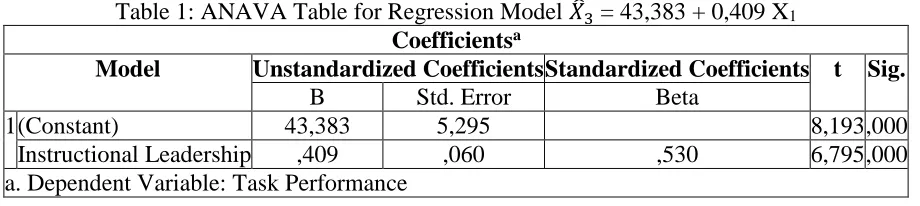
Table 1: ANAVA Table for Regression Model 𝑋̂3 = 43,383 + 0,409 X1
Coefficientsa
Model Unstandardized Coefficients Standardized Coefficients t Sig.
B Std. Error Beta
1 (Constant) 43,383 5,295 8,193 ,000
Instructional Leadership ,409 ,060 ,530 6,795 ,000
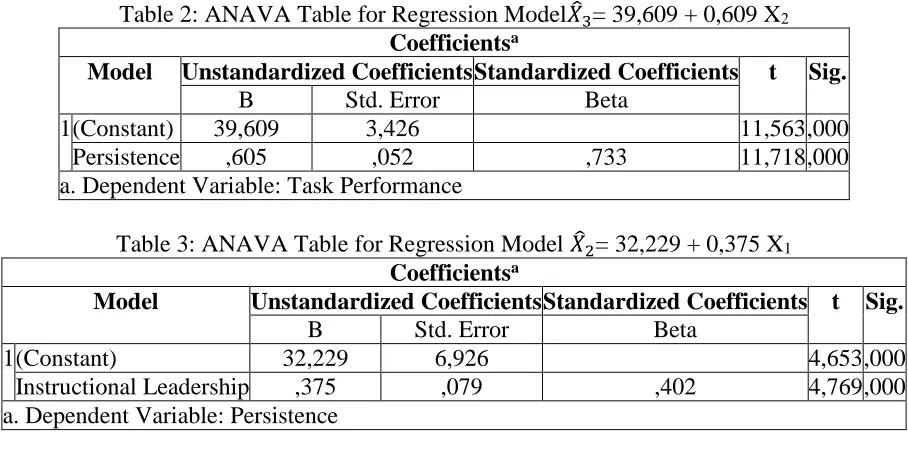
Http://www.ijetmr.com©International Journal of Engineering Technologies and Management Research [57] Table 2: ANAVA Table for Regression Model𝑋̂3= 39,609 + 0,609 X2
Coefficientsa
Model Unstandardized Coefficients Standardized Coefficients t Sig.
B Std. Error Beta
1 (Constant) 39,609 3,426 11,563 ,000
Persistence ,605 ,052 ,733 11,718 ,000
a. Dependent Variable: Task Performance
Table 3: ANAVA Table for Regression Model 𝑋̂2= 32,229 + 0,375 X1
Coefficientsa
Model Unstandardized Coefficients Standardized Coefficients t Sig.
B Std. Error Beta
1 (Constant) 32,229 6,926 4,653 ,000
Instructional Leadership ,375 ,079 ,402 4,769 ,000
a. Dependent Variable: Persistence
Requirements test analysis carried out was a simple regression error estimation normality test using the Komolgorov-Smirnov test and homogeneity test using the Bartlett test. Based on the results of the normality test and homogeneity test, it could be seen that the data were normally distributed and different groups of dependent variable scores based on groups of independent variable scores were equally homogeneous at a significant level of α = 0,05. Before using the regression equation in order to draw conclusions in testing hypotheses, the regression models obtained were tested for significance and linearity using the Ftest and ANAVA. Based on the results of the significance and linearity test, the regression equations of 𝑋̂3 = 43,383 + 0,409 X1, 𝑋̂3= 39,609 + 0,609 X2, 𝑋̂2= 32,229 + 0,375 X1were significant and linear.
Based on the calculation results in points 1, 2, and 3 above, it can be described empirical models as follows:
Figure 1: Empirical Model
Table 4: A Summary of Hyphothesis Test’s Results
Direct or Indirect n Path Coefficient tcal ttable
0.05 0.01
X1 on X3 120 0.531 6,795** 1.9858 2.6297
X2 on X3 120 0.733 11,718** 1.9858 2.6297
X1 on X2 120 0.402 4,769** 1.9858 2.6297
X1 on X3 through X2 120 0,113 1,229ns 1.9861 2.6303
Http://www.ijetmr.com©International Journal of Engineering Technologies and Management Research [58] The result of this research showed that (1) instructional leadership had a significant direct effect to affective task performance with path coefficient Phi31= 0,531and tcal= 6,795; (2) task
performance ersistence had a significant direct effect to affective with path coefficient Phi31=
0,733and tcal= 11,718; (3) instructional leadership had a significant direct effect to persistence with
path coefficient Phi31= 0,402and tcal= 4,769; and (4) instructional leadership had non-significant
indirect effect to affective task performance through persistence with path coefficient Phi31= 0,113
and tcal= 1,229. A summary of hyphothesis test’s results were presented in Table 4.
The results of the first hypothesis test indicate that there is a significant direct effect between instructional leadership on task performance, so from these results it is evident that instructional leadership can influence teacher task performance. This is in accordance with research conducted by Wayne K. Hoy (2013) that a positive relationship between instructional leadership is monitoring conducted on the progress of task performance, providing constructive feedback, maintaining high academic standards, and making active observations of teacher. In addition, it was also emphasized by research conducted by Sri Setiyani (2014) that the better the leadership of the principal, the teacher's performance would increase. This means that the higher the principal's leadership, the better the teacher's performance.
Basically the principal's leadership behavior greatly influences the effectiveness of the teacher's performance. Even in this case Duignan in Karwati (2016) the basic leadership of principals is constructed on five dimensions that are important for every headmaster to have. The five leadership, namely: a) educational capabilities (educational capabilities); b) personal capabilities (personal capabilities); c) rational capabilities; d) intellectual abilities; and e) organizational capabilities. This indicates that the principal is the most important factor influencing the principal's leadership including leadership, supervision, and policy.
Task performance is the result that must be achieved. The performance of a task can also be marked by how a person can adjust not only to a new environment but also a new task. From this understanding we can also understand that someone who has a performance is he who has good relationship competence with other people who also have high work ability, because people who have high work ability can adapt or adjust to various jobs encountered.
Basically, in order that the leadership of the analog can run effectively, the principal needs to use a combination of leadership styles, namely transformational and transactional. Bass et.al (1990) states that transactional leadership plays a role in building the foundation between superiors and subordinates while transformational leadership is more to improve and develop the abilities and performance of subordinates through challenging tasks, to motivate and inspire subordinates.
Http://www.ijetmr.com©International Journal of Engineering Technologies and Management Research [59] (2014) research explaining that there is a significant positive influence between teacher work motivation on teacher performance.
Basically, perseverance motivation is an expertise in directing subordinates to organizational goals so they want to work and try so that the desires of subordinates and organizational goals can be achieved. Motivation for perseverance of someone doing a job because of a necessity of life that must be met. The necessities of life can be in the form of economic needs, namely to get money, while non-economic needs can be interpreted as the need to obtain an award for achievements.
In addition, Chuck Williams (2009) has also revealed that the set of forces that initiate / initiate, direct, and make people survive or persevere in their efforts to achieve goals. Business persistence is concerned with the choices people make about how long they will put forth effort in their work before reducing or eliminating those efforts. Teacher involvement in terms of perseverance involves the teacher's performance results on the leadership of his superiors, so that a teacher's willingness to work on assignments for a period of time until the results achieved can be realized properly.
The third hypothesis test results show that there is a significant direct effect between instructional leadership on perseverance, so that the results prove that leadership by the school principal can influence teacher persistence. This was revealed by Jason A. Colquitt (2011) that instructional leadership strives for someone who has an important role to regulate and direct the group to work diligently to achieve a goal to be achieved, although sometimes in achieving a goal there are obstacles and difficulties. The same thing is also conveyed by the principal as a leader is a subject who must transform his leadership through providing guidance, demands or suggestions to the people they lead so that the school's goals are achieved. Thus instructional leadership can influence the readiness to start doing activities in a behavior and can be seen as a change in energy that is characterized by the emergence of a sense of desire and preceded by a response to the existence of goals.
The results of the fourth hypothesis test showed that there was an insignificant indirect effect between instructional leadership on task performance through perseverance. Even though in the previous hypothesis namely perseverance on task performance towards instructional leadership equally influences its exogenous variables and the results are stated to be significant, the indirect effect of instructional leadership on task performance through persistence states that there is no significant indirect effect. Therefore it can be said that perseverance is not a good mediated variable for instructional leadership and task performance. These results then become new discoveries in this study, so that to improve the performance of teacher assignments can be done through the leadership style of superiors (in this case the principal) performed to his subordinates and other variables can be intermediary variables to improve task performance.
4. Conclusions and Recommendations
Http://www.ijetmr.com©International Journal of Engineering Technologies and Management Research [60] performance through perseverance. Based on these findings, the conclusion of this study is that both instructional leadership and perseverance have a direct and significant effect on the performance of teacher assignments. Thus, the better the principal's instructional leadership in terms of monitoring, providing constructive feedback, maintaining high academic standards, making active observations of teachers and teacher persistence, will improve the performance of teacher assignments. In this study, perseverance is proven to be a good variable mediator for instructional leadership and task performance. Therefore, to improve the performance of teacher's work, the principal's instructional leadership and perseverance need to be considered.
Based on the conclusions above, the implications and suggestions of this study are as follows: 1) Providing policy implications for the institutions, both at the school level and the level of the South Tangerang City Education Office; 2) Contribute to the development of leadership theory, perseverance, and task performance. This is because, based on the results of the study it appears that there is a significant direct effect between instructional leadership on task performance, perseverance on task performance, and instructional leadership on perseverance; 3) Be the basis for further research that wants to examine the performance of the task.
Acknowledgements
This research got any financial support by Mr. R. Djoko Wahyu Watyono, Mrs. Siti Aisyah, Muhammad Iqbal Febriansyah, and Dwi Agustina special thanks for them. I would thank also to support given by SMP Pustek Serpong for administrative permission and especially for Mr. Iwan Setiawan for help in developing instrument as well.
References
[1] Broni, A. Afful. Relationship between Motivation and Job Performance at the University of Mines and Technology, Tarkwa, Ghana: Leadership Lesson. Scientific Research Journal Vol.3, 2012. [2] Colquit, Jason A. et. al., Trust, Trust and Trust Propensity: A Meta-Analytic Test of Thair Unique
Relationship with Risk Taking and Job Performance ". Journal of Applied Psycology Vol. 92 (4). 2007.
[3] Colquitt, Jason A. Jeffery A. Lepine, and Michael J. Wesson. Organizational Behavior: Improving Performance and Commitment in the Workplace. New York: McGraw-Hill / Irwin. 2011
[4] Cook, Mark. Personal Selection, Adding Value Trough People, Fifth Edition. Hong Kong: A. John Wiley & Sons, Ltd. Publication 2009
[5] Craswel, John W. Education Research (Planning, Conducting and Evaluating Quantitative and Qualitative Research). New Jersey: Pearson. 2008.
[6] Doh, J. P., S. A. Stumpf and W. G. Tymon. Responsible leadership helps retain talent in (India. Journal of Business Ethics. 2011. Volume 98 (1).
[7] Fennema, J. Look at students through a conceptual framework: creation, fall, redemption. Sioux Center, IA: Dordt College Press. 1994.
[8] Firmawati, Yusrizal, and Nasir Usman. Effect of Principal Leadership and Work Motivation on Teacher Performance. Journal of Masters in Education Administration in Postgraduate Syiah Kuala University. ISSN 2302-0156. Volume 5, No. 3, August 2017.
[9] Germain, M. L. Traits and skills theories as the nexus between leadership and expertise: Reality or fallacy Performance Improvement. 2012. Volume 51 (5).
Http://www.ijetmr.com©International Journal of Engineering Technologies and Management Research [61] [11] Hellriegel, Don and Jhon W. Slocum, Jr., Organizational Behavior, Thirteenth Edition. United State
of America: South Western Cengage Learning. 2008.
[12] Hill, Napoleon. Think and Grow Rich. __: Northcoast Publication ltd.
[13] Hoy, K. Wayne & Miskel. Educational Administration. New York: Higher Education. 2008. [14] Hoy, Wayne K. And Cecil G. Miskel. Educational Administration 9 Edition. New York: Mc Graw
Hill. 2013.
[15] http://en.wikipedia.org/wiki/Adaptive_performance (Pulakos, ED, Arad, S., Donovan, MA, & Plamondon, KE (2000) Adaptability in the workplace: development of a taxonomy of adaptive performance Journal of Applied Psychology, 85 (4) (accessed 31 October 2018).
[16] http://kbbi.web.id/ (Accessed on 3 November 2018)
[17] Ministry of National Education. Learning Leadership, Material Strengthening the Principal's Capabilities. Jakarta: Ministry of National Education. 2011
[18] Leithwood, K. and Duke, D. L. A Century's quest to understand school leadership.In Murphy, J and Louis, K. (Eds.) Handbook of Research in Educational Administration. San Francisco: Jossy-Bass. 1999
[19] Liao, Hui. Joseph J and Aprana Joshi. Research in Personal and Human Resources Management Volume 29. Emerald Group Publishing Limited. 2010.
[20] Mulyanto. Increased learning motivation through the development of learning strategies accompanied by positive parenting approaches. Jakarta: University of Indonesia. 2010.
[21] Mulyasa. Principal Management and Leadership. Jakarta: Earth Literacy. 2012.
[22] Owen, Robert G. Organizational Behavior In Education. United State of America: Allyn and Bacon. 1995.
[23] Peterson, Christopher. Martin E. P. Seligmen. New York: Oxford University Press. 2004.
[24] Pynes, Joan E. Human Resources Management for Public and Nonprofit Organizatios. John Wiley & Sons, Inc. All right reserved. 2009
[25] Robbins, Stephen P. Organizational Behavior. New Jersey: Pearson Educational Inc. 2011
[26] Scehermrhorn, Hunt, Osbon & Uhl-bien, Organizational Behavior, eleventh edition. Jhon Wiley & sons Ltd. 2011
[27] Setianing Hartanti, Astrid., And Tjutju Yuniarsih. Effects of Teacher Professional Competence and Work Motivation on Teacher Performance in Vocational High Schools. Journal of Office Management Education Vol. 3 No.1, January 2018.
[28] Setiyati, Sri. Effects of Principal Leadership, Work Motivation, and School Culture on Teacher Performance. Journal of Technology and Vocational Education, Volume 22, Number 2, October 2014.
[29] Sugiono. Quantitative, Qualitative, and R&D Research Methods. Bandung: Alfabeta. 2008. [30] Sunarsih, Grandson. Principal's Transformational Leadership and Teacher Achievement
Motivation for Teachers' Teaching Performance. Journal of Educational Administration Vol.XXIV No.2, October 2017.
[31] RI Law No. 20 of 2003 concerning the National Education System
[32] Williams, Chuck. Management 5e. Canada: South Western Cengage Learning. 2009.
*Corresponding author.