Http://www.ijetmr.com©International Journal of Engineering Technologies and Management Research [263]
EXPERIMENTAL STUDY AND SEM ANALYSIS ON MORTAR CUBE
WITH WOOD ASH FOR PARTIAL REPLACEENT OF CEMENT
Dr G Elangovan 1, Mrs. V. M. Rajanandhini 2 1
HOD, Department of Civil Engineering, University College of Engineering, Thirukkuvalai, Nagapattinam -610 204, Tamil Nadu, India
2
Assistant Professor, Department of Civil Engineering, University College of Engineering, Thirukkuvalai, Nagapattinam -610 204,Tamil Nadu, India
Abstract:
In the present view, several buildings are constructed ranging from ordinary residential building to sky - scrap structures. Invariably in all the structures, mortar plays a vital role in construction. Generally mortar is mixture of cement, fine aggregate, water and different type of admixtures used depends upon the situation. The cost of cement is increasing progressively day to day. In consequently cost of the building is also being increased. Wood ash does not make any pollution and eco – friendly for green building construction. This material is easily get more from burning of wood in home and industries, there by the cost of material too be reduced. Therefore, it has planned to conduct experiment on mortar in which the cement is partially replaced by wood ash. SEM Analysis is also carried out in mortar mix for observing bond between cement and wood ash.
Keywords: Concrete; Compressive Strength; Ordinary Portland Cement; Wood Ash.
Cite This Article:Dr G Elangovan, and Mrs. V. M. Rajanandhini. (2018). “EXPERIMENTAL STUDY AND SEM ANALYSIS ON MORTAR CUBE WITH WOOD ASH FOR PARTIAL REPLACEENT OF CEMENT.” International Journal of Engineering Technologies and Management Research, 5(3), 263-269. DOI: https://doi.org/10.29121/ijetmr.v5.i3.2018.200.
1. Introduction
Http://www.ijetmr.com©International Journal of Engineering Technologies and Management Research [264] Pozzolanic mortar is a lime based mortar, but is made with an additive of volcanic ash that allows it to be hardened under water.
2. Materials Used
Cement
Cement is fine, grey powder. It is mixed with water and sand to make mortar. In the present work OPC cement of 43 grades were used for experimental study for casting cubes for all concrete and mortar mixes. The cement was uniform colour i.e. grey with light greenish shade and was free from any hard lumps. The Specific gravity of the cement is 3.1. The fineness of the cement is 3.25%.
Fine Aggregate
Usually natural sand is used as a fine aggregate at places where natural sand is not available crushed stone is used as fine aggregate. Sieve analysis of the fine aggregate was carried out in the laboratory. The sand was first sieved through 4.75mm sieve to remove any particle greater than 4.75 mm sieve and then washed to remove the dust. The specific gravity of fine aggregate is 2.63. But the normal value of specific gravity of sand is 2.63. Low value of specific gravity of 2 and below would suggest the presence of organic matter or porous particles in sand. Sand containing heavy substances such as iron may have specific gravity values above 3 .The fineness modulus of aggregate is 2.94 which is said to be strong enough to use.
Water
Water used for mixing and curing shall be clean and free from Injurious amount oils, acids, alkalis, salts, sugar, organic materials other substance that may be deleterious to concrete or steel. Portable water is generally considered satisfactory for mixing and curing of mortar or concrete.
Wood Ash
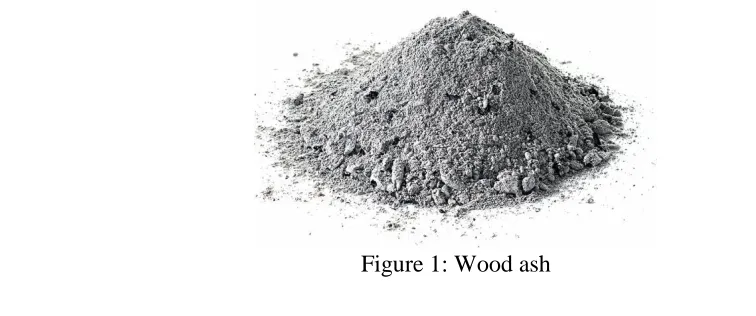
Wood ash is residue powder left after the combustion of wood, such as burning wood in a home fireplace or an industrial power plant. The wood ash sample passing through 90µ sieve is taken for testing. The Fineness of wood ash is 4.33% and the Specific gravity of wood ash is 2. The type of wood, combustion temperature and combustion time plays a vital role in the quantity of ash produced and its chemical composition as shown in Table 1 and wood ash as shown in Figure 1.
Http://www.ijetmr.com©International Journal of Engineering Technologies and Management Research [265] Table 1: Chemical Compositions of Wood Ash
Oxide composition Wood Ash
Sio2 46.05
Cao 18.23
Fe2O3 8.12
Al2O3 7.55
MgO 2.1
K2O 4.2
Na2O 1.5
TiO2 0.1
MnO 2.85
P2O5 1.7
SO3 1.4
LOI 6.2
3. Mix Proportion
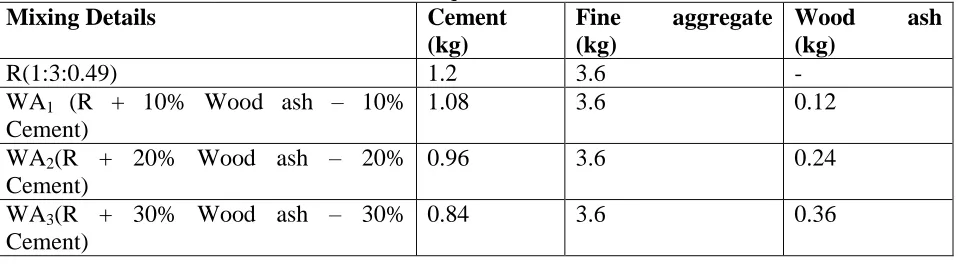
The mix proportioning of conventional mortar includes the proportioning of the various ingredients like cement, fine aggregate, wood ash. In this experimental work mix ratio 1:3 is used. The total quantity of concrete required for the entire numbers of mortar are determined. From which, the quantity of wood ash and fine aggregate are determined by parts excluding cement. From that quantity, the weight of ingredients is determined by multiplying with its weight. The corresponding water content is water cement ratio. Following Tables 2 gives the mix proportion of mortar cube the Quantities of Materials required for various Mixes.
Table 2: Quantities of Materials required for various Mixes of Mortar cube
Mixing Details Cement
(kg)
Fine aggregate
(kg)
Wood ash
(kg)
R(1:3:0.49) 1.2 3.6 -
WA1 (R + 10% Wood ash – 10% Cement)
1.08 3.6 0.12
WA2(R + 20% Wood ash – 20% Cement)
0.96 3.6 0.24
WA3(R + 30% Wood ash – 30% Cement)
0.84 3.6 0.36
4. Result and Discussions
4.1.Compressive Strength Test
Http://www.ijetmr.com©International Journal of Engineering Technologies and Management Research [266] Remove cube from the curing tank. Wipe off surface water and frit with a damp cloth. Wipe test machine platens with dry cloth. Place the test cube centrally on the test cube facing towards you. Lower the top pattern on to the cube and ensure a uniform seating by section. Gently rotating the platen as it is brought to bear on the cube. Make sure that test machine is set to the correct loading and pointers are read as zero. Apply the load without shock and continuously. Record the maximum load the cube can sustain. Compressive strength can be calculated by using the following formula,
Compressive strength () = Pmax / A
Where,
= Compressive strength in N/mm2 Pmax = Maximum load that cube sustained A = Cross sectional area of the cube
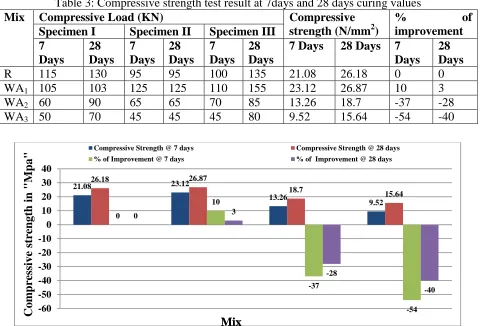
Compressive strength test result at 7days and 28 days curing values are presented in Table 3. Compressive strength of reference concrete mix 21.08 N/mm2 and 26.18 N/mm2 at 7 days and 28 days, it is observed that an increasing of percentage of wood ash, compressive strength goes on increasing up to 10% beyond that strength goes on decreasing. Hence concluded that is no use adding wood ash beyond 10% of cement. Figure 2 shows variation of compressive strength at 7 days and 28 days curing.
Table 3: Compressive strength test result at 7days and 28 days curing values
Mix Compressive Load (KN) Compressive
strength (N/mm2)
% of
improvement
Specimen I Specimen II Specimen III
7 Days 28 Days 7 Days 28 Days 7 Days 28 Days
7 Days 28 Days 7
Days 28 Days
R 115 130 95 95 100 135 21.08 26.18 0 0
WA1 105 103 125 125 110 155 23.12 26.87 10 3
WA2 60 90 65 65 70 85 13.26 18.7 -37 -28
WA3 50 70 45 45 45 80 9.52 15.64 -54 -40
Figure 2: Effect of wood ash on compressive strength after 7days and 28 days curing
21.08 23.12
13.26
9.52 26.18 26.87
18.7 15.64
0
10
-37
-54
0 3
-28 -40 -60 -50 -40 -30 -20 -10 0 10 20 30 40
Compressive Strength @ 7 days Compressive Strength @ 28 days
% of Improvement @ 7 days % of Improvement @ 28 days
Http://www.ijetmr.com©International Journal of Engineering Technologies and Management Research [267] 4.2.Scanning Electron Microscopy (SEM) Analysis
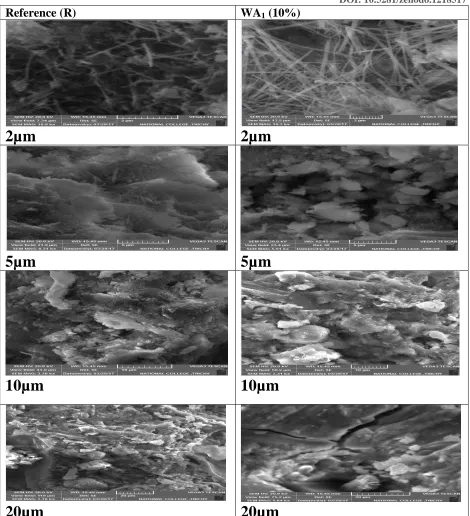
Scanning electron microscopy (SEM) is a powerful technique in the examination of materials. The SEM analysis is used to find out micro structures of mortar and textural & compositional inter relationships of mortar components. It also used for find out the effect of w/c ratio and the addition of mineral admixtures.
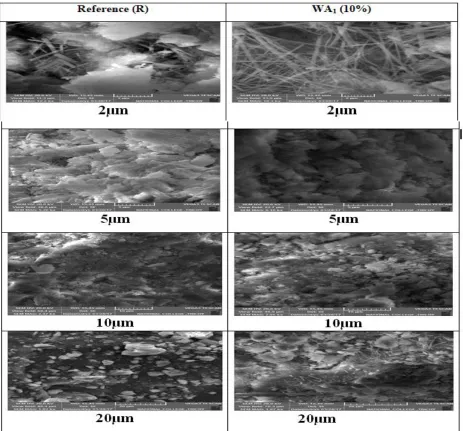
SEM micrographs were recorded with VEGA3 TE scanning electron microscope with a maximum accelerating voltage of 20Kv at high vacuum mode. SEM photographs are presented for reference mix and WA1 mix at 2, 5, 10, 20 µm to show particles distribution in mortar cube after 7 days and 28 days curing as in figure 3 and 4. From SEM photograph one can easily understand how bonding occurred an cement with sand and cement with wood ash.
Http://www.ijetmr.com©International Journal of Engineering Technologies and Management Research [268]
Reference (R) WA1 (10%)
2µm
2µm
5µm
5µm
10µm
10µm
20µm
20µm
Figure 4: SEM analysis for mortar cube after 28 days curing
5. Conclusions and Recommendations
Based on the test results obtained from the experimental program of this work the following major conclusions are arrived from compressive strength test and SEM analysis.
Http://www.ijetmr.com©International Journal of Engineering Technologies and Management Research [269] and 26.87 Mpa, and its percentage improvement is 10 over reference mix. 3 over reference mix. Consequently, it is concluded that concrete mix having 10% replacement of cement by wood ash (WA1 mix) is better mix and has the highest compressive strength for both 7days and 28days curing test results.
SEM photographs are presented for reference mix and WA1 mix at 2, 5, 10, 20 µm to show particles distribution in mortar cube after 7 days and 28 days curing. From SEM photograph one can easily understand how bonding occurred an cement with sand and cement with wood ash.
References
[1] Marthon. C., 2012. Saw dust ash (SDA) as a partial replacement of cement, International Journal
of Engineering Research and application. 2(4):1980-1985.
[2] Abdulahi. M., 2006. Characteristics of wood ash/OPC concrete, Leonardo Electronic Journal
Practices and Technologies., Issue 8, January-June 2006 p. 9-16.
[3] Gopalakrishna..S, Rajamane.N.P., Neelamega.M, Peter. J.A.and Dattatreya J.K., 2001.Effect of
partial replacement of cement with fly ash on the strength and durability of HPC. The Indian Concrete Journal, pp. 335-341.
[4] Rafat Siddique.S., 2012.Utilization of wood ash in concrete manufacturing, resources
conversation and recycling.pp:27-33.
[5] Singh, M., and Siddique, R. (2014). “Strength properties and micro-structural properties of
concrete containing coal bottom ash as partial replacement of fine aggregate” Construction and Building Materials (50) 246–256.
[6] IS: 383-1970, „Specification for Fine aggregate from natural resources – second revision‟, Bureau
of Indian Standards, New Delhi.
[7] Krammart, P. and Tangtermsirikul. S. (2004). “Properties of cement made by partially replacing
cement raw materials with municipal solid waste ashes and calcium carbide waste” Construction and Building Materials (18) 579–583.
[8] Aribisala, O. J. and Bamisaye, A. J., (2006). “Viability of Bone Powder As Partial Replacement
for Cement in Concrete.” Botswana Journal of Technology, Vol 15, (1).
[9] M.L. Gambhir Concrete technology.
*Corresponding author.