Sentence Clustering using PageRank Topic Model
Kenshin Ikegami
Department of Systems Innovation The University of Tokyo
Tokyo, Japan
Yukio Ohsawa
Department of Systems Innovation The University of Tokyo
Tokyo, Japan
Abstract
The clusters of review sentences on the view-points from the products’ evaluation can be applied to various use. The topicmodels, for example UnigramMixture (UM), can be used for this task. However, there are two prob-lems. One problem is that topic models de-pend on the randomly-initialized parameters and computation results are not consistent. The other is that the number of topics has to be set as a preset parameter. To solve these prob-lems, we introduce PageRank Topic Model (PRTM), that approximately estimates multi-nomial distributions over topics and words in a vocabulary using network structure analy-sismethods to Word Co-occurrence Graphs. In PRTM, an appropriate number of topics is estimated using the Newmanmethod from a Word Co-occurrence Graph. Also, PRTM achieves consistent results because multino-mial distributions over words in a vocabulary are estimated using PageRank and a multino-mial distribution over topics is estimated as a convex quadratic programming problem. Us-ing two review datasets about hotels and cars, we show that PRTM achieves consistent re-sults in sentence clustering and an appropriate estimation of the number of topics for extract-ing the viewpoints fromthe products’ evalua-tion.
1 Introduction
Many people buy products through electronic com
-merce and Internet auction site. Consumers have to use products’ detailed information for decision
making in purchasing because they cannot see the
real products. In particular, reviews fromother con-sumers give them useful information because re-views contain consumers’ experience in practical use. Also, reviews are useful for providers of prod-ucts or services tomeasure the consumers’ satisfac-tion.
In our research, we focus on generating clus-ters of review sentences on the viewpoints from
the products’ evaluation. For example, reviews of home electric appliance are usually written based on the following the viewpoints: performance, design, price, etc. If we generate clusters of the review sen-tences on these viewpoints, the clusters can be ap-plied to various uses. For example, if we extract rep-resentative expressions from clusters of sentences, we can summarize reviews briefly. This is useful be-cause some products have thousands of reviews and hard to be read and understood.
There are variousmethods to generate clusters of sentences. Among severalmethods, we adopt prob-abilistic generative models for sentence clustering because the summarizations of clusters can be rep-resented as word distributions. Probabilistic genera-tivemodels are themethods that assume underlying probabilistic distributions generating observed data, and that estimate the probabilistic distributions from
the observed data. In languagemodeling, these are called topicmodels.
Latent Dirichlet Allocation (LDA) (Blei et al., 2003) is a well-known topic model used in
docu-ment clustering. LDA represents each document as a mixture of topics. A topic means a multinomial distribution over words in a vocabulary.
(φk1,· · · , φkV), whereV denotes the size of vocab-ulary andφkv denotes the appearance probability of v-th termin the k-th topic. UM estimates am ulti-nomial distribution over topics, θ = (θ1,· · ·, θK), where θk denotes the appearance probability of k -th topic. After all, K+1multinomial distributions,θ andφ = (φ1,· · · ,φK)are estimated fromthe ob-served data, whereKdenotes the number of topics. Using estimated θ and φ, the probability that a document is generated fromφk is calculated. This probability determines the clusters of the sentences. In UM, θ and φ can be estimated by iterative computation. However, sinceθandφare initialized randomly, computation results are not consistent. In addition to this, the number of topicsKhas to be set as a preset parameter.
To estimate the appropriate number of topics, the average cosine distance (AveDis) of each pair of topics can be used (Cao et al., 2009). Thismeasure is based on the assumption that better topic distri-butions have fewer overlapping words. However, to estimate the appropriate number of topics based on thismeasure, we need to set several numbers of top-ics and it takesmuch time to calculate.
In this paper, we introduce PageRank Topic Model (PRTM) to consistently estimateφandθ us-ing Word Co-occurrence Graphs. PRTM consists of 4 steps as follows:
1. Convert corpusW into a Word Co-occurrence GraphGw.
2. Divide graphGwinto several communities.
3. Measure PageRank in each community and es-timatemultinomial distributions over words in a vocabularyφ.
4. Estimate amultinomial distribution over topics
θas a convex quadratic programming problem
assuming the linearity ofφ.
Network structures have been applied to several Natural Language Processing tasks (Ohsawa et al., 1998) (Bollegala et al., 2008). For example, syn-onyms can be identified using network community detectionmethod, e.g. the Newmanmethod (Clauset et al., 2004) (Sakaki et al., 2007). In this research,
3, we calculate the appearance probability of nodes using PageRank (Brin and Page, 1998). PageRank is the appearance probability of nodes in a network. In Word Co-occurrence GraphGw, each node repre-sents a word. Therefore, we regard a set of PageR-ank of nodes asφ. After that, θ is estimated using a convex quadratic programming problembased on the assumption of the linearity ofφin step 4. From
these steps, reproducible φ, θ and clustering re-sults can be obtained because the Newmanmethod, PageRank and the convex quadratic programming problemare not depending on randominitialization of parameters.
There is another advantage to identify comm u-nities of co-occurrence words using the Newman
method. The Newmanmethod yields an optimized number of communities K in the sense it extracts communities tomaximize ModularityQ. Modular-ityQis onemeasure of the strength of division of a network structure into several communities. When
modularityQismaximized, the graph is expected to be divided into an appropriate number of comm uni-ties.
Our main contributions are summarized as fol-lows:
• Using PRTM, we estimate consistentm
ultino-mial distributions over topics and words. It en-ables us to get consistent computation results of sentence clustering.
• PRTM yields an appropriate number of topics,
K, as well as the other parameters. It ismore suitable to estimate the number of viewpoints fromthe products’ evaluation than the average cosine distancemeasurement.
In this paper, we first explain our proposed
method, PRTM, in section 2. We show the
experi-mental results in section 3 and compare with related works in section 4. At last, we discuss our conclu-sions in section 5.
2 Proposed Method
show our proposedmethod, PageRank Topic Model, in subsection 2.3.
2.1 Newmanmethod
The Newman method is a method to detect several communities from a network structure (Clauset et al., 2004). Themethod puts together nodes tom
axi-mize ModularityQ. ModularityQis defined as fol-lows:
Q=
K
i=1
(eii−a2i) (1)
where K is the number of communities, eii is the ratio of the number of edges in the i-th community to the total number of edges in the network, ai is the ratio of the number of edges thei-th community fromthe other communities to the total number of edges in the network.
Modularity Q represents the density of connec-tions between the nodes within communities. There-fore, the higher the ModularityQis, themore accu-rately the network is divided into communities. In the Newmanmethod, communities are extracted by the following steps:
1. Assign each node to a community.
2. Calculate the increment in Modularity ΔQ when any two communities aremerged into one community.
3. Merge the two communities, that score the highest ΔQ in the previous process, into one community.
4. Repeat step 2 and step 3 as long asQincreases.
2.2 PageRank
PageRank (Brin and Page, 1998) is the algorithm
to measure the importance of each node in a net-work structure. It has been applied to evaluating the importance of websites in the World Wide Web. In PageRank, the transition probabilitymatrixH ∈
RV+×V is generated from network structure, where
V denotes the number of nodes. Hij represents the transition probability fromnodenito nodenj, a ra-tio of the number of edges fromnodenito nodenj to the total number of edges fromnodeni. However, if node ni does not have outgoing edges (dangling
node), nodeni does not have transition to any other nodes. To solve this problem,matrixH is extended tomatrixG∈RV+×V as follows:
G=dH+ (1−d)1
V1T1 (2)
wheredis a real number within [0, 1] and1∈{1}V. PageRank of nodeni, i.e. P R(ni), is calculated us-ingmatrixGas follows:
RT =RTG (3)
where R = (P R(ni),· · ·, P R(nV))T. Equa-tion (3) can be solved with the simultaneous linear equations or the powermethod.
2.3 PageRank Topic Model
In this subsection, we explain our proposedmethod, PageRank Topic Model (PRTM), to estimate a
multinomial distribution over topicsθ and words in a vocabularyφusing a Word Co-occurrence Graph. PRTM consists of 4 steps as shown in section 1. We explain themby following these steps.
Step 1: First, we convert a dataset into a bag of words. Each bag represents a sentence in the dataset. We define Word Co-occurrence GraphGw(V, E)as an undirected weighted graph where each vocabu-laryvi is represented by a nodeni ∈ V. An edge eij ∈ E is created between nodeni and nodenj if viandvj co-occur in the bag of words.
Step 2: We apply the Newman method to graph
Gw to extract communities Com(k), where k =
1,· · · , K andK denotes the number of comm uni-ties. Com(k) is a set of nodes in Gw. From this results, we generate Word Co-occurrence SubGraph
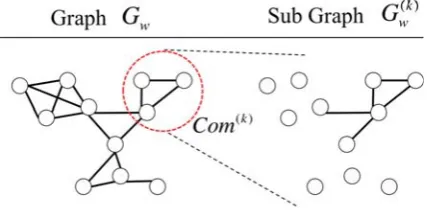
G(wk)(V(k), E(k)). AlthoughV(k) is the same asV ofGw, an edgee(ijk) ∈ E(k)is created if nodeni or njexists inCom(k). Figure 1 shows the relationship betweenCom(k)andG(wk).
Step 3: Wemeasure the importance of each node in
G(wk) with PageRank. Page et al. (1999) explained PageRank by the randomsurfer model. A random
surfer is a person who opens a browser to any page and starts following hyperlinks. PageRank can be interpreted as the probability of a randomsurfer ex-istence in nodes. In this case, a noden(ik)represents vocabulary vi. Therefore P R(n(ik)) represents the
Figure 1: The relationship betweenCom(k)andG(k)w
appearance probability of wordvi inG(wk). We re-gardG(wk)ask-th topic and definemultinomial dis-tributions over words in a vocabularyφkas follows:
φk= (φk1,· · · , φkV)
= (P R(n(1k)),· · ·, P R(n(Vk))) (4)
Step 4: We estimate amultinomial distribution over topics θ using φ, that is estimated in Step 3. To estimateθ, we assume the linearity ofφas follows:
φ·v= K
k=1
φkvθk (5)
whereφ·vdenotes the appearance probability ofv-th termin graphGw. However, it is impossible to esti-mate aθk that satisfies Equation (5) in all of words in a vocabulary because each φk is independently estimated using PageRank.
Therefore, we estimateθkminimizing the follow-ing equation:
argmin θ L
= argmin θ
V
v
(φ·v− K
k=1
φkvθk)2
s.t.θ= 1,θ≥0
(6)
By reformulating Equation (6), the following equation can be obtained:
argmin θ L
= argmin θ
1
2θTQθ+cTθ
s.t.θ= 1,θ≥0
(7)
denotes2φi φj and thei-th element of vectorc de-notes−2φ·Tφi.
Equation (7) is formulated as a convex quadratic programming problem, of which a global optimum
solution should be obtained.
The probability that documentdis generated from k-th topic, i.e. p(zd = k|wd), is calculated as fol-lows:
p(zd=k|wd) = Kp(wd|k)p(k) k=1p(wd|k)p(k)
= θk
V v=1φNkvdv
K
k=1θk Vv=1φNkdvv
(8)
whereNdv denotes the number ofv-th termin doc-umentd.
3 Experiments
In this section, we show the evaluation results of PRTM using real-world text data in comparison with UM and LDA. In subsection 3.1, we explain our test datasets and themeasure used to evaluate sentence clustering accuracy. Furthermore, we present the conditions of UM and LDA in the same subsection. We show topic examples estimated by PRTM, UM, and LDA in subsection 3.2. In subsection 3.3, we compare the sentence clustering accuracy of PRTM with that of UM and LDA. In addition, we compare the estimated number of topics of PRTM with that of the average cosine distancemeasurement in sub-section 3.4.
3.1 Preparation for Experiment
In the experiments, we used the following two datasets:
Hotel Reviews: This is Rakuten Travel1 Japanese
review dataset and has been published by Rakuten, Inc. In this dataset, there are 4309 sentences of 1000 reviews. We tokenized them using Japanese m or-phological analyzer,mecab2, and selected nouns and adjectives. It contains a vocabulary of 3780 words and 19401 word tokens. During preprocessing, we removed high-frequency words appearingmore than 300 times and low frequency words appearing less
1http://travel.rakuten.co.jp/
breakfast breakfast breakfast bath bath breakfast satisfaction meal satisfaction wide wide service very satisfaction support care care absent service delicious convenient comfortable good location
meal delicious absent big bath absent satisfaction
cluster3 cluster4
PRTM UM LDA PRTM UM LDA
good station breakfast support support breakfast location convenient reception reception reception good station close support feeling staff satisfaction cheap location satisfaction reservation check-in very fee
convenience-store
bath good kindness shame
cluster5 cluster6
PRTM UM LDA PRTM UM LDA
different reservation support absent satisfaction breakfast bathing plan satisfaction other opportunity wide bathroom non-smoking breakfast people wide station difficult preparation reception preparation business-trip absent illumination breakfast very voice very care
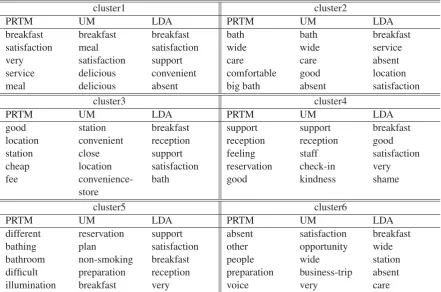
Table 1: Top 5th terms in each topic by PRTM, UM, and LDA. Each termhas been translated fromJapanese to English using Google translation.
3.2 Topic Examples
We used Hotel Reviews dataset and estimated words distributionsφby PRTM, UM, and LDA. All of the PRTM, UM, and LDA were given the number of top-icsK = 6.
In Table 1, we show the terms of top fifth ap-pearance probabilities in each topic estimated. As we can see, PRTM and UM contain similar terms in cluster 1, 2, 3, and 4. For example, in cluster 1, both of PRTM and UM have terms, “breakfast” and “meal”. Therefore its topic seems to be “Food.” On the other hand, there are the same terms, “sup-port” and “reception”, in cluster 4. This topic seems to represent “Service.” However, in LDA, the
esti-mation seems to fail because all of the topics have similar words (e.g. the word “breakfast” exists in all the topics.) For these reasons, it ismore suitable to assume that each sentence has one topic than to assume that it hasmultiple topics.
3.3 Sentence Clustering Accuracy
We evaluated sentence clustering accuracy com par-ing PRTM with UM and LDA on Hotel Review and Car Review datasets. By changing the number of topicsK from3 to 20, we trained topics and word distributions θ, φwith PRTM, UM, and LDA. We generated clusters of sentences by Equation (8) in PRTM and UM. In LDA, we decided the cluster of sentence using topic distributions of each sentence. The sentence clustering accuracy was evaluated by
F1 score on Purity and Inverse Purity. F1 scores of UM and LDA were themean values of the tests run-ning ten times, because the computation results vary depending on randomly initializedθandφ.
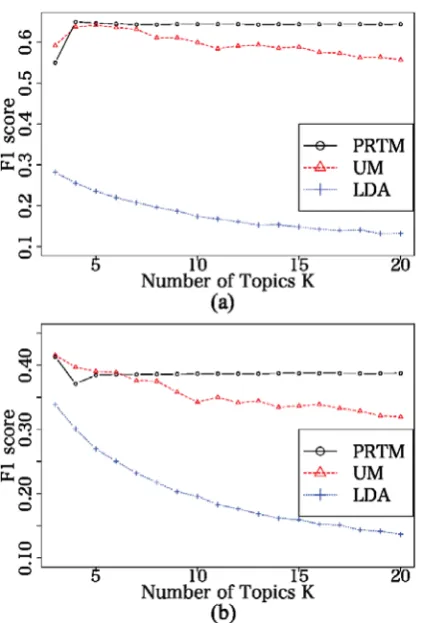
Figure 2:F1score comparison with different numbers of topics. (a) Hotel Reviews. (b) Car Reviews.
with PRTM, F1 score did not decrease if K be-came larger. TheF1scores of LDA were lower than PRTM and UM because it is not suitable for review sentence clustering asmentioned in subsection 3.2.
Table 2 shows the comparison of the appearance probabilitiesθk with the number of topics K = 6 andK = 12. Similar θk was estimated by PRTM and UM with K = 6. However, with K = 12, PRTM had the larger deviation of theθkfrom2.93×
10−6 to2.52×10−1. On the other hand, UM with K = 12had themore uniformθkthan PRTM. This large deviation ofθof PRTM prevents sentences in the same category from being divided into several clusters. This is the reason why theF1score of UM gradually decreased and PRTM achieved invariant sentence clustering accuracy.
3.4 Appropriate Number of Topics
PRTM yields an appropriate number of topics by
maximization of Modularity Q. On the other hand, the appropriate number of topics in UM and LDA
Number of TopicsK = 6 θk PRTM UM
θ1 2.58×10⁻¹ 3.11×10⁻¹ θ2 2.54×10⁻¹ 1.77×10⁻¹ θ3 2.24×10⁻¹ 1.71×10⁻¹ θ4 1.68×10⁻¹ 1.40×10⁻¹ θ5 7.04×10⁻² 1.27×10⁻¹ θ6 2.70×10⁻² 7.39×10⁻²
Number of TopicsK= 12 θk PRTM UM
θ1 2.52×10⁻¹ 2.20×10⁻¹ θ2 2.50×10⁻¹ 1.23×10⁻¹ θ3 2.17×10⁻¹ 1.14×10⁻¹ θ4 1.65×10⁻¹ 9.58×10⁻² θ5 6.94×10⁻² 9.58×10⁻² θ6 2.13×10⁻² 7.34×10⁻² θ7 1.79×10⁻² 6.35×10⁻² θ8 7.62×10⁻³ 6.03×10⁻² θ9 2.28×10⁻⁴ 5.54×10⁻² θ10 1.58×10⁻⁵ 4.02×10⁻² θ11 1.28×10⁻⁵ 3.90×10⁻² θ12 2.93×10⁻⁶ 1.83×10⁻²
Table 2: The appearance probabilities θk comparison withK= 6andK= 12. Sorted in descending order.
can be estimated using the average cosine dis-tance (AveDis)measurement. Therefore, we com -pared Modularity of PRTM with AveDis of UM and LDA with different numbers of topics. We trained topic and word distributions θ, φ, and es-timated the optimal number of topicsK with both of Hotel Reviews and Car Reviews. The AveDis scores of UM and LDA were themean values of the tests running three times for the same reason as sub-section 3.3.
Figure 3 shows the experimental results. The
AveDisof UM got the smallest scores inK = 47 with Hotel Reviews and inK= 47in Car Reviews. Furthermore,AveDisof LDA decreasedm onoton-ically in the range of K = 3 toK = 60. On the other hand, the Modularity of PRTM got largest in
K = 7with Hotel Reviews and inK = 6with Car Reviews. When we consider that Rakuten Travel website scores hotels by six viewpoints and that Edmunds website scores cars by eight viewpoints, the Modularity of PRTM estimates more appropri-ate number of topics thanAveDisof UM in review
Figure 3: Modularity and Ave-Dis comparison with dif-ferent numbers of topics. (a) Hotel Reviews. (b) Car Re-views.
datasets.
4 Related Work
There are several previous works of probabilis-tic generative models. Latent Dirichlet Allocation (LDA) (Blei et al., 2003) estimates topic distribu-tions for each document and word distributions for each topic. On the other hand, Unigram Mixtures (UM) (Nigam et al., 2000) estimates a topic dis-tribution for all the documents and word distribu-tions for each topic. In both papers, theirmodels are tested at document classification task using WebKB datasets which contain 4199 web sites and 23830 words in a vocabulary. Twitter-LDA (Zhao et al., 2011) has been presented to estimatemore coherent topic fromtweets which consist of less than 140 let-ters. In Twitter-LDAmodel, it is hypothesized that one tweet is regarded to be generated fromone topic such as UM. Twitter-LDA is tested using over 1m il-lion tweets which have over 20000 words in a vo-cabulary.
scribed in section 1. However, these probabilistic generativemodels needmuch amount of datasets to get consistent computation results. In our exper-iments, we used about 4000 sentences of reviews which are the same number of documents as in WebKB datasets. However, there are few words in a vocabulary since a sentence of reviews has fewer words than a website. Therefore, in UM and LDA, the computation results seriously depended on randomly-initialized parameters, and lower cluster-ing accuracy was obtained than PRTM in our exper-iment. To get consistent computation results from
short sentence corpus with probabilistic generative
models, over 1million sentences are needed for like the experiment in Twitter-LDA. However, our pro-posedmethod, PageRank Topic Model (PRTM), can get consistentmultinomial distributions over topics and words with few datasets because the network structure analysis methods are not dependent on randomly-initialized parameters. Therefore, PRTM achieved higher sentence clustering accuracy than UM and LDA with few review datasets.
5 Conclusion
In this paper, we have presented PageRank Topic Model (PRTM) to estimate a multinomial distri-bution over topics θ and words φ applying the network structure analysis methods and the con-vex quadratic programming problem to Word -Co-occurrence Graphs. With PRTM, the consistent computation results can be obtained because PRTM is not denpendent on randomly-initializedθandφ. Furthermore, compared to other approaches at the task of estimations of the appropriate number of top-ics, PRTM estimated more appropriate number of topics for extracting the viewpoints from reviews datasets.
Acknowledgments
References
Aaron Clauset, Mark EJ Newman and Cristopher Moore. 2004. Finding community structure in very large net-works. Physical review E, 70(6):066111.
Arthur P. Dempster, Nan M. Laird, and Donald B. Ru-bin. 1977. Maximumlikelihood fromincomplete data via the EM algorithm.Journal of the Royal Statistical Society, Series B (methodological), 39(1): 1–38. Danushka Bollegala, Yutaka Matsuo, and Mitsuru
Ishizuka. 2008. A Co-occurrence Graph-based Ap-proach for Personal Name Alias Extraction from An-chor Texts.In Proceedings of International Joint Con-ference on Natural Language Processing: 865–870. David M. Blei, Andrew Y. Ng and Michael I. Jordan.
2003. Latent Dirichlet allocation. the Journal of ma-chine Learning research, 3: 993–1022.
Juan Cao, Tian Xia, Jintao Li, Yongdong Zhang, and Sheng Tang. 2009. A density-based method for adaptive LDAmodel selection. Neurocomputing, 72: 1775–1781.
Jun S. Liu. 1994. The collapsed Gibbs sampler in Bayesian computations with applications to a gene regulation problem. Journal of the American Statis-tical Association, 89(427): 958–966.
Kamal Nigam, Andrew K. McCallum, Sebastian Thrun, and TomMitchell. 2000. Text Classification from La-beled and UnlaLa-beled Documents using EM. Machine Learning, 39(2/3): 61–67.
Kavita Ganesan and ChengXiang Zhai. 2011. Opinion-Based Entity Ranking. Information Retrieval. Larry Page, Sergey Brin, Rajeev Motwani, and Terry
Winograd. 1999. The pagerank citation ranking: Bringing order to the web. Technical Report 1999-66, Stanford InfoLab. Previous number = SIDL-WP-1999-0120.
Mikio Yamamoto and Kugatsu Sadamitsu. 2005. Dirich-let Mixtures in Text Modeling. CS Technical report CS-TR-05-1, University of Tsukuba, Japan.
Sergey Brin and Larry Page. 1998. The anatomy of a large-scale hypertextual Web search engine. Com-puter Networks and ISDN Systems, 30(17):107–117. Takeshi Sakaki, Yutaka Matsuo, Koki Uchiyama and
Mit-suru Ishizuka 2007. Construction of Related Terms Thesauri fromthe Web. Journal of Natural Language Processing, 14(2):3–31.
Wayne Xin Zhao, Jing Jiang, Jianshu Weng, Jing He, Ee-Peng Lim, Hongfei Yan, and Xiaoming Li. 2011. Comparing twitter and traditional media using topic models. The annual European Conference on Infor-mation Retrieval:338–349.
Yee W. Teh, David Newman, and Max Welling. 2006. A collapsed variational Bayesian inference algorithm
for latent Dirichlet allocation. In Advances in Neural Information Processing Systems: 1353–1360.
Ying Zhao and George Karypis. 2001. Criterion func-tions for document clustering: Experiments and analy-sis. Technical Report TR 01–40, Department of Com-puter Science, University of Minnesota, Minneapolis, MN.
Yukio Ohsawa, Nels E. Benson, and Masahiko Yachida. 1998. KeyGraph: Automatic Indexing by Co-occurrence Graph based on Building Construction Metaphor. In Proceedings of Advanced Digital Li-brary Conference: 12–18.