Decreasing birth asphyxia: utility of
statistical process control in a
low-resource setting
Mariya Mukhtar-Yola,1 Lamidi Isah Audu,1 Oluyinka Olaniyan,2 Henry T Akinbi,3 Adekunle Dawodu,4 Edward F Donovan5
To cite: Mukhtar-Yola M, Audu LI, Olaniyan O, et al. Decreasing birth asphyxia: utility of statistical process control in a low-resource setting. BMJ Open Quality 2018;7:e000231. doi:10.1136/ bmjoq-2017-000231 Received 16 October 2017 Revised 23 June 2018 Accepted 11 August 2018
1Neonatal Unit, Department of Paediatrics, National Hospital Abuja (NHA), Abuja, Nigeria 2Department of Obstetrics and Gynecology, National Hospital Abuja, Abuja, Nigeria 3Perinatal Institute, Cincinnati Children’s Hospital Medical Center, Cincinnatti, Ohio, USA 4Global Health Center, CCHMC, Cincinnati, Ohio, USA 5James Anderson Center for Health Systems Excellence, CCHMC, Cincinnati, Ohio, USA Correspondence to Dr Mariya Mukhtar-Yola; mariyamukhtar@ yahoo. com © Author(s) (or their employer(s)) 2018. Re-use permitted under CC BY-NC. No commercial re-use. See rights and permissions. Published by BMJ.
AbstrAct
The neonatal period is a critical time for survival of the child. A disproportionate amount of neonatal deaths occur in low-resource countries and are attributable to perinatal events, especially birth asphyxia. This project aimed to reduce the incidence of birth asphyxia by 20% by June 2014 through training in neonatal resuscitation and improving the availability of resuscitation equipment in the delivery room in the National Hospital Abuja, Nigeria. A prospective, longitudinal study using statistical process control analytical methods was done enrolling babies delivered at the National Hospital Abuja.
Low Apgar scores or birth asphyxia (defined a priori as any score <7 at 1, 5 and/or at 10 min) was assessed. To ensure reliability and validity of Apgar scoring, trainings on scoring were held for labour and delivery staff. Interventions included provision of additional equipment and trainings on neonatal resuscitation. Apgar scores were aggregated weekly over 25 months. Control charts with three SE confidence limits were used to monitor the proportion of scores ≤7.
The baseline incidence of low Apgar scores, as defined a priori, was 33%, 17% and 10% while postintervention the incidence was 18%, 17% and 6% at 1, 5 and 10 min, respectively—a reduction of 45% and 40% in the 1-min and 10-min low Apgar scores.
Increased communication, additional resuscitation equipment and training of delivery personnel on neonatal resuscitation are associated with reductions in measures of birth asphyxia. These improvements have been sustained and efforts are ongoing to spread our interventions to other special care delivery units/nursery in adjoining states. Our study demonstrates the feasibility and utility of using improvement science methods to assess and improve perinatal outcome in low-resource settings.
Problem
In Nigeria, every year, over 260 000 babies die within the first month of life with about 90 000 babies dying on the first day of life.1 About
33% of these deaths are attributed to asphyxia and yet 70%–80% of these deaths could be prevented if essential interventions in existing health packages reached women and babies on time.2 3 Several studies have
iden-tified that limited access to healthcare; poor human and material resource and capacity to
intervene at the time of delivery contribute to the high morbidity and mortality.4 To
under-stand the problem in detail and to identify the failure modes at the National Hospital Abuja (NHA), an audit of the baseline inci-dence of low Apgar scores as a measure of birth asphyxia was found to be 33%, 17% and 10% at 1, 5 and 10 min, respectively. Realising that systems and processes could be improved for the benefit of these babies, this study aimed at reducing the incidence of birth asphyxia in the delivery room by 20% by March 2014 at the NHA. We hypothesised that training on neonatal resuscitation and improving the availability of resuscitation equipment will increase the incidence of 1, 5 and 10 min Apgar scores >6 by at least 20%.
The NHA is a 400-bed tertiary facility that serves as a referral centre for all hospitals within Abuja and the neighbouring states. About 2000 newborns are delivered at this hospital every year. Some births occur to booked patients of the hospital but many births are to mothers referred shortly before delivery because of pregnancy complica-tions. The study design was prospective and longitudinal using statistical process control analytical methods.5 Infants delivered at the
NHA during the study period were included while, babies with major congenital malfor-mations, birth before arrival and stillbirths were excluded.
background
The neonatal period is a critical time for survival of the child. More than 80% of all newborn deaths result from three prevent-able and treatprevent-able conditions: complications due to prematurity, neonatal infections and intrapartum-related deaths (including birth asphyxia).6 7 In 2012, it was estimated that
globally about 2.9 million newborns die every year and 2.6 million are delivered stillborn.2
Seventy-five per cent of these deaths occur in South Asia and sub-Saharan Africa and about
copyright.
on September 12, 2020 by guest. Protected by
three-quarters of all neonatal deaths occur during the first week of life, with 1 million babies dying on the day they are born.2 Perinatal asphyxia accounts for over 800 000
newborn deaths each year.2 For each intrapartum-related
newborn death, many more babies are left with perma-nent disabilities.8 Since newborn deaths still account
for 44% of under-5 deaths globally, neonatal mortality and stillbirths require greater visibility in the emerging post-2015 sustainable development agenda if the overall under-5 mortality is to be significantly reduced.3
Nigeria has the highest number of newborn deaths in Africa, and the second highest in the world.5
Three-quar-ters of these deaths could be prevented if essential inter-ventions in existing health packages reached women and babies on time.1–3 Although some progress has been
made in the reduction of the neonatal mortality rate from 48/1000 live birth in 2003 to 37/1000 live birth in 2013, much more can be achieved using available newer strategies.8–10 Several reasons have been identified as
chal-lenges to reducing birth asphyxia in sub-Saharan Africa including lack of skilled workers and resuscitation equip-ment. In an observational study of 193 healthcare workers drawn from different counties in Kenya, only 12% of the nurses had received any formal in-service training on neonatal resuscitation and >70% of them considered their knowledge about neonatal resuscitation inadequate and blamed it on inadequate medical training programmes.11
Similarly in western Nigeria, Ogunlesi et al reported that of 176 nurses sampled from 4 hospitals, only 14.0% had attended neonatal resuscitation training course within the past 5 years.12 In a survey of four hospitals in western
Nigeria, only 31.8%, 53.1%, 58.1% and 35.2% had access to radiant warmers, ambu bags, suction machine and oxygen delivery units, respectively.12
An important step to improving neonatal care and reducing neonatal mortality in low-income and middle-income nations is assessment of neonatal health-care resources, community engagement and improved government funding of health services. This will allow identification of areas of healthcare policy and public participation needing modification to enhance survival of newborns.13
Studies from the USA demonstrated that significant improvement in Apgar scores occurred among neonates after Neonatal Resuscitation Programme (NRP) instruc-tion.14 15 Studies of both state-wide and individual hospital
populations showed that there was a statistically signifi-cantly lower proportion of high-risk newborns with low (0–6) 5 and 10 min Apgar scores after the training. After adjusting for several maternal characteristics, logistic regression analysis revealed that high-risk newborns with low 1 min Apgar scores were more likely to increase their 5 min Apgar scores after NRP instruction.14,15 Similar find-ings were reported from South Africa16 and Cambodia.17
Preventive safe motherhood strategies to reduce neonatal deaths due to intrapartum hypoxia such as birth preparedness, presence of a skilled attendant at delivery, danger sign recognition and training of staff
on neonatal resuscitation could reduce the incidence of birth asphyxia.1–3 This study set out to determine the
effect of reducing the gaps in knowledge and skills in neonatal resuscitation, improving communication and the availability of equipment needed for resuscitation on the incidence of birth asphyxia.
In planning this work, weekly meetings both virtual and physical took place involving all authors and at times supporting staff for about 6 months. Thereafter, meet-ings took place twice a month until project conclusion. Selected residents, records clerks and data entry clerks were recruited and placed on monthly stipends. Lack of a project funding was a significant barrier to maintaining engaged staff.
Staff of the labour ward and neonatal unit who partic-ipated in data collection were involved at an onsite meeting and given written project descriptions and copies of the ethical approvals. Mothers were provided with patient information sheets, which provided details about the ongoing project.
measuremenTs
To determine a baseline incidence of asphyxia, a review of medical records of all births was conducted retrospec-tively covering the 16-month period (February 2012–June 2013) prior to initiation of study interventions. Addition-ally, using a questionnaire with a checklist completed by labour ward and neonatal nurses during 100 nursing shifts, we determined the availability and functionality of equipment for resuscitation, the availability of healthcare workers to support neonatal resuscitation and the propor-tion of staff that had already received Neonatal Resusci-tation Training (NRT) or Helping Babies Breath (HBB) training. This was done to identify any gaps in required manpower, equipment and supplies.
Maternity and neonatal staff were retrained in May 2013 on the Apgar scoring system as a reproducible measure to assess asphyxia and to ensure uniformity in scoring.
Results of baseline assessment revealed that the neonatal unit is a level 2b nursery with 3 units that had a total capacity of 30 beds inclusive of cots and 10 incu-bators. Four consultants, 4 senior residents, 4 junior residents and about 60 nursing staff managed the unit. Results of the preliminary audit showed that the labour ward had 16 delivery beds, 4 resuscitation stations or warmers, an ultrasound machine, a cardiotocograph, mobile fetal heart monitoring machine, wall oxygen and suction points. Mobile manual suction devices and mucous extractors were also available. The staff consisted of 20 midwives/nurses, 10 consultants and 20 residents.
When surveyed, 51% of the midwives reported that they had received training in NRT or HBB in the preceding 2 years, 31% reported they had never received any formal training while 18% did not respond.
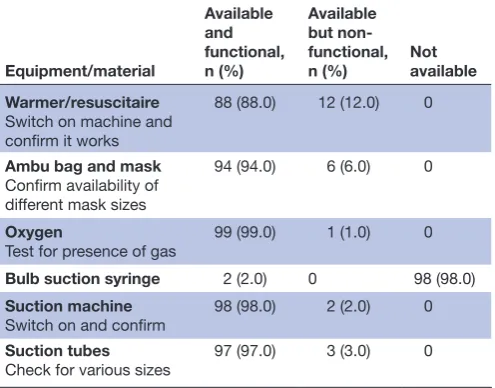
In response to survey questions regarding resuscita-tion equipment and supplies availability and funcresuscita-tion- function-ality, the midwives responses are shown in table 1. In the
copyright.
on September 12, 2020 by guest. Protected by
free comment section provided in the checklist, it was reported that the available equipment were not suffi-cient given the number of babies delivered in the unit. Consumables were also often lacking.
Sixty-four per cent of the questionnaires were completed in the labour ward, while 36% were completed in the obstetrics operating room.
Standard improvement science methods18 and
statis-tical process control analyses were used including special cause rules that identified probabilities of <2% (p<0.02). Control charts with 3 SE confidence limits were used to monitor the proportion of Apgar scores ≥7.
design
After the baseline data collection period, interventions were offered starting July 2013 and data collection continued prospectively to March 2014. Plan-do-study-act (PDSA) cycles were used to trial the improvement inter-ventions and assess the impact on low Apgar scores. Interventions offered included education and awareness meetings with the NHA management, faculty and staff of obstetrics and gynaecology (OBGYN) and paediatrics in July 2013 to highlight the importance of communication between the two departments and the need for training and skill acquisition in order to reduce the incidence of birth asphyxia. Second, additional resuscitation equip-ment was supplied to the labour room in August 2013. These were expected to help in the effective resuscita-tion of the babies. Finally, training in neonatal resusci-tation was initiated in batches starting September 2013 for 70 doctors and nurses using the HBB training tools developed by the American Academy of Paediatrics.19
Four Neonatologists, an obstetrician, two midwives and some administrative assistants conducted the training. To ensure sustainability, refresher training was provided to the staff every 6 months.
sTraTegy
Beginning January 2012, Apgar scores were aggregated weekly over 25 months. The incidence of asphyxia was assessed and plotted monthly using statistical process control methods. Using these assessments, interventions were reviewed every 3 months to identify failure modes and balancing measures in order to determine whether the interventions needed to be modified, adapted or adopted.
Pdsa1: educaTion and awareness (July 2013; week 73)
aim
To sensitise the hospital management and relevant departments on the need for effective communication, training on neonatal resuscitation and provision of equip-ment and supplies to reduce the incidence of low Apgar scores by 20% by March 2014.
Plan
Hold awareness meetings with hospital management, staff and faculty of OBGYN and paediatrics to highlight the importance of communication between the two departments and the need for training and skill acquisi-tion in order to reduce the incidence of low Apgar scores. Emphasis was placed on inviting paediatricians to all high-risk deliveries and daily notification of the newborn unit of booked elective caesarean sections in order to enable a paediatrician to be in attendance.
do
Four meetings were held; one with the hospital clin-ical directorate, the second with the maintenance and procurement directorate and two separate meetings between faculty and staff of OBGYN and paediatrics. The last meeting had a least 25 people in attendance while the earlier meetings each had 6 people in attendance. The management and staff of relevant departments embraced this renewed effort and offered to collaborate and plan for resources to achieve the common goal.
study
The results showed that collaboration resulted in more commitment towards facilitating the requirements to reduce low Apgar scores. Increased communication resulted in paediatricians attending high-risk deliveries and planned surgeries.
act
We identified the need for resuscitation equipment as our next PDSA cycle.
Pdsa 2: resusciTaTion equiPmenT (augusT 2013; week 77)
aim
To sensitise the hospital management and relevant depart-ments on the need for effective communication, training on neonatal resuscitation and provision of equipment Table 1 Checklist for resuscitation equipment in delivery
room
Equipment/material
Available and functional, n (%)
Available but non-functional, n (%)
Not available Warmer/resuscitaire
Switch on machine and confirm it works
88 (88.0) 12 (12.0) 0
Ambu bag and mask Confirm availability of different mask sizes
94 (94.0) 6 (6.0) 0
Oxygen
Test for presence of gas 99 (99.0) 1 (1.0) 0 Bulb suction syringe 2 (2.0) 0 98 (98.0) Suction machine
Switch on and confirm
98 (98.0) 2 (2.0) 0
Suction tubes
Check for various sizes 97 (97.0) 3 (3.0) 0
copyright.
on September 12, 2020 by guest. Protected by
and supplies to reduce the incidence of low Apgar scores by 20% by March 2014.
Plan
To request of hospital management that additional equip-ment was required for the labour and delivery rooms.
Prediction
Availability of additional equipment and supplies will facilitate effective resuscitation of babies and improve the skills of staff.
do
The hospital management supplied additional resus-citaires, bag and masks ventilators, consumables, etc.
study
The result confirmed this as a crucial intervention as the number of resuscitation equipment doubled and a supply chain was established for consumables.
act
We put in measures for routine maintenance of equip-ment and sustained supply of consumables and identified the need for training on neonatal resuscitation as our target for the next PDSA.
Pdsa 3: Hbb Training
(sePTember–ocTober 2013; weeks 81–87) aim
To sensitise the hospital management and relevant departments on the need for effective communication, training on neonatal resuscitation and provision of equip-ment and supplies to reduce the incidence of low Apgar scores by 20% by March 2014.
Plan
To conduct serial trainings on neonatal resuscitation for doctors and nurses in delivery room and neonatal unit, using HBB tools.
Prediction
Neonatal resuscitation training will improve the skills of doctors and midwives as 31% of midwives reported that they had not received a formal training in the preceding 2 years.
do
Seventy doctors and midwives were trained on neonatal resuscitation in batches.
study
Skills in neonatal resuscitation improved as the incidence of low Apgar scores reduced to 18% in 1 min, and 6% in 10 min.
act
This was implemented as a standard. Refresher trainings are provided every 6 months.
resulTs
From February 2012 through March 2014, there were 3427 births at NHA, approximately 33 births per week. Only 3347 (98%) had complete records. Patients booked at the NHA were 2723 (81.4%), while unbooked patients were 624 (18.6%). Fifty-two per cent of babies were deliv-ered vaginally, 17.7% by elective caesarean section and 28% by emergency caesarean section while the others had assisted vaginal delivery. The maternal age was 31.4±4.8 years (range 15–50 years); mean gestational age was 37.7±2.8 weeks (range 25–44 weeks); mean birth weight was 3.05±0.75 kg (range 500–5600 g). Preterm babies constituted about 20%.
Findings from this study showed that although some of the required resuscitation equipment were avail-able, some (eg, radiant warmers) were not functional as reported by 12% of the interviewees. Appropriate-sized facemasks for positive pressure ventilation were also reported to be unavailable or non-functional by 6% of questionnaire respondents. The use of bulb syringes for suctioning was almost non-existent (2%) as wall suction or mobile suction device with nasal catheters and mucous extractors predominated. Only 51% of the labour and delivery room staff had received any formal training on NRT or HBB in the 2 years preceding the study. Although these staff are constantly working in the delivery room, there is no protocol in place for periodic skill evalua-tion and retraining especially when new guidelines are introduced.
During the 16-month period prior to initiating the intervention, the average incidences of Apgar scores <7 were 33%, 17% and 10% while the average incidences after the interventions (PDSA cycles) initiated were 18%, 17% and 6% at 1, 5 and 10 min, respectively (figures 1–3). This demonstrates reductions in measures of birth asphyxia of 45%, and 40% at 1 and 10 min, respectively.
Figure 1 shows a control chart with weekly per cent of 1 min Apgar scores≥7. A special cause, indicating an increase in the proportion of Apgar scores≥7 was iden-tified in week 73 (3 weeks after initiation of interven-tions), thereafter a new mean for weekly Apgar scores≥7 was calculated. This indicates that there was a statisti-cally significant change in Apgar scores likely related to improvements in care. No special cause was observed during the course of the study in the weekly Apgar scores for 5 min (figure 2). For the 10 min score, a special cause showing a statistically significant increase in the propor-tion of Apgar scores≥7 was identified during the first week of August 2013, that is, week 73 (3 weeks after initiation of interventions). Thereafter, a new mean for weekly 10 min Apgar score was calculated and displayed (figure 3). The three figures each suggest a decrease in variation among Apgar scores associated with the variation possibly due to standardisation of care.
copyright.
on September 12, 2020 by guest. Protected by
lessons and limiTaTions
This study examined the feasibility of using improve-ment science methods in resource-limited settings to evaluate the effect of several interventions on babies at risk of low Apgar scores. The results of this study indi-cate that strengthening communication between hospital management, obstetricians, midwives, NICU nursing staff and neonatologists, providing additional equip-ment and trainings on neonatal resuscitation improved Apgar scores in 1 and 10 min as compared with historical controls. Important lessons learnt to keep the staff moti-vated about the project include: periodic project updates to the labour and delivery team by displaying run charts
on the wards to show progress being made and the role of resuscitation champions for onsite mentoring.
This quality improvement project has positively impacted both the healthcare system in the NHA and the care provided by healthcare workers. The delivery room has benefited with additional equipment and supplies as well as protocols on neonatal resuscitation. Addition-ally, there is improved communication and interaction between the obstetricians, midwives and neonatologist, strengthened by the joint participation during the HBB training sessions.
There are a number of limitations in this study. First, the study used retrospective or historical data to obtain Figure 1 Control chart of weekly per cent of 1 min Apgar scores at NHA ≥7 demonstrating a special cause likely related to improvement in care. HBB, Helping Babies Breathe; NHA, National Hospital Abuja; OBGYN, obstetrics and gynaecology.
Figure 2 Control chart of weekly per cent of 5 min Apgar scores at NHA≥7. There was no special cause identified. HBB, Helping Babies Breathe; NHA, National Hospital Abuja; OBGYN, obstetrics and gynaecology.
copyright.
on September 12, 2020 by guest. Protected by
comparison data on birth asphyxia and thus was limited by the availability of a common newborn database over the years. Medical records are still kept in paper regis-ters rather than electronic medical records, which may increase the likelihood of missing data. For example, in some shifts there were records of 1, 5, 10 and 20 min Apgar scores while some shifts carried only 1 and 5 min Apgar scores. Attempts were made to use as much of the common information as possible to control for possible differential bias over the years. Second, competence in reproducibly assigning Apgar scores may have evolved over the years. We can only vouch for the consistency of Apgar scores post-training during the study period. Rothberg et al20 demonstrated that some staff tended to
assign higher Apgar scores than independent observers. In order to mitigate this issue, trainings on Apgar scoring was conducted to all delivery and neonatal staff prior to the prospective arm of the study to introduce some stan-dardisation. The emphasis placed on Apgar categories (0–3, 4–6, 7–10) rather than unit changes in an Apgar score was an attempt to minimise bias and reduce effect of inter-rater variability among healthcare personnel. This particular design in which the interventions, by necessity, were applied to all caregivers in a single hospital could not feasibly include a concurrent group of newborns. Thus, it is possible that there were unplanned and unmea-sured changes in care that resulted in improved Apgar scores. Because this version of longitudinal statistical process control methods suffers from this possible bias, a type 1 error threshold of 0.02% was used rather than the conventional threshold of 0.05%. Due to two episodes of industrial action in the hospital during study period, the number of babies delivered in the hospital was not as large as under normal circumstances; however, this did not have an impact on the study.
conclusion
Retraining of delivery personnel, enhanced communica-tion and improved availability of resuscitacommunica-tion resources is associated with reductions in low Apgar scores as a proxy for birth asphyxia of 45% and 40% at 1 and 10 min, respectively. This study demonstrates the feasibility and utility of applying improvement science methods to assess and improve perinatal outcome in low-resource settings.
This project has established a sustainable communica-tion channel between the obstetricians and the neona-tologists. Administration of biannual refresher HBB trainings to health workers and extending lessons learnt to other neonatal centres in Abuja will ensure conti-nuity and spread. Resuscitation champions in the labour ward are helping to drive this. The joint quarterly peri-natal meetings will be strengthened to further facilitate communication among all staff. Additionally, the hospital has a policy of requesting equipment needs from various units at the beginning of each year. We will capitalise on this to sustain supply of required life-saving equipment, in addition to reaching out to partners for support.
Several lessons have been learnt during this project, including the importance of communication, teamwork, clear agreements on project responsibilities, adequate forecasting of required equipment and consumables as well as the importance of obtaining grants when conducting large projects. When change is being intro-duced to any system, there are ‘laggers’ and ‘leaders’, but with effective team work and communication the ‘laggers’ also join eventually to achieve the common goal. These lessons will be carried forward to our next improvement project.
Acknowledgements All the staff in the labour, delivery suite and newborn unit are hereby acknowledged for their involvement and contributions to this project. Drs AT Otuneye and AB Mairami are specially acknowledged for assisting in the HBB training.
Figure 3 Control chart of weekly per cent of 10 min Apgar scores at NHA ≥7 demonstrating a special cause likely related to improvement in care. HBB, Helping Babies Breathe; NHA, National Hospital Abuja; OBGYN, obstetrics and ynaecology.
copyright.
on September 12, 2020 by guest. Protected by
Contributors All authors contributed to the concept and design of the study. MM-Y, LIA and OY contributed to data collection. MM-Y, EFD, AD and HTA conducted the data analysis and interpretation, MM-Y did the manuscript preparation while all authors did the editing and critical review. MM-Y is the guarantor and takes responsibility for all aspects of the work.
Funding Partial funding was received from the National Hospital Abuja for Helping Babies Breath training, while Save The Children Nigeria supported the training with resuscitation tools and charts.
Competing interests None declared.
Ethics approval Ethical approval was obtained from both Ethical Review Boards of NHA and CCHMC.
Provenance and peer review Not commissioned; externally peer reviewed. Open access This is an open access article distributed in accordance with the Creative Commons Attribution Non Commercial (CC BY-NC 4.0) license, which permits others to distribute, remix, adapt, build upon this work non-commercially, and license their derivative works on different terms, provided the original work is properly cited, appropriate credit is given, any changes made indicated, and the use is non-commercial. See: http:// creativecommons. org/ licenses/ by- nc/ 4. 0/.
references
1. Save the children. Surviving the First Day, State of the Worlds Mothers. Geneva: World Health Organization, 2013.
2. Every newborn an executive summary for the lancet’s series. Lancet
2014.
3. World Health Organization. Neonatal and perinatal mortality: country, regional and global estimates. http:// apps. who. int/ iris/ bitstream/ handle/ 10665/ 43444/ 9241563206_ eng. pdf? sequence= 1& isAllowed=y (accessed 11 Jul 2017).
4. World Health Organization. Every Newborn. An action plan to end preventable deaths. Geneva: WHO, 2014.
5. Marilyn KH, Robert FH. Introduction To Statistical Process Control Techniques: Statit software, 2007.
6. Lawn JE, Blencowe H, Oza S, et al. Every Newborn: progress, priorities, and potential beyond survival. Lancet 2014;384:189–205.
7. Federal Ministry of Health. Saving Newborn Lives in Nigeria: Newborn Health in the context of the Integrated Maternal, Newborn and Child Health Strategy. 2 edn. Abuja: Federal Ministry of Health, 2011:20–6.
8. National population commission. NIGERIADEMOGRAPHIC AND HEALTH SURVEY, 2013.
9. Gl D, Kinney MV, chopra M, et al. Who has been caring for the baby?
Lancet 2014;14:60458.
10. Bhutta ZA, Das JK, Bahl R, et al. Can available interventions end preventable deaths in mothers, newborn babies, and stillbirths, and at what cost? Lancet 2014;384:347–70.
11. Murila F, Obimbo MM, Musoke R. Assessment of knowledge on neonatal resuscitation amongst health care providers in Kenya. Pan Afr Med J 2012;11:78.
12. Ogunlesi TA, Dedeke OI, Adekambi FA, et al. Neonatal resuscitation: knowledge and practice of nurses In Western Nigeriaigeria. South African Journal of Child Health 2008;2:23–5.
13. Dawodu A. Neonatology in developing countries: problems, practices and prospects. Ann Trop Paediatr 1998;18 Suppl:S73–S79.
14. Patel D, Piotrowski ZH, Nelson MR, et al. Effect of a statewide neonatal resuscitation training program on Apgar scores among high-risk neonates in Illinois. Pediatrics 2001;107:648–55. 15. Patel D, Piotrowski ZH. Positive changes among very low birth
weight infant apgar scores that are associated with the neonatal resuscitation program in illinois. J Perinatol 2002;22:386–90. 16. Couper ID, Thurley JD, Hugo JF, et al. The neonatal resuscitation
training project in rural South Africa. Rural Remote Health 2005;5:459.
17. RACHA. The neonatal resuscitation skills training program in cambodia its impact on the health care professionals’ competency in newborn resuscitation. 2006 http:// rc. racha. org. kh (accessed 14 Feb2017).
18. Shojania KG, Grimshaw JM. Evidence-based quality improvement: the state of the science. Health Aff 2005;24:138–50.
19. American Academy of Paediatrics. Helping Babies Breathe. Learner workbook. 2010.
20. Rothberg AD, Cooper PA, Fisher HM, et al. Apgar scores and asphyxia. results of a study and proposal for a clinical grading system. S Afr Med J 1986;69:605–7.
copyright.
on September 12, 2020 by guest. Protected by