Journal of Industrial Engineering and Management Studies Vol. 5, No. 1, 2018, pp. 66-84
DOI: 10.22116/JIEMS.2018.66505
www.jiems.icms.ac.ir
Developing customer relationship management (CRM) processes
using standard frameworks and MCDM techniques
Saeid Emamgholizadeh1,*, Ahmad Jafarzadeh Afshari1, Maryam Shabani Bahmand1
Abstract
Organizations have found that functional approach to business destroys flexibility and agility by gaining experience over the time. The main weakness with Task-based organizations is that they can hardly act flexibly and adapt themselves to the changing environment. In today’s' dynamic and competitive business world, organizations focus significantly on managing and improving their business processes. Therefore, nowadays to be survived and successful, certainly the process approach must be followed. In addition, organizations having such improvement and innovations are looking to create organizational wealth. In this regard, the present study is trying to identify and describe processes from reputable reference models in Customer Relationship Management (CRM) and more importantly to design and streamline CRM processes effectively for organizations in order to improve processes and offer value to customers. In this paper, first by identifying and explaining CRM reference models, three models were selected based on five criteria (flexibility, Understandability, comprehensiveness, Completeness and Usability) using Analytic Hierarchy Process (AHP) technique which are relatively as follow: SAP, CCOR & PCF. Then, the processes of the three models were extracted and gathered in a comprehensive list to offer a united framework to design CRM processes. Finally, a case study will show the applicability of the proposed model. With this paper, we enrich research by a valuable process framework for developing well-designed reference models.
Keywords:CRM Reference Models; Process design; AHP; QFD.
Received: Junary 2018-17 Revised: May 2018-05 Accepted: June 2018-09
1. Introduction
Many scholars hold the view that previous models usually are blueprints of recommended practice and, thus, are sources of reusable and efficient business processes on organizations which can model their own business. Their main purpose is to streamline the design of enterprise models and enable organizations to apply ‘Best Practice’ knowledge. Whereas, they do not fully explain how to identify and design organizational processes and difficulties arise when an attempt is made to implement a CRM project in a company using reference models.
Since a low quality reference models can be damaging for the organization, a considerable number of works focus on guiding the development process to achieve a better RM quality (Oufkir et al, 2017; Andreas and Frank, 2016; Matook and Indulska, 2009; Thomas, 2006). Whereas, modelers do not have the teaching or the experience necessities to create process models of high quality (Avila, 2018).
In general terms, this means a necessity to identify reference models to develop process modeling.
The present research focuses on designing a conceptual framework of processes based on CRM reference models using AHP and QFD techniques.
In this paper, we established two research questions:
RQ1 What are general and CRM reference models in the literature to develop a valuable process framework?
RQ2 How can organizations choose their business processes from reference model using a systematic procedure and based on their strategic objectives?
To solve RQ1, a review of the literature about reference models and process modeling is necessary and for RQ2, our case study is performed based on our proposed process framework.
Moreover, this paper has two main objectives:
Objective 1: Identify and describe CRM reference models in order to develop a comprehensive process framework.
Objective 2: Providing CRM processes to organizations based on their strategic objectives. None of the previous objectives has been explored in detail in the past, making this research a significant contribution to understanding the overall context of the area and promoting the process reference models.
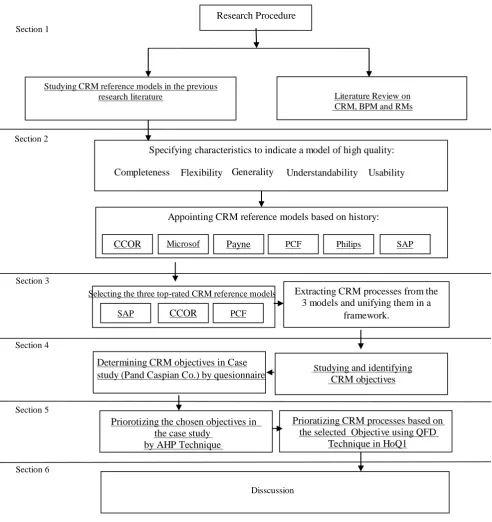
Figure 1. Research Procedure
Specifying characteristics to indicate a model of high quality: Studying CRM reference modelsin the previous
research literature Literature Reviewon
CRM, BPM and RMs Research Procedure
Appointing CRM reference models based on history:
CCOR Microsof t CRM
Payne PCF Philips SAP
SAP CCOR PCF
Understandability Usability Generality
Flexibility
Selecting the three top-rated CRM reference models using AHP:
Extracting CRM processes from the 3 models and unifying them in a
framework.
Determining CRM objectives in Case
study (Pand Caspian Co.) by quesionnaire Studying and iCRM objectivesdentifying
Prioratizing CRM processes based on FD the selected Objective using Q
1 Q Technique in Ho in
objectives chosen
Priorotizing the
the case study by AHP Technique
Disscussion Completeness
Section 1
Section 2
Section 3
Section 4
Section 5
2. Literature Review
2.1. Reference ModelsIn 2018, Avila published a dissertation in which he investigated in detail process modeling guidelines by studying 520 articles and how effective modelers are in using them. He performed this in order to create comprehensible process models and their practicablity. He revealed that there is a lack of empirical studies in the literature that analyze process modeling guidelines as a group, which is how they are most frequently used in practice (Avila, 2018).
In 2017, Oufkir and co-workers designed a KM reference model fitting any kind of
KM projects in view of producing a high quality model. They reported that this model is built on existing KM models literature and enhanced with theoretical findings. In particular, it is composed of three interrelated sub-models: KM processes, socio-technical influencing KM factors and KM key performance indicators.
Garbutt and his co-workers demonstrated the integrative relationship between Business Process Management and Enterprise Resource Planning Systems. Business process orientation takes cognizance of interdependencies and cross functional information sharing. ERP in turn incorporates software modules with the purpose of integrating business processes and functions. ERP is seen as an enabler of business processes which are automated through the ERP software, but BPM is not dependent on the technology. When considering enterprise systems it is necessary to take into account business process management together with enterprise resource planning (Garbutt et al, 2016).
Dijkman et al. provided an overview and comparison of the prevailing approaches to design such a business process architecture both with the usability and actual use of the indentified approaches. The five approaches are as following: goal-based, action-based, object-based, function-based and reference model based (Dijkman et al, 2011).
Jede and his colleagues provided a new conceptual process model for reference model development. They used a scientific approach consisting of four steps by developing a requirements framework for designing reference models, using this framework as a basis for the comparison of well-documented reference models, consolidating the gained insights from step one and two into a conceptual process model and Finally their case study (Jede et al, 2016).
In a wide-ranging of analysis of Spiegel and Caulliraux (2012), they define reference models comprehensively and explain how to combine them suitably.
Most published surveys on reference model literature are in German. Matook and Indulska mention that there has been little discussion about developing and assessing reference models (Matook et al, 2009). Therefore, they suggest a tool to manage and assess the quality of reference models.
Tomas highlights the need to define reference models and provided a new definition from different aspects. He points out that a reference model is an integrated model which is modified gradually by obtaining practical experiences of organizations (Tomas, 2005).
Fettke and his colleagues also analised 30 process reference models comprehensively based on a framework consisting of criteria such as application domain, used process modeling languages, model’s size, known evaluations and applications of process reference models (Fettek et al, 2005).
2.2. Customer Relationship Management
The Customer relationship management definition follows from relationship marketing and is produced as the values and strategies of relationship marketing with specific prominence on customer relationships turned into a concrete application (Abu Amuna et al, 2017).
In the literature, the term “CRM” tends to be used to refer to business strategy that aims to understand, anticipate and manage the needs of an organization’s current and potential customers. It requires a customer-centric business philosophy and culture to support effective customer service and process. They studied the adoption of CRM strategies and its system in Small and medium-sized enterprises thoroughly (Njoroge, E. W. and Ombui, K., 2016). Literature suggests that economic and social benefits arise from extended relationships with customers, and often recognizes that customer relationships are vital to the long-term success of the firm (Harrison, 2016).
According to Gartner (2011), CRM is a widely-implemented business strategy that focuses on customer segmentation to organize the customer-centric enterprises, and thus satisfy the customer needs and increase the revenues and profits. Therefore, this shows a need to be explicit about exactly what is meant by the word ‘CRM’.
In broad terms, CRM can be defined as any stimulus that is a concept which focuses on customer needs and demands that re-design the enterprise and its information technology-driven business process, CRM combines a series of methods, software and Internet access capability with customer-oriented business strategy and aims to get the profits and achieve high customer satisfaction (Burghard and Galimi 2011).
The term ‘conceptual CRM framework’ can be traced back to Payne and Frow. In their pioneering examination, they provide and discuss various kinds of CRM and also CRM processes thoroughly (Payne and Frow, 2013).
3. Conceptual background
3.1. Definitions3.1.1. Customer Relationship Management (CRM)
In section 1, a brief overview of the related definitions, CRM and reference models are provided.
CRM strategy attaches three fundamental dimensions of organizations, philosophy, technology and the strategy. Furthermore, the success of Customer CRM strategy contingent on the correct stability between three significant organizational resources: processes, technology, and people. (Abu Auna et al, 2017)
CRM is a widely implemented model for managing a company’s interactions with customers, clients, and sales prospects. It involves using technology to organize, automate, and synchronize business processes- principally sales activities, but also those for marketing, customer service, and technical support.
CRM systems are designed to compile information on customers across different channels -- or points of contact between the customer and the company - which could include the company's website, telephone, live chat, direct mail, marketing materials and social media (Yadav, 2016).
3.1.2. Process
A business process is the work an organization performs to manufacture its products and offer its services. Regardsless of its type, be it governmental, enerprise or non-profit, the management of a business process is fundemental to assure the quality and efficiency of the work being done, ensuring the competence of an organization (Avila , 2018). The term ‘Process’ refers to the coordination of activities in line with achieving goal. CRM processes in fact are those which customer orientation is at its center. A better process is thus one that better contributes to meeting the strategic objectives of an organization. (La Rosa et al, 2017) According to Mendoza et al. (2007), the main business processes that should be addressed in CRM implementation are: marketing, sales, and services.
3.1.3. Reference Models
Reference Models usually are blueprints of recommended practice and, thus, are sources of reusable and efficient business processes on organizations which can model their own business. Their main purpose is to streamline the design of enterprise models and enable organizations to apply ‘Best Practice’ knowledge.
Models are widely used in order to business process reengineering, packaged software customization, activity based costing, ISO certification and software selection. Therefore, the demand for a high model quality is evident (Schuette and Rotthowe, 2017).
According to one of the publications of American Productivity a nd Quality Center (APQC) in 2011, developing and assessing processes consumes a large portion of an organization’s time. A process framework or reference model accelerates this process and increases the speed and depth at which an organization can study internal and external practices and processes. A process framework accelerates benchmarking activities by reducing the effort required to define a common language that Fettke, Loos and Zwicker published a survey that covers 30 of these.
While a variety of definitions of the term ‘reference model’ have been suggested, this paper will use the definition first suggested by Tomas (2005) who saw it as “Best Practice” for offering re-usable solutions. Actually, it is an abstract framework providing clearly defined solutions in a specific domain, integrating Business process re-engineering (BPR) concepts, Benchmarking and measuring processes in a specific framework. Three kinds have been introduced: General Organizational reference models, reference models for specific industries and domain-specific reference models.
3.2. Selecting six Reference Models
In section 2, six models will be employed from literature based on three criteria as follow: access to models by the present researcher, updated models and practicality. Therefore, CCOR, Microsoft CRM, Payne, PCF, Philips and SAP are selected.
Furthermore, it should be mentioned that the four main vendors of CRM systems are Salesforce.com, Microsoft, SAP and Oracle. Other providers are popular among small-to mid-market businesses, but these four tend to be the choice of large corporations (Yadav, 2016).
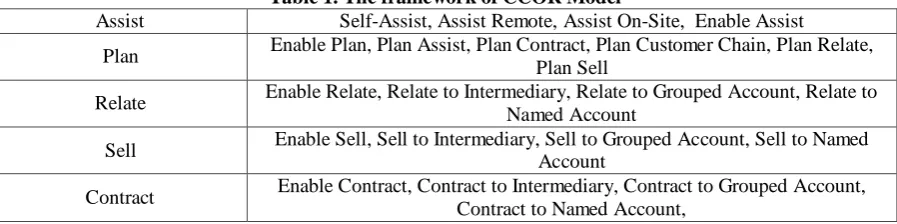
CCOR Model – The Customer-Chain Operations Reference-model (CCOR) is the product of the Supply-Chain Council (SCC), an independent, non-for-profit global corporation. This model can be divided into 5 main areas: Assist, plan, Relate, Sell and Contract.
Table 1. The framework of CCOR Model
Self-Assist, Assist Remote, Assist On-Site, Enable Assist Assist
Enable Plan, Plan Assist, Plan Contract, Plan Customer Chain, Plan Relate, Plan Sell
Plan
Enable Relate, Relate to Intermediary, Relate to Grouped Account, Relate to Named Account
Relate
Enable Sell, Sell to Intermediary, Sell to Grouped Account, Sell to Named Account
Sell
Enable Contract, Contract to Intermediary, Contract to Grouped Account, Contract to Named Account,
Contract
Microsoft CRM Model – Microsoft is one of the software leaders in offering services and solutions to people and businesses. Its model can be classified into 4 main areas in CRM: Sales, Service, Marketing and Enterprise Resource Planning (ERP). Table 2 shows the three main areas of the model.
Table 2.The framework of Microsoft CRM Model
Leads, Opportunities, communication, Data Base, Process Sales
Planning, Budgeting, Marketing List, Campaign Management, following Marketing
Cases, Calls, Resource Management, Scheduling, Knowledge Base Service
Payne Model – Payne and Frow (2005) identified a strategic framework for CRM and introduced 5 key cross-functional processes: Strategy development process, Value creation process, Multichannel integration process, Information Management process and performance assessment process. Figure 1 provides Payne model in detail.
Figure 2. The processes in Payne Model in detail
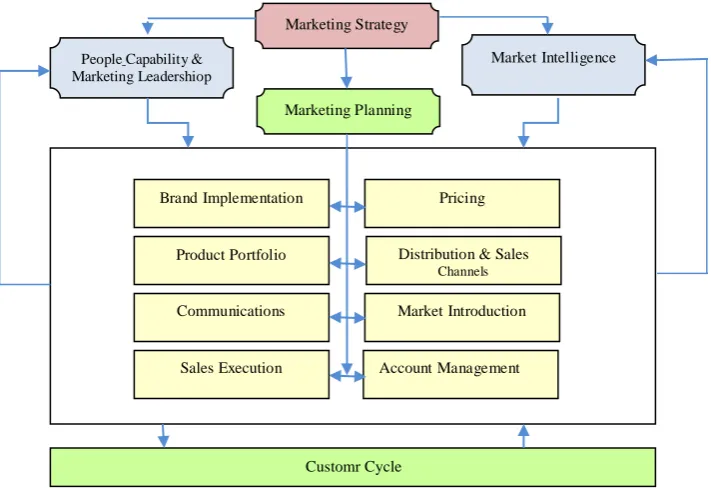
PCF model- APQC’s Process Classification Framework (PCF) is taxonomy of cross-functional business processes was developed for the purpose of allowing the comparison of organizational performance within and among organizations. The Process Classification Framework was developed by APQC. The PCF organizes operating and management processes into 12 enterprise-level categories, including process groups and more than 1,000 processes and associated activities. Figure 2 provides a whole view of this model.
Customer Strategy
• Customer Choice
• Customer characteristics
• Segment granularity
Value Creation Process Multichannel Integration Process
Performance assasement process
Business Strategy
• Business Vision
• Competetive characteriistics
Strategy development process
Value customer receives
• Value proposition
• Value assessment
Value Organization receives: Acquisition Economics Retention Economics Cu st o m er se g m en t li fe ti m e v al u e an al y si s SalesForce Outlets Telephony Direct Marketing Electronic Commerce Mobile Commerce P h ys ic al Int e gr a te d c ha nne l m a na ge m e nt Shareholder results
• Employee Value
• Customer Value
• Shareholder Value\
• Cost Reduction
Performance monitoring
•Standards
•Metrics & KPIs
• Results
• Cost Reduction
V
ir
tu
al
Data respository
IT systems Analysis tools Front Office applications
Figure 3. The view of PCF Model into 2 main process groups
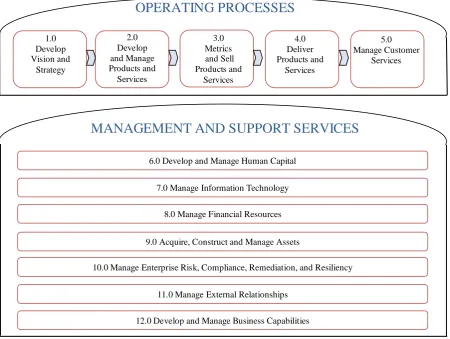
Philips Model – This model was developed by Philips Company. It was introduced as a tool for overcoming the weaknesses of EFQM and can be divided into 12 sub-processes. Figure 3 offers a view of this model.
1.0 Develop Vision and
Strategy
2.0 Develop and Manage Products and Services
3.0 Metrics and Sell Products and
Services
4.0 Deliver Products and
Services
5.0 Manage Customer
Services
OPERATING PROCESSES
6.0 Develop and Manage Human Capital
7.0 Manage Information Technology
8.0 Manage Financial Resources
9.0 Acquire, Construct and Manage Assets
10.0 Manage Enterprise Risk, Compliance, Remediation, and Resiliency
11.0 Manage External Relationships
12.0 Develop and Manage Business Capabilities
Figure 4. Philips Model with its processes
SAP Model – SAP stands for Systems, Applications, and Products in Data Processing and it is classified into 4 main areas: Marketing, Sales, Service and Interaction channels. Table 3 presents the four areas of the model.
Table 3. The areas of SAP model
Marketing Planning, Segment Management, List Management, Campaign Management, Trade Promotion Management, Lead Management, Marketing Analytics
Marketing
Sales Planning, Territory Management, Account and Contact Management, Activity Management, Opportunity Management, Quotation and Order Management, Product Configuration and Pricing, Billing and Contract Management, Incentive and
Commission Management, Time and Travel Management, Sales Analytics Sales
Installed Base Management, Warranty Management, Knowledge Management, Contract and Entitlement Management, Resource Planning, Service Order and Service Ticket, Complaints and Returns, Service Analytics
Service
Telemarketing, Telesales, Teleservice, Interactive Center Analytics Interaction
Channels
3.3: Specifying Factors to assess model quality:
In Section 2, three models should be shortlisted from the 6 nominated models based on the best quality factors. Mudi and Shank )1994) derived a set of desired characteristics that indicate a model of high quality: Flexibility, Understandability, Usability, Completeness and Generality. Every model can be described by a set of desired characteristics that can also be used to assess model quality. The following items are brief descriptions of the 5 factors they introduced:
Flexibility: Ease with which a reference model adapts and accommodates to changes of the requirements other than those for which it was specifically designed.
Understandability: Degree to which the purpose, concepts and structure of the reference model is clear to the users.
Generality: Degree to which the reference model performs a broad range of functionsand is usable in different cases.
Brand Implementation Pricing
Product Portfolio Distribution & Sales
Channels
Communications Market Introduction
Sales Execution Account Management Marketing Planning
Marketing Strategy
Market Intelligence People Capability &
Marketing Leadershiop
Completeness: Degree to which all the components of the reference model are present under a predefined scope.
3.4. Identifying CRM Objectives
A better process is thus one that better contributes to meeting the strategic objectives of an organization (La Rosa et al, 2017). Therefore in Section 4, it is believed to identify the CRM objectives in order to to distinguish suitable processes accordingly.
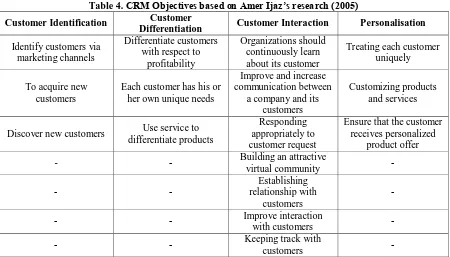
Based on Amer Ijaz’s research in 2005, CRM objectives are classified in to 4 main groups: Customer Identification, Customer Differentiation, Customer Interaction and Personalization. Table 4 presents the four groups.
Table 4. CRM Objectives based on Amer Ijaz’s research (2005)
Personalisation Customer Interaction
Customer Differentiation Customer Identification
Treating each customer uniquely Organizations should
continuously learn about its customer Differentiate customers
with respect to profitability Identify customers via
marketing channels
Customizing products and services Improve and increase
communication between a company and its
customers Each customer has his or
her own unique needs To acquire new
customers
Ensure that the customer receives personalized
product offer Responding
appropriately to customer request Use service to
differentiate products Discover new customers
- Building an attractive
virtual community -
-
- Establishing
relationship with customers -
-
- Improve interaction
with customers -
-
- Keeping track with
customers -
-
4. Methodology
The section below describes the methodology of this paper. The method is descriptive and practical and data collection incorporated interviews and questionnaires. The universe in Section 2 is CRM professionals and professors among international groups of LinkedIn site. A random sample was recruited from different groups (such as SAP, APQC, ERP Community and Microsoft Dynamics CRM Fun-as-Usual in). The universes in Sections 4 and 5 are managers and experts of a manufacturing Company in Tehran, Iran named “Pand Caspian Company”.
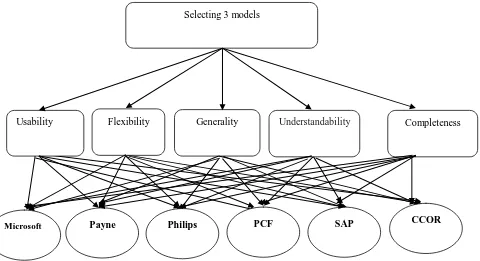
At this present research, AHP and QFD calculations were performed on www.bpmsg.com using Microsoft Excell 2010. In order to perform AHP technique, first the decision hierarchy was structured from the top with the goal of the decision, through the intermediate levels to the lowest level (which is a set of the alternatives).
This paper has attempted to provide a brief summary of some suitable reference models and design CRM processes based on the selected models for our case study.
Figure 5. The AHP hierarchy of selecting 3 models out of 6 models
In terms of AHP technique, seven sets of pairwise comparison matrices were constructed, one for the factors with respect to the goal and six matrices of factors with respect to the reference models. Then, some CRM professionals and professors were asked to fill in AHP questionnaire with the scales of 1, 3, 5, 7 and 9. The questionnaire was in both Persian and English languages. 25 ones were distributed among different people in SAP, APQC, ERP Community and Microsoft Dynamics CRM Fun-as-Usual groups of LinkedIn. Just 10 questionnaires were completely filled and returned. Also, a glossary of information on the six models was sent to help the responders.
Having done the calculation, the first pairwise comparison matrix of factors with respect to the goal would be presented in Figure 5.
Figure 6. The paired comparison matrix with respect to the goal
Selecting 3 models
Completeness Understandability
Generality Flexibility
Usability
CCOR
With regard to the weights above, the most prioritized factors are “Usability”, “Understand ability” and “flexibility” with the priorities of 38.04%, 24.47% and 17.36% respectively. It is clear that its Consistency Ratio (CR) is 2.4% and acceptable (less than 10% is fine).
Following, the overall composite weight of each alternative was computed (Table 5).
Table 5. Overall composite weight of the alternatives
Overall weight Completeness Generality Flexibility Understandability Usability Criteria 0.1456 0.0556 0.1736 0.2447 0.3804
0.2001 2 0.2280 0.2114 0.1880 0.1928 0.1982 CCOR
0.2679 1 0.2121 0.4062 0.3926 0.1730 0.2734 SAP
0.1541 3 0.1797 0.1100 0.1188 0.1769 0.1522 PCF
0.1103 6 0.1089 0.0739 0.0774 0.1332 0.1166 Philips
0.1481 4 0.1563 0.1037 0.1059 0.1854 0.1468 Payne
0.1185 5 0.1150 0.0948 0.1134 0.1387 0.1127 Microsoft
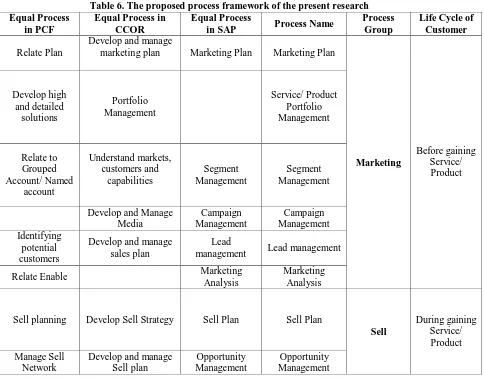
As discussed above (in Section 3), SAP, CCOR and PCF models are the most prioritized and weighted. Subsequently, all CRM processes of the three mentioned models were extracted and gathered in a united list. At this stage, the repeated processes were eliminated.
Table 6 provides the process framework in 5 categories with the equal processes in the three models.
Table 6. The proposed process framework of the present research Equal Process
in PCF
Equal Process in CCOR
Equal Process
in SAP Process Name
Process Group
Life Cycle of Customer
Relate Plan
Develop and manage
marketing plan Marketing Plan Marketing Plan
Marketing Before gaining Service/ Product Develop high and detailed solutions Portfolio Management Service/ Product Portfolio Management Relate to Grouped Account/ Named account Understand markets, customers and capabilities Segment Management Segment Management
Develop and Manage Media Campaign Management Campaign Management Identifying potential customers
Develop and manage sales plan
Lead
management Lead management
Relate Enable Marketing
Analysis
Marketing Analysis
Sell planning Develop Sell Strategy Sell Plan Sell Plan
Sell During gaining Service/ Product Manage Sell Network
Develop and manage Sell plan
Opportunity Management
Portfolio Solution Management Develop Marketing Strategy Product Configuration and Pricing Product Configuration and Pricing Customer Chain Planning Develop Customer Relationship Management Account Management and Contracts Chain Customer Configuration Management Sell to Grouped
Account/ Named Account
Delivery Services to Customers Contract Management and Statements Contract Management and Statements
Sell Enable Sell Analysis Sell Analysis
Assist Plan
Plan and Customer Service Operation Management Service Plan Service After gaining Service/ Product Chain Customer Asset Management Acquire, Construct, and Manage Assets
Installed Base Management Installed Base Management Remote Assist/ On-site Assist
Delivery Service to Customers Service Contract Management Service Contract Management Contract with Mediators
Plan and align Supply Chain Resources Resource planning Supply Chain Resource Planning Close Request Customer Complain
Management
Complains and Refunds
Complains and Refunds Assist Enable Service Analysis Service Analysis
assess the external environment Assess the external environment Strategy Developmen t Perform internal analysis Perform internal analysis Establish Strategic Vision Establish Strategic Vision Develop mission statement Develop mission statement coordinate and align
functional and process strategies coordinate and align functional and process strategies Relate with mediators
Define and Manage Interaction Channel Customer Interaction Channel Customer Interaction Channel Integrate Multichann el
Telemarketing Telemarketing Telemarketing/
E-marketing
Telesales Telesales Telesales/
E-sales
Teleservice Teleservice Teleservice/
E-Service Interaction Channel Analysis Interaction Channel Analysis
5. Case study- Pand Caspian Company
Having discussed how to construct the proposed process framework by extracting the CRM proceses from the selected reference models (Section 3), the next section of this paper addresses to our case study.
factories in Eshtehard and Qazvin Industrial Cities. The factory in Eshtehard produces electrical weighing systems and the other makes mechanical weighing equipment.
Moving on now to identify and determine strategic objectives of our case study, when the processes of the first three models were extracted (Table 6). Therefore, first based on the objectives mentioned in part 3-4, the strategic objectives of the company were identified by interviews with some of its senior managers (Table 7).
Table 7. The strategic objective of Pand Caspian Company
Personalisation Customer Interaction Customer Differentiation Customer Identification OBJ.7: Customizing road bascules according
to customers’ requests Obj.5: Learning more
from customers in order to design and manufacture better Obj.3: Offering extra
services and spare parts to get more satisfaction
of customers Obj. 1: Identify
customers via marketing channels
Obj. 8: Guarantee quality of products in
respect to its raw material and production OBJ.6 Electronic
communications (to introduce new products,
new services by email, SMS, etc.) Obj.4: Identify demands
and needs of customers individually Obj. 2: To acquire new
customers by persuading them and giving more
information
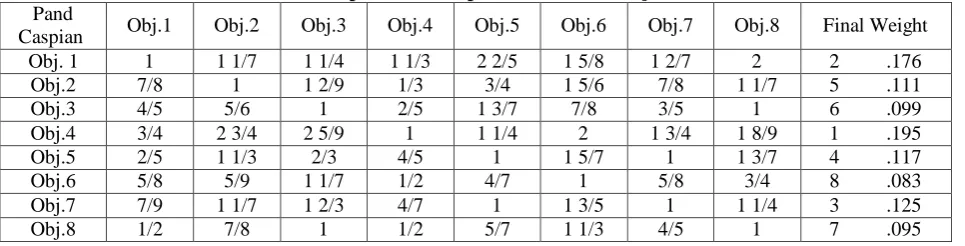
On the other hand, the objectives in organizations don’t have the same priority. Therefore, the strategic objectives were weighted by AHP technique and compared in pairs by 5 managers. It is clear that the pair-wise comparison matrix of objectives is consistent and acceptable (the CR is 2.3%). Table 8 shows the pair-wise comparison matrix of objective
Table 8. the pair-wise comparison matrix of objectives
Final Weight Obj.8 Obj.7 Obj.6 Obj.5 Obj.4 Obj.3 Obj.2 Obj.1 Pand Caspian
2 .176 2 1 2/7 1 5/8 2 2/5 1 1/3 1 1/4 1 1/7 1 Obj. 1
5 .111 1 1/7 7/8 1 5/6 3/4 1/3 1 2/9 1 7/8 Obj.2
6 .099 1 3/5 7/8 1 3/7 2/5 1 5/6 4/5 Obj.3
1 .195 1 8/9 1 3/4 2 1 1/4 1 2 5/9 2 3/4 3/4 Obj.4
4 .117 1 3/7 1 1 5/7 1 4/5 2/3 1 1/3 2/5 Obj.5
8 .083 3/4 5/8 1 4/7 1/2 1 1/7 5/9 5/8 Obj.6
3 .125 1 1/4 1 1 3/5 1 4/7 1 2/3 1 1/7 7/9 Obj.7
7 .095 1 4/5 1 1/3 5/7 1/2 1 7/8 1/2 Obj.8
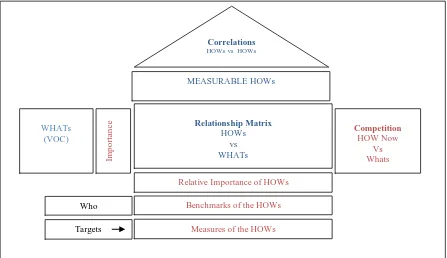
Figure 7. The House of Quality
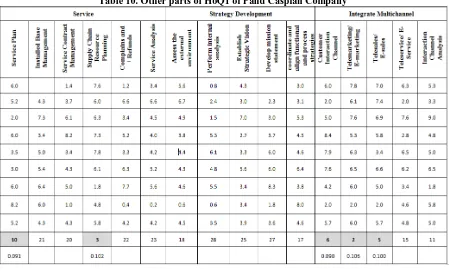
To complete the HOQ1, five managers and experts of the company were interviewed and asked to prioritize the processes from the range of 1 (the least important) to 10 (the most important) based on the strategic objectives of their company. The free houses in HoQ1 show that the responders have found no relation between the process and the objective.
Once all questionnaires returned back, the average rate of each house was calculated based on the 5 responders.
Finally, the rates were multiplied by the weights of the objectives and summed up in the column. Table 9 presents the completed HOQ1. In summary, it has been shown from this result (Table 9) that the most important CRM processes of the company are Marketing Planning, Telemarketing/ E-marketing and Supply Chain Resource Planning.
Correlations
HOWs vs HOWs
MEASURABLE HOWs
Relationship Matrix HOWs
vs WHATs
Relative Importance of HOWs
Benchmarks of the HOWs
Measures of the HOWs
Competition HOW Now
Vs Whats
Im
p
o
rtan
ce
WHATs (VOC)
Table 9. Results of HoQ1 and prioritization of CRM processes
Table 10. Other parts of HoQ1 of Pand Caspian Company
6. Conclusion
be used in future process modeling projects, as these are the most suitable processes in CRM area we have found.
There is a lack of empirical studies in the literature that analyze reference models and process modeling, which is how they are most frequently used in practice. Therefore, we established question 2”How can organizations choose their business processes from reference model using a systematic procedure and based on their strategic objectives?”.
Consequently, we planned and conducted a case study in which the processes of a manufacturing company were all prioritized by using our proposed process framework and the company’s’ strategic objectives. We evaluated the more important processes by identifying its objectives.
However, the results are just suitable to this specific company, but the framework can be easily used for companies based on their strategies. Table 10 indicates Marketing Planning is the most important process in the mentioned company. Other priorities are shown as below.
Table 10. The prioritization of the most important processes of Pand Caspian Rank Weight
Process Name
1 0.112
Marketing Planning
2 0.106
Telemarketing/ E-marketing
3 0.102
Supply Chain Resource Planning
4 1.000
Service and Product Development
5 0.100
Telesales/ E-sales
6 0.090
Customer Interaction Channel
7 0.098
Sales Analysis
8 0.095
Product Configuration and Pricing
9 0.094
Sell Analysis
10 0.091
Service Planning
7. Limitations and further research
Our research has some limitations which inspire us for future work. On the side of our systematic review, we are unable to guarantee the exhaustiveness of our search, as this is impossible (Brocke et al., 2015). Despite a lot of reference models being introduced in previous studies, most couldn’t be used practically used due to close source and also we didn’t have access to the content of some practical models. Therefore, we were forced to consider some criteria to choose the reference models such as access to the model, being practical and updated of the model.
Another limitation of our search is that gaining more information needs much time and budget.
In a future work, it’s important to investigate other reference models to develop a better framework. The research would have been more relevant if a wider range of reference models had been explored.
Since there is no Iranian CRM software in Iran and few companies buy their software very extensive from outside, therefore it would be great idea to localise such software by further practical research. In addition, the authors would like to suggest that companies can use the procedure in identifying and designing their processes.
8. Managerial implications
For managers and practitioners working in the area of CRM, this research provides direction to design CRM processes. For example, organizations may need help to develop the organizational processes, skills, and knowledge necessary to effectively apply customer data in order to create effective interaction or communication points.
We suggest that companies especially those which are interested in customizing their CRM systems should focus more on processes of their company and seek what exactly they need based on their strategic objectives.
Acknowledgement
The authors are thankful to the managers and experts of Pand Caspian Company for their comments, ideas, and suggestionsand also we would like to take this opportunity to thank Dr. Mostafa Haji Aghaee for his valuable feedback and kind help.
References
Abu Amuna, Y. M., Al Shobaki, M. J., Abu Naser, S.S, and Badwan, J. J.(2017), “Understanding Critical Variables for Customer Relationship Management in Higher Education Institution from Employees Perspective”, ITEE, Vol. 6, No. 1, pp. 10-16.
Amer Ijaz, P. A., (2005). “Objectives, Strategies and expected Benefits of Customer Relationship Management”, Dissertation of Master graduate of Lulea University of Technology, pp 26- 30.
Avila, D. T., (2018). “Process Modeling Guidelines: Systematic, Dissertation of Master graduate of Universidade Federal do Rio Grande do Sul”, Programa de Pós-Graduação em Computação, Porto Alegre, pp. 3- 48.
Brocke, J.V., (2015). “Standing on the shoulders of giants: Challenges and recommendations of literature search in information systems research”, Communications of the Association for Information Systems, Vol. 37.
Burghard, C., and Galimi, J. (2012). “Customer Relationship Management: New MCO catalyst”, Gartner, Advisory, Vol. 1, pp. 2-3.
Dijkman, R.M., Vanderfeesten, I.T.P., and Reijers, H.A., (2011). “The road to a business process architecture: an overview of approaches and their use”, BETA publication: working papers, Vol. 350, pp. 1-7.
Fettke, P., Loos, P., and Zwicker, J., (2005). “Business Process Reference Models: Survey and Classification”, International Conference on Business Process Management, Springer Link, BPM 2005: Business Process Management Workshops, pp. 469-483.
Garbutt, M., and Schuler, J. (2016). “Towards an Understanding of the Integrative Relationship Between Business Process Management and Enterprise Resource Planning, Association for Information Systems”, AIS Electronic Library (AISeL), CONF-IRM 2016 Proceedings. 3.
Harrison, D.E., (2016). “Understanding the Impact of Information Quality on Customer Relationship Management”, Doctor of Business Administration Dissertations, College of Business Kennesaw State University.
Kale, V., (2015). “Implementing SAP CRM, The guide for Business and Technology Managers”, CRC Press, pp. 229- 251.
Kalpic, B., and Bernus, P. (2002). “Business process modeling in industry – the powerful tool in enterprise management”, Computers in Industry, Vol. 47, pp.299 – 318.
La Rosa, M., van der Aalst, W.M.P., Dumas, M., and Milani, F.P., (2015). “Business Process Variability Modeling: A Survey”, ACM Comput.
Matook, S., and Indulska, M., (2009). “Improving the quality of process reference models: A quality function deployment-based approach”, Decision Support Systems, Vol.47, pp. 60- 71.
Mendoza, L., Marius, A., Pérez, M., and Griman, A., (2017). “Critical Success Factors for a Customer Relationship Management Strategy”, Information and Software Technology, Vol. 49, pp. 913–945. Moody, D., and Shanks, G., (1994). “What makes a good data model? Evaluating the quality of entity relationship models”, in: P. Loucopolous (Ed.), Proceedings of the 13th International Conference on the Entity Relationship Approach, England, Manchester.
Njoroge, E.W., and Ombui, k., (2016). “Determinants of Customer Relationship Management Strategies on the performance of Small and Medium Enterprises in Westlands Nairobi City”, International Academic Journal of Human Resource and Business Administration, Vol. 2, No. 1, pp. 17-28.
Oufkir,L., Fredj, M., and Kassou, I., (2017). “Performance Measurement for Knowledge Management: Designing a Reference Model”, Journal of Organizational Knowledge Management, IBIMA Publishing.
Payne, A., (2005). Handbook of CRM: Achieving Excellence in Customer Management, Elsevier, Oxford, UK.
Payne, A., and Frow, P. (2013). “A Strategic Framework for Customer Relationship Management”, Journal of Marketing, Vol. 69, No. 4, pp. 167-176.
Schuette, R., and Rotthowe, T., (1998). “The Guidelines of Modeling - an approach to enhance the quality in information models”, International Conference on Conceptual Modeling, Springer Verlag Berlin, pp. 240-254.
Spiegel, T., and Caulliraux, H.M., (2012). “Developing an Organizational Reference Model by Selecting and Integrating Multiple References”, Journal of Management Research, Vol. 4, No. 1. Thomas, O., (2005). “Understanding the Term Reference Model in Information Systems Research: History, Literature Analysis and Explanation”, Satellite workshop of the Third International Conference on Business Process Management, France.
Thomas, O., (2006). “Understanding the Term Reference Model in Information Systems Research: History, Literature Analysis and Explanation”, Proceeding of the Business Process Management Workshops (BPM), 5 September, France.